REVIEW 4 major objections 5 minor 35 references
Introducing Fractional Classification Loss for Robust Learning with Noisy Labels
T0 review · 4 major / 5 minor · reviewed 2026-08-05 · deepseek-v4-flash
Pith's one-line read FCL, a learnable-parameter loss, claims to self-calibrate its robustness to label noise during training
desk verdict A genuinely new loss construction with a learnable robustness parameter, worth engaging despite an overstated 'no tuning' claim and an unanalyzed stability question for mu. read the letter →
The pith
A machine-rendered reading of the paper's core claim, the machinery that carries it, and where it could break.
The reading
What carries the argument
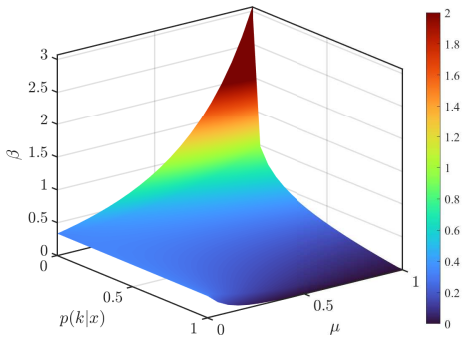
The central object is the fractional derivative of the cross-entropy term with respect to the negative log-likelihood, defined by $\ell^{\mu}_{\mathrm{FCE}} = [-\log p(k\mid x)]^{1-\mu}/\Gamma(2-\mu)$, added to the MAE term. This identity reduces the two active-passive loss coefficients $\alpha$ and $\beta$ to a single parameter $\mu$; Section 3.2 derives the correspondence $\beta = 2\Gamma(2-\mu)[-\log p(k\mid x)]^{\mu}/A$ for SCE. The mechanism that carries the argument is the gradient of $\ell_{\mathrm{FCE}}$ with respect to $\mu$, computed via the quotient rule and the digamma function, which lets $\mu$ itself be optimized by backpropagation. To keep this update stable, the authors accum
What would settle it
Train FCL on a synthetic dataset with a known noise rate and record $\mu$ each epoch. If, for some noise level, $\mu$ does not converge to an interior value but instead oscillates, collapses to 0 or 1, or converges to a value that makes test accuracy worse than a tuned fixed-$\mu$ baseline, the self-calibration claim fails. An analytic version: compute the sign of $\mathbb{E}[\partial \ell / \partial \mu]$ on a mixture of clean and mislabeled examples; if it never changes sign over $\mu \in [0,1]$ at a given noise rate, the update has no equilibrium.
Extended reading notes
Core claim
The paper claims that the fractional derivative order $\mu$ of the FCE loss is a learnable robustness dial: $\ell_{\mathrm{FCL}} = [-\log p(k\mid x)]^{1-\mu}/\Gamma(2-\mu) + \ell_{\mathrm{MAE}}$. At $\mu=0$ this reduces to CE plus MAE, giving fast but noise-sensitive learning; at $\mu=1$ it reduces to a shifted MAE, giving noise-robust but slow learning. The central argument is that FCL possesses a self-balancing trade-off: larger $\mu$ decreases the gradient on low-probability (noisy or hard) examples and increases it on high-probability (clean or easy) examples. Consequently, gradient-based updates of $\mu$ naturally move it upward on noisy datasets and downward on clean datasets. The auth
Load-bearing premise
The load-bearing premise is that gradient-based updates of $\mu$ will settle at a stable, noise-appropriate value because increasing $\mu$ helps on noisy examples but hurts on clean ones; the paper asserts this trade-off and validates it empirically, but provides no convergence or stability analysis.
Editorial extensions
If this is right
- Users of FCL do not need to know the label-noise rate in advance: $\mu$ self-adjusts, so the same training recipe applies from clean data to 80% symmetric noise.
- Because $\mu$ rises on noisy data and falls on clean data, FCL implements the CE-MAE robustness/convergence trade-off without the grid search that GCE, SCE, and other active-passive losses require.
- FCL plugs into standard deep-learning pipelines with modest overhead: on CIFAR-10 it takes roughly 1.37 times the training time of CE and about 1.2 times that of APL baselines.
- The $\mu$-learning mechanism is independent of the specific network, so the same self-tuning loss can be ported to other architectures and datasets without re-tuning.
- On high-noise regimes (e.g., 0.6 and 0.8 symmetric noise), FCL reports the largest accuracy gains over tuned baselines, suggesting the benefit grows exactly where manual tuning is hardest.
Reading between the lines
- One consequence the authors leave implicit is that the same self-balancing update likely transfers to other active-passive loss pairs: any passive term with a nonzero gradient on easy examples could preserve the stabilizing trade-off that makes $\mu$ learnable.
- The explicit mapping between $\mu$ and the SCE coefficient $\beta$ points to a broader design principle: a robustness parameter that monotonically reweights easy versus hard examples may be a sufficient condition for stable gradient-based tuning, independent of the fractional-calculus derivation.
- A testable extension suggested by the paper's setup is to add a prior or scheduler on $\mu$: the initial five-epoch freeze and the large learning rate hint that the reported behavior could be improved on small or class-imbalanced datasets, but this is not studied in the paper.
- Because the $\mu$-gradient contains $\log(-\log p)$, it is numerically sensitive near $p=1$; studying where the reported gradient-norm clipping actually binds could reveal whether the stability of $\mu$ depends on that detail.
Editorial analysis
A structured set of objections, weighed in public.
Referee Report
Summary. The paper proposes Fractional Classification Loss (FCL), an active-passive loss for learning with noisy labels. The active component is a fractional derivative of the cross-entropy loss with respect to the negative log-likelihood, ℓ_FCE = [−log p]^{1−μ}/Γ(2−μ), combined with the MAE passive loss. The authors show that μ interpolates between CE-like and MAE-like behavior, and they make μ learnable, updating it once per epoch with gradient descent. They claim that FCL automatically calibrates its robustness to label noise by learning μ upward in noisy settings and downward in clean settings, thereby eliminating manual tuning of robustness hyperparameters. Experiments on MNIST, CIFAR-10, and CIFAR-100 under symmetric and asymmetric noise are reported, together with ablations on CIFAR-10 at 60% noise.
Significance. If the automatic calibration mechanism is reliable, FCL would be a practically valuable contribution: it removes the per-dataset tuning burden of robust losses (GCE's q, SCE's α/β, APL coefficients) while achieving competitive accuracy. The FCE construction is elegant and the gradient derivations with respect to p and μ are largely correct. The paper provides a reasonably broad empirical study and ablations, and the authors identify a real trade-off: increasing μ decreases the penalty on hard/noisy examples but increases the penalty on easy/clean examples. However, the central claim that μ can be stably learned without manual tuning is not backed by a convergence or boundedness analysis, and the paper's own ablation shows sensitivity to the initial value of μ. These gaps are load-bearing for the 'no manual hyperparameter tuning' claim.
major comments (4)
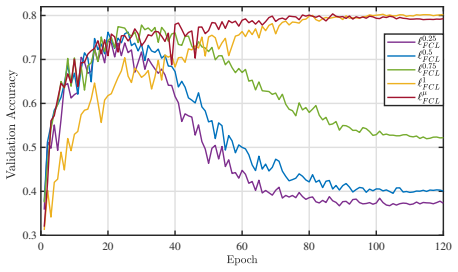
- [Section 4; Algorithm 1; Eq. (27)] The learning rule for μ is unconstrained. Algorithm 1 line 12 updates μ by gradient descent with no clipping or projection, and Eq. (27) shows that the per-sample gradient for μ changes sign depending on u = −log p. For μ > 1, the FCE loss [−log p]^{1−μ}/Γ(2−μ) diverges as p→1, and Γ(2−μ) has poles for μ≥2, so the loss and gradient become meaningless. The paper asserts that the trade-off in Fig. 1 'enables stable learning of μ' but provides no analysis showing that the average update has a stable attractor in [0,1]. The only empirical evidence is Fig. 4 and Fig. 6 on CIFAR-10. Since automatic calibration is the central claim, a projection step or a formal boundedness/convergence argument must be supplied.
- [Section 3.2, Eqs. (20)–(22)] There is an algebraic error in the derivation linking μ to SCE's β. From Eq. (11), ℓ_FCE = u^{1−μ}/Γ(2−μ) with u = −log p, so when isolating the CE term u, the coefficient is u^{−μ}/Γ(2−μ), not [−log p]^μ/Γ(2−μ) as written in Eq. (20). Consequently Eq. (22) has the u^μ factor in the numerator instead of the denominator and is missing a negative sign; as printed, β is negative for A<0, which is impossible for a loss weight. The correct relation is β = −2 Γ(2−μ) [−log p]^μ / A. Although this mapping is interpretive and not used in the training algorithm, the error should be corrected because the section's stated purpose is to demonstrate the relationship.
- [Abstract; Section 5.1.2] The claim of 'without manual hyperparameter tuning' is overstated. The method introduces new manually chosen hyperparameters: initial μ(0)=0.5, μ-learning rate λμ=0.1, the 5-epoch warm-up, and the once-per-epoch update schedule (Section 5.2.3, Algorithm 1). The ablation in Section 5.1.2 shows that initializing μ at 0 or 0.25 leads to underfitting, and the authors recommend μ(0)=0.5 as a 'balanced choice'—that is manual tuning of the key robustness parameter. The paper should either temper the claim to 'removes tuning of the loss-shape parameter after fixing the initialization and μ-optimizer settings' or provide a sensitivity analysis showing that performance is stable across a range of these new hyperparameters.
- [Section 5.2; Table 2] The empirical evidence for the adaptive-μ mechanism is limited to CIFAR-10. Figure 6 shows μ trajectories only for CIFAR-10 noise levels, and no final μ values or trajectories are reported for MNIST, CIFAR-100, or asymmetric noise. The central assertion that μ 'tunes higher in noisier datasets and lower in cleaner ones' is therefore not fully verified. Additionally, the comparison in Table 2 gives tuned hyperparameters to baselines while FCL uses fixed defaults, which is favorable to FCL but makes the 'no manual tuning' comparison asymmetric; a sensitivity analysis of FCL's own hyperparameters, or a comparison where baselines use default settings, would strengthen the claim.
minor comments (5)
- [Algorithm 1] The notation is confusing: 'for each mini-batch B⊂D^η of size B' uses B for both the mini-batch and its size, and line 12 divides by B, which appears to be the mini-batch size rather than the number of mini-batches. Also, the text mentions using an optimizer such as Adam or SGD, but the algorithm shows a plain SGD update; please clarify.
- [Section 5.2.3] The paper states that the gradient norm is clipped to 10, but it is unclear whether this clipping applies to ∇μℓ as well. If gradient clipping is applied to μ, it may indirectly bound updates but not the value of μ; please specify.
- [Table 2] Some entries appear suspicious: NCE+MAE on MNIST asymmetric 0.2 reports 99.90±0.17, higher than its clean result of 99.35, and CIFAR-100 NCE+MAE at η=0.6 reports 15.21±24.61 with a very large standard deviation. Please check these numbers and consider reporting significance tests or per-seed results.
- [Section 5.2.1 and 5.2.4] The baselines are given per-dataset tuned hyperparameters from the original papers, whereas FCL uses fixed defaults. While this is the intended point, it should be stated more explicitly in the main text (not only in Section 5.2.4) that the comparison is 'tuned baselines vs. default FCL'.
- [Appendix] The fractional derivative definition in Eq. (31) is stated to hold for x, k ≥ 0, but the paper applies it to u = −log p(k|x), which is nonnegative for p∈(0,1]. For p=1, u=0 and the expression is zero or singular depending on μ; a brief comment on the domain of p would be helpful.
Circularity Check
No circularity: FCL's construction, adaptive-µ training, and evaluation are self-contained.
full rationale
The paper's central derivation is definitional rather than circular. FCL is explicitly constructed as the fractional derivative of CE with respect to the negative log-likelihood plus MAE (Eqs. 10-11); the special cases µ=0 and µ=1 are direct evaluations of this construction, not independent results smuggled back into the definition. The mapping to SCE's β in Section 3.2 is an interpretive relation, not a fitted prediction: it does not use test data or a subset of the target result to manufacture a claim. The learnable-µ mechanism in Algorithm 1 updates µ by gradients of the same loss on the training set; the reported observation that µ tends to increase with noise level is an empirical outcome, not an input, because the algorithm never receives the true noise rate. The only self-citation [7] is contextual motivation for fractional-order robust losses and is not load-bearing: no theorem, uniqueness claim, or central premise is imported from it. Claims about 'unique property' and 'stable learning' are supported by experiments and local analysis, not by a self-citation chain. The skeptical concern that µ is unconstrained and could leave [0,1] is a stability/correctness risk, not a circularity issue, and therefore does not affect the circularity score. No step reduces by construction to its own inputs.
Assumptions & free parameters
free parameters (3)
- Initial fractional order µ(0) =
0.5
- Learning rate for µ (λµ) =
0.1
- Warm-up epochs for µ =
5
assumptions (4)
- standard math The fractional derivative of the power function u^1 equals Γ(2)/Γ(2-µ) u^(1-µ).
- domain assumption MAE is noise-tolerant and CE is not.
- domain assumption The active-passive decomposition (α L_active + β L_passive) yields noise-robust losses.
- ad hoc to paper The trade-off between penalties on hard and easy examples guarantees stable gradient-based learning of µ.
Cite this review
Pith. "Pith review of Introducing Fractional Classification Loss for Robust Learning with Noisy Labels." pith.science (2026). https://pith.science/paper/QLGGE5FP
@misc{pith2026250806346,
  author       = {Pith},
  title        = {Pith review of: Introducing Fractional Classification Loss for Robust Learning with Noisy Labels},
  year         = {2026},
  howpublished = {\url{https://pith.science/paper/QLGGE5FP}},
  note         = {Machine review of arXiv:2508.06346}
}
abstract
Robust loss functions are crucial for training deep neural networks in the presence of label noise, yet existing approaches require extensive, dataset-specific hyperparameter tuning. In this work, we introduce Fractional Classification Loss (FCL), an adaptive robust loss that automatically calibrates its robustness to label noise during training. Built within the active-passive loss framework, FCL employs the fractional derivative of the Cross-Entropy (CE) loss as its active component and the Mean Absolute Error (MAE) as its passive loss component. With this formulation, we demonstrate that the fractional derivative order $\mu$ spans a family of loss functions that interpolate between MAE-like robustness and CE-like fast convergence. Furthermore, we integrate $\mu$ into the gradient-based optimization as a learnable parameter and automatically adjust it to optimize the trade-off between robustness and convergence speed. We reveal that FCL's unique property establishes a critical trade-off that enables the stable learning of $\mu$: lower log penalties on difficult or mislabeled examples improve robustness but impose higher penalties on easy or clean data, reducing model confidence in them. Consequently, FCL can dynamically reshape its loss landscape to achieve effective classification performance under label noise. Extensive experiments on benchmark datasets show that FCL achieves state-of-the-art results without the need for manual hyperparameter tuning.
Figures


Figures from the paper (3 more)


Reference graph
Works this paper leans on
-
[1]
N. Natarajan, I. S. Dhillon, P. K. Ravikumar, A. Tewari, Learning with noisy labels, in: Advances in Neural Information Processing Systems, Vo l. 26, 2013
work page 2013
-
[2]
Y. Liu, Y. Liu, X. Bruce, S. Zhong, Z. Hu, Noise-robust oversam pling for im- balanced data classification, Pattern Recognition 133 (2023) 1090 08
work page 2023
-
[3]
Y. Wei, Y. Kang, W. Yin, Y. Wang, Generalization of the gradient me thod with fractional order gradient direction, J. Franklin Inst. 357 (4) (20 20) 2514–2532
- [4]
- [5]
-
[6]
C. Bao, Y. Pu, Y. Zhang, Fractional-order deep backpropagat ion neural net- work, Comput. Intell. Neurosci. 2018 (1) (2018) 7361628
work page 2018
-
[7]
M. C. Kurucu, M. G¨ uzelkaya, I. Eksin, T. Kumbasar, When frac tional calcu- lus meets robust learning: Adaptive robust loss functions, Knowl.-B ased Syst. (2025) 113136
work page 2025
-
[8]
J. Tang, B. Liu, S. Fu, Y. Tian, G. Kou, Advancing robust regres sion: Ad- dressing asymmetric noise with the blinex loss function, Inf. Fusion 1 10 (2024) 102463
work page 2024
Show all 35 references
-
[9]
J. Liu, M. Feng, X. Xiu, W. Liu, Towards robust and sparse linear d iscriminant analysis for image classification, Pattern Recognition 153 (2024) 11 0512
2024
-
[10]
Patrini, A
G. Patrini, A. Rozza, A. Krishna Menon, R. Nock, L. Qu, Making d eep neural networks robust to label noise: A loss correction approach, in: Pr oceedings of the IEEE Conference on Computer Vision and Pattern Recognition, 2017, pp. 1944–1952
2017
-
[11]
S. An, Y. Zhang, C. Wang, Relative neighborhood rough featur e selection and robust classification for multi-density data, Pattern Recognition 1 61 (2025) 111303
2025
-
[12]
X. Zhou, X. Liu, D. Zhai, J. Jiang, X. Ji, Asymmetric loss function s for noise- tolerant learning: Theory and applications, IEEE Trans. Pattern A nal. Mach. Intell. 45 (7) (2023) 8094–8109
2023
-
[13]
Y. Li, Z. Guo, L. Wang, Cltr: Continual learning time-varying reg ularization for robust classification of noisy label images, Pattern Recognition (20 25) 112137
-
[14]
T. Xiao, T. Xia, Y. Yang, C. Huang, X. Wang, Learning from mass ive noisy labeled data for image classification, in: Proceedings of the IEEE Con ference on Computer Vision and Pattern Recognition, 2015, pp. 2691–2699
2015
-
[15]
Zheng, A
G. Zheng, A. H. Awadallah, S. Dumais, Meta label correction for noisy label learning, in: Proceedings of the AAAI Conference on Artificial Inte lligence, Vol. 35, 2021, pp. 11053–11061
2021
-
[16]
X. Yu, S. Zhang, L. Jia, Y. Wang, M. Song, Z. Feng, Noise is the f atal poison: A noise-aware network for noisy dataset classification, Neurocomp ut. 563 (2024) 126829. 23
2024
-
[17]
Y. Li, Y. Chen, X. Yu, D. Chen, X. Shen, Sure: Survey recipes f or building reliable and robust deep networks, in: Proceedings of the IEEE/CV F Conference on Computer Vision and Pattern Recognition, 2024, pp. 17500–175 10
2024
-
[18]
Englesson, H
E. Englesson, H. Azizpour, Robust classification via regression for learning with noisy labels, in: Proceedings of the International Conference on L earning Rep- resentations, 2024
2024
-
[19]
Jiang, Z
L. Jiang, Z. Zhou, T. Leung, L.-J. Li, F.-F. Li, Mentornet: Lear ning data-driven curriculum for very deep neural networks on corrupted labels, in: Proceedings of the International Conference on Machine Learning, 2018, pp. 2304–2313
2018
-
[20]
Y. Wei, H. Xiao, H. Shi, Z. Jie, J. Feng, T. S. Huang, Jo-src: A co ntrastive ap- proach for combating noisy labels, in: Proceedings of the IEEE/CVF Conference on Computer Vision and Pattern Recognition, 2021, pp. 5192–5201
2021
-
[21]
H. Song, M. Kim, J.-G. Lee, Selfie: Refurbishing unclean samples f or robust deep learning, in: Proceedings of the International Conference on Mac hine Learning, 2019, pp. 5907–5915
2019
-
[22]
Y. Wu, J. Yao, X. Xia, J. Yu, R. Wang, B. Han, T. Liu, Mitigating lab el noise on graph via topological sample selection, in: Proceedings of the 41st I nternational Conference on Machine Learning, PMLR, 2024, p. to appear, arXiv :2403.01942
2024 arXiv
-
[23]
B. Han, Q. Yao, X. Yu, G. Niu, M. Xu, W. Hu, I. Tsang, M. Sugiyam a, Co- teaching: Robust training of deep neural networks with extremely noisy la- bels, in: Proceedings of the Advances in Neural Information Proce ssing Systems (NeurIPS), 2018, pp. 8527–8537
2018
-
[24]
J. Li, R. Socher, S. C. H. Hoi, Dividemix: Learning with noisy labels a s semi- supervised learning, in: Proceedings of the International Confer ence on Learning Representations, 2020
2020
-
[25]
Tanaka, D
D. Tanaka, D. Ikami, T. Yamasaki, K. Aizawa, Joint optimization f ramework for learning with noisy labels, in: Proceedings of the IEEE Conference on Computer Vision and Pattern Recognition, 2018, pp. 5552–5560
2018
-
[26]
Ghosh, H
A. Ghosh, H. Kumar, P. S. Sastry, Robust loss functions unde r label noise for deep neural networks, in: Proceedings of the AAAI Conference o n Artificial Intelligence, Vol. 31, 2017. 24
2017
-
[27]
X. Ma, H. Huang, Y. Wang, S. Romano, S. Erfani, J. Bailey, Norm alized loss functions for deep learning with noisy labels, in: Proceedings of the I nternational Conference on Machine Learning, PMLR, 2020, pp. 6543–6553
2020
-
[28]
L. Feng, S. Shu, Z. Lin, F. Lv, L. Li, B. An, Can cross entropy lo ss be robust to label noise?, in: Proceedings of the Twenty-Ninth International J oint Conference on Artificial Intelligence, 2021, pp. 2206–2212
2021
-
[29]
A. Mao, M. Mohri, Y. Zhong, Cross-entropy loss functions: Th eoretical analysis and applications, in: Proceedings of the International Conferenc e on Machine Learning, PMLR, 2023, pp. 23803–23828
2023
-
[30]
Zhang, M
Z. Zhang, M. Sabuncu, Generalized cross entropy loss for tra ining deep neu- ral networks with noisy labels, in: Advances in Neural Information P rocessing Systems, Vol. 31, 2018
2018
-
[31]
Y. Wang, X. Ma, Z. Chen, Y. Luo, J. Yi, J. Bailey, Symmetric cros s entropy for robust learning with noisy labels, in: Proceedings of the IEEE/CV F Inter- national Conference on Computer Vision, 2019, pp. 322–330
2019
-
[32]
Englesson, H
E. Englesson, H. Azizpour, Generalized jensen–shannon diver gence loss for learning with noisy labels, in: Advances in Neural Information Proces sing Sys- tems, Vol. 34, 2021, pp. 30284–30297
2021
-
[33]
X. Ye, X. Li, T. Liu, Y. Sun, W. Tong, et al., Active negative loss fu nctions for learning with noisy labels, in: Advances in Neural Information Pro cessing Systems, Vol. 36, 2023, pp. 6917–6940
2023
-
[34]
X. Ma, Y. Wang, M. E. Houle, S. Zhou, S. Erfani, S. Xia, S. Wijewic krema, J. Bailey, Dimensionality-driven learning with noisy labels, in: Proceedin gs of the International Conference on Machine Learning, PMLR, 2018, pp. 3355–3364
2018
-
[35]
K. S. Miller, B. Ross, An introduction to the fractional calculus a nd fractional differential equations, John Wiley & Sons, 1993. 25
1993
Reviewed August 5, 2026 · model on record in the stance chip above.
Discussion (0). Sign in to comment.