REVIEW 3 major objections 5 minor 110 references
Estimating dayside effective temperatures of hot Jupiters and associated uncertainties through Gaussian process regression
T0 review · 3 major / 5 minor · reviewed 2026-08-14 · deepseek-v4-flash
Pith's one-line read Gaussian process regression can recover unbiased dayside effective temperatures of hot Jupiters from just three broad-band eclipse measurements, with uncertainties that behave like true 68% confidence intervals.
desk verdict A useful new application of GP regression to sparse secondary-eclipse photometry, with a nice catalogue, but the uncertainty calibration is partly circular because the signal variance was tuned on the same simulated data used for validation. read the letter →
The pith
A machine-rendered reading of the paper's core claim, the machinery that carries it, and where it could break.
The reading
What carries the argument
The carrying object is Gaussian process regression with the squared-exponential covariance kernel $k(r)=\sigma^2 \exp(-r^2/(2l^2))$, applied to brightness-temperature spectra converted from wavelength to frequency. The hyperparameters are fixed rather than fit to the sparse target data: the log length scale is set to $\ln(l^2)=-8.55$ (about $1.4\times10^{13}$ Hz, i.e., 0.19 µm at 2 µm), chosen from the low-resolution structure of water opacity, and the log signal variance is set to $\ln(\sigma^2)=-4$ (14% of the normalized brightness temperature), chosen from a 37-planet training sample. The GP uses a constant mean function equal to the inverse-error-weighted mean brightness temperature, so it behaves like the error-weighted mean method far from observed points but inflates uncertainty where the spectrum is undersampled. This uncertainty inflation is the key mechanism that the simpler estimators lack.
What would settle it
Take a planet with both sparse WFC3+IRAC eclipse measurements and a full JWST secondary-eclipse spectrum, integrate the full spectrum to obtain the true bolometric dayside temperature, and check whether the truth falls inside the quoted 1σ interval; if it does for fewer than about 68% of a sample of such planets, the coverage claim is falsified.
Extended reading notes
Core claim
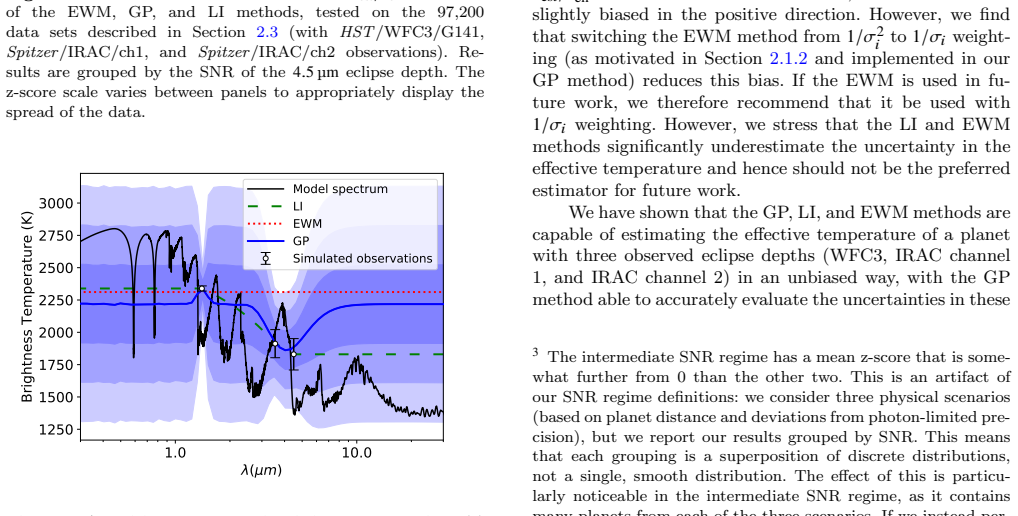
The central claim is that a Gaussian process with a squared-exponential kernel, a correlation length scale fixed by water opacity, and a signal variance of 14% can recover unbiased dayside effective temperatures from as few as three broad-band measurements, with uncertainty estimates that are statistically accurate in all signal-to-noise regimes. On 97,200 simulated data sets, the GP produces z-scores—how far an estimate sits from the true temperature in units of its quoted uncertainty—centered near zero with standard deviations near one, whereas the error-weighted mean and linear-interpolation methods produce z-score spreads larger than one, meaning they underestimate the total error, especially at high signal-to-noise where undersampling dominates. The paper also establishes a limitation: with only the 3.6 and 4.5 µm IRAC bands, effective temperatures are systematically underestimated and known to no better than about 20% at 1σ, because those bands form in the cooler upper atmosphere and the model suite contains no thermal inversions.
Load-bearing premise
The method's claimed 68% coverage depends on real hot Jupiter spectra resembling the simulated suite: cloud-free, without thermal inversions, and with brightness-temperature variability around the assumed 14%.
Editorial extensions
If this is right
- Dayside effective temperatures with reliable uncertainties can be obtained from just three broad-band eclipse measurements (WFC3 plus IRAC channels 1 and 2), so planets without full spectra no longer require a retrieval to get a trustworthy temperature.
- IRAC-only 3.6 and 4.5 µm eclipse data should not be used to quote effective temperatures with precision better than about 20% at 1σ, regardless of estimator.
- The error-weighted mean method, if used, should switch from inverse-variance weighting to inverse-error weighting to reduce outlier influence.
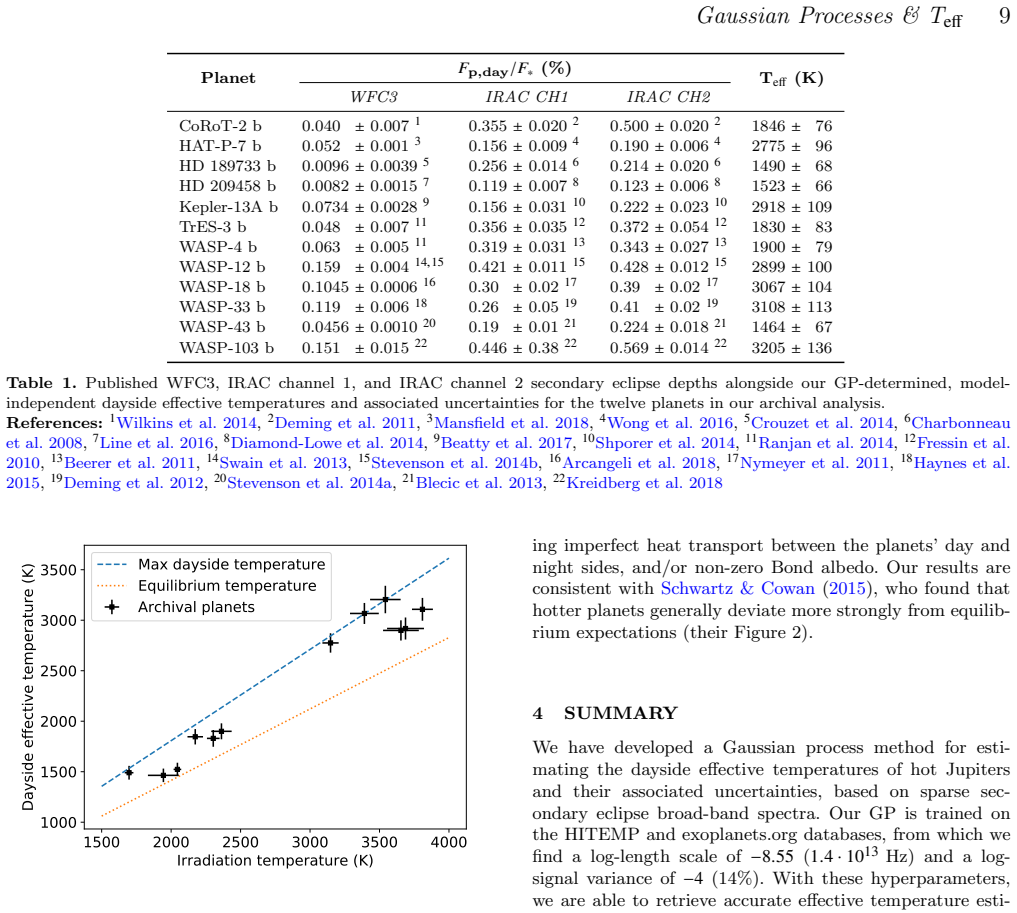
- The twelve published temperatures, with 1σ uncertainties between ±66 K and ±136 K, constitute a testable prediction that upcoming space-based spectra will confirm or refute.
Reading between the lines
- If the GP is applied to other band combinations, the fixed signal variance of 14% should be retrained: observations that resolve finer spectral structure would likely favour a shorter length scale and a smaller amplitude, otherwise the quoted uncertainties may become too conservative.
- Injecting thermal-inversion models into the simulation suite is a direct stress test; it would likely show that the IRAC-only low-temperature bias shrinks or reverses, and it would reveal how much of the claimed 68% coverage depends on the no-inversion assumption.
- The z-score validation used in this paper could usefully become a standard check for any future empirical temperature estimator, since it exposes underestimation of uncertainty that average accuracy alone does not.
Editorial analysis
A structured set of objections, weighed in public.
Referee Report
Summary. The paper proposes a Gaussian-process regression method for estimating dayside effective temperatures of hot Jupiters from sparse secondary-eclipse photometry, specifically WFC3 white-light data plus warm Spitzer IRAC channels 1 and 2. The GP uses a squared-exponential kernel whose length scale is fixed from the HITEMP water spectrum and whose signal variance is fixed at 14%, with an inverse-error-weighted-mean prior. The authors benchmark the method against the error-weighted mean and linear interpolation on 97,200 simulated data sets generated from 324 cloud-free, radiative-equilibrium Pyrat Bay models, using Test/Teff ratios and z-scores as metrics. They find GP z-score distributions close to N(0,1) across SNR regimes while EWM and LI produce biased z-scores, and they caution that using only IRAC channels is significantly biased. The method is then applied to twelve hot Jupiters, yielding effective temperatures with uncertainties from 66 to 136 K, and the authors assert that 68% of the catalogue true temperatures will fall within the reported 1-sigma intervals.
Significance. If the calibration claims hold, this is a useful and fast model-independent estimator for sparse exoplanet eclipse data, and it provides a uniform catalogue of effective temperatures. The paper is transparent about its methods, provides public code, uses a large and reproducible simulation suite, and gives an honest treatment of the IRAC-only limitation. The main weakness is that the uncertainty calibration is not independently validated: the fixed signal variance is selected in part to make the same benchmark's z-scores look calibrated, and the simulation suite contains only non-inverted, cloud-free models, so the transfer of the 68% coverage statement to real planets is an extrapolation rather than a measured property.
major comments (3)
- [Section 2.1.2 and Section 3.1] The fixed log-signal variance (-4, 14%) is explicitly justified in Section 2.1.2 by the z-score behavior obtained in Section 3.1, and Section 3.1 uses the same 97,200 simulated data sets to validate the method. This makes the reported near-N(0,1) z-score distributions a consistency check rather than an independent test, and the headline comparison of GP against EWM and LI is therefore compromised as evidence for superior uncertainty estimation. I request a hold-out or cross-validated benchmark, or a sensitivity analysis showing that the conclusions are robust to signal variance over a physically plausible range, and a corresponding rephrasing of the validation claims.
- [Sections 2.2.1, 3.1, and 3.2] The simulation suite contains only cloud-free, non-inverted, radiative-equilibrium models, and Section 3.1 explicitly acknowledges the absence of thermal inversions and clouds. The physical argument for a 14% signal variance in Section 2.1.2 is based on a skin-temperature bound that assumes a non-inverted temperature profile. Consequently, the Section 3.2 assertion that 68% of catalogue true temperatures will fall within the reported 1-sigma intervals is not a measured coverage for real hot Jupiters, which may have thermal inversions or patchy clouds. Please either add simulations with inversions and clouds or replace that assertion with a clearly conditional statement about coverage under the simulation assumptions.
- [Abstract, Section 2.1, and Table 1] The temperature estimates are repeatedly described as "model-independent," but the GP result depends on the fixed kernel hyperparameters, the chosen mean function, and the normalization scheme. I recommend either defining the term carefully or describing the estimates as GP-prior-based or empirically calibrated, so that readers are not misled about the role of the adopted assumptions in the catalogue values.
minor comments (5)
- [Table 1] In the WASP-103 row, the IRAC channel 1 uncertainty appears as "±0.38" without a leading zero; if this is intended to be ±0.038, please correct the table.
- [Section 2.2.1] The text cites "Pyrat Bay (Cubillos et al., in prep.)," but the reference list contains only Cubillos (2016) and Blecic (2016); please provide the appropriate in-preparation citation or revise the text.
- [Equation (5)] The integral in Equation (5) is missing a closing parenthesis in the integrand; please rewrite it with unambiguous notation for the wavelength limits.
- [Throughout] The database is referred to variously as "exoplanets.org," "Exoplanets Data Explorer," and "exoplanet.org"; please use one consistent name.
- [Section 2.1.2] The sentence "This choice is consistent with theoretical expectations, as we have discussed" appears before the skin-layer discussion that follows; consider reordering or adding a pointer so the discussion is not introduced after its conclusion.
Circularity Check
Uncertainty calibration is partially circular: the fixed signal variance is tied to the same simulated z-score benchmark used to assert 68% coverage.
-
fitted input called prediction
[Section 2.1.2 (hyperparameter selection) and Section 3.1 (simulated benchmark); coverage claim in Section 3.2]
"For this reason, we fix the log-signal variance hyperparameter as−4, or 14%. This choice is consistent with theoretical expectations, as we have discussed. It also becomes strongly motivated following our analysis in Section 3.1: with this hyperparameter, we retrieve statistically-appropriate distributions of effective temperature estimates."
Signal variance controls GP output uncertainty. The paper fixes log sigma^2 = -4 partly because on the same 97,200 simulated data sets later used as the benchmark this value yields 'statistically-appropriate distributions of effective temperature estimates.' The z-score distributions in Sec 3.1 then validate GP uncertainty estimates, and Sec 3.2 asserts 68% of true temperatures will fall in the quoted 1-sigma intervals. Since the validation metric helped motivate the hyperparameter, near-N(0,1) z-scores are partly a consistency check on the tuning target, not an independent test. Partial, not total: length scale comes from HITEMP; central signal variance value comes from a 37-planet training set plus 16% skin-layer estimate; only the calibration/coverage claim is affected.
full rationale
The GP temperature estimates themselves are not derived from the benchmark: the mean function is the error-weighted mean of the observed brightness temperatures, the length scale is estimated from the HITEMP water line list, and the central signal variance is trained on 37 archival hot Jupiters and checked against the skin-layer estimate (16%). Thus the reported temperatures have independent content and are not forced by the simulation suite. However, the uncertainty-calibration claim is partially circular. In Sec 2.1.2 the paper fixes sigma^2 = 14% and states that this choice is 'strongly motivated' by the Sec 3.1 z-score distributions computed from the same 97,200 simulated observations later used as validation. The near-N(0,1) z-scores and the Sec 3.2 assertion that 68% of real temperatures will lie in the quoted 1-sigma intervals are therefore partly a restatement of the hyperparameter selection criterion rather than an independent, out-of-sample test. The circularity is partial because an external training set and a physical skin-layer argument independently point to the same hyperparameter value; had the choice been made a priori, the z-score check would have been a genuine test. A separate scope limitation (not circularity) is that the simulation suite contains only cloud-free, non-inverted, radiative-equilibrium models (Sec 2.2.1), so the 68% coverage claim for real planets is an extrapolation beyond the tested model family. Score 4 reflects one partially circular validation step with independent external grounding for the central method.
Assumptions & free parameters
free parameters (2)
- Log length scale hyperparameter ln(l^2) =
-8.55 (l = 1.4e13 Hz, equivalent to 0.19 um at 2 um)
- Log signal variance hyperparameter ln(sigma^2) =
-4 (14 percent brightness temperature amplitude)
assumptions (6)
- domain assumption The 324 Pyrat Bay model spectra are representative of real hot Jupiter dayside emission.
- domain assumption The absence of thermal inversions and clouds in the simulated spectra does not change the robustness ranking of GP versus EWM and LI.
- ad hoc to paper The squared-exponential GP kernel with fixed frequency length scale and 14 percent signal variance is an appropriate prior for all hot Jupiter brightness-temperature spectra.
- domain assumption Reflected starlight is negligible in the infrared bands used.
- domain assumption The photon-limited noise model and Monte Carlo propagation capture the dominant uncertainties in real eclipse measurements.
- domain assumption Published eclipse depths and system parameters are accurate and their uncertainties are Gaussian.
Cite this review
Pith. "Pith review of Estimating dayside effective temperatures of hot Jupiters and associated uncertainties through Gaussian process regression." pith.science (2026). https://pith.science/paper/QLOXHJ5P
@misc{pith2026190802631,
  author       = {Pith},
  title        = {Pith review of: Estimating dayside effective temperatures of hot Jupiters and associated uncertainties through Gaussian process regression},
  year         = {2026},
  howpublished = {\url{https://pith.science/paper/QLOXHJ5P}},
  note         = {Machine review of arXiv:1908.02631}
}
abstract
In this work, we outline a new method for estimating dayside effective temperatures of exoplanets and associated uncertainties using Gaussian process (GP) regression. By applying our method to simulated observations, we show that the GP method estimates uncertainty more robustly than other model-independent approaches. We find that unbiased estimates of effective temperatures can be made using as few as three broad-band measurements (white-light HST WFC3 and the two warm Spitzer IRAC channels), although we caution that estimates made using only IRAC can be significantly biased. We then apply our GP method to the twelve hot Jupiters in the literature whose secondary eclipse depths have been measured by WFC3 and IRAC channels 1 and 2: CoRoT-2 b; HAT-P-7 b; HD 189733 b; HD 209458 b; Kepler-13A b; TrES-3 b; WASP-4 b; WASP-12 b; WASP-18 b; WASP-33 b; WASP-43 b; and WASP-103 b. We present model-independent dayside effective temperatures for these planets, with uncertainty estimates that range from $\pm$66 K to $\pm$136 K.
Figures


Figures from the paper (2 more)

Reference graph
Works this paper leans on
-
[1]
Almosallam I. A., Lindsay S. N., Jarvis M. J., Roberts S. J., 2016, @doi [ ] 10.1093/mnras/stv2425 , 455, 2387
-
[2]
Ambikasaran S., Foreman-Mackey D., Greengard L., Hogg D. W., O'Neil M., 2015, @doi [IEEE Transactions on Pattern Analysis and Machine Intelligence] 10.1109/TPAMI.2015.2448083 , 38
arXiv 2015
-
[3]
Ammler-von Eiff M., Santos N. C., Sousa S. G., Fernandes J., Guillot T., Israelian G., Mayor M., Melo C., 2009, @doi [ ] 10.1051/0004-6361/200912360 , 507, 523
-
[4]
Arcangeli J., et al., 2018, @doi [ ] 10.3847/2041-8213/aab272 , 855, L30
-
[5]
Asplund M., Grevesse N., Sauval A. J., Scott P., 2009, @doi [ ] 10.1146/annurev.astro.46.060407.145222 , http://adsabs.harvard.edu/abs/2009ARA\
arXiv 2009
-
[6]
C., Borchers B., Thurber C
Aster R. C., Borchers B., Thurber C. H., 2013, Parameter Estimation and Inverse Problems. Elsevier
2013
-
[7]
Bahcall N. A., 1986, @doi [Annals of the New York Academy of Sciences] 10.1111/j.1749-6632.1986.tb47983.x , 470, 331
arXiv 1986
-
[8]
Barman T. S., Hauschildt P. H., Allard F., 2005, @doi [ ] 10.1086/444349 , 632, 1132
doi:10.1086/444349 2005
Show all 110 references
-
[9]
G., Madhusudhan N., Tsiaras A., Zhao M., Gilliland R
Beatty T. G., Madhusudhan N., Tsiaras A., Zhao M., Gilliland R. L., Knutson H. A., Shporer A., Wright J. T., 2017, @doi [ ] 10.3847/1538-3881/aa899b , 154, 158
2017 doi
-
[10]
M., et al., 2011, @doi [ ] 10.1088/0004-637X/727/1/23 , 727, 23
Beerer I. M., et al., 2011, @doi [ ] 10.1088/0004-637X/727/1/23 , 727, 23
2011 doi
-
[11]
Beichman C., et al., 2014, @doi [ ] 10.1086/679566 , 126, 1134
2014 doi
-
[12]
Benneke B., 2015, preprint ( @eprint arXiv 1504.07655 )
2015 arXiv
-
[13]
Blecic J., 2016, preprint ( @eprint arXiv 1604.02692 )
2016 arXiv
-
[14]
Blecic J., et al., 2013, @doi [ ] 10.1088/0004-637X/779/1/5 , 779, 5
2013 doi
-
[15]
O., 2016, @doi [ ] 10.3847/0067-0049/225/1/4 , http://adsabs.harvard.edu/abs/2016ApJS..225....4B 225, 4
Blecic J., Harrington J., Bowman M. O., 2016, @doi [ ] 10.3847/0067-0049/225/1/4 , http://adsabs.harvard.edu/abs/2016ApJS..225....4B 225, 4
2016 doi
-
[16]
Blecic J., Dobbs-Dixon I., Greene T., 2017, @doi [ ] 10.3847/1538-4357/aa8171 , 848, 127
2017 doi
-
[17]
Borysow A., 2002, @doi [ ] 10.1051/0004-6361:20020555 , http://adsabs.harvard.edu/abs/2002A\
2002 doi
-
[18]
Borysow A., Frommhold L., 1989, @doi [ ] 10.1086/167515 , http://adsabs.harvard.edu/abs/1989ApJ...341..549B 341, 549
1989 doi
-
[19]
Borysow J., Frommhold L., Birnbaum G., 1988, @doi [ ] 10.1086/166112 , http://adsabs.harvard.edu/abs/1988ApJ...326..509B 326, 509
1988 doi
-
[20]
Borysow A., Frommhold L., Moraldi M., 1989, @doi [ ] 10.1086/167027 , http://adsabs.harvard.edu/abs/1989ApJ...336..495B 336, 495
1989 doi
-
[21]
G., Fu Y., 2001, @doi [ ] 10.1016/S0022-4073(00)00023-6 , http://adsabs.harvard.edu/abs/2001JQSRT..68..235B 68, 235
Borysow A., Jorgensen U. G., Fu Y., 2001, @doi [ ] 10.1016/S0022-4073(00)00023-6 , http://adsabs.harvard.edu/abs/2001JQSRT..68..235B 68, 235
2001 doi
-
[22]
J., Stello D., 2009, @doi [ ] 10.1111/j.1365-2966.2009.14679.x , 395, 2226
Brewer B. J., Stello D., 2009, @doi [ ] 10.1111/j.1365-2966.2009.14679.x , 395, 2226
2009
-
[23]
S., Sharp C
Burrows A., Marley M. S., Sharp C. M., 2000, @doi [ ] 10.1086/308462 , http://adsabs.harvard.edu/abs/2000ApJ...531..438B 531, 438
2000 doi
-
[24]
Cartier K. M. S., et al., 2017, @doi [ ] 10.3847/1538-3881/153/1/34 , http://adsabs.harvard.edu/abs/2017AJ....153...34C 153, 34
2017 doi
-
[25]
L., 2004, preprint ( @eprint arXiv astro-ph/0405087 )
Castelli F., Kurucz R. L., 2004, preprint ( @eprint arXiv astro-ph/0405087 )
2004 arXiv
-
[26]
A., Barman T., Allen L
Charbonneau D., Knutson H. A., Barman T., Allen L. E., Mayor M., Megeath S. T., Queloz D., Udry S., 2008, @doi [ ] 10.1086/591635 , 686, 1341
2008 doi
-
[27]
S., et al., 2000, in Breckinridge J
Cheng E. S., et al., 2000, in Breckinridge J. B., Jakobsen P., eds, Vol. 4013, UV, Optical, and IR Space Telescopes and Instruments. pp 367--373, @doi 10.1117/12.394020
2000 doi
-
[28]
B., Agol E., 2011, @doi [ ] 10.1088/0004-637X/729/1/54 , 729, 54
Cowan N. B., Agol E., 2011, @doi [ ] 10.1088/0004-637X/729/1/54 , 729, 54
2011 doi
-
[29]
B., Agol E., Charbonneau D., 2007, @doi [ ] 10.1111/j.1365-2966.2007.11897.x , 379, 641
Cowan N. B., Agol E., Charbonneau D., 2007, @doi [ ] 10.1111/j.1365-2966.2007.11897.x , 379, 641
2007
-
[30]
B., et al., 2015, @doi [ ] 10.1086/680855 , 127, 311
Cowan N. B., et al., 2015, @doi [ ] 10.1086/680855 , 127, 311
2015 doi
-
[31]
Croll B., et al., 2015, @doi [ ] 10.1088/0004-637X/802/1/28 , 802, 28
2015 doi
-
[32]
Crossfield I. J. M., Hansen B. M. S., Barman T., 2012, @doi [ ] 10.1088/0004-637X/746/1/46 , 746, 46
2012 doi
-
[33]
R., Deming D., Madhusudhan N., 2014, @doi [ ] 10.1088/0004-637X/795/2/166 , 795, 166
Crouzet N., McCullough P. R., Deming D., Madhusudhan N., 2014, @doi [ ] 10.1088/0004-637X/795/2/166 , 795, 166
2014 doi
-
[34]
E., 2016, preprint ( @eprint arXiv 1604.01320 )
Cubillos P. E., 2016, preprint ( @eprint arXiv 1604.01320 )
2016 arXiv
-
[35]
E., 2017, @doi [ ] 10.3847/1538-4357/aa9228 , http://adsabs.harvard.edu/abs/2017ApJ...850...32C 850, 32
Cubillos P. E., 2017, @doi [ ] 10.3847/1538-4357/aa9228 , http://adsabs.harvard.edu/abs/2017ApJ...850...32C 850, 32
2017 doi
-
[36]
B., Bowman W
Deming D., Harrington J., Laughlin G., Seager S., Navarro S. B., Bowman W. C., Horning K., 2007, @doi [ ] 10.1086/522496 , 667, L199
2007 doi
-
[37]
Deming D., et al., 2011, @doi [ ] 10.1088/0004-637X/726/2/95 , 726, 95
2011 doi
-
[38]
Deming D., et al., 2012, @doi [ ] 10.1088/0004-637X/754/2/106 , 754, 106
2012 doi
-
[39]
B., Bean J
Diamond-Lowe H., Stevenson K. B., Bean J. L., Line M. R., Fortney J. J., 2014, @doi [ ] 10.1088/0004-637X/796/1/66 , 796, 66
2014 doi
-
[40]
M., Aigrain S., Gibson N., Barstow J
Evans T. M., Aigrain S., Gibson N., Barstow J. K., Amundsen D. S., Tremblin P., Mourier P., 2015, @doi [ ] 10.1093/mnras/stv910 , 451, 680
2015 doi
-
[41]
M., et al., 2017, @doi [ ] 10.1038/nature23266 , 548, 58
Evans T. M., et al., 2017, @doi [ ] 10.1038/nature23266 , 548, 58
2017 doi
-
[42]
G., et al., 2004, @doi [ ] 10.1086/422843 , 154, 10
Fazio G. G., et al., 2004, @doi [ ] 10.1086/422843 , 154, 10
2004 doi
-
[43]
K., Line M
Feng Y. K., Line M. R., Fortney J. J., Stevenson K. B., Bean J., Kreidberg L., Parmentier V., 2016, @doi [ ] 10.3847/0004-637X/829/1/52 , 829, 52
2016 doi
-
[44]
W., Morton T
Foreman-Mackey D., Hogg D. W., Morton T. D., 2014, @doi [ ] 10.1088/0004-637X/795/1/64 , 795, 64
2014 doi
-
[45]
Foreman-Mackey D., Agol E., Ambikasaran S., Angus R., 2017, @doi [ ] 10.3847/1538-3881/aa9332 , 154, 220
2017 doi
-
[46]
J., 2018, preprint ( @eprint 1804.08149 )
Fortney J. J., 2018, preprint ( @eprint 1804.08149 )
2018 arXiv
-
[47]
J., Marley M
Fortney J. J., Marley M. S., Lodders K., Saumon D., Freedman R., 2005, @doi [ ] 10.1086/431952 , 627, L69
2005 doi
-
[48]
J., Cooper C
Fortney J. J., Cooper C. S., Showman A. P., Marley M. S., Freedman R. S., 2006, @doi [ ] 10.1086/508442 , 652, 746
2006 doi
-
[49]
J., Marley M
Fortney J. J., Marley M. S., Barnes J. W., 2007, @doi [ ] 10.1086/512120 , https://ui.adsabs.harvard.edu/abs/2007ApJ...659.1661F 659, 1661
2007 doi
-
[50]
A., Charbonneau D., O'Donovan F
Fressin F., Knutson H. A., Charbonneau D., O'Donovan F. T., Burrows A., Deming D., Mandushev G., Spiegel D., 2010, @doi [ ] 10.1088/0004-637X/711/1/374 , 711, 374
2010 doi
-
[51]
Gandhi S., Madhusudhan N., 2018, @doi [ ] 10.1093/mnras/stx2748 , 474, 271
2018 doi
-
[52]
Garhart E., et al., 2019, preprint ( @eprint arXiv 1901.07040 )
2019 arXiv
-
[53]
P., Aigrain S., Roberts S., Evans T
Gibson N. P., Aigrain S., Roberts S., Evans T. M., Osborne M., Pont F., 2012, @doi [ ] 10.1111/j.1365-2966.2011.19915.x , 419, 2683
2012
-
[54]
X., Wright J
Han E., Wang S. X., Wright J. T., Feng Y. K., Zhao M., Fakhouri O., Brown J. I., Hancock C., 2014, @doi [ ] 10.1086/678447 , 126, 827
2014 doi
-
[55]
J., Schwartz J
Hansen C. J., Schwartz J. C., Cowan N. B., 2014, @doi [ ] 10.1093/mnras/stu1699 , 444, 3632
2014 doi
-
[56]
M., Madhusudhan N., Deming D., Knutson H., 2015, @doi [ ] 10.1088/0004-637X/806/2/146 , 806, 146
Haynes K., Mandell A. M., Madhusudhan N., Deming D., Knutson H., 2015, @doi [ ] 10.1088/0004-637X/806/2/146 , 806, 146
2015 doi
-
[57]
S., Skemer A
Henderson C. S., Skemer A. J., Morley C. V., Fortney J. J., 2017, @doi [ ] 10.1093/mnras/stx1495 , 470, 4557
2017 doi
-
[58]
G., et al., 2016, @doi [ ] 10.3847/0004-6256/152/2/44 , 152, 44
Ingalls J. G., et al., 2016, @doi [ ] 10.3847/0004-6256/152/2/44 , 152, 44
2016 doi
-
[59]
Irwin P. G. J., et al., 2008, @doi [ ] 10.1016/j.jqsrt.2007.11.006 , 109, 1136
2008 doi
-
[60]
Jones E., Oliphant T., Peterson P., et al., 2001, SciPy : Open source scientific tools for Python , http://www.scipy.org/
2001
-
[61]
A., et al., 2015, @doi [ ] 10.1088/0004-637X/810/2/118 , 810, 118
Kammer J. A., et al., 2015, @doi [ ] 10.1088/0004-637X/810/2/118 , 810, 118
2015 doi
-
[62]
B., 2017, @doi [ ] 10.3847/2041-8213/aa8b6b , 849, L5
Keating D., Cowan N. B., 2017, @doi [ ] 10.3847/2041-8213/aa8b6b , 849, L5
2017 doi
-
[63]
Kreidberg L., et al., 2018, @doi [ ] 10.3847/1538-3881/aac3df , 156, 17
2018 doi
-
[64]
L., 1970, SAO Special Report, http://adsabs.harvard.edu/abs/1970SAOSR.309.....K 309
Kurucz R. L., 1970, SAO Special Report, http://adsabs.harvard.edu/abs/1970SAOSR.309.....K 309
1970
-
[65]
Lavie B., et al., 2017, @doi [ ] 10.3847/1538-3881/aa7ed8 , 154, 91
2017 doi
-
[66]
Lecavelier Des Etangs A., Pont F., Vidal-Madjar A., Sing D., 2008, @doi [ ] 10.1051/0004-6361:200809388 , http://adsabs.harvard.edu/abs/2008A\
2008 doi
-
[67]
Lee G., Dobbs-Dixon I., Helling C., Bognar K., Woitke P., 2016, @doi [ ] 10.1051/0004-6361/201628606 , http://adsabs.harvard.edu/abs/2016A
2016 doi
-
[68]
Lee G. K. H., Wood K., Dobbs-Dixon I., Rice A., Helling C., 2017, @doi [ ] 10.1051/0004-6361/201629804 , http://adsabs.harvard.edu/abs/2017A
2017 doi
-
[69]
E., Rothman L
Li G., Gordon I. E., Rothman L. S., Tan Y., Hu S.-M., Kassi S., Campargue A., Medvedev E. S., 2015, @doi [ ] 10.1088/0067-0049/216/1/15 , http://adsabs.harvard.edu/abs/2015ApJS..216...15L 216, 15
2015 doi
-
[70]
R., et al., 2013, @doi [ ] 10.1088/0004-637X/775/2/137 , 775, 137
Line M. R., et al., 2013, @doi [ ] 10.1088/0004-637X/775/2/137 , 775, 137
2013 doi
-
[71]
R., et al., 2016, @doi [ ] 10.3847/0004-6256/152/6/203 , 152, 203
Line M. R., et al., 2016, @doi [ ] 10.3847/0004-6256/152/6/203 , 152, 203
2016 doi
-
[72]
Springer International Publishing, Cham, pp 1--30
Madhusudhan N., 2018, Atmospheric Retrieval of Exoplanets. Springer International Publishing, Cham, pp 1--30
2018
-
[73]
Malik M., et al., 2017, @doi [ ] 10.3847/1538-3881/153/2/56 , http://adsabs.harvard.edu/abs/2017AJ....153...56M 153, 56
2017 doi
-
[74]
Mancini L., et al., 2013, @doi [ ] 10.1093/mnras/stt1394 , 436, 2
2013 doi
-
[75]
Mansfield M., et al., 2018, @doi [ ] 10.3847/1538-3881/aac497 , 156, 10
2018 doi
-
[76]
S., Gelino C., Stephens D., Lunine J
Marley M. S., Gelino C., Stephens D., Lunine J. I., Freedman R., 1999, @doi [ ] 10.1086/306881 , 513, 879
1999 doi
-
[77]
M \'a rquez-Neila P., Fisher C., Sznitman R., Heng K., 2018, @doi [Nature Astronomy] 10.1038/s41550-018-0504-2
2018 doi
-
[78]
Martioli E., et al., 2018, @doi [ ] 10.1093/mnras/stx3009 , 474, 4264
2018 doi
-
[79]
V., Knutson H., Line M., Fortney J
Morley C. V., Knutson H., Line M., Fortney J. J., Thorngren D., Marley M. S., Teal D., Lupu R., 2017, @doi [ ] 10.3847/1538-3881/153/2/86 , 153, 86
2017 doi
-
[80]
Nymeyer S., et al., 2011, @doi [ ] 10.1088/0004-637X/742/1/35 , 742, 35
2011 doi
-
[81]
T., 2010, Principles of Planetary Climate
Pierrehumbert R. T., 2010, Principles of Planetary Climate
2010
-
[82]
L., Heske A., Escudero Sanz I., Crouzet P.-E., 2016, in Space Telescopes and Instrumentation 2016: Optical, Infrared, and Millimeter Wave
Puig L., Pilbratt G. L., Heske A., Escudero Sanz I., Crouzet P.-E., 2016, in Space Telescopes and Instrumentation 2016: Optical, Infrared, and Millimeter Wave. p. 99041W, @doi 10.1117/12.2230964
2016 doi
-
[83]
M., 2014, @doi [ ] 10.1088/0004-637X/785/2/148 , 785, 148
Ranjan S., Charbonneau D., D \'e sert J.-M., Madhusudhan N., Deming D., Wilkins A., Mandell A. M., 2014, @doi [ ] 10.1088/0004-637X/785/2/148 , 785, 148
2014 doi
-
[84]
Adaptative computation and machine learning series, University Press Group Limited
Rasmussen C., Williams C., 2006, Gaussian Processes for Machine Learning. Adaptative computation and machine learning series, University Press Group Limited
2006
-
[85]
Roman M., Rauscher E., 2019, @doi [The Astrophysical Journal] 10.3847/1538-4357/aafdb5 , 872, 1
2019 doi
-
[86]
S., et al., 2010, @doi [ ] 10.1016/j.jqsrt.2010.05.001 , 111, 2139
Rothman L. S., et al., 2010, @doi [ ] 10.1016/j.jqsrt.2010.05.001 , 111, 2139
2010 doi
-
[87]
B., Lightman A
Rybicki G. B., Lightman A. P., 2004, Radiative Processes in Astrophysics. John Wiley & Sons
2004
- [88]
-
[89]
Statist.] 10.1214/aos/1176344136 , 6, 461
Schwarz G., 1978, @doi [Ann. Statist.] 10.1214/aos/1176344136 , 6, 461
1978
-
[90]
J., Hansen B
Seager S., Richardson L. J., Hansen B. M. S., Menou K., Cho J. Y.-K., Deming D., 2005, @doi [ ] 10.1086/444411 , 632, 1122
2005 doi
-
[91]
Shporer A., et al., 2014, @doi [ ] 10.1088/0004-637X/788/1/92 , 788, 92
2014 doi
-
[92]
B., et al., 2010, @doi [ ] 10.1038/nature09013 , 464, 1161
Stevenson K. B., et al., 2010, @doi [ ] 10.1038/nature09013 , 464, 1161
2010 doi
-
[93]
B., et al., 2014a, @doi [Science] 10.1126/science.1256758 , 346, 838
Stevenson K. B., et al., 2014a, @doi [Science] 10.1126/science.1256758 , 346, 838
-
[94]
B., Bean J
Stevenson K. B., Bean J. L., Madhusudhan N., Harrington J., 2014b, @doi [ ] 10.1088/0004-637X/791/1/36 , 791, 36
-
[95]
B., et al., 2017, @doi [ ] 10.3847/1538-3881/153/2/68 , 153, 68
Stevenson K. B., et al., 2017, @doi [ ] 10.3847/1538-3881/153/2/68 , 153, 68
2017 doi
-
[96]
Swain M., et al., 2013, @doi [ ] 10.1016/j.icarus.2013.04.003 , 225, 432
2013 doi
-
[97]
O., Deming D., Burrows A., Grillmair C
Todorov K. O., Deming D., Burrows A., Grillmair C. J., 2014, @doi [ ] 10.1088/0004-637X/796/2/100 , 796, 100
2014 doi
-
[98]
P., Tinetti G., Rocchetto M., Barton E
Waldmann I. P., Tinetti G., Rocchetto M., Barton E. J., Yurchenko S. N., Tennyson J., 2015, @doi [ ] 10.1088/0004-637X/802/2/107 , 802, 107
2015 doi
-
[99]
W., et al., 2004, @doi [ ] 10.1086/422992 , 154, 1
Werner M. W., et al., 2004, @doi [ ] 10.1086/422992 , 154, 1
2004 doi
-
[100]
N., Deming D., Madhusudhan N., Burrows A., Knutson H., McCullough P., Ranjan S., 2014, @doi [ ] 10.1088/0004-637X/783/2/113 , 783, 113
Wilkins A. N., Deming D., Madhusudhan N., Burrows A., Knutson H., McCullough P., Ranjan S., 2014, @doi [ ] 10.1088/0004-637X/783/2/113 , 783, 113
2014 doi
-
[101]
Wong I., et al., 2015, @doi [ ] 10.1088/0004-637X/811/2/122 , 811, 122
2015 doi
-
[102]
Wong I., et al., 2016, @doi [ ] 10.3847/0004-637X/823/2/122 , 823, 122
2016 doi
-
[103]
N., Tennyson J., 2014, @doi [ ] 10.1093/mnras/stu326 , http://adsabs.harvard.edu/abs/2014MNRAS.440.1649Y 440, 1649
Yurchenko S. N., Tennyson J., 2014, @doi [ ] 10.1093/mnras/stu326 , http://adsabs.harvard.edu/abs/2014MNRAS.440.1649Y 440, 1649
2014 doi
-
[104]
R., Wright J., Monnier J
Zhao M., Milburn J., Barman T., Hinkley S., Swain M. R., Wright J., Monnier J. D., 2012, @doi [ ] 10.1088/2041-8205/748/1/L8 , 748, L8
2012 doi
-
[105]
Zhou G., Bayliss D. D. R., Kedziora-Chudczer L., Tinney C. G., Bailey J., Salter G., Rodriguez J., 2015, @doi [ ] 10.1093/mnras/stv2138 , 454, 3002
2015 doi
-
[106]
P., 2018, @doi [The Astronomical Journal] 10.3847/1538-3881/aae77c , 156, 268
Zingales T., Waldmann I. P., 2018, @doi [The Astronomical Journal] 10.3847/1538-3881/aae77c , 156, 268
2018 doi
-
[107]
write newline
" write newline "" before.all 'output.state := FUNCTION fin.entry write newline FUNCTION new.block output.state before.all = 'skip after.block 'output.state := if FUNCTION new.sentence output.state after.block = 'skip output.state before.all = 'skip after.sentence 'output.stat...
-
[108]
N., 2013, Journal of Improbable Astronomy, 1, 1
Author A. N., 2013, Journal of Improbable Astronomy, 1, 1
2013
-
[109]
D., 2015, Journal of Interesting Stuff, 17, 198
Jones C. D., 2015, Journal of Interesting Stuff, 17, 198
2015
-
[110]
B., 2014, The Example Journal, 12, 345 (Paper I)
Smith A. B., 2014, The Example Journal, 12, 345 (Paper I)
2014
Reviewed August 14, 2026 · model on record in the stance chip above.
Discussion (0). Continue with ORCID to comment.