REVIEW 6 major objections 6 minor 29 references
SCAR: A Characterization Scheme for Multi-Modal Dataset
T0 review · 6 major / 6 minor · reviewed 2026-08-05 · deepseek-v4-flash
Pith's one-line read SCAR is a four-axis dataset characterization scheme that estimates the minimal 'foundation data' size needed for generalization and uses it to guide multimodal data completion.
desk verdict Eq. 6 inverts the confidence term and drops the dataset-size factor, so the FDS estimator is not supported by the PAC bound; the experiments also show cases where SCAR-guided completion hurts accuracy. read the letter →
The pith
A machine-rendered reading of the paper's core claim, the machinery that carries it, and where it could break.
The reading
What carries the argument
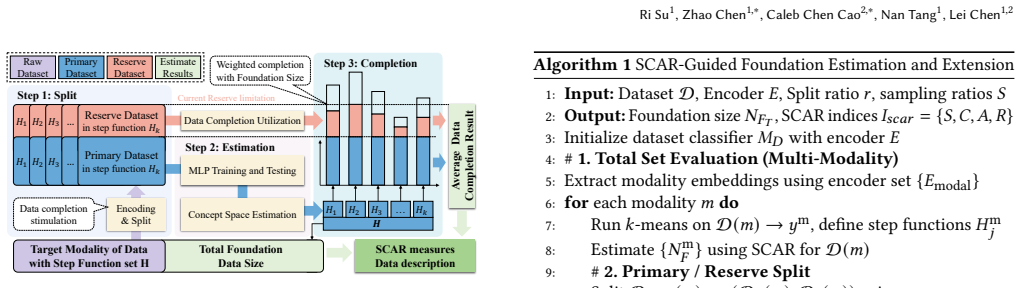
The mechanism is a step-function task model: each binary label is a Heaviside threshold on a fixed linear projection of a lossless latent code K = φ*(X), with tasks being sets of such step functions. Concept-space growth is modeled as |H_j| = α_j(1 − e^{−λ_j n}), a saturating exponential whose fitted α_j is the asymptotic concept-space size. The SCAR-to-bound mapping sets I_s = r, I_c ≜ 1 − δ, I_a ≜ 1 − ε_j, and I_r ≜ 1 − ε′_j, producing |H_j| ≤ I_c exp{2 I_s (I_r − I_a)^2} and a lower bound n_j ≥ ln(|H_j|*/δ*)/(2ε*²). A Bonferroni-style union bound over correlated step-function errors converts per-function FDS into a set-level FDS n*. Cross-modal pseudo-supervision uses k-means clusters in
What would settle it
Compute SCAR and FDS for a dataset with the paper's frozen-encoder linear probe, then train the same task with a different-capacity model family on random subsets of increasing size; if the predicted foundation size does not match where accuracy actually saturates, FDS is probe-specific rather than a dataset property.
Extended reading notes
Core claim
SCAR models each task as a set of step functions H_j applied to a shared latent representation, and estimates the size |H_j| of the concept space behind each step function as an exponential saturation curve |H_j| = α_j(1 − e^{−λ_j n}), an assumption motivated by the exponential form of a PAC-style generalization bound. The four measures are mapped onto the terms of that bound: Scale is the downsampling ratio, Coverage plays the role of confidence δ, Authenticity plays 1 − ε (strict error), and Richness plays 1 − ε′ (loose empirical error). Plugging these into a Bonferroni-style inequality gives a per-function and set-level lower bound on the sample count—the Foundation Data Size. The paper's
Load-bearing premise
The whole estimate rests on treating three SCAR scores—coverage, authenticity, richness—as the confidence and error terms in a statistical learning bound, and on assuming that the space of learnable concepts grows as a saturating exponential curve; if either mapping is wrong, the predicted foundation size just reflects the probe's own accuracy curve rather than a property of the dataset.
Editorial extensions
If this is right
- Datasets can be scored without retraining: a frozen pretrained encoder plus a linear probe yields four SCAR indices and a Foundation Data Size estimate for any modality.
- If FDS is correct, data collection and pruning can target known shortfalls instead of adding random samples, because the minimal sufficient scale is estimated in advance.
- Per-step foundation-size gaps give a concrete allocation rule for data completion, and the paper reports that this rule outperforms random and class-average sampling on Flickr30k, COCO Captions, MSR-VTT, and AudioCaps.
- Cross-modal pseudo-supervision lets one modality's cluster structure supervise another, yielding separate FDS estimates for paired modalities and exposing cross-modal alignment gaps.
- Large-scale corpora such as ImageNet, Wikipedia, and DBPedia meet their estimated Foundation Data Size, while smaller multimodal datasets fall short, indicating uneven class-level fitting.
Reading between the lines
- A testable extension would be to compute SCAR and FDS before training, then check whether adding data beyond the predicted foundation size actually stops improving generalization; the paper's framework implies this should hold.
- Because SCAR is computed from a specific frozen encoder, FDS estimates are relative to that representation; comparing datasets across encoder families may require re-normalizing the measures.
- Synthetic datasets with known step-function concept spaces could directly validate whether FDS tracks true saturation, since the paper's experiments use real corpora where the ground-truth concept space is unknown.
- The exponential growth model predicts diminishing returns after a certain scale, which could be used as an early-stopping rule for data acquisition even if the four SCAR indices are treated only as heuristics.
Editorial analysis
A structured set of objections, weighed in public.
Referee Report
Summary. The paper proposes SCAR, a set of four dataset characteristics (Scale, Coverage, Authenticity, Richness), and uses them to estimate a 'Foundation Data Size' (FDS) — the minimal data scale needed for generalization. The authors derive FDS from a PAC-style bound (Eq. 5), an exponential model of concept-space growth (Eq. 4/7), and linear-probe accuracies on downsampled subsets. They extend the estimate to a set of step functions via a Bonferroni inequality and use the resulting per-function and set-level FDS to guide a data-completion strategy in multimodal settings. Experiments cover image, text, video, and audio datasets with multiple pretrained encoders, and code is released.
Significance. If the derivation were sound, FDS would be a useful, model-agnostic diagnostic for data acquisition and subset selection. The paper is also commendable for its empirical breadth and for releasing code. However, the central theoretical bridge from the PAC bound to the SCAR-based FDS is algebraically incorrect (Eq. 6), the FDS formula is misstated, and the estimator ultimately inverts a curve fitted to the same probe accuracies that define the SCAR measures. As a result, the paper does not establish FDS as an intrinsic dataset property, and the experimental results are mixed rather than consistently supportive. The contribution as stated is therefore not validated by the manuscript.
major comments (6)
- [§3.3, Eq. (6)] Eq. (6) does not follow from Eq. (5). With the paper's own definitions I_c ≜ 1−δ, I_s = n/n*, and (I_r−I_a) = ε_j−ε'_j, Eq. (5) gives |H_j| ≤ (1−I_c) exp(2 n* I_s (I_r−I_a)^2). Eq. (6) instead uses I_c as the confidence factor and drops the n* factor. The complement substitution reverses the direction of the bound: larger coverage (smaller δ) should tighten the bound, but Eq. (6) loosens it. The missing n* changes the exponent by orders of magnitude for realistic dataset sizes. Because Eq. (6) is the only link between probe-derived SCAR values and the FDS estimate, the FDS estimates in §3.3 and §4.1 are not consequences of the PAC bound.
- [§3.3, after Eq. (7)] The stated lower bound 'n_j ≥ ln(|H_j|*/δ*) 2ε*²' is algebraically wrong. Solving |H_j| ≤ δ exp(2 n ε²) for n gives n ≥ ln(|H_j|/δ) / (2 ε²). As printed, the inequality is dimensionally inconsistent and would not yield the claimed lower bound. This formula is the actual FDS estimate used in the experiments, so the numerical results are not reproducible from the equations as written.
- [Definition 1 and footnote 2] Definition 1 requires Pr(err_{D,H}(f,D) ≥ ε) = 0 for all N > n. The practical approximation with δ=0.01 and ε=0.01 is a PAC statement that bounds the probability of error, not zero error. These are not interchangeable: the PAC bound in Eq. (2) only controls the probability of a large error, and a nonzero δ is not an 'approximation' of δ=0. The FDS is therefore not the minimal size satisfying Definition 1, and the conceptual link between the abstract definition and the estimator is missing.
- [§3.1 and §3.3, Eq. (7)] The 'concept space size' |H_j| is not an observed or independently estimated quantity; it is the output of the parametric curve α_j(1−e^{−λ_j n}) fitted to the same linear-probe accuracies that define the SCAR measures. FDS is then obtained by inverting this fitted curve at chosen δ* and ε*. Consequently, FDS reduces to a reparameterization of the probe's own accuracy curve. This may be a reasonable heuristic, but it contradicts the paper's claim that FDS is 'model-agnostic' and derived from a theoretical framework. The circular relationship between the fitted curve and the resulting FDS should be acknowledged and validated against an independent ground truth.
- [§4.1, Eq. (8)-(9)] The set-level FDS is under-specified. The text introduces 'a threshold t* at which the bound is attained with equality in step function series' but does not define how t* is computed. The subsequent instruction to 'solve exp(−2 n* ε_E^{*2}) = t* numerically' is meaningless without t*. Moreover, the positive-correlation assumption in Eq. (8) is not used in Eq. (9); the displayed Bonferroni expression is just the union bound from Eq. (1) with Pr(E_j) substituted. The set-level FDS estimate therefore lacks a clear derivation.
- [Table 2 and §5.2] The claim that 'SCAR consistently delivers superior or comparable performance' is not supported by Table 2. For AudioCaps, SCAR is worse than random for both text and audio in every reported encoder row (e.g., AudioCaps text with CLAP: 40.47 vs 40.97; with Pengi: 7.24 vs 7.69; AudioCaps audio with CLAP: 25.99 vs 26.27; with Pengi: 11.04 vs 11.91). For MSR-VTT video with X-CLIP, SCAR is below random (41.30 vs 43.10). These cases are not 'parity'; they are losses. The experimental section therefore does not establish the effectiveness of FDS-guided completion, and the large standard deviations (e.g., 31.30, 23.20) make several other differences statistically fragile.
minor comments (6)
- [§3.2.2] Coverage I_c is first defined as a Jensen-Shannon divergence between empirical logit distributions and a fitted Gaussian, then set equal to 1−δ. The mapping from a distributional-divergence value to a PAC confidence parameter is asserted without justification; please clarify the probabilistic model.
- [Eq. (1)] The notation I^{(k')}_r is not formally defined; the reader cannot reproduce the Bonferroni expansion without additional explanation of the index set.
- [§4.3] The symbols I_s, I_c, I_a, I_r are redefined with different formulas in §4.3 than in §3.2. This is confusing; please use different names or explicitly state that these are aggregate-level counterparts.
- [Figure 3] Axes and color-bar legends are missing in both panels. The prose makes quantitative-sounding claims (e.g., 'high authenticity but differ in coverage') that cannot be verified from the figure.
- [Table 2 caption] The caption does not define the baselines: 'rand.' and 'avg.' are used but not explained, and 'Pri. Acc.'/'Ext. Acc.' need a precise definition (accuracy on what split, after what training?).
- [§3.2.1 and §3.3] The statements that 'computing n and r yields numerically equivalent results with λ' and that 'λ_j* = λ_j × n is numerically equivalent to λ_j' are unclear. λ_j is a fitted parameter; multiplying by n changes the quantity being regressed. This should be clarified.
Circularity Check
Foundation Data Size is a reparameterization of the fitted exponential accuracy curve; the PAC bridge (Eq. 6) is algebraically invalid, so the FDS prediction reduces to the regression.
-
fitted input called prediction
[Section 3.1 Eq. (4); Section 3.3 Eq. (7) and the inequality n_j ≥ ln(|H_j|*/δ*) 2ε*^2; Section 4.2 completion weights]
"|𝐻𝑗| =𝛼𝑗(1−𝑒−𝜆𝑗𝑛), (4) where𝛼𝑗,𝜆𝑗 > 0 are regression parameters. ... |𝐻𝑗| =𝛼𝑗(1− exp{−𝜆∗ 𝑗𝐼𝑠}), |𝐻𝑗|∗ =𝛼𝑗 (7) ... Considering the Eq. 2, we can derive the following inequality: 𝑛𝑗≥ ln(|𝐻𝑗|∗/𝛿∗) 2𝜖∗2"
The FDS lower bound n_j is obtained by inverting the fitted exponential |H_j| = α_j(1−e^{−λ_j n}) with user-chosen δ*, ε*. The parameters α_j and λ_j are fitted by regression to the same linear-probe accuracy curves on downsampled data (Sec. 3.1: 'By evaluating model performance on downsampled data, we apply Eq. 2 to constrain the growth curve'). Thus the 'foundation data size' is not an independently measured dataset property; it is a monotone transform of the fitted asymptotic concept-space size α_j. The completion weights in Sec. 4.2 then allocate data according to max(0, n*_j−n_j), so the predicted per-class data need is forced by the same fitted curve that generated n*_j. The claimed PAC derivation is the only would-be non-circular link, and it is broken: substituting I_c=1−δ, I_s=n/n
full rationale
The paper's central quantitative output—Foundation Data Size—is not derived from the PAC bound in the way the text claims. Eq. 6 does not follow from Eq. 5 under the paper's own definitions: I_c is defined as 1−δ, so it should appear as (1−I_c) in the confidence factor, and the dataset-size factor n= n* I_s should remain in the exponent. Because Eq. 6 is algebraically wrong, the estimated FDS has no theoretical support from the Bonferroni/PAC argument. What remains is Eq. 7 plus regression: α_j and λ_j are fitted to the probe's accuracy curves on downsampled data, and n_j is obtained by inverting that fitted curve with arbitrary δ*, ε*. The completion strategy then uses these n_j values to decide how many samples to add per class, so the 'prediction' of which classes need more data is a re-expression of the fitted curve rather than an independent dataset property. This is a fitted-input-called-prediction pattern, with the additional problem that the purported theoretical bridge is a non-sequitur. There is no self-citation chain or imported uniqueness theorem; the circularity is internal to the estimation procedure. Score 6 reflects that the central FDS estimate partially reduces by construction to the fitted regression, while some empirical content remains in the downstream completion experiments.
Assumptions & free parameters
free parameters (8)
- α_j =
estimated by regression (not reported per dataset)
- λ_j =
estimated by regression (not reported)
- δ* =
0.01
- ε* =
0.01
- δ*_E =
0.01
- ε*_E =
0.01·log(k)
- k (number of clusters) =
set to dataset class count
- primary/reserve split ratio =
0.6
assumptions (6)
- domain assumption A lossless ideal encoder φ* exists such that K = φ*(X) fully determines X and labels are threshold-linear projections of K.
- domain assumption The latent representation is identical across modalities: K = φ*_α(X_mα) = φ*_β(X_mβ).
- ad hoc to paper Concept space size grows as |H_j| = α_j(1 - e^{-λ_j n}) with independent incremental contributions.
- domain assumption Error events across step functions are positively correlated such that joint probabilities are at least the product of marginals (Eq. 8).
- standard math The standard deviation bound Pr(E_j) ≤ |H_j| exp(-2nε²) applies with |H_j| reinterpreted as a data-dependent concept-space size.
- ad hoc to paper Definition 1's zero-error requirement is approximated by δ=0.01 and ε=0.01.
invented entities (2)
-
Foundation Data Size (FDS)
-
Data-dependent concept space size |H_j|(n) = α_j(1-e^{-λ_j n})
Cite this review
Pith. "Pith review of SCAR: A Characterization Scheme for Multi-Modal Dataset." pith.science (2026). https://pith.science/paper/QLWGHLMC
@misc{pith2026250819659,
  author       = {Pith},
  title        = {Pith review of: SCAR: A Characterization Scheme for Multi-Modal Dataset},
  year         = {2026},
  howpublished = {\url{https://pith.science/paper/QLWGHLMC}},
  note         = {Machine review of arXiv:2508.19659}
}
read the original abstract
Foundation models exhibit remarkable generalization across diverse tasks, largely driven by the characteristics of their training data. Recent data-centric methods like pruning and compression aim to optimize training but offer limited theoretical insight into how data properties affect generalization, especially the data characteristics in sample scaling. Traditional perspectives further constrain progress by focusing predominantly on data quantity and training efficiency, often overlooking structural aspects of data quality. In this study, we introduce SCAR, a principled scheme for characterizing the intrinsic structural properties of datasets across four key measures: Scale, Coverage, Authenticity, and Richness. Unlike prior data-centric measures, SCAR captures stable characteristics that remain invariant under dataset scaling, providing a robust and general foundation for data understanding. Leveraging these structural properties, we introduce Foundation Data-a minimal subset that preserves the generalization behavior of the full dataset without requiring model-specific retraining. We model single-modality tasks as step functions and estimate the distribution of the foundation data size to capture step-wise generalization bias across modalities in the target multi-modal dataset. Finally, we develop a SCAR-guided data completion strategy based on this generalization bias, which enables efficient, modality-aware expansion of modality-specific characteristics in multimodal datasets. Experiments across diverse multi-modal datasets and model architectures validate the effectiveness of SCAR in predicting data utility and guiding data acquisition. Code is available at https://github.com/McAloma/SCAR.
Figures


Reference graph
Works this paper leans on
- [1]
-
[2]
A., Adeli, E., Altman, R., Arora, S., von Arx, S., Bernstein, M
Bommasani, R., Hudson, D. A., Adeli, E., Altman, R., Arora, S., von Arx, S., Bernstein, M. S., Bohg, J., and Bosselut, A. e. a. On the opportunities and risks of foundation models. arXiv preprint arXiv:2108.07258 (2021)
arXiv 2021
-
[3]
Emerging properties in self-supervised vision transformers
Caron, M., Touvron, H., Misra, I., Jégou, H., Mairal, J., Bojanowski, P., and Joulin, A. Emerging properties in self-supervised vision transformers. In Proceedings of the IEEE/CVF ICCV (2021), pp. 9650–9660
work page 2021
-
[4]
Learning with instance- dependent label noise: A sample sieve approach
Cheng, H., Zhu, Z., Li, X., Gong, Y., Sun, X., and Liu, Y. Learning with instance- dependent label noise: A sample sieve approach. In ICLR (2021)
work page 2021
-
[5]
Pengi: An audio language model for audio tasks
Deshmukh, S., Elizalde, B., Singh, R., and W ang, H. Pengi: An audio language model for audio tasks. In Advances in Neural Information Processing Systems (2023), A. Oh, T. Neumann, A. Globerson, K. Saenko, M. Hardt, and S. Levine, Eds., vol. 36, Curran Associates, Inc., pp. 18090–18108
work page 2023
-
[6]
Bert: Pre-training of deep bidirectional transformers for language understanding
Devlin, J., Chang, M.-W., Lee, K., and Toutanova, K. Bert: Pre-training of deep bidirectional transformers for language understanding. In Proceedings of the 2019 conference of the North American chapter of the association for computational linguistics: human language technologies, volume 1 (2019), pp. 4171–4186
work page 2019
-
[7]
An image is worth 16x16 words: Transformers for image recognition at scale
Dosovitskiy, A., Beyer, L., et al. An image is worth 16x16 words: Transformers for image recognition at scale. In ICLR (2021), OpenReview.net
work page 2021
-
[8]
Glavic, B., Li, P., Liu, Z., Gawlick, D., and Krishnaswamy, V. e. Towards an objective metric for data value through relevance. In CIDR (2024)
work page 2024
Show all 29 references
-
[9]
Deep residual learning for image recog- nition
He, K., Zhang, X., Ren, S., and Sun, J. Deep residual learning for image recog- nition. In Proceedings of the IEEE conference on CVPR (2016), pp. 770–778
2016
-
[10]
An in- formation fusion approach to learning with instance-dependent label noise
Jiang, Z., Zhou, K., Liu, Z., Li, L., Chen, R., Choi, S.-H., and Hu, X. An in- formation fusion approach to learning with instance-dependent label noise. In International Conference on Learning Representations (2021)
2021
-
[11]
Mind the data gap: Bridging large language models (llms) to enterprise data integration
Kayali, M., Wenz, F., Tatbul, N., and Demiralp, Ç. Mind the data gap: Bridging large language models (llms) to enterprise data integration. CIDR (2024)
2024
-
[12]
Roberta: A robustly optimized BERT pretraining approach
Liu, Y., Ott, M., Goyal, N., Du, J., Joshi, M., Chen, D., Levy, O., Lewis, M., Zettlemoyer, L., and Stoyanov, V. Roberta: A robustly optimized BERT pretraining approach. CoRR abs/1907.11692 (2019)
1907 arXiv
-
[13]
X-clip: End-to-end multi- grained contrastive learning for video-text retrieval
Ma, Y., Xu, G., Sun, X., Y an, M., Zhang, J., and Ji, R. X-clip: End-to-end multi- grained contrastive learning for video-text retrieval. In Proceedings of the 30th ACM international conference on multimedia (2022), pp. 638–647
2022
-
[14]
Databases unbound: Querying all of the world’s bytes with ai
Madden, S., Cafarella, M., Franklin, M., and Kraska, T. Databases unbound: Querying all of the world’s bytes with ai. Proceedings of the VLDB Endowment 17, 12 (2024), 4546–4554
2024
-
[15]
Z.Uniform convergence may be unable to explain generalization in deep learning
Nagarajan, V., and Kolter, J. Z.Uniform convergence may be unable to explain generalization in deep learning. Advances in NeuralIPS 32 (2019)
2019
-
[16]
Northcutt, C., and Jiang, L. e. a. Confident learning: Estimating uncertainty in dataset labels. Journal of Artificial Intelligence Research 70 (2021), 1373–1411
2021
-
[17]
J., Goel, K., and Ré, C
Orr, L. J., Goel, K., and Ré, C. Data management opportunities for foundation models. In CIDR (2022)
2022
-
[18]
W., Hallacy, C., Ramesh, A., Goh, G., Agarwal, S., Sastry, G., et al
Radford, A., Kim, J. W., Hallacy, C., Ramesh, A., Goh, G., Agarwal, S., Sastry, G., et al. Learning transferable visual models from natural language supervision. In International conference on machine learning (2021), PmLR, pp. 8748–8763
2021
-
[19]
Uselis, A., Dittadi, A., and Oh, S. J. Does data scaling lead to visual composi- tional generalization? In Forty-second ICML (2025)
2025
-
[20]
Videoclip-xl: Advancing long description understanding for video clip models, 2024
W ang, J., W ang, C., Huang, K., Huang, J., and Jin, L. Videoclip-xl: Advancing long description understanding for video clip models, 2024
2024
-
[21]
W ang, T., Zhu, J.-Y., Torralba, A., and Efros, A. A. Dataset distillation. arXiv preprint arXiv:1811.10959 (2018)
2018 arXiv
-
[22]
Large-scale contrastive language-audio pretraining with feature fusion and keyword-to-caption augmentation
Wu, Y., Chen, K., Zhang, T., Hui, Y., Berg-Kirkpatrick, T., and Dubnov, S. Large-scale contrastive language-audio pretraining with feature fusion and keyword-to-caption augmentation. In ICASSP (2023), IEEE, pp. 1–5
2023
-
[23]
TMLR 2022 (2022)
Yu, J., W ang, Z., V asudevan, V., Yeung, L., Seyedhosseini, M., and Wu, Y.Coca: Contrastive captioners are image-text foundation models. TMLR 2022 (2022)
2022
-
[24]
P., Lai, K.-H., Y ang, F., and Hu, X.Data-centric ai: Perspectives and challenges
Zha, D., Bhat, Z. P., Lai, K.-H., Y ang, F., and Hu, X.Data-centric ai: Perspectives and challenges. In Proceedings of the 2023 SIAM international conference on data mining (SDM) (2023), SIAM, pp. 945–948
2023
-
[25]
Sigmoid loss for language image pre-training
Zhai, X., Mustafa, B., Kolesnikov, A., and Beyer, L. Sigmoid loss for language image pre-training. In ICCV (2023), IEEE, pp. 11941–11952
2023
-
[26]
Understanding deep learning requires rethinking generalization
Zhang, C., Bengio, S., Hardt, M., Recht, B., and Vinyals, O. Understanding deep learning requires rethinking generalization. In ICLR (2017)
2017
-
[27]
Mathematical analysis of machine learning algorithms
Zhang, T. Mathematical analysis of machine learning algorithms . Cambridge University Press, 2023
2023
-
[28]
In ECCV (2024), Springer, pp
Zhao, Z., Shang, Y., Wu, J., and Y an, Y.Dataset quantization with active learning based adaptive sampling. In ECCV (2024), Springer, pp. 346–362
2024
-
[29]
Zhou, D., W ang, K., and Gu, J. e. a. Dataset quantization. In Proceedings of the IEEE/CVF International Conference on Computer Vision (2023), pp. 17205–17216
2023
Reviewed August 5, 2026 · model on record in the stance chip above.
Discussion (0). Sign in to comment.