REVIEW 2 major objections 6 minor 198 references
Rydberg atomic quantum radios map free-space RF fields onto atomic quantum states, offering a path past classical receiver limits for full-spectrum, ultra-sensitive, anti-jam links.
Reviewed by Pith at T0; open to challenge. T0 means a machine referee read the full paper against a public rubric. the ladder, T0–T4 →
T0 review · grok-4.5
2026-07-11 01:45 UTC pith:QMMLDRA6
load-bearing objection Solid, usable survey that actually bridges atomic physics to comms channel models; organizational novelty is real, soft spots are the usual lab-to-field ones the authors already flag. the 2 major comments →
Rydberg Atomic Quantum Radio: A Comprehensive Survey From Wireless Communication Perspective
The pith
A machine-rendered reading of the paper's core claim, the machinery that carries it, and where it could break.
Core claim
By mapping free-space electromagnetic fields directly onto the quantum-state evolution of Rydberg atoms rather than onto conduction currents, RAQ radios can simultaneously furnish ultra-wideband coverage (Hz–THz), sensitivity below the room-temperature thermal-noise floor, and inherent out-of-band rejection, thereby alleviating the classical bottlenecks that prevent conventional RF receivers from meeting SAGSIN requirements; the survey supplies the first systematic bridge from optical-Bloch atomic response models to equivalent baseband channel models usable for capacity and system analysis.
What carries the argument
The optical-Bloch-equation (OBE) atomic response that converts incident RF Rabi frequency into probe-laser coherence ρ₂₁ (and thence complex susceptibility χ), which is then linearized into steady-state, small-signal, or dynamic equivalent baseband channels of the form y(t)=H_eq(x(t))+n_eq(t).
Load-bearing premise
The idealized steady-state and small-signal linearizations of the optical Bloch equations, plus the laboratory noise models, remain accurate once the vapor cell, lasers, and photodetector leave the controlled table-top and enter a vibrating, temperature-varying, multi-user field environment.
What would settle it
Build a compact multi-band RAQ front-end, place it outdoors under realistic temperature and vibration, and measure whether the measured sensitivity, instantaneous bandwidth, and bit-error rate still match the OBE-derived equivalent-channel predictions within a few decibels; systematic deviation falsifies the modeling bridge.
Editorial analysis
A structured set of objections, weighed in public.
Referee Report
Summary. This survey reviews Rydberg atomic quantum (RAQ) radios as a quantum-enabled RF reception paradigm that maps free-space electromagnetic fields onto atomic quantum-state evolution (via EIT/AT and optical Bloch dynamics) rather than conduction currents. It organizes the literature from quantum fundamentals and receiver architectures through atomic response and noise models, metric-enhancement techniques and trade-offs (sensitivity, instantaneous bandwidth, operating frequency), equivalent baseband channel models (steady-state linear/nonlinear, small-signal, dynamic), capacity considerations, non-idealities, RAQ-enabled communication technologies (modulation, cognitive/sensing, interference-resilient, low/high-frequency, MIMO), and application scenarios (satellite, ISAC, RIS, SWIPT, etc.), ending with open challenges and future directions. The central claim is organizational and bridging: that the atomic response can be cast as communication-usable channel models and that RAQ receivers can alleviate classical bottlenecks for SAGSIN-class requirements.
Significance. If the synthesis holds, the paper supplies a useful interdisciplinary roadmap that is currently missing: Table I correctly positions prior reviews as physics- or sensing-centric, while this work systematically links optical-Bloch response (Sections II–III) to equivalent baseband channels (Section V) and wireless system concepts (Sections VI–VII). Strengths include explicit comparison of Λ/Ξ/V EIT pathways, tabulated experimental sensitivities and bandwidths (Tables III–IV, Fig. 10), a clear taxonomy of channel linearizations (Fig. 12), and an honest open-challenges section that already flags field-deployability and model validity. For a survey in eess.SP, that bridge is a genuine contribution even without new theorems.
major comments (2)
- Section V-B and V-C: The equivalent-channel taxonomy (steady-state linear/nonlinear, small-signal, dynamic) is the paper’s distinctive bridge to communications, yet capacity discussion remains thin—largely citing SIMO scaling, MIMO electromagnetic modeling, and SNR/dynamic-response proxies without a worked example that plugs the derived H_eq (or H_dyn(s)) into a concrete capacity or BER expression under the noise model of III-B3. A short numerical illustration (e.g., capacity vs. EIT linewidth / LO operating point using the linearized model) would make the bridge load-bearing rather than primarily taxonomic.
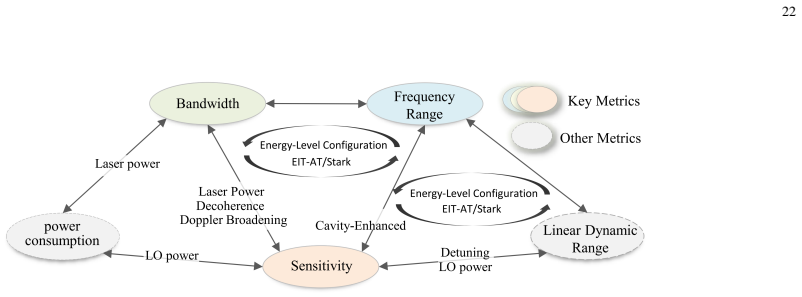
- Section IV and Fig. 9: Trade-offs among sensitivity, instantaneous bandwidth, and operating frequency are asserted as central, but the figure and surrounding text remain qualitative. The survey would be stronger if at least one quantitative Pareto or constraint relation (e.g., from EIT linewidth vs. decoherence rates already present in the OBE discussion) were extracted from the cited experiments so that the “inherent trade-off” claim is not only narrative.
minor comments (6)
- Index terms and abstract: “wireless communicationns” is misspelled; fix consistently.
- Throughout: “quantum-enbaled,” “Meawhile,” “qualityn,” and similar typos should be cleaned in a proof pass.
- Fig. 1 caption and body: publication-trend claims would benefit from a brief note on search methodology (databases, keywords, cutoff date) so the growth narrative is reproducible.
- Section III-A2 (atomic transmitter): the subsection is interesting but thin relative to the receiver focus; either expand with a short comparison table or clearly mark it as an outlook to avoid imbalance.
- Notation: Rabi frequencies and detunings appear with slight symbol variations across II–V; a single notation table early in Section II would help non-physics readers.
- References: a few arXiv-only and “early access” items are fine for a fast-moving field, but ensure DOIs/venue are filled where available before final publication.
Circularity Check
No significant circularity: the survey organizes external literature and standard OBE-to-baseband mappings without self-referential definitions, fitted-as-prediction steps, or load-bearing self-citation chains.
full rationale
This is a literature survey whose central contribution is organizational: it reviews quantum mechanisms (EIT/AT, OBEs), receiver architectures, metric trade-offs, and then casts published atomic-response results into equivalent baseband channel models (steady-state linear/nonlinear, small-signal, dynamic) usable for capacity and system analysis. The models in III-B and V-B are standard projections of the Lindblad/OBE dynamics already present in the cited physics literature; they are not derived by fitting free parameters to the same data later called predictions, nor by defining quantities in terms of themselves. Self-citations (e.g., co-author works on RAQ-MIMO, RIS-assisted, SWIPT, satellite reception) appear as ordinary related prior art in the application sections and are not invoked as uniqueness theorems or unverified premises that force the survey’s framing. No ansatz is smuggled via self-citation, and no known empirical pattern is merely renamed. The paper itself flags the idealized OBE linearizations under field conditions as an open challenge rather than a hidden circular premise. Consequently the derivation chain is self-contained against external benchmarks and exhibits none of the enumerated circularity patterns.
Axiom & Free-Parameter Ledger
axioms (3)
- domain assumption Optical Bloch equations (Lindblad master equation projected onto atomic basis) correctly describe the open-system dynamics of Rydberg ensembles under laser and RF driving.
- domain assumption Rotating-wave and weak-probe approximations remain valid for the laser intensities and detunings used in the surveyed experiments.
- standard math Standard quantum numbers and dipole selection rules for alkali Rydberg states determine allowed transitions and polarizabilities.
Cite this review
Pith. "Pith review of Rydberg Atomic Quantum Radio: A Comprehensive Survey From Wireless Communication Perspective." pith.science (2026). https://pith.science/paper/QMMLDRA6
@misc{pith2026260705931,
  author       = {Pith},
  title        = {Pith review of: Rydberg Atomic Quantum Radio: A Comprehensive Survey From Wireless Communication Perspective},
  year         = {2026},
  howpublished = {\url{https://pith.science/paper/QMMLDRA6}},
  note         = {Machine review of arXiv:2607.05931}
}
read the original abstract
Next-generation space-air-ground-sea integrated networks (SAGSIN) impose unprecedented demands on advanced radio frequency (RF) receivers for full-spectrum agility, ultra-high sensitivity, and anti-jamming resilience, pushing conventional electronic receivers to their physical limits. To address these challenges, the Rydberg atomic quantum (RAQ) radio has emerged as a promising quantum-enabled receiver paradigm that directly maps electromagnetic fields onto atomic quantum states, offering an alternative to alleviate bottlenecks of conventional RF front ends. To provide a clear research roadmap, this survey presents a comprehensive review of RAQ radios by bridging atomic physics and wireless communications. Specifically, we first introduce the underlying quantum mechanisms, representative architectures, and atomic response models of RAQ radio. On this basis, state-of-the-art techniques for enhancing sensitivity, instantaneous bandwidth, and operating frequency are systematically reviewed, with particular emphasis on the inherent trade-offs among these key metrics. To connect quantum response with communication theory, we further analyze equivalent channel modeling frameworks for characterizing systematic performance limits. From the wireless communication perspective, some RAQ-enabled advanced technologies including cognitive, interference-resilient, low-frequency and multiple-input multiple-output (MIMO) communications are reviewed, alongside emerging deployment scenarios such as satellite networks, integrated sensing and communications, and reconfigurable intelligent surface-assisted systems. Finally, we identify open challenges and provide potential future directions of RAQ radio to inspire the further exploration.
Figures




Reference graph
Works this paper leans on
-
[1]
A survey on space-air-ground-sea integrated network security in 6G,
H. Guo, J. Li, J. Liu, N. Tian, and N. Kato, “A survey on space-air-ground-sea integrated network security in 6G,”IEEE Commun. Surveys Tuts., vol. 24, no. 1, pp. 53–87, 2022
work page 2022
-
[2]
Space-air-ground integrated wireless networks for 6G: Basics, key technologies, and future trends,
Y . Xiao, Z. Ye, M. Wu, H. Li, M. Xiao, and M.-S. Alouini, “Space-air-ground integrated wireless networks for 6G: Basics, key technologies, and future trends,”IEEE J. Sel. Areas Commun., vol. 42, no. 12, pp. 3327–3354, 2024
work page 2024
-
[3]
X. Luo, H.-H. Chen, and Q. Guo, “LEO/VLEO satellite communications in 6G and beyond networks–technologies, applications, and challenges,”IEEE Netw., vol. 38, no. 5, pp. 273–285, 2024
work page 2024
-
[4]
A survey on millimeter-wave beamforming enabled UA V communications and networking,
Z. Xiao, L. Zhu, Y . Liu, P. Yi, R. Zhang, and X.-G. Xia, “A survey on millimeter-wave beamforming enabled UA V communications and networking,”IEEE Commun. Surveys Tuts., vol. 24, no. 1, pp. 557–610, 2022. 45
work page 2022
-
[5]
C. Lin, G. Han, J. Jiang, C. Li, S. B. H. Shah, and Q. Liu, “Underwater pollution tracking based on software-defined multi-tier edge computing in 6G-based underwater wireless networks,”IEEE J. Sel. Areas Commun., vol. 41, no. 2, pp. 491–503, 2023
work page 2023
-
[6]
Extremely low frequency (ELF) communication to submarines,
H. E. Rowe, “Extremely low frequency (ELF) communication to submarines,”IEEE Trans. Commun., vol. 22, no. 4, pp. 371–385, Apr. 1974
work page 1974
-
[7]
T. Rossi, M. De Sanctis, M. Ruggieri, C. Riva, L. Luini, and G. Codispoti, “Satellite communication and propagation experiments through the Alphasat Q/V band aldo paraboni technology demonstration payload,”IEEE Aerosp. Electron. Syst. Mag., vol. 31, no. 3, pp. 18–27, 2016
work page 2016
-
[8]
Ueber strahlen electrischer kraft,
H. Hertz, “Ueber strahlen electrischer kraft,”Ann. Phys., vol. 272, pp. 769–783, 1889
-
[9]
Guglielmo Marconi: The father of long distance radio communication: An engineer’s tribute,
P. K. Bondyopadhyay, “Guglielmo Marconi: The father of long distance radio communication: An engineer’s tribute,” inProc. 25th Eur. Microw. Conf., vol. 2, 1995, pp. 879–885
work page 1995
-
[10]
The software radio architecture,
J. Mitola, “The software radio architecture,”IEEE Commun. Mag., vol. 33, no. 5, pp. 26–38, 1995
work page 1995
-
[11]
D. J. Griffiths,Introduction to Electrodynamics, 4th ed. Cambridge: Cambridge University Press, 2017
work page 2017
-
[12]
C. A. Balanis,Antenna Theory: Analysis and Design, 3rd ed. New York: Wiley-Interscience, 2005
work page 2005
-
[13]
Multifunction, multiband, and multimode wireless receivers: A path toward the future,
J. Moghaddasi and K. Wu, “Multifunction, multiband, and multimode wireless receivers: A path toward the future,”IEEE Microw. Mag., vol. 21, no. 12, pp. 104–125, 2020
work page 2020
-
[14]
Razavi,RF Microelectronics, 2nd ed
B. Razavi,RF Microelectronics, 2nd ed. Prentice Hall, 2011
work page 2011
-
[15]
Physical limitations of omni-directional antennas,
L. J. Chu, “Physical limitations of omni-directional antennas,”J. Appl. Phys., vol. 19, no. 12, pp. 1163–1175, 1948
work page 1948
-
[16]
Rydberg atomic receiver: Next frontier of wireless communications,
M. Cui, Q. Zeng, and K. Huang, “Rydberg atomic receiver: Next frontier of wireless communications,”IEEE Commun. Mag., vol. 64, no. 1, pp. 146–152, 2026
work page 2026
-
[17]
Watch NIST’s “atomic television
National Institute of Standards and Technology, “Watch NIST’s “atomic television” live and in color,” [Online]. Available: https: //www.nist.gov/news-events/news/2022/08/watch-nists-atomic-television-live-and-color, Aug. 2022, [Accessed: May 19, 2026]
work page 2022
-
[18]
Sub-1-ms instinctual interference adaptive GaN LNA front end with power and linearity tuning,
J. Yang, B. Chatterjee, M. Abu Khater, M. Thorsell, S. E. Gunnarsson, T. Kiuruet al., “Sub-1-ms instinctual interference adaptive GaN LNA front end with power and linearity tuning,”IEEE Trans. Microw. Theory Techn., vol. 71, no. 9, pp. 4037–4051, Sep. 2023
work page 2023
-
[19]
Digital communication with Rydberg atoms and amplitude-modulated microwave fields,
D. H. Meyer, K. C. Cox, F. K. Fatemi, and P. D. Kunz, “Digital communication with Rydberg atoms and amplitude-modulated microwave fields,”Appl. Phys. Lett., vol. 112, no. 21, 2018
work page 2018
-
[20]
watch NIST’s ’atomic television’ live and in color
National Institute of Standards and Technology. (2022) “watch NIST’s ’atomic television’ live and in color”. National Institute of Standards and Technology. [Accessed: May 19, 2026]. [Online]. Available: https://www.nist.gov/news-events/news/2022/08/ watch-nists-atomic-television-live-and-color
work page 2022
-
[21]
US army tests world’s first long-range quantum radio communication
The Defense Post. (2023) “US army tests world’s first long-range quantum radio communication”. The Defense Post. [Accessed: May 18, 2026]. [Online]. Available: https://thedefensepost.com/2023/12/22/us-army-quantum-communication/
work page 2023
-
[22]
Satellite Signal Detection via Rydberg-Atom Receiver
M. Lei, J. Zhang, Q. Luo, Z. Zhang, M. Wang, and M. Shi, “Satellite signal detection via Rydberg-atom receiver,”arXiv preprint arXiv:2506.15439, 2025
work page internal anchor Pith review Pith/arXiv arXiv 2025
-
[23]
Broadband Rydberg atom-based electric-field probe for SI-traceable, self-calibrated measurements,
C. L. Holloway, J. A. Gordon, S. Jefferts, A. Schwarzkopf, D. A. Anderson, S. A. Milleret al., “Broadband Rydberg atom-based electric-field probe for SI-traceable, self-calibrated measurements,”IEEE Trans. Antennas Propag., vol. 62, no. 12, pp. 6169–6182, 2014
work page 2014
-
[24]
Quantum-limited atomic receiver in the electrically small regime,
K. C. Cox, D. H. Meyer, F. K. Fatemi, and P. D. Kunz, “Quantum-limited atomic receiver in the electrically small regime,”Phys. Rev. Lett., vol. 121, no. 11, p. 110502, 2018
work page 2018
-
[25]
Quantum-based amplitude modulation radio receiver using Rydberg atoms,
Z. Song, W. Zhang, X. Liu, H. Zou, J. Zhang, Z. Jianget al., “Quantum-based amplitude modulation radio receiver using Rydberg atoms,” inProc. IEEE Globecom Workshops (GC Wkshps). IEEE, 2018, pp. 1–6
work page 2018
-
[26]
Rydberg-atom-based digital communication using a continuously tunable radio-frequency carrier,
Z. Song, H. Liu, X. Liu, W. Zhang, H. Zou, J. Zhanget al., “Rydberg-atom-based digital communication using a continuously tunable radio-frequency carrier,”Opt. Express, vol. 27, no. 6, pp. 8848–8857, Mar. 2019
work page 2019
-
[27]
An atomic receiver for AM and FM radio communication,
D. A. Anderson, R. E. Sapiro, and G. Raithel, “An atomic receiver for AM and FM radio communication,”IEEE Trans. Antennas Propag., vol. 69, no. 5, pp. 2455–2462, May 2021
work page 2021
-
[28]
A multiple-band Rydberg atom-based receiver: AM/FM stereo reception,
C. L. Holloway, M. T. Simons, A. H. Haddab, J. A. Gordon, D. A. Anderson, G. Raithelet al., “A multiple-band Rydberg atom-based receiver: AM/FM stereo reception,”IEEE Antennas Propag. Mag., vol. 63, no. 3, pp. 63–76, 2021
work page 2021
-
[29]
Detecting and receiving phase-modulated signals with a Rydberg atom-based receiver,
C. L. Holloway, M. T. Simons, J. A. Gordon, and D. Novotny, “Detecting and receiving phase-modulated signals with a Rydberg atom-based receiver,”IEEE Antennas Wirel. Propag. Lett, vol. 18, no. 9, pp. 1853–1857, 2019
work page 2019
-
[30]
Warm Rydberg atom-based quadrature amplitude-modulated receiver,
J. Nowosielski, M. Jastrz˛ ebski, P. Halavach, K. Łukanowski, M. Jarzyna, M. Mazelaniket al., “Warm Rydberg atom-based quadrature amplitude-modulated receiver,”Opt. Express, vol. 32, no. 17, pp. 30 027–30 039, 2024. 46
work page 2024
-
[31]
Atomic superheterodyne receiver based on microwave-dressed Rydberg spectroscopy,
M. Jing, Y . Hu, J. Ma, H. Zhang, L. Zhang, L. Xiaoet al., “Atomic superheterodyne receiver based on microwave-dressed Rydberg spectroscopy,”Nat. Phys., vol. 16, no. 9, pp. 911–915, 2020
work page 2020
-
[32]
N. Prajapati, A. P. Rotunno, S. Berweger, M. T. Simons, A. B. Artusio-Glimpse, S. D. V oranet al., “TV and video game streaming with a quantum receiver: A study on a Rydberg atom-based receiver’s bandwidth and reception clarity,”AVS Quantum Sci., vol. 4, no. 3, 2022
work page 2022
-
[33]
Vapor-cell-based atomic electrometry for detection frequencies below 1 kHz,
Y .-Y . Jau and T. Carter, “Vapor-cell-based atomic electrometry for detection frequencies below 1 kHz,”Phys. Rev. Appl., vol. 13, no. 5, p. 054034, 2020
work page 2020
-
[34]
Assessment of Rydberg atoms for wideband electric field sensing,
D. H. Meyer, Z. A. Castillo, K. C. Cox, and P. D. Kunz, “Assessment of Rydberg atoms for wideband electric field sensing,”J. Phys. B: At. Mol. Opt. Phys., vol. 53, no. 3, p. 034001, 2020
work page 2020
-
[35]
Rydberg atom electric field sensors for communications and sensing,
C. T. Fancher, D. R. Scherer, M. C. S. John, and B. L. S. Marlow, “Rydberg atom electric field sensors for communications and sensing,” IEEE Trans. Quantum Eng., vol. 2, pp. 1–13, 2021
work page 2021
-
[36]
A. Artusio-Glimpse, M. T. Simons, N. Prajapati, and C. L. Holloway, “Modern RF measurements with hot atoms: A technology review of Rydberg atom-based radio frequency field sensors,”IEEE Microw. Mag., vol. 23, no. 5, pp. 44–56, 2022
work page 2022
-
[37]
Electric field measurement and application based on Rydberg atoms,
B. Liu, L. Zhang, Z. Liu, Z. Deng, D. Ding, B. Shiet al., “Electric field measurement and application based on Rydberg atoms,” Electromagn. Sci., vol. 1, no. 2, p. 0020151, 2023
work page 2023
-
[38]
N. Schlossberger, N. Prajapati, S. Berweger, A. P. Rotunno, A. B. Artusio-Glimpse, M. T. Simonset al., “Rydberg states of alkali atoms in atomic vapour as SI-traceable field probes and communications receivers,”Nat. Rev. Phys., vol. 6, no. 10, pp. 606–620, 2024
work page 2024
-
[39]
Rydberg atom electric field sensing for metrology, communication and hybrid quantum systems,
H. Zhang, Y . Ma, K. Liao, W. Yang, Z. Liu, D. Dinget al., “Rydberg atom electric field sensing for metrology, communication and hybrid quantum systems,”Sci. Bull., vol. 69, no. 10, pp. 1515–1535, 2024
work page 2024
-
[40]
Rydberg atom RF sensing: State of the art, principles, metrics and roadmaps,
A. Babusenan, F. Munoz, J.-B. Quéleneet al., “Rydberg atom RF sensing: State of the art, principles, metrics and roadmaps,”IEEE Sensors Reviews, pp. 1–24, 2026
work page 2026
-
[41]
Rydberg atomic quantum receivers for classical wireless communication and sensing,
T. Gong, A. Chandra, C. Yuen, Y . L. Guan, R. Dumke, C. M. S. Seeet al., “Rydberg atomic quantum receivers for classical wireless communication and sensing,”IEEE Wirel. Commun., 2025
work page 2025
-
[42]
New paradigm for integrated sensing and communication with Rydberg atomic receiver,
M. Chen, T. Mao, Y . Zhao, W. Xiao, D. Zheng, Z. Wanget al., “New paradigm for integrated sensing and communication with Rydberg atomic receiver,”arXiv preprint arXiv:2506.13304, 2025, submitted to IEEE Communications Magazine
- [43]
-
[44]
T. F. Gallagher, “Rydberg atoms,”Rep. Prog. Phys., vol. 51, no. 2, p. 143, 1988
work page 1988
-
[45]
Role of dressed-state interference in electromagnetically induced transparency,
S. Khan, V . Bharti, and V . Natarajan, “Role of dressed-state interference in electromagnetically induced transparency,”Phys. Lett. A, vol. 380, no. 48, pp. 4100–4104, 2016
work page 2016
-
[46]
Electromagnetically induced transparency: Optics in coherent media,
M. Fleischhauer, A. Imamo ˘glu, and J. P. Marangos, “Electromagnetically induced transparency: Optics in coherent media,”Rev. Mod. Phys., vol. 77, no. 2, pp. 633–673, 2005
work page 2005
-
[47]
Electromagnetically induced transparency quantum memory for non-classical states of light,
X. Lei, L. Ma, J. Yan, X. Zhou, Z. Yan, and X. Jia, “Electromagnetically induced transparency quantum memory for non-classical states of light,”Adv. Phys. X, vol. 7, no. 1, p. 2060133, 2022
work page 2022
-
[48]
Y .-q. Liu, Zhanget al., “Magnetically tuned single-Zeeman-sublevel Rydberg EIT of a 87Rb 38F state for resonant L-band microwave electric field sensing,”Opt. Express, vol. 34, no. 1, pp. 651–660, 2026
work page 2026
-
[49]
A simple derivation of the Lindblad equation,
C. A. Brasil, F. F. Fanchini, and R. d. J. Napolitano, “A simple derivation of the Lindblad equation,”Rev. Bras. Ensino Física, vol. 35, no. 1, p. 1303, 2013
work page 2013
-
[50]
A Rydberg atom-based mixer: Measuring the phase of a radio frequency wave,
M. T. Simons, J. A. Gordon, and C. L. Holloway, “A Rydberg atom-based mixer: Measuring the phase of a radio frequency wave,”Appl. Phys. Lett., vol. 114, no. 11, p. 114101, 2019
work page 2019
-
[51]
Linear dynamic range of a Rydberg-atom microwave superheterodyne receiver,
F. Wu, Q. An, Z. Sun, and Y . Fu, “Linear dynamic range of a Rydberg-atom microwave superheterodyne receiver,”Phys. Rev. A, vol. 107, no. 4, p. 043108, 2023
work page 2023
-
[52]
Harnessing Rydberg Atomic Receivers: From Quantum Physics to Wireless Communications
Y . Chen, X. Guo, C. Yuen, Y . Zhao, Y . L. Guan, C. M. S. Seeet al., “Harnessing Rydberg atomic receivers: From quantum physics to wireless communications,”arXiv preprint arXiv:2501.11842, 2025
work page internal anchor Pith review Pith/arXiv arXiv 2025
-
[53]
Atomic superheterodyne receiver sensitivity estimation based on homodyne readout,
S. Wu, R. Ni, C. Gong, Q. Zhu, G. Jiang, and G. Yang, “Atomic superheterodyne receiver sensitivity estimation based on homodyne readout,” inProc. IEEE INC-USNC-URSI Radio Sci. Meeting. IEEE, 2024, pp. 193–194
work page 2024
-
[54]
Atom-based sensing of weak radio frequency electric fields using homodyne readout,
S. Kumar, H. Fan, H. Kübler, J. Sheng, and J. P. Shaffer, “Atom-based sensing of weak radio frequency electric fields using homodyne readout,”Sci. Rep., vol. 7, no. 1, p. 42981, 2017
work page 2017
-
[55]
W. Yang, M. Jing, H. Zhanget al., “Enhancing the sensitivity of atom-based microwave-field electrometry using a Mach-Zehnder interferometer,”Phys. Rev. Appl., vol. 19, p. 064021, 2023. 47
work page 2023
-
[56]
T. Gong, J. Sun, C. Yuen, G. Hu, Y . Zhao, Y . L. Guanet al., “Rydberg atomic quantum receivers for classical wireless communications and sensing: Their models and performance,”IEEE Transactions on Communications, 2026
work page 2026
-
[57]
From atom-based RF metrology to quantum RF receivers and emitters,
D. Latypov, “From atom-based RF metrology to quantum RF receivers and emitters,” inProc. IEEE Nat. Aerosp. Electron. Conf. (NAECON), 2024, pp. 80–82
work page 2024
-
[58]
Compact quantum VLF/ELF sources for submarine to air communication,
——, “Compact quantum VLF/ELF sources for submarine to air communication,” inProc. Sixth Underwater Commun. Netw. Conf. (UComms), 2022, pp. 1–4
work page 2022
-
[59]
L. Ma, D. A. Anderson, and G. Raithel, “Paschen-back effects and Rydberg-state diamagnetism in vapor-cell electromagnetically induced transparency,”Phys. Rev. A, vol. 95, no. 6, p. 061804, 2017
work page 2017
-
[60]
L. Ma, M. A. Viray, D. A. Anderson, and G. Raithel, “Measurement of DC and AC electric fields inside an atomic vapor cell with wall-integrated electrodes,”Phys. Rev. Appl., vol. 18, no. 2, p. 024001, 2022
work page 2022
-
[61]
Rydberg RF receiver operation to track RF signal fading and frequency drift,
L. W. Bussey, A. Winterburn, M. Menchetti, F. Burton, and T. Whitley, “Rydberg RF receiver operation to track RF signal fading and frequency drift,”J. Lightw. Technol., vol. 39, no. 24, pp. 7813–7820, 2021
work page 2021
-
[62]
Microwave electrometry via electromagnetically induced absorption in cold Rydberg atoms,
K.-Y . Liao, H.-T. Tu, S.-Z. Yang, C.-J. Chen, X.-H. Liu, J. Lianget al., “Microwave electrometry via electromagnetically induced absorption in cold Rydberg atoms,”Phys. Rev. A, vol. 101, no. 5, p. 053432, 2020
work page 2020
-
[63]
Properties and utilization in time-dependent Rydberg EIT,
Z. Jia, Q. Li, Y . Wang, Y . You, B. Chen, and Y . Peng, “Properties and utilization in time-dependent Rydberg EIT,”Opt. Continuum, vol. 3, no. 2, pp. 135–147, 2024
work page 2024
-
[64]
S. M. Bohaichuk, D. Booth, K. Nickerson, H. Tai, and J. P. Shaffer, “Origins of Rydberg-atom electrometer transient response and its impact on radio-frequency pulse sensing,”Phys. Rev. Appl., vol. 18, no. 3, p. 034030, 2022
work page 2022
-
[65]
Analytical model for transient evolution of an EIT-AT spectrum with Rydberg atoms,
F. Li, “Analytical model for transient evolution of an EIT-AT spectrum with Rydberg atoms,”Opt. Lett., vol. 50, no. 4, pp. 1369–1372, 2025
work page 2025
-
[66]
S. Ren, Y . Tang, C. Yang, H. Zhou, and S. Wang, “Research on dynamic solution analysis and applications based on the Rydberg atom superheterodyne structure,”Opt. Express, vol. 32, no. 24, pp. 42 397–42 417, 2024
work page 2024
-
[67]
General signal model and capacity limit for Rydberg quantum information system,
J. Zhu and L. Dai, “General signal model and capacity limit for Rydberg quantum information system,”IEEE Trans. Wireless Commun., vol. 25, pp. 8292–8307, 2026
work page 2026
-
[68]
Response analysis of four-level heterodyne Rydberg atom receiver,
Y . Tang, S. Wang, S. Ren, C. Yang, H. Zhou, and C. Lu, “Response analysis of four-level heterodyne Rydberg atom receiver,”IEEE Trans. Antennas Propag., 2026
work page 2026
-
[69]
Tight capacity bounds for indoor visible light communications with signal-dependent noise,
J.-Y . Wang, X.-T. Fu, R.-R. Lu, J.-B. Wang, M. Lin, and J. Cheng, “Tight capacity bounds for indoor visible light communications with signal-dependent noise,”IEEE Trans. Wireless Commun., Nov. 2020
work page 2020
-
[70]
M. T. Simons, M. D. Kautz, C. L. Holloway, D. A. Anderson, G. Raithel, D. Stacket al., “Electromagnetically induced transparency and autler-townes splitting in the presence of band-limited white gaussian noise,”J. Appl. Phys., vol. 123, no. 20, 2018
work page 2018
-
[71]
Comparison of Noise Temperature of Rydberg-Atom and Electronic Microwave Receivers
G. S. Botello, S. Verploegh, E. Bottomley, and Z. Popovi ´c, “Comparison of Noise Temperature of Rydberg-Atom and Electronic Microwave Receivers,”arXiv preprint arXiv:2209.00908v2, Oct. 2022
work page internal anchor Pith review Pith/arXiv arXiv 2022
-
[72]
Noise performance of a Rydberg atomic receiver,
Y . Tang, H. Zhou, C. Yang, S. Ren, S. Wang, and C. Lu, “Noise performance of a Rydberg atomic receiver,”Phys. Rev. Appl., vol. 112, no. 4, p. 043106, Oct. 2025
work page 2025
-
[73]
Highly sensitive microwave electrometry with enhanced instantaneous bandwidth,
B. Yang, Y . Yan, X. Li, L. Xiao, X. Li, L. Chenet al., “Highly sensitive microwave electrometry with enhanced instantaneous bandwidth,” Phys. Rev. Appl., vol. 21, no. 3, p. L031003, 2024
work page 2024
-
[74]
M. T. Simons, J. A. Gordon, C. L. Holloway, D. A. Anderson, S. A. Miller, and G. Raithel, “Using frequency detuning to improve the sensitivity of electric field measurements via electromagnetically induced transparency and autler-townes splitting in Rydberg atoms,” Appl. Phys. Lett., vol. 108, no. 17, 2016
work page 2016
-
[75]
S. Wu, C. Gong, S. Li, R. Ni, and J. Zhu, “Theoretical analysis of heterodyne Rydberg atomic receiver sensitivity based on transit relaxation effect and frequency detuning,”arXiv preprint arXiv:2306.17790, 2023
work page internal anchor Pith review Pith/arXiv arXiv 2023
-
[76]
Numerical model of n-level cascade systems for atomic radio frequency sensing applications,
L. W. Bussey, Y . B. Kale, S. Winter, F. A. Burton, Y .-H. Lien, K. Bongset al., “Numerical model of n-level cascade systems for atomic radio frequency sensing applications,”EPJ Quantum Technol., vol. 11, no. 1, p. 77, 2024
work page 2024
-
[77]
D. A. Anderson, E. G. Paradis, and G. Raithel, “A vapor-cell atomic sensor for radio-frequency field detection using a polarization-selective field enhancement resonator,”Appl. Phys. Lett., vol. 113, no. 7, 2018
work page 2018
-
[78]
Deep-subwavelength resonator based Rydberg atomic receiver for HF band enhanced sensing,
W. Wan, Y . Linet al., “Deep-subwavelength resonator based Rydberg atomic receiver for HF band enhanced sensing,”IEEE Antennas Wireless Propag. Lett., vol. 25, no. 1, pp. 19–23, 2026
work page 2026
-
[79]
A photonic crystal receiver for Rydberg atom-based sensing,
H. Amarloo, M. Noaman, S.-P. Yu, D. Booth, S. Mirzaee, R. Pandiyanet al., “A photonic crystal receiver for Rydberg atom-based sensing,” Commun. Eng., vol. 4, no. 1, p. 70, 2025. 48
work page 2025
-
[80]
Field enhancement for sensitivity improvement of a room-temperature Rydberg-atom receiver,
G. Sandidge, G. S. Botello, and Z. Popovi ´c, “Field enhancement for sensitivity improvement of a room-temperature Rydberg-atom receiver,” inProc. IEEE/MTT-S Int. Microw. Symp. (IMS). IEEE, 2023, pp. 553–556
work page 2023
discussion (0)
Sign in with ORCID, Apple, or X to comment. Anyone can read and Pith papers without signing in.