REVIEW 3 major objections 5 minor 18 references
Low Complexity Artificial Noise Aided Beam Focusing Design in Near-Field Terahertz Communications
T0 review · 3 major / 5 minor · reviewed 2026-08-07 · deepseek-v4-flash
Pith's one-line read Near-field terahertz links can be secured with a low-complexity beam focusing scheme that nearly matches optimal secrecy rates.
desk verdict A competent, subfield-scoped extension of [10] with a real closed-form power split and credible simulations, but Lemma 1's sign assertion is unproven and needs a numerical sweep before the alpha formula is trustworthy. read the letter →
The pith
A machine-rendered reading of the paper's core claim, the machinery that carries it, and where it could break.
The reading
What carries the argument
The machinery is the ratio-symmetric decomposition of the secrecy rate. With MRT-type analog beam focusing, the secrecy rate becomes $\log_2\left(\frac{\eta + \rho_1^2/\rho_2^2}{\eta + \rho_3^2/\rho_4^2}\right)$ after dropping noise, where $\eta = \alpha/(1-\alpha)$; for small $\eta$ this separates into a signal subproblem depending only on $\rho_1/\rho_3$ and an AN subproblem depending only on $\rho_4/\rho_2$. The correlations $\rho_i$ are defined through near-field steering-vector inner products, and the Fresnel-integral approximations of $\rho_1$ and $\rho_3$ (from [16]) convert each subproblem into a one-dimensional search over the focusing radius. Lemma 1 then supplies a closed-form $\alpha$ by setting the derivative of $\Omega=(A+B)/(A+C)$ to zero, treating the numerator as a quadratic in $\alpha$.
What would settle it
Evaluate the correlation values $\rho_i$ for a geometry with the user at $(5\text{ m}, 0)$ and the eavesdropper at $(3.5\text{ m}, 0.01\text{ rad})$, substitute them into $F_1$ and $F_2$ in Eqs. (29)-(30), and check whether either coefficient is nonnegative. If either is, the derivative sign argument behind Lemma 1 fails, and the closed-form $\alpha$ is not shown to maximize the exact secrecy rate; a full grid search over $\alpha$ would then settle whether the claimed optimality still holds.
Extended reading notes
Core claim
On the paper's own terms, the central discovery is that the near-field secrecy-rate maximization P1, which is non-convex and costly, can be approximated by two decoupled designs: choose the signal focusing point $Q_S$ to maximize $\log_2(\rho_1^2/\rho_3^2)$ and the AN focusing point $Q_A$ to maximize $\log_2(\rho_4^2/\rho_2^2)$, with both angular coordinates fixed to the user's and eavesdropper's angles, respectively. The correlations $\rho_i$ are the magnitudes of inner products between near-field steering vectors, and after a Fresnel-integral approximation (from [16]) each subproblem becomes a one-dimensional search over the radial distance. The paper further derives a closed-form power allocation ratio $\alpha$ (Lemma 1) that maximizes the full noise-included secrecy-rate expression once the two focusing points are fixed. The numerical message is that this $O(NM)$ scheme achieves a secrecy rate very close to the $O((NM)^3)$ optimal joint design and consistently higher than the benchmark schemes in [7], [9], and [10].
Load-bearing premise
The closed-form power allocation rests on an unproven sign claim: two expressions are asserted to be always negative because of the beam focusing choices, yet they contain terms whose sign is not fixed by those choices.
Editorial extensions
If this is right
- The proposed scheme achieves a secrecy rate close to the optimal joint signal-and-AN beam focusing design while cutting computational complexity from $O((NM)^3)$ to $O(NM)$.
- The optimal signal and AN focusing points are not the user and the eavesdropper themselves; they move to balance higher received power against higher leakage, and move closer to the user as the eavesdropper approaches the legitimate user.
- Artificial noise is only beneficial when the eavesdropper is closer to the base station than the legitimate user; otherwise the closed-form power allocation sets $\alpha = 0$.
- The performance advantage over existing signal beam focusing, null-space AN, and AN beam focusing schemes is most pronounced in the $r_E < r_B$ regime.
Reading between the lines
- A natural next test is multi-user/multi-eavesdropper operation: the paper's footnote pairs each user with its most correlated eavesdropper, but joint power allocation across pairs and the effect of shared eavesdroppers on the one-dimensional search remain to be verified by simulation.
- The sign claims for $F_1$ and $F_2$ in Lemma 1 could be replaced by explicit conditions on the correlations; if those conditions fail in some geometry, the closed-form $\alpha$ would need to be replaced by a one-dimensional search over $\alpha$, preserving low complexity.
- The high-SNR noise-neglect approximation suggests the scheme's secrecy-rate advantage may shrink at low SNR; a direct low-SNR extension would likely need to couple the two focusing subproblems again.
- The same decoupling idea could be applied to secure beam focusing in other near-field bands or with planar arrays, where the angular dimension adds a second search degree.
Editorial analysis
A structured set of objections, weighed in public.
Referee Report
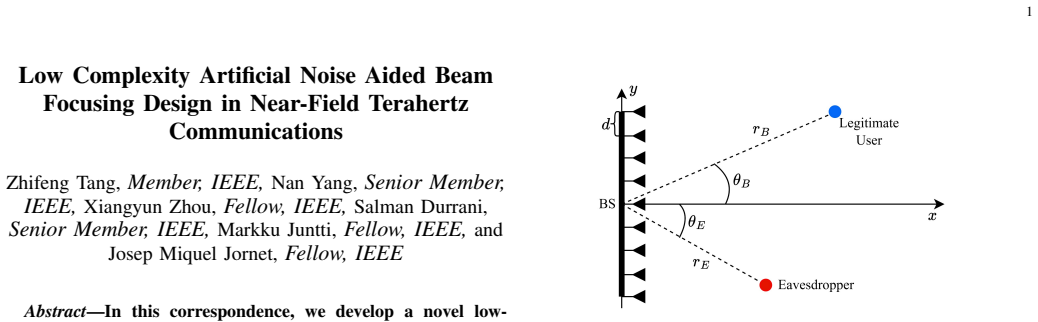
Summary. The paper considers a downlink near-field terahertz wiretap system in which a base station with a large-scale uniform linear array transmits to a single-antenna legitimate user while an eavesdropper is present. The authors formulate a secrecy-rate maximization problem over the signal beam focusing vector, the artificial-noise (AN) beam focusing vector, and the power allocation ratio. They decouple the problem into separate signal and AN beam focusing subproblems under a noise-neglect and small-η approximation, solve each by a one-dimensional search, and then derive a closed-form power allocation ratio α in Lemma 1. Numerical results show that the proposed scheme performs close to the optimal joint beam focusing design and outperforms existing low-complexity benchmarks at O(NM) complexity.
Significance. If the analytical claims are fully substantiated, the paper would offer a practical low-complexity design for AN-aided near-field THz physical-layer security, which is a relevant problem for extremely large-scale arrays. The paper is commendably explicit about its computational complexity and provides numerical comparisons against several benchmark schemes. The derivations are traceable to stated references, and the numerical evaluation is reproducible in structure. However, the main analytical result, Lemma 1, depends on an unproven sign assertion, and the beam focusing design relies on a high-SNR, small-η approximation whose interaction with the later power allocation is not fully quantified. These issues are load-bearing for the central claim that the closed-form α and the decoupled focusing points achieve the claimed near-optimal secrecy rate.
major comments (3)
- [Sec. III-B (Lemma 1, Eqs. (27)-(31))] The proof of Lemma 1 asserts that F2 and F1 are 'always smaller than zero' because the beam focusing design maximizes ρ1^2/ρ2^2 and ρ4^2/ρ3^2. This implication is not established. F1 in Eq. (29) contains mixed-sign terms such as σ^2(ρ2^2ρ3^2 - ρ1^2ρ4^2) and P gB ρ1^2ρ2^2(ρ3^2 - ρ4^2) + P gE ρ3^2ρ4^2(ρ2^2 - ρ1^2), and F2 in Eq. (30) contains P gB gE ρ2^2ρ4^2(ρ2^2ρ3^2 - ρ1^2ρ4^2) plus additional sign-indefinite terms. The two ratio inequalities do not fix the signs of these expressions, nor do they control the relative weights gB versus gE. Additionally, Eq. (27) returns the stationary point of ∂Ω/∂α without checking whether this root lies in the feasible interval [0,1); if the positive root exceeds 1, the maximum over α∈[0,1) is at the boundary. The numerical test in Fig. 3 covers only the displayed geometry and does not close the proof gap. I recommend either proving the sign claim under explicit sufficient conditions (e.g., the specific operating regime where ρ1^2 > ρ2^2 and ρ4^2 > ρ3^2 with known gB/gE bounds) or adding a systematic parameter sweep comparing the α from Eq. (27) with a numerical line search on the exact secrecy rate expression.
- [Sec. III-A, Eqs. (20)-(23)] The beam focusing design is obtained through two successive approximations: noise is neglected in Eq. (20), and then the small-η expansion log((η + A)/(η + B)) ≈ log(A/B) is used to decouple the problem into P2 and P3. This decoupling is optimal only in the limiting regime η→0 with high SNR, but Lemma 1 may return a non-negligible α for which the focusing points are not necessarily optimal. The paper should quantify the error of these approximations, for example by bounding or numerically evaluating the first-order correction η(1/A - 1/B), and should demonstrate that the focusing points obtained from the approximate objective remain near-optimal for the α delivered by Lemma 1 over a broader parameter range than the single geometry in Fig. 3.
- [Sec. III-A, paragraph after Eq. (23)] The manuscript states that θS = θB and θA = θE are adopted because 'the received signal power at the legitimate user is maximized when θS = θB, and the received AN power at the eavesdropper is maximized when θA = θE,' citing [10, Proposition 1]. However, the actual subproblems P2 and P3 maximize the ratios ρ1^2/ρ3^2 and ρ4^2/ρ2^2, not the individual received powers. Maximizing the numerator of a ratio does not generally maximize the ratio when the denominator also depends on the same variable. The cited proposition should be checked for whether it indeed applies to the ratio objectives, or a direct proof or numerical validation of the optimality of θS = θB and θA = θE for P2 and P3 should be provided.
minor comments (5)
- [Eq. (16)] The expression RS = log2((A+B)/(A+C)) omits the positive-part operator; since the text defines RS = (RB - RE)^+, the expression is valid only when RB > RE. Please clarify that the optimization assumes the regime where the secrecy rate is positive and that the design ensures this regime.
- [Sec. III-A, footnote 2] The noise-neglect approximation in Eq. (20) is justified by a high-SNR assumption; when this assumption is later used to set the beam focusing points independently of α, the paper should restate the SNR regime in which the subsequent α optimization remains valid.
- [Eqs. (24)-(26)] The definitions of β2 and β3 contain the term sqrt(d |(1-θE^2)/rE - (1-θS^2)/rS|) with an absolute value, but the earlier expression for β1 uses |(1-θB^2)/rB - (1-θS^2)/rS|. Please ensure the notation is consistent and unambiguous, especially for the arguments of the Fresnel integrals.
- [Fig. 3] The verification of Lemma 1 in Fig. 3 is limited to a single geometry; adding a second panel with different rB, rE, or θE would make the claim that the closed-form α matches the exact optimum considerably more convincing.
- [Sec. IV, complexity discussion] The statement that the proposed scheme has complexity O(NM) would benefit from a more explicit description of how M scales with the desired accuracy of the one-dimensional search, and from a statement of the complexity per beam focusing subproblem rather than only the total order.
Circularity Check
No significant circularity: the sealed analysis derives beam focusing and power allocation forward from the secrecy-rate expression, with external references used as standard building blocks rather than as forced self-citation.
full rationale
The paper's derivation chain is: exact secrecy rate in Eq. (16), noise-neglected approximation in Eq. (20), decoupling into separate signal and AN beam-focusing subproblems in Eqs. (22)-(23), one-dimensional search over the focusing point using Fresnel-based correlation approximations from [16, Lemma 1], and finally a closed-form power allocation ratio obtained from the derivative of the exact expression in Lemma 1, Eqs. (27)-(31). Each step is an algebraic or explicit approximation of the same stated objective; no parameter is fitted to a subset of the secrecy-rate data and then renamed as a prediction. The correlation definition and the angle choices theta_S = theta_B and theta_A = theta_E are taken from [10], and the Fresnel approximation from [16]; neither is a self-citation, so the self-citation-load-bearing and uniqueness-imported patterns do not apply. The paper also does not disguise an ansatz as a derivation: the MRT-based analog beam focusing is introduced as a design choice, not as a uniqueness result. The only substantive weakness is a rigor gap in the proof of Lemma 1: the assertion that F1 and F2 are always negative because the beam-focusing design maximizes rho1^2/rho2^2 and rho4^2/rho3^2 is not established, since mixed-sign terms such as rho2^2*rho3^2 - rho1^2*rho4^2 and gB-versus-gE weighted brackets are not sign-determined by those two ratio objectives alone. That is a correctness concern about an unproven sign claim, not a circular reduction: the closed-form alpha is still derived from the exact expression rather than being chosen to match the numerical output, and Fig. 3 checks it against the exact secrecy-rate curve for the simulated geometry. No enumerated circularity pattern is exhibited with a concrete quote showing Eq. X reducing to Eq. Y by construction.
Assumptions & free parameters
assumptions (5)
- domain assumption Perfect CSI of both the legitimate user and the eavesdropper is available at the BS
- domain assumption The channel is LoS-dominated; NLoS paths are negligible
- domain assumption Noise power is negligible relative to received signal and AN power
- ad hoc to paper The power allocation ratio eta = alpha/(1-alpha) is small in the beam focusing design
- ad hoc to paper F2 and F1 in Lemma 1 are always negative under the beam focusing design
Cite this review
Pith. "Pith review of Low Complexity Artificial Noise Aided Beam Focusing Design in Near-Field Terahertz Communications." pith.science (2026). https://pith.science/paper/QMOMVC7O
@misc{pith2026250208967,
  author       = {Pith},
  title        = {Pith review of: Low Complexity Artificial Noise Aided Beam Focusing Design in Near-Field Terahertz Communications},
  year         = {2026},
  howpublished = {\url{https://pith.science/paper/QMOMVC7O}},
  note         = {Machine review of arXiv:2502.08967}
}
read the original abstract
In this paper, we develop a novel low-complexity artificial noise (AN) aided beam focusing scheme in a near-field terahertz wiretap communication system. In this system, the base station (BS) equipped with a large-scale array transmits signals to a legitimate user, while mitigating information leakage to an eavesdropper. We formulate an optimization problem to maximize the secrecy rate achieved at the legitimate user and solve it by designing the optimal beam focusing and power allocation. Numerical results demonstrate the significant performance improvement achieved by the proposed AN aided beam focusing scheme, especially when the eavesdropper is located closer to the BS than the legitimate user.
Figures


Reference graph
Works this paper leans on
-
[10]
Performance Analysis and Low-Complexity Beamforming Design for Near-Field Physical Layer Security
Y . Zhang, Y . Fang, X. Yu, C. You, and Y .-J. A. Zhang, “Performance analysis and low-complexity beamforming design for near-field physical layer security,” Jul. 2024. [Online]. Available: https://arxiv.org/abs/2407.13491
work page Pith review arXiv 2024
-
[16]
Hierarchical codebook design for near-field mmWave MIMO communications systems,
J. Chen, F. Gao, M. Jian, and W. Yuan, “Hierarchical codebook design for near-field mmWave MIMO communications systems,”IEEE Wireless Commun. Lett. , vol. 12, no. 11, pp. 1926–1930, Nov. 2023
work page 1926
-
[1]
Toward 6G networks: Use cases and technologies,
M. Giordani, M. Polese, M. Mezzavilla, S. Rangan, and M. Zorzi, “Toward 6G networks: Use cases and technologies,” IEEE Commun. Mag., vol. 58, no. 3, pp. 55–61, Mar. 2020
work page 2020
-
[2]
Terahertz communications for massive connec- tivity and security in 6G and beyond era,
N. Yang and A. Shafie, “Terahertz communications for massive connec- tivity and security in 6G and beyond era,” IEEE Commun. Mag., vol. 62, no. 2, pp. 72–78, Feb. 2024
work page 2024
-
[3]
Z. Tang, N. Yang, S. Durrani, X. Zhou, M. Juntti, and J. M. Jornet, “Coverage analysis for 3D indoor terahertz communication system over multi-cluster fluctuating two-ray fading channels,” IEEE Trans. Commun., pp. 1–14, May 2025
work page 2025
-
[4]
Sub-terahertz near field channel measurements and analysis with beamforming and bessel beams,
D. Bodet, V . Petrov, S. Petrushkevich, and J. M. Jornet, “Sub-terahertz near field channel measurements and analysis with beamforming and bessel beams,” Sci. Rep. , vol. 14, no. 19675, pp. 1–13, Aug. 2024
work page 2024
-
[5]
Physical layer security with near-field beamforming,
J. Ferreira, J. Guerreiro, and R. Dinis, “Physical layer security with near-field beamforming,” IEEE Access , vol. 12, pp. 4801–4811, Dec. 2024
work page 2024
-
[6]
Physical layer security in near-field communications,
Z. Zhang, Y . Liu, Z. Wang, X. Mu, and J. Chen, “Physical layer security in near-field communications,” IEEE Trans. V eh. Technol., vol. 73, no. 7, pp. 10 761–10 766, Jul. 2024
work page 2024
Show all 18 references
-
[7]
Max-min secrecy rate optimization through beam focusing in near-field communications,
A. A. Nasir, “Max-min secrecy rate optimization through beam focusing in near-field communications,” IEEE Commun. Lett. , vol. 28, no. 7, pp. 1594–1598, Jul. 2024
2024
-
[8]
Wavefront hopping for physical layer security in 6G and beyond near-field THz communications,
V . Petrov, H. Guerboukha, A. Singh, and J. M. Jornet, “Wavefront hopping for physical layer security in 6G and beyond near-field THz communications,” IEEE Trans. Commun. , pp. 1–1, 2024
2024
-
[9]
Physical layer security for near-field communications via directional modulation,
J. Chen, Y . Xiao, K. Liu, Y . Zhong, X. Lei, and M. Xiao, “Physical layer security for near-field communications via directional modulation,” IEEE Trans. V eh. Technol., vol. 73, no. 8, pp. 12 242–12 246, Aug. 2024
2024
-
[11]
Near-field wideband secure communications: An analog beamfocusing approach,
Y . Zhang, H. Zhang, S. Xiao, W. Tang, and Y . C. Eldar, “Near-field wideband secure communications: An analog beamfocusing approach,” IEEE Trans. Signal Process. , vol. 72, pp. 2173–2187, Apr. 2024
2024
-
[12]
Sensing- enhanced channel estimation for near-field XL-MIMO systems,
S. Liu, X. Yu, Z. Gao, J. Xu, D. W. K. Ng, and S. Cui, “Sensing- enhanced channel estimation for near-field XL-MIMO systems,” Mar
-
[13]
Fast near-field beam training for extremely large-scale array,
Y . Zhang, X. Wu, and C. You, “Fast near-field beam training for extremely large-scale array,” IEEE Wireless Commun. Lett. , vol. 11, no. 12, pp. 2625–2629, Dec. 2022
2022
-
[14]
Near- field communications: A tutorial review,
Y . Liu, Z. Wang, J. Xu, C. Ouyang, X. Mu, and R. Schober, “Near- field communications: A tutorial review,” IEEE Open J. Commun. Soc. , vol. 4, pp. 1999–2049, Aug. 2023
1999
-
[15]
Coverage analysis for 3D terahertz communication systems,
A. Shafie, N. Yang, S. Durrani, X. Zhou, C. Han, and M. Juntti, “Coverage analysis for 3D terahertz communication systems,” IEEE J. Select. Areas Commun. , vol. 39, no. 6, pp. 1817–1832, Jun. 2021
2021
-
[17]
The teranova platform: An integrated testbed for ultra- broadband wireless communications at true terahertz frequencies,
P. Sen, D. A. Pados, S. N. Batalama, E. Einarsson, J. P. Bird, and J. M. Jornet, “The teranova platform: An integrated testbed for ultra- broadband wireless communications at true terahertz frequencies,” Com- put. Netw., vol. 179, p. 107370, Oct. 2020
2020
-
[2024]
Available: https://arxiv.org/abs/2403.11809
[Online]. Available: https://arxiv.org/abs/2403.11809
Reviewed August 7, 2026 · model on record in the stance chip above.
Discussion (0). Continue with ORCID to comment.