REVIEW 3 major objections 4 minor 4 cited by
Unfolding the Headline: Iterative Self-Questioning for News Retrieval and Timeline Summarization
T0 review · 3 major / 4 minor · reviewed 2026-08-10 · deepseek-v4-flash
Pith's one-line read A retrieval loop in which an LLM repeatedly asks itself 5W1H questions about a news topic, rewrites them into search queries, and merges per-round timelines can match or beat dedicated timeline-summarization systems without a prebuilt…
desk verdict Useful new benchmark and a coherent retrieval-based TLS framework, but the headline results are picked on test labels, so the empirical claims need a corrected evaluation before they can be trusted. read the letter →
The pith
A machine-rendered reading of the paper's core claim, the machinery that carries it, and where it could break.
The reading
What carries the argument
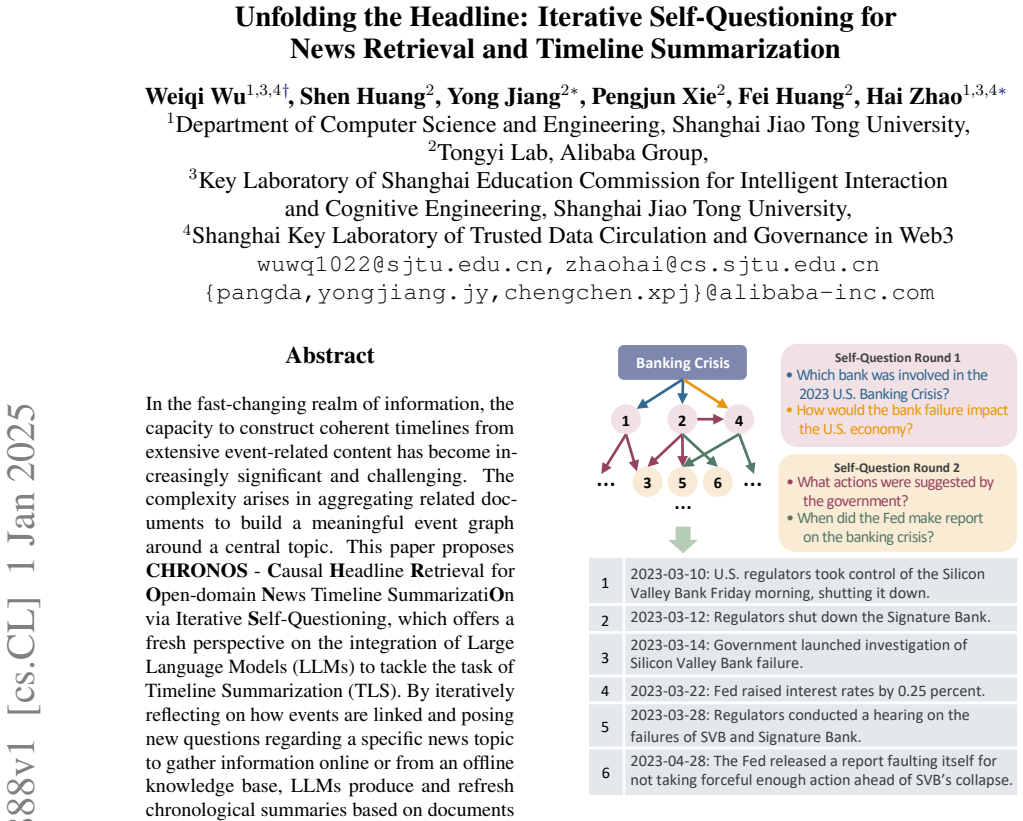
The load-bearing mechanism is the iterative self-questioning loop. Starting from a target headline, the LLM is prompted as an experienced journalist to ask at least five 5W1H questions (What, Who, Why, Where, When, How) that the current news database cannot answer; a rewriter decomposes each question into two or three search-ready queries; retrieved headlines and articles are read and stored; and a divide-and-conquer summarizer generates a timeline per round, then merges them by aligning dates and descriptions. Few-shot exemplars are selected by Chrono-Informativeness, a score that measures whether the documents a question retrieves produce dates matching a reference timeline (Date F1). The loop is what turns search into an event graph: each retrieved article is treated as evidence of a temporal or causal edge between the target event and another node.
What would settle it
Re-run the Open-TLS and closed-domain experiments with the self-questioning round and model chosen before seeing any test metric, say, a fixed round and a fixed model, or a validation split, and compare CHRONOS with DIRECT, REWRITE, and LLM-TLS; if the consistent improvements and the closed-domain parity disappear, the central claim is selection-dependent.
Extended reading notes
Core claim
On the paper's own terms, the discovery is that retrieval quality, not the summarizer, is the bottleneck in timeline summarization, and that a self-questioning retrieval loop relieves that bottleneck. CHRONOS poses 5W1H questions about the target news and previously retrieved documents, rewrites each question into focused queries, searches the web or an offline corpus, and asks the LLM to generate and then merge timelines round by round. The paper reports consistent improvement across all metrics over DIRECT and REWRITE baselines on Open-TLS for GPT-3.5-Turbo, GPT-4o, and Qwen2.5-72B, and reports that on Crisis and T17 CHRONOS is comparable to LLM-TLS, the strongest published closed-domain system, while taking about 5.6 percent of its runtime on Crisis. It also claims that the ratio of correctly predicted dates (Date F1) is among the strongest, and that the Open-TLS dataset is larger and more topically diverse than existing public TLS benchmarks.
Load-bearing premise
The validity of the headline comparison rests on the assumption that the optimal self-questioning round (Table 2) and the best-performing model (Section 5.4.2) were not selected using test-set labels; if they were, the claimed improvements are partly a consequence of that selection.
Editorial extensions
If this is right
- Open-domain timeline summarization becomes practical: a search API plus an LLM can replace a curated corpus, so new topics can be summarized as they break.
- The same retrieval loop transfers to closed-domain settings, where it matches prior event-graph and LLM-clustering systems at much lower inference cost.
- Question rewriting is load-bearing: ablations show that removing the rewriter lowers Date F1 substantially on Open-TLS, Crisis, and T17.
- Relevant few-shot exemplars matter: choosing examples by Chrono-Informativeness outperforms random exemplars and zero-shot prompting.
- There is an optimal number of self-questioning rounds; performance rises then falls, so a system should stop before retrieval noise swamps the merge step.
Reading between the lines
- Editorial inference: if the reported gains survive a properly held-out selection of round count and model, the 5W1H self-questioning template is a reusable control strategy for temporal information-gathering tasks beyond news, such as biography generation or conflict tracking.
- Editorial inference: the peak-then-decline curve across rounds suggests an adaptive stopping rule, stop when a new round retrieves no articles whose dates are absent from the current timeline, would be cheaper and more robust than a fixed round count.
- Editorial inference: because Chrono-Informativeness is defined against reference timelines, the few-shot pool is tied to labeled data; replacing that score with a retrieval-diversity proxy would test whether the method's benefit comes from example selection or from the questioning loop itself.
- Editorial inference: the efficiency comparison counts only inference time; end-to-end deployment would also pay search-API latency and cost, so the practical speed advantage may be smaller than the reported 5.6 percent figure.
Signed reviews
Editorial analysis
A structured set of objections, weighed in public.
Referee Report
Summary. The paper proposes CHRONOS, an LLM-driven iterative self-questioning and retrieval framework for timeline summarization (TLS). CHRONOS alternates between generating 5W1H questions about a target news topic, rewriting those questions into search queries, retrieving documents from the web or an offline corpus, and generating/merging chronologically ordered timelines. The authors also introduce Open-TLS, a new dataset of 50 professionally authored timelines on recent news topics. Experiments compare CHRONOS against DIRECT and REWRITE baselines on Open-TLS and against prior TLS systems on the closed-domain Crisis and T17 benchmarks, reporting improvements on several metrics and claiming to rival state-of-the-art closed-domain systems.
Significance. If the central claims hold, the paper would make a useful practical contribution: a retrieval-based self-questioning loop that builds timelines without a pre-collected corpus, plus a new, larger, and more current open-domain TLS dataset. The authors release code and data, which aids reproducibility. The ablations on exemplar selection, question rewriting, and the number of retrieval rounds provide structured evidence about which components matter. However, the headline comparisons are undermined by test-label-based selection of models and rounds, and by few-shot example curation that uses reference timelines from the same benchmarks; these issues call into question the magnitude and even the direction of the claimed gains, particularly the small margins on closed-domain datasets.
major comments (3)
- [§5.4.2, Table 2] The headline comparisons are selected on test labels. Section 5.4.2 states 'We select the best-performing model to report its performance,' and Table 2 reports 'outcomes from the optimal self-questioning round.' This is a search over three backbone LLMs and over several rounds, all chosen after seeing the test results, while the DIRECT/REWRITE baselines have no rounds and LLM-TLS⋆ is fixed to Qwen2.5-72B. The small closed-domain margins (e.g., AR-2 0.045 vs 0.036 on Crisis; 0.042 vs 0.040 on T17) could plausibly be artifacts of this selection. The paper should report results for all models and all rounds, or select configurations on a held-out validation split, before claiming consistent improvement or SOTA parity.
- [§3.1, §5.1] The few-shot example pool is curated using reference timelines from the same benchmarks used for evaluation. Chrono-Informativeness (Eq. in §3.1) is defined as Date_F1(T_Q,N, T_ref), and Section 5.1 states that the example pool is built from Crisis, T17, and Open-TLS topics. Even when the target topic's own pair is excluded, the few-shot demonstrations for a test topic are selected using reference timelines from the same benchmark, which injects test-set information into the prompt construction and can inflate Date F1 in particular. The authors should construct the example pool without using evaluation benchmarks' references, or demonstrate that the selection does not change when using a development split.
- [§5.1, Tables 2 and 3] The paper reports averages of 3 runs but gives no standard deviations, confidence intervals, or significance tests. This is especially important because several headline comparisons are small (notably AR-2 on T17: 0.042 vs 0.040, and Date F1 on Crisis: 0.323 vs 0.329), and the selection of the best model and best round from the test set makes the results even more sensitive to variance. Without error bars or significance testing, the reader cannot tell whether the claimed advantages are reliable.
minor comments (4)
- [§5.5.2, Table 4] The text says the removal of the rewriter causes 'a slight improvement (+0.02)' on Crisis AR-2, but Table 4 shows 0.047 without the rewriter versus 0.045 with it, a difference of +0.002. The stated value appears to be off by an order of magnitude.
- [Table 1] The column headers 'A vg.l' and 'A vg.k' are rendered with a spurious space. This formatting issue obscures the meaning of the statistics.
- [Figure 3] The caption and text do not specify whether the scores in Figure 3 are averaged across all Open-TLS topics or shown per topic. Clarifying this would make the round-selection behavior easier to interpret.
- [§5.7.2, Table 7] The case study would benefit from a note on how the final merged timeline is produced from the two rounds; the table shows Round 1 and Round 2 generated timelines but not the merged output that would be evaluated.
Circularity Check
Headline results are selected on test labels and few-shot examples are curated with reference timelines from the evaluation benchmarks.
-
fitted input called prediction
[Sec. 3.1 and Sec. 5.1 (Example Pool)]
"The Chrono-Informativeness of a set of questions Q = (q1, . . . , qm) for a given news topic is calculated as: CI(Q, N) = Date_F1(TQ,N , Tref ) ... By generating an extensive set of questions for a given news topic, we can use the greedy algorithm to identify the topm questions that maximize CI (Q, N). ... To build the example pool for the few-shot self-questioning prompt, we utilize GPT-4o to generate 50 questions for topics in the Crisis, T17, and Open-TLS datasets. When selecting the most similar demonstrations from the example pool, we exclude the topic-questions pair of the target news."
The few-shot demonstrations are selected by maximizing Date_F1 against professional reference timelines, and the pool is built from the very benchmarks (Crisis, T17, Open-TLS) later used for evaluation. For each Open-TLS test topic, the demonstrators come from other Open-TLS topics whose reference timelines were used to choose the questions, so ground-truth date information from the evaluation distribution is baked into the prompts. The reported Date F1 and ROUGE scores are therefore partly produced by prompts fitted to the test benchmark's labels; the zero-shot and random-exemplar comparisons in Table 4 measure the effect of this label-based selection rather than question quality alone.
-
fitted input called prediction
[Table 2 caption and Fig. 3]
"Table 2: Experimental results on Open-TLS. We present the outcomes from the optimal self-questioning round."
The 'optimal' round is chosen after observing evaluation scores on the Open-TLS test topics; Figure 3 plots AR-1, AR-2, and Date F1 against rounds on this dataset. Reporting the maximum over rounds makes the round index a test-fit hyperparameter, and the DIRECT/REWRITE baselines have no analogous selection. The claimed consistent improvement in Table 2 is thus the best-case comparison over rounds, not the output of a fixed procedure, and no held-out validation is provided to show the chosen round transfers.
1 more flagged steps
-
fitted input called prediction
[Sec. 5.4.2]
"We select the best-performing model to report its performance for presentation."
For the closed-domain comparisons in Table 3, the CHRONOS row is the result of choosing among GPT-3.5-Turbo, GPT-4o, and Qwen2.5-72B after seeing their scores on Crisis and T17. This test-label model selection means the 'rivals SOTA' claim rests on the best of three backbones, while LLM-TLS is fixed to Qwen2.5-72B and the non-LLM baselines have no such search. The reported SOTA parity is a maximum over a model family chosen on the test benchmarks, not a prediction from a single specified system.
full rationale
The paper contains no formal derivation whose conclusion equals its premise; CHRONOS is an empirical system, so the circularity concern is not a theorem but the evaluation protocol. Three concrete selection steps make the headline numbers partly self-fulfilling. First, the few-shot self-questioning examples are chosen by maximizing Chrono-Informativeness, defined as Date_F1 against reference timelines, and the example pool is built from the same benchmarks (Crisis, T17, Open-TLS) later used for evaluation. The target topic's own pair is excluded, but the other topics' reference timelines still come from the same evaluation distribution, so the prompts carry label-derived information that inflates especially Date F1. Second, Table 2 reports 'the optimal self-questioning round,' meaning the round is selected on the Open-TLS test scores shown in Figure 3. Third, Table 3 reports 'the best-performing model,' selected on the Crisis and T17 test scores, so the CHRONOS row is a maximum over three backbones. Each of these is a test-label-based selection that the baselines do not enjoy, and the claimed consistent gains and SOTA parity are therefore not predictions from a single fixed system. The paper's self-citations, such as Ma et al. (2023) for query rewriting and the Qwen technical report, are not load-bearing for the central claim, and there is no uniqueness theorem or ansatz-smuggling issue. The retrieval-and-merge idea itself has independent content; the circularity lies in the evaluation selection, not in the method's definition.
Assumptions & free parameters
free parameters (4)
- m (number of questions per round) =
5
- N (maximum retrieved documents per round) =
30
- s (number of few-shot examples) =
3
- Number of self-questioning rounds =
Optimal round per model on test set
assumptions (4)
- domain assumption 5W1H self-questions and rewritten queries can retrieve documents that support a journalist-grade timeline.
- domain assumption Reference timelines by professional journalists are complete and accurate ground truth.
- domain assumption Date F1 and ROUGE variants are valid proxies for timeline quality.
- ad hoc to paper Few-shot questions selected by Chrono-Informativeness against reference timelines transfer to unseen topics.
Cite this review
Pith. "Pith review of Unfolding the Headline: Iterative Self-Questioning for News Retrieval and Timeline Summarization." pith.science (2026). https://pith.science/paper/QMTTKIC6
@misc{pith2026250100888,
  author       = {Pith},
  title        = {Pith review of: Unfolding the Headline: Iterative Self-Questioning for News Retrieval and Timeline Summarization},
  year         = {2026},
  howpublished = {\url{https://pith.science/paper/QMTTKIC6}},
  note         = {Machine review of arXiv:2501.00888}
}
read the original abstract
In the fast-changing realm of information, the capacity to construct coherent timelines from extensive event-related content has become increasingly significant and challenging. The complexity arises in aggregating related documents to build a meaningful event graph around a central topic. This paper proposes CHRONOS - Causal Headline Retrieval for Open-domain News Timeline SummarizatiOn via Iterative Self-Questioning, which offers a fresh perspective on the integration of Large Language Models (LLMs) to tackle the task of Timeline Summarization (TLS). By iteratively reflecting on how events are linked and posing new questions regarding a specific news topic to gather information online or from an offline knowledge base, LLMs produce and refresh chronological summaries based on documents retrieved in each round. Furthermore, we curate Open-TLS, a novel dataset of timelines on recent news topics authored by professional journalists to evaluate open-domain TLS where information overload makes it impossible to find comprehensive relevant documents from the web. Our experiments indicate that CHRONOS is not only adept at open-domain timeline summarization, but it also rivals the performance of existing state-of-the-art systems designed for closed-domain applications, where a related news corpus is provided for summarization.
Figures


Figures from the paper (1 more)

Forward citations
Cited by 4 Pith papers
-
TIM: A Large-Scale Dataset and large Timeline Intelligence Model for Open-domain Timeline Summarization
A timeline summarization model trained on a new 1,189-topic dataset outperforms much larger general LLMs on the authors' open-domain test set.
-
VRAG-RL: Empower Vision-Perception-Based RAG for Visually Rich Information Understanding via Iterative Reasoning with Reinforcement Learning
VRAG-RL uses GRPO reinforcement learning with visual cropping actions and a retrieval-aware reward to improve vision-language RAG agents on document benchmarks.
-
Xinyu AI Search: Enhanced Relevance and Comprehensive Results with Rich Answer Presentations
Xinyu, an integrated generative AI search engine with query decomposition, multi-source retrieval, and rich answer presentation, outperforms eight existing technologies in human evaluations.
-
Towards Explainable Temporal Reasoning in Large Language Models: A Structure-Aware Generative Framework
A new benchmark (ETR) and a structure-aware LLM framework (GETER) inject temporal graph embeddings as a soft prompt to improve explainable temporal reasoning.
Reference graph
Works this paper leans on
-
[1]
Sweta Agrawal, Chunting Zhou, Mike Lewis, Luke Zettlemoyer, and Marjan Ghazvininejad. 2023. https://doi.org/10.18653/v1/2023.findings-acl.564 In-context examples selection for machine translation . In Findings of the Association for Computational Linguistics: ACL 2023, pages 8857--8873, Toronto, Canada. Association for Computational Linguistics
-
[2]
James Allan, Rahul Gupta, and Vikas Khandelwal. 2001. https://api.semanticscholar.org/CorpusID:5559872 Temporal summaries of new topics . In Annual International ACM SIGIR Conference on Research and Development in Information Retrieval
work page 2001
-
[3]
Jeffery Ansah, Lin Liu, Wei Kang, Selasi Kwashie, Jixue Li, and Jiuyong Li. 2019. https://api.semanticscholar.org/CorpusID:86527418 A graph is worth a thousand words: Telling event stories using timeline summarization graphs . The World Wide Web Conference
work page 2019
-
[4]
Jinze Bai, Shuai Bai, Yunfei Chu, Zeyu Cui, Kai Dang, Xiaodong Deng, Yang Fan, Wenhang Ge, Yu Han, Fei Huang, Binyuan Hui, Luo Ji, Mei Li, Junyang Lin, Runji Lin, Dayiheng Liu, Gao Liu, Chengqiang Lu, K. Lu, Jianxin Ma, Rui Men, Xingzhang Ren, Xuancheng Ren, Chuanqi Tan, Sinan Tan, Jianhong Tu, Peng Wang, Shijie Wang, Wei Wang, Shengguang Wu, Benfeng Xu, ...
arXiv 2023
-
[5]
Marcia J. Bates. 1989. https://api.semanticscholar.org/CorpusID:59771305 The design of browsing and berrypicking techniques for the online search interface . Online Review, 13(5):407--424
work page 1989
-
[6]
Giang Binh Tran, Mohammad Alrifai, and Dat Quoc Nguyen. 2013. https://doi.org/10.1145/2487788.2487829 Predicting relevant news events for timeline summaries . In Proceedings of the 22nd International Conference on World Wide Web, WWW '13 Companion, page 91–92, New York, NY, USA. Association for Computing Machinery
arXiv 2013
-
[7]
Tom Brown, Benjamin Mann, Nick Ryder, Melanie Subbiah, Jared D Kaplan, Prafulla Dhariwal, Arvind Neelakantan, Pranav Shyam, Girish Sastry, Amanda Askell, Sandhini Agarwal, Ariel Herbert-Voss, Gretchen Krueger, Tom Henighan, Rewon Child, Aditya Ramesh, Daniel Ziegler, Jeffrey Wu, Clemens Winter, Chris Hesse, Mark Chen, Eric Sigler, Mateusz Litwin, Scott Gr...
2020
-
[8]
Xiuying Chen, Zhangming Chan, Shen Gao, Meng-Hsuan Yu, Dongyan Zhao, and Rui Yan. 2019. https://api.semanticscholar.org/CorpusID:199466316 Learning towards abstractive timeline summarization . In International Joint Conference on Artificial Intelligence
work page 2019
Show all 49 references
-
[9]
Hai Leong Chieu and Yoong Keok Lee. 2004. https://api.semanticscholar.org/CorpusID:16022713 Query based event extraction along a timeline . In Annual International ACM SIGIR Conference on Research and Development in Information Retrieval
2004
-
[10]
Qingxiu Dong, Lei Li, Damai Dai, Ce Zheng, Zhiyong Wu, Baobao Chang, Xu Sun, Jingjing Xu, and Zhifang Sui. 2022. https://api.semanticscholar.org/CorpusID:255372865 A survey on in-context learning
2022
-
[11]
Yunfan Gao, Yun Xiong, Xinyu Gao, Kangxiang Jia, Jinliu Pan, Yuxi Bi, Yi Dai, Jiawei Sun, Qianyu Guo, Meng Wang, and Haofen Wang. 2023. https://api.semanticscholar.org/CorpusID:266359151 Retrieval-augmented generation for large language models: A survey . ArXiv, abs/2312.10997
2023 arXiv
-
[12]
Demian Gholipour Ghalandari and Georgiana Ifrim. 2020. https://doi.org/10.18653/v1/2020.acl-main.122 Examining the state-of-the-art in news timeline summarization . In Proceedings of the 58th Annual Meeting of the Association for Computational Linguistics, pages 1322--1334, On...
2020 doi
-
[13]
Clinton Gormley and Zachary J. Tong. 2015. https://api.semanticscholar.org/CorpusID:62964734 Elasticsearch: The definitive guide
2015
-
[14]
Qisheng Hu, Geonsik Moon, and Hwee Tou Ng. 2024. https://aclanthology.org/2024.acl-long.390 From moments to milestones: Incremental timeline summarization leveraging large language models . In Proceedings of the 62nd Annual Meeting of the Association for Computational Linguist...
2024
-
[15]
Gautier Izacard, Patrick Lewis, Maria Lomeli, Lucas Hosseini, Fabio Petroni, Timo Schick, Jane Dwivedi-Yu, Armand Joulin, Sebastian Riedel, and Edouard Grave. 2023. http://jmlr.org/papers/v24/23-0037.html Atlas: Few-shot learning with retrieval augmented language models . Jour...
2023
-
[16]
Takeshi Kojima, Shixiang Shane Gu, Machel Reid, Yutaka Matsuo, and Yusuke Iwasawa. 2022. https://api.semanticscholar.org/CorpusID:249017743 Large language models are zero-shot reasoners . ArXiv, abs/2205.11916
2022 arXiv
-
[17]
Mojtaba Komeili, Kurt Shuster, and Jason Weston. 2022. https://doi.org/10.18653/v1/2022.acl-long.579 I nternet-augmented dialogue generation . In Proceedings of the 60th Annual Meeting of the Association for Computational Linguistics (Volume 1: Long Papers), pages 8460--8478, ...
2022 doi
-
[18]
Huayang Li, Yixuan Su, Deng Cai, Yan Wang, and Lemao Liu. 2022. https://api.semanticscholar.org/CorpusID:246472929 A survey on retrieval-augmented text generation . ArXiv, abs/2202.01110
2022 arXiv
-
[19]
Manling Li, Tengfei Ma, Mo Yu, Lingfei Wu, Tian Gao, Heng Ji, and Kathleen McKeown. 2021. https://doi.org/10.18653/v1/2021.emnlp-main.519 Timeline summarization based on event graph compression via time-aware optimal transport . In Proceedings of the 2021 Conference on Empiric...
2021 doi
-
[20]
Xiaonan Li, Kai Lv, Hang Yan, Tianyang Lin, Wei Zhu, Yuan Ni, Guotong Xie, Xiaoling Wang, and Xipeng Qiu. 2023. https://doi.org/10.18653/v1/2023.acl-long.256 Unified demonstration retriever for in-context learning . In Proceedings of the 61st Annual Meeting of the Association ...
2023 doi
-
[21]
Jiachang Liu, Dinghan Shen, Yizhe Zhang, Bill Dolan, Lawrence Carin, and Weizhu Chen. 2022. https://doi.org/10.18653/v1/2022.deelio-1.10 What makes good in-context examples for GPT -3? In Proceedings of Deep Learning Inside Out (DeeLIO 2022): The 3rd Workshop on Knowledge Extr...
2022 doi
-
[22]
Xinbei Ma, Yeyun Gong, Pengcheng He, Hai Zhao, and Nan Duan. 2023. https://api.semanticscholar.org/CorpusID:258841283 Query rewriting for retrieval-augmented large language models . ArXiv, abs/2305.14283
2023 arXiv
-
[23]
Sebastian Martschat and Katja Markert. 2017. https://aclanthology.org/E17-2046 Improving ROUGE for timeline summarization . In Proceedings of the 15th Conference of the E uropean Chapter of the Association for Computational Linguistics: Volume 2, Short Papers , pages 285--290,...
2017
-
[24]
Sebastian Martschat and Katja Markert. 2018. https://doi.org/10.18653/v1/K18-1023 A temporally sensitive submodularity framework for timeline summarization . In Proceedings of the 22nd Conference on Computational Natural Language Learning, pages 230--240, Brussels, Belgium. As...
2018 doi
-
[25]
Reiichiro Nakano, Jacob Hilton, Suchir Balaji, Jeff Wu, Ouyang Long, Christina Kim, Christopher Hesse, Shantanu Jain, Vineet Kosaraju, William Saunders, Xu Jiang, Karl Cobbe, Tyna Eloundou, Gretchen Krueger, Kevin Button, Matthew Knight, Benjamin Chess, and John Schulman. 2021...
2021 arXiv
-
[26]
O'Day and Robin Jeffries
Vicki L. O'Day and Robin Jeffries. 1993. https://api.semanticscholar.org/CorpusID:9511304 Orienteering in an information landscape: how information seekers get from here to there . Proceedings of the INTERACT '93 and CHI '93 Conference on Human Factors in Computing Systems
1993
- [27]
-
[28]
Keqin Peng, Liang Ding, Yancheng Yuan, Xuebo Liu, Min Zhang, Yuanxin Ouyang, and Dacheng Tao. 2024. https://doi.org/10.18653/v1/2024.acl-long.492 Revisiting demonstration selection strategies in in-context learning . In Proceedings of the 62nd Annual Meeting of the Association...
2024 doi
-
[29]
Kun Qian, Yisi Sang, Farima Bayat , Anton Belyi, Xianqi Chu, Yash Govind, Samira Khorshidi, Rahul Khot, Katherine Luna, Azadeh Nikfarjam, Xiaoguang Qi, Fei Wu, Xianhan Zhang, and Yunyao Li. 2024. https://doi.org/10.18653/v1/2024.dash-1.1 APE : Active learning-based tooling for...
2024 doi
-
[30]
Ori Ram, Yoav Levine, Itay Dalmedigos, Dor Muhlgay, Amnon Shashua, Kevin Leyton-Brown, and Yoav Shoham. 2023. https://doi.org/10.1162/tacl_a_00605 In-context retrieval-augmented language models . Transactions of the Association for Computational Linguistics, 11:1316--1331
2023 doi
-
[31]
Yijia Shao, Yucheng Jiang, Theodore Kanell, Peter Xu, Omar Khattab, and Monica Lam. 2024. https://doi.org/10.18653/v1/2024.naacl-long.347 Assisting in writing W ikipedia-like articles from scratch with large language models . In Proceedings of the 2024 Conference of the North ...
2024 doi
-
[32]
Weijia Shi, Julian Michael, Suchin Gururangan, and Luke Zettlemoyer. 2022. https://doi.org/10.18653/v1/2022.emnlp-main.214 Nearest neighbor zero-shot inference . In Proceedings of the 2022 Conference on Empirical Methods in Natural Language Processing, pages 3254--3265, Abu Dh...
2022 doi
-
[33]
Shamane Siriwardhana, Rivindu Weerasekera, Elliott Wen, Tharindu Kaluarachchi, Rajib Rana, and Suranga Nanayakkara. 2023. https://doi.org/10.1162/tacl_a_00530 Improving the domain adaptation of retrieval augmented generation ( RAG ) models for open domain question answering . ...
2023 doi
-
[34]
Daivik Sojitra, Raghav Jain, Sriparna Saha, Adam Jatowt, and Manish Gupta. 2024. https://api.semanticscholar.org/CorpusID:271114336 Timeline summarization in the era of llms . In Annual International ACM SIGIR Conference on Research and Development in Information Retrieval
2024
-
[35]
Julius Steen and Katja Markert. 2019. https://api.semanticscholar.org/CorpusID:208029433 Abstractive timeline summarization . Proceedings of the 2nd Workshop on New Frontiers in Summarization
2019
-
[36]
Giang Tran, Eelco Herder, and Katja Markert. 2015 a . https://doi.org/10.3115/v1/P15-1154 Joint graphical models for date selection in timeline summarization . In Proceedings of the 53rd Annual Meeting of the Association for Computational Linguistics and the 7th International ...
2015 doi
-
[37]
Giang Binh Tran, Mohammad Alrifai, and Eelco Herder. 2015 b . https://api.semanticscholar.org/CorpusID:15143609 Timeline summarization from relevant headlines . In European Conference on Information Retrieval
2015
-
[38]
Sha Wang, Yuchen Li, Hanhua Xiao, Lambert Deng, and Yanfei Dong. 2023. http://arxiv.org/abs/2311.11652 Web news timeline generation with extended task prompting
2023 arXiv
-
[39]
Zhenhua Wang, Lidan Shou, Ke Chen, Gang Chen, and Sharad Mehrotra. 2015. https://api.semanticscholar.org/CorpusID:63838029 On summarization and timeline generation for evolutionary tweet streams . IEEE Transactions on Knowledge and Data Engineering, 27:1301--1315
2015
-
[40]
Chen Xiuying, Li Mingzhe, Gao Shen, Chan Zhangming, Dongyan Zhao, Gao Xin, Zhang Xiangliang, and Rui Yan. 2022. https://arxiv.org/abs/2301.00867 Follow the timeline! generating abstractive and extractive timeline summary in chronological order . In Transactions on Information ...
2022 arXiv
-
[41]
Rui Yan, Xiaojun Wan, Jahna Otterbacher, Liang Kong, Xiaoming Li, and Yan Zhang. 2011. https://api.semanticscholar.org/CorpusID:7139529 Evolutionary timeline summarization: a balanced optimization framework via iterative substitution . Proceedings of the 34th international ACM...
2011
- [42]
-
[43]
Zhe Yang, Damai Dai, Peiyi Wang, and Zhifang Sui. 2023 b . https://doi.org/10.18653/v1/2023.findings-emnlp.880 Not all demonstration examples are equally beneficial: Reweighting demonstration examples for in-context learning . In Findings of the Association for Computational L...
2023 doi
-
[44]
Bingsheng Yao, Guiming Chen, Ruishi Zou, Yuxuan Lu, Jiachen Li, Shao Zhang, Yisi Sang, Sijia Liu, James Hendler, and Dakuo Wang. 2024. https://doi.org/10.18653/v1/2024.findings-naacl.115 More samples or more prompts? exploring effective few-shot in-context learning for LLM s w...
2024 doi
-
[45]
Yi Yu, Adam Jatowt, Antoine Doucet, Kazunari Sugiyama, and Masatoshi Yoshikawa. 2021. https://api.semanticscholar.org/CorpusID:236460255 Multi-timeline summarization (mtls): Improving timeline summarization by generating multiple summaries . In Annual Meeting of the Associatio...
2021
-
[46]
Peitian Zhang, Shitao Xiao, Zheng Liu, Zhicheng Dou, and Jian-Yun Nie. 2023. https://api.semanticscholar.org/CorpusID:263835099 Retrieve anything to augment large language models . ArXiv, abs/2310.07554
2023
-
[47]
Penghao Zhao, Hailin Zhang, Qinhan Yu, Zhengren Wang, Yunteng Geng, Fangcheng Fu, Ling Yang, Wentao Zhang, and Bin Cui. 2024. https://api.semanticscholar.org/CorpusID:268091298 Retrieval-augmented generation for ai-generated content: A survey . ArXiv, abs/2402.19473
2024 arXiv
-
[48]
URL: " 'urlintro :=
ENTRY address author booktitle chapter edition editor howpublished institution journal key month note number organization pages publisher school series title type volume year eprint doi pubmed url lastchecked label extra.label sort.label short.list INTEGERS output.state before...
-
[49]
write newline
" write newline "" before.all 'output.state := FUNCTION n.dashify 't := "" t empty not t #1 #1 substring "-" = t #1 #2 substring "--" = not "--" * t #2 global.max substring 't := t #1 #1 substring "-" = "-" * t #2 global.max substring 't := while if t #1 #1 substring * t #2 gl...
Reviewed August 10, 2026 · model on record in the stance chip above.
Discussion (0). Continue with ORCID to comment.