REVIEW 2 major objections 5 minor 33 references
The Boosted DC Algorithm for linearly constrained DC programming
T0 review · 2 major / 5 minor · reviewed 2026-08-14 · deepseek-v4-flash
Pith's one-line read The paper proves that a boosted version of the DC algorithm converges to KKT points for linearly constrained difference-of-convex programs, with geometric convergence when the objective is quadratic.
desk verdict A clean extension of BDCA to linearly constrained DC programs, but Theorem 3.1's limit passage is genuinely incomplete and needs a repaired assumption before the main convergence claim can stand. read the letter →
The pith
A machine-rendered reading of the paper's core claim, the machinery that carries it, and where it could break.
The reading
What carries the argument
The load-bearing mechanism is the active-set feasibility check plus the line-search boost inside DCA. After the DCA subproblem gives $y_k$, the inclusion $I(y_k)\subseteq I(x_k)$ is shown equivalent to $d_k=y_k-x_k$ being a feasible direction at $y_k$; only then is a backtracking line search along $d_k$ allowed, which prevents infinite loops when $y_k$ lies on the boundary of the feasible set. The descent inequality produced by the strong convexity of $g$ and $h$ yields monotone decrease of $\varphi$ and $\|d_k\|\to 0$, and a standard local error bound for the projected-gradient residual $\|x-P_F(x-\sigma^{-1}(Qx+q))\|$ converts that decrease into a geometric rate for quadratic objectives.
What would settle it
Inspect the limiting step where the multipliers in the subproblem KKT system are passed to the limit: if the feasible set has no Slater point, those multipliers need not converge, and a cluster point obtained this way may fail the KKT conditions. A concrete search is to run Algorithm 1 on a feasible set with empty interior, such as $F=\{x\in\mathbb{R}^2: x_1\le 0,\ -x_1\le 0,\ x_2\le 1\}$, with a DC objective whose subproblem multipliers diverge along the generated sequence; any convergent run whose limit is not a KKT point would refute Theorem 3.1 as stated in the body.
Extended reading notes
Core claim
The central claim is that the accelerated DCA idea survives the addition of polyhedral constraints. Algorithm 1 solves at each iteration the strongly convex subproblem $\min_{x\in F} g(x) - \langle u_k,x\rangle$ with $u_k\in\partial h(x_k)$, producing $y_k$, then checks whether the active set at $y_k$ is contained in the active set at $x_k$; if so, it performs a backtracking line search along $d_k=y_k-x_k$. The proof shows $\varphi(x_{k+1})\le \varphi(y_k)-\alpha\lambda_k^2\|d_k\|^2 \le \varphi(x_k)-(\alpha\lambda_k^2+\rho)\|d_k\|^2$, so the objective decreases monotonically and $\|d_k\|\to 0$. Under the Slater condition, the KKT multipliers of the subproblems stay controlled, and taking limits in the subproblem KKT conditions identifies every cluster point as a KKT point of the original problem. For quadratic objectives the iterates are shown to be a Cauchy sequence via a local error bound, giving R-linear (geometric) convergence.
Load-bearing premise
The convergence proof needs a Slater point for the feasible set—a feasible point strictly satisfying every linear inequality—so the Lagrange multipliers of the subproblems cannot blow up when the algorithm's limiting argument is made; the abstract states this condition, while the theorem statement in the paper body does not.
Editorial extensions
If this is right
- Every cluster point of BDCA on a linearly constrained DC program is a KKT point under the Slater condition, so practitioners can safely use the boosted method wherever DCA was used.
- For quadratic objectives with a solution, BDCA converges geometrically without needing the starting point to be close to a solution, and the bound is explicit in terms of the descent constants.
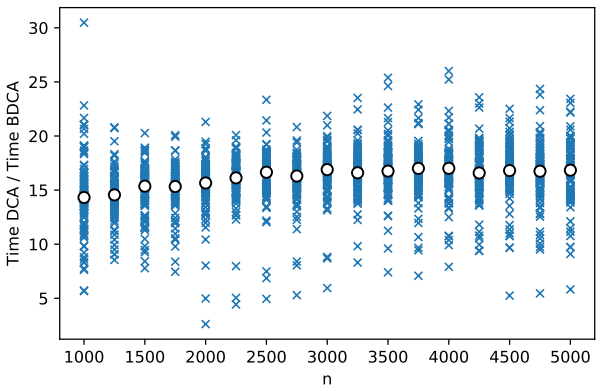
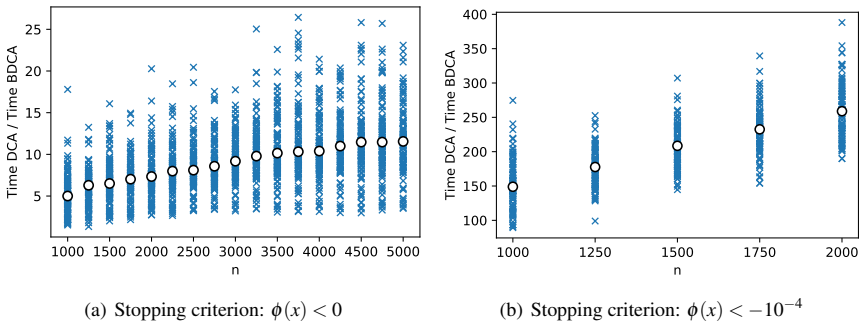
- On copositivity testing, a negative objective value at any BDCA iterate certifies non-copositivity, so faster convergence means earlier certificates on hard matrices; the experiments report about 15 times faster on Horn matrices and larger gains on nearly copositive ones.
- On $\ell_\infty$-trust-region subproblems, BDCA reaches similar objective values roughly three times faster on average, making it a practical drop-in for bound-constrained quadratic subproblems.
Reading between the lines
- Beyond the paper, the same 'boost then check feasibility' pattern might extend to DC programs with conic or semidefinite constraints if a cheap membership test replaces the active-set inclusion; the paper's own remark on general convex constraints shows the current check breaks there.
- If the Slater condition is truly necessary, then linearly constrained DC problems where every feasible point lies on a boundary, such as equality constraints written as two inequalities, need a modified treatment; this is a natural stress test for Theorem 3.1.
- The geometric-rate proof for quadratic objectives could be adapted to other norms or regularizers because it only needs the DCA step to behave like a projection and a local error bound to hold; testing this on $\ell_1$-trust-region or sparse recovery would be a direct extension.
- The empirical tendency of BDCA to escape poor local minima, combined with the new constrained version, suggests a practical multi-start heuristic for NP-hard detection problems: run BDCA from several starting points and keep the best objective value, which the paper's experiments already do implicitly.
Signed reviews
Editorial analysis
A structured set of objections, weighed in public.
Referee Report
Summary. This paper extends the Boosted DC Algorithm (BDCA) to difference-of-convex programs with linear inequality constraints. Algorithm 1 performs a classical DCA step by solving a strongly convex quadratic subproblem, then, when the DCA direction is feasible at the new point, takes an extrapolation step with a backtracking line search. The main theoretical claims are Theorem 3.1, which states that the objective values decrease monotonically and that every cluster point of the generated sequence is a KKT point of the constrained problem, and Theorem 4.1, which states that for quadratic objective functions the generated sequence converges R-linearly (geometrically) to a KKT point. The numerical section compares DCA and BDCA on two NP-hard problem classes: testing copositivity of a matrix and solving l_infinity-trust-region subproblems, reporting that BDCA outperforms DCA by a factor of three to fifteen in running time.
Significance. If the convergence claims are valid, this is a practically useful contribution: it provides a simple acceleration of DCA for linearly constrained DC programs with the same theoretical guarantees as DCA, and it gives a self-contained geometric convergence proof in the quadratic case. The paper's descent estimates in Proposition 3.1 and the line-search feasibility check are well motivated, and the numerical tests on challenging NP-hard instances are carefully presented. However, the main convergence theorem has a load-bearing gap: the proof of Theorem 3.1(ii) passes KKT multipliers and subgradients to the limit without proving boundedness, and the theorem statement omits the Slater condition that appears in the abstract. This affects both Theorem 3.1 and, through its final step, Theorem 4.1.
major comments (2)
- [Section 3] The proof of Theorem 3.1(ii) extracts a convergent subsequence x_{k_j}->x_bar and then 'takes the limit' in the KKT system (8) without proving that the multiplier sequences mu_i^{(k_j)} and the selected subgradients u_{k_j} are bounded. The statement of Theorem 3.1 does not include the Slater condition that appears in the abstract, and the proof never uses it. Slater's condition guarantees existence of multipliers for each convex subproblem (P_k), but it does not by itself give uniform boundedness of those multipliers along the subsequence; one also needs a bound on the vectors nabla g(y_{k_j}) - u_{k_j}, which can fail when h has unbounded subgradients on the boundary of its domain. Closedness of the graph of partial h does not help when u_{k_j} is unbounded, so the conclusion that x_bar is a KKT point is not established. This is load-bearing because Theorem 3.1(ii) is the main convergence claim and is also used at the end of Theorem 4.1.
- [Theorem 4.1, final step] Theorem 4.1 concludes 'x* is in F*, by Theorem 3.1(ii)' after showing that the sequence is Cauchy. Because Theorem 3.1(ii) is not justified as written, the convergence-to-a-KKT-point conclusion in Theorem 4.1 is also not currently established. Even if Theorem 3.1 is repaired, the proof should state explicitly which additional assumptions are used (for example, finite-valued h, or a Slater-based lemma proving uniform boundedness of the multipliers).
minor comments (5)
- [Lemma 3.1] In the statement of Lemma 3.1, the symbol D(y_k) is used to denote the set of active constraint indices, but D(y_k) was already defined in Section 2 as the cone of feasible directions. The condition should be 'for all i in I(y_k)' rather than 'for all i in D(y_k)'.
- [Theorem 3.1(ii)] The word 'exits' in the phrase 'there exits a subsequence' should be 'exists'.
- [Abstract versus full text] The supplied abstract states that the convergence result holds 'if the feasible set has a Slater point', but the full-text abstract and Theorem 3.1 omit this condition. These statements should be harmonized, and the theorem should either include the Slater condition or explain why it is not needed.
- [Proposition 3.1] Parts (i) and (iii) of Proposition 3.1 are relegated to references without proof. A short derivation or a more detailed reference to the constrained setting would improve the paper's self-containedness.
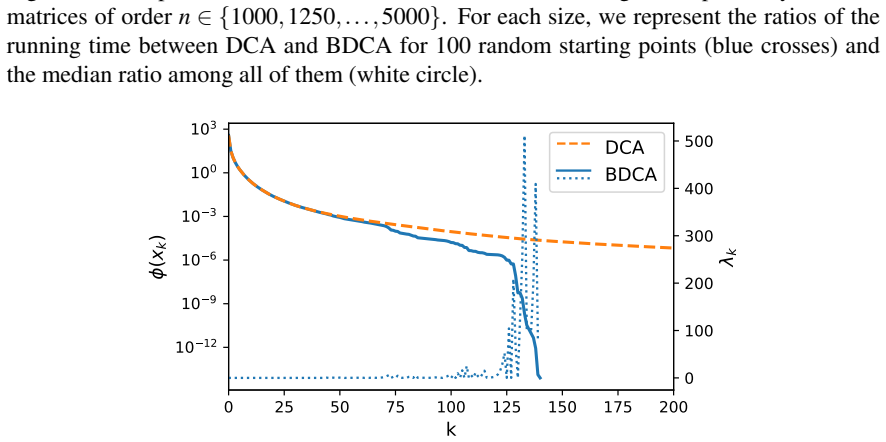
- [Figures 2 and 5] The left axes of Figures 2 and 5 use a logarithmic scale, but the displayed objective values can be non-positive or close to zero. The paper should explain how zero and negative values are handled on the log scale.
Circularity Check
No significant circularity: the convergence and rate theorems are derived from subproblem KKT systems and external error-bound lemmas; the Slater/limit-passage issue is a proof gap, not a circular reduction.
full rationale
I find no step in which a claimed prediction or first-principles result reduces to its own input by construction. The descent inequality of Proposition 3.1 follows from the KKT system (5) of the strongly convex subproblem, strong monotonicity of ∂h, and the feasibility of xk; it does not assume the theorem being proved. Theorem 3.1 derives monotone decrease from (7) and then attempts to pass to the limit in (8). The step 'taking the limit as j→∞ in (8)' is not justified as written because the multipliers μ_i and the subgradients u_{k_j} need a convergent subsequence, and Theorem 3.1 as stated omits the Slater condition that appears in the abstract; however, this is a missing boundedness/closedness argument, not a circular definition or a fitted parameter relabeled as a prediction. Theorem 4.1 uses the external error-bound Lemma 4.2 from Luo–Tseng/Tuan and Lemma 4.1, together with Theorem 3.1(i), to prove geometric convergence; the KKT identification of the limit is not injected as an assumption. The omitted proofs citing [1] and [3] are self-citations by overlapping authors, but they are not load-bearing circularity: the cited propositions are published results with their own assumptions, and the constrained/nonsmooth extension is independently argued through (5), (6), and (7). The numerical experiments use fixed algorithmic parameters and shared random starting points; they are empirical benchmarks, not predictions fitted to a subset of the reported data. Overall the derivation is self-contained apart from one rigor gap and minor self-citation, so the circularity score is low.
Assumptions & free parameters
assumptions (5)
- domain assumption The feasible set F has a Slater point (a point strictly satisfying all linear inequality constraints).
- domain assumption g and h are strongly convex with common modulus rho > 0 (Assumption 1).
- domain assumption g is continuously differentiable on an open set containing dom h (Assumption 2).
- standard math The local error bound in Lemma 4.2 holds (from Luo-Tseng [17] and Tuan [29]).
- domain assumption The quadratic problem (PQ) has a solution (stated in Theorem 4.1).
Cite this review
Pith. "Pith review of The Boosted DC Algorithm for linearly constrained DC programming." pith.science (2026). https://pith.science/paper/QNEUPY2G
@misc{pith2026190801138,
  author       = {Pith},
  title        = {Pith review of: The Boosted DC Algorithm for linearly constrained DC programming},
  year         = {2026},
  howpublished = {\url{https://pith.science/paper/QNEUPY2G}},
  note         = {Machine review of arXiv:1908.01138}
}
read the original abstract
The Boosted Difference of Convex functions Algorithm (BDCA) has been recently introduced to accelerate the performance of the classical Difference of Convex functions Algorithm (DCA). This acceleration is achieved thanks to an extrapolation step from the point computed by DCA via a line search procedure. In this work, we propose an extension of BDCA that can be applied to difference of convex functions programs with linear constraints, and prove that every cluster point of the sequence generated by this algorithm is a Karush--Kuhn-Tucker point of the problem if the feasible set has a Slater point. When the objective function is quadratic, we prove that any sequence generated by the algorithm is bounded and R-linearly (geometrically) convergent. Finally, we present some numerical experiments where we compare the performance of DCA and BDCA on some challenging problems: to test the copositivity of a given matrix, to solve one-norm and infinity-norm trust-region subproblems, and to solve piecewise quadratic problems with box constraints. Our numerical results demonstrate that this new extension of BDCA outperforms DCA.
Figures
Figures from the paper (2 more)


Reference graph
Works this paper leans on
-
[29]
N.: Linear convergence of a type of iterative sequences in nonconvex quadratic programming
Tuan H. N.: Linear convergence of a type of iterative sequences in nonconvex quadratic programming. J. Math. Anal. Appl. , 423, 1311–1319 (2015)
work page 2015
-
[1]
Aragón Artacho, F.J., Fleming, R., Vuong, P.T.: Accelerating the DC algorithm for smooth functions. Math. Program. 169(1), 95–118 (2018)
work page 2018
-
[2]
Springer Undergraduate Texts in Mathematics and Technology (2019)
Aragón, F.J., Goberna, M.A., López, M.A., Rodríguez, M.M.L.: Nonlinear Optimiza- tion. Springer Undergraduate Texts in Mathematics and Technology (2019)
work page 2019
-
[3]
The Boosted DC Algorithm for nonsmooth functions
Aragón Artacho, F.J., Vuong, P.T.: The boosted DC algorithm for nonsmooth functions. ArXiv: 1812.06070 (2019)
work page Pith review arXiv 2019
-
[4]
Bomze, I.M.: Copositive optimization-precent developments and applications. Euro- pean J. Oper. Res.216(3), 509–520 (2012)
work page 2012
-
[5]
Burer, S.: On the copositive representation of binary and continuous nonconvex quadratic programs. Math. Program. 120(2), 479–495 (2009)
work page 2009
-
[6]
MPS/SIAM Series on Optimization (2000)
Conn, A.R., Gould, N.I.M., Toint, P.L.: Trust-region methods. MPS/SIAM Series on Optimization (2000)
work page 2000
-
[7]
Dür, M., Hiriart-Urruty, J.-B.: Testing copositivity with the help of difference-of-convex optimization. Math. Program. 140(1), 31–43 (2013) 18
work page 2013
Show all 33 references
-
[8]
Fukushima, M., Mine, H.: A generalized proximal point algorithm for certain non- convex minimization problems. Int. J. Syst. Sci. 12(8), 989–1000 (1981)
1981
-
[9]
Geremew, W., Nam, N.M., Semenov, A., Boginski, V ., Pasiliao, E.: A DC program- ming approach for solving multicast network design problems via the Nesterov smooth- ing technique. J. Glob. Optim. 72(4), 705–729 (2018)
2018
-
[10]
Geremew, S., Mouffe, M., Toint, P.L., Weber-Mendonça, M.: A recursive 𝓁∞-trust- region method for bound-constrained nonlinear optimization. IMA J. Numer. Anal. 28, 827–861 (2008)
2008
-
[11]
Electron
Johnson, C.R., Reams, R.: Constructing copositive matrices from interior matrices. Electron. J. Linear Al., 17, 9–20 (2008)
2008
-
[12]
de Klerk, E., Pasechnik, D.V .: Approximation of the stability number of a graph via copositive programming. SIAM J. Optim., 12(4), 875–892 (2002)
2002
-
[13]
Le Thi, H.A., Pham Dinh, T.: DC Programming and DCA: Thirty Years of Develop- ments. Math. Program. 169(1), 5–68 (2018)
2018
-
[14]
Le Thi, H.A., Pham Dinh, T., Yen, N.D.: Behavior of DCA sequences for solving the trust-region subproblem. J. Global Optim. 53(2), 317–329 (2012)
2012
-
[15]
Le Thi, H.A., Pham Dinh, T.: The DC (difference of convex functions) programming and DCA revisited with DC models of real world nonconvex optimization problems.Ann. Oper. Res. 133(1-4), 23–46 (2005)
2005
-
[16]
Le Thi, H.A., V . N. Huynh, Pham Dinh, T.: Convergence analysis of Difference-of- Convex Algorithm with subanalytic data. J. Optim. Theory Appl., 179, 103–126 (2018)
2018
-
[17]
Luo, Z.Q., Tseng, P: Error bound and convergence analysis of matrix splitting algo- rithms for the affine variational inequality problem. SIAM J. Optim. , 2, 43–54 (1992)
1992
-
[18]
Mine, H., Fukushima, M.: A minimization method for the sum of a convex function and a continuously differentiable function. J. Optim. Theory Appl. 33(1), 9–23 (1981)
1981
-
[19]
Mordukhovich, B.S.: Variational Analysis and Generalized Differentiation, vol. II . Springer-Verlag Berlin Heidelberg (2006)
2006
-
[20]
Murty, K.G., Kabadi, S.N.: Some NP-complete problems in quadratic and nonlinear programming. Math. Program. 39, 117–129 (1987)
1987
-
[21]
M., Geremew, W., Reynolds, R., Tran, T.: Nesterov’s smoothing technique and minimizing differences of convex functions for hierarchical clustering
Nam, N. M., Geremew, W., Reynolds, R., Tran, T.: Nesterov’s smoothing technique and minimizing differences of convex functions for hierarchical clustering. Optim. Lett. 12, 455–473 (2018)
2018
-
[22]
Nie, J., Yang, Z., Zhang, X.: A complete semidefinite algorithm for detecting coposi- tive matrices and tensors. SIAM J. Optim. 28(4), 2902-2921 (2018)
2018
-
[23]
ArXiv: 1906.01509 (2019) 19
Niu, Y .S., Wang, Y .J.: Higher-order moment portfolio optimization via difference-of- convex programming and sums-of-squares. ArXiv: 1906.01509 (2019) 19
2019 arXiv
-
[24]
Anal.27(4), 895–919 (2019)
de Oliveira, W., Tcheou, M.P.: An Inertial Algorithm for DC Programming.Set-Valued Var. Anal.27(4), 895–919 (2019)
2019
-
[25]
Acta Math
Pham Dinh, T., Le Thi, H.A.: Convex analysis approach to DC programming: theory, algorithms and applications. Acta Math. Vietnam., 22, 289–355 (1997)
1997
-
[26]
optimization algorithm for solving the trus- region subproblem
Pham Dinh, T., Le Thi, H.A.: A D.C. optimization algorithm for solving the trus- region subproblem. SIAM J. Optim., 8(2), 476–505 (1998)
1998
-
[27]
: Combining DCA (DC Algorithms) and interior point techniques for large-scale nonconvex quadratic programming.Optimization Methods and Software, 23, 609–629 (2008)
Pham Dinh, T., Le Thi, H.A., Akoa, F. : Combining DCA (DC Algorithms) and interior point techniques for large-scale nonconvex quadratic programming.Optimization Methods and Software, 23, 609–629 (2008)
2008
-
[28]
N.: Convergence rate of the Pham Dinh-Le Thi algorithm for the trust-region subproblem
Tuan H. N.: Convergence rate of the Pham Dinh-Le Thi algorithm for the trust-region subproblem. J. Optim. Theory Appl. , 154, 904–915 (2012)
2012
-
[30]
N., Yen, N.D.: Convergence of the Pham Dinh-Le Thi’s algorithm for the trust-region subproblem
Tuan H. N., Yen, N.D.: Convergence of the Pham Dinh-Le Thi’s algorithm for the trust-region subproblem. J. Glob. Optim., 55, 337-347 (2013)
2013
-
[31]
Princeton University Press (1972)
Rockafellar, R.T.: Convex Analysis. Princeton University Press (1972)
1972
-
[32]
Rockafellar, R.T., Wets, R.J.-B.: Variational Analysis, Grundlehren Math. Wiss. 317, Springer, New York (1998)
1998
-
[33]
H., Wang, Y
Xu, H.M., Xue, H., Chen, X. H., Wang, Y . Y .: Solving Indefinite Kernel Support Vector Machine with Difference of Convex Functions Programming. Proceedings of the Thirty-First AAAI Conference on Artificial Intelligence (AAAI-17) 20
Reviewed August 14, 2026 · model on record in the stance chip above.
Discussion (0). Continue with ORCID to comment.