REVIEW 5 minor 3 cited by
A Practical and Consistent Parametrization of Dark Matter Self-Interactions
T0 review · 0 major / 5 minor · reviewed 2026-08-14 · deepseek-v4-flash
Pith's one-line read Dark matter's self-scattering reduces to a two-parameter formula.
desk verdict A practical, honest paper that makes the effective-range two-parameter language the default for SIDM velocity dependence; the numerics check out and the limitations are disclosed, so it deserves a real referee. read the letter →
The pith
A machine-rendered reading of the paper's core claim, the machinery that carries it, and where it could break.
The reading
What carries the argument
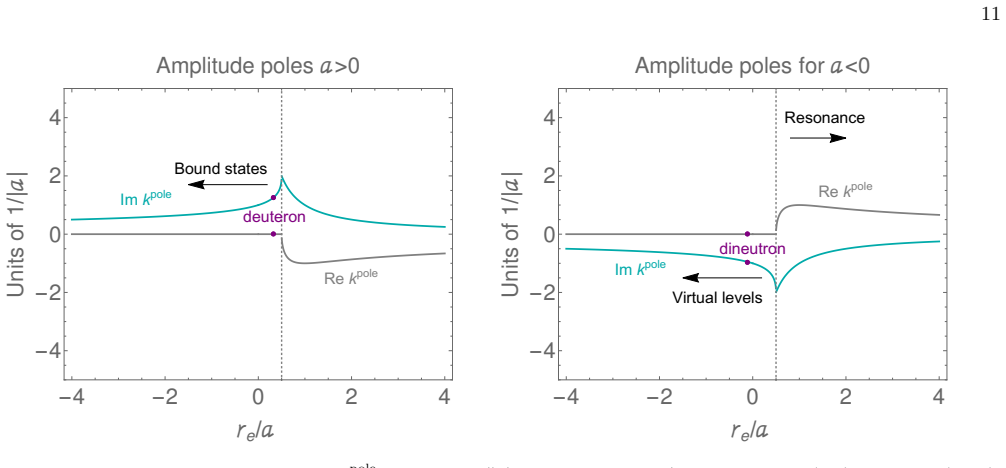
The load-bearing object is the effective-range expansion of the phase shift, $$ $k^{{2\ell+1}}$\cot\delta_\ell(k) \simeq -\frac{1}{a_\$ell^{{2\ell+1}}$} + \frac{1}{2} r_{e,\ell}^{2\ell-1} $k^{2}$, $$ truncated at order $k^2$; for S-wave scattering this produces Eq. (4), and written in terms of the relative velocity it becomes Eq. (8). The expansion is justified because $k^{2\ell+1}\cot\delta_\ell(k)$ is analytic at $k=0$ for finite-range interactions, so low-energy scattering depends only on the scattering length and effective range. The paper also derives a first-order differential equation for the phase shift, which makes the numerical extraction of $a$ and $r_e$ straightforward, and uses the amplitude poles $k_\pm = (i/a)(1 \pm \sqrt{1-2r_e/a})$ to connect those two parameters to bound states, virtual levels, and resonances. For cases where the minimal formula fails, a version with a background phase $e^{2ikR}$ describes antiresonances and sharp resonances.
What would settle it
Compute the exact S-wave cross section for an attractive Yukawa potential with $m_\phi=1\,\mathrm{MeV}$, $m=3\,\mathrm{GeV}$, and $\alpha=0.04$ at $v=1000\,\mathrm{km/s}$, and compare it with Eq. (8) using $a$ and $r_e$ extracted from low velocities; agreement would support the universality claim, while the mismatch in this classical regime would show where the two-parameter formula stops working.
Extended reading notes
Core claim
The central claim is that the effective-range approximation for non-relativistic scattering works for dark matter self-interactions across the astrophysically relevant velocity range. Concretely, the S-wave cross section is $$ \$\sigma$(v) = 4\pi $a^{2}$ \left( \left(1 - \frac{1}{8}\frac{r_e}{a}(m a v)^2\right)^2 + \frac{1}{4}(m a v)^2 \right)^{-1}, $$ where $v$ is the relative velocity, $m$ the dark matter mass, $a$ the scattering length, and $r_e$ the effective range; only $ma$ and the ratio $r_e/a$ control the velocity dependence. The paper verifies this formula against numerical solutions of the Schrödinger equation for attractive and repulsive Yukawa potentials, shows that it reproduces a Breit-Wigner resonance with an energy-dependent width, and traces its poles in the complex momentum plane to bound states, virtual levels, or resonances. Fitting the formula to semi-analytically extracted halo cross sections gives benchmark parameters such as $a=19.2\,\mathrm{fm}$, $r_e=0.01\,\mathrm{fm}$, and $m=14.9\,\mathrm{GeV}$ for the best-fit case.
Load-bearing premise
The formula assumes the dark-matter force has a short range, so that at every velocity the collision looks point-like and S-wave scattering dominates; for a light mediator whose range rivals the particle's de Broglie wavelength, the approximation breaks down.
Editorial extensions
If this is right
- Astrophysical simulations can implement self-interacting dark matter by specifying $(a, r_e, m)$ instead of a full particle model, making different scenarios directly comparable in the same simulation.
- For $\sigma/m \sim 10\,\mathrm{cm^2/g}$ at dwarf scales, dark matter masses below a few GeV are excluded by cluster observations unless the effective-range parameters are tuned to suppress high-velocity scattering.
- The velocity dependence of the cross section determines only the ratio $r_e/a$ and the product $ma$; the signs of $a$ and $r_e$ cannot be fixed by $\sigma(v)$, so the underlying intermediate state (bound, virtual, or resonant) is not observable from the scattering data alone.
- The formalism extends to subleading inelastic processes: a complex scattering length relates annihilation and elastic cross sections by $\sigma_{\mathrm{an},0}(k) \simeq \sigma_0(k) |\mathrm{Im}\,a|/(\mathrm{Re}\,a)^2$.
Reading between the lines
- A measurement of $\sigma$ at two well-separated velocities (say dwarf and cluster scales) would fix $a$ and $r_e$; a third measurement would test whether nature's self-interactions are truly effective-range-like or require the improved antiresonance formula of Section V.
- If future data show a cross section rising toward cluster scales, that would select $r_e/a > 1$ and hence a narrow-resonance interpretation; a flat cross section would point to contact-like models—a diagnostic that does not require building a UV-complete theory.
- The classical-regime breakdown for light mediators implies that any model with mediator mass of a few MeV must be treated with the full partial-wave sum once cluster-scale velocities matter; the two-parameter formula is not a universal fit for such models.
- The benchmark fits suggest that current data do not strongly constrain $r_e/a$, so upcoming simulations exploring sub-halo dynamics inside the Milky Way may be the first place where the effective range actually becomes measurable.
Signed reviews
Editorial analysis
A structured set of objections, weighed in public.
Referee Report
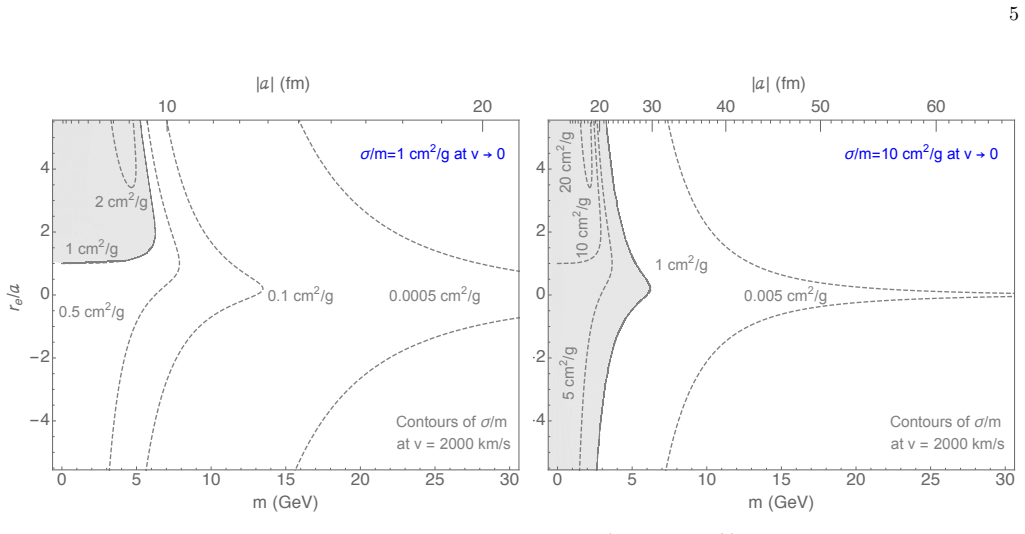
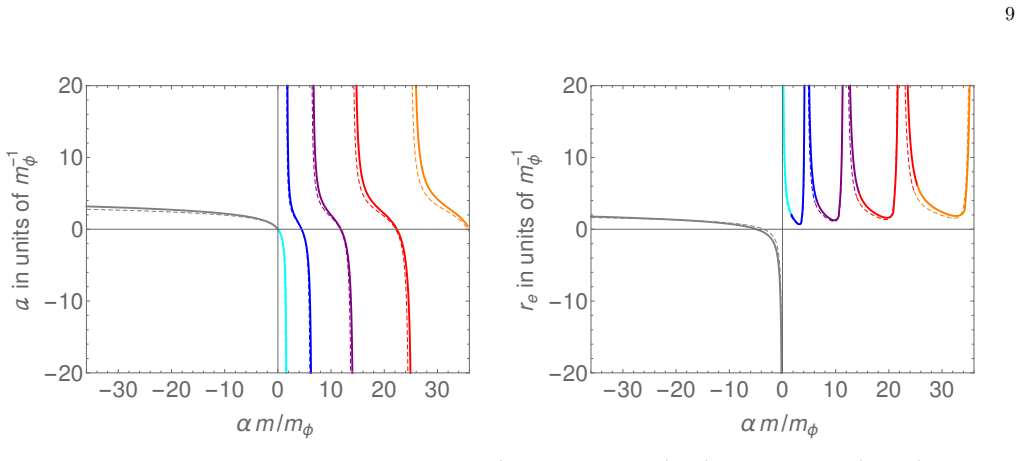
Summary. This paper proposes the effective-range expansion (ERE) as a practical, model-independent parametrization of the velocity-dependent S-wave dark matter self-interaction cross section. The central formula, Eq. (8), expresses σ(v) in terms of the scattering length a, the effective range r_e, and the DM mass m, and the authors benchmark this approximation against exact numerical Schrödinger solutions for attractive and repulsive Yukawa potentials (Figs. 1, 8, 9), finding excellent agreement outside the classical regime. They then use the parametrization to derive astrophysical constraints (Figs. 4 and 5), fit the parameters to inferred halo cross sections (Fig. 6), interpret a and r_e in terms of concrete models (contact interaction, light mediator, bound/virtual states, resonances, SIMPs), and propose extensions for antiresonances, sharp resonances, and inelastic scattering (Sec. V). The paper is explicit about the domain of validity of the ERE, identifying the classical regime and antiresonances as places where the two-parameter formula fails.
Significance. If the claims hold, the paper provides a valuable model-independent tool for SIDM simulations and phenomenological studies, analogous to the role of the effective-range expansion in nuclear physics. Its strengths include: (i) the central formula is derived from the standard analytic expansion of k cot δ, not fitted to numerical data; (ii) the approximation is validated against exact quantum-mechanical results for both signs of the Yukawa potential; (iii) the limitations are disclosed rather than hidden, with concrete extensions in Sec. V; (iv) the insight that only |a| and r_e/a can be constrained by velocity-dependent cross sections is stated and demonstrated. The astrophysical fits in Fig. 6 are appropriately hedged as illustrative. The paper does not oversell the parametrization; it explicitly notes where it fails.
minor comments (5)
- [Sec. IV.C, Eq. (17)] Equation (17) as printed is dimensionally inconsistent: the left-hand side k has units of inverse length, while the right-hand side (i a/2)(1 ± sqrt(1 - 2 r_e/a)) has units of length. The correct solution of the pole condition k cot δ = i k is k = (i/r_e)(1 ± sqrt(1 - 2 r_e/a)), and the subsequent deuteron binding-energy check in Eq. (18) and Fig. 10 are consistent with the correct formula. Please correct Eq. (17) and any related text.
- [Sec. II, Fig. 1] The paper clearly acknowledges the classical regime (m_φ ≲ 5 MeV for the benchmark) where the effective-range approximation fails, but since the abstract and introduction emphasize the broad applicability of the two-parameter formula, consider adding an explicit caveat in the abstract that the parametrization applies to short-range interactions with kR ≪ 1.
- [Sec. III.B, Fig. 6] The fitting procedure that produces the benchmark parameter sets S1–S4 is not fully described; please state the likelihood or χ² definition and the velocity distribution parameters (e.g., v0 for each halo class) so that the fit is reproducible.
- [Sec. IV.B, Eq. (15)] In the Born regime, Eq. (15) gives r_e = 4/(m α), which is negative for a repulsive Yukawa potential (α < 0). The text does not comment on this sign, and since Eq. (8) depends only on r_e/a, negative values are physically acceptable; a short remark would avoid confusion.
- [Sec. V.A, Eq. (21)] In the improved antiresonance formula, the parameters a and r_e are not the standard scattering length and effective range, as the text notes; however, using different symbols (e.g., ã and r̃_e) would prevent readers from confusing them with the parameters of Sec. II.
Circularity Check
No significant circularity: the effective-range parametrization is a standard low-energy expansion benchmarked against numerical quantum mechanics, and the astrophysical fit is an application, not an input.
full rationale
The central claim, Eqs. (4) and (8), follows algebraically from the standard effective-range expansion k cot δ0 = -1/a + (1/2) r_e k^2 stated in Eq. (3), with a and r_e defined by the low-momentum expansion of the phase shift (Eq. (A6)-(A7)). No target cross section is fed into the derivation of the formula; the two-parameter velocity dependence is a consequence of the expansion, not a fit to the astrophysical data that Eq. (8) is later applied to. The paper explicitly benchmarks the approximation against numerically solved Schrödinger cross sections for Yukawa potentials in Figs. 8 and 9, and it discloses the classical-regime and antiresonance failures (Sec. II and Sec. V), which further shows that the validity claim is delimited rather than manufactured. The fit in Fig. 6 is an application of the parametrization to observational extractions and is labeled as a fit, not as a prediction from first principles. The self-citation [20] is used only for mapping narrow-resonance phenomenology and appears in a remark about extensions; the central effective-range formalism is supported by the independent, classical Bethe/Blatt-Jackson derivation reproduced in Appendix A, and its numerical validation is performed in this paper. No load-bearing argument reduces to a self-citation or to the fitted values, so the honest finding is no significant circularity.
Assumptions & free parameters
free parameters (4)
- Scattering length a =
Benchmark values: S1 = 19.2 fm, S2 = 25.6 fm, S3 = 3.8 fm, S4 = 37.4 fm
- Effective range r_e =
Benchmark values: S1 = 0.01 fm, S2 = 256.1 fm, S3 = -57 fm, S4 = -748.9 fm
- Dark matter mass m =
Benchmark values: S1 = 14.9 GeV, S2 = 9.2 GeV, S3 = 1 GeV, S4 = 15.7 GeV
- Hard-sphere radius R (antiresonance improvement) =
First antiresonance of Yukawa: a approximately R = -0.85, r_e = 13.4 (units of m_phi^{-1})
assumptions (7)
- standard math Non-relativistic Schrodinger equation with a finite-range potential governs dark matter self-scattering.
- standard math The phase shift quantity k^{2l+1} cot delta_l is analytic at k = 0 and expands as Eq. (3), with higher-order terms negligible.
- domain assumption S-wave dominates the scattering in the velocity and parameter regions considered.
- domain assumption Interactions are elastic in halos, with inelastic processes subleading.
- domain assumption Dark matter velocities in halos follow a Maxwell-Boltzmann distribution with cutoff, Eq. (10).
- domain assumption Observational constraints from galaxy clusters (sigma/m < 0.2-1 cm^2/g) and dwarf scales (1-10 cm^2/g) are external inputs.
- domain assumption In the Born regime, perturbative expansion of the phase shift is valid (alpha m << m_phi).
Cite this review
Pith. "Pith review of A Practical and Consistent Parametrization of Dark Matter Self-Interactions." pith.science (2026). https://pith.science/paper/QNTWNE4O
@misc{pith2026190806067,
  author       = {Pith},
  title        = {Pith review of: A Practical and Consistent Parametrization of Dark Matter Self-Interactions},
  year         = {2026},
  howpublished = {\url{https://pith.science/paper/QNTWNE4O}},
  note         = {Machine review of arXiv:1908.06067}
}
read the original abstract
Self-interacting dark matter has been proposed to explain the apparent mass deficit in astrophysical small-scale halos, while observations from galaxy clusters suggest that the corresponding cross section depends on the velocity. Accounting for this is often believed to be highly model-dependent with studies mostly focusing on scenarios with light mediators. Based on the effective-range formalism, in this work we point out a model-independent approach which accurately approximates the velocity dependence of the self-interaction cross section with only two parameters. We illustrate how this parameterization can be simultaneously interpreted in various well-motivated scenarios, including self-interactions induced by Yukawa forces, Breit-Wigner resonances and bound states. We investigate the astrophysical implications and discuss how the approximation can be improved in certain special regimes where it works poorly.
Figures


Figures from the paper (9 more)






Forward citations
Cited by 3 Pith papers
-
Dark Neutrons as Dark Matter: Collisions in Halos and Direct Detection from Dark CP Violation
A non-zero topological angle in a confining dark sector induces CP-violating pion-baryon couplings that naturally generate velocity-dependent dark matter self-interactions and dark electric dipole moments for direct d...
-
Pion dark matter in a $\theta$ vacuum: a thermal relic with sharp velocity-dependent self-interactions
A QCD-like dark sector with a theta vacuum and a dark photon portal can simultaneously reproduce the dark matter relic abundance and produce the sharply velocity-dependent self-interactions inferred from small-scale s...
-
Effect of Cosmic Neutrino Background on the Dark Matter Self-interaction via Neutrino force
The cosmic neutrino background screens the neutrino-pair force between scalar dark matter particles for m_chi below the CnuB temperature, reshaping SIDM parameter space and eliminating Sommerfeld enhancement.
Reference graph
Works this paper leans on
-
[1]
A simple method to find the phase shift 14
-
[2]
Then, Eqs
The S-wave case Let us take 𝓁 = 0 and introduce uk(r) = rRk, 0(r). Then, Eqs. (A1) and (A2) read ( d2 dr2 +k2−mV (r) ) uk(r) = 0, (A12) and uk(0) = 0, uk(r)→ψk(r) = sin (kr +δ0) sinδ0 at r→∞ . (A13) Here we have chosen a convenient normalization factor for uk. In the following we will find it useful to employ 10 Simple changes of variable on Eq. (A4) allow...
-
[3]
The Hulth´ en Potential 16 B. Velocity-averaged cross sections 16 ∗Electronic address: xiaoyong.chu@oeaw.ac.at †Electronic address: camilo.garcia.cely@desy.de ‡Electronic address: hitoshi@berkeley.edu, hitoshi.murayama@ipmu.jp, Hamamatsu Professor I. INTRODUCTION In contrast to the ordinary substances found on Earth, more than three quarters of the matter...
arXiv 1908
-
[4]
[35] presented a system- atic method for solving Eq
A simple method to find the phase shift In the SIDM context, Ref. [35] presented a system- atic method for solving Eq. (A1). Here we would like to point out a simpler possibility that will not only pro- vide a powerful method to solve for the phase shift but will also allow us to define the scattering length and the effective range. Let us first define t𝓁,k(r)...
-
[5]
The tentative non-vanishing values of σ/m –extracted from observational data at various scales– can also be fit in terms of the effective-range parameters. See Fig. 6. Our results suggest that more precise measurements and 14 better extractions are needed to identify or constrain such parameters. Nevertheless, since the value ofre/a only af- fects the cross...
-
[6]
The Hulth´ en Potential In the main text, it has been mentioned that the Hulth´ en potential V (r) =±αδe−δr/(1−e−δr) (A19) approximates well the Yukawa potential if one sets δ =√ 2ζ(3)mφ, where α gives the coupling and mφ is the mediator mass of the Yukawa potential [78]. The advan- tage of employing the Hulth´ en potential is that its cor- responding Sch...
- [7]
-
[8]
D. N. Spergel and P. J. Steinhardt, Phys. Rev. Lett. 84, 3760 (2000), astro-ph/9909386
arXiv 2000
Show all 84 references
- [9]
-
[10]
J. S. Bullock and M. Boylan-Kolchin, Ann. Rev. Astron. Astrophys. 55, 343 (2017), 1707.04256
2017 arXiv
-
[11]
R. Dave, D. N. Spergel, P. J. Steinhardt, and B. D. Wan- delt, Astrophys. J. 547, 574 (2001), astro-ph/0006218
2001 arXiv
-
[12]
Vogelsberger, J
M. Vogelsberger, J. Zavala, and A. Loeb, Mon. Not. Roy. Astron. Soc. 423, 3740 (2012), 1201.5892
2012 arXiv
-
[13]
Rocha, A
M. Rocha, A. H. G. Peter, J. S. Bullock, M. Kaplinghat, S. Garrison-Kimmel, J. Onorbe, and L. A. Moustakas, Mon. Not. Roy. Astron. Soc. 430, 81 (2013), 1208.3025
2013 arXiv
-
[14]
A. H. G. Peter, M. Rocha, J. S. Bullock, and M. Kapling- hat, Mon. Not. Roy. Astron. Soc. 430, 105 (2013), 1208.3026
2013 arXiv
-
[15]
O. D. Elbert, J. S. Bullock, S. Garrison-Kimmel, M. Rocha, J. Oorbe, and A. H. G. Peter, Mon. Not. Roy. Astron. Soc. 453, 29 (2015), 1412.1477
2015 arXiv
-
[16]
A. B. Fry, F. Governato, A. Pontzen, T. Quinn, M. Trem- mel, L. Anderson, H. Menon, A. M. Brooks, and J. Wad- 17 sley, Mon. Not. Roy. Astron. Soc. 452, 1468 (2015), 1501.00497
2015 arXiv
-
[17]
S. W. Randall, M. Markevitch, D. Clowe, A. H. Gon- zalez, and M. Bradac, Astrophys. J. 679, 1173 (2008), 0704.0261
2008 arXiv
-
[18]
Kaplinghat, S
M. Kaplinghat, S. Tulin, and H.-B. Yu, Phys. Rev. Lett. 116, 041302 (2016), 1508.03339
2016 arXiv
-
[19]
Robertson, R
A. Robertson, R. Massey, and V. Eke, Mon. Not. Roy. Astron. Soc. 465, 569 (2017), 1605.04307
2017 arXiv
-
[20]
Bondarenko, A
K. Bondarenko, A. Boyarsky, T. Bringmann, and A. Sokolenko, JCAP 1804, 049 (2018), 1712.06602
2018 arXiv
-
[21]
O. D. Elbert, J. S. Bullock, M. Kaplinghat, S. Garrison- Kimmel, A. S. Graus, and M. Rocha, ApJ 853, 109 (2018), 1609.08626
2018 arXiv
- [22]
-
[23]
J. L. Feng, M. Kaplinghat, and H.-B. Yu, Phys. Rev. Lett. 104, 151301 (2010), 0911.0422
2010 arXiv
-
[24]
M. R. Buckley and P. J. Fox, Phys. Rev. D81, 083522 (2010), 0911.3898
2010 arXiv
-
[25]
Tulin, H.-B
S. Tulin, H.-B. Yu, and K. M. Zurek, Phys. Rev. Lett. 110, 111301 (2013), 1210.0900
2013 arXiv
-
[26]
X. Chu, C. Garcia-Cely, and H. Murayama, Phys. Rev. Lett. 122, 071103 (2019), 1810.04709
2019 arXiv
- [27]
- [28]
-
[29]
J. D. March-Russell and S. M. West, Phys. Lett. B676, 133 (2009), 0812.0559
2009 arXiv
- [30]
-
[31]
J. M. Cline, Z. Liu, G. Moore, and W. Xue, Phys. Rev. D90, 015023 (2014), 1312.3325
2014 arXiv
- [32]
- [33]
-
[34]
H. A. Bethe, Phys. Rev. 76, 38 (1949)
1949
-
[35]
J. M. Blatt and J. D. Jackson, Phys. Rev. 76, 18 (1949)
1949
-
[36]
H. P. Noyes, Ann. Rev. Nucl. Part. Sci. 22, 465 (1972)
1972
-
[37]
V. G. J. Stoks, R. A. M. Klomp, M. C. M. Rentmeester, and J. J. de Swart, Phys. Rev. C48, 792 (1993)
1993
-
[38]
T. F. O’Malley, L. Spruch, and L. Rosenberg, Journal of Mathematical Physics 2, 491 (1961)
1961
-
[39]
R. O. Berger and L. Spruch, Phys. Rev. 138, B1106 (1965)
1965
-
[40]
van Haeringen and L
H. van Haeringen and L. P. Kok, Phys. Rev. A26, 1218 (1982)
1982
-
[41]
Tulin, H.-B
S. Tulin, H.-B. Yu, and K. M. Zurek, Phys. Rev. D87, 115007 (2013), 1302.3898
2013 arXiv
-
[42]
A. B. Newman, T. Treu, R. S. Ellis, and D. J. Sand, Astrophys. J. 765, 25 (2013), 1209.1392
2013 arXiv
-
[43]
Kuzio de Naray, S
R. Kuzio de Naray, S. S. McGaugh, and W. J. G. de Blok, Astrophys. J. 676, 920 (2008), 0712.0860
2008 arXiv
-
[44]
S.-H. Oh, W. J. G. de Blok, E. Brinks, F. Walter, and R. C. Kennicutt, Jr, Astron. J. 141, 193 (2011), 1011.0899
2011 arXiv
- [45]
-
[46]
Sokolenko, K
A. Sokolenko, K. Bondarenko, T. Brinckmann, J. Zavala, M. Vogelsberger, T. Bringmann, and A. Boyarsky, JCAP 1812, 038 (2018), 1806.11539
2018 arXiv
-
[47]
Kummer, M
J. Kummer, M. Brggen, K. Dolag, F. Kahlhoefer, and K. Schmidt-Hoberg (2019), 1902.02330
2019 arXiv
- [48]
-
[49]
Sameie, H.-B
O. Sameie, H.-B. Yu, L. V. Sales, M. Vogelsberger, and J. Zavala (2019), 1904.07872
2019 arXiv
-
[50]
Kahlhoefer, M
F. Kahlhoefer, M. Kaplinghat, T. R. Slatyer, and C.-L. Wu (2019), 1904.10539
2019 arXiv
-
[51]
A. D. Dolgov, Yad. Fiz. 31, 1522 (1980)
1980
-
[52]
E. D. Carlson, M. E. Machacek, and L. J. Hall, Astro- phys. J. 398, 43 (1992)
1992
-
[53]
Hochberg, E
Y. Hochberg, E. Kuflik, T. Volansky, and J. G. Wacker, Phys. Rev. Lett. 113, 171301 (2014), 1402.5143
2014 arXiv
-
[54]
L. D. Landau and E. M. Lifshits, Quantum Mechanics , vol. v.3 of Course of Theoretical Physics (Butterworth- Heinemann, Oxford, 1991), ISBN 9780750635394
1991
-
[55]
A. G. Sitenko and P. J. Shepherd, Lectures in scattering theory, Internat. Ser. Mono. Natural Philos. (Pergamon, Oxford, 1971), trans. from the Russian, URL https:// cds.cern.ch/record/102667
1971
-
[56]
Weinberg, Phys
S. Weinberg, Phys. Rev. 137, B672 (1965)
1965
-
[57]
Hochberg, E
Y. Hochberg, E. Kuflik, H. Murayama, T. Volansky, and J. G. Wacker, Phys. Rev. Lett. 115, 021301 (2015), 1411.3727
2015 arXiv
- [58]
-
[59]
H. M. Lee and M.-S. Seo, Phys. Lett. B748, 316 (2015), 1504.00745
2015 arXiv
-
[60]
Hansen, K
M. Hansen, K. Langæble, and F. Sannino, Phys. Rev. D92, 075036 (2015), 1507.01590
2015 arXiv
- [61]
- [62]
-
[63]
Bernal, X
N. Bernal, X. Chu, C. Garcia-Cely, T. Hambye, and B. Zaldivar, JCAP 1603, 018 (2016), 1510.08063
2016 arXiv
- [64]
- [65]
-
[66]
Kuflik, M
E. Kuflik, M. Perelstein, N. R.-L. Lorier, and Y.-D. Tsai, Phys. Rev. Lett. 116, 221302 (2016), 1512.04545
2016 arXiv
- [67]
- [68]
-
[69]
Pappadopulo, J
D. Pappadopulo, J. T. Ruderman, and G. Trevisan, Phys. Rev. D94, 035005 (2016), 1602.04219
2016 arXiv
-
[70]
Farina, D
M. Farina, D. Pappadopulo, J. T. Ruderman, and G. Tre- visan, JHEP 12, 039 (2016), 1607.03108
2016 arXiv
-
[71]
U. K. Dey, T. N. Maity, and T. S. Ray (2016), 1612.09074
2016 arXiv
- [72]
-
[73]
S.-M. Choi, H. M. Lee, and M.-S. Seo, JHEP 04, 154 (2017), 1702.07860
2017 arXiv
-
[74]
S.-M. Choi, Y. Hochberg, E. Kuflik, H. M. Lee, Y. Mam- brini, H. Murayama, and M. Pierre (2017), 1707.01434
2017 arXiv
- [75]
-
[76]
S.-M. Choi, H. M. Lee, P. Ko, and A. Natale, Phys. Rev. D98, 015034 (2018), 1801.07726
2018 arXiv
-
[77]
Berlin, N
A. Berlin, N. Blinov, S. Gori, P. Schuster, and N. Toro, Phys. Rev. D97, 055033 (2018), 1801.05805
2018 arXiv
-
[78]
S.-M. Choi, H. M. Lee, Y. Mambrini, and M. Pierre (2019), 1904.04109. 18
2019 arXiv
- [79]
-
[80]
McGehee, H
R. McGehee, H. Murayama, and Y.-D. Tsai, in prepara- tion (2019)
2019
-
[81]
K. Blum, R. Sato, and T. R. Slatyer, JCAP 1606, 021 (2016), 1603.01383
2016 arXiv
-
[82]
Mitroy, Phys
J. Mitroy, Phys. Rev. A 66, 022716 (2002)
2002
-
[83]
D. R. Phillips and T. D. Cohen, Phys. Lett. B390, 7 (1997), nucl-th/9607048
1997 arXiv
- [84]
Reviewed August 14, 2026 · model on record in the stance chip above.
Discussion (0). Continue with ORCID to comment.