REVIEW 2 major objections 4 minor 83 references
Hierarchical multiscale fracture modeling of carbon-nitride nanosheet reinforced composites by combining cohesive phase-field and molecular dynamics
T0 review · 2 major / 4 minor · reviewed 2026-08-12 · deepseek-v4-flash
Pith's one-line read The paper claims that combining molecular-dynamics input with a cohesive phase-field fracture model predicts that the tensile strength of graphene- and carbon-nitride-nanosheet reinforced polymers rises nonlinearly with filler thickness…
desk verdict The MD data and phase-field benchmarks are solid, but the 1-10 nm scaling claim likely reflects the fixed regularization length, not a material effect. read the letter →
The pith
A machine-rendered reading of the paper's core claim, the machinery that carries it, and where it could break.
The reading
What carries the argument
The load-bearing machinery is a two-step hierarchical transfer: molecular dynamics supplies the homogenized parameter set $\zeta_p=[E,\nu,G_c,\sigma_0]$ for the fiber, the matrix, and the van der Waals interface; a cohesive phase-field fracture model then uses these parameters in a smeared damage field $d\in[0,1]$ (0 intact, 1 cracked) whose crack density is anisotropic for the fiber through the structure tensor $A=I+\alpha\,\mathbf{a}\otimes\mathbf{a}$ and isotropic for the matrix. The star-convex energy decomposition with parameter $\gamma^*$ separates tension from compression so that mixed-mode crack initiation is controlled, and the fracture scale is set by Irwin's internal length $l_{ch}=E G_c/\sigma_0^2$, which fixes the degradation parameter $a_1=4l_{ch}/(\pi l_f)$. The scaling claim emerges from sweeping the representative volume element size from 1 nm to 1 µm at fixed volume fraction while keeping the MD-derived parameters fixed.
What would settle it
Run the same composite-cell simulations at RVE sizes 1, 5, and 10 nm with successively smaller crack-band widths (for example $l_f=0.01$, $0.005$, $0.002$) while keeping the MD-derived interface strength fixed. If the 45.78% strength drop between 1 nm and 5 nm shrinks or vanishes as the band narrows, the scaling effect is a regularization artifact; alternatively, direct MD tensile tests of composites with different nanosheet thicknesses would settle whether the continuum prediction matches atomistics.
Extended reading notes
Core claim
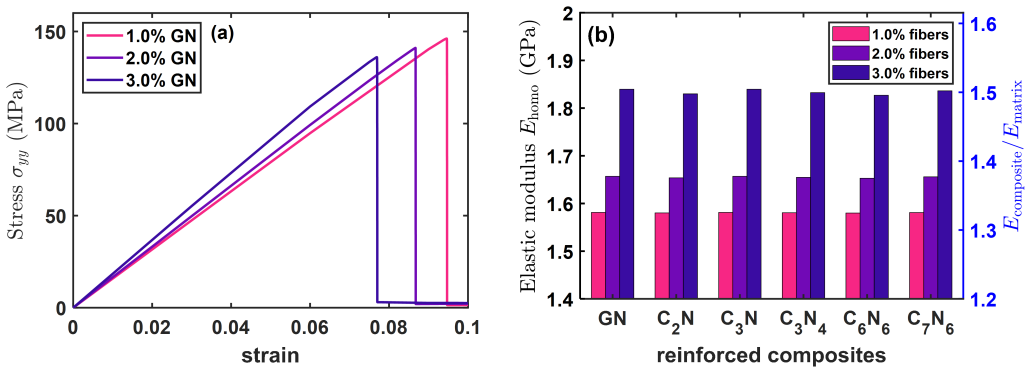
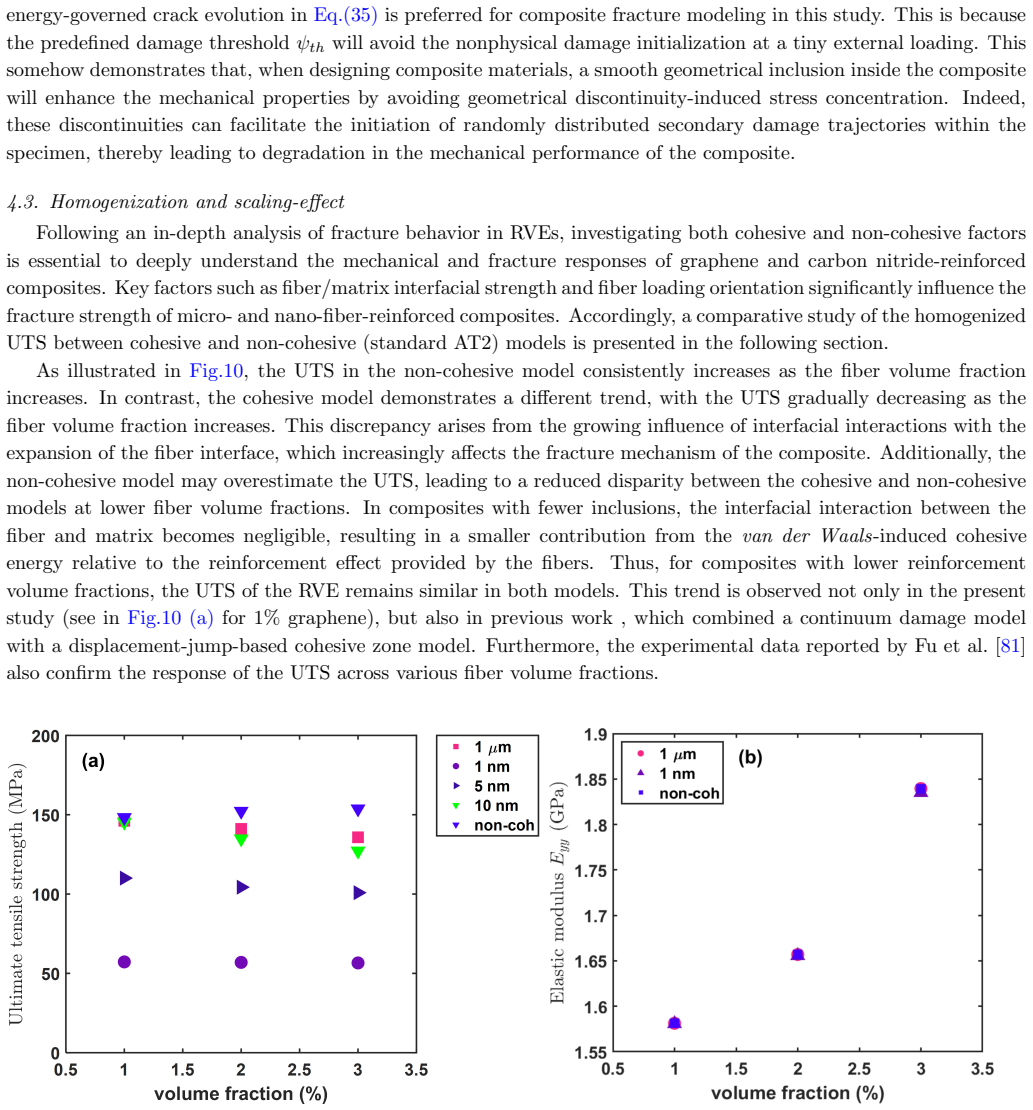
On the paper's own terms, the discovery is that the fracture strength of a nanosheet-reinforced composite is governed not only by reinforcement content but by the physical size of the filler in the few-nanometer regime. The authors obtain homogenized elastic modulus, Poisson's ratio, critical energy release rate, and cohesive interface strength from molecular dynamics for graphene and several carbon-nitride monolayers (C3N, C2N, C3N4, C6N6, C7N6) with a P3HT matrix, and feed these into an anisotropic star-convex cohesive phase-field model at the microscale. The model predicts that tensile strength increases nonlinearly with filler thickness, with the strongest variation below 10 nm; they attribute this to interface strength dominating fracture resistance for thin nanosheets and reinforcement distribution and density taking over for thicker fillers. They also show that the cohesive model gives a decreasing ultimate tensile strength with rising fiber volume fraction, opposite to the non-cohesive model, and that the homogenized elastic modulus is barely affected by scale.
Load-bearing premise
The load-bearing premise is that one fixed crack-band width and the hand-set model parameters ($\alpha=500$, $\gamma^*=3$) remain physically valid for every simulated cell size from 1 nm to 1 µm; if that width is comparable to the smallest cells, the predicted 1–10 nm strength drop could be an artifact of how the model spreads cracks rather than a real material property.
Editorial extensions
If this is right
- If the claimed scaling effect is real, nanocomposite strength data should report nanosheet thickness or lateral size alongside volume fraction, because the 1–10 nm window is where strength changes fastest.
- The reversal between cohesive and non-cohesive predictions means that models that ignore van der Waals interface strength will overestimate the benefit of raising filler content in polymer nanocomposites.
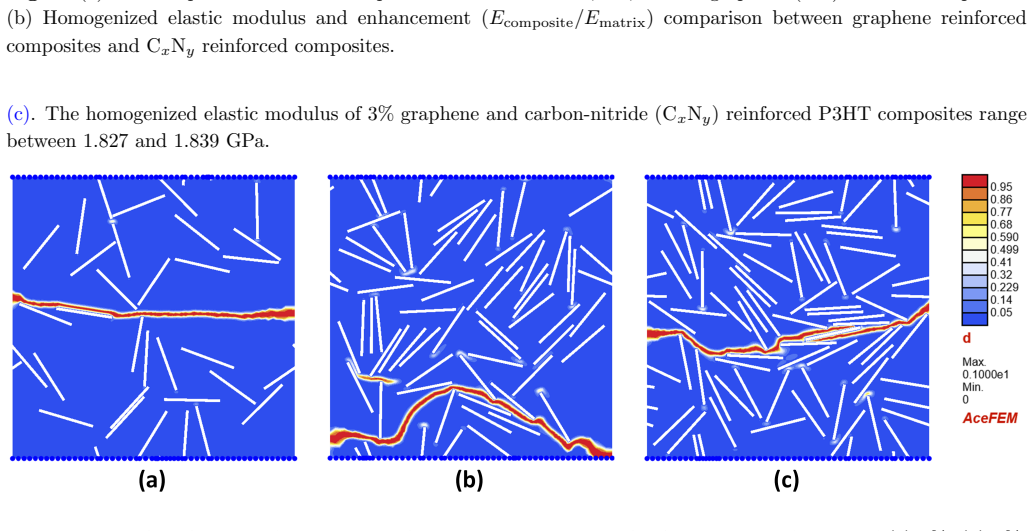
- For design, smooth inclusions are preferable: the simulations show fiber edge tips generate stress concentrations that seed secondary damage.
- The framework gives quantitative validation targets, such as a 3% C3N/P3HT composite being about 1.49 times stiffer than pure P3HT and all tested 3% composites having moduli in the 1.827–1.839 GPa range.
- The predicted elastic modulus is nearly scale-independent, so stiffness can be treated as size-independent while strength cannot.
Reading between the lines
- A direct way to test whether the 1–10 nm scaling is physical rather than numerical would be to repeat the RVE sweep with progressively smaller regularization lengths; if the strength drop vanishes as the crack band narrows, the effect belongs to the model's diffused crack geometry, not the material.
- The reported points suggest that a power-law or exponential design rule could be fitted to the 1–10 nm strength data, but the paper does not fit one; extracting such a curve would give engineers a compact formula.
- Because temperature effects are omitted, coupling the same pipeline to temperature-dependent potentials could shift both the cohesive strength and the size-effect onset.
- The cohesive strengths are tens of megapascals below the pure-matrix strength, which implies a critical RVE size below which interface failure dominates bulk failure—a crossover length the paper does not explicitly extract.
Editorial analysis
A structured set of objections, weighed in public.
Referee Report
Summary. This manuscript proposes a hierarchical multiscale scheme in which molecular dynamics simulations supply elastic constants, critical energy release rates, and interfacial cohesive strengths for graphene and carbon-nitride nanosheets and a P3HT matrix, and a regularized cohesive phase-field model then simulates fracture in composite RVE microstructures. The phase-field part uses an anisotropic crack density function with a structure tensor, a star-convex tension/compression energy decomposition, and cohesive softening laws. The model is validated against reference three-point bending tests, and RVE simulations are used to report a size effect in which the homogenized ultimate tensile strength increases nonlinearly as the RVE 'scale size' decreases from 1 micrometer to 1 nanometer, with the largest variation between 1 nm and 10 nm. The conclusion interprets this as a filler-thickness-dependent strengthening effect.
Significance. If established, the framework would be valuable because it offers a practical MD-to-continuum workflow for 2D-material nanocomposites and the central scaling prediction is falsifiable by experiments or fully atomistic models. The paper deserves credit for computing the nanoscale inputs independently of the continuum model, for reproducing reference force-displacement curves in the three-point bending benchmarks, and for preferring an energy-based crack-driving force that avoids nonphysical damage initiation at small loads. However, the manuscript's central quantitative claim is not yet supported because the composite-scale simulations fix the phase-field regularization length and use the RVE size as a proxy for filler thickness without a stated mapping or a convergence study at the composite scale.
major comments (2)
- [Sections 4.2 and 4.3] The regularization length is set to lf=0.01 with no units stated in Section 4.2, and the same value is used for every RVE in Section 4.3, where the smallest scale sizes are 1 nm, 5 nm, and 10 nm. If lf=0.01 µm, then lf equals the 10 nm RVE size and is ten times the 1 nm RVE size, so at these scales the 'crack' is a diffuse damage band spanning the entire RVE and the computed UTS reflects the regularization parameter rather than a material property. The benchmark convergence studies in Section 3 (lf = 2.5 mm and lf = 5 µm) do not cover the nanometer range. The authors should state the units of lf and provide a composite-scale convergence study, for example varying lf at fixed volume fraction and mesh resolution for RVE sizes of 1, 5, and 10 nm and reporting the homogenized UTS and crack patterns; without this, the 45.78% and 22.54% differences reported in Fig. 10(a) cannot be attributed to filler-thickness scaling.
- [Sections 4.3 and 5] The manuscript uses 'scale size' and 'filler thickness' interchangeably, but no mapping between the RVE side length and the physical filler thickness is provided. In the RVE construction the fiber is a rectangular inclusion at a fixed volume fraction, so changing the 'scale size' simultaneously changes the inclusion dimensions and their spacing; this does not isolate the thickness of a nanosheet reinforcement. The conclusion that 'tensile strength increased nonlinearly with filler thickness' is therefore under-specified. The authors should define how filler thickness is extracted from the RVE geometry and, ideally, vary the filler thickness or aspect ratio independently of the RVE size.
minor comments (4)
- [Introduction] The sentence attributing the synthesis of g-C3N4 to '2009' with reference [5] appears inconsistent with the cited 2015 publication; please verify the date and the reference.
- [Throughout] The text uses the nonstandard typography 'R VE' in many places; it should be consistently written as 'RVE'.
- [Equation (18)] The expression 'a1 = 4 lch/π lf' should be written with brackets or spacing (e.g., a1 = 4 lch / (π lf)) to avoid a misreading of the denominator; the derivation in Appendix C.2 is consistent, so this is purely a typographical issue.
- [Table 1 and Section 4.2] The computed Poisson's ratio for P3HT (0.40) differs from the cited reference values, and the text states that reference Poisson's ratios are substituted when discrepancies are large; it would be helpful to state the substituted values explicitly and to note whether the reported scaling trends are sensitive to this substitution.
Circularity Check
No circular reduction: the MD inputs are computed independently, and the composite scaling curves are genuine model outputs, not fitted targets; the score reflects only minor unnamed self-citations that are not load-bearing.
full rationale
The derivation chain is not circular in the reduction sense. The material parameters E, nu, Gc, and sigma0 are obtained from LAMMPS via the virial stress and energy-release-rate formulas (Eqs. 1-2), independently of the phase-field model, and are then used as inputs in the microscale cohesive phase-field formulation. No composite ultimate tensile strength datum is used to fit these parameters or to tune the phase-field parameters; lf = 0.01, alpha = 500, and gamma* = 3 are fixed in Section 4.2 and the 1 nm to 1 micron scaling curves in Fig. 10(a) are outputs rather than fitted targets. The phase-field model is checked against external benchmarks (Rots et al. three-point bending and Teichtmeister et al. anisotropic bending) with convergence studies at the benchmark scale, so the central modeling machinery has independent support. The main verifiability defect is the repeated reliance on unnamed prior work by the same authors, e.g., Section 2.1.1: 'For more details, the reader is referred to our previous work .', Section 2.1.2 on the hierarchical bridging concept, and Section 4.3 on earlier scaling observations; these citations cannot be checked but they are not the logical basis for the headline scaling claim. The more serious concern is a correctness and sensitivity issue, not circularity: with lf fixed while the RVE scale is swept from 1 nm to 1 micron, the 1-10 nm window could be dominated by the regularization length, and no composite-scale lf-convergence study is provided; the concluding limitations on temperature effects, rigid nanosheets, and transverse isotropy are acknowledged but do not make the derivation circular.
Assumptions & free parameters
free parameters (4)
- Anisotropic penalty parameter alpha =
500
- Star-convex decomposition parameter gamma* =
3
- Phase-field regularization length lf =
0.01 (unit not specified)
- Substituted Poisson's ratios for fibers =
Reference values from [71-74]
assumptions (5)
- standard math The regularized phase-field crack surface Gamma_l Gamma-converges to the sharp crack Gamma_c as lf approaches 0.
- domain assumption P3HT is brittle and linear under small strains below its glass transition temperature.
- domain assumption Homogenized MD properties of a single monolayer and of the polymer can be transferred directly to the continuum RVE without size corrections.
- ad hoc to paper The fiber fracture orientation is captured by a single predefined angle phi=pi/3 with a constant structure tensor A (alpha=500).
- domain assumption Lennard-Jones 9-6 hybrid potential with Waldman-Hagler mixing describes the fiber-matrix interface adequately.
Cite this review
Pith. "Pith review of Hierarchical multiscale fracture modeling of carbon-nitride nanosheet reinforced composites by combining cohesive phase-field and molecular dynamics." pith.science (2026). https://pith.science/paper/QO34VLYT
@misc{pith2026241114492,
  author       = {Pith},
  title        = {Pith review of: Hierarchical multiscale fracture modeling of carbon-nitride nanosheet reinforced composites by combining cohesive phase-field and molecular dynamics},
  year         = {2026},
  howpublished = {\url{https://pith.science/paper/QO34VLYT}},
  note         = {Machine review of arXiv:2411.14492}
}
read the original abstract
Understanding the fracture mechanisms in composite materials across scales, from nano- to micro-scales, is essential for an in-depth understanding of the reinforcement mechanisms and designing the next generation of lightweight, high-strength composites. However, conventional methods struggle to model the complex fracture behavior of nanocomposites, particularly at the fiber-matrix interface. The phase-field regularized cohesive fracture model has proven to be effective in simulating crack initiation, branching, and propagation; however, capturing the cohesive fracture strength at smaller scales remains a significant challenge. This study introduces a novel approach that combines an energy-based star-convex decomposition cohesive phase-field fracture model with molecular dynamics simulations to explore the thickness dependency of nanocomposite mechanical properties. The proposed framework enables hierarchical modeling of carbon-nitride nanosheet-reinforced composites' mechanical and fracture behaviors. The developed model could elucidate complex fracture processes across different scales and highlight critical scaling effects. This methodology provides an efficient solution for uncovering hierarchical fracture mechanisms in reinforced nanocomposites, offering valuable insights into their fracture behavior and strengthening mechanisms.
Figures


Figures from the paper (7 more)


Reference graph
Works this paper leans on
-
[1]
Electric field effect in atomically thin carbon films
Kostya S Novoselov, Andre K Geim, Sergei V Morozov, De-eng Jiang, Yanshui Zhang, Sergey V Dubonos, Irina V Grigorieva, and Alexandr A Firsov. Electric field effect in atomically thin carbon films. Science, 306(5696):666–669, 2004
2004
-
[2]
The rise of graphene
Andre K Geim and Konstantin S Novoselov. The rise of graphene. Nature Materials, 6(3):183–191, 2007
2007
-
[3]
Detection of individual gas molecules adsorbed on graphene
Fredrik Schedin, Andrei Konstantinovich Geim, Sergei Vladimirovich Morozov, Ew W Hill, Peter Blake, Mi I Katsnelson, and Kostya Sergeevich Novoselov. Detection of individual gas molecules adsorbed on graphene. Nature Materials, 6(9):652–655, 2007
2007
-
[4]
The electronic properties of graphene
AH Castro Neto, Francisco Guinea, Nuno MR Peres, Kostya S Novoselov, and Andre K Geim. The electronic properties of graphene. Reviews of Modern Physics , 81(1):109, 2009
work page 2009
-
[5]
Metal-free efficient photocatalyst for stable visible water splitting via a two-electron pathway
Juan Liu, Yang Liu, Naiyun Liu, Yuzhi Han, Xing Zhang, Hui Huang, Yeshayahu Lifshitz, Shuit-Tong Lee, Jun Zhong, and Zhenhui Kang. Metal-free efficient photocatalyst for stable visible water splitting via a two-electron pathway. Science, 347(6225):970–974, 2015
work page 2015
-
[6]
Graphene–multilayer graphene nanocomposites as highly efficient thermal interface materials
Khan MF Shahil and Alexander A Balandin. Graphene–multilayer graphene nanocomposites as highly efficient thermal interface materials. Nano Letters, 12(2):861–867, 2012
work page 2012
-
[7]
Superior thermal conductivity of single-layer graphene
Alexander A Balandin, Suchismita Ghosh, Wenzhong Bao, Irene Calizo, Desalegne Teweldebrhan, Feng Miao, and Chun Ning Lau. Superior thermal conductivity of single-layer graphene. Nano Letters, 8(3):902–907, 2008
work page 2008
-
[8]
Measurement of the elastic properties and intrinsic strength of monolayer graphene
Changgu Lee, Xiaoding Wei, Jeffrey W Kysar, and James Hone. Measurement of the elastic properties and intrinsic strength of monolayer graphene. Science, 321(5887):385–388, 2008
work page 2008
Show all 83 references
-
[9]
Physicochemical and Piezoresistive properties of smart cementitious composites with graphene nanoplates and graphite plates
Wenkui Dong, Wengui Li, Kejin Wang, and Surendra P Shah. Physicochemical and Piezoresistive properties of smart cementitious composites with graphene nanoplates and graphite plates. Construction and Building Materials , 286:122943, 2021
2021
-
[10]
Thermal conductivity of graphene polymorphs and compounds: From C 3N to graphdiyne lattices
S Milad Hatam-Lee, Ali Rajabpour, and Sebastian Volz. Thermal conductivity of graphene polymorphs and compounds: From C 3N to graphdiyne lattices. Carbon, 161:816–826, 2020
2020
-
[11]
Carbon-nitride 2D nanostructures: thermal conductivity and interfacial thermal conductance with the silica substrate
Ali Rajabpour, Saeed Bazrafshan, and Sebastian Volz. Carbon-nitride 2D nanostructures: thermal conductivity and interfacial thermal conductance with the silica substrate. Physical Chemistry Chemical Physics , 21(5):2507–2512, 2019
2019
-
[12]
Two-dimensional polyaniline (C3N) from carbonized organic single crystals in solid state
Javeed Mahmood, Eun Kwang Lee, Minbok Jung, Dongbin Shin, Hyun-Jung Choi, Jeong-Min Seo, Sun-Min Jung, Dongwook Kim, Feng Li, Myoung Soo Lah, et al. Two-dimensional polyaniline (C3N) from carbonized organic single crystals in solid state. Proceedings of the National Academy of...
2016
-
[13]
A computational library for multiscale modeling of material failure
Hossein Talebi, Mohammad Silani, St´ ephane PA Bordas, Pierre Kerfriden, and Timon Rabczuk. A computational library for multiscale modeling of material failure. Computational Mechanics, 53:1047–1071, 2014
2014
-
[14]
Multiscale modeling of material failure: Theory and computational methods
Pattabhi Ramaiah Budarapu, Xiaoying Zhuang, Timon Rabczuk, and Stephane PA Bordas. Multiscale modeling of material failure: Theory and computational methods. Advances in Applied Mechanics , 52:1–103, 2019
2019
-
[15]
Multiscale FE2 elastoviscoplastic analysis of composite structures
Fr´ ed´ eric Feyel. Multiscale FE2 elastoviscoplastic analysis of composite structures. Computational Materials Science , 16(1-4):344–354, 1999
1999
-
[16]
FE2 multiscale approach for modelling the elastoviscoplastic behaviour of long fibre SiC/Ti composite materials
Fr´ ed´ eric Feyel and Jean-Louis Chaboche. FE2 multiscale approach for modelling the elastoviscoplastic behaviour of long fibre SiC/Ti composite materials. Computer Methods in Applied Mechanics and Engineering , 183(3-4):309–330, 2000
2000
-
[17]
A comparative study of 1D nonlocal integral Timoshenko beam and 2D nonlocal integral elasticity theories for bending of nanoscale beams
Hooman Danesh, Mahdi Javanbakht, and Mohammad Mohammadi Aghdam. A comparative study of 1D nonlocal integral Timoshenko beam and 2D nonlocal integral elasticity theories for bending of nanoscale beams. Continuum Mechanics and Thermodynamics, pages 1–23, 2021
2021
-
[18]
Hooman Danesh and Mahdi Javanbakht. Free vibration analysis of nonlocal nanobeams: a comparison of the one-dimensional nonlocal integral Timoshenko beam theory with the two-dimensional nonlocal integral elasticity theory. Mathematics and Mechanics of Solids , 27(4):557–577, 2022
2022
-
[19]
Nonlinear finite element methods
Peter Wriggers. Nonlinear finite element methods . Springer Science & Business Media, 2008
2008
-
[20]
A phase field model for rate-independent crack propagation: Robust algorithmic implementation based on operator splits
Christian Miehe, Martina Hofacker, and Fabian Welschinger. A phase field model for rate-independent crack propagation: Robust algorithmic implementation based on operator splits. Computer Methods in Applied Mechanics and Engineering , 199(45-48):2765– 2778, 2010
2010
-
[21]
Thermodynamically consistent phase-field models of fracture: Variational principles and multi-field FE implementations
Christian Miehe, Fabian Welschinger, and Martina Hofacker. Thermodynamically consistent phase-field models of fracture: Variational principles and multi-field FE implementations. International Journal for Numerical Methods in Engineering , 83(10):1273–1311, 2010
2010
-
[22]
Extended finite element and meshfree methods
Timon Rabczuk, Jeong-Hoon Song, Xiaoying Zhuang, and Cosmin Anitescu. Extended finite element and meshfree methods. Academic Press, 2019
2019
-
[23]
Dual-horizon peridynamics
Huilong Ren, Xiaoying Zhuang, Yongchang Cai, and Timon Rabczuk. Dual-horizon peridynamics. International Journal for Numerical Methods in Engineering , 108(12):1451–1476, 2016
2016
-
[24]
Dual-horizon peridynamics: A stable solution to varying horizons
Huilong Ren, Xiaoying Zhuang, and Timon Rabczuk. Dual-horizon peridynamics: A stable solution to varying horizons. Computer Methods in Applied Mechanics and Engineering , 318:762–782, 2017
2017
-
[25]
A unified phase-field theory for the mechanics of damage and quasi-brittle failure
Jian-Ying Wu. A unified phase-field theory for the mechanics of damage and quasi-brittle failure. Journal of the Mechanics and Physics of Solids , 103:72–99, 2017
2017
-
[26]
An anisotropic cohesive fracture model: Advantages and limitations of length-scale insensitive phase-field damage models
Shahed Rezaei, Ali Harandi, Tim Brepols, and Stefanie Reese. An anisotropic cohesive fracture model: Advantages and limitations of length-scale insensitive phase-field damage models. Engineering Fracture Mechanics, 261:108177, 2022
2022
-
[27]
Prediction of fracture and damage in micro/nano coating systems using cohesive zone elements
Shahed Rezaei, Stephan Wulfinghoff, and Stefanie Reese. Prediction of fracture and damage in micro/nano coating systems using cohesive zone elements. International Journal of Solids and Structures , 121:62–74, 2017
2017
-
[28]
Finite deformation cohesive zone phase field model for crack propagation in multi-phase microstructures
Preetam Tarafder, Saikat Dan, and Somnath Ghosh. Finite deformation cohesive zone phase field model for crack propagation in multi-phase microstructures. Computational Mechanics, 66(3):723–743, 2020
2020
-
[29]
Phase field modeling and computer implementation: A review
X Zhuang, S Zhou, GD Huynh, P Areias, and T Rabczuk. Phase field modeling and computer implementation: A review. Engineering Fracture Mechanics, 262:108234, 2022. 24
2022
-
[30]
Phase-field modeling of fluid-driven dynamic cracking in porous media.Computer Methods in Applied Mechanics and Engineering , 350:169–198, 2019
Shuwei Zhou, Xiaoying Zhuang, and Timon Rabczuk. Phase-field modeling of fluid-driven dynamic cracking in porous media.Computer Methods in Applied Mechanics and Engineering , 350:169–198, 2019
2019
-
[31]
Hooman Danesh and Mahdi Javanbakht. Thermodynamically consistent nonlocal kernel with boundary effect compensation and its application to the coupled phase field-nonlocal integral elasticity equations for modeling of martensitic transformations. Mechanics of Advanced Materials...
2022
-
[32]
Hooman Danesh, Mahdi Javanbakht, and Sam Mirzakhani. Nonlocal integral elasticity based phase field modelling and simulations of nanoscale thermal-and stress-induced martensitic transformations using a boundary effect compensation kernel. Computational Materials Science, 194:1...
2021
-
[33]
Fast parallel algorithms for short-range molecular dynamics
Steve Plimpton. Fast parallel algorithms for short-range molecular dynamics. Journal of Computational Physics , 117(1):1–19, 1995
1995
-
[34]
VESTA 3 for three-dimensional visualization of crystal, volumetric and morphology data
Koichi Momma and Fujio Izumi. VESTA 3 for three-dimensional visualization of crystal, volumetric and morphology data. Journal of Applied Crystallography , 44(6):1272–1276, 2011
2011
-
[35]
Optimized Tersoff and Brenner empirical potential parameters for lattice dynamics and phonon thermal transport in carbon nanotubes and graphene
L Lindsay and DA Broido. Optimized Tersoff and Brenner empirical potential parameters for lattice dynamics and phonon thermal transport in carbon nanotubes and graphene. Physical Review B , 81(20):205441, 2010
2010
-
[36]
Influence of disorder on thermal transport properties of boron nitride nanostructures
Cem Sevik, Alper Kinaci, Justin B Haskins, and Tahir C ¸ a˘ gın. Influence of disorder on thermal transport properties of boron nitride nanostructures. Physical Review B , 86(7):075403, 2012
2012
-
[37]
Stretchable organic solar cells
Darren J Lipomi, Benjamin C-K Tee, Michael Vosgueritchian, and Zhenan Bao. Stretchable organic solar cells. Advanced Materials, 23(15):1771–1775, 2011
2011
-
[38]
Rudolf Clausius. XVI. On a mechanical theorem applicable to heat. The London, Edinburgh, and Dublin Philosophical Magazine and Journal of Science , 40(265):122–127, 1870
-
[39]
I.—On reciprocal figures, frames, and diagrams of forces
J Clerk Maxwell. I.—On reciprocal figures, frames, and diagrams of forces. Earth and Environmental Science Transactions of the Royal Society of Edinburgh , 26(1):1–40, 1870
-
[40]
A mathematical homogenization perspective of virial stress
Wen Chen and Jacob Fish. A mathematical homogenization perspective of virial stress. International Journal for Numerical Methods in Engineering, 67(2):189–207, 2006
2006
-
[41]
An atomistic methodology of energy release rate for graphene at nanoscale
Zhen Zhang, Xianqiao Wang, and James D Lee. An atomistic methodology of energy release rate for graphene at nanoscale. Journal of Applied Physics , 115(11), 2014
2014
-
[42]
Molecular dynamics simulation of nanocrack propagation in single-layer MoS 2 nanosheets
Hongwei Bao, Yuhong Huang, Zhi Yang, Yunjin Sun, Yu Bai, Yaping Miao, Paul K Chu, Kewei Xu, and Fei Ma. Molecular dynamics simulation of nanocrack propagation in single-layer MoS 2 nanosheets. The Journal of Physical Chemistry C , 122(2):1351–1360, 2018
2018
-
[43]
COMPASS: an ab initio force-field optimized for condensed-phase applications overview with details on alkane and benzene compounds
Huai Sun. COMPASS: an ab initio force-field optimized for condensed-phase applications overview with details on alkane and benzene compounds. The Journal of Physical Chemistry B , 102(38):7338–7364, 1998
1998
-
[44]
Characterization of thermal transport in low-dimensional boron nitride nanostructures
Cem Sevik, Alper Kinaci, Justin B Haskins, and Tahir C ¸ a˘ gın. Characterization of thermal transport in low-dimensional boron nitride nanostructures. Physical Review B , 84(8):085409, 2011
2011
-
[45]
David A Pearlman, David A Case, James W Caldwell, Wilson S Ross, Thomas E Cheatham III, Steve DeBolt, David Ferguson, George Seibel, and Peter Kollman. AMBER, a package of computer programs for applying molecular mechanics, normal mode analysis, molecular dynamics and free ene...
1995
-
[46]
All-atom empirical potential for molecular modeling and dynamics studies of proteins
Alex D MacKerell Jr, Donald Bashford, MLDR Bellott, Roland Leslie Dunbrack Jr, Jeffrey D Evanseck, Martin J Field, Stefan Fischer, Jiali Gao, H Guo, Sookhee Ha, et al. All-atom empirical potential for molecular modeling and dynamics studies of proteins. The Journal of Physical...
1998
-
[47]
Structure and energetics of ligand binding to proteins: Escherichia coli dihydrofolate reductase-trimethoprim, a drug-receptor system
Pnina Dauber-Osguthorpe, Victoria A Roberts, David J Osguthorpe, Jon Wolff, Moniqe Genest, and Arnold T Hagler. Structure and energetics of ligand binding to proteins: Escherichia coli dihydrofolate reductase-trimethoprim, a drug-receptor system. Proteins: Structure, Function,...
1988
-
[48]
Molecular dynamics simulation of nanocomposites using BIOVIA materials studio, lammps and gromacs
Sumit Sharma. Molecular dynamics simulation of nanocomposites using BIOVIA materials studio, lammps and gromacs . Elsevier, 2019
2019
-
[49]
Approximation of free-discontinuity problems
Andrea Braides. Approximation of free-discontinuity problems. Number 1694. Springer Science & Business Media, 1998
1998
-
[50]
Robust numerical implementation of non-standard phase-field damage models for failure in solids
Jian-Ying Wu. Robust numerical implementation of non-standard phase-field damage models for failure in solids. Computer Methods in Applied Mechanics and Engineering , 340:767–797, 2018
2018
-
[51]
Approximation of functional depending on jumps by elliptic functional via t- convergence
Luigi Ambrosio and Vincenzo Maria Tortorelli. Approximation of functional depending on jumps by elliptic functional via t- convergence. Communications on Pure and Applied Mathematics , 43(8):999–1036, 1990
1990
-
[52]
Optimal approximations by piecewise smooth functions and associated variational problems
David Bryant Mumford and Jayant Shah. Optimal approximations by piecewise smooth functions and associated variational problems. Communications on Pure and Applied Mathematics , 1989
1989
-
[53]
Modeling dynamic fracture of solids with a phase-field regularized cohesive zone model
Vinh Phu Nguyen and Jian-Ying Wu. Modeling dynamic fracture of solids with a phase-field regularized cohesive zone model. Computer Methods in Applied Mechanics and Engineering , 340:1000–1022, 2018
2018
-
[54]
Experimental determination of crack softening characteristics of normalweight and lightweight
H Cornelissen, D Hordijk, and H Reinhardt. Experimental determination of crack softening characteristics of normalweight and lightweight. Heron, 31(2):45–46, 1986
1986
-
[55]
On the energy decomposition in variational phase-field models for brittle fracture under multi-axial stress states
Francesco Vicentini, Camilla Zolesi, Pietro Carrara, Corrado Maurini, and Laura De Lorenzis. On the energy decomposition in variational phase-field models for brittle fracture under multi-axial stress states. International Journal of Fracture, pages 1–27, 2024
2024
-
[56]
Double-phase-field formulation for mixed-mode fracture in rocks
Fan Fei and Jinhyun Choo. Double-phase-field formulation for mixed-mode fracture in rocks. Computer Methods in Applied Mechanics and Engineering, 376:113655, 2021
2021
-
[57]
Adaptive virtual element method for large-strain phase-field fracture
Blaˇ z Hudobivnik, Fadi Aldakheel, and Peter Wriggers. Adaptive virtual element method for large-strain phase-field fracture. In Current Trends and Open Problems in Computational Mechanics , pages 195–206. Springer, 2022
2022
-
[58]
An efficient phase-field model of shear fractures using deviatoric stress split
Ehsan Haghighat and David Santill´ an. An efficient phase-field model of shear fractures using deviatoric stress split. Computational Mechanics, pages 1–16, 2023. 25
2023
-
[59]
Phase-field modeling of brittle fracture using an efficient virtual element scheme
Fadi Aldakheel, Blaˇ z Hudobivnik, Ali Hussein, and Peter Wriggers. Phase-field modeling of brittle fracture using an efficient virtual element scheme. Computer Methods in Applied Mechanics and Engineering , 341:443–466, 2018
2018
-
[60]
Simo and J.W
J.C. Simo and J.W. Ju. Strain-and stress-based continuum damage models-I. formulation. International Journal of Solids and Structures, 23(7):821–840, 1987
1987
-
[61]
Crack nucleation in variational phase-field models of brittle fracture
Erwan Tann´ e, Tianyi Li, Blaise Bourdin, J-J Marigo, and Corrado Maurini. Crack nucleation in variational phase-field models of brittle fracture. Journal of the Mechanics and Physics of Solids , 110:80–99, 2018
2018
-
[62]
Automation of Finite Element Methods
Joze Korelc and Peter Wriggers. Automation of Finite Element Methods . Springer, 2016
2016
-
[63]
Computational modeling of concrete fracture
Jan Gerrit Rots et al. Computational modeling of concrete fracture. 1988
1988
-
[64]
An iteration scheme for phase field model for cohesive fracture and its implementation in Abaqus
Peng Zhang, Xiaofei Hu, Xiaoyi Wang, and Weian Yao. An iteration scheme for phase field model for cohesive fracture and its implementation in Abaqus. Engineering Fracture Mechanics, 204:268–287, 2018
2018
-
[65]
Phase field modeling of fracture in anisotropic brittle solids
S Teichtmeister, D Kienle, Fadi Aldakheel, and M-A Keip. Phase field modeling of fracture in anisotropic brittle solids. International Journal of Non-Linear Mechanics , 97:1–21, 2017
2017
-
[66]
Phase field modeling of fracture in fiber reinforced composite laminate
Peng Zhang, Xiaofei Hu, Tinh Quoc Bui, and Weian Yao. Phase field modeling of fracture in fiber reinforced composite laminate. International Journal of Mechanical Sciences , 161:105008, 2019
2019
-
[67]
A molecular dynamic study of nano-fracture of C3N
MD Imrul Reza Shishir and Alireza Tabarraei. A molecular dynamic study of nano-fracture of C3N. In ASME International Mechanical Engineering Congress and Exposition , volume 59469, page V009T11A051. American Society of Mechanical Engineers, 2019
2019
-
[68]
Strain modulation of band offsets at the PCBM/P3HT heterointerface
Guido Menichetti, Renato Colle, and Giuseppe Grosso. Strain modulation of band offsets at the PCBM/P3HT heterointerface. The Journal of Physical Chemistry C , 121(25):13707–13716, 2017
2017
-
[69]
Elastic moduli of organic electronic materials by the buckling method
Dongha Tahk, Hong H Lee, and Dahl-Young Khang. Elastic moduli of organic electronic materials by the buckling method. Macro- molecules, 42(18):7079–7083, 2009
2009
-
[70]
Numerical and experimental analyses of the crack propagation in nanocomposite thin-films by using dynamic particle difference methods
Kyeong-Hwan Kim, Seongsik Jeong, and Hae-Jin Kim. Numerical and experimental analyses of the crack propagation in nanocomposite thin-films by using dynamic particle difference methods. Polymer, 240:124527, 2022
2022
-
[71]
Elastic moduli of single-walled carbon nanotubes and their ropes
Shuchi Gupta, K Dharamvir, and VK Jindal. Elastic moduli of single-walled carbon nanotubes and their ropes. Physical Review B , 72(16):165428, 2005
2005
-
[72]
Modeling of graphene–polymer interfacial mechanical behavior using molecular dynamics
Amnaya P Awasthi, Dimitris C Lagoudas, and Daniel C Hammerand. Modeling of graphene–polymer interfacial mechanical behavior using molecular dynamics. Modelling and Simulation in Materials Science and Engineering , 17(1):015002, 2008
2008
-
[73]
Band structure engineering of graphene by strain: First-principles calculations
Gui Gui, Jin Li, and Jianxin Zhong. Band structure engineering of graphene by strain: First-principles calculations. Physical Review B, 78(7):075435, 2008
2008
-
[74]
Computational characterization of monolayer C3N: A two-dimensional nitrogen-graphene crystal
Xiaodong Zhou, Wanxiang Feng, Shan Guan, Botao Fu, Wenyong Su, and Yugui Yao. Computational characterization of monolayer C3N: A two-dimensional nitrogen-graphene crystal. Journal of Materials Research , 32(15):2993–3001, 2017
2017
-
[75]
Investigation of fracture and mechanical properties of monolayer C3N using molecular dynamic simulations
Md Imrul Reza Shishir, Mohan Surya Raja Elapolu, and Alireza Tabarraei. Investigation of fracture and mechanical properties of monolayer C3N using molecular dynamic simulations. Mechanics of Materials , 160:103895, 2021
2021
-
[76]
Elastic and electronic properties of C 2N monolayer: first-principles calculation
Yusuf Zuntu Abdullahi, Tiem Leong Yoon, and Thong Leng Lim. Elastic and electronic properties of C 2N monolayer: first-principles calculation. Materials Research Express, 6(2):025601, 2018
2018
-
[77]
Anisotropic fracture of graphene revealed by surface steps on graphite
Cangyu Qu, Diwei Shi, Li Chen, Zhanghui Wu, Jin Wang, Songlin Shi, Enlai Gao, Zhiping Xu, and Quanshui Zheng. Anisotropic fracture of graphene revealed by surface steps on graphite. Physical Review Letters, 129(2):026101, 2022
2022
-
[78]
Atomistically motivated interface model to account for coupled plasticity and damage at grain boundaries
Shahed Rezaei, David Jaworek, Jaber Rezaei Mianroodi, Stephan Wulfinghoff, and Stefanie Reese. Atomistically motivated interface model to account for coupled plasticity and damage at grain boundaries. Journal of the Mechanics and Physics of Solids , 124:325–349, 2019
2019
-
[79]
A novel FFT-based phase field model for damage and cracking behavior of heterogeneous materials
YJ Cao, WQ Shen, Jian-Fu Shao, and W Wang. A novel FFT-based phase field model for damage and cracking behavior of heterogeneous materials. International Journal of Plasticity , 133:102786, 2020
2020
-
[80]
A cohesive law for interfaces between multi-wall carbon nanotubes and polymers due to the van der Waals interactions
WB Lu, J Wu, J Song, KC Hwang, LY Jiang, and Y Huang. A cohesive law for interfaces between multi-wall carbon nanotubes and polymers due to the van der Waals interactions. Computer Methods in Applied Mechanics and Engineering , 197(41-42):3261–3267, 2008
2008
-
[81]
Effects of particle size, particle/matrix interface adhesion and particle loading on mechanical properties of particulate–polymer composites
Shao-Yun Fu, Xi-Qiao Feng, Bernd Lauke, and Yiu-Wing Mai. Effects of particle size, particle/matrix interface adhesion and particle loading on mechanical properties of particulate–polymer composites. Composites Part B: Engineering , 39(6):933–961, 2008
2008
-
[82]
Thermal conductivity of graphene laminate
Hoda Malekpour, K-H Chang, J-C Chen, C-Y Lu, DL Nika, KS Novoselov, and AA Balandin. Thermal conductivity of graphene laminate. Nano Letters, 14(9):5155–5161, 2014
2014
-
[83]
New combining rules for rare gas van der Waals parameters
Marvin Waldman and Arnold T Hagler. New combining rules for rare gas van der Waals parameters. Journal of Computational Chemistry, 14(9):1077–1084, 1993. 26
1993
Reviewed August 12, 2026 · model on record in the stance chip above.
Discussion (0). Continue with ORCID to comment.