REVIEW 4 major objections 6 minor 55 references
Cross-Contextual Vision-Language Adaptation with LoRA for Personalized Severe Adverse Event Detection in Clinical Wound Monitoring
T0 review · 4 major / 6 minor · reviewed 2026-07-11 · grok-4.5
Pith's one-line read A dual-stream LoRA fusion on frozen BiomedCLIP plus multi-signal temporal OOD scoring flags severe wound complications without ever seeing SAE labels at training.
desk verdict Solid first real-data OOD framing for wound SAE with a clean dual-stream LoRA idea; gains are real on FPR/ID accuracy but thin on AUROC, and the terminal-only labeling plus VLM-generated Td keep the evaluation soft. read the letter →
The pith
A machine-rendered reading of the paper's core claim, the machinery that carries it, and where it could break.
The reading
What carries the argument
Cross-contextual LoRA fusion: two low-rank adapters (clinical and descriptive) whose matrices are composed both within-stream and across-stream (B^c A^c, B^d A^d, B^c A^d, B^d A^c) to produce a single enriched caption embedding that is then scored by four complementary image-text and caption-prototype alignments, regularised by area-reweighted temporal drift.
What would settle it
A patient-level hold-out experiment in which terminal SAE images are no longer isolated as the sole OOD targets, or in which the auto-generated wound descriptions are replaced by clinician-written notes of the same length; if AUROC and FPR95 then collapse to baseline levels, the central claim fails.
Extended reading notes
Core claim
Cross-contextual dual-stream LoRA fusion of clinical notes and wound descriptions, combined with a four-signal temporal OOD score that never sees SAE labels, yields the strongest reported detection of severe adverse wound events on real longitudinal clinical data while preserving high in-distribution healing classification accuracy.
Load-bearing premise
That the final image of a patient who later experiences an adverse event can be treated as pure out-of-distribution while all earlier images from the same patient remain clean in-distribution training samples, and that the automatically generated wound descriptions faithfully capture the visual features needed by the four alignment scores.
Editorial extensions
If this is right
- Routine clinic photographs and structured notes become sufficient for early SAE risk flagging without a separate SAE annotation pipeline.
- Parameter-efficient dual-stream adapters can specialise a frozen biomedical VLM to longitudinal wound trajectories without full fine-tuning.
- Wound-area change can be used as a physiologically grounded reweighting signal that amplifies temporal OOD penalties precisely when healing stalls or reverses.
- The same multi-signal score can be thresholded at different percentiles to trade sensitivity for specificity according to clinical workflow needs.
Reading between the lines
- The same cross-stream LoRA composition may transfer to other longitudinal medical imaging problems where two complementary text streams (structured EHR fields and free-text observations) must be fused under label scarcity.
- Because the ID text bank is built from fused training embeddings rather than hand-crafted prompts, the method is less brittle to changes in clinical vocabulary across sites or time.
- If the temporal drift term continues to dominate ablations, area-change reweighting could become a generic regulariser for any vision-language OOD detector deployed on progressive disease trajectories.
Editorial analysis
A structured set of objections, weighed in public.
Referee Report
Summary. The paper proposes a multimodal framework for clinical wound monitoring that frames severe adverse event (SAE) detection as personalized out-of-distribution (OOD) detection. It freezes a BiomedCLIP backbone, adapts dual text streams (structured clinical context Tc and wound descriptions Td) with separate LoRA adapters, and fuses them via a cross-contextual merged adapter (Eq. 1) that includes same-stream and cross-stream terms. A wound-adapted quadruple OOD score (semantic matching, visual typicality, caption-text and caption-visual alignment) is combined with covariate-consistency and area-reweighted temporal-drift losses (Eqs. 9–14). On the longitudinal SmartBoot DFU dataset with patient-level splits, the method reports AUROC 0.729, FPR95 0.490 and ID accuracy 0.937, outperforming DPM, LoCoOp and TQPM, with ablations on modalities, fusion terms and loss components.
Significance. If the evaluation holds under scrutiny, this is a useful first step toward unsupervised SAE flagging in real longitudinal wound care: it requires no SAE labels at training time, couples clinical semantics with visual descriptors via parameter-efficient LoRA, and encodes a physiologically motivated area-based temporal prior. Strengths include patient-level partitioning, systematic modality/fusion/loss ablations (Tables 5–7), covariate-shift robustness (Table 4), and an explicit threshold-sensitivity analysis (Table 3). The absolute AUROC margin over DPM is small (0.008), and default-threshold SAE recall is low (0.25), so clinical impact depends on whether the multi-signal and temporal gains remain after addressing labeling and caption-generation assumptions. The work is of clear applied interest to medical CV and multimodal OOD communities.
major comments (4)
- Section 9 (Clinical outcome labeling) and the problem statement treat only the terminal image of AE/SAE patients as OOD while earlier images from the same patients remain ID. This assumes the adverse event is a sudden distributional jump rather than a progressive trajectory. If precursors already appear in earlier visits, the detector may partly learn patient-specific trajectory signatures rather than pure novelty, inflating AUROC/FPR95 relative to DPM/TQPM/LoCoOp (Table 2). The paper should quantify how early OOD scores rise for AE/SAE patients (e.g., visit-wise score trajectories as in Fig. 5/6 with statistics), report sensitivity when intermediate visits are also held out or labeled OOD, and discuss the progressive-vs-terminal assumption explicitly as a limitation.
- Section 9 (Multimodal representation) states that Td is produced by a separate VLM under a restricted prompt. The four alignment scores, the data-driven ID text bank (Eqs. 3–5), and the fused SFUSED score all inherit any systematic bias or leakage in those captions. Without a human-validated sample of Td quality, or an ablation that replaces Td with clinician-written or template descriptions, it is hard to attribute multi-signal gains (Table 5: Image+Td vs full model) to genuine cross-contextual reasoning rather than caption artifacts. Please report caption quality metrics or a controlled Td-source ablation.
- Table 2: the AUROC gain over DPM is only 0.008 (0.729 vs 0.721), with no confidence intervals, bootstrap estimates, or statistical tests, and the cohort is a single trial with few AE/SAE patients. Given the free parameters (LoRA rank/scale, fusion scalars, λcov/λtemp, δq, τ, γs), the claim of consistent outperformance needs uncertainty quantification and, ideally, a second cohort or leave-one-site-style check. Without this, the central empirical claim remains under-supported.
- Table 3 and §4.4: at the default 95th-percentile threshold the SAE recall is 0.25 (FPR 0.057); the more balanced 90th-percentile point still yields only 0.50 recall. For a screening-oriented clinical claim of “early risk identification,” the paper should justify the operating point against clinical cost of missed SAEs, report precision/recall or PR-AUC, and clarify whether the framework is intended as a high-specificity alert or a high-sensitivity screen.
minor comments (6)
- Figure 3 caption states DPM achieves a “marginally higher AUROC,” but Table 2 shows Ours 0.729 > DPM 0.721; align caption and table.
- Notation: problem statement uses D={x_t, y_i} and later D={I,T}; unify indexing of time t vs sample i early in §3.
- Eq. (1) and Table 1 introduce fusion weights α,β,λ,μ; later SFUSED uses β,η and γcap. Clarify which scalars are learned vs fixed and avoid reusing β for different roles.
- Implementation details (Supp. §8) give r=4, α=8, λcov=0.1, λtemp=0.05; move a compact hyperparameter table into the main paper for reproducibility.
- Related work cites the authors’ T-QPM arXiv; briefly state what is inherited vs newly designed for wounds so novelty boundaries are clear to non-specialists.
- Abstract says “promising performance”; main text claims outperformance—tone should be consistent with the modest absolute margins and low default recall.
Circularity Check
Empirical multimodal OOD method with minor self-citation to authors' T-QPM; no derivation reduces to its inputs by construction.
-
self citation load bearing
[Sec. 2 Related Works; Sec. 3.2 Wound-Adapted OOD Detector; Extended Related Work (T-QPM)]
"Our framework extends T-QPM [30] to longitudinal wound monitoring by replacing handcrafted prompts with LoRA-derived prototypes and introducing wound-area-aware temporal regularization. ... we use the cross-contextual representation hi ... in a wound-adapted instantiation of the Temporal Quadruple-Pattern Matching (T-QPM) framework [30]."
T-QPM [30] is by overlapping authors (Naiknaware & Sekeh). The four-score temporal OOD scaffold is imported from that prior work rather than re-derived. However this is not load-bearing circularity: the paper reimplements TQPM as a baseline it beats (Table 2: 0.519 vs 0.729 AUROC), and the wound-specific additions (dual-stream cross-contextual LoRA, data-driven prototypes, area-reweighted LTEMP) are independent. The central empirical claim does not reduce to the self-citation by construction.
full rationale
This is an empirical vision-language / OOD methods paper, not a first-principles derivation. ID text-bank prototypes (Eqs. 3–5) are data-driven means of projected training embeddings; the decision threshold δ is a percentile of training ID fused scores; and SFUSED (Eq. 8) is a designed multi-signal score with learnable positive weights—all standard OOD practice, not algebraically forced predictions. The dual-stream LoRA fusion (Eqs. 1–2), area-reweighted temporal penalty (Eqs. 11–13), and patient-level evaluation against external baselines (DPM, LoCoOp) plus TQPM as a reimplemented baseline supply independent content. The only self-reference is adaptation of the authors' prior T-QPM scoring scaffold and a light theoretical nod to [34]; neither uniqueness theorem nor fitted parameter is renamed as a prediction. Terminal-only SAE labeling and VLM-generated Td are evaluation-design risks, not circularity of the claimed method. Score 1 for minor non-load-bearing self-citation only.
Assumptions & free parameters
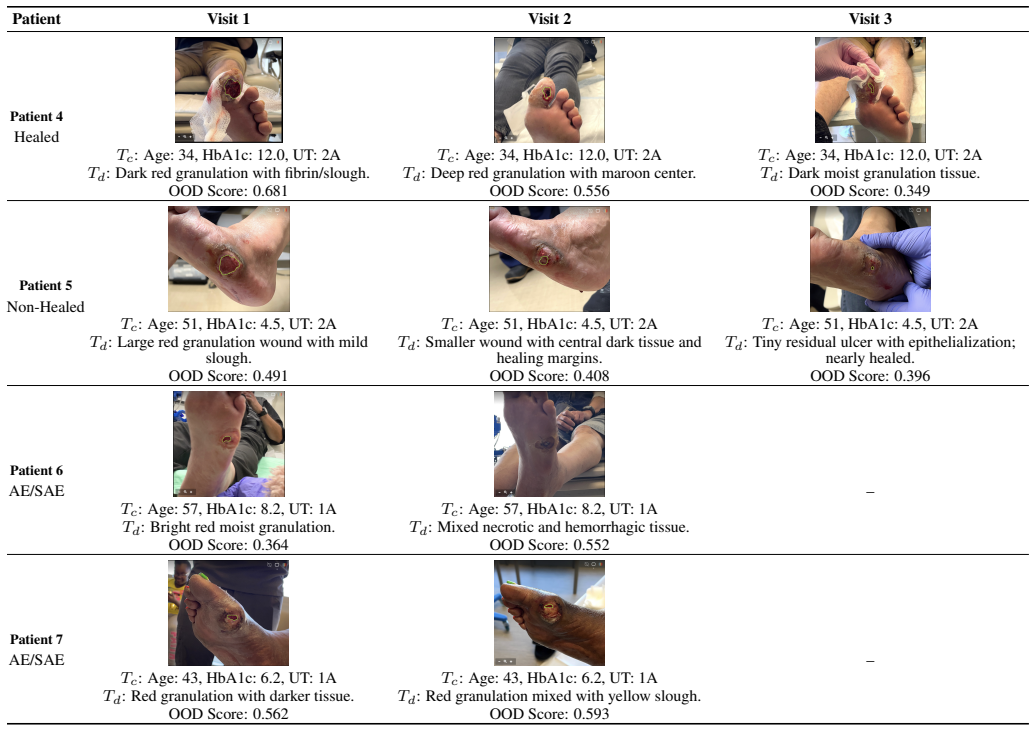
free parameters (5)
- LoRA rank r and scale α
- fusion scalars α,β,λ,μ and softplus β̃,η̃
- loss weights λcov, λtemp
- decision threshold δq percentile
- temperature τ and spatial mix γs
assumptions (4)
- domain assumption Normal healing produces monotonically decreasing wound area; expansion is a physiological anomaly that should amplify the temporal OOD penalty.
- domain assumption SAE presentations lie outside the support of the ID healing classes and can therefore be detected without SAE labels by mismatch to ID prototypes.
- ad hoc to paper Automatically generated Td descriptions (restricted VLM prompt) are faithful enough proxies for visual wound state that caption-text and caption-visual scores remain informative.
- domain assumption Patient-level chronological split with terminal SAE images held out as OOD is a valid evaluation of personalized early detection.
invented entities (2)
-
cross-contextual merged adapter ΔWmerged = αBcAc + βBdAd + λBcAd + μBdAc
-
wound-adapted fused OOD score SFUSED combining SID, SVIS, SCAP-T, SCAP-V with area-reweighted temporal penalty
Cite this review
Pith. "Pith review of Cross-Contextual Vision-Language Adaptation with LoRA for Personalized Severe Adverse Event Detection in Clinical Wound Monitoring." pith.science (2026). https://pith.science/paper/QO45F7UN
@misc{pith2026260705625,
  author       = {Pith},
  title        = {Pith review of: Cross-Contextual Vision-Language Adaptation with LoRA for Personalized Severe Adverse Event Detection in Clinical Wound Monitoring},
  year         = {2026},
  howpublished = {\url{https://pith.science/paper/QO45F7UN}},
  note         = {Machine review of arXiv:2607.05625}
}
read the original abstract
Wound monitoring is a critical yet underserved clinical challenge, where timely identification of severe adverse events (SAEs) such as infection, tissue deterioration, and delayed healing can significantly impact patient outcomes. While vision-language models (VLMs) show strong multimodal reasoning, they often lack domain-specific grounding to integrate wound imagery with heterogeneous clinical information, and provide limited mechanisms for detecting cases that diverge from the training distribution. We present a multimodal framework for automated wound monitoring and SAE detection. Our approach leverages paired clinical notes and wound descriptions capturing visual characteristics such as appearance, surrounding skin condition, color changes, and signs of inflammation or healing progression, encoded through a dual-stream Low-Rank Adaptation (LoRA) framework built on a frozen BiomedCLIP backbone. We introduce a cross-contextual LoRA fusion mechanism enabling information exchange between clinical semantics and visual wound descriptors, producing context-aware multimodal representations without full model fine-tuning. To identify personalized SAEs, we propose a wound-specific out-of-distribution (OOD) detection framework combining semantic matching, visual typicality, caption-text alignment, and caption-visual alignment into a unified SAE (OOD) score. To capture healing dynamics, we incorporate covariate consistency and temporal drift penalties that leverage changes in wound characteristics across visits. Experiments on a longitudinal wound dataset collected through clinical visits show promising performance on both wound healing assessment and SAE detection, highlighting the potential of semantically enriched, temporally aware vision-language systems for clinical wound monitoring and early risk identification.
Figures


Figures from the paper (3 more)


Reference graph
Works this paper leans on
-
[1]
D. M. Anisuzzaman, Chuanbo Wang, Behrouz Rostami, Sandeep Gopalakrishnan, Jeffrey Niezgoda, and Zeyun Yu. Multi-modal wound classification using wound image and location by deep neural network.Scientific Reports, 12(1): 20057, 2022. 2, 12
2022
-
[2]
D. M. Anisuzzaman, Chuanbo Wang, Behrouz Rostami, Sandeep Gopalakrishnan, Jeffrey Niezgoda, and Zeyun Yu. Image-based artificial intelligence in wound assessment: A systematic review.Advances in Wound Care, 11(12):687– 709, 2022. 12
2022
-
[3]
Armstrong, Andrew J
David G. Armstrong, Andrew J. M. Boulton, and Sicco A. Bus. Diabetic foot ulcers and their recurrence.New England Journal of Medicine, 376(24):2367–2375, 2017. 2, 12
2017
-
[4]
Castro, Benedikt Boecking, Harshita Sharma, Kenza Bouzid, Anja Thieme, Anton Schwaighofer, Maria Wetscherek, Matthew P
Shruthi Bannur, Stephanie Hyland, Qianchu Liu, Fernando Perez-Garcia, Maximilian Ilse, Daniel C. Castro, Benedikt Boecking, Harshita Sharma, Kenza Bouzid, Anja Thieme, Anton Schwaighofer, Maria Wetscherek, Matthew P. Lun- gren, Aditya Nori, Javier Alvarez-Valle, and Ozan Oktay. Learning to exploit temporal structure for biomedical vision- language process...
2023
-
[5]
Autoencoders for unsuper- vised anomaly segmentation in brain MR images: A com- parative study.Medical Image Analysis, 69:101952, 2021
Christoph Baur, Stefan Denner, Benedikt Wiestler, Nassir Navab, and Shadi Albarqouni. Autoencoders for unsuper- vised anomaly segmentation in brain MR images: A com- parative study.Medical Image Analysis, 69:101952, 2021. 12, 13
2021
-
[6]
Andrew J. M. Boulton, Loretta Vileikyte, Gunnel Ragnarson-Tennvall, and Jan Apelqvist. The global burden of diabetic foot disease.The Lancet, 366(9498): 1719–1724, 2005. 1, 2, 12
2005
-
[7]
Reeves, Joseph M
Bill Cassidy, Connah Kendrick, Neil D. Reeves, Joseph M. Pappachan, Claire O’Shea, David G. Armstrong, and Moi Hoon Yap. Diabetic foot ulcer grand challenge 2021: Evaluation and summary. InDiabetic Foot Ulcers Grand Challenge (DFUC 2021), Lecture Notes in Computer Sci- ence, vol. 13183. Springer, 2022. 2, 12
2021
-
[8]
Fabio Cruciani, Manon Kappelhof, Bram Hartogsveld, Linda Schoonmade, Joanne J. T. H. Roelofs, Max J. L. Peters, Ivo Smits, Roel Wijnands, Ed van Bavel, Anton F. W. van der Steen, and Michiel Schinkel. Multimodal ai on wound im- ages and clinical notes for home patient referral.arXiv preprint arXiv:2501.13247, 2025. 2, 12
work page Pith review arXiv 2025
Show all 55 references
-
[9]
Extremely simple activation shaping for out- of-distribution detection
Andrija Djurisic, Nebojsa Bozanic, Arjun Ashok, and Rosanne Liu. Extremely simple activation shaping for out- of-distribution detection. InProceedings of the International Conference on Learning Representations (ICLR), 2023. 2, 12
2023
-
[10]
Graham, Walter H
Mark S. Graham, Walter H. L. Pinaya, Petru-Daniel Tudosiu, Parashkev Nachev, Sebastien Ourselin, and Jorge Cardoso. Denoising diffusion models for out-of-distribution detection. InProceedings of the IEEE/CVF Conference on Computer Vision and Pattern Recognition Workshops (CVPR...
2023
-
[11]
Domain-specific language model pre- training for biomedical natural language processing.ACM Transactions on Computing for Healthcare, 3(1):1–23, 2021
Yu Gu, Robert Tinn, Hao Cheng, Michael Lucas, Naoto Usuyama, Xiaodong Liu, Tristan Naumann, Jianfeng Gao, and Hoifung Poon. Domain-specific language model pre- training for biomedical natural language processing.ACM Transactions on Computing for Healthcare, 3(1):1–23, 2021. 12
2021
-
[12]
A baseline for detecting misclassified and out-of-distribution examples in neural net- works
Dan Hendrycks and Kevin Gimpel. A baseline for detecting misclassified and out-of-distribution examples in neural net- works. InProceedings of the International Conference on Learning Representations (ICLR), 2017. 2, 12
2017
-
[13]
Deep anomaly detection with outlier exposure
Dan Hendrycks, Mantas Mazeika, and Thomas Dietterich. Deep anomaly detection with outlier exposure. InProceed- ings of the International Conference on Learning Represen- tations (ICLR), 2019. 2, 12
2019
-
[14]
Out-of-distribution detec- tion in medical image analysis: A survey.arXiv preprint arXiv:2404.18279, 2024
Ziyang Hong, Yizhou Yue, Yongkang Chen, Lin Cong, Hongbo Lin, Yuning Luo, Menghan Wang, Wei Wang, Jialin Xu, Xiaokun Yang, et al. Out-of-distribution detec- tion in medical image analysis: A survey.arXiv preprint arXiv:2404.18279, 2024. 13
2024 arXiv
-
[15]
Parameter-efficient transfer learning for nlp
Neil Houlsby, Andrei Giurgiu, Stanislaw Jastrzebski, Bruna Morrone, Quentin de Laroussilhe, Andrea Gesmundo, Mona Attariyan, and Sylvain Gelly. Parameter-efficient transfer learning for nlp. InProceedings of the International Confer- ence on Machine Learning (ICML), pages 2790...
2019
-
[16]
Hu, Yelong Shen, Phillip Wallis, Zeyuan Allen- Zhu, Yuanzhi Li, Shean Wang, Lu Wang, and Weizhu Chen
Edward J. Hu, Yelong Shen, Phillip Wallis, Zeyuan Allen- Zhu, Yuanzhi Li, Shean Wang, Lu Wang, and Weizhu Chen. LoRA: Low-rank adaptation of large language models. InIn- ternational Conference on Learning Representations, 2022. 1, 2, 3, 12
2022
-
[17]
Winclip: Zero- /few-shot anomaly classification and segmentation
Jongheon Jeong, Yang Zou, Taewan Kim, Dongqing Zhang, Avinash Ravichandran, and Onkar Dabeer. Winclip: Zero- /few-shot anomaly classification and segmentation. InPro- ceedings of the IEEE/CVF Conference on Computer Vision and Pattern Recognition (CVPR), pages 19606–19616, 2023. 13
2023
-
[18]
Negative label guided ood detec- 9 tion with pretrained vision-language models
Xue Jiang, Feng Liu, Zhen Fang, Hong Chen, Tongliang Liu, Feng Zheng, and Bo Han. Negative label guided ood detec- 9 tion with pretrained vision-language models. InProceedings of the International Conference on Learning Representations (ICLR), 2024. 2, 13
2024
-
[19]
A simple unified framework for detecting out-of-distribution samples and adversarial attacks
Kimin Lee, Kibok Lee, Honglak Lee, and Jinwoo Shin. A simple unified framework for detecting out-of-distribution samples and adversarial attacks. InAdvances in Neural In- formation Processing Systems, pages 7167–7177, 2018. 2, 12
2018
-
[20]
Llava-med: Training a large language- and-vision assistant for biomedicine in one day
Chunyuan Li, Cliff Wong, Sheng Zhang, Naoto Usuyama, Haotian Liu, Jianwei Yang, Tristan Naumann, Hoifung Poon, and Jianfeng Gao. Llava-med: Training a large language- and-vision assistant for biomedicine in one day. InAd- vances in Neural Information Processing Systems (NeurIP...
2024
-
[21]
BLIP-2: Bootstrapping language-image pre-training with frozen image encoders and large language models
Junnan Li, Dongxu Li, Silvio Savarese, and Steven Hoi. BLIP-2: Bootstrapping language-image pre-training with frozen image encoders and large language models. InIn- ternational Conference on Machine Learning, pages 19730– 19742, 2023. 1, 12
2023
-
[22]
Prefix-tuning: Optimizing continuous prompts for generation
Xiang Lisa Li and Percy Liang. Prefix-tuning: Optimizing continuous prompts for generation. InProceedings of the 59th Annual Meeting of the Association for Computational Linguistics (ACL), pages 4582–4597, 2021. 12
2021
-
[23]
Shiyu Liang, Yixuan Li, and R. Srikant. Enhancing the re- liability of out-of-distribution image detection in neural net- works. InProceedings of the International Conference on Learning Representations (ICLR), 2018. 2, 12
2018
-
[24]
Energy-based out-of-distribution detection
Weitang Liu, Xiaoyun Wang, John Owens, and Yixuan Li. Energy-based out-of-distribution detection. InAdvances in Neural Information Processing Systems (NeurIPS), pages 21464–21475, 2020. 2, 12
2020
-
[25]
Delving into out-of-distribution detection with vision-language representations
Yifei Ming, Ziyang Cai, Jiuxiang Gu, Yiyou Sun, Wei Li, and Yixuan Li. Delving into out-of-distribution detection with vision-language representations. InAdvances in Neural Information Processing Systems, 2022. 2
2022
-
[26]
Delving into out-of-distribution detection with vision-language representations
Yifei Ming, Ziyang Cai, Jiuxiang Gu, Yiyou Sun, Wei Li, and Yixuan Li. Delving into out-of-distribution detection with vision-language representations. InAdvances in Neural Information Processing Systems, 2022. 13
2022
-
[27]
Locoop: Few-shot out-of-distribution detection via prompt learning
Atsuyuki Miyai, Qing Yu, Go Irie, and Kiyoharu Aizawa. Locoop: Few-shot out-of-distribution detection via prompt learning. InAdvances in Neural Information Processing Sys- tems (NeurIPS), pages 76298–76310, 2023. 2, 6, 13
2023
-
[28]
Gl-mcm: Global and local maximum concept matching for zero-shot out-of-distribution detection.International Jour- nal of Computer Vision, 2025
Atsuyuki Miyai, Qing Yu, Go Irie, and Kiyoharu Aizawa. Gl-mcm: Global and local maximum concept matching for zero-shot out-of-distribution detection.International Jour- nal of Computer Vision, 2025. 2, 13
2025
-
[29]
Michael Moor, Stefan Hegselmann, Niklas Gruber, Hyun Jin Kim, Michela Klug, Aditya Bose, Roy Katan, Harsha Nori, Matthew Davison, Urvashi Bhatt, Jason Alan Fries, and Nigam H. Shah. Med-flamingo: A multimodal medical few- shot learner. InProceedings of Machine Learning for Hea...
2023
-
[30]
T-QPM: Enabling temporal out-of-distribution detection and domain general- ization for vision-language models in open-world.arXiv preprint arXiv:2603.18481, 2026
Aditi Naiknaware and Salimeh Sekeh. T-QPM: Enabling temporal out-of-distribution detection and domain general- ization for vision-language models in open-world.arXiv preprint arXiv:2603.18481, 2026. 2, 4, 6, 13
2026 arXiv
-
[31]
Learning transferable visual models from natural language supervision
Alec Radford, Jong Wook Kim, Chris Hallacy, Aditya Ramesh, Gabriel Goh, Sandhini Agarwal, Girish Sastry, Amanda Askell, Pamela Mishkin, Jack Clark, Gretchen Krueger, and Ilya Sutskever. Learning transferable visual models from natural language supervision. InProceedings of the...
2021
-
[32]
Behrouz Rostami, D. M. Anisuzzaman, Chuanbo Wang, Sandeep Gopalakrishnan, Jeffrey Niezgoda, and Zeyun Yu. Multiclass wound image classification using an ensem- ble deep cnn-based classifier.Computers in Biology and Medicine, 134:104536, 2021. 2, 12
2021
-
[33]
Detect-and- segment: A deep learning approach to automate wound im- age segmentation.Informatics in Medicine Unlocked, 29: 100884, 2022
Gaetano Scebba, Jia Zhang, Sara Catanzaro, Cosmin Mihai, Oliver Distler, Martin Berli, and Walter Karlen. Detect-and- segment: A deep learning approach to automate wound im- age segmentation.Informatics in Medicine Unlocked, 29: 100884, 2022. 1, 2, 12
2022
-
[34]
Understanding cross-modal contributions in continual vision-language models: A theo- retical perspective.arXiv preprint arXiv:2606.14883, 2026
Salimeh Sekeh and Mary Wisell. Understanding cross-modal contributions in continual vision-language models: A theo- retical perspective.arXiv preprint arXiv:2606.14883, 2026. 1, 2, 12, 13
2026
-
[35]
React: Out-of- distribution detection with rectified activations
Yiyou Sun, Chuan Guo, and Yixuan Li. React: Out-of- distribution detection with rectified activations. InAdvances in Neural Information Processing Systems (NeurIPS), pages 144–157, 2021. 2, 12
2021
-
[36]
Out-of- distribution detection with deep nearest neighbors
Yiyou Sun, Yifei Ming, Xiaojin Zhu, and Yixuan Li. Out-of- distribution detection with deep nearest neighbors. InPro- ceedings of the International Conference on Machine Learn- ing (ICML), pages 20827–20840, 2022. 2, 12
2022
-
[37]
Csi: Novelty detection via contrastive learning on dis- tributionally shifted instances
Jihoon Tack, Sangwoo Mo, Jongheon Jeong, and Jinwoo Shin. Csi: Novelty detection via contrastive learning on dis- tributionally shifted instances. InAdvances in Neural Infor- mation Processing Systems (NeurIPS), pages 11839–11852,
-
[38]
Gomez, Lukasz Kaiser, and Illia Polosukhin
Ashish Vaswani, Noam Shazeer, Niki Parmar, Jakob Uszko- reit, Llion Jones, Aidan N. Gomez, Lukasz Kaiser, and Illia Polosukhin. Attention is all you need. InAdvances in Neural Information Processing Systems (NeurIPS), 2017. 13
2017
-
[39]
Chuanbo Wang, D. M. Anisuzzaman, Victor Williamson, Mrinal Kanti Dhar, Behrouz Rostami, Jeffrey Niezgoda, Sandeep Gopalakrishnan, and Zeyun Yu. Fully automatic wound segmentation with deep convolutional neural net- works.Scientific Reports, 10(1):21897, 2020. 2, 12
2020
-
[40]
Vim: Out-of-distribution with virtual-logit matching
Haoqi Wang, Zhizhong Li, Litong Feng, and Wayne Zhang. Vim: Out-of-distribution with virtual-logit matching. InPro- ceedings of the IEEE/CVF Conference on Computer Vision and Pattern Recognition (CVPR), pages 4921–4930, 2022. 2, 12
2022
-
[41]
Clipn for zero-shot ood detection: Teaching clip to say no
Hualiang Wang, Yi Li, Huifeng Yao, and Xiaomeng Li. Clipn for zero-shot ood detection: Teaching clip to say no. InProceedings of the IEEE/CVF International Conference on Computer Vision (ICCV), pages 1802–1812, 2023. 2, 13
2023
-
[42]
Medclip: Contrastive learning from unpaired medical images and text.arXiv preprint arXiv:2210.10163, 2022
Zifeng Wang, Zhenbang Wu, Dinesh Agarwal, and Jimeng Sun. Medclip: Contrastive learning from unpaired medical images and text.arXiv preprint arXiv:2210.10163, 2022. 2, 12
2022 arXiv
-
[43]
Openood: Benchmarking generalized out-of-distribution de- tection
Jingkang Yang, Pengyun Wang, Dejian Zou, Zitang Zhou, Kunyuan Ding, Wenxuan Peng, Haoqi Wang, Guangyao 10 Chen, Bo Li, Yiyou Sun, Xuefeng Du, Kaiyang Zhou, Wayne Zhang, Dan Hendrycks, Yixuan Li, and Ziwei Liu. Openood: Benchmarking generalized out-of-distribution de- tection. ...
2022
-
[44]
Generalized out-of-distribution detection: A survey.Inter- national Journal of Computer Vision, 132(12):5635–5662,
Jingkang Yang, Kaiyang Zhou, Yixuan Li, and Ziwei Liu. Generalized out-of-distribution detection: A survey.Inter- national Journal of Computer Vision, 132(12):5635–5662,
-
[45]
Adalora: Adaptive budget allocation for parameter-efficient fine-tuning
Qingru Zhang, Minshuo Chen, Alexander Bukharin, Nikos Karampatziakis, Pengcheng He, Yu Cheng, Weizhu Chen, and Tuo Zhao. Adalora: Adaptive budget allocation for parameter-efficient fine-tuning. InProceedings of the In- ternational Conference on Learning Representations (ICLR),
-
[46]
Lungren, Tris- tan Naumann, and Hoifung Poon
Sheng Zhang, Yanbo Xu, Naoto Usuyama, Jaspreet Kaur Bagga, Robert Tinn, Sam Preston, Rajesh Rao, Mu-Hsin Wei, Naveen Valluri, Cliff Wong, Matthew P. Lungren, Tris- tan Naumann, and Hoifung Poon. BiomedCLIP: a mul- timodal biomedical foundation model pretrained from fif- teen m...
2023 arXiv
-
[47]
Vision-language dual-pattern matching for out-of-distribution detection
Zihan Zhang, Zhuo Xu, and Xiang Xiang. Vision-language dual-pattern matching for out-of-distribution detection. In European Conference on Computer Vision, pages 273–291. Springer, 2024. 2, 6
2024
-
[48]
Conditional prompt learning for vision-language models
Kaiyang Zhou, Jingkang Yang, Chen Change Loy, and Zi- wei Liu. Conditional prompt learning for vision-language models. InIEEE/CVF Conference on Computer Vision and Pattern Recognition, pages 16816–16825, 2022. 1, 2, 12
2022
-
[49]
Learning to prompt for vision-language models.In- ternational Journal of Computer Vision, 130(9):2337–2348,
Kaiyang Zhou, Jingkang Yang, Chen Change Loy, and Ziwei Liu. Learning to prompt for vision-language models.In- ternational Journal of Computer Vision, 130(9):2337–2348,
-
[50]
A systematic review of image- based AI for wound assessment [2] identifies segmentation, tissue classification, and healing-trajectory prediction as the three central tasks
Extended Related Work Wound Image Analysis and DFU Monitoring Chronic wound management imposes a substantial global burden: DFUs affect 15–25% of diabetic patients over their lifetime with 25–44% one-year recurrence rates following healing [3, 6]. A systematic review of image-...
-
[51]
Details on Quadruple Cross-Modal Scores SID: Semantic Matching Score (image↔ID text bank). SID(Ii) = max k∈{0,1} zID(Ii)[k] τ .(16) A high value indicates that the wound image is visually con- sistent with a known ID healing class; a low value suggests the visual appearance de...
-
[52]
Implementation Details All experiments were implemented in PyTorch and con- ducted on a single NVIDIA L40 GPU. The proposed framework utilizes BiomedCLIP as the multimodal vision- language backbone, where wound images are encoded us- ing the pretrained visual encoder and clini...
-
[53]
The covari- ate consistency and temporal consistency objectives were weighted byλ cov = 0.1andλ temp = 0.05, respectively
The temperature parameter used in the multimodal sim- ilarity computation was fixed toτ= 0.07, while the spatial attention mixing weight was set toγ s = 0.5. The covari- ate consistency and temporal consistency objectives were weighted byλ cov = 0.1andλ temp = 0.05, respective...
-
[54]
Baseline images were assigned to week 0, while subsequent visits were indexed by their cor- responding clinical follow-up week
Clinical Description of Wound Dataset Temporal wound organization.For each participant, wound images were chronologically ordered according to the clinical visit sequence extracted from image filenames and study metadata. Baseline images were assigned to week 0, while subseque...
-
[55]
Training Dynamics Figure 3 in the main paper shows the three individual loss components over 10 epochs.L ID decreases rapidly in early epochs, reflecting stable adaptation to in-distribution wound categories.L COV remains consistently low throughout, confirming invariant OOD a...
Reviewed July 11, 2026 · model on record in the stance chip above.
Discussion (0). Sign in to comment.