REVIEW 3 major objections 5 minor 1 cited by
Low-Resource Name Tagging Learned with Weakly Labeled Data
T0 review · 3 major / 5 minor · reviewed 2026-08-14 · deepseek-v4-flash
Pith's one-line read The paper claims a two-module model trained only on noisy Wikipedia labels beats weakly supervised baselines in low-resource name tagging.
desk verdict A plausible two-module weak-supervision architecture for NER, but the self-built Wikipedia test set and a theta_n inconsistency leave the headline F1 gains unvalidated on real low-resource text. read the letter →
The pith
A machine-rendered reading of the paper's core claim, the machinery that carries it, and where it could break.
The reading
What carries the argument
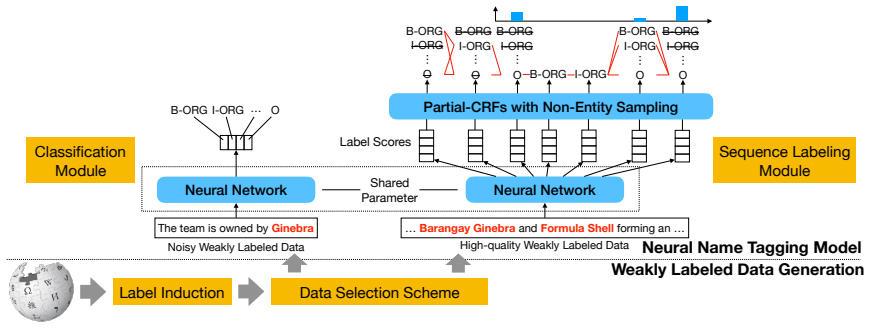
Partial-CRFs with non-entity sampling is the central machinery: a conditional random field that, for unlabeled words, sums probability over all compatible label sequences instead of requiring one gold label, augmented by a sampling step that labels some unlabeled words as O using linguistic features such as adjacency to an entity, frequency of appearing inside mentions, and term/document frequency. Around it, the paper places a data-selection scheme that scores each Wikipedia sentence by annotation confidence and coverage, applies thresholds $\theta_q$ and $\theta_n$, and splits the corpus into high-quality portions for the sequence module and noisy portions for the classification module; a shared BiLSTM with CNN character embeddings carries both modules.
What would settle it
Take the five languages, have native-speaker annotators label a held-out set of ordinary sentences not filtered by anchor coverage, and run the trained model against it; if the F1 gap over baselines disappears or reverses, the reported improvement is an artifact of test-set construction.
Extended reading notes
Core claim
On the paper's own terms, the central discovery is that all weakly labeled data can be used profitably if split by quality: a classification module trained only on labeled words in noisy sentences pretrains the tag classifier by capturing context, while a sequence-labeling module trained on high-confidence sentences with Partial-CRFs and non-entity sampling reaches a globally consistent tag sequence. The two modules share parameters and are trained in sequence, with classifier pretraining followed by sequence-labeling fine-tuning. In experiments on Welsh, Bengali, Yoruba, Mongolian, and Egyptian Arabic, this combined model consistently outperforms all baselines in F1, such as 93.4 versus 92.3 on Bengali and 90.1 versus 87.1 on Mongolian, and it outperforms all food-domain baselines by 7.8% F1 on average. The authors interpret the gains as coming from recall: the model exploits far more training signal, while non-entity sampling controls the precision loss that plain Partial-CRFs suffer.
Load-bearing premise
The evaluation assumes that an automatically built Wikipedia test set, selected by the same anchor and taxonomy pipeline that makes the training labels, behaves like real human-annotated text in these low-resource languages.
Editorial extensions
If this is right
- The model needs no seed annotations, domain dictionaries, or human-annotated NER data, so it can be applied to a new language or domain as soon as Wikipedia anchors and a category taxonomy are available.
- The quality split makes training efficient: the Mongolian study shows runtime dropping from about 90 to 20 minutes while F1 stays stable, so large noisy corpora become usable in practice.
- Non-entity sampling lets Partial-CRF training proceed without explicit O labels, and tuning the sampling ratio $\alpha$ interpolates between pure Partial-CRF behavior and full CRF behavior.
- The method works across different encoders, since CNN, BiLSTM, and Transformer variants all reach competitive precision in the reported experiments.
Reading between the lines
- If the Wikipedia-derived test set is biased toward anchor-like text, the 6% and 7.8% gains could shrink on human-annotated low-resource text; the safe reading is that the method is a strong free pretraining step, not proof of parity with supervised taggers.
- The two-module split suggests a general recipe for other sequence tasks with partial labels, such as part-of-speech tagging or chunking from weakly supervised sources: use noisy data for context modeling and clean data for transition constraints.
- The non-entity sampling features $f_2$ and $f_3$ are language-independent statistics, so a natural test is whether they transfer to morphologically richer languages beyond the five studied, and whether the $f_1$ feature should be disabled globally.
- A testable extension is to combine this weak-only pretraining with a small amount of human annotation, measuring how much labeled data is needed to match fully supervised systems.
Signed reviews
Editorial analysis
A structured set of objections, weighed in public.
Referee Report
Summary. The paper proposes a neural name-tagging system trained exclusively on weakly labeled Wikipedia data, without seed annotations or external dictionaries. It splits weakly labeled sentences into a high-quality portion used to train a Partial-CRF sequence-labeling module and a noisy portion used to pretrain a word-level classification module, with parameters shared between the two modules. Labels are induced from Wikipedia anchors and a taxonomy, and a sentence-level quality score based on annotation confidence and coverage is used to perform the split. Experiments on five low-resource languages and a fine-grained food domain report average F1 gains of 6% and 7.8% over adapted weakly supervised baselines, together with efficiency gains.
Significance. The proposed two-module design is a reasonable and clearly described approach to exploiting noisy weakly labeled data, and the idea of using the classification module to pretrain the shared encoder on large noisy data while the sequence labeler focuses on high-quality data is well motivated. The paper provides consistent equations, detailed ablations of non-entity sampling ratio and features, and a public code release, which are welcome strengths. However, the significance of the empirical claims is currently limited by the non-independent test set and the absence of significance testing. If the method is re-evaluated on independent human-annotated benchmarks, the approach could be a practical contribution to low-resource name tagging.
major comments (3)
- [6.1 and 6.4] Section 6.1 states 'By heuristically setting θq = 0.1, θn = 0.9' to produce the high-quality/noisy split and the statistics in Table 1, while Section 6.4 states 'we pick up θn = 0.1 in experiments.' These two values are incompatible: with θn = 0.1, the high-quality set would be much larger than reported in Table 1, and the noisy set correspondingly smaller, changing the balance between the two modules. The exact configuration used for Tables 2 and 3 is therefore ambiguous. Please clarify the correct threshold and report the actual number of high-quality and noisy sentences used in the main experiments.
- [6.1, Tables 2-3] The test set is not an independent human-annotated benchmark. As described in Section 6.1, test sentences are selected from the same Wikipedia anchor/taxonomy pipeline used to generate the training labels, by keeping 25% of sentences with the highest annotation confidence and coverage above 0.3. These are the same quality measures used in the data selection scheme of Section 4.2 to split training data. This creates a risk of circularity: the model may learn to imitate the label-induction process rather than to recognize entities in naturally occurring text. No human-annotated test set is used for any language or for the food domain, so the reported 6% and 7.8% average F1 gains may not transfer to real low-resource text. Please evaluate on independent human-annotated data, or at least on a held-out set constructed by a different annotation process, and report both results.
- [6.2, Tables 2-3] The claim that the model 'consistently outperforms all baselines' is not supported by statistical significance testing. Several test sets are very small (e.g., Yoruba has 77 test sentences and 232 mentions; Mongolian has 173 sentences), so the reported differences, which are often only 1–3 F1 points, may fall within the noise. Please report variance across multiple runs, confidence intervals, or pairwise significance tests for all languages and the food domain.
minor comments (5)
- [5.1, Eq. (7)] In Eq. (7), the loss is written over 'Dnq'; based on the surrounding text this should be 'Dhq', the high-quality set. Please correct the subscript.
- [5.1] In Eq. (8), the notation '˜yi = N' is used for unlabeled words, but 'N' is not defined in the preliminaries (Section 3.1 defines UN, B-NT, I-NT). Please define N or use the existing notation.
- [6.1, Training Details] The non-entity feature weights λ1, λ2, λ3 are set heuristically to 0, 0.9, 0.1. It would be helpful to state the range over which these were tuned and whether the main results are stable to perturbations of these values.
- [6.2] The sentence 'we greatly improve recall (2.7% to 9.34% on average)' is unclear; it appears to mean that recall improvements range from 2.7 to 9.34 percentage points. Please rephrase.
- [Figure 3(a)] The x-axis for the efficiency analysis is not labeled in the figure caption; please include axis labels showing θn values and units for training time.
Circularity Check
The reported F1 gains are measured against a test set generated and selected by the same Wikipedia-anchor/taxonomy pipeline that creates the training labels, making the benchmark partially self-referential.
-
self definitional
[Section 6.1 (Datasets; Eqs. (2)-(4))]
"Since most datasets on low-resource languages are not publicly available, we use Wikipedia data as the 'ground truth' ... For correctness, we then pick up test data of 25% sentences that has highest annotation confidence and exceed 0.3 coverage."
Both training and test labels are generated by the same label-induction process from Wikipedia anchors and taxonomy (Eq. (1)). The test sentences are selected using the same annotation-confidence q(X,Ỹ) (Eq. (2)) and coverage n(X,Ỹ) (Eq. (3)) scores that define the high-quality/noisy split in Eq. (4). Thus the F1 in Tables 2-3 measures agreement with the paper's own WL-generation function on anchor-dense sentences, not with human-annotated NER in ordinary low-resource text. The reported 6%/7.8% gains are relative to this self-generated benchmark; the evaluation does not by construction validate the claim that the model transfers to arbitrary low-resource settings.
full rationale
The model equations and training objectives are not themselves circular: the two-module learning scheme (classification pre-training on noisy data, Partial-CRFs on high-quality data) is a genuine derivation from the WL data, and the baselines are compared on the same labels. The core circularity is the evaluation. Section 6.1 declares Wikipedia data to be 'ground truth' and then builds the test set by taking the 25% of sentences with highest annotation confidence and coverage above 0.3, using the same q and n scores from Eqs. (2)-(3) that define the training split. Consequently, the F1 is by construction a measure of how well the model reproduces the anchor-derived labeling function on sentences that function already scores as high-quality; it is not an independent test of name tagging on real low-resource text. A secondary reproducibility issue is that θn is set to 0.9 in Section 6.1 but stated as 0.1 in Section 6.4, which makes the actual train/test split ambiguous; this is a correctness concern rather than circularity. The paper also cites Pan et al. (2017), a work sharing author Heng Ji, as precedent for the Wikipedia-as-ground-truth choice, but the more concrete problem is the self-generated test set itself.
Assumptions & free parameters
free parameters (5)
- θq (annotation confidence threshold) =
0.1
- θn (annotation coverage threshold) =
0.1 (per Section 6.4; Section 6.1 says 0.9)
- α (non-entity sampling ratio) =
0.9
- λ1, λ2, λ3 (non-entity feature weights) =
0, 0.9, 0.1
- Test selection coverage threshold =
0.3
assumptions (5)
- domain assumption Wikipedia anchors and taxonomy provide reliable entity labels for training and evaluation.
- domain assumption Quality score q and coverage n separate high-quality from noisy sentences.
- domain assumption Non-entity sampling features (f1, f2, f3) predict which unlabeled words are O.
- domain assumption High-confidence test sentences from Wikipedia are a valid proxy for real NER test sets.
- ad hoc to paper The manual mapping Γ(Y) from entity types to taxonomy categories is correct.
Cite this review
Pith. "Pith review of Low-Resource Name Tagging Learned with Weakly Labeled Data." pith.science (2026). https://pith.science/paper/QOIBICER
@misc{pith2026190809659,
  author       = {Pith},
  title        = {Pith review of: Low-Resource Name Tagging Learned with Weakly Labeled Data},
  year         = {2026},
  howpublished = {\url{https://pith.science/paper/QOIBICER}},
  note         = {Machine review of arXiv:1908.09659}
}
read the original abstract
Name tagging in low-resource languages or domains suffers from inadequate training data. Existing work heavily relies on additional information, while leaving those noisy annotations unexplored that extensively exist on the web. In this paper, we propose a novel neural model for name tagging solely based on weakly labeled (WL) data, so that it can be applied in any low-resource settings. To take the best advantage of all WL sentences, we split them into high-quality and noisy portions for two modules, respectively: (1) a classification module focusing on the large portion of noisy data can efficiently and robustly pretrain the tag classifier by capturing textual context semantics; and (2) a costly sequence labeling module focusing on high-quality data utilizes Partial-CRFs with non-entity sampling to achieve global optimum. Two modules are combined via shared parameters. Extensive experiments involving five low-resource languages and fine-grained food domain demonstrate our superior performance (6% and 7.8% F1 gains on average) as well as efficiency.
Figures


Figures from the paper (1 more)

Forward citations
Cited by 1 Pith paper
-
Unveiling Factors for Enhanced POS Tagging: A Study of Low-Resource Medieval Romance Languages
Fine-tuning open-source LLMs outperforms prompting for POS tagging on medieval Occitan, French, and Spanish, and pooling Romance training data helps the most under-resourced texts.
Reference graph
Works this paper leans on
-
[1]
URL: " 'urlintro :=
ENTRY address author booktitle chapter edition editor howpublished institution journal key month note number organization pages publisher school series title type volume year eprint doi pubmed url lastchecked label extra.label sort.label short.list INTEGERS output.state before.all mid.sentence after.sentence after.block STRINGS urlintro eprinturl eprintpr...
-
[2]
write newline
" write newline "" before.all 'output.state := FUNCTION n.dashify 't := "" t empty not t #1 #1 substring "-" = t #1 #2 substring "--" = not "--" * t #2 global.max substring 't := t #1 #1 substring "-" = "-" * t #2 global.max substring 't := while if t #1 #1 substring * t #2 global.max substring 't := if while FUNCTION word.in bbl.in capitalize " " * FUNCT...
-
[3]
Isabelle Augenstein, Leon Derczynski, and Kalina Bontcheva. 2017. Generalisation in named entity recognition: A quantitative analysis. Computer Speech & Language
work page 2017
-
[4]
Yixin Cao, Lei Hou, Juanzi Li, and Zhiyuan Liu. 2018 a . Neural collective entity linking. In COLING
work page 2018
-
[5]
Yixin Cao, Lei Hou, Juanzi Li, Zhiyuan Liu, Chengjiang Li, Xu Chen, and Tiansi Dong. 2018 b . Joint representation learning of cross-lingual words and entities via attentive distant supervision. In EMNLP
work page 2018
-
[6]
Yixin Cao, Lifu Huang, Heng Ji, Xu Chen, and Juanzi Li. 2017. Bridge text and knowledge by learning multi-prototype entity mention embedding. In ACL
work page 2017
-
[7]
Yixin Cao, Zhiyuan Liu, Chengjiang Li, Juanzi Li, and Tat-Seng Chua. 2019 a . Multi-channel graph neural network for entity alignment. In ACL
work page 2019
-
[8]
Yixin Cao, Xiang Wang, Xiangnan He, Zikun Hu, and Tat-Seng Chua. 2019 b . Unifying knowledge graph learning and recommendation: Towards a better understanding of user preferences. In WWW
work page 2019
Show all 44 references
-
[9]
Jason Chiu and Eric Nichols. 2016. Named entity recognition with bidirectional lstm-cnns. TACL
2016
-
[10]
Ronan Collobert, Jason Weston, L \'e on Bottou, Michael Karlen, Koray Kavukcuoglu, and Pavel Kuksa. 2011. Natural language processing (almost) from scratch. JMLR
2011
-
[11]
Maud Ehrmann, Marco Turchi, and Ralf Steinberger. 2011. Building a multilingual named entity-annotated corpus using annotation projection. In Proceedings of the International Conference Recent Advances in Natural Language Processing
2011
-
[12]
Xiaocheng Feng, Xiachong Feng, Bing Qin, Zhangyin Feng, and Ting Liu. 2018. Improving low resource named entity recognition using cross-lingual knowledge transfer. In IJCAI
2018
-
[13]
Alexander Fritzler, Varvara Logacheva, and Maksim Kretov. 2018. Few-shot classification in named entity recognition task. arXiv preprint arXiv:1812.06158
2018 arXiv
-
[14]
Johanna Gei , Andreas Spitz, and Michael Gertz. 2017. Neckar: a named entity classifier for wikidata. In International Conference of the German Society for Computational Linguistics and Language Technology. Springer
2017
-
[15]
Alex Graves, Abdel-rahman Mohamed, and Geoffrey Hinton. 2013. Speech recognition with deep recurrent neural networks. In 2013 IEEE international conference on acoustics, speech and signal processing
2013
-
[16]
James Hammerton. 2003. Named entity recognition with long short-term memory. In NAACL
2003
-
[17]
Sepp Hochreiter and J \"u rgen Schmidhuber. 1997. Long short-term memory. Neural computation
1997
-
[18]
Maximilian Hofer, Andrey Kormilitzin, Paul Goldberg, and Alejo Nevado-Holgado. 2018. Few-shot learning for named entity recognition in medical text. arXiv preprint arXiv:1811.05468
2018 arXiv
-
[19]
Jun Kuang, Yixin Cao, Jianbing Zheng, Xiangnan He, Ming Gao, and Aoying Zhou. 2019. Improving neural relation extraction with implicit mutual relations. arXiv preprint arXiv:1907.05333
2019 arXiv
-
[20]
John Lafferty, Andrew McCallum, and Fernando CN Pereira. 2001. Conditional random fields: Probabilistic models for segmenting and labeling sequence data. In ICML
2001
-
[21]
Guillaume Lample, Miguel Ballesteros, Sandeep Subramanian, Kazuya Kawakami, and Chris Dyer. 2016. Neural architectures for named entity recognition. In NAACL
2016
-
[22]
Yann LeCun, Bernhard Boser, John S Denker, Donnie Henderson, Richard E Howard, Wayne Hubbard, and Lawrence D Jackel. 1989. Backpropagation applied to handwritten zip code recognition. Neural computation
1989
-
[23]
Yankai Lin, Zhiyuan Liu, and Maosong Sun. 2017. Neural relation extraction with multi-lingual attention. In ACL
2017
-
[24]
Ying Lin, Shengqi Yang, Veselin Stoyanov, and Heng Ji. 2018. A multi-lingual multi-task architecture for low-resource sequence labeling. In ACL
2018
-
[25]
Xuezhe Ma and Eduard Hovy. 2016. End-to-end sequence labeling via bi-directional lstm-cnns-crf. In ACL
2016
-
[26]
Stephen Mayhew, Chen-Tse Tsai, and Dan Roth. 2017. Cheap translation for cross-lingual named entity recognition. In EMNLP
2017
-
[27]
Jian Ni, Georgiana Dinu, and Radu Florian. 2017. Weakly supervised cross-lingual named entity recognition via effective annotation and representation projection. In ACL
2017
-
[28]
Joel Nothman, James R Curran, and Tara Murphy. 2008. Transforming wikipedia into named entity training data. In Proceedings of the Australasian Language Technology Association Workshop 2008
2008
-
[29]
Xiaoman Pan, Boliang Zhang, Jonathan May, Joel Nothman, Kevin Knight, and Heng Ji. 2017. Cross-lingual name tagging and linking for 282 languages. In ACL
2017
-
[30]
Nanyun Peng and Mark Dredze. 2016. Improving named entity recognition for chinese social media with word segmentation representation learning. In ACL
2016
-
[31]
Jeffrey Pennington, Richard Socher, and Christopher Manning. 2014. Glove: Global vectors for word representation. In EMNLP
2014
-
[32]
Jingbo Shang, Liyuan Liu, Xiaotao Gu, Xiang Ren, Teng Ren, and Jiawei Han. 2018. Learning named entity tagger using domain-specific dictionary. In EMNLP
2018
-
[33]
Qianru Sun, Yaoyao Liu, Tat-Seng Chua, and Bernt Schiele. 2019. Meta-transfer learning for few-shot learning. In CVPR
2019
-
[34]
a ckstr \
Oscar T \"a ckstr \"o m, Dipanjan Das, Slav Petrov, Ryan McDonald, and Joakim Nivre. 2013. Token and type constraints for cross-lingual part-of-speech tagging. TACL
2013
-
[35]
Chen-Tse Tsai, Stephen Mayhew, and Dan Roth. 2016. Cross-lingual named entity recognition via wikification. In CoNLL
2016
-
[36]
Ashish Vaswani, Noam Shazeer, Niki Parmar, Jakob Uszkoreit, Llion Jones, Aidan N Gomez, ukasz Kaiser, and Illia Polosukhin. 2017. Attention is all you need. In NeurIPS
2017
-
[37]
Xiang Wang, Dingxian Wang, Canran Xu, Xiangnan He, Yixin Cao, and Tat-Seng Chua. 2019. Explainable reasoning over knowledge graphs for recommendation. In Proceedings of the AAAI Conference on Artificial Intelligence, volume 33, pages 5329--5336
2019
-
[38]
Jiateng Xie, Zhilin Yang, Graham Neubig, Noah A Smith, and Jaime Carbonell. 2018. Neural cross-lingual named entity recognition with minimal resources. In EMNLP
2018
-
[39]
Mingbin Xu, Hui Jiang, and Sedtawut Watcharawittayakul. 2017. A local detection approach for named entity recognition and mention detection. In ACL
2017
-
[40]
Yaosheng Yang, Wenliang Chen, Zhenghua Li, Zhengqiu He, and Min Zhang. 2018. Distantly supervised ner with partial annotation learning and reinforcement learning. In COLING
2018
-
[41]
Zhilin Yang, Ruslan Salakhutdinov, and William W Cohen. 2017. Transfer learning for sequence tagging with hierarchical recurrent networks. In ICLR
2017
-
[42]
Atefeh Zafarian, Ali Rokni, Shahram Khadivi, and Sonia Ghiasifard. 2015. Semi-supervised learning for named entity recognition using weakly labeled training data. In AISP
2015
-
[43]
Boliang Zhang, Xiaoman Pan, Tianlu Wang, Ashish Vaswani, Heng Ji, Kevin Knight, and Daniel Marcu. 2016. Name tagging for low-resource incident languages based on expectation-driven learning. In NAACL
2016
-
[44]
Jing Zhang, Yixin Cao, Lei Hou, Juanzi Li, and Hai-Tao Zheng. 2017. Xlink: An unsupervised bilingual entity linking system. In CCL
2017
Reviewed August 14, 2026 · model on record in the stance chip above.
Discussion (0). Continue with ORCID to comment.