REVIEW 3 major objections 5 minor 24 references
A Unified Point-Based Framework for 3D Segmentation
T0 review · 3 major / 5 minor · reviewed 2026-08-14 · deepseek-v4-flash
Pith's one-line read A unified point-based network fusing 2D appearance, 3D structure, and global context reports 63.4% mIoU on ScanNet, beating prior fusion methods by double digits.
desk verdict A genuinely useful fusion recipe with clean validation ablations, but the test-set superiority over 3DMV/SplatNet rests on leaderboard scores rather than same-protocol runs. read the letter →
The pith
A machine-rendered reading of the paper's core claim, the machinery that carries it, and where it could break.
The reading
What carries the argument
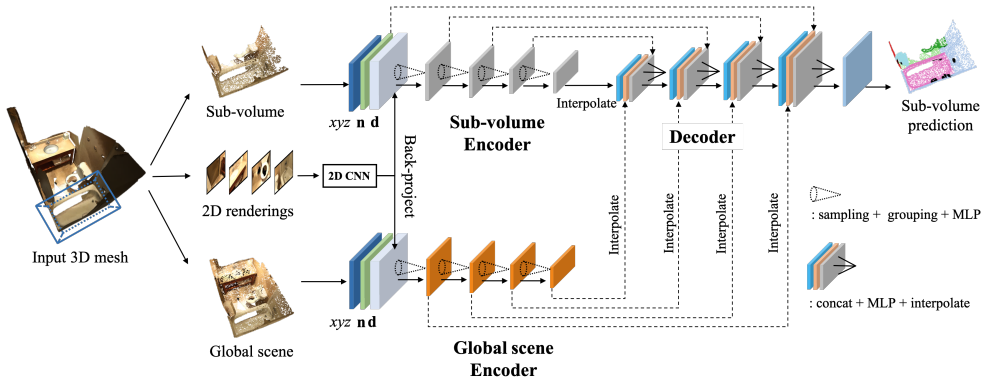
The load-bearing object is the point-level feature vector $(x,y,z,n_x,n_y,n_z,d)$ where $d$ is a 256-dimensional image feature back-projected from a 2D segmentation network. The back-projection is the critical association step: each pixel is unprojected along its ray, intersected with the triangle mesh, and its features are distributed to the three vertices by barycentric interpolation; occluded vertices receive zero vectors. This vector is fed to two point-based encoders: a sub-volume encoder that preserves local detail on 8192 sampled points, and a global scene encoder that reads a sparse 16384-point sample of the whole scene to produce context priors. A four-layer decoder concatenates local, global, and skip features at each point and upsamples to per-point class probabilities. The paper's argument is that this joint point representation — appearance, geometry, context — is what produces the reported gains, with overlapping sliding windows and synthetic camera poses as supporting mechanisms.
What would settle it
Run the paper's exact validation protocol with the global scene encoder removed while keeping image features and normals: the paper predicts 66.3% mIoU, so a result at or above the full 68.2% would show the global-context prior is not doing the claimed work. For the overall superiority claim, a matched head-to-head against 3D Sparse Conv with fine-tuned 2cm voxels and a 3D ResNet backbone — which the paper notes reaches higher performance than the 5cm setting it compares against — would settle whether the point-based fusion genuinely leads.
Extended reading notes
Core claim
The paper's central claim is that 3D semantic segmentation improves when pixel-level appearance, point-level geometry, and global scene context are optimized together in one point-based network, rather than in separate or voxel-based streams. On the ScanNet benchmark it reports 63.4% mIoU on the test set with synthetic camera poses, compared with 48.4% for 3DMV and 39.3% for SplatNet, and 68.2% on validation. The authors attribute the gains to the fused feature vector: adding normals, global context, and 2D image features to raw coordinates raises validation mIoU monotonically from 53.5% to 68.2%. They further show that synthetic camera poses improve robustness to structure-from-motion errors and that overlapping prediction windows add a further boost.
Load-bearing premise
The test-set superiority rests on comparing the authors' own runs with scores other teams posted on the public ScanNet leaderboard, where training data, input modalities, and inference details are not controlled; if those numbers are not directly comparable, the margin claim weakens.
Editorial extensions
If this is right
- On ScanNet validation, every additional feature type — vertex normals, global context, then 2D image features — raises mIoU monotonically from 53.5% (xyz only) to 68.2% (all four).
- With synthesized camera poses, test mIoU rises from 62.1% to 63.4%, and vertex coverage rises from 95.2% to 98.8% as rendered image count increases.
- Overlapping sliding-window inference improves validation mIoU from 59.5% (no overlap) to 62.2% (0.45 m stride).
- Fusing 2D appearance helps precisely in textureless or structureless regions, such as distinguishing pictures from walls.
- Because the framework processes points directly, it avoids the quantization errors of voxelization that the paper attributes to voxel and lattice baselines.
Reading between the lines
- An implicit consequence is that any sensor stream with estimated camera poses — not just offline reconstructed meshes — could receive the same 2D-3D fusion, since the association step only needs poses and a surface representation.
- The per-point concatenated representation is agnostic to the output head, so adapting the decoder to predict instance labels or object parts is a natural next step.
- The synthetic-camera experiments suggest that rendering density is a continuous knob: one could replace SfM refinement with view planning that maximizes vertex coverage, which the paper's Table 5 data already hints at.
- A possible stronger test of the global-context mechanism would be to ablate the scene encoder on scene types not seen at training time; the paper only reports aggregate gains across 21 scene types.
Signed reviews
Editorial analysis
A structured set of objections, weighed in public.
Referee Report
Summary. This paper proposes a unified point-based framework for 3D semantic segmentation on ScanNet. The method renders RGB images from estimated or synthesized camera poses, extracts DeepLab features, back-projects them onto mesh vertices via barycentric interpolation, and concatenates these 256-d descriptors with point coordinates and normals. A sub-volume encoder processes local point clouds, a global scene encoder pools sparse scene-wide context, and a decoder fuses these streams to label each point. Validation experiments analyze feature combinations (Table 3), sliding-window stride (Table 4), and synthetic camera pose density (Table 5); test-set results (Table 2) report 63.4% mIoU with synthetic poses, compared with leaderboard scores of 48.4% for 3DMV and 39.3% for SplatNet. The central claim is that jointly optimizing 2D texture, 3D geometry, and global context yields superior 3D segmentation.
Significance. If the empirical claims are supported, the contribution is useful and timely. The design is simple and modular, the release of code aids reproducibility, and the feature ablation in Table 3 gives a clean, monotone progression from 53.5% (xyz) to 68.2% (full) on validation, supporting the claim that 2D appearance, geometry, and global context are complementary. The synthetic-pose analysis (Table 5) and its 1.3-point test gain are also practically relevant. However, the headline test-set advantage over 3DMV and SplatNet currently rests on leaderboard scores rather than same-protocol runs, and the validation comparison against 3D Sparse Conv uses an explicitly weakened configuration. The significance of the superiority claim therefore depends on closing that protocol gap; the architectural contribution itself is credible.
major comments (3)
- [Section 4, Table 2] The test-set superiority claim over 3DMV and SplatNet is not backed by a same-protocol comparison. Section 4 states that these baselines are taken from the ScanNet leaderboard, while the authors' own runs use their training configuration, synthetic camera poses, and overlapping sliding windows. The paper shows that these choices matter: overlap adds 2.7 points (Section 6.2) and synthetic poses add 1.3 points (Table 2). Since the baselines' inference and preprocessing settings are not controlled, the reported margins (63.4 vs. 48.4 and 39.3) may not be attributable to the unified architecture. I request controlled validation runs for 3DMV and SplatNet under the same inference protocol, or an explicit caveat that Table 2 is a leaderboard comparison, not a controlled comparison.
- [Section 4, Table 1] The validation comparison with 3D Sparse Conv uses a weakened configuration, as the text admits: 'we use 5cm3 color voxels ... though 3D Sparse Conv reaches higher performance with 2cm3 voxels when using 3D ResNet as the backbone network.' Reporting only the 5cm/3D-UNet result makes the 68.2% vs. 60.5% margin over this baseline difficult to interpret as a superiority result. The authors should also report the stronger configuration (2cm voxels with 3D ResNet) or justify why 5cm is the appropriate comparison point for the claim.
- [Section 6.2, Table 4] The stride-size ablation does not state which feature set was used. The 0.45m result (62.2%) equals the xyz+n+gc row of Table 3 and is 6 points below the full model (xyz+n+d+gc, 68.2%), suggesting the ablation was run without the 2D DeepLab features. Since Section 3.3 cites Table 4 to justify the full model's stride, the overlap gain should be re-measured with the full feature set, or the text should explicitly state the configuration used and qualify the conclusion accordingly.
minor comments (5)
- [Table 2, PointNet++ row] The entry '261' for the 'door' class appears to be a typo for '26.1'; please correct it.
- [Section 6.3, Table 5] The text states 'resulting in 61446 and 23146 images in total' while Table 5 lists 61447 images for the first row; the inconsistency should be reconciled.
- [Section 3.1] The introduction says the framework is applicable to any 3D point cloud and 2D image pair, but Section 3.1.2 explicitly requires a triangle mesh for ray-triangle intersection; please clarify how the method handles meshless point clouds.
- [Section 4] The DeepLab baseline samples one frame every 20 frames 'using the same sampling rate as our method,' but Section 3.1 does not state a sampling rate for the proposed method's rendered images; please clarify the matching.
- [Tables 3-5] No variance or repeated runs are reported; adding standard deviations across seeds would help confirm that the 2-6 point differences in the ablations are not within run-to-run noise.
Circularity Check
No significant circularity: the 3D segmentation claim is an external benchmark evaluation, not a derivation from fitted inputs or self-citations.
full rationale
The paper's derivation chain is empirical: it trains a joint 2D-3D point-based architecture on the ScanNet training split and evaluates on held-out validation and test sets. No equation defines the target metric in terms of an input parameter; no fitted parameter is renamed as a prediction; no load-bearing claim is justified by a self-citation. The ablation tables compare feature sets and stride sizes under the same protocol, and the test-set comparison uses external leaderboard scores for baselines. The paper even explicitly discloses that the 3D Sparse Conv validation baseline uses a weakened configuration: 'we use 5cm3 color voxels in 3D Sparse Conv [8] experiment in order to fairly compare with 3DMV [6], though 3D Sparse Conv reaches higher performance with 2cm3 voxels when using 3D ResNet [9] as the backbone network.' That disclosure indicates an honest, non-circular comparison, though the uncontrolled leaderboard baselines (3DMV, SplatNet) are a fairness/correctness risk, not a circularity. Since the central claim is an empirical result evaluated against a public benchmark rather than a derivation from assumptions, there is no significant circularity.
Assumptions & free parameters
free parameters (4)
- Sliding-window stride =
0.45 m
- Synthetic rendered image count =
61,447 (validation), 23,146 (testing)
- Sub-volume and scene sampling counts =
8192 points per sub-volume; 16384 points per scene
- DeepLab feature dimension =
256 channels
assumptions (4)
- domain assumption ScanNet benchmark annotations and online evaluation are reliable and the test set is fixed.
- domain assumption DeepLab features pretrained on ADE20K and fine-tuned on ScanNet renderings transfer useful 2D appearance information to 3D points.
- domain assumption Back-projecting pixel rays and using barycentric interpolation correctly assigns image features to the correct mesh vertices under arbitrary camera poses.
- domain assumption PointNet++ style sampling and grouping with the listed radii captures local geometric structure at the scales needed for indoor objects.
Cite this review
Pith. "Pith review of A Unified Point-Based Framework for 3D Segmentation." pith.science (2026). https://pith.science/paper/QOKWGYMR
@misc{pith2026190800478,
  author       = {Pith},
  title        = {Pith review of: A Unified Point-Based Framework for 3D Segmentation},
  year         = {2026},
  howpublished = {\url{https://pith.science/paper/QOKWGYMR}},
  note         = {Machine review of arXiv:1908.00478}
}
read the original abstract
3D point cloud segmentation remains challenging for structureless and textureless regions. We present a new unified point-based framework for 3D point cloud segmentation that effectively optimizes pixel-level features, geometrical structures and global context priors of an entire scene. By back-projecting 2D image features into 3D coordinates, our network learns 2D textural appearance and 3D structural features in a unified framework. In addition, we investigate a global context prior to obtain a better prediction. We evaluate our framework on ScanNet online benchmark and show that our method outperforms several state-of-the-art approaches. We explore synthesizing camera poses in 3D reconstructed scenes for achieving higher performance. In-depth analysis on feature combinations and synthetic camera pose verify that features from different modalities benefit each other and dense camera pose sampling further improves the segmentation results.
Figures


Figures from the paper (3 more)


Reference graph
Works this paper leans on
- [1]
-
[2]
L.-C. Chen, G. Papandreou, I. Kokkinos, K. Murphy, and A. L. Yuille. Deeplab: Semantic image segmentation with deep convolutional nets, atrous convolution, and fully con- nected crfs. TPAMI, 2018. 4323, 4324, 4325
work page 2018
-
[3]
¨O. C ¸ ic ¸ek, A. Abdulkadir, S. S. Lienkamp, T. Brox, and O. Ronneberger. 3d u-net: learning dense volumetric seg- mentation from sparse annotation. In MICCAI, 2016. 4325
work page 2016
-
[4]
A. Dai, A. X. Chang, M. Savva, M. Halber, T. Funkhouser, and M. Nießner. http://kaldir.vc.in.tum.de/ scannet_benchmark/. 4322, 4324, 4325, 4328
-
[5]
A. Dai, A. X. Chang, M. Savva, M. Halber, T. A. Funkhouser, and M. Nießner. Scannet: Richly-annotated 3d reconstructions of indoor scenes. In CVPR, 2017. 4321, 4322, 4324, 4325
work page 2017
- [6]
-
[7]
B. Graham. Sparse 3d convolutional neural networks. In BMVC, 2015. 4321, 4322
work page 2015
- [8]
Show all 24 references
-
[9]
K. He, X. Zhang, S. Ren, and J. Sun. Deep residual learning for image recognition. In CVPR, 2016. 4325
2016
-
[10]
Hermans, G
A. Hermans, G. Floros, and B. Leibe. Dense 3d semantic mapping of indoor scenes from rgb-d images. InICRA, 2014. 4322
2014
-
[11]
Liang, B
M. Liang, B. Yang, S. Wang, and R. Urtasun. Deep contin- uous fusion for multi-sensor 3d object detection. In ECCV,
-
[12]
C. Liu, J. Wu, and Y . Furukawa. Floornet: A unified frame- work for floorplan reconstruction from 3d scans. In ECCV,
-
[13]
W. Liu, A. Rabinovich, and A. C. Berg. Parsenet: Looking wider to see better. In ICLR, 2016. 4321
2016
-
[14]
Maturana and S
D. Maturana and S. Scherer. V oxnet: A 3d convolutional neural network for real-time object recognition. In IROS,
-
[15]
McCormac, A
J. McCormac, A. Handa, A. Davison, and S. Leutenegger. Semanticfusion: Dense 3d semantic mapping with convolu- tional neural networks. In ICRA, 2017. 4322
2017
-
[16]
C. R. Qi, H. Su, K. Mo, and L. J. Guibas. Pointnet: Deep learning on point sets for 3d classification and segmentation. In CVPR, 2017. 4321, 4322
2017
-
[17]
C. R. Qi, L. Yi, H. Su, and L. J. Guibas. Pointnet++: Deep hierarchical feature learning on point sets in a metric space. In NIPS, 2017. 4321, 4322, 4324, 4325, 4326, 4327
2017
-
[18]
H. Su, V . Jampani, D. Sun, S. Maji, E. Kalogerakis, M.-H. Yang, and J. Kautz. Splatnet: Sparse lattice networks for point cloud processing. In CVPR, 2018. 4321, 4322, 4325
2018
-
[19]
H. Su, S. Maji, E. Kalogerakis, and E. Learned-Miller. Multi- view convolutional neural networks for 3d shape recognition. In ICCV, 2015. 4321
2015
-
[20]
Tchapmi, C
L. Tchapmi, C. Choy, I. Armeni, J. Gwak, and S. Savarese. Segcloud: Semantic segmentation of 3d point clouds. In 3DV, 2017. 4321
2017
-
[21]
W. Wang, R. Yu, Q. Huang, and U. Neumann. Sgpn: Sim- ilarity group proposal network for 3d point cloud instance segmentation. In CVPR, 2018. 4321, 4322
2018
-
[22]
H. Zhao, J. Shi, X. Qi, X. Wang, and J. Jia. Pyramid scene parsing network. In CVPR, 2017. 4321
2017
-
[23]
B. Zhou, H. Zhao, X. Puig, S. Fidler, A. Barriuso, and A. Tor- ralba. Scene parsing through ade20k dataset. InCVPR, 2017. 4323
2017
-
[24]
Zhou and O
Y . Zhou and O. Tuzel. V oxelnet: End-to-end learning for point cloud based 3d object detection. arXiv preprint arXiv:1711.06396, 2017. 4321
2017 arXiv
Reviewed August 14, 2026 · model on record in the stance chip above.
Discussion (0). Continue with ORCID to comment.