REVIEW 4 major objections 6 minor 12 references
Eta-WavLM: Efficient Speaker Identity Removal in Self-Supervised Speech Representations Using a Simple Linear Equation
T0 review · 4 major / 6 minor · reviewed 2026-08-07 · deepseek-v4-flash
Pith's one-line read In Eta-WavLM, subtracting a linear speaker prediction from WavLM features removes most speaker identity and improves voice conversion.
desk verdict Simple linear residual removes a chunk of speaker information from WavLM, but the 'independence' claim is contradicted by the paper's own Table 1; a useful empirical result that needs honest re-framing. read the letter →
The pith
A machine-rendered reading of the paper's core claim, the machinery that carries it, and where it could break.
The reading
What carries the argument
The central object is the affine decomposition $s = f(d) + \eta$ with $f(d) = d^\top A^* + b^*$, where $A^* \in \mathbb{R}^{P \times Q}$ is a latent basis mapping the PCA-reduced speaker embedding ($P=128$) into the WavLM feature space ($Q=1024$) and $b^*$ is a per-dimension bias. The map is fit in closed form via the pseudo-inverse on stacked subsampled frames, then applied at inference by subtracting the same per-utterance speaker term from every frame of the utterance. The load-bearing hypothesis is that high-dimensional SSL embedding spaces linearize speaker/content separation, so a linear $f$ suffices.
What would settle it
Take the fitted linear map and apply it with speaker embeddings that have been randomly permuted across utterances; if the resulting eta representations still reduce speaker classification accuracy by the same amount, then the speaker identity subtraction itself is not the active mechanism and the claimed decomposition is not what removes speaker information.
Extended reading notes
Core claim
The central discovery is that the relation between WavLM frame representations and ECAPA-TDNN speaker embeddings is well approximated by an affine map, so the speaker-independent residual is obtained by subtracting that map: $\eta = s - (d^\top A^* + b^*)$. The latent basis $A^*$ and bias $b^*$ are estimated once by solving a least-squares problem with the pseudo-inverse on the LibriSpeech training set, using 100 randomly subsampled frames per utterance and PCA-reduced speaker embeddings of dimension 128. The authors report that this residual preserves enough content that a voice conversion system trained on it outperforms the same system with unmodified WavLM features and with perturbation, per-utterance standardization, soft speech units, and RepCodec vector quantization, on both a clean female target and a noisier male target.
Load-bearing premise
The method assumes that a speaker embedding encodes only speaker identity and that its relationship to the SSL features is linear, so subtracting the fitted linear map removes speaker information without touching content; if the embedding leaks content or the relation is nonlinear, the residual will lose content or retain speaker traces.
Editorial extensions
If this is right
- 10-way speaker classification accuracy on Eta-WavLM features falls to about 55.7% from 82.3% on unmodified WavLM features, with the same SVM classifier and data.
- In any-to-one voice conversion toward LJSpeech, Eta-WavLM achieves a WER of 3.81% versus 4.56% for WavLM and lower than all four disentanglement baselines, with a MOS of 4.00 versus 3.84 for WavLM.
- Target speaker similarity (T-SSIM) improves to 92.46% for LJSpeech and 89.32% for Elliot Miller, the best among all compared methods.
- The method requires no fine-tuning, quantization, or extra loss functions: it is a single pseudo-inverse fit on frozen WavLM and ECAPA-TDNN features.
Reading between the lines
- If the fitted affine map transfers across domains, the same $A^*$ and $b^*$ estimated on LibriSpeech could be applied to other SSL speech features or languages without re-estimation, which the paper leaves untested.
- The residual speaker accuracy above chance suggests a nonlinear or higher-order residual model could further suppress identity, possibly by iterating the same correction on the residual.
- The latent basis $A^*$ can be read as the directions in WavLM space most associated with speaker identity, so the same machinery could be used to add a target speaker's identity to content-only features for voice conversion or expressive TTS.
- A direct testable follow-up is to use a speaker embedding that provably contains no phonetic information (e.g., from whispered speech) and check whether eta preserves content even better; the paper does not perform this.
Editorial analysis
A structured set of objections, weighed in public.
Referee Report
Summary. The paper proposes Eta-WavLM, a lightweight post-processing module that subtracts from WavLM frame representations a per-utterance linear prediction computed from a PCA-reduced speaker embedding. The linear map is learned by least squares on LibriSpeech train (Eqs. 3-6), and at inference the residual eta = S - 1_K(d^T A* + b*) (Eq. 11) is fed to downstream tasks. The authors evaluate the residual with a 10-way SVM speaker classification task and with an any-to-one voice conversion system for two target speakers, reporting lower WER/PER, higher speaker similarity, and higher MOS than several baselines. They also ablate the choice of speaker encoder (Resemblyzer, WavLM-SV, ECAPA-TDNN) and PCA dimension.
Significance. If substantiated, the method would be attractive: it is simple, uses frozen off-the-shelf models, requires no fine-tuning, and the paper provides a demo and a reasonable set of baselines. The linear algebra is correct and the preprocessing is cheap, which are genuine strengths. However, the central claim of 'speaker independence' is not supported by the paper's own quantitative results, and the reported VC improvements are small and lack uncertainty quantification. The contribution, as currently demonstrated, is a partial reduction of linearly predictable speaker information, not the disentanglement promised in the title and abstract. This is still potentially useful for VC, but the paper must be substantially revised, with claims scaled to the evidence and additional statistical and residual analyses.
major comments (4)
- [Abstract; §3.1, Table 1; Limitations] The central claim that Eta-WavLM 'achieves speaker independence' is contradicted by Table 1: the residual representations still support 55.73% 10-way speaker classification accuracy, far above the 10% chance level. The paired t-test (T=18.41, p=5.12e-5) supports only the weaker conclusion that accuracy drops from 82.30%; it does not establish independence. The Limitations section acknowledges that 'traces of speaker identity still persist.' Because the abstract and contribution list repeat the stronger claim, the manuscript is internally inconsistent. Please reframe the central claim as partial speaker-information reduction and add a quantitative independence test (e.g., speaker verification EER on the residual, or classification accuracy on held-out speakers with chance-adjusted reporting).
- [§2.2–2.3, Eqs. (3)–(11)] Eq. (11) subtracts a single vector 1_K(d^T A* + b*) that is constant across all frames of an utterance. Consequently, the method can remove only a rank-1, utterance-level component of the WavLM representation that is linearly predictable from one global speaker embedding. Frame-dependent speaker cues (articulation dynamics, formant trajectories) and any nonlinear speaker-related content in s are untouched, which is consistent with the residual 55.73% accuracy. The linearity assumption is motivated only by generic references (Ethayarajh et al., 2018; Mohamed et al., 2024) and is not validated for this specific representation pair; the paper should test whether the relationship between ECAPA-TDNN embeddings and WavLM frames is approximately linear, e.g., by comparing the residual speaker classification after linear versus nonlinear (e.g., kernel or MLP) prediction.
- [§3.2, Table 2] The claim that the proposed method 'significantly enhances' or 'significantly improves' VC is not backed by inferential statistics. WER, PER, and SSIM values are reported as single numbers with no confidence intervals, no per-utterance paired tests, and no correction for the six-way comparison; for example, the LJSpeech WER difference between Eta-WavLM (3.81) and the next-best baseline (4.13) is 0.32 percentage points, and the PER difference to WavLM is 0.21 points. With a 60-utterance test set, such gaps may lie within sampling noise. Please provide bootstrap confidence intervals or paired significance tests for all objective metrics, and state how the MOS confidence intervals were computed (e.g., number of ratings per sample).
- [§3.3, Table 3] The ablation selects ECAPA-TDNN/PCA-128 from Table 3, but the differences between configurations are small (e.g., WER 3.91 vs 3.81; T-SSIM 89.76 vs 92.46) and no uncertainty is reported, so the selection may be driven by noise. The ablation also uses only the LJSpeech target, so the conclusion that ECAPA-TDNN/PCA-128 is robust across target speakers is not established. If the final configuration was chosen on the same evaluation set used to report the main results, the headline numbers may be optimistically biased. Please report the ablation with confidence intervals or on a separate validation set.
minor comments (6)
- [Table 1] The reported standard deviations (±0.01) are inconsistent with the fold accuracies; for example, the Eta-WavLM folds span 53.82–58.77, which gives a sample standard deviation of about 2.1, not 0.01. Please recompute and report these values correctly.
- [§1, Contribution 2] The claim that the method reduces speaker accuracy by 'nearly 30%' is ambiguous: the relative reduction is about 32% and the absolute reduction is about 27 percentage points. Please state which quantity is meant.
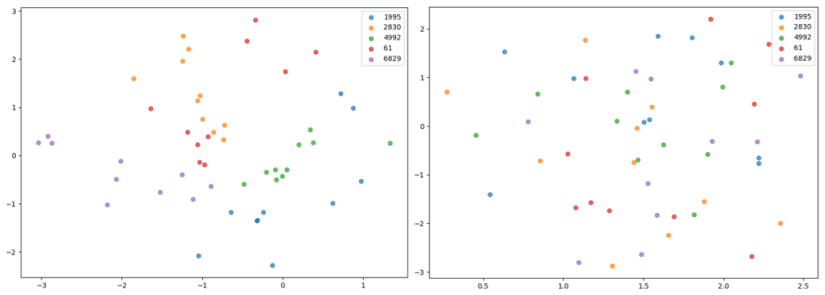
- [§3.1, Figures 2–3] The UMAP and PaCMAP figures are qualitative; adding a quantitative cluster metric (e.g., silhouette score) would strengthen the claim that speaker clusters disappear.
- [§3.2.2] The VC baseline list omits models specifically designed for speaker disentanglement such as ContentVec; the phrase 'state-of-the-art methods' in the abstract should be qualified to the compared set.
- [§2.2–2.3] No code or configuration details are provided for reproducing A*, b*, and the PCA fit; the demo audio is helpful but insufficient for full reproducibility. Please release scripts or provide detailed hyperparameters.
- [§3.2.4] The notation T-SSIM and S-SSIM is confusing because SSIM conventionally denotes structural similarity; consider renaming to 'target-speaker similarity' and 'source-speaker similarity' with a different abbreviation.
Circularity Check
No circularity: the residual construction removes the linearly predictable component by definition, but the speaker-independence claim is evaluated externally and is in fact contradicted by the paper's own Table 1.
full rationale
The derivation chain is: assume s = f(d) + eta (Eq. 1), define eta = s - f(d) (Eq. 2), and fit f as a linear least-squares map from PCA-reduced speaker embeddings D to SSL frames S (Eqs. 3-6). The resulting eta (Eq. 11) is, by construction, the residual after removing the component of S that is linearly predictable from D on the fitting set. That part is definitional, not circular. The paper's substantive claim that eta is speaker-independent is not forced by the equations: it is tested with a held-out 10-way SVM speaker classifier (Table 1) and with an external voice-conversion evaluation (Table 2) using metrics such as WER, PER, and cosine similarity from an independent speaker-verification model. These tests are not equivalent to the fitting objective. Moreover, the paper's own data reject the strong 'speaker independence' claim: Table 1 shows Eta-WavLM retains 55.73% accuracy versus 10% chance, and the Limitations section concedes that 'our method does not fully eliminate speaker-specific information' and that 'traces of speaker identity still persist in the resulting features.' This is an overclaim, not a circularity. The linearity assumption is an explicit ansatz justified by cited work on linear structure in embedding spaces; it is an unverified premise, not a reduction to the target result. Self-citations (e.g., Ruggiero et al. 2024 for layer selection and the voice-conversion backbone) are configuration choices and are not load-bearing for the central disentanglement claim. No prediction is a fitted parameter renamed; no uniqueness theorem is imported; no known result is merely renamed. Therefore no significant circularity is present.
Assumptions & free parameters
free parameters (5)
- PCA dimension P =
128
- Frames per utterance L =
100
- WavLM layer index =
15
- Speaker encoder selection =
ECAPA-TDNN
- Linear map A* and bias b* =
Learned on LibriSpeech training set
assumptions (4)
- domain assumption SSL representation s additively decomposes as f(d) + eta (Eq. 1)
- domain assumption f is linear in the PCA-reduced speaker embedding
- domain assumption The speaker embedding d carries only speaker identity, not content
- domain assumption PCA preserves all speaker-relevant information
Cite this review
Pith. "Pith review of Eta-WavLM: Efficient Speaker Identity Removal in Self-Supervised Speech Representations Using a Simple Linear Equation." pith.science (2026). https://pith.science/paper/QOSTHBND
@misc{pith2026250519273,
  author       = {Pith},
  title        = {Pith review of: Eta-WavLM: Efficient Speaker Identity Removal in Self-Supervised Speech Representations Using a Simple Linear Equation},
  year         = {2026},
  howpublished = {\url{https://pith.science/paper/QOSTHBND}},
  note         = {Machine review of arXiv:2505.19273}
}
read the original abstract
Self-supervised learning (SSL) has reduced the reliance on expensive labeling in speech technologies by learning meaningful representations from unannotated data. Since most SSL-based downstream tasks prioritize content information in speech, ideal representations should disentangle content from unwanted variations like speaker characteristics in the SSL representations. However, removing speaker information often degrades other speech components, and existing methods either fail to fully disentangle speaker identity or require resource-intensive models. In this paper, we propose a novel disentanglement method that linearly decomposes SSL representations into speaker-specific and speaker-independent components, effectively generating speaker disentangled representations. Comprehensive experiments show that our approach achieves speaker independence and as such, when applied to content-driven tasks such as voice conversion, our representations yield significant improvements over state-of-the-art methods.
Figures


Reference graph
Works this paper leans on
-
[4]
Enhanc- ing the stability of llm-based speech generation sys- tems through self-supervised representations. ArXiv, abs/2402.03407. Leland McInnes, John Healy, Nathaniel Saul, and Lukas Grossberger
-
[7]
V oice cloning: a multi-speaker text-to-speech synthesis approach based on transfer learning. ArXiv, abs/2102.05630. Hubert Siuzdak
-
[10]
Vec- tok speech: speech vectorization and tokenization for neural speech generation. ArXiv, abs/2310.07246. Figure 3: PaCMAP projections of the WavLM (a) and Eta-WavLM (b) representations extracted from 10 utterances of 5 speakers (with ids 1995, 2830, 4992, 61,
-
[12]
and (Ruggiero et al., 2024). The acous- tic model takes SSL representations as input rather than graphemes or phonemes as in a typical TTS task and outputs mel spectrograms of the target speaker. The model is composed by an encoder and an autoregressive decoder. Both the encoder and decoder are preceded by a feed-forward pre-net, and a final linear layer ...
work page 2024
-
[2015]
Librispeech: An asr corpus based on public domain audio books. 2015 IEEE International Conference on Acoustics, Speech and Signal Processing (ICASSP), pages 5206–5210. Adam Polyak, Yossi Adi, Jade Copet, Eugene Kharitonov, Kushal Lakhotia, Wei-Ning Hsu, Ab- del rahman Mohamed, and Emmanuel Dupoux
work page 2015
-
[2017]
Generalized end-to-end loss for speaker verification. 2018 IEEE International Con- ference on Acoustics, Speech and Signal Processing (ICASSP), pages 4879–4883. Yingfan Wang, Haiyang Huang, Cynthia Rudin, and Yaron Shaposhnik
work page 2018
-
[2018]
In Annual Meeting of the Associa- tion for Computational Linguistics
Towards understanding linear word analogies. In Annual Meeting of the Associa- tion for Computational Linguistics . Wei-Ning Hsu, Benjamin Bolte, Yao-Hung Hubert Tsai, Kushal Lakhotia, Ruslan Salakhutdinov, and Abdel rahman Mohamed. 2021a. Hubert: Self-supervised speech representation learning by masked prediction of hidden units. IEEE/ACM Transactions on...
work page 2021
-
[2021]
SpeechBrain: A general-purpose speech toolkit. Preprint, arXiv:2106.04624. ArXiv:2106.04624. Giuseppe Ruggiero, Matteo Testa, Jürgen Van de Walle, and Luigi Di Caro
Show all 12 references
-
[2022]
ICASSP 2022 - 2022 IEEE International Conference on Acoustics, Speech and Signal Processing (ICASSP), pages 6562–
A comparison of discrete and soft speech units for improved voice conversion. ICASSP 2022 - 2022 IEEE International Conference on Acoustics, Speech and Signal Processing (ICASSP), pages 6562–
2022
-
[2023]
ICASSP 2023 - 2023 IEEE International Conference on Acoustics, Speech and Signal Process- ing (ICASSP), pages 1–5
Ace- vc: Adaptive and controllable voice conversion using explicitly disentangled self-supervised speech repre- sentations. ICASSP 2023 - 2023 IEEE International Conference on Acoustics, Speech and Signal Process- ing (ICASSP), pages 1–5. Keith Ito and Linda Johnson
2023
-
[2024]
ArXiv, abs/2402.08093
Base tts: Lessons from building a billion-parameter text- to-speech model on 100k hours of data. ArXiv, abs/2402.08093. Álvaro Martín-Cortinas, Daniel Sáez-Trigueros, Iv’an Vall’es-P’erez, Biel Tura Vecino, Piotr Bilinski, Ma- teusz Lajszczak, Grzegorz Beringer, Roberto Barra-...
-
[6829]
from the LibriSpeech test-clean set. A PaCMAP Visualization In this section, we replicate the analysis from Sec- tion 3.1 using PaCMAP (Wang et al., 2021), an alternative dimensionality reduction technique to UMAP that is known for preserving both global and local data structu...
2021
Reviewed August 7, 2026 · model on record in the stance chip above.
Discussion (0). Sign in to comment.