Floquet quantum multiparameter estimation with periodic-driving-induced topological phase transition
Pith reviewed 2026-05-08 18:06 UTC · model grok-4.3
The pith
Near a driving-induced topological phase transition, multiparameter estimation reaches Heisenberg scaling and beyond.
A machine-rendered reading of the paper's core claim, the machinery that carries it, and where it could break.
Core claim
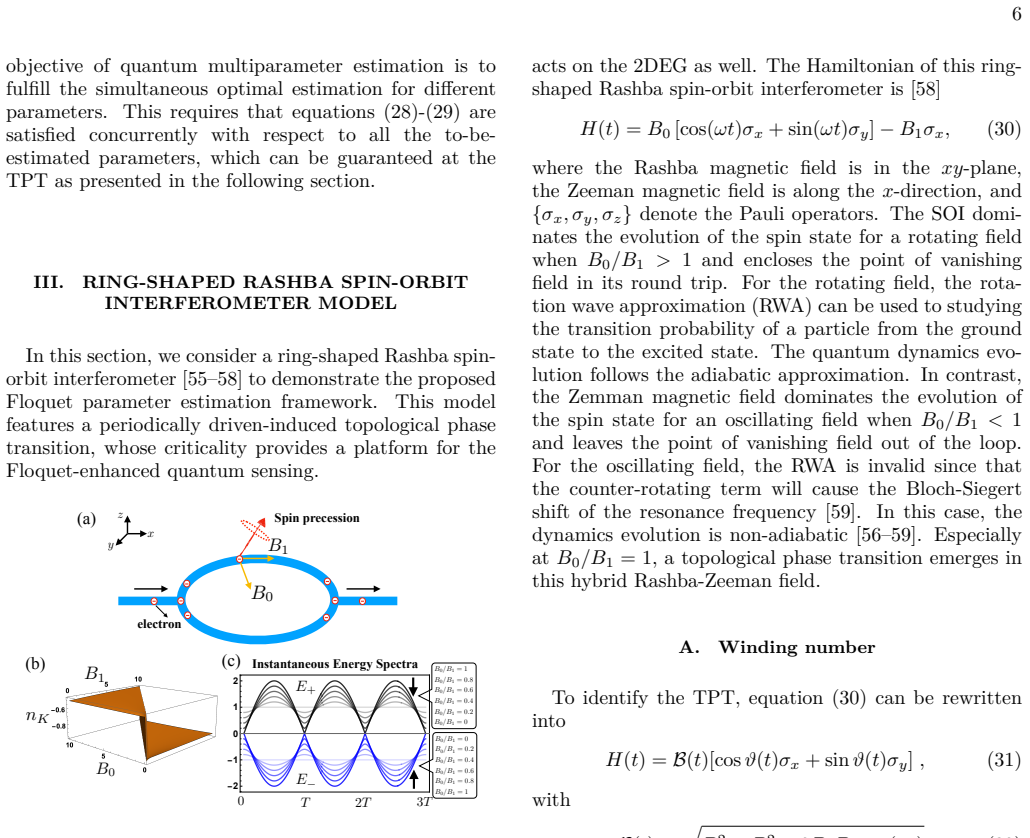
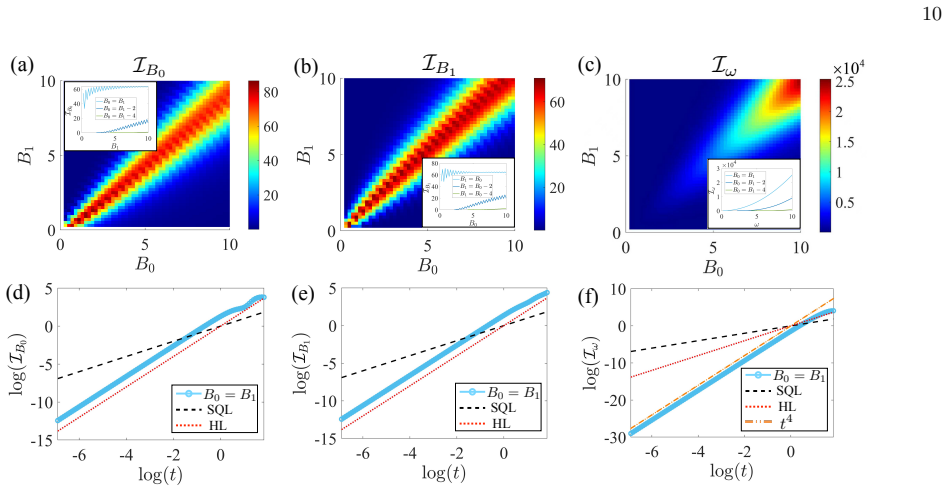
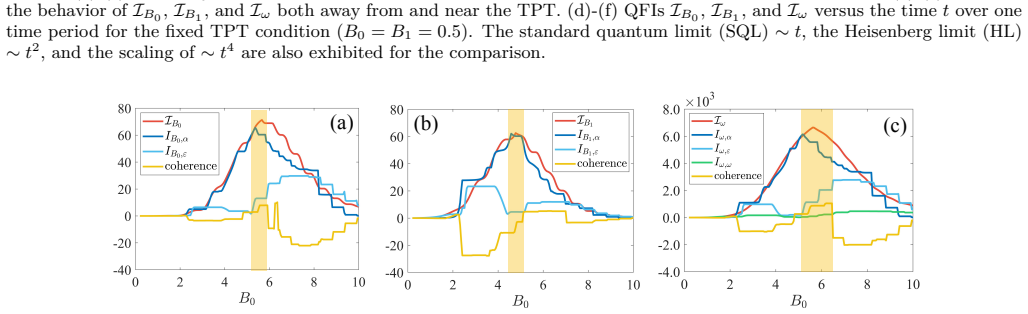
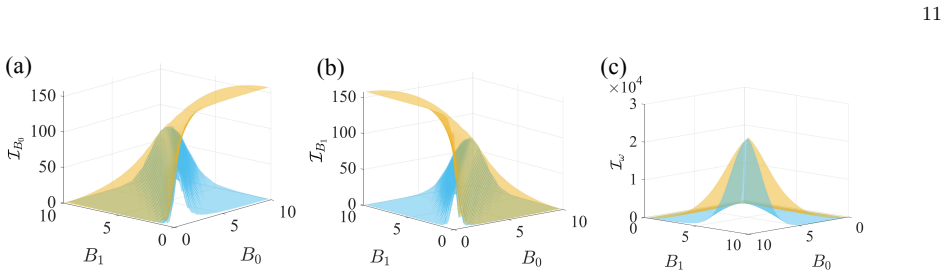
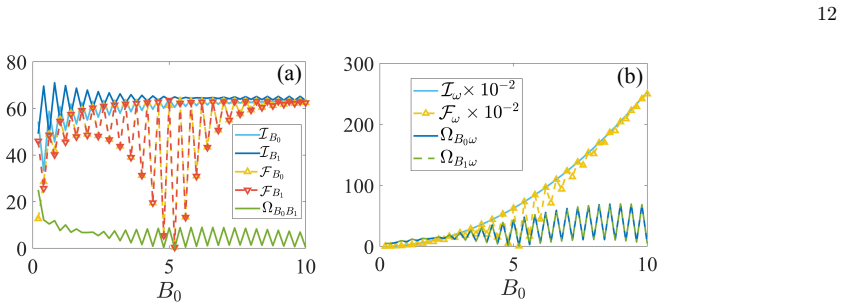
In the Floquet theory framework applied to a periodically driven Rashba spin-orbit interferometer with topological phase transition, the quantum Fisher information matrix and measurement incompatibility receive explicit contributions from Floquet eigenmodes, quasienergies, and multi-photon processes. In the vicinity of the TPT boundary, this produces pronounced enhancement in the estimation precision of multiple parameters with Heisenberg limit scaling and higher, while measurement incompatibility vanishes in an oscillatory manner and stroboscopic projective measurement achieves the highest attainable precision.
What carries the argument
Floquet theory framework that isolates the separate roles of eigenmodes, quasienergies, and multi-photon processes in determining the quantum Fisher information matrix and measurement incompatibility for the ring-shaped Rashba spin-orbit interferometer.
If this is right
- Estimation precision for multiple parameters is markedly enhanced near the TPT boundary and attains Heisenberg scaling or better.
- Measurement incompatibility vanishes in an oscillatory manner with changes in driving parameters.
- Stroboscopic projective measurements reach the highest estimation precision possible in these driven systems.
Where Pith is reading between the lines
- The same Floquet decomposition could be applied to other periodically driven models to recover optimal multiparameter bounds when static approximations break down.
- Topological phase transitions engineered by periodic driving may serve as a tunable resource for super-Heisenberg metrology in a range of quantum sensors.
- Varying the driving frequency or amplitude in cold-atom or photonic realizations could directly map the predicted oscillatory decay of incompatibility.
Load-bearing premise
That the Floquet framework fully accounts for eigenmodes, quasienergies, and multi-photon processes in the quantum Fisher information matrix and incompatibility for general time-periodically driven systems where static Hamiltonians fail.
What would settle it
An experiment on the Rashba interferometer that measures no precision enhancement or persistently non-zero incompatibility near the topological phase transition boundary would falsify the reported scaling and oscillatory vanishing.
Figures
read the original abstract
Periodically driven systems provide a powerful platform for quantum multiparameter estimation. Constructing a static effective Hamiltonian in a proper rotating frame is commonly employed to assess the attainable precision. However, such an approach becomes nonfeasible for more general time-periodically driven systems. To tackle this dilemma, we develop a quantum multiparameter estimation strategy in the Floquet theory framework. The contributions of Floquet eigenmodes, quasienergies, and multi-photon processes to the quantum Fisher information matrix and measurement incompatibility are determined, respectively. Moreover, this approach is applied to a ring-shaped Rashba spin-orbit interferometer model exhibiting the topological phase transition (TPT). In the vicinity of the TPT boundary, we reveal a pronounced enhancement in the estimation precision of multiple parameters with the Heisenberg limit scaling and even higher. Meanwhile, the measurement incompatibility vanishes in an oscillatory manner, and the stroboscopic projective measurement enables the highest estimation precision achievable. This work provides a complete Floquet picture for time-dependent critical quantum multiparameter estimation.
Editorial analysis
A structured set of objections, weighed in public.
Referee Report
Summary. The paper develops a Floquet-theory framework for quantum multiparameter estimation in general time-periodically driven systems where static effective-Hamiltonian constructions fail. It derives the separate contributions of Floquet eigenmodes, quasienergies, and multi-photon processes to the quantum Fisher information matrix and to measurement incompatibility. The framework is then applied to a ring-shaped Rashba spin-orbit interferometer that exhibits a periodic-driving-induced topological phase transition; near the TPT boundary the authors report enhanced multiparameter precision that reaches or exceeds Heisenberg scaling, an oscillatory vanishing of incompatibility, and optimality of stroboscopic projective measurements.
Significance. If the derivations are correct and the claimed reductions hold, the work supplies a general, non-perturbative tool for metrology in driven systems that static approximations cannot address. The concrete demonstration of precision enhancement at a driven TPT, together with the incompatibility analysis, would be a useful addition to the quantum-sensing literature. The absence of an explicit high-frequency benchmark against known rotating-frame results, however, leaves the central technical claim incompletely validated.
major comments (1)
- Floquet QFIM and incompatibility derivation: the manuscript presents new expressions for the contributions of eigenmodes, quasienergies, and multi-photon processes but does not supply an explicit analytic or numerical reduction to the known effective-Hamiltonian (rotating-wave) result in the high-frequency limit on a minimal driven system (e.g., a periodically driven two-level atom). Without this check, it remains unclear whether the quasienergy derivatives and stroboscopic averaging reproduce established limits, which is load-bearing for the claim that the framework fully captures the physics when static methods fail.
Simulated Author's Rebuttal
We thank the referee for the positive evaluation of our work and for the constructive suggestion regarding validation of the Floquet framework. We address the major comment below and will incorporate the requested benchmark in the revised manuscript.
read point-by-point responses
-
Referee: Floquet QFIM and incompatibility derivation: the manuscript presents new expressions for the contributions of eigenmodes, quasienergies, and multi-photon processes but does not supply an explicit analytic or numerical reduction to the known effective-Hamiltonian (rotating-wave) result in the high-frequency limit on a minimal driven system (e.g., a periodically driven two-level atom). Without this check, it remains unclear whether the quasienergy derivatives and stroboscopic averaging reproduce established limits, which is load-bearing for the claim that the framework fully captures the physics when static methods fail.
Authors: We agree that an explicit high-frequency benchmark would strengthen the validation of our general framework. Although the derivations are constructed such that the quasienergy and eigenmode contributions reduce to the rotating-wave effective Hamiltonian when the driving frequency is large compared to other scales, we acknowledge the value of a concrete demonstration. In the revised manuscript we will add a numerical example on a periodically driven two-level atom, explicitly comparing the Floquet QFIM and incompatibility expressions to the known rotating-wave results in the high-frequency regime. This will confirm that the stroboscopic averaging and quasienergy derivatives recover the established limits. revision: yes
Circularity Check
Floquet QFIM and incompatibility derivation is self-contained from standard theory
full rationale
The paper derives the multiparameter estimation expressions by determining the separate contributions of Floquet eigenmodes, quasienergies, and multi-photon processes to the QFIM and measurement incompatibility directly within the Floquet framework. This is presented as a general first-principles construction for time-periodic driving where static effective-Hamiltonian methods fail, followed by application to the Rashba model near the TPT. No step reduces by construction to a fitted input, self-defined quantity, or load-bearing self-citation; the central formulas are not equivalent to their inputs via renaming or ansatz smuggling. The derivation chain remains independent of the specific model results.
Axiom & Free-Parameter Ledger
axioms (1)
- domain assumption Floquet theory applies to the periodically driven quantum system and captures all relevant contributions to estimation precision
Reference graph
Works this paper leans on
-
[1]
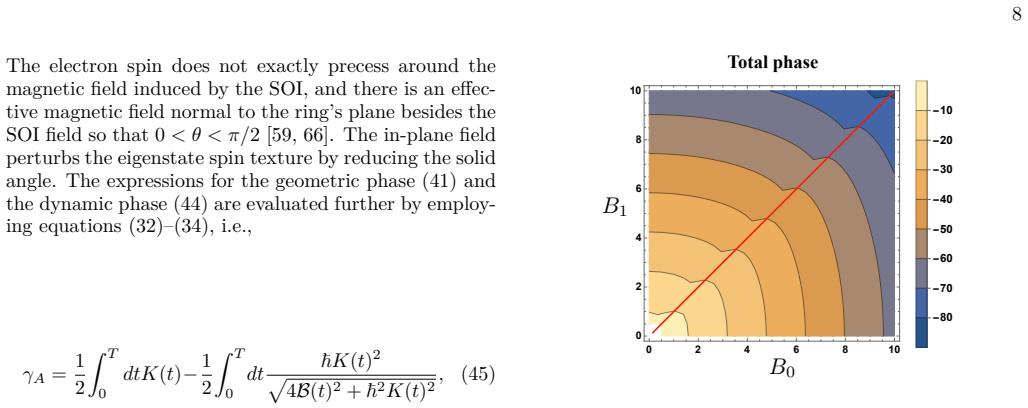
Berry phase in adiabatic approximation For a generic spin state |ψ(t)⟩, the Berry phase is de- fined as γB = Z T 0 dt⟨ψ(t)|i∂t|ψ(t)⟩ = Ω 2 , (37) with the solid angle Ω = 2 π(1 − cos θ) , (38) where θ represents the angle between the spin precession axis and the binormal direction to the ring plane. The ratio tan θ = ωSO/ω relates the Lamor frequency ωSO ...
-
[2]
Aharonov-Anandan phase in non-adiabatic evolution One can perform an SU(2) rotation transformation such that the spin is instantaneously aligned with the ap- plied field. The generic spin state |ψ(t)⟩ is transformed into |ψR(t)⟩ = U †(t)|ψ(t)⟩ with U †(t) = exp (iϑ(t)σz/2). The Schrödinger equation for |ψR(t)⟩ writes iℏ∂t|ψR(t)⟩ = U †(t)H(t)U (t) + i∂tU †...
-
[3]
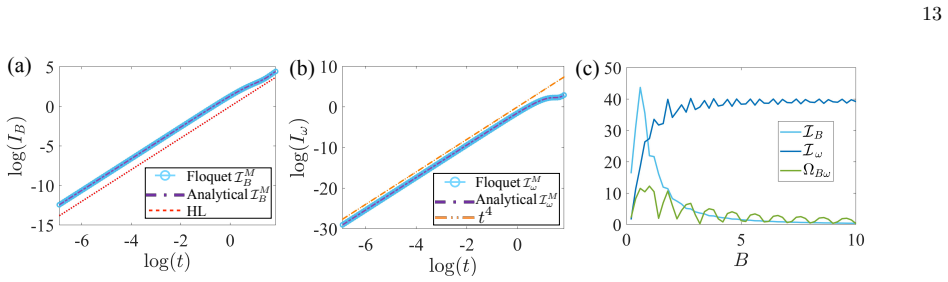
As shown in figures 7 (a)-(b), the QFI maximum for the parameter B scales as ∼ t2 (HL), and the scaling reaches ∼ t4 for the parameter ω. Although the scaling ∼ t4 for the frequency estimation appears in both the Rashba model and the rotating magnetic-field model, this is not a universal property of all periodically driven two-level systems within the Flo...
-
[4]
Cayssol J, Dóra B, Simon F and Moessner R 2013 Floquet topological insulators Phys. Status Solidi (RRL)–Rapid Res. Lett. 7 101
work page 2013
-
[5]
Zhang X et al 2022 Digital quantum simulation of Flo- quet symmetry-protected topological phases Nature 607 468
work page 2022
-
[6]
Greilich A, Kopteva N E, Korenev V L, Haude P A and Bayer M 2025 Exploring nonlinear dynamics in periodi- cally driven time crystal from synchronization to chaotic motion Nat. Commun. 16 2936
work page 2025
-
[7]
Lange G D, Rist `e D, Dobrovitski V V and Hanson R 2011 Single-spin magnetometry with multipulse sensing sequences Phys. Rev. Lett. 106 080802
work page 2011
-
[8]
Lang J, Liu R and Monteiro T 2015 Dynamical- decoupling-based quantum sensing: Floquet spec- troscopy Phys. Rev. X 5 041016
work page 2015
-
[9]
Pham L M, Bar-Gill N, Belthangady C, Sage D L, Cap- pellaro P, Lukin M D, Yacoby A and Walsworth R L 2012 Enhanced solid-state multispin metrology using dy- namical decoupling Phys. Rev. B 86 045214
work page 2012
-
[10]
Saleem Z H, Shaji A and Gray S K 2023 Optimal time for sensing in open quantum systems Phys. Rev. A 108 022413
work page 2023
-
[11]
Bai S and An J 2023 Floquet engineering to overcome no-go theorem of noisy quantum metrology Phys. Rev. Lett. 131 050801
work page 2023
-
[12]
Erglis A, Sazhin A, Vewinger F, Weitz M, Buhmann S Y and Schmitt J 2025 Time-periodic driving of a bath- coupled open quantum gas of light Phys. Rev. Lett. 135 033603
work page 2025
-
[13]
Kundu A, Rajak A and Nag T 2021 Dynamics of fluctu- ation correlation in a periodically driven classical system Phys. Rev. B 104 075161
work page 2021
-
[14]
Giovannetti V, Lloyd S and Maccone L 2006 Quantum metrology Phys. Rev. Lett. 96 010401
work page 2006
-
[15]
Paris M G A 2009 Quantum estimation for quantum technology Int. J. Quantum Inf. 7 125
work page 2009
-
[16]
Yuan H 2016 Sequential feedback scheme outperforms the parallel scheme for Hamiltonian parameter estima- tion Phys. Rev. Lett. 117 160801
work page 2016
-
[17]
Liu J, Yuan H, Lu X M, Wang X 2020 Quantum Fisher information matrix and multiparameter estimation J. Phys. A: Math. Theor. 53 023001
work page 2020
-
[18]
Pang S and Jordan A N 2017 Optimal adaptive control for quantum metrology with time-dependent Hamiltoni- ans Nat. Commun. 8 14695
work page 2017
-
[19]
Hou Z, Jin Y, Chen H, Tang J-F, Huang C-J, Yuan H, Xiang G, Li C-Y and Guo G-C 2021 “Super-Heisenberg” and Heisenberg scalings achieved simultaneously in the estimation of a rotating field Phys. Rev. Lett. 126 070503
work page 2021
-
[20]
Shirley J H 1965 Solution of the Schrödinger equation with a hamiltonian periodic in time Phys. Rev. 138 B979
work page 1965
-
[21]
Schmidt A and Vega S 1992 The Floquet theory of nu- clear magnetic resonance spectroscopy of single spins and dipolar coupled spin pairs in rotating solids J. Chem. Phys. 96 2655
work page 1992
-
[22]
Chu S-I and Telnov D A 2004 Beyond the Floquet the- orem: generalized Floquet formalisms and quasienergy methods for atomic and molecular multiphoton processes in intense laser fields Phys. Rep. 390 1
work page 2004
-
[23]
Mishra U and Bayat A 2021 Driving enhanced quantum sensing in partially accessible many-body systems Phys. Rev. Lett. 127 080504
work page 2021
- [24]
-
[25]
Iemini F, Fazio R and Sanpera A 2024 Floquet time crys- tals as quantum sensors of ac fields Phys. Rev. A 109 L050203
work page 2024
-
[26]
Holthaus M 2015 Floquet engineering with quasienergy bands of periodically driven optical lattices J. Phys. B 49 013001
work page 2015
-
[27]
Boyers E, Pandey M, Campbell D K, Polkovnikov A, Sels D and Sushkov A O 2019 Floquet-engineered quantum state manipulation in a noisy qubit Phys. Rev. A 100 012341
work page 2019
-
[28]
Goldman N and Dalibard J 2014 Periodically driven quantum systems: Effective Hamiltonians and engi- neered gauge fields Phys. Rev. X 4 031027
work page 2014
-
[29]
Eckardt A 2017 Colloquium: Atomic quantum gases in periodically driven optical lattices Rev. Mod. Phys. 89 011004
work page 2017
-
[30]
Albarelli F and Demkowicz-Dobrza ´nski R 2022 Probe in- compatibility in multiparameter noisy quantum metrol- ogy Phys. Rev. X 12 011039
work page 2022
-
[31]
Ragy S, Jarzyna M and Demkowicz-Dobrzański R 2016 Compatibility in multiparameter quantum metrology Phys. Rev. A 94 052108
work page 2016
-
[32]
Sidhu J S, Ouyang Y, Campbell E T and Kok P 2021 Tight bounds on the simultaneous estimation of incom- patible parameters Phys. Rev. X 11 011028
work page 2021
-
[33]
Matsumoto K 2002 A new approach to the Cramér–Rao- type bound of the pure-state model J. Phys. A: Math. Gen. 35 3111
work page 2002
-
[34]
Carollo A, Spagnolo B, Dubkov A A and Valenti D 2019 On quantumness in multi-parameter quantum estimation J. Stat. Mech. 094010
work page 2019
-
[35]
Belliardo F and Giovannetti V 2021 Incompatibility in quantum parameter estimation New J. Phys. 23 063055
work page 2021
-
[36]
Yang Y, Ru S, An M, Wang Y, Wang F, Zhang P and Li F 2022 Multiparameter simultaneous optimal estimation with an SU(2) coding unitary evolution Phys. Rev. A 105 022406
work page 2022
-
[37]
Giovannetti V, Lloyd S and Maccone L 2004 Quantum- enhanced measurements: beating the standard quantum limit Science 306 1330
work page 2004
-
[38]
Caves C M 1981 Quantum-mechanical noise in an inter- ferometer Phys. Rev. D 23 1693
work page 1981
-
[39]
Zhao X, Yang Y and Chiribella G 2020 Quantum metrol- ogy with indefinite causal order Phys. Rev. Lett. 124 190503
work page 2020
-
[40]
Fresco G D, Spagnolo B, Valenti D and Carollo A 2022 Multiparameter quantum critical metrology SciPost Phys. 13 077
work page 2022
-
[41]
Candia R D, Minganti F, Petrovnin K V, Paraoanu G S and Felicetti S 2023 Critical parametric quantum sensing npj Quantum Inf. 9 23
work page 2023
-
[42]
Hotter C, Ritsch H and Gietka K 2024 Combining critical and quantum metrology Phys. Rev. Lett. 132 060801
work page 2024
- [43]
-
[44]
Niezgoda A and Chwedeńczuk J 2021 Many-body non- locality as a resource for quantum-enhanced metrology Phys. Rev. Lett. 126 210506
work page 2021
-
[45]
Ding D S, Liu Z-K, Shi B-S, Guo G-C, Mølmer K and Adams C S 2022 Enhanced metrology at the critical point of a many-body Rydberg atomic system Nat. Phys. 18 1447
work page 2022
-
[46]
Boixo S, Flammia S T, Caves C M and Geremia J M 2007 Generalized limits for single-parameter quantum estima- tion Phys. Rev. Lett. 98 090401
work page 2007
- [47]
-
[48]
Mukhopadhyay C and Bayat A 2024 Modular many-body quantum sensors Phys. Rev. Lett. 133 120601
work page 2024
-
[49]
Yu M, Li X, Chu Y, Mera B, Ünal F N, Yang P, Liu Y, Goldman N and Cai J 2024 Experimental demonstration of topological bounds in quantum metrology Natl. Sci. Rev. 11 nwae065
work page 2024
-
[50]
Yang Y, Yuan H and Li F 2024 Quantum multiparameter estimation enhanced by a topological phase transition Phys. Rev. A 109 022604
work page 2024
-
[51]
Mizuta K 2025 Nearly optimal quasienergy estimation and eigenstate preparation of time-periodic Hamiltonians by Sambe space formalism Phys. Rev. Research 7 013068
work page 2025
-
[52]
Eckardt A and Anisimovas E 2015 High-frequency ap- proximation for periodically driven quantum systems from a Floquet-space perspective New J. Phys. 17 093039
work page 2015
-
[54]
The Fourier factor satisfies ⟨t|m⟩ = eimωt for the time vector |t⟩, which indicates that the probe state is |β, 0⟩, since ⟨0|m⟩ = 1 at the initial time t = 0
-
[55]
Zhang L-H, Liu Z-K, Liu B, Zhang Z-Y, Guo G-C, Ding D-S and Shi B-S 2022 Rydberg microwave-frequency- comb spectrometer Phys. Rev. Applied 18 014033
work page 2022
-
[56]
Bukov M, D’Alessio L and Polkovnikov A 2015 Universal high-frequency behavior of periodically driven systems: from dynamical stabilization to Floquet engineering Adv. Phys. 64 139
work page 2015
-
[57]
Restrepo S, Cerrillo J, Bastidas V M, Angelakis D G and Brandes T 2016 Driven open quantum systems and Flo- quet stroboscopic dynamics Phys. Rev. Lett. 117 250401
work page 2016
-
[58]
Manchon A, Koo H C, Nitta J, Frolov S M and Duine R A 2015 New perspectives for Rashba spin–orbit coupling Nat. Mater. 14 871
work page 2015
-
[59]
Lyanda-Geller Y 1993 Topological transitions in Berry’s phase interference effects Phys. Rev. Lett. 71 657
work page 1993
-
[60]
Ying Z-J, Gentile P, Baltanás J P, Frustaglia D, Ortix C and Cuoco M 2020 Geometric driving of two-level quan- tum systems Phys. Rev. Research 2 023167
work page 2020
-
[61]
Reynoso, Baltanás J P, Saarikoski H, Vázquez-Lozano J E, Nitta J and Frustaglia D 2017 Spin resonance under topological driving fields New J. Phys. 19 063010
work page 2017
-
[62]
Nagasawa F, Frustaglia D, Saarikoski H, Richter K and Nitta J 2013 Control of the spin geometric phase in semi- conductor quantum rings Nat. Commun. 4 2526
work page 2013
-
[63]
Ying Z-J, Gentile P, Ortix C and Cuoco M 2016 De- signing electron spin textures and spin interferometers by shape deformations Phys. Rev. B 94 081406
work page 2016
-
[64]
Aharonov Y and Anandan J 1987 Phase change during a cyclic quantum evolution Phys. Rev. Lett. 58 1593
work page 1987
-
[65]
Roy R and Harper F 2017 Periodic table for Floquet topological insulators Phys. Rev. B 96 155118
work page 2017
-
[66]
Gavensky L, Usaj G and Goldman N 2025 Štředa formula for Floquet systems: topological invariants and quan- tized anomalies from Cesàro summation Phys. Rev. X 17 15 031067
work page 2025
-
[67]
Popp M, Frustaglia D and Richter K 2003 Conditions for adiabatic spin transport in disordered systems Phys. Rev. B 68 041303
work page 2003
-
[68]
Nagasawa F, Takagi J, Kunihashi Y, Kohda M and Nitta J 2012 Experimental demonstration of spin geometric phase: radius dependence of time-reversal Aharonov– Casher oscillations Phys. Rev. Lett. 108 086801
work page 2012
-
[69]
Meijer F E, Morpurgo A F and Klapwijk T M 2002 One- dimensional ring in the presence of Rashba spin-orbit in- teraction: derivation of the correct Hamiltonian Phys. Rev. B 66 033107
work page 2002
-
[70]
The midline extraction removes fast oscillations and al- lows us to focus on the background behavior near the TPT. Other extraction procedures, such as fitting the peaks with a Lorentzian lineshape on top of a quadratic polynomial background, are also applicable, but are not essential to our proposal and are used only to extract the slowly varying trend
-
[71]
Scully M O and Zubairy M S 1997 Quantum Optics (Cambridge University Press)
work page 1997
-
[72]
Wang G, Liu Y-X, Schloss J M, Alsid S T, Braje D A and Cappellaro P 2022 Sensing of arbitrary-frequency fields using a quantum mixer Phys. Rev. X 12 021061
work page 2022
-
[73]
Scholz I, Meier B H and Ernst M 2007 Operator-based triple-mode Floquet theory in solid-state NMR J. Chem. Phys. 127 204504
work page 2007
-
[74]
Leskes M, Madhu P K and Vega S 2010 Floquet theory in solid-state nuclear magnetic resonance Prog. Nucl. Magn. Reson. Spectrosc. 57 345
work page 2010
-
[75]
Awschalom D D, Samarth N and Loss D 2002 Semicon- ductor Spintronics and Quantum Computation (Springer Science & Business Media)
work page 2002
-
[76]
Liu X Z, Xu Y G, Yu G, Wei L M, Lin T, Guo S L, Chu J H, Zhou W Z, Zhang Y G and Lockwood D J 2013 The effective g-factor in In 0.53Ga0.47As/In0.52Al0.48As quan- tum well investigated by magnetotransport measurement J. Appl. Phys. 113 033704
work page 2013
discussion (0)
Sign in with ORCID, Apple, or X to comment. Anyone can read and Pith papers without signing in.