REVIEW 2 major objections 5 minor 2 cited by
A statistical mechanics derivation and implementation of non-conservative phase field models for front propagation in elastic media
T0 review · 2 major / 5 minor · reviewed 2026-08-11 · deepseek-v4-flash
Pith's one-line read The paper derives, without phenomenology or fitting, a non-conservative phase field model for front propagation in a one-dimensional elastic medium from the microscopic Langevin dynamics, yielding coupled strain-phase gradient-flow…
desk verdict The derivation is careful and the numerical results are credible, but the singular (μ, Φ) phase field equations—the paper's central deliverable—are never integrated through a transition, leaving the most important claim untested. read the letter →
The pith
A machine-rendered reading of the paper's core claim, the machinery that carries it, and where it could break.
The reading
What carries the argument
The load-bearing machinery is the STIV reduction: a variational scheme that projects the Fokker-Planck dynamics of the microscopic Langevin equation onto a parametric family of densities, here a strictly diagonal multivariate Gaussian with means $\mu_i$ and variances $\sigma_i^2$. From this ansatz one obtains the mean interaction force $\hat{f}(\epsilon,\tau) = \langle -u'(z)\rangle_{z\sim\mathcal{N}(\epsilon,\tau^2)}$, which determines both the kinetic equations for $\mu$ and $\sigma$ and the non-equilibrium free energy, with no free parameters left to fit. The promotion of phase fractions to independent variables uses the invertible map $\hat{\Phi}_i = \Phi(\epsilon_i/\tau_i)$, valid away from $\epsilon_i=0$, which replaces the $\sigma$ variables by $\hat{\Phi}$ and transforms the dissipation matrix into a coupled contravariant tensor. All derived thermodynamic rates, including work, heat, and total entropy production, follow by substituting the approximate density into the stochastic thermodynamics definitions.
What would settle it
A direct check is to run Langevin simulations of the quartic double-well mass-spring chain under the same cyclic protocol and measure the off-diagonal entries of the particle-position covariance matrix during coexistence; if those correlations are large enough to shift the mean spring forces $\langle -u'(z)\rangle$ beyond the reported agreement, the strictly diagonal Gaussian ansatz is falsified. A second observable is the total entropy production late in the cyclic protocol, where the paper already reports the approximation beginning to break down.
Extended reading notes
Core claim
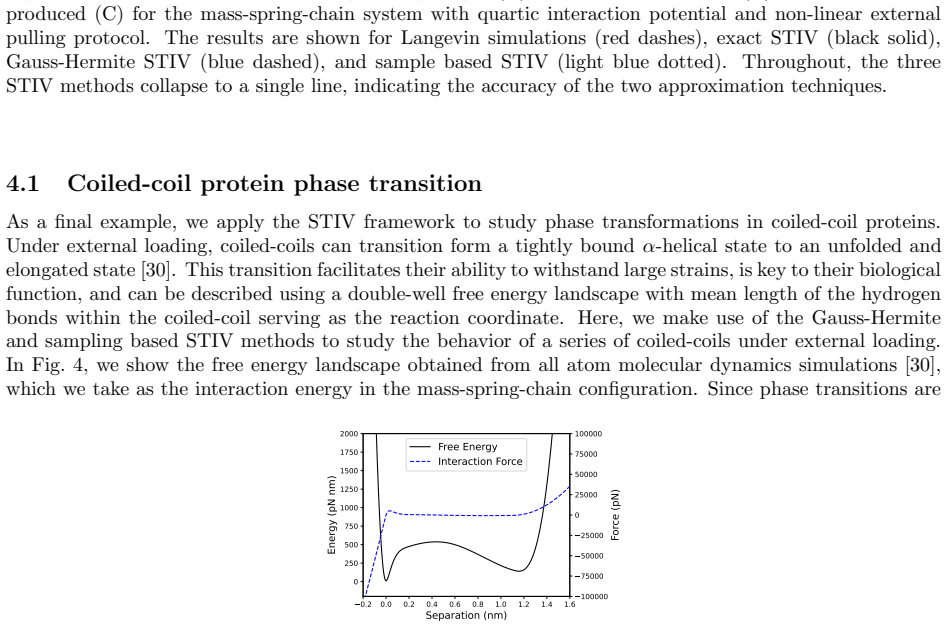
At the center of the paper is the claim that a phase field model need not be postulated but can be projected out of microscopic dynamics. For a one-dimensional chain of masses connected by double-well springs and pulled by an external protocol, the STIV variational principle applied to a diagonal multivariate Gaussian ansatz produces kinetic equations for the mean positions $\mu_i$ and standard deviations $\sigma_i$, and a change of variables promotes the spring phase fractions $\hat{\Phi}_i = \Phi((\mu_i-\mu_{i-1})/\sqrt{\sigma_i^2+\sigma_{i-1}^2})$ to independent fields. In these variables the dynamics is a gradient flow of the non-equilibrium free energy $\hat{A}_{\mathrm{neq}} = \sum_i \hat{U}(\epsilon_i,\tau_i) - (1/2\beta)\sum_i \log \sigma_i^2 + \mathrm{const}$, with a mobility matrix that is not block diagonal, so strain and phase dynamics are coupled. The free energy is non-local in $\hat{\Phi}$ through the entropy term but contains no $|\nabla\Phi|^2$ interfacial term, unlike standard Landau-Ginzburg phase field energies. The paper further states that, in all examples tested, the model captures stress-induced nucleation without additional physics, and that the predictions agree with Langevin simulations for spring lengths, external force, and total entropy production, including for a realistic coiled-coil potential, with Gauss-Hermite and sampling-based numerical implementations for arbitrary potentials.
Load-bearing premise
The load-bearing premise is that the true distribution of particle positions during a front transition is well enough approximated by a single Gaussian with independent coordinates; because the paper itself notes the true density is multimodal and the covariance is taken to be strictly diagonal, this ansatz is the step that carries every subsequent formula.
Editorial extensions
If this is right
- For one-dimensional elastic chains with double-well interactions, phase field simulation inputs such as free energy, mobilities, and interface structure can be computed from the interatomic potential, temperature, and drag coefficient alone.
- The strain and phase fields must be evolved together, because the mobility matrix is not block diagonal; treating them independently, as traditional Allen-Cahn formulations do, is not the gradient flow this derivation yields.
- The physical interface width is resolved rather than artificially widened, so numerical costs scale with real interfacial physics and standard diffuse-interface acceleration is not automatically available.
- Stress-induced nucleation of fronts is an emergent property of the model, so no stochastic noise or artificial nucleation events are needed in the tested one-dimensional systems.
- Arbitrary double-well potentials, including data-driven ones, can be inserted through either Gauss-Hermite quadrature or sample-based polynomial approximation, with accuracy checked against analytical cases.
Reading between the lines
- If the diagonal-Gaussian closure remains accurate in higher dimensions, the same construction could yield parameter-free phase field models for multi-dimensional transformations; the paper notes that the change of variables to phase fractions is no longer one-to-one there, so a different set of coarse variables would be needed.
- The absence of a $|\nabla\Phi|^2$ term suggests that interfacial energy is not an independent input but an emergent consequence of entropy and potential averaging; in regimes where the Gaussian closure is poor, such as strong coexistence with two well-separated peaks, the model's error should show up first in the entropy production rate.
- A natural testable extension is to replace the diagonal Gaussian with a multimodal or mixture ansatz; the sampling-based implementation already points toward densities that are easy to sample, and such an ansatz might preserve the derivation while capturing coexistence more faithfully.
- Because the model outputs total entropy production at much lower cost than trajectory-based estimates, it could serve as a cheap consistency check for fluctuation-theorem relations in simulated or experimental single-molecule pulling, although this use is not explored in the paper.
Editorial analysis
A structured set of objections, weighed in public.
Referee Report
Summary. This paper uses the Stochastic Thermodynamics with Internal Variables (STIV) framework to derive a phase field model for a one-dimensional mass-spring chain with double-well interactions. Starting from Langevin dynamics, the authors posit a strictly diagonal multivariate Gaussian approximation to the density of states, obtain kinetic equations for the mean positions μ and standard deviations σ, and show that these obey a gradient flow with respect to a non-equilibrium free energy. They then introduce a change of variables from (μ, σ) to (μ, Φ), where Φ is the probability that each spring is in the right well, yielding a coupled, non-diagonal gradient flow that resembles an Allen-Cahn-type phase field model. The paper reports closed-form results for piecewise quadratic and quartic potentials, presents two numerical implementations for arbitrary potentials, and validates the approach against Langevin simulations for these potentials and for a coiled-coil protein interaction potential.
Significance. If the central claims hold, this is a significant methodological contribution: it provides a parameter-free, microscopically grounded alternative to phenomenological Allen-Cahn models for a class of one-dimensional elastic systems, with quantitative predictions for forces, free energies, and entropy production, and it naturally captures stress-driven transitions without added nucleation physics. The derivation is explicit and internally consistent: the gradient flow structure is verified in Appendix B, the change of variables is worked out in detail, and the two numerical implementations agree with the analytical results and with Langevin simulations for three different potentials. The main caveats are that the entire construction rests on the diagonal Gaussian closure, which is acknowledged to be inaccurate during multimodal transition states, and that the phase-field form (μ, Φ) is validated only indirectly: all reported simulations are performed in the (μ, σ) variables, while the (μ, Φ) equations are singular at transition points and are not numerically integrated in the paper.
major comments (2)
- [Section 3.1, equation for dΦ_i/dt] The change of variables (μ, σ) → (μ, Φ) is one-to-one only away from Φ_i = 1/2, and the text asserts on page 7 that 'the new equations can be numerically integrated through phase transition points without loss of accuracy' because τ_i = (μ_i − μ_{i−1})/Φ^{−1}(Φ_i) is finite and continuous at the singular set. However, no proof of continuity of the transformed vector field is given, and no numerical experiment in the paper integrates the (μ, Φ) equations across a transition: Figures 2, 3, and 5 all report results from the (μ, σ) form (or its numerical approximations), not from the singularly reparameterized phase-field equations. Since a propagating front is precisely a sequence of crossings of Φ_i = 1/2, this is a load-bearing gap: the central object of the phase-field formulation—the dynamics of the phase variables across the front—remains untested. Please provide either an analytic proof of the removable singularity (including regularity of the transformed vector field in a neighborhood of the singular set) or a numerical demonstration of a full front propagation using the (μ, Φ) equations.
- [Section 3, Eqs. (6)–(7) and Section 5] The strictly diagonal multivariate Gaussian ansatz stated in Section 3 ('we take for the approximate density of states ... a strictly diagonal multivariate Gaussian') is the sole closure that produces the free energy (7), the mobilities, and the gradient flow structure. Section 5 acknowledges that 'the true density of states is highly multimodal during transitions,' so the Gaussian closure truncates exactly the physics of coexistence and nucleation that the phase field model is intended to describe. The paper's abstract claims a derivation 'without appeal to phenomenology or fitting to experiments or simulation data,' but the Gaussian ansatz is an undetermined modeling assumption, and its accuracy is demonstrated only for N = 8, a few potentials and protocols, and always in the (μ, σ) variables. No quantitative closure-error analysis is provided (e.g., a comparison with the full-covariance STIV model of [19] or with a multi-modal parametric family). Please either temper the 'without appeal to phenomenology' claim to reflect the role of the Gaussian closure, or add a systematic closure-error study that quantifies the error of the diagonal Gaussian approximation across the protocol and parameter range tested.
minor comments (5)
- [Section 3, paragraph after Eq. (7)] There is a typo: 'Moerover' should be 'Moreover'.
- [Section 6, Data Availability] The data availability statement says source code 'will be made available and linked here prior to final submission,' but no link or repository identifier is present in the manuscript. For reproducibility, please provide a persistent DOI or URL.
- [Section 3, Eq. (6) and surrounding text] The symbol Φ is used both for the cumulative distribution function of a standard Gaussian and for the phase fraction vector (e.g., Φ(ε/τ) versus RhatΦ_i). This overloading is confusing, especially in the equations for RhatΦ_i. Consider using a distinct notation for the CDF, such as N(·) or G(·).
- [Section 3.1, Fig. 1] The claim that the STIV free energy and a traditional phase field free energy 'reveal qualitatively similar transition paths' is supported only by visual inspection of the yellow dashed lines in panels (B) and (C). A quantitative comparison of barrier heights or of the path in (ε, Φ) space would make this statement more rigorous.
- [Appendix A and Section 3] The derivation in Appendix A is presented as a specialization of results from [19], but the main text does not always clearly delineate which expressions are new to this paper (e.g., the derivation of the phase-field equations) and which are taken from [19]. A short statement at the start of Section 3 distinguishing the novel contributions would help readers.
Circularity Check
No significant circularity; the phase-field model is an explicit change of variables from the authors' STIV framework, whose self-citation is independent and re-validated here.
full rationale
The derivation chain is self-contained after the stated Gaussian closure. The STIV evolution equation (Eq. 4) is cited to the authors' prior work [19], but that framework is an independently published variational method rooted in Eyink's action principle and stochastic thermodynamics, with stated assumptions that do not include the phase-field result. Moreover, the paper re-derives the Gaussian expectation values in Appendices A and B and validates the resulting models against Langevin simulations, so this self-citation is not circular. The new phase-field structure is obtained by the exact algebraic change of variables (µ, σ) to (µ, Φ) described in Section 3.1; the paper explicitly states that the transformed equations are equivalent to the previous µ, σ equations away from transitions, so the phase-field dynamics are a reparameterization rather than a fitted prediction. The non-equilibrium free energy and mobility matrix are computed from Gaussian averages of the given interaction potential, not fitted to the quantities being predicted. The identified weaknesses, such as the diagonal-Gaussian closure and the singular behavior of the (µ, Φ) equations at Φ = 1/2, are approximation and numerical-integration concerns rather than instances of circular reasoning.
Assumptions & free parameters
assumptions (4)
- domain assumption The true density of states is well approximated by a strictly diagonal multivariate Gaussian distribution with mean μ and variances σ^2.
- domain assumption The microscopic dynamics are overdamped Langevin equations at constant temperature with drag η and diffusion d = 1/(ηβ).
- domain assumption The total energy is a sum of nearest-neighbor pair interactions u(x_i - x_{i-1}) plus a boundary spring to the external control.
- domain assumption The Eyink variational principle and the stochastic thermodynamics definitions for work, heat, and entropy production are accepted as the basis for STIV.
Cite this review
Pith. "Pith review of A statistical mechanics derivation and implementation of non-conservative phase field models for front propagation in elastic media." pith.science (2026). https://pith.science/paper/QPB2I572
@misc{pith2026241217972,
  author       = {Pith},
  title        = {Pith review of: A statistical mechanics derivation and implementation of non-conservative phase field models for front propagation in elastic media},
  year         = {2026},
  howpublished = {\url{https://pith.science/paper/QPB2I572}},
  note         = {Machine review of arXiv:2412.17972}
}
read the original abstract
Over the past several decades, phase field modeling has been established as a standard simulation technique for mesoscopic science, allowing for seamless boundary tracking of moving interfaces and relatively easy coupling to other physical phenomena. However, despite its widespread success, phase field modeling remains largely driven by phenomenological justifications except in a handful of instances. In this work, we leverage a recently developed statistical mechanics framework for non-equilibrium phenomena, called Stochastic Thermodynamics with Internal Variables (STIV), to provide the first derivation of a phase field model for front propagation in a one dimensional elastic medium without appeal to phenomenology or fitting to experiments or simulation data. In the resulting model, the variables obey a gradient flow with respect to a non-equilibrium free energy, although notably, the dynamics of the strain and phase variables are coupled, and while the free energy functional is non-local in the phase field variable, it deviates from the traditional Landau-Ginzburg form. Moreover, in the systems analyzed here, the model accurately captures stress induced nucleation of transition fronts without the need to incorporate additional physics. We find that the STIV phase field model compares favorably to Langevin simulations of the microscopic system and we provide two numerical implementations enabling one to simulate arbitrary interatomic potentials.
Figures


Figures from the paper (2 more)

Forward citations
Cited by 2 Pith papers
-
On a structure preserving closure of Langevin dynamics
A closure method that turns overdamped Langevin dynamics into gradient-flow macroscopic models for arbitrary approximate densities, automatically satisfying the second law.
-
Bridging statistical mechanics and thermodynamics away from equilibrium: a data-driven approach for learning internal variables and their dynamics
A machine learning framework learns thermodynamically consistent internal variables and Markovian evolution equations directly from stochastic particle trajectories, validated on an analytically solvable trap model an...
Reference graph
Works this paper leans on
-
[19]
A statistical mechanics framework for con- structing nonequilibrium thermodynamic models
Travis Leadbetter, Prashant K Purohit, and Celia Reina. A statistical mechanics framework for con- structing nonequilibrium thermodynamic models. PNAS Nexus , 2(12):pgad417, 2023. 17
work page 2023
-
[1]
Phase-field models for microstructure evolution
Long-Qing Chen. Phase-field models for microstructure evolution. Annual Review of Materials Research, 32(1):113–140, 2002
work page 2002
-
[2]
Phase-field models in materials science
Ingo Steinbach. Phase-field models in materials science. Modelling and simulation in materials science and engineering, 17(7):073001, 2009
work page 2009
-
[3]
An introduction to phase-field modeling of mi- crostructure evolution
Nele Moelans, Bart Blanpain, and Patrick Wollants. An introduction to phase-field modeling of mi- crostructure evolution. Calphad, 32(2):268–294, 2008
work page 2008
-
[4]
Heike Emmerich. The diffuse interface approach in materials science: thermodynamic concepts and applications of phase-field models , volume 73. Springer Science & Business Media, 2003
work page 2003
-
[6]
Phase-field simula- tion of solidification
William J Boettinger, James A Warren, Christoph Beckermann, and Alain Karma. Phase-field simula- tion of solidification. Annual review of materials research , 32(1):163–194, 2002
work page 2002
-
[7]
Quantitative phase-field model of alloy solidification
Blas Echebarria, Roger Folch, Alain Karma, and Mathis Plapp. Quantitative phase-field model of alloy solidification. Physical Review E—Statistical, Nonlinear, and Soft Matter Physics , 70(6):061604, 2004
work page 2004
-
[8]
Christian Miehe, Martina Hofacker, and Fabian Welschinger. A phase field model for rate-independent crack propagation: Robust algorithmic implementation based on operator splits. Computer Methods in Applied Mechanics and Engineering , 199(45-48):2765–2778, 2010
work page 2010
Show all 30 references
-
[9]
Phase field modeling of crack propagation
Robert Spatschek, Efim Brener, and Alain Karma. Phase field modeling of crack propagation. Philo- sophical Magazine, 91(1):75–95, 2011
2011
-
[10]
Morphogenesis and propagation of complex cracks induced by thermal shocks
Blaise Bourdin, Jean-Jacques Marigo, Corrado Maurini, and Paul Sicsic. Morphogenesis and propagation of complex cracks induced by thermal shocks. Physical review letters , 112(1):014301, 2014
2014
-
[11]
Modeling and numerical simulations of dendritic crystal growth
Ryo Kobayashi. Modeling and numerical simulations of dendritic crystal growth. Physica D: Nonlinear Phenomena, 63(3-4):410–423, 1993
1993
-
[12]
Phase-field modeling of two-dimensional crystal growth with anisotropic diffusion
Esteban Meca, Vivek B Shenoy, and John Lowengrub. Phase-field modeling of two-dimensional crystal growth with anisotropic diffusion. Physical Review E—Statistical, Nonlinear, and Soft Matter Physics , 88(5):052409, 2013
2013
-
[13]
A phase-field theory of dislocation dynamics, strain hardening and hysteresis in ductile single crystals.Journal of the Mechanics and Physics of Solids , 50(12):2597–2635, 2002
Marisol Koslowski, Alberto M Cuitino, and Michael Ortiz. A phase-field theory of dislocation dynamics, strain hardening and hysteresis in ductile single crystals.Journal of the Mechanics and Physics of Solids , 50(12):2597–2635, 2002
2002
-
[14]
Phase-field modeling of microstructure evolution: Recent applications, perspectives and challenges
Damien Tourret, Hong Liu, and Javier LLorca. Phase-field modeling of microstructure evolution: Recent applications, perspectives and challenges. Progress in Materials Science , 123:100810, 2022
2022
-
[15]
Free energy of a nonuniform system
John W Cahn and John E Hilliard. Free energy of a nonuniform system. I. Interfacial free energy. The Journal of Chemical Physics , 28(2):258–267, 1958
1958
-
[16]
A microscopic theory for antiphase boundary motion and its application to antiphase domain coarsening
Samuel M Allen and John W Cahn. A microscopic theory for antiphase boundary motion and its application to antiphase domain coarsening. Acta Metallurgica, 27(6):1085–1095, 1979
1979
-
[17]
Entropy production and the geometry of dissipative evolution equations
Celia Reina and Johannes Zimmer. Entropy production and the geometry of dissipative evolution equations. Physical Review E , 92(5):052117, 2015
2015
-
[18]
New coarse-grained derivation of a phase field model for precipitation
Q Bronchart, Y Le Bouar, and A Finel. New coarse-grained derivation of a phase field model for precipitation. Physical Review Letters, 100(1):015702, 2008
2008
-
[20]
Thermodynamics with internal variables
Gerard A Maugin and Wolfgang Muschik. Thermodynamics with internal variables. Part I. General concepts. Journal of Non-Equilibrium Thermodynamics , 1994
1994
-
[21]
Dynamics and thermodynamics of complex fluids
Miroslav Grmela and Hans Christian ¨Ottinger. Dynamics and thermodynamics of complex fluids. I. Development of a general formalism. Physical Review E , 56(6):6620, 1997
1997
-
[22]
Stochastic thermodynamics, fluctuation theorems and molecular machines
Udo Seifert. Stochastic thermodynamics, fluctuation theorems and molecular machines. Reports on Progress in Physics, 75(12):126001, 2012
2012
-
[23]
Action principle in nonequilibrium statistical dynamics
Gregory L Eyink. Action principle in nonequilibrium statistical dynamics. Physical Review E , 54(4):3419, 1996
1996
-
[24]
The fokker-planck equation
H Risken. The fokker-planck equation. methods of solution and applications., 1989
1989
-
[25]
Multi phase field model for solid state transformation with elastic strain
Ingo Steinbach and Markus Apel. Multi phase field model for solid state transformation with elastic strain. Physica D: Nonlinear Phenomena , 217(2):153–160, 2006
2006
-
[26]
Handbook of mathematical functions with formulas, graphs, and mathematical tables , volume 55
Milton Abramowitz and Irene A Stegun. Handbook of mathematical functions with formulas, graphs, and mathematical tables , volume 55. US Government printing office, 1948
1948
-
[27]
Phase field modeling of simultaneous nucleation and growth by explicitly incorporating nucleation events
JP Simmons, C Shen, and Y Wang. Phase field modeling of simultaneous nucleation and growth by explicitly incorporating nucleation events. Scripta materialia , 43(10):935–942, 2000
2000
-
[28]
Remarks on some open problems in phase-field modelling of solidification
Mathis Plapp. Remarks on some open problems in phase-field modelling of solidification. Philosophical Magazine, 91(1):25–44, 2011
2011
-
[29]
ASM Handbook, volume 22A Fundamentals of Modeling for Metals Processing , chapter Modeling of nucleation processes, pages 203–219
Emmanuel Clouet. ASM Handbook, volume 22A Fundamentals of Modeling for Metals Processing , chapter Modeling of nucleation processes, pages 203–219. ASM International, 2009
2009
-
[30]
Combined molec- ular/continuum modeling reveals the role of friction during fast unfolding of coiled-coil proteins
Alejandro Torres-S´ anchez, Juan M Vanegas, Prashant K Purohit, and Marino Arroyo. Combined molec- ular/continuum modeling reveals the role of friction during fast unfolding of coiled-coil proteins. Soft Matter, 15(24):4961–4975, 2019
2019
-
[31]
Robust kernel density estimation
JooSeuk Kim and Clayton D Scott. Robust kernel density estimation. The Journal of Machine Learning Research, 13(1):2529–2565, 2012. 18
2012
Reviewed August 11, 2026 · model on record in the stance chip above.
Discussion (0). Continue with ORCID to comment.