REVIEW 4 major objections 6 minor 1 cited by
Enhancing Spatial Reasoning in Multimodal Large Language Models through Reasoning-based Segmentation
T0 review · 4 major / 6 minor · reviewed 2026-08-06 · deepseek-v4-flash
Pith's one-line read The paper claims that spatial reasoning in 3D point-cloud language models is a trainable two-stage process: first segment the objects relevant to a question, then feed their mask-pooled features back through the model's connector to…
desk verdict A clean two-stage reasoning-prior idea for 3D MLLMs with consistent gains, but the self-generated dataset and supervision make the headline results need release and human validation before they fully convince. read the letter →
The pith
A machine-rendered reading of the paper's core claim, the machinery that carries it, and where it could break.
The reading
What carries the argument
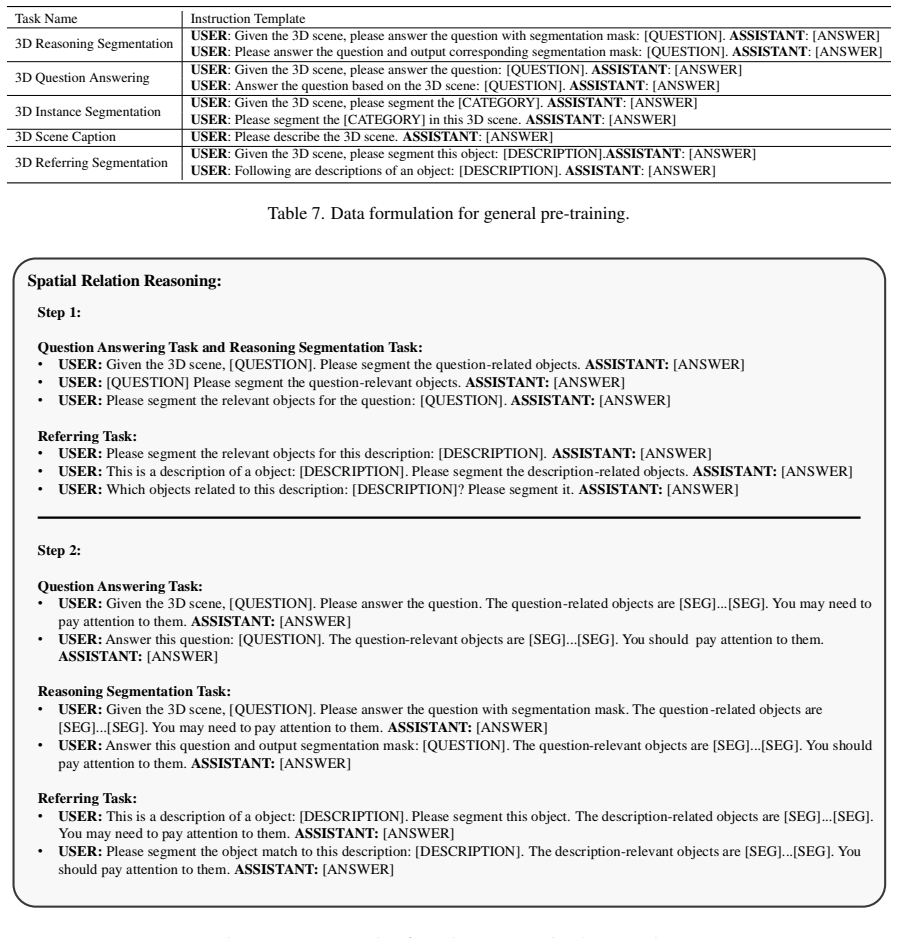
The central object is Relevant Reasoning Segmentation (R2S), a two-stage pipeline built on the [SEG]-token interface: a first instruction asks the model to segment question-related objects, giving masks $M^r$; mask-pooling aggregates super-point features $f^p$ into per-object features $f^r = f^p \times M^r$; a second instruction embeds these features into the Q-Former along with the question ($w' \oplus f^r$), refining the latent queries to $q'_l$ and the object features to $f'_r$; the LLM then generates the answer and the mask decoder produces the final mask from the refined [SEG] hidden state. The mechanism that carries the argument is that the first stage provides a concrete visual prior that the second stage can attend to, rather than requiring the model to infer relevant objects and target simultaneously.
What would settle it
Take the 3D ReasonSeg validation set, have humans re-annotate every question's target and relevant objects, and recompute the reported gIoU and Acc@50 on the cleaned subset; if R2S's gains shrink to noise, the measured improvement is an artifact of noisy LLM-generated labels.
Extended reading notes
Core claim
The central claim is that spatial reasoning in 3D point-cloud language models can be trained by emulating human two-step search: first recognize the objects that are relevant to the question, then inspect those objects closely to locate the target. Compared with direct instruction tuning, this two-step decomposition improves Acc@50 on ScanRefer from 38.7 to 48.7 and gIoU on 3D ReasonSeg from 29.2 to 33.1, with consistent gains on ScanQA's BLEU-4, CIDEr, METEOR, and Rouge-L. The authors argue the mechanism is the visual prior: mask-pooling the segmented relevant objects produces instance-level features that carry spatial detail ordinary text names cannot, and feeding these features through the Q-Former in a second pass lets the model refine its latent queries before the final mask is decoded. They also claim existing datasets are too simple (e.g., 'in front of' is ambiguous in ScanRefer) and that 3D ReasonSeg supplies the missing complex spatial reasoning supervision.
Load-bearing premise
The load-bearing premise is that the large-language-model-generated object lists and question-answer pairs, after rule-based filtering, are accurate enough to serve as ground truth for both training supervision and the 3D ReasonSeg evaluation; the authors themselves note that noise remains after cleaning.
Editorial extensions
If this is right
- R2S can be layered onto any 3D MLLM that already outputs [SEG] tokens, so the two-stage recipe is a drop-in training strategy rather than a new architecture.
- 3D ReasonSeg provides a reusable benchmark whose questions deliberately require object functionality, visual attributes, and spatial relations; models trained on it generalize better to ScanRefer and ScanQA.
- The relevant-object augmentation (randomly dropping or adding priors during training) makes the model robust to imperfect first-stage predictions at inference.
- The largest improvements appear exactly on spatial-reasoning metrics (Acc@50 and gIoU), supporting the claim that explicit prior learning addresses the identified failure mode.
Reading between the lines
- A testable extension is to iterate the two stages more than once, using the refined mask as the prior for another pass; the paper's architecture would support it without new components.
- Since the priors are mask-level features rather than text, the method implicitly teaches the model to ground relational language in geometry; that suggests it could transfer to embodied instruction following where object positions matter.
- Because both the dataset and the target-relevant annotations are LLM-generated, a human-annotated subset of 3D ReasonSeg would be the cleanest way to separate genuine reasoning gains from alignment with the data generator's annotation style.
Editorial analysis
A structured set of objections, weighed in public.
Referee Report
Summary. The paper proposes Relevant Reasoning Segmentation (R2S), a two-stage framework for 3D point-cloud segmentation guided by spatial reasoning. In Stage 1, the model predicts masks for objects relevant to a question, and these masks are used to pool visual features that are injected as reasoning priors into a revised instruction. In Stage 2, the Q-Former and LLM are run again with the prior-augmented instruction to produce the final segmentation. The paper also introduces 3D ReasonSeg, a dataset of 25,185 training and 3,966 validation samples generated by Llama 3.1 from SceneVerse object annotations and filtered with rule-based heuristics. Experiments on ScanRefer, ScanQA, and 3D ReasonSeg compare the baseline, baseline trained with 3D ReasonSeg, and the full R2S method, reporting consistent improvements across all metrics, with ablations on the prior-guided refinement, the number of latent queries, and the text-loss weight.
Significance. If the results are robust, R2S provides a conceptually simple and effective way to inject explicit reasoning priors into 3D multimodal LLMs, and 3D ReasonSeg could become a useful resource for evaluating spatial reasoning. The paper's strengths include a clear problem formulation, a well-motivated two-stage design, and extensive ablations. The improvements on ScanRefer Acc@50 (38.7 to 48.7) and 3D ReasonSeg gIoU (29.2 to 33.1) are substantial. However, the benchmark and the prior supervision are both generated by the same LLM, and the paper does not demonstrate that the generated labels are accurate enough to serve as reliable ground truth. The lack of independent validation of the dataset, combined with several internal specification gaps, makes the central claim of robust spatial-reasoning gains provisional pending additional evidence.
major comments (4)
- [Sec. 3.3, Appendix A, and Limitation] The claim that 3D ReasonSeg has 'precise annotations' and is maintained through 'manual verification processes' is not supported by the described procedure. Appendix A states that manual examination was used to formulate filtering strategies, but no spot-check rate, inter-annotator agreement, or correction counts are reported. The Limitation section concedes that 'some noise remains in our dataset even after data cleaning procedures.' Because the same Llama 3.1-generated labels supervise the R2S prior stage (Sec. 3.2, Eqs. 6-7) and also define the 3D ReasonSeg evaluation targets, the gIoU gains in Table 2 (29.2 to 33.1) and the R2S-specific improvements in Table 3 may partly reflect the model's ability to imitate the generator's biases rather than to perform human-validated spatial reasoning. Please provide an independent human-annotated subset with per-sample accuracy statistics, or evaluate on an existing human-annotated reasoning benchmark, to demonstrate that the gains transfer beyond the self-generated benchmark.
- [Sec. 3.2, Eqs. (6)-(9)] The handling of multiple relevant-object masks is underspecified. Eq. (7) defines f_r as a single feature tensor via f_p × M_r, implying one mask, but the text and Fig. 4 describe n relevant objects with features f^1_r, ..., f^n_r. The paper does not state whether M_r aggregates masks by summation or averaging, whether each object is pooled separately, how many feature vectors are produced, or how these vectors are inserted into the instruction embedding w′ ⊕ f_r (e.g., as additional tokens or as a sequence concatenated to the Q-Former query). Without this detail, the architecture is not reproducible. Please specify the exact tensor operations, the number and shape of the prior features, and the exact injection mechanism for scenes with multiple relevant objects.
- [Sec. 4.2, Table 5] The prose states that 'setting λtxt to 1.0 achieves optimal balance in performance,' but Table 5 shows that λtxt=0.5 yields the best or tied-best score on all metrics except ScanRefer Acc@25 and Acc@50, where λtxt=0.1 is slightly higher. For example, ScanQA CIDEr is 75.2 for λtxt=0.5 versus 72.6 for λtxt=1.0, and 3D ReasonSeg gIoU is 29.2 versus 28.6. This is a direct contradiction between the text and the table. Please correct the text to reflect the actual optimum and state how sensitive the main conclusions are to this hyperparameter.
- [Sec. 3.3 and Table 2] The paper does not disclose whether the scenes used in 3D ReasonSeg overlap with the scenes in the ScanQA and ScanRefer evaluation sets. If 3D ReasonSeg is built from ScanNet or SceneVerse scenes that also appear in ScanQA/ScanRefer, then training on 3D ReasonSeg could inflate the cross-benchmark gains (e.g., ScanRefer Acc@50 from 38.7 to 48.7) through scene-level memorization rather than transferable spatial reasoning. Please report the scene-level split, the number of unique scene IDs in each split, and verify that the evaluation scenes are disjoint from all training scenes.
minor comments (6)
- [Abstract and Sec. 1] The phrase 'manual verification processes' overstates the procedure described in Appendix A, which reports only manual examination to design filtering strategies. Consider replacing it with 'rule-based filtering informed by manual inspection.'
- [Sec. 1, Contributions] The first contribution bullet says 'Relevant Segmentation (R2S)' but the method is introduced as 'Relevant Reasoning Segmentation (R2S).' Please fix the typo.
- [Table 3] The caption says 'Ablation study on the Prior-guided Refinement,' but the meaning of the 'wo PR' and 'text-based' rows is not fully explicit. Please state in the caption whether all rows include training on 3D ReasonSeg.
- [Tables 2-5] No variance or significance tests are reported. Providing repeated-run mean and standard deviation for at least the main reported numbers would help assess the stability of the improvements, especially for metrics where the differences are a few points.
- [Sec. 4.1 and Eq. (11)] The sentence 'we assign equal weights of 1 to the BCE and DICE loss' is redundant with the unweighted sum in Eq. (11); clarify whether any weights are applied.
- [Eq. (7)] The multiplication symbol in f_r = f_p × M_r is ambiguous. Please specify whether this is elementwise multiplication between the super-point features and the mask scores, and state the dimensions of the result.
Circularity Check
No derivation-level circularity: the framework and benchmark are self-contained empirical contributions, with external benchmarks providing independent support.
full rationale
The paper's central claims are empirical: R2S improves segmentation and QA metrics, and the new 3D ReasonSeg dataset provides training and evaluation samples. The method equations (Eqs. 1-11) describe a feed-forward architecture with a two-stage prior and refinement; no equation-level reduction to the input labels or to a fitted parameter occurs. The ScanRefer and ScanQA results are evaluated against human-created benchmarks, and the R2S gains on those benchmarks are not derived from the paper's own dataset. The 3D ReasonSeg benchmark is generated with Llama 3.1 from SceneVerse annotations, and Section 3.4 further uses Llama 3.1 to produce target-relevant object supervision for R2S; the Appendix A filtering is rule-based and the Limitation section concedes 'some noise remains in our dataset even after data cleaning procedures.' This is a legitimate benchmark-validity concern — the test distribution may share systematic LLM bias with the training supervision — but it is not circularity in the derivation sense: the benchmark labels and the model predictions are not the same quantity by construction, no fitted parameter is renamed as a prediction, and the external benchmarks provide an independent check. The few self-citations (e.g., following LISA [26] for the [SEG] token and gIoU metric) are standard methodological borrowing and are not load-bearing for the central claim. Therefore the paper merits a circularity score of 0.
Assumptions & free parameters
free parameters (5)
- Text loss weight lambda_txt =
0.5 (Table 5)
- Number of Q-Former latent queries =
32
- Learning rate schedule =
1e-4 to 1e-6 cosine
- Distance threshold for 'near' filtering =
not reported
- Relevant-object augmentation omission/addition probability =
not reported
assumptions (5)
- domain assumption OneFormer3D encoder and OPT 1.3B frozen LLM provide sufficient capacity for spatial reasoning after fine-tuning other modules.
- ad hoc to paper Llama 3.1-generated question-reasoning-answer triples and relevant-object labels are correct enough to serve as ground truth after rule-based filtering.
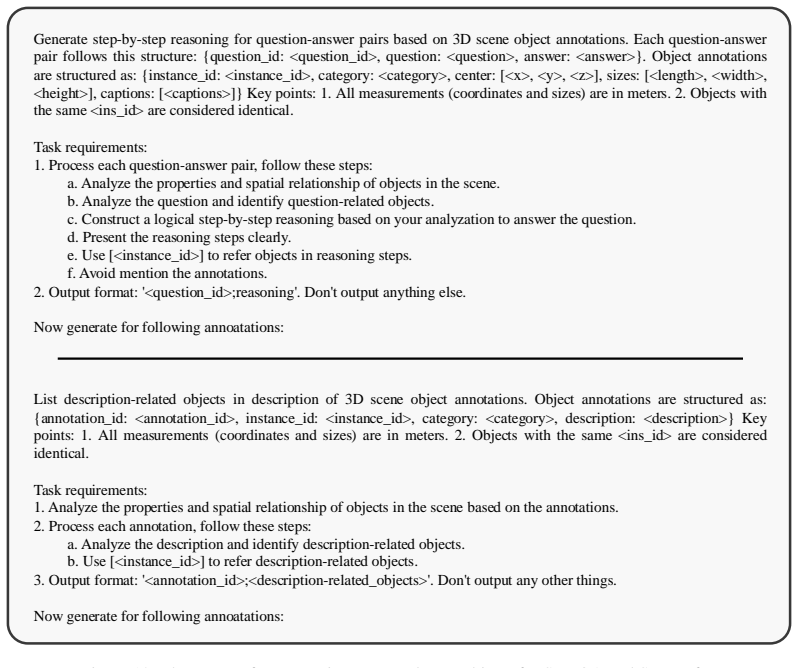
- domain assumption Super-point aggregation preserves sufficient spatial detail for precise segmentation.
- domain assumption Per-scene gIoU is an appropriate metric for evaluating reasoning-based segmentation.
- ad hoc to paper Mask-pooling in Eq. (7) yields features that preserve target-relevant object identity and position.
Cite this review
Pith. "Pith review of Enhancing Spatial Reasoning in Multimodal Large Language Models through Reasoning-based Segmentation." pith.science (2026). https://pith.science/paper/QPJUCV5L
@misc{pith2026250623120,
  author       = {Pith},
  title        = {Pith review of: Enhancing Spatial Reasoning in Multimodal Large Language Models through Reasoning-based Segmentation},
  year         = {2026},
  howpublished = {\url{https://pith.science/paper/QPJUCV5L}},
  note         = {Machine review of arXiv:2506.23120}
}
abstract
Recent advances in point cloud perception have demonstrated remarkable progress in scene understanding through vision-language alignment leveraging large language models (LLMs). However, existing methods may still encounter challenges in handling complex instructions that require accurate spatial reasoning, even if the 3D point cloud data provides detailed spatial cues such as size and position for identifying the targets. To tackle this issue, we propose Relevant Reasoning Segmentation (R$^2$S), a reasoning-based segmentation framework. The framework emulates human cognitive processes by decomposing spatial reasoning into two sequential stages: first identifying relevant elements, then processing instructions guided by their associated visual priors. Furthermore, acknowledging the inadequacy of existing datasets in complex reasoning tasks, we introduce 3D ReasonSeg, a reasoning-based segmentation dataset comprising 25,185 training samples and 3,966 validation samples with precise annotations. Both quantitative and qualitative experiments demonstrate that the R$^2$S and 3D ReasonSeg effectively endow 3D point cloud perception with stronger spatial reasoning capabilities, and we hope that they can serve as a new baseline and benchmark for future work.
Figures


Figures from the paper (9 more)




Forward citations
Cited by 1 Pith paper
-
Synthetic Stimuli, Real Gains: Rethinking VLM Fine-Tuning Through Fully Controlled Data Generation
Fine-tuning VLMs on balanced synthetic images with known object positions improves absolute-position accuracy on real COCO images by 13-21 points while using two orders of magnitude less data.
Reference graph
Works this paper leans on
-
[1]
Flamingo: a visual language model for few-shot learning
Jean-Baptiste Alayrac, Jeff Donahue, Pauline Luc, Antoine Miech, Iain Barr, Yana Hasson, Karel Lenc, Arthur Men- sch, Katherine Millican, Malcolm Reynolds, et al. Flamingo: a visual language model for few-shot learning. Advances in neural information processing systems, 35:23716–23736,
-
[2]
Scanqa: 3d question answering for spatial scene understanding
Daichi Azuma, Taiki Miyanishi, Shuhei Kurita, and Motoaki Kawanabe. Scanqa: 3d question answering for spatial scene understanding. In proceedings of the IEEE/CVF conference on computer vision and pattern recognition, pages 19129– 19139, 2022. 2, 6, 7, 12
work page 2022
-
[3]
Semantic scene com- pletion via integrating instances and scene in-the-loop
Yingjie Cai, Xuesong Chen, Chao Zhang, Kwan-Yee Lin, Xiaogang Wang, and Hongsheng Li. Semantic scene com- pletion via integrating instances and scene in-the-loop. In Proceedings of the IEEE/CVF Conference on Computer Vision and Pattern Recognition, pages 324–333, 2021. 2
work page 2021
-
[4]
Scanrefer: 3d object localization in rgb-d scans using natural language
Dave Zhenyu Chen, Angel X Chang, and Matthias Nießner. Scanrefer: 3d object localization in rgb-d scans using natural language. In European conference on computer vision, pages 202–221. Springer, 2020. 2, 6, 7, 12
work page 2020
-
[5]
Language conditioned spatial relation reasoning for 3d object grounding
Shizhe Chen, Pierre-Louis Guhur, Makarand Tapaswi, Cordelia Schmid, and Ivan Laptev. Language conditioned spatial relation reasoning for 3d object grounding. Advances in neural information processing systems, 35:20522–20535,
-
[6]
Ll3da: Visual interactive instruction tuning for omni-3d understand- ing reasoning and planning
Sijin Chen, Xin Chen, Chi Zhang, Mingsheng Li, Gang Yu, Hao Fei, Hongyuan Zhu, Jiayuan Fan, and Tao Chen. Ll3da: Visual interactive instruction tuning for omni-3d understand- ing reasoning and planning. InProceedings of the IEEE/CVF Conference on Computer Vision and Pattern Recognition, pages 26428–26438, 2024. 1, 2, 3, 6, 7
work page 2024
-
[7]
Mppnet: Multi-frame feature intertwining with proxy points for 3d temporal ob- ject detection
Xuesong Chen, Shaoshuai Shi, Benjin Zhu, Ka Chun Che- ung, Hang Xu, and Hongsheng Li. Mppnet: Multi-frame feature intertwining with proxy points for 3d temporal ob- ject detection. In European Conference on Computer Vision, pages 680–697. Springer, 2022. 2
work page 2022
-
[8]
Trajectoryformer: 3d object tracking transformer with predictive trajectory hypotheses
Xuesong Chen, Shaoshuai Shi, Chao Zhang, Benjin Zhu, Qiang Wang, Ka Chun Cheung, Simon See, and Hong- sheng Li. Trajectoryformer: 3d object tracking transformer with predictive trajectory hypotheses. In Proceedings of the IEEE/CVF International Conference on Computer Vision, pages 18527–18536, 2023. 2
work page 2023
Show all 77 references
-
[9]
Grounded 3d-llm with referent tokens
Yilun Chen, Shuai Yang, Haifeng Huang, Tai Wang, Ruiyuan Lyu, Runsen Xu, Dahua Lin, and Jiangmiao Pang. Grounded 3d-llm with referent tokens. arXiv preprint arXiv:2405.10370, 2024. 2, 7
2024 arXiv
-
[10]
Reslt: Residual learning for long-tailed recog- nition
Jiequan Cui, Shu Liu, Zhuotao Tian, Zhisheng Zhong, and Jiaya Jia. Reslt: Residual learning for long-tailed recog- nition. IEEE transactions on pattern analysis and machine intelligence, 45(3):3695–3706, 2022. 12
2022
-
[11]
Scannet: Richly-annotated 3d reconstructions of indoor scenes
Angela Dai, Angel X Chang, Manolis Savva, Maciej Hal- ber, Thomas Funkhouser, and Matthias Nießner. Scannet: Richly-annotated 3d reconstructions of indoor scenes. In Proceedings of the IEEE conference on computer vision and pattern recognition, pages 5828–5839, 2017. 6
2017
-
[12]
Mta- clip: Language-guided semantic segmentation with mask- text alignment
Anurag Das, Xinting Hu, Li Jiang, and Bernt Schiele. Mta- clip: Language-guided semantic segmentation with mask- text alignment. arXiv preprint arXiv:2407.21654, 2024. 2
2024 arXiv
-
[13]
Bert: Pre-training of deep bidirectional transformers for language understanding
Jacob Devlin. Bert: Pre-training of deep bidirectional transformers for language understanding. arXiv preprint arXiv:1810.04805, 2018. 12, 14
2018 arXiv
-
[14]
Pla: Language-driven open- vocabulary 3d scene understanding
Runyu Ding, Jihan Yang, Chuhui Xue, Wenqing Zhang, Song Bai, and Xiaojuan Qi. Pla: Language-driven open- vocabulary 3d scene understanding. In Proceedings of the IEEE/CVF conference on computer vision and pattern recognition, pages 7010–7019, 2023. 2
2023
-
[15]
The llama 3 herd of models, 2024
Abhimanyu Dubey, Abhinav Jauhri, Abhinav Pandey, Ab- hishek Kadian, Ahmad Al-Dahle, Aiesha Letman, and Akhil Mathur et.al. The llama 3 herd of models, 2024. 5, 6, 12
2024
-
[16]
Point-bind & point-llm: Aligning point cloud with multi-modality for 3d understand- ing, generation, and instruction following
Ziyu Guo, Renrui Zhang, Xiangyang Zhu, Yiwen Tang, Xi- anzheng Ma, Jiaming Han, Kexin Chen, Peng Gao, Xi- anzhi Li, Hongsheng Li, et al. Point-bind & point-llm: Aligning point cloud with multi-modality for 3d understand- ing, generation, and instruction following. arXiv prepri...
2023 arXiv
-
[17]
Imagebind-llm: Multi-modality instruction tun- ing
Jiaming Han, Renrui Zhang, Wenqi Shao, Peng Gao, Peng Xu, Han Xiao, Kaipeng Zhang, Chris Liu, Song Wen, Ziyu Guo, et al. Imagebind-llm: Multi-modality instruction tun- ing. arXiv preprint arXiv:2309.03905, 2023. 2
2023 arXiv
-
[18]
3d-llm: Inject- ing the 3d world into large language models
Yining Hong, Haoyu Zhen, Peihao Chen, Shuhong Zheng, Yilun Du, Zhenfang Chen, and Chuang Gan. 3d-llm: Inject- ing the 3d world into large language models. Advances in Neural Information Processing Systems, 36:20482–20494,
-
[19]
Chat-3d v2: Bridging 3d scene and large language models with object identifiers
Haifeng Huang, Zehan Wang, Rongjie Huang, Luping Liu, Xize Cheng, Yang Zhao, Tao Jin, and Zhou Zhao. Chat-3d v2: Bridging 3d scene and large language models with object identifiers. arXiv preprint arXiv:2312.08168, 2023. 1, 2, 3, 7
2023 arXiv
-
[20]
An embodied generalist agent in 3d world
Jiangyong Huang, Silong Yong, Xiaojian Ma, Xiongkun Linghu, Puhao Li, Yan Wang, Qing Li, Song-Chun Zhu, Baoxiong Jia, and Siyuan Huang. An embodied generalist agent in 3d world. arXiv preprint arXiv:2311.12871, 2023. 2
2023 arXiv
-
[21]
Multi- view transformer for 3d visual grounding
Shijia Huang, Yilun Chen, Jiaya Jia, and Liwei Wang. Multi- view transformer for 3d visual grounding. In Proceedings of the IEEE/CVF Conference on Computer Vision and Pattern Recognition, pages 15524–15533, 2022. 2, 7
2022
-
[22]
Sceneverse: Scaling 3d vision-language learn- ing for grounded scene understanding
Baoxiong Jia, Yixin Chen, Huangyue Yu, Yan Wang, Xuesong Niu, Tengyu Liu, Qing Li, and Siyuan Huang. Sceneverse: Scaling 3d vision-language learn- ing for grounded scene understanding. arXiv preprint arXiv:2401.09340, 2024. 5, 6
2024 arXiv
-
[23]
Guided point contrastive learn- ing for semi-supervised point cloud semantic segmentation
Li Jiang, Shaoshuai Shi, Zhuotao Tian, Xin Lai, Shu Liu, Chi-Wing Fu, and Jiaya Jia. Guided point contrastive learn- ing for semi-supervised point cloud semantic segmentation. 9 In Proceedings of the IEEE/CVF international conference on computer vision, pages 6423–6432, 2021. 12
2021
-
[24]
Berg, Wan-Yen Lo, Piotr Doll ´ar, and Ross Girshick
Alexander Kirillov, Eric Mintun, Nikhila Ravi, Hanzi Mao, Chloe Rolland, Laura Gustafson, Tete Xiao, Spencer White- head, Alexander C. Berg, Wan-Yen Lo, Piotr Doll ´ar, and Ross Girshick. Segment anything. arXiv:2304.02643, 2023. 3
2023 arXiv
-
[25]
Oneformer3d: One transformer for unified point cloud segmentation
Maxim Kolodiazhnyi, Anna V orontsova, Anton Konushin, and Danila Rukhovich. Oneformer3d: One transformer for unified point cloud segmentation. In Proceedings of the IEEE/CVF Conference on Computer Vision and Pattern Recognition, pages 20943–20953, 2024. 2, 6, 12, 14
2024
-
[26]
Lisa: Reasoning segmentation via large language model
Xin Lai, Zhuotao Tian, Yukang Chen, Yanwei Li, Yuhui Yuan, Shu Liu, and Jiaya Jia. Lisa: Reasoning segmentation via large language model. In Proceedings of the IEEE/CVF Conference on Computer Vision and Pattern Recognition, pages 9579–9589, 2024. 3, 7
2024
-
[27]
Step-dpo: Step-wise preference op- timization for long-chain reasoning of llms
Xin Lai, Zhuotao Tian, Yukang Chen, Senqiao Yang, Xian- gru Peng, and Jiaya Jia. Step-dpo: Step-wise preference op- timization for long-chain reasoning of llms. arXiv preprint arXiv:2406.18629, 2024. 12
2024 arXiv
-
[28]
Large-scale point cloud semantic segmentation with superpoint graphs
Loic Landrieu and Martin Simonovsky. Large-scale point cloud semantic segmentation with superpoint graphs. In Proceedings of the IEEE conference on computer vision and pattern recognition, pages 4558–4567, 2018. 3
2018
-
[29]
Blip-2: Bootstrapping language-image pre-training with frozen image encoders and large language models
Junnan Li, Dongxu Li, Silvio Savarese, and Steven Hoi. Blip-2: Bootstrapping language-image pre-training with frozen image encoders and large language models. In International conference on machine learning, pages 19730– 19742. PMLR, 2023. 1, 3, 12, 14
2023
-
[30]
Uni3d-llm: Unifying point cloud perception, generation and editing with large language models
Dingning Liu, Xiaoshui Huang, Yuenan Hou, Zhihui Wang, Zhenfei Yin, Yongshun Gong, Peng Gao, and Wanli Ouyang. Uni3d-llm: Unifying point cloud perception, generation and editing with large language models. arXiv preprint arXiv:2402.03327, 2024. 2
2024 arXiv
-
[31]
Decoupled weight decay regularization
I Loshchilov. Decoupled weight decay regularization. arXiv preprint arXiv:1711.05101, 2017. 6
2017 arXiv
-
[32]
Sqa3d: Situated question answering in 3d scenes
Xiaojian Ma, Silong Yong, Zilong Zheng, Qing Li, Yi- tao Liang, Song-Chun Zhu, and Siyuan Huang. Sqa3d: Situated question answering in 3d scenes. arXiv preprint arXiv:2210.07474, 2022. 2
2022 arXiv
-
[33]
An end-to-end transformer model for 3d object detection
Ishan Misra, Rohit Girdhar, and Armand Joulin. An end-to-end transformer model for 3d object detection. In Proceedings of the IEEE/CVF international conference on computer vision, pages 2906–2917, 2021. 2
2021
-
[34]
Boosting few-shot 3d point cloud segmentation via query-guided enhancement
Zhenhua Ning, Zhuotao Tian, Guangming Lu, and Wenjie Pei. Boosting few-shot 3d point cloud segmentation via query-guided enhancement. In Proceedings of the 31st ACM international conference on multimedia, pages 1895–1904,
1904
-
[35]
Hierarchi- cal dense correlation distillation for few-shot segmentation
Bohao Peng, Zhuotao Tian, Xiaoyang Wu, Chengyao Wang, Shu Liu, Jingyong Su, and Jiaya Jia. Hierarchi- cal dense correlation distillation for few-shot segmentation. In Proceedings of the IEEE/CVF Conference on Computer Vision and Pattern Recognition, pages 23641–23651, 2023. 12
2023
-
[36]
Scalable language model with generalized contin- ual learning
Bohao Peng, Zhuotao Tian, Shu Liu, Mingchang Yang, and Jiaya Jia. Scalable language model with generalized contin- ual learning. arXiv preprint arXiv:2404.07470, 2024. 12
2024 arXiv
-
[37]
Oa-cnns: Omni- adaptive sparse cnns for 3d semantic segmentation
Bohao Peng, Xiaoyang Wu, Li Jiang, Yukang Chen, Heng- shuang Zhao, Zhuotao Tian, and Jiaya Jia. Oa-cnns: Omni- adaptive sparse cnns for 3d semantic segmentation. In Proceedings of the IEEE/CVF Conference on Computer Vision and Pattern Recognition, pages 21305–21315, 2024. 12
2024
-
[38]
Openscene: 3d scene understanding with open vocabularies
Songyou Peng, Kyle Genova, Chiyu Jiang, Andrea Tagliasacchi, Marc Pollefeys, Thomas Funkhouser, et al. Openscene: 3d scene understanding with open vocabularies. In Proceedings of the IEEE/CVF conference on computer vision and pattern recognition, pages 815–824, 2023. 2
2023
-
[39]
Explore the potential of clip for training-free open vocab- ulary semantic segmentation
Tong Shao, Zhuotao Tian, Hang Zhao, and Jingyong Su. Explore the potential of clip for training-free open vocab- ulary semantic segmentation. In European Conference on Computer Vision, pages 139–156. Springer, 2024. 12
2024
-
[40]
Pointr- cnn: 3d object proposal generation and detection from point cloud
Shaoshuai Shi, Xiaogang Wang, and Hongsheng Li. Pointr- cnn: 3d object proposal generation and detection from point cloud. In Proceedings of the IEEE/CVF conference on computer vision and pattern recognition, pages 770–779,
-
[41]
Open- mask3d: Open-vocabulary 3d instance segmentation
Ayc ¸a Takmaz, Elisabetta Fedele, Robert W Sumner, Marc Pollefeys, Federico Tombari, and Francis Engelmann. Open- mask3d: Open-vocabulary 3d instance segmentation. arXiv preprint arXiv:2306.13631, 2023. 2
2023 arXiv
-
[42]
Mind the interference: Retaining pre-trained knowledge in parameter efficient continual learning of vision-language models
Longxiang Tang, Zhuotao Tian, Kai Li, Chunming He, Han- tao Zhou, Hengshuang Zhao, Xiu Li, and Jiaya Jia. Mind the interference: Retaining pre-trained knowledge in parameter efficient continual learning of vision-language models. In European Conference on Computer Vision, page...
2024
-
[43]
Learning shape-aware embedding for scene text detection
Zhuotao Tian, Michelle Shu, Pengyuan Lyu, Ruiyu Li, Chao Zhou, Xiaoyong Shen, and Jiaya Jia. Learning shape-aware embedding for scene text detection. In Proceedings of the IEEE/CVF conference on computer vision and pattern recognition, pages 4234–4243, 2019. 12
2019
-
[44]
Prior guided feature enrich- ment network for few-shot segmentation
Zhuotao Tian, Hengshuang Zhao, Michelle Shu, Zhicheng Yang, Ruiyu Li, and Jiaya Jia. Prior guided feature enrich- ment network for few-shot segmentation. IEEE transactions on pattern analysis and machine intelligence, 44(2):1050– 1065, 2020. 12
2020
-
[45]
Adaptive perspective distillation for semantic segmen- tation
Zhuotao Tian, Pengguang Chen, Xin Lai, Li Jiang, Shu Liu, Hengshuang Zhao, Bei Yu, Ming-Chang Yang, and Jiaya Jia. Adaptive perspective distillation for semantic segmen- tation. IEEE Transactions on Pattern Analysis and Machine Intelligence, 45(2):1372–1387, 2022. 12
2022
-
[46]
Generalized few-shot semantic segmentation
Zhuotao Tian, Xin Lai, Li Jiang, Shu Liu, Michelle Shu, Hengshuang Zhao, and Jiaya Jia. Generalized few-shot semantic segmentation. In Proceedings of the IEEE/CVF Conference on Computer Vision and Pattern Recognition, pages 11563–11572, 2022. 12
2022
-
[47]
Learning context-aware classifier for semantic segmentation
Zhuotao Tian, Jiequan Cui, Li Jiang, Xiaojuan Qi, Xin Lai, Yixin Chen, Shu Liu, and Jiaya Jia. Learning context-aware classifier for semantic segmentation. In Proceedings of the AAAI Conference on Artificial Intelligence, pages 2438– 2446, 2023. 12 10
2023
-
[48]
Chat-3d: Data-efficiently tuning large language model for universal dialogue of 3d scenes
Zehan Wang, Haifeng Huang, Yang Zhao, Ziang Zhang, and Zhou Zhao. Chat-3d: Data-efficiently tuning large language model for universal dialogue of 3d scenes. arXiv preprint arXiv:2308.08769, 2023. 1, 2, 7
2023 arXiv
-
[49]
Visual chatgpt: Talking, drawing and editing with visual foundation models
Chenfei Wu, Shengming Yin, Weizhen Qi, Xiaodong Wang, Zecheng Tang, and Nan Duan. Visual chatgpt: Talking, drawing and editing with visual foundation models. arXiv preprint arXiv:2303.04671, 2023. 1
2023 arXiv
-
[50]
Pointllm: Empowering large language models to understand point clouds
Runsen Xu, Xiaolong Wang, Tai Wang, Yilun Chen, Jiang- miao Pang, and Dahua Lin. Pointllm: Empowering large language models to understand point clouds. arXiv preprint arXiv:2308.16911, 2023. 1, 2
2023 arXiv
-
[51]
Llm- grounder: Open-vocabulary 3d visual grounding with large language model as an agent
Jianing Yang, Xuweiyi Chen, Shengyi Qian, Nikhil Madaan, Madhavan Iyengar, David F Fouhey, and Joyce Chai. Llm- grounder: Open-vocabulary 3d visual grounding with large language model as an agent. In 2024 IEEE International Conference on Robotics and Automation (ICRA), pages 7...
2024
-
[52]
Lisa++: An improved baseline for reasoning segmentation with large language model.arXiv preprint arXiv:2312.17240, 2023
Senqiao Yang, Tianyuan Qu, Xin Lai, Zhuotao Tian, Bohao Peng, Shu Liu, and Jiaya Jia. Lisa++: An improved baseline for reasoning segmentation with large language model.arXiv preprint arXiv:2312.17240, 2023. 12
2023 arXiv
-
[53]
Unified language-driven zero-shot domain adaptation
Senqiao Yang, Zhuotao Tian, Li Jiang, and Jiaya Jia. Unified language-driven zero-shot domain adaptation. In Proceedings of the IEEE/CVF Conference on Computer Vision and Pattern Recognition, pages 23407–23415, 2024
2024
-
[54]
Visionzip: Longer is better but not necessary in vision language models
Senqiao Yang, Yukang Chen, Zhuotao Tian, Chengyao Wang, Jingyao Li, Bei Yu, and Jiaya Jia. Visionzip: Longer is better but not necessary in vision language models. In Proceedings of the Computer Vision and Pattern Recognition Conference, pages 19792–19802, 2025. 12
2025
-
[55]
Mm-react: Prompting chatgpt for multimodal reasoning and action
Zhengyuan Yang, Linjie Li, Jianfeng Wang, Kevin Lin, Ehsan Azarnasab, Faisal Ahmed, Zicheng Liu, Ce Liu, Michael Zeng, and Lijuan Wang. Mm-react: Prompting chatgpt for multimodal reasoning and action. arXiv preprint arXiv:2303.11381, 2023. 1
2023 arXiv
-
[56]
mplug-owl: Modularization empowers large language models with multimodality
Qinghao Ye, Haiyang Xu, Guohai Xu, Jiabo Ye, Ming Yan, Yiyang Zhou, Junyang Wang, Anwen Hu, Pengcheng Shi, Yaya Shi, et al. mplug-owl: Modularization empowers large language models with multimodality. arXiv preprint arXiv:2304.14178, 2023. 1
2023 arXiv
-
[57]
Opt: Open pre-trained trans- former language models
Susan Zhang, Stephen Roller, Naman Goyal, Mikel Artetxe, Moya Chen, Shuohui Chen, Christopher Dewan, Mona Diab, Xian Li, Xi Victoria Lin, et al. Opt: Open pre-trained trans- former language models. arXiv preprint arXiv:2205.01068,
-
[58]
Multi3drefer: Grounding text description to multiple 3d objects
Yiming Zhang, ZeMing Gong, and Angel X Chang. Multi3drefer: Grounding text description to multiple 3d objects. In Proceedings of the IEEE/CVF International Conference on Computer Vision, pages 15225–15236, 2023. 2, 7
2023
-
[59]
3dvg- transformer: Relation modeling for visual grounding on point clouds
Lichen Zhao, Daigang Cai, Lu Sheng, and Dong Xu. 3dvg- transformer: Relation modeling for visual grounding on point clouds. In Proceedings of the IEEE/CVF International Conference on Computer Vision, pages 2928–2937, 2021. 7
2021
-
[60]
Empowering 3d visual grounding with reasoning capabilities
Chenming Zhu, Tai Wang, Wenwei Zhang, Kai Chen, and Xihui Liu. Empowering 3d visual grounding with reasoning capabilities. arXiv preprint arXiv:2407.01525, 2024. 2, 7
2024 arXiv
-
[61]
Minigpt-4: Enhancing vision-language understanding with advanced large language models
Deyao Zhu, Jun Chen, Xiaoqian Shen, Xiang Li, and Mo- hamed Elhoseiny. Minigpt-4: Enhancing vision-language understanding with advanced large language models. arXiv preprint arXiv:2304.10592, 2023. 1
2023 arXiv
-
[62]
in the right of
Ziyu Zhu, Xiaojian Ma, Yixin Chen, Zhidong Deng, Siyuan Huang, and Qing Li. 3d-vista: Pre-trained transformer for 3d vision and text alignment. In Proceedings of the IEEE/CVF International Conference on Computer Vision, pages 2911– 2921, 2023. 7 11 A. Data construction details...
2023
-
[63]
Focus on detecting and distinguishing objects
Generate challenging object-centric questions using the annotations: a. Focus on detecting and distinguishing objects. The answer should specify one or more objects. b. Include at least two of the objects' uses, appearance, positions, and sizes. c. Require logical reasoning to...
-
[64]
Provide step-by-step reasoning for each question follow these steps:
-
[65]
Analyze the properties and spatial relationship of objects in the scene
-
[66]
Analyze the question and identify question-related objects
-
[67]
Construct a logical step-by-step reasoning based on your analyzation to answer the question
-
[68]
Present the reasoning steps clearly
-
[69]
For multiple objects of the same category, use [<ins_id>][<ins_id>][<ins_id>], etc
Use [<ins_id>] to refer objects in reasoning steps . For multiple objects of the same category, use [<ins_id>][<ins_id>][<ins_id>], etc
-
[70]
Answer the question accurately
-
[71]
Only use objects from the annotations
-
[72]
Don't output anything else
Output format: 'question;reasoning;answer'. Don't output anything else. Now generate for following annotations: Figure 9. The prompt for yielding 3D ReasonSeg. Generate step-by-step reasoning for question-answer pairs based on 3D scene object annotations. Each question-answer ...
-
[73]
Analyze the properties and spatial relationship of objects in the scene
Process each question-answer pair, follow these steps: a. Analyze the properties and spatial relationship of objects in the scene. b. Analyze the question and identify question-related objects. c. Construct a logical step-by-step reasoning based on your analyzation to answer t...
-
[74]
Don't output anything else
Output format: '<question_id>;reasoning'. Don't output anything else. Now generate for following annoatations: List description-related objects in description of 3D scene object annotations. Object annotations are structured as: {annotation_id: <annotation_id>, instance_id: <i...
-
[75]
Analyze the properties and spatial relationship of objects in the scene based on the annotations
-
[76]
Analyze the description and identify description-related objects
Process each annotation, follow these steps: a. Analyze the description and identify description-related objects. b. Use [<instance_id>] to refer description-related objects
-
[77]
Don't output any other things
Output format: '<annotation_id>;<description-related_objects>'. Don't output any other things. Now generate for following annoatations: Figure 10. The prompt for generating target-relevant objects for ScanQA and ScanRefer. 13 Task Name Instruction Template 3D Reasoning Segment...
Reviewed August 6, 2026 · model on record in the stance chip above.
Discussion (0). Sign in to comment.