REVIEW 3 major objections 6 minor 34 references
It Takes a Graph to Know a Graph: Rewiring for Homophily with a Reference Graph
T0 review · 3 major / 6 minor · reviewed 2026-08-15 · deepseek-v4-flash
Pith's one-line read Rewiring with a label-aware reference graph beats specialized GNNs
desk verdict A clean, practical rewiring method whose empirical story holds up — but the abstract overclaims past what the experiments actually compare against. read the letter →
The pith
A machine-rendered reading of the paper's core claim, the machinery that carries it, and where it could break.
The reading
What carries the argument
The load-bearing object is the reference graph $G_r$, a second graph on the same node set whose edge set is derived from a clipped label-driven diffusion kernel $\Gamma = P D P$: first normalize a Gaussian feature-affinity matrix $W_D$ into a diffusion kernel $D$, define a label-propagation kernel $P$ from training labels, and multiply $P D P$ so labels are propagated onto unlabeled nodes through feature geometry. Row-wise clipping of $\Gamma$ yields the binary adjacency of $G_r$. Two propositions carry the argument: edge addition improves expected homophily exactly when the reference graph's edges not already present are more homophilic than the original graph (Prop. 1), and edge deletion improves it when the common part of the original graph and the reference graph's complement is less homophilic than the original (Prop. 2). A corollary simplifies the addition condition to $H(G_r) > H(G)$ when the reference graph is much larger than the original, which is the condition used in practice. Scalability comes from partitioning the graph into balanced clusters, rewiring each cluster independently, and reattaching inter-cluster edges, giving per-cluster cost $O(c^3)$ and overall $O(c^2 n)$, effectively linear in the number of nodes when clusters are small.
What would settle it
On a heterophilic benchmark, corrupt the node features so they are independent of the class labels while keeping the original graph and label distribution fixed; REFine should then fail to produce a reference graph with $H(G_r) > H(G)$ and should show no accuracy gain over training on the original graph. A cleaner test: run the method on two synthetic graphs with identical structure and labels, one with label-aligned features and one with permuted features, and compare rewired homophily and test accuracy.
Extended reading notes
Core claim
The central claim is that a graph's own structure can be improved for message passing by consulting a second graph, the reference graph, built from the same nodes, and that homophily-enhancing rewiring is provably effective when the reference graph is more homophilic than the original. Formally, the paper links edge homophily to a lower bound on the Dirichlet energy of any linearly separable embedding: $\mathrm{tr}(Z^T L Z) \geq \frac{\alpha_m |E|}{2\|W\|^2}(1-H(G))$, so low-homophily graphs force a trade-off between smoothing and separability. It then proves that adding random edges from the reference graph increases expected homophily if $H(G_r \setminus G) > H(G)$, and deleting random edges shared with the reference graph's complement increases it if $H(G \cap G_r^c) < H(G)$. The practical discovery is that a reference graph built from feature similarities and training labels via the label-driven diffusion kernel $\Gamma = P D P$ is homophilic enough to trigger these conditions, and that rewiring with it improves node classification for standard GNNs across low-homophily benchmarks.
Load-bearing premise
The method assumes the feature space gives a meaningful similarity measure aligned with the labels; if it does not, the label-driven reference graph will not be more homophilic than the original graph, and the rewiring step can lower both homophily and accuracy.
Editorial extensions
If this is right
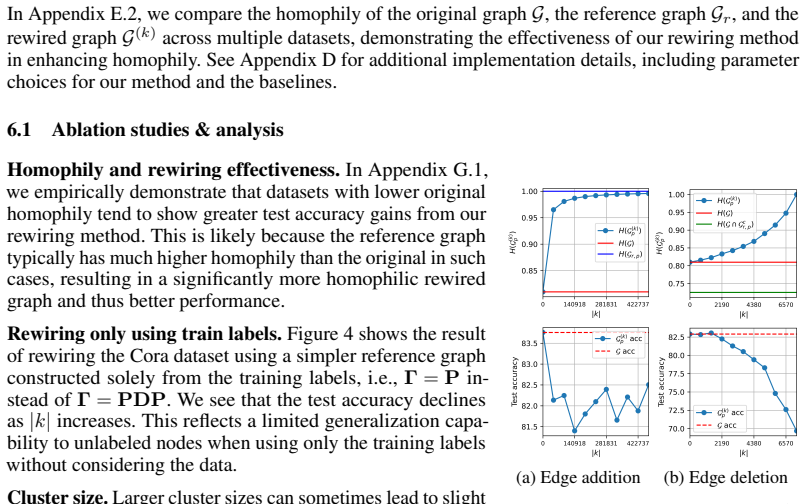
- Standard GNNs (GCN, GATv2, APPNP) can match or exceed specialized heterophilic architectures (MixHop, H2GCN, GPRGNN, OrderedGNN) simply by training on the rewired graph.
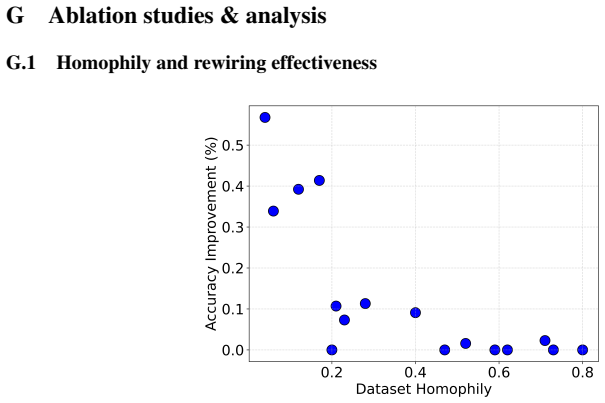
- The larger the homophily gap between the original graph and the reference graph, the larger the expected accuracy gain; datasets with very low original homophily benefit most.
- The method scales to graphs with hundreds of thousands of nodes because rewiring is performed independently on clusters, with complexity linear in node count when clusters are small.
- Rewiring can be guided by a simple check: if the reference graph, or its residual edges, is not more homophilic than the original, edge addition should be avoided because it degrades both homophily and accuracy.
- A reference graph constructed from features and training labels can be used to rewire larger graphs without requiring full label supervision, since only training labels enter the diffusion kernel.
Reading between the lines
- Because the reference graph is built from features and training labels only, the same construction could be applied inductively to unseen graphs in a trained model's deployment, provided the label-driven diffusion kernel can be estimated from a small labeled seed.
- The homophily conditions in Propositions 1 and 2 could be used online: estimate $H(G_r \setminus G)$ and $H(G \cap G_r^c)$ from a validation sample, then choose edge addition, deletion, or no rewiring accordingly, turning $k$ from a fixed hyperparameter into an adaptive decision.
- If feature similarity and label structure diverge, for example when features are noisy or dominated by a spurious signal, the method's own condition predicts failure; a test on a graph with deliberately label-uncorrelated features would sharpen the boundary of applicability.
- The reference-graph idea could also be used to target properties other than homophily, such as preserving local clustering or reducing over-squashing, by choosing the reference graph to encode the desired structural prior.
Signed reviews
Editorial analysis
A structured set of objections, weighed in public.
Referee Report
Summary. The paper proposes REFine, a graph rewiring method that increases edge homophily by adding or deleting edges guided by a reference graph constructed from node features and training labels via label-driven diffusion. The authors prove that adding or removing random edges from or against a suitable reference graph improves expected homophily (Props. 1-2), and they prove a lower bound linking homophily to the Dirichlet energy of linearly separable embeddings (Thm. 1). The method clusters large graphs with METIS for scalability and is evaluated on 11 heterophilic datasets across GCN, GATv2, and APPNP, comparing favorably to several rewiring baselines and specialized GNNs. The paper includes code and reports extensive ablations, including the effect of cluster size and the homophily of the constructed reference graphs.
Significance. If the concerns below are addressed, the paper makes a useful contribution: it gives a clean expected-homophily monotonicity result for reference-guided rewiring, a scalable and practical algorithm, and strong empirical gains on several heterophilic benchmarks. The release of code and the use of standard benchmarks support reproducibility. The main conceptual novelty—using a feature- and label-driven reference graph to rewire for homophily—is well motivated. However, the strongest claims in the abstract and introduction are currently broader than what is actually verified, and one central proof contains an algebraic error that must be corrected.
major comments (3)
- [Appendix A.1, proof of Theorem 1] The proof contains an algebraic error: the displayed equality \sum_{(u,v)\in E} A_{uv}\|y_u - y_v\|^2 = 2\|W\|^2\operatorname{tr}(Z^T L Z) is false because \|(z_u - z_v)W\|^2 is not equal to \|W\|^2\|z_u - z_v\|^2 for a general matrix W. The correct step is an inequality \|(z_u - z_v)W\|^2 \le \|W\|^2\|z_u - z_v\|^2, which still yields the stated lower bound after dividing by \|W\|^2. This must be corrected; as written, the proof does not establish Theorem 1, which is the paper's main theoretical motivation.
- [Section 2 and Tables 1-2] The abstract and Section 1 claim that REFine 'outperforms existing rewiring techniques,' but the only homophily-targeted rewiring method discussed in Section 2, DHGR [23], is excluded from all experiments on the basis that it is closer to graph structure learning. The baselines actually evaluated (SDRF, FoSR, BORF) are designed for over-smoothing and over-squashing, not homophily. As a result, the headline claim is not substantiated for the directly relevant competitor. The authors should either add a DHGR comparison (even on a subset of datasets) or narrow the claim to the evaluated baselines.
- [Section 5 and Props. 1-2] The theoretical guarantees of Props. 1 and 2 apply to a random rewiring process on the whole graph and require exact conditions on H(G_r\setminus G) and H(G\cap G_r^c). In the deployed method, rewiring is performed per METIS cluster, the conditions are checked only approximately using a sampled graph (Appendix C.3), and the choice of edge addition versus deletion is selected as a hyperparameter by validation accuracy rather than by whether the proposition's condition holds. The abstract's statement 'with theoretical guarantees on the homophily of the rewired graph' therefore overstates the connection between the theory and the actual algorithm. The gap should be made explicit and analyzed, or the guarantee should be limited to the idealized setting of Section 4.1.
minor comments (6)
- [Section 5, notation] The text 'where n<n ' is missing a subscript, and 'Y =\in \mathbb{R}^{n\times 1}' contains a typo; please fix both.
- [Section 4.2, figure reference] The text refers to '(4a)' and '(4b)' when discussing Figure 2; these should be '(2a)' and '(2b)'.
- [Appendix A.2, sampling model] The proof models edge selection as i.i.d. Bernoulli draws, while Algorithm 1 samples a random subset without replacement. The expectation formula is unaffected by this distinction, but the proof should state the correct sampling model or justify the equivalence.
- [Theorem 1 statement] The theorem says 'linearly separable embeddings,' but the proof assumes the exact equality Y = ZW, i.e., a zero-error linear classifier. This assumption is stronger than linear separability and should be stated explicitly in the theorem.
- [Appendix D] 'T/0' should be 'T/O' (timeout).
- [Table 1 caption] The REFine Gain row uses upward and downward arrows without a definition; please add a note that they indicate positive and negative gains, respectively.
Circularity Check
No significant circularity: the theoretical guarantees are direct consequences of the edge-homophily definition, and the accuracy gains are independent empirical measurements.
full rationale
The central theoretical results (Theorem 1, Propositions 1 and 2, Corollary 1) are derived self-containedly from the definition of edge homophily and elementary algebra. For example, Proposition 1's condition H(Gr\G) > H(G) is exactly the sign condition for the derivative of E[H(G(k))] with respect to k, so the 'guarantee' is a mathematical implication rather than an assumption of the conclusion. The label-driven diffusion kernel Γ = PDP is attributed to the authors' prior work [14], but Section 5 and Appendix C.2 specify the construction in full, and Appendix E.3 evaluates H(Gr) for Γ = D versus Γ = PDP on real data; the accuracy results in Tables 1 and 2 are direct experimental measurements after validation-set hyperparameter selection, not quantities forced by the definitions. No fitted parameter is renamed as a prediction, and no uniqueness theorem is imported from the authors' prior work. The omission of DHGR from the comparison tables is a benchmarking completeness concern, not circularity.
Assumptions & free parameters
free parameters (5)
- scale parameter epsilon =
searched in {1e-8, 1e-7, 1e-6, 1e-5, 1e-4, 1e-3, 1e-2, 1e0, 1e1, 1e2}
- number of rewired edges k =
searched in {0.1m, 0.3m, 0.5m, 0.7m, 0.9m, m}
- kernel choice Gamma = PDP vs D =
binary choice
- rewiring direction =
addition or deletion
- cluster size c =
100 or 500
assumptions (4)
- domain assumption The feature space offers a meaningful measure of similarity that aligns with the labels
- domain assumption Message passing GNNs inherently smooth embeddings along the graph
- domain assumption The sampled graph homophily approximates the true graph homophily
- standard math METIS produces balanced clusters and preserves useful structure
Cite this review
Pith. "Pith review of It Takes a Graph to Know a Graph: Rewiring for Homophily with a Reference Graph." pith.science (2026). https://pith.science/paper/QQ2SGUWW
@misc{pith2026250512411,
  author       = {Pith},
  title        = {Pith review of: It Takes a Graph to Know a Graph: Rewiring for Homophily with a Reference Graph},
  year         = {2026},
  howpublished = {\url{https://pith.science/paper/QQ2SGUWW}},
  note         = {Machine review of arXiv:2505.12411}
}
read the original abstract
Graph Neural Networks (GNNs) excel at analyzing graph-structured data but struggle on heterophilic graphs, where connected nodes often belong to different classes. While this challenge is commonly addressed with specialized GNN architectures, graph rewiring remains an underexplored strategy in this context. We provide theoretical foundations linking edge homophily, GNN embedding smoothness, and node classification performance, motivating the need to enhance homophily. Building on this insight, we introduce a rewiring framework that increases graph homophily using a reference graph, with theoretical guarantees on the homophily of the rewired graph. To broaden applicability, we propose a label-driven diffusion approach for constructing a homophilic reference graph from node features and training labels. Through extensive simulations, we analyze how the homophily of both the original and reference graphs influences the rewired graph homophily and downstream GNN performance. We evaluate our method on 11 real-world heterophilic datasets and show that it outperforms existing rewiring techniques and specialized GNNs for heterophilic graphs, achieving improved node classification accuracy while remaining efficient and scalable to large graphs.
Figures


Figures from the paper (6 more)


Reference graph
Works this paper leans on
-
[23]
Make heterophilic graphs better fit gnn: A graph rewiring approach
Wendong Bi, Lun Du, Qiang Fu, Yanlin Wang, Shi Han, and Dongmei Zhang. Make heterophilic graphs better fit gnn: A graph rewiring approach. IEEE Transactions on Knowledge and Data Engineering, 2024
work page 2024
-
[1]
Braingnn: Interpretable brain graph neural network for fmri analysis
Xiaoxiao Li, Yuan Zhou, Nicha Dvornek, Muhan Zhang, Siyuan Gao, Juntang Zhuang, Dustin Scheinost, Lawrence H Staib, Pamela Ventola, and James S Duncan. Braingnn: Interpretable brain graph neural network for fmri analysis. Medical Image Analysis, 74:102233, 2021
2021
-
[2]
Learning effective road network representation with hierarchical graph neural networks
Ning Wu, Xin Wayne Zhao, Jingyuan Wang, and Dayan Pan. Learning effective road network representation with hierarchical graph neural networks. In Proceedings of the 26th ACM SIGKDD international conference on knowledge discovery & data mining, pages 6–14, 2020
work page 2020
-
[3]
Fast and flexible protein design using deep graph neural networks
Alexey Strokach, David Becerra, Carles Corbi-Verge, Albert Perez-Riba, and Philip M Kim. Fast and flexible protein design using deep graph neural networks. Cell systems, 11(4):402–411, 2020
work page 2020
-
[4]
Birds of a feather: Homophily in social networks
Miller McPherson, Lynn Smith-Lovin, and James M Cook. Birds of a feather: Homophily in social networks. Annual review of sociology, 27(1):415–444, 2001
2001
-
[5]
Graph neural networks for graphs with heterophily: A survey
Xin Zheng, Yi Wang, Yixin Liu, Ming Li, Miao Zhang, Di Jin, Philip S Yu, and Shirui Pan. Graph neural networks for graphs with heterophily: A survey. arXiv preprint arXiv:2202.07082, 2022
arXiv 2022
-
[6]
Be- yond homophily in graph neural networks: Current limitations and effective designs
Jiong Zhu, Yujun Yan, Lingxiao Zhao, Mark Heimann, Leman Akoglu, and Danai Koutra. Be- yond homophily in graph neural networks: Current limitations and effective designs. Advances in neural information processing systems, 33:7793–7804, 2020
work page 2020
-
[7]
Two sides of the same coin: Heterophily and oversmoothing in graph convolutional neural networks
Yujun Yan, Milad Hashemi, Kevin Swersky, Yaoqing Yang, and Danai Koutra. Two sides of the same coin: Heterophily and oversmoothing in graph convolutional neural networks. In 2022 IEEE International Conference on Data Mining (ICDM), pages 1287–1292. IEEE, 2022
work page 2022
Show all 34 references
-
[8]
Mixhop: Higher-order graph convolutional architectures via sparsified neighborhood mixing
Sami Abu-El-Haija, Bryan Perozzi, Amol Kapoor, Nazanin Alipourfard, Kristina Lerman, Hrayr Harutyunyan, Greg Ver Steeg, and Aram Galstyan. Mixhop: Higher-order graph convolutional architectures via sparsified neighborhood mixing. In international conference on machine learning...
2019
-
[9]
Adaptive universal generalized pagerank graph neural network
Eli Chien, Jianhao Peng, Pan Li, and Olgica Milenkovic. Adaptive universal generalized pagerank graph neural network. arXiv preprint arXiv:2006.07988, 2020
2006 arXiv
-
[10]
Exploiting neighbor effect: Conv-agnostic gnn framework for graphs with heterophily
Jie Chen, Shouzhen Chen, Junbin Gao, Zengfeng Huang, Junping Zhang, and Jian Pu. Exploiting neighbor effect: Conv-agnostic gnn framework for graphs with heterophily. IEEE Transactions on Neural Networks and Learning Systems, 2023
2023
-
[11]
Rewiring techniques to mitigate over- squashing and oversmoothing in gnns: A survey
Hugo Attali, Davide Buscaldi, and Nathalie Pernelle. Rewiring techniques to mitigate over- squashing and oversmoothing in gnns: A survey. arXiv preprint arXiv:2411.17429, 2024
2024 arXiv
-
[12]
Deeper insights into graph convolutional networks for semi-supervised learning
Qimai Li, Zhichao Han, and Xiao-Ming Wu. Deeper insights into graph convolutional networks for semi-supervised learning. In Proceedings of the AAAI conference on artificial intelligence, volume 32, 2018
2018
-
[13]
On the bottleneck of graph neural networks and its practical implications
Uri Alon and Eran Yahav. On the bottleneck of graph neural networks and its practical implications. arXiv preprint arXiv:2006.05205, 2020
2006 arXiv
-
[14]
Supervised and semi-supervised diffusion maps with label-driven diffusion
Harel Mendelman and Ronen Talmon. Supervised and semi-supervised diffusion maps with label-driven diffusion. In The Thirteenth International Conference on Learning Representations, 2025
2025
-
[15]
Diffusion maps
Ronald R Coifman and Stéphane Lafon. Diffusion maps. Applied and computational harmonic analysis, 21(1):5–30, 2006
2006
-
[16]
Geom-gcn: Geometric graph convolutional networks
Hongbin Pei, Bingzhe Wei, Kevin Chen-Chuan Chang, Yu Lei, and Bo Yang. Geom-gcn: Geometric graph convolutional networks. arXiv preprint arXiv:2002.05287, 2020
2002 arXiv
-
[17]
New benchmarks for learning on non-homophilous graphs
Derek Lim, Xiuyu Li, Felix Hohne, and Ser-Nam Lim. New benchmarks for learning on non-homophilous graphs. arXiv preprint arXiv:2104.01404, 2021. 10
2021 arXiv
-
[18]
Neighborhood homophily-based graph convolutional network
Shengbo Gong, Jiajun Zhou, Chenxuan Xie, and Qi Xuan. Neighborhood homophily-based graph convolutional network. In Proceedings of the 32nd ACM international conference on information and knowledge management, pages 3908–3912, 2023
2023
-
[19]
Graph neural networks with heterophily
Jiong Zhu, Ryan A Rossi, Anup Rao, Tung Mai, Nedim Lipka, Nesreen K Ahmed, and Danai Koutra. Graph neural networks with heterophily. In Proceedings of the AAAI conference on artificial intelligence, volume 35, pages 11168–11176, 2021
2021
-
[20]
Powerful graph convolutional networks with adaptive propagation mechanism for homophily and heterophily
Tao Wang, Di Jin, Rui Wang, Dongxiao He, and Yuxiao Huang. Powerful graph convolutional networks with adaptive propagation mechanism for homophily and heterophily. In Proceedings of the AAAI conference on artificial intelligence, volume 36, pages 4210–4218, 2022
2022
-
[21]
Revisiting over-smoothing and over-squashing using ollivier-ricci curvature
Khang Nguyen, Nong Minh Hieu, Vinh Duc Nguyen, Nhat Ho, Stanley Osher, and Tan Minh Nguyen. Revisiting over-smoothing and over-squashing using ollivier-ricci curvature. In International Conference on Machine Learning, pages 25956–25979. PMLR, 2023
2023
-
[22]
Understanding over-squashing and bottlenecks on graphs via curvature
Jake Topping, Francesco Di Giovanni, Benjamin Paul Chamberlain, Xiaowen Dong, and Michael M Bronstein. Understanding over-squashing and bottlenecks on graphs via curvature. arXiv preprint arXiv:2111.14522, 2021
2021 arXiv
-
[24]
Opengsl: A comprehensive benchmark for graph structure learning
Zhiyao Zhou, Sheng Zhou, Bochao Mao, Xuanyi Zhou, Jiawei Chen, Qiaoyu Tan, Daochen Zha, Yan Feng, Chun Chen, and Can Wang. Opengsl: A comprehensive benchmark for graph structure learning. Advances in Neural Information Processing Systems, 36:17904–17928, 2023
2023
-
[25]
How to learn a graph from smooth signals
Vassilis Kalofolias. How to learn a graph from smooth signals. In Artificial intelligence and statistics, pages 920–929. PMLR, 2016
2016
-
[26]
Measuring and relieving the over-smoothing problem for graph neural networks from the topological view
Deli Chen, Yankai Lin, Wei Li, Peng Li, Jie Zhou, and Xu Sun. Measuring and relieving the over-smoothing problem for graph neural networks from the topological view. In Proceedings of the AAAI conference on artificial intelligence, volume 34, pages 3438–3445, 2020
2020
-
[27]
A fast and high quality multilevel scheme for partitioning irregular graphs
George Karypis and Vipin Kumar. A fast and high quality multilevel scheme for partitioning irregular graphs. SIAM Journal on scientific Computing, 20(1):359–392, 1998
1998
-
[28]
Fosr: First-order spectral rewiring for addressing oversquashing in gnns
Kedar Karhadkar, Pradeep Kr Banerjee, and Guido Montúfar. Fosr: First-order spectral rewiring for addressing oversquashing in gnns. arXiv preprint arXiv:2210.11790, 2022
2022 arXiv
-
[29]
Semi-supervised classification with graph convolutional networks
Thomas N Kipf and Max Welling. Semi-supervised classification with graph convolutional networks. arXiv preprint arXiv:1609.02907, 2016
2016 arXiv
-
[30]
How attentive are graph attention networks?arXiv preprint arXiv:2105.14491, 2021
Shaked Brody, Uri Alon, and Eran Yahav. How attentive are graph attention networks?arXiv preprint arXiv:2105.14491, 2021
2021 arXiv
-
[31]
Predict then propagate: Graph neural networks meet personalized pagerank
Johannes Gasteiger, Aleksandar Bojchevski, and Stephan Günnemann. Predict then propagate: Graph neural networks meet personalized pagerank. arXiv preprint arXiv:1810.05997, 2018
2018 arXiv
-
[32]
Ordered gnn: Ordering message passing to deal with heterophily and over-smoothing.arXiv preprint arXiv:2302.01524, 2023
Yunchong Song, Chenghu Zhou, Xinbing Wang, and Zhouhan Lin. Ordered gnn: Ordering message passing to deal with heterophily and over-smoothing.arXiv preprint arXiv:2302.01524, 2023
2023 arXiv
-
[33]
Less is more: on the over- globalizing problem in graph transformers
Yujie Xing, Xiao Wang, Yibo Li, Hai Huang, and Chuan Shi. Less is more: on the over- globalizing problem in graph transformers. arXiv preprint arXiv:2405.01102, 2024
2024 arXiv
-
[34]
T/O" indicates a timeout and
Oleg Platonov, Denis Kuznedelev, Michael Diskin, Artem Babenko, and Liudmila Prokhorenkova. A critical look at the evaluation of gnns under heterophily: Are we really making progress? arXiv preprint arXiv:2302.11640, 2023. 11 A Proofs A.1 Proof of Theorem 1 Proof of Theorem 1....
2023 arXiv
Reviewed August 15, 2026 · model on record in the stance chip above.
Discussion (0). Continue with ORCID to comment.