REVIEW 6 minor 9 references
This paper proposes a mixture of the binomial and a new bi-uniform distribution as a simple heavy-tailed alternative that preserves the binomial mean and fits a classical family sex-ratio data set better than the binomial or beta-binomial.
Reviewed by Pith at T0; open to challenge. T0 means a machine referee read the full paper against a public rubric. the ladder, T0–T4 →
T0 review · deepseek-v4-flash
2026-08-01 16:08 UTC pith:QQGPMZMB
load-bearing objection A small but honest paper: a new two-parameter mixture that trades flexibility for simplicity, with correct math and a transparent application.
A binomial-like probability distribution with heavy tails
The pith
A machine-rendered reading of the paper's core claim, the machinery that carries it, and where it could break.
Core claim
The central claim is that the weighted arithmetic mean of the binomial pmf and a bi-uniform pmf produces a binomial-like distribution with heavier tails. The bi-uniform component uses only two probability values, split at the integer part of np, and is constructed to share the binomial's expectation. The mixture therefore has expectation np and variance w·v1 + (1−w)·v2, a simplification that holds only because the components have equal means. The paper proves that the bi-uniform variance v2 always exceeds the binomial variance v1 for n≥2 and 0<p<1, so any positive mixture weight on the bi-uniform guarantees overdispersion. In the classical sex-ratio application, minimum chi-square estimation
What carries the argument
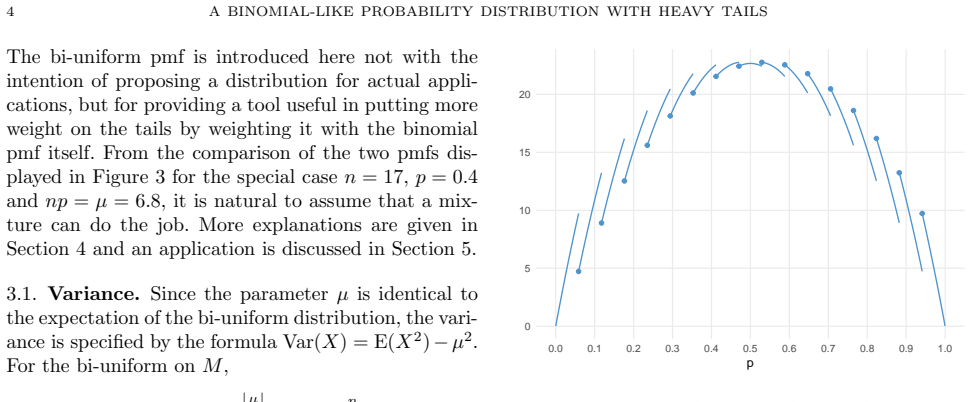
The machinery is the bi-uniform distribution on {0,...,n}: a pmf taking only two values p1 and p2, separated at the breakpoint floor(µ), with µ chosen as np. Its role is to carry excess probability to both tails in a way that is completely specified once µ is fixed. The mixture pX(x)=w·p_binomial(x)+(1−w)·p_biuniform(x) then does the work: the shared mean makes the variance a convex combination, the positive variance difference v2−v1 guarantees heavier tails for any w<1, and w is the single parameter that controls how much tail weight is added.
Load-bearing premise
The load-bearing premise is that the real overdispersion in the data has the same two-block shape as the bi-uniform distribution—constant extra probability on the low side and constant extra probability on the high side, meeting at floor(np); if real excess-tail structure is shaped differently, the fitted weight w will not generalize to other overdispersed data.
What would settle it
Fit the mixture to other overdispersed count data, especially data generated by a beta-binomial with strongly skewed parameters or by a process with tail inflation concentrated at one extreme only. If the optimal weight w moves far from 1 or the chi-square advantage over the beta-binomial disappears, the bi-uniform's two-block tail assumption is not the right generic correction.
If this is right
- Because the mixture preserves the binomial expectation, the method-of-moments estimate of p is unchanged; only the additional weight w is estimated from the variance.
- Valid weights require the sample variance to lie between the binomial and bi-uniform variances; outside that range the mixture will not fit, bounding the method's applicability.
- Minimum chi-square estimation of w (0.98802) yields a better chi-square fit to the classical sex-ratio data than both the binomial and beta-binomial, though the model is still rejected by a formal goodness-of-fit test.
- The construction is less flexible than the beta-binomial—it cannot produce U-shaped pmfs—so it is most appropriate for data that look binomial apart from extra tail mass.
Where Pith is reading between the lines
- The same construction works for any two discrete pmfs on the same support that share a mean; the bi-uniform is just the simplest block-shaped companion, so the recipe could be re-run with other tail-heavy companions.
- The variance formula has a breakpoint at floor(np), and the positivity proof splits on whether np is an integer, suggesting that the mixture's properties—and its fit—may jump when p crosses a value where np is an integer.
- A natural testable extension is to replace the single breakpoint with a smoother two-parameter tail correction, trading the model's simplicity for wider applicability while keeping the mean fixed.
- The paper's caution about diagnosing overdispersion—raw variance comparison almost always shows a difference—directly supports using dispersion tests and effect sizes rather than point estimates when deciding whether a heavier-tailed model is warranted.
Editorial analysis
A structured set of objections, weighed in public.
Referee Report
Summary. The paper proposes a new discrete distribution on {0,...,n}, formed as a weighted arithmetic mean of a binomial pmf and a newly introduced 'bi-uniform' pmf with the same mean np. It derives the bi-uniform's pmf and variance, proves that its variance exceeds the binomial variance for 0<p<1 and n>1, and develops method-of-moments and minimum-chi-square estimation for the mixing weight w. The model is applied to Geissler's classical sex-ratio data (n=8, m=53680), where the mixture achieves a Pearson chi-square of 43.58 versus 91.87 for the binomial and 53.31 for the beta-binomial, while preserving the same fitted mean. The paper is explicitly pedagogical in tone and positions the construction as a simple, tractable alternative to the beta-binomial for overdispersed count data.
Significance. If the result holds, the paper offers a genuinely elementary way to model extra-binomial variance: the mixture is defined by a weighted arithmetic mean of two pmfs, requires no calculus or continuous compounding, and preserves the binomial mean by construction. The variance formula and the positivity proof are correct and self-contained, and the numerical application reproduces the reported chi-square values. The contribution is modest but useful for teaching and for simple data fitting. The paper is honest about its limitations: it does not claim the bi-uniform component is a realistic data-generating mechanism, and it notes that the more flexible beta-binomial will be preferable in other settings. The availability of a closed-form variance and a simple moment estimator are concrete strengths.
minor comments (6)
- [Section 3] In the derivation of the bi-uniform expectation, the second displayed equality has a sign error: the term involving p2 should be added, not subtracted, after expanding the sum over {floor(mu)+1,...,n}. The following system and the final formulas p1 and p2 are correct, but the intermediate step as printed is inconsistent and will confuse readers.
- [Section 5.3 / Table 2] The minimum-chi-square estimate of w is obtained by a dense grid search on the same data that are later used to evaluate the fit. This is in-sample optimization and may overstate the improvement. The paper partially addresses this by also reporting the moment-based mixture ('Mixture (mom)'), whose chi-square is 45.47, still below the beta-binomial's 53.31. Still, the comparison of the grid-search mixture with the moment-fitted beta-binomial is not apples-to-apples; a sentence acknowledging this and, ideally, a beta-binomial minimum-chi-square fit or a small bootstrap for w would strengthen the claim.
- [Section 5.3] No standard errors or confidence intervals are reported for the fitted parameters p and w. Given the very large sample size (m=53680), the uncertainty is likely small, but a brief bootstrap or delta-method statement would make the application more complete and would help readers gauge the stability of the chi-square comparison.
- [Section 5.4] The sentence explaining degrees of freedom reads 'n is minus one the number of categories', which is garbled. The intended meaning is that there are n+1 categories, so df = n - k after one degree is lost to the total. Please rephrase for clarity.
- [Table 1 caption] Typo: 'observ counts' should be 'observed counts'.
- [Section 4.1.1] The condition for 0 <= w <= 1 is written with potentially ambiguous notation. It should clearly state: hat(v)_1 <= s^2 <= hat(v)_2, where hat(v)_1 and hat(v)_2 are the variance estimates obtained by replacing p with hat(p). The current formatting makes it look like squared quantities.
Circularity Check
No significant circularity: the heavy-tail construction is explicit, the derivations are parameter-free, and the application is a transparent in-sample fit.
full rationale
The paper's central claims are the construction of a bi-uniform distribution, the derivation of its variance, the proof that its variance exceeds the binomial variance, and the resulting mixture. None of these reduces to its inputs by construction in a misleading way. The bi-uniform is defined by two probability values and the requirement that its expectation equal a specified value μ; the fact that the mixture then has expectation np is openly a design constraint, not a discovered prediction. The variance increase is a genuine algebraic theorem: v2 is derived from the definition, and d(n,p)=v2-v1 is proved positive for all valid n,p without fitting any data. The paper also transparently states that the bi-uniform was introduced 'not with the intention of proposing a distribution for actual applications, but for providing a tool useful in putting more weight on the tails.' The application to Geissler's data is a fitting exercise, not an out-of-sample prediction. The minimum-chi-square estimate of w guarantees that the fitted mixture has chi-square no larger than the nested binomial (w=1), but this is explicitly presented as estimation, not as a forecast; moreover the moment-based mixture, whose w is not chosen to minimize chi-square, also yields a smaller chi-square (45.47) than the binomial (91.87), providing independent in-sample evidence. No load-bearing self-citations appear: all references (Fisher, Skellam, Johnson et al., Hogg et al., etc.) are external. The paper also acknowledges the mixture's limited flexibility and that other data circumstances may favor the beta-binomial. The reported numerical expected frequencies and chi-square values are consistent with the formulas. Therefore there is no circular derivation chain or disguised fitted-input-as-prediction.
Axiom & Free-Parameter Ledger
free parameters (2)
- p =
0.51468
- w =
0.98802 (min chi-square) / 0.98526 (method of moments)
axioms (3)
- standard math Binomial distribution formulas and properties (pmf, expectation np, variance np(1-p))
- standard math Pearson chi-square statistic follows a chi-square distribution with n-k degrees of freedom under the null hypothesis
- domain assumption Geissler's 53,680 families are an independent and identically distributed sample with constant p
invented entities (1)
-
bi-uniform distribution
no independent evidence
read the original abstract
A simple alternative to the binomial distribution that places more probability weight on the tails is considered. Its derivation only requires the weighted arithmetic mean of two discrete probability mass functions, one being the binomial itself and the other being the bi-uniform introduced here. Some properties are derived, and an application to a classical data set is discussed. The presentation can be seen as an exemplary treatise on how to construct a statistical model, derive statistical properties, fit models to actual data by employing estimation methods, and verify appropriateness by using elements from statistical hypothesis testing.
Figures



Reference graph
Works this paper leans on
-
[1]
and Stegun, I
Abramowitz, M. and Stegun, I. (1972),Handbook of Mathematical Functions, National Bureau of Stan- dards, Applied Mathematics Series
1972
-
[2]
(1988),Statistical Power Analysis for the Behavioral Sciences
Cohen, J. (1988),Statistical Power Analysis for the Behavioral Sciences. Second Edition, Lawrence Erl- baum Associates
1988
-
[3]
Fisher, R. A. (1958),Statistical Methods for Research Workers. Thirteenth Edition - Revised, Oliver and Boyd
1958
-
[4]
(2011), ‘Going beyond the book: towards critical reading in statistics teaching’,Teaching Sta- tistics34(3), 82–86
Gelman, A. (2011), ‘Going beyond the book: towards critical reading in statistics teaching’,Teaching Sta- tistics34(3), 82–86
2011
-
[5]
and Kanji, G
Harris, R. and Kanji, G. (1983), ‘On the use of minimum chi-square estimation’,Journal of the Royal Statistical Society: Series D (The Statistician) 32(4), 379–394
1983
-
[6]
V., McKean, J
Hogg, R. V., McKean, J. W. and Craig, A. T. (2019), Introduction to Mathematical Statistics. Eighth Edi- tion., Pearson
2019
-
[7]
and Hayakawa, R
Ishii, G. and Hayakawa, R. (1960), ‘On the compound binomial distribution’,Annals of the Institute of Sta- tistical Mathematics12(1), 69–80
1960
-
[8]
L., Kemp, A
Johnson, N. L., Kemp, A. W. and Kotz, S. (2005),Uni- variate Discrete Distributions. Third Edition, John Wiley & Sons
2005
-
[9]
Skellam, J. G. (1948), ‘A probability distribution de- rived from the binomial distribution by regarding the probability of success as variable between the sets of trials’,Journal of the Royal Statistical Society. Se- ries B (Methodological)10(2), 257–261
1948
discussion (0)
Sign in with ORCID, Apple, or X to comment. Anyone can read and Pith papers without signing in.