Dimensional Confinement Driven Scattering Inversion in NaCrTe₂
Pith reviewed 2026-06-25 22:48 UTC · model grok-4.3
The pith
Reducing NaCrTe2 to monolayer inverts dominant scattering from polar optical phonons to acoustic deformation potentials.
A machine-rendered reading of the paper's core claim, the machinery that carries it, and where it could break.
Core claim
Dimensionality reduction in NaCrTe2 induces a coupled magnetostructural reconstruction, reducing the band gap from 0.44 eV in bulk to 0.15 eV in the monolayer and enhancing the static dielectric constant. This drives a fundamental scattering inversion: bulk transport is limited by polar optical phonon scattering, whereas the monolayer becomes dominated by acoustic deformation potential scattering. The crossover results from simultaneous suppression of the Fröhlich interaction via enhanced dielectric screening and amplification of acoustic scattering due to pronounced lattice softening.
What carries the argument
The scattering inversion mechanism arising from enhanced dielectric screening suppressing the Fröhlich interaction combined with lattice softening amplifying acoustic deformation potential scattering.
If this is right
- Transport properties in NaCrTe2 can be tuned by controlling the number of layers to switch the limiting scattering process.
- The interplay between dielectric screening, lattice stiffness, and band topology determines scattering dominance in low-dimensional magnetic semiconductors.
- Monolayer NaCrTe2 should exhibit mobility behavior governed by acoustic phonons rather than polar optical phonons.
- Optimizing electronic performance in similar materials requires accounting for dimensionality effects on both screening and lattice dynamics.
Where Pith is reading between the lines
- Other van der Waals magnetic semiconductors may show analogous scattering inversions upon dimensional confinement.
- Device design could exploit layer thickness to select the scattering regime that maximizes conductivity at operating temperatures.
- First-principles predictions of this inversion could be tested by comparing calculated and measured mobilities in bulk versus monolayer samples.
Load-bearing premise
The first-principles calculations correctly predict the increase in the static dielectric constant and the lattice softening that cause the scattering inversion.
What would settle it
Experimental measurement of the temperature dependence of carrier mobility or the scattering rates in bulk versus monolayer NaCrTe2 samples would confirm or refute whether polar optical phonon scattering limits bulk transport but acoustic deformation potential scattering limits monolayer transport.
Figures
read the original abstract
Dimensionality reduction provides a powerful route to tune the electronic and magnetic properties of van der Waals materials, yet its influence on electronic transport remains complex due to competing effects from quantum confinement and modified scattering mechanisms. Here, we investigate this interplay in an antiferromagnetic semiconductor $\text{NaCrTe}_2$ using first-principles calculations combined with the Boltzmann transport equation beyond the constant relaxation time approximation. Our results show that the monolayer limit induces a coupled magnetostructural reconstruction, reducing the band gap from $0.44$ eV (bulk) to $0.15$ eV (monolayer) and significantly enhancing the static dielectric constant. This evolution triggers a fundamental scattering inversion: whereas bulk transport is limited by polar optical phonon (POP) scattering, the monolayer becomes dominated by acoustic deformation potential (ADP) scattering. We show that this crossover originates from the simultaneous suppression of the Fr\"ohlich interaction through enhanced dielectric screening and the amplification of acoustic scattering due to pronounced lattice softening. These results clarify how the interplay between dielectric screening, lattice stiffness, and band topology governs transport in low-dimensional magnetic semiconductors, providing a framework to optimize their electronic performance.
Editorial analysis
A structured set of objections, weighed in public.
Referee Report
Summary. The manuscript investigates dimensionality effects on transport in the antiferromagnetic van der Waals semiconductor NaCrTe₂ via first-principles DFT and the Boltzmann transport equation beyond the constant relaxation time approximation. It claims that the monolayer undergoes a magnetostructural reconstruction that reduces the gap from 0.44 eV (bulk) to 0.15 eV, enhances the static dielectric constant, and softens the lattice, producing a scattering inversion: bulk transport is POP-limited while the monolayer becomes ADP-limited due to suppressed Fröhlich coupling and amplified acoustic scattering.
Significance. If the computed dielectric enhancement and lattice softening are robust, the result would demonstrate that dimensional confinement can invert the dominant scattering channel in 2D magnetic semiconductors, providing a concrete mechanism linking dielectric screening, lattice stiffness, and band topology to transport optimization.
major comments (2)
- [Abstract] Abstract: the central inversion claim rests on the DFT-predicted increase in static dielectric constant (suppressing POP) and lattice softening (enhancing ADP), yet the abstract and reported results supply no numerical values for these quantities, no convergence tests (k-mesh, energy cutoff, vacuum spacing for the 2D slab), and no comparison to experiment or higher-level methods such as hybrid functionals or GW. Without these, it is impossible to confirm that the crossover actually occurs.
- [Methods/Results (implied from abstract)] The use of standard semilocal DFT+DFPT for an antiferromagnetic 2D system raises a load-bearing concern for the dielectric and phonon results; semilocal functionals are known to underestimate gaps and can misestimate ionic contributions to screening and force constants, and 2D macroscopic dielectric extraction requires careful treatment of the long-wavelength limit. No such validation or sensitivity analysis is described.
minor comments (1)
- [Abstract] The abstract states that calculations go "beyond the constant relaxation time approximation" but does not specify which scattering mechanisms are treated explicitly or how the relaxation times are obtained from the matrix elements.
Simulated Author's Rebuttal
We thank the referee for their careful reading and constructive comments on our manuscript. We address each major comment below and indicate the revisions we will make.
read point-by-point responses
-
Referee: [Abstract] Abstract: the central inversion claim rests on the DFT-predicted increase in static dielectric constant (suppressing POP) and lattice softening (enhancing ADP), yet the abstract and reported results supply no numerical values for these quantities, no convergence tests (k-mesh, energy cutoff, vacuum spacing for the 2D slab), and no comparison to experiment or higher-level methods such as hybrid functionals or GW. Without these, it is impossible to confirm that the crossover actually occurs.
Authors: We agree that the abstract would be strengthened by explicit numerical values for the dielectric constant and lattice softening. The main text already contains these quantities along with the reported gap reduction; we will revise the abstract to include them. We will also add a dedicated paragraph (or supplementary section) reporting convergence tests with respect to k-mesh density, plane-wave cutoff, and vacuum spacing. No experimental transport data exist for the monolayer, and we will note this; higher-level GW or hybrid calculations for the full set of dielectric and phonon properties lie outside the present computational scope but we will add a brief discussion of their expected impact on the trends. revision: yes
-
Referee: [Methods/Results (implied from abstract)] The use of standard semilocal DFT+DFPT for an antiferromagnetic 2D system raises a load-bearing concern for the dielectric and phonon results; semilocal functionals are known to underestimate gaps and can misestimate ionic contributions to screening and force constants, and 2D macroscopic dielectric extraction requires careful treatment of the long-wavelength limit. No such validation or sensitivity analysis is described.
Authors: We acknowledge the known shortcomings of semilocal functionals for gaps and dielectric screening. All calculations were performed consistently with PBE+DFPT to maintain compatibility with the Boltzmann transport treatment. For the 2D dielectric constant we used a large vacuum spacing together with dense q-point sampling to approach the long-wavelength limit. We will expand the Methods and Discussion sections to include an explicit sensitivity analysis of the dielectric and phonon results with respect to these technical choices and to note the functional limitations. A full set of hybrid-functional or GW validations, however, is not feasible within the current study. revision: partial
- Full validation of the dielectric and phonon results with hybrid functionals or GW for the antiferromagnetic monolayer
Circularity Check
No circularity: results are direct outputs of standard first-principles pipeline
full rationale
The paper computes the monolayer vs bulk changes in static dielectric constant (via DFPT) and phonon softening, then solves the Boltzmann transport equation to obtain scattering rates and the POP-to-ADP crossover. No quantity is defined in terms of the target inversion, no parameter is fitted to a subset of the transport data and then called a prediction, and no self-citation supplies a uniqueness theorem or ansatz that forces the result. The derivation chain is therefore self-contained against external benchmarks and receives the default non-circularity finding.
Axiom & Free-Parameter Ledger
axioms (1)
- domain assumption Standard DFT approximations (exchange-correlation functional, pseudopotentials) are sufficiently accurate for the electronic structure and phonon properties of NaCrTe2.
Reference graph
Works this paper leans on
-
[1]
3(a) and 3(b) for PBE and HSE06, respectively
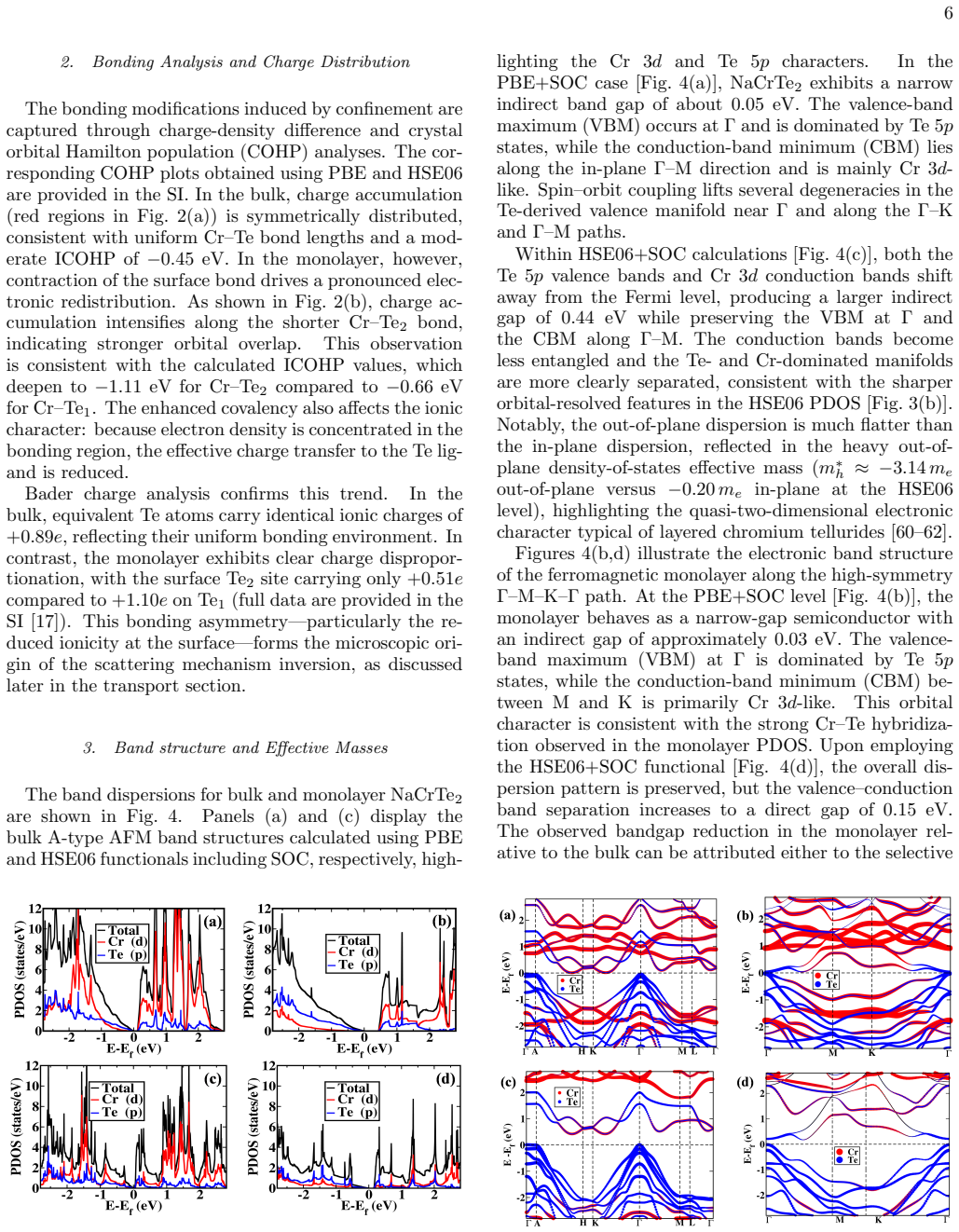
Density of states The influence of the exchange–correlation functional on the orbital-resolved electronic structure of bulk NaCrTe2 is summarized in the spin–orbit-coupled pro- jected densities of states (PDOS) shown in Fig. 3(a) and 3(b) for PBE and HSE06, respectively. PDOS ob- tained using PBE+U, SCAN, and SCAN+Uare pro- vided in the SI[17]. Across all...
-
[2]
The cor- responding COHP plots obtained using PBE and HSE06 are provided in the SI
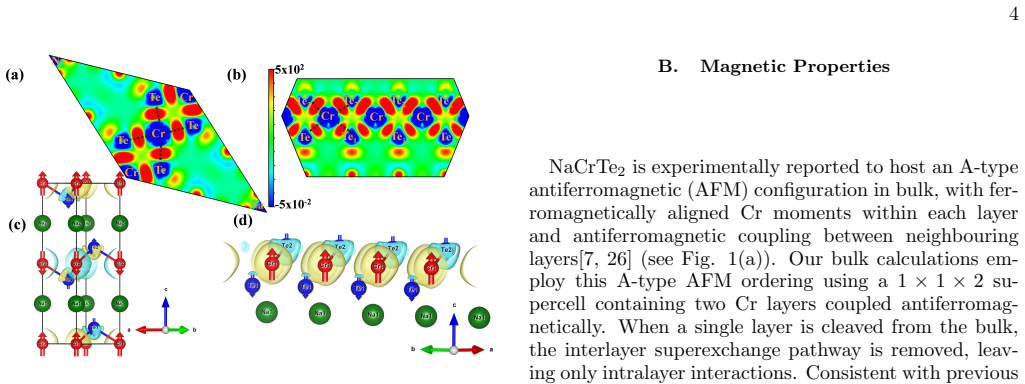
Bonding Analysis and Charge Distribution The bonding modifications induced by confinement are captured through charge-density difference and crystal orbital Hamilton population (COHP) analyses. The cor- responding COHP plots obtained using PBE and HSE06 are provided in the SI. In the bulk, charge accumulation (red regions in Fig. 2(a)) is symmetrically di...
-
[3]
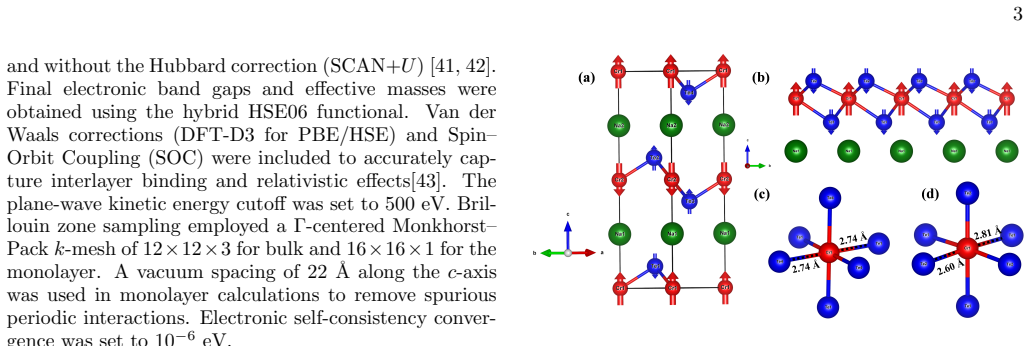
Band structure and Effective Masses The band dispersions for bulk and monolayer NaCrTe2 are shown in Fig. 4. Panels (a) and (c) display the bulk A-type AFM band structures calculated using PBE and HSE06 functionals including SOC, respectively, high- FIG. 3. Atom projected density of states of bulk and mono- layer NaCrTe2 using (a,c) PBE (b,d) HSE06 functi...
-
[4]
scattering inversion
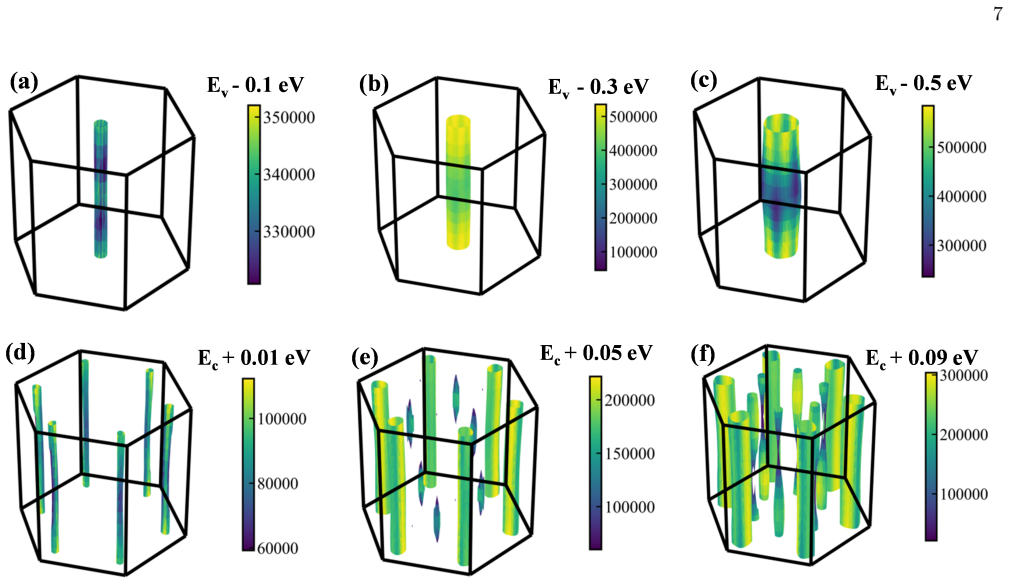
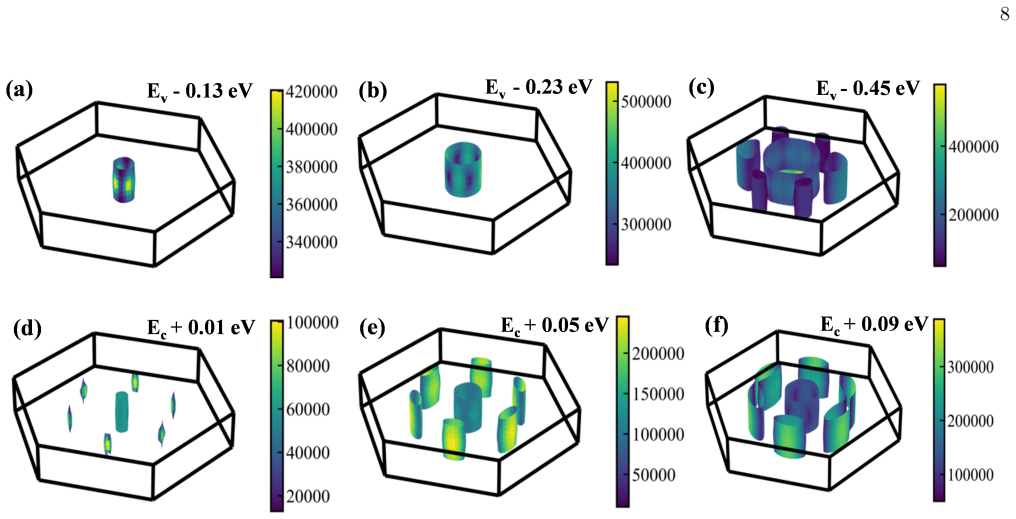
Fermi Isoenergy Surface To elucidate the microscopic origin of the effective- mass renormalization, we plot the Fermi isoenergy sur- faces of bulk and monolayer NaCrTe 2 in Figs. 5 and 6, where color denotes the group velocity. In the bulk [Figs. 5(a–c)], the valence-band isosurfaces form open cylindrical tubes alongk z, reflecting the layered elec- troni...
-
[5]
F.M.R. Engelsman, G.A. Wiegers, F. Jellinek, and B. Van Laar. Crystal structures and magnetic structures of some metal(i) chromium(iii) sulfides and selenides. Journal of Solid State Chemistry, 6(4):574–582, 1973. ISSN 0022-4596. doi:https://doi.org/10.1016/S0022- 4596(73)80018-0. 12
-
[6]
Lin Pan, David B´ erardan, and Nita Dragoe. High ther- moelectric properties of n-type agbise2.Journal of the American Chemical Society, 135(13):4914–4917, 2013. doi:10.1021/ja312474n
-
[7]
Thermoelectric properties of tlbite 2.Journal of Alloys and Compounds, 351(1):279–282, 2003
Ken Kurosaki, Atsuko Kosuga, and Shinsuke Yamanaka. Thermoelectric properties of tlbite 2.Journal of Alloys and Compounds, 351(1):279–282, 2003. ISSN 0925-8388. doi:https://doi.org/10.1016/S0925-8388(02)01038-1
-
[8]
Girish C. Tewari, T. S. Tripathi, and A. K. Rastogi. Thermoelectric properties of layer-antiferromagnet cu- crs2.Journal of Electronic Materials, 39(8):1133–1139, Aug 2010. ISSN 1543-186X. doi:10.1007/s11664-010- 1185-5
-
[9]
Damay, S
F. Damay, S. Petit, S. Rols, M. Braendlein, R. Daou, E. Elka¨ ım, F. Fauth, F. Gascoin, C. Martin, and A. Maig- nan. Localised ag+ vibrations at the origin of ultralow thermal conductivity in layered thermoelectric agcrse2. Scientific Reports, 6(1):23415, Mar 2016. ISSN 2045-
2016
-
[10]
doi:10.1038/srep23415
-
[11]
Hannah McKeever, Niraj Nitish Patil, Manoj Pala- bathuni, and Shalini Singh. Functional alkali metal-based ternary chalcogenides: Design, properties, and opportu- nities.Chemistry of Materials, 35(23):9833–9846, 2023. doi:10.1021/acs.chemmater.3c01652
-
[12]
Wangping Xu, Sajjad Ali, Yuanjun Jin, Xiaozhi Wu, and Hu Xu. Intrinsic ferromagnetic semiconductors in two- dimensional alkali-based chromium chalcogenides.ACS Applied Electronic Materials, 2(12):3853–3858, 2020. doi: 10.1021/acsaelm.0c00686
-
[13]
Alsaleh, Nirpendra Singh, and Udo Schwin- genschl¨ ogl
Najebah M. Alsaleh, Nirpendra Singh, and Udo Schwin- genschl¨ ogl. Role of interlayer coupling for the power fac- tor of cusbs 2 and cusbse2.Phys. Rev. B, 94:125440, Sep
-
[14]
doi:10.1103/PhysRevB.94.125440
-
[15]
Vijay Kumar Gudelli, V. Kanchana, and G. Vaitheeswaran. Cualte 2: A promising bulk thermoelectric material.Journal of Alloys and Compounds, 648:958–965, 2015. ISSN 0925-8388. doi:https://doi.org/10.1016/j.jallcom.2015.07.042
-
[16]
First-principles calculations of thermoelectric transport properties of quaternary and ternary bulk chalcogenide crystals.Materials, 15(8),
Sahib Hasan, Saro San, Khagendra Baral, Neng Li, Paul Rulis, and Wai-Yim Ching. First-principles calculations of thermoelectric transport properties of quaternary and ternary bulk chalcogenide crystals.Materials, 15(8),
-
[17]
ISSN 1996-1944. doi:10.3390/ma15082843. URL https://www.mdpi.com/1996-1944/15/8/2843
-
[18]
Vijay Kumar Gudelli, V. Kanchana, G. Vaitheeswaran, A. Svane, and N. E. Christensen. Thermoelectric proper- ties of chalcopyrite type cugate2 and chalcostibite cusbs2. Journal of Applied Physics, 114(22):223707, 12 2013. ISSN 0021-8979. doi:10.1063/1.4842095
-
[19]
Catherine Witteveen, Elisabetta Nocerino, Sara A L´ opez-Paz, Harald O Jeschke, Vladimir Y Pomjakushin, Martin M˚ ansson, and Fabian O von Rohr. Synthesis and anisotropic magnetic properties of licrte2 single crys- tals with a triangular-lattice antiferromagnetic structure. Journal of Physics: Materials, 6(3):035001, may 2023. doi:10.1088/2515-7639/acd27a
-
[20]
Lei Liu, Dong-Qin Xie, Hao Liang, Zhi-Guo Li, and Hua-Zhong Guo. Two-dimensional li-based ternary chalcogenides limte2 (m = al, ga, and in): Promis- ing high-temperature thermoelectric materials.Vac- uum, 222:113023, 2024. ISSN 0042-207X. doi: https://doi.org/10.1016/j.vacuum.2024.113023
-
[21]
Kristen Kaasbjerg, Kristian S. Thygesen, and Karsten W. Jacobsen. Phonon-limited mobility in n-type single-layer MoS 2 from first principles. Physical Review B, 85(11):115317, 2012. doi: 10.1103/PhysRevB.85.115317
-
[22]
Wentao Li and Chenxiu Yang. Suppressed ther- mal conductivity of bilayer sns: A comparative study among the monolayer, bilayer and bulk sns. Physica E: Low-dimensional Systems and Nanostruc- tures, 145:115521, 2023. ISSN 1386-9477. doi: https://doi.org/10.1016/j.physe.2022.115521
-
[23]
Charge-carrier thermalization in bulk and monolayer CdTe.Physical Review B, 103(12):125113, 2021
Dinesh Yadav, Fabian Pauly, and Maxim Trushin. Charge-carrier thermalization in bulk and monolayer CdTe.Physical Review B, 103(12):125113, 2021. doi: 10.1103/PhysRevB.103.125113
-
[24]
dimensional confinement driven scattering inversion in nacrte2
Himanshu Sharma, Bhawna Sahni, Tanusri Saha- Dasgupta, and Aftab Alam. Supporting information for “dimensional confinement driven scattering inversion in nacrte2”, 2026
2026
-
[25]
M. Baenitz, M. M. Piva, S. Luther, J. Sichelschmidt, K. M. Ranjith, H. Dawczak-D¸ ebicki, M. O. Ajeesh, S.- J. Kim, G. Siemann, C. Bigi, P. Manuel, D. Khalyavin, D. A. Sokolov, P. Mokhtari, H. Zhang, H. Yasuoka, P. D. C. King, G. Vinai, V. Polewczyk, P. Torelli, J. Wos- nitza, U. Burkhardt, B. Schmidt, H. Rosner, S. Wirth, H. K¨ uhne, M. Nicklas, and M. S...
-
[26]
The magnetic struc- ture of tlcrte2.ChemInform, 37(4), 2006
Sabina Ronneteg, Marck-Willem Lumey, Richard Dron- skowski, and Rolf Berger. The magnetic struc- ture of tlcrte2.ChemInform, 37(4), 2006. doi: https://doi.org/10.1002/chin.200604015
-
[27]
Xiaoqian Zhang, Qiangsheng Lu, Wenqing Liu, Wei Niu, Jiabao Sun, Jacob Cook, Mitchel Vaninger, Paul F. Miceli, David J. Singh, Shang-Wei Lian, Tay-Rong Chang, Xiaoqing He, Jun Du, Liang He, Rong Zhang, Guang Bian, and Yongbing Xu. Room-temperature in- trinsic ferromagnetism in epitaxial crte2 ultrathin films. Nature Communications, 12(1):2492, May 2021. I...
-
[28]
crte 2 as a two-dimensional material for topological magnetism in complex hetero- bilayers.Phys
Nihad Abuawwad, Manuel dos Santos Dias, Hazem Abusara, and Samir Lounis. crte 2 as a two-dimensional material for topological magnetism in complex hetero- bilayers.Phys. Rev. B, 108:094409, Sep 2023. doi: 10.1103/PhysRevB.108.094409
-
[29]
Magnetism of two-dimensional chromium tellurides
Jiefu Yang, Chao Zhu, Ya Deng, Bijun Tang, and Zheng Liu. Magnetism of two-dimensional chromium tellurides. iScience, 26(5):106567, 2023. ISSN 2589-0042. doi: https://doi.org/10.1016/j.isci.2023.106567
-
[30]
Chaowei Hu, Kyle N. Gordon, Pengfei Liu, Jinyu Liu, Xiaoqing Zhou, Peipei Hao, Dushyant Narayan, Eve Em- manouilidou, Hongyi Sun, Yuntian Liu, Harlan Brawer, Arthur P. Ramirez, Lei Ding, Huibo Cao, Qihang Liu, Dan Dessau, and Ni Ni. A van der waals antiferromag- netic topological insulator with weak interlayer magnetic coupling.Nature Communications, 11(1...
-
[31]
Pim Witte, Annemijn M. van Koten, and Machteld E. Kamminga. Tuning the magnetic properties of van der waals materials by intercalation.Mater. Adv., 5:6702– 6718, 2024. doi:10.1039/D4MA00539B
-
[32]
13 Spin-flip-driven giant magnetotransport in a-type anti- ferromagnet NaCrte2.Phys
Junjie Wang, Jun Deng, Xiaowei Liang, Guoying Gao, Tianping Ying, Shangjie Tian, Hechang Lei, Yanpeng Song, Xu Chen, Jian-gang Guo, and Xiaolong Chen. 13 Spin-flip-driven giant magnetotransport in a-type anti- ferromagnet NaCrte2.Phys. Rev. Mater., 5:L091401, Sep
-
[33]
doi:10.1103/PhysRevMaterials.5.L091401
-
[34]
Plumb, Sailong Ju, Ming Shi, Zhongkai Liu, Jian-gang Guo, Xiaolong Chen, Yulin Chen, and Lexian Yang
Yidian Li, Xian Du, Junjie Wang, Runzhe Xu, Wenx- uan Zhao, Kaiyi Zhai, Jieyi Liu, Houke Chen, Yi- heng Yang, Nicholas C. Plumb, Sailong Ju, Ming Shi, Zhongkai Liu, Jian-gang Guo, Xiaolong Chen, Yulin Chen, and Lexian Yang. Quantum-confined tunable fer- romagnetism on the surface of a van der waals antiferro- magnet nacrte 2.Nano Letters, 24(32):9832–9838...
-
[35]
J. Paier, M. Marsman, K. Hummer, G. Kresse, I. C. Gerber, and J. G. ´Angy´ an. Screened hybrid density functionals applied to solids.The Journal of Chemical Physics, 124(15):154709, 04 2006. ISSN 0021-9606. doi: 10.1063/1.2187006
-
[36]
Jie Chen, Weiyu Xie, Kaihang Li, Shengbai Zhang, and Yi-Yang Sun. Benchmarking pbe+d3 and scan+rvv10 methods using potential energy surfaces generated with mp2+δccsd(t) calculation.Chinese Physics B, 29(1): 013102, jan 2020. doi:10.1088/1674-1056/ab5fbb
-
[37]
and Ernzerhof, Matthias , year =
Jochen Heyd, Gustavo E. Scuseria, and Matthias Ernzer- hof. Hybrid functionals based on a screened coulomb po- tential.The Journal of Chemical Physics, 118(18):8207– 8215, 05 2003. ISSN 0021-9606. doi:10.1063/1.1564060
-
[38]
Kresse and J
G. Kresse and J. Furthm¨ uller. Efficiency of ab-initio total energy calculations for metals and semiconductors using a plane-wave basis set.Comput. Mater. Sci., 6(1):15–50,
-
[39]
G. Kresse and J. Furthm¨ uller. Efficient iterative schemes for ab initio total-energy calculations using a plane- wave basis set.Phys. Rev. B, 54:11169, 1996. doi: 10.1103/PhysRevB.54.11169
-
[40]
P. E. Bl¨ ochl. Projector augmented-wave method. Phys. Rev. B, 50:17953–17979, 1994. doi: 10.1103/PhysRevB.50.17953
-
[41]
G. Kresse and D. Joubert. From ultrasoft pseu- dopotentials to the projector augmented-wave method.Phys. Rev. B, 59:1758–1775, 1999. doi: 10.1103/PhysRevB.59.1758
-
[42]
Available: https://doi.org/10.1103/PhysRevLett.77.3865
John P. Perdew, Kieron Burke, and Matthias Ernz- erhof. Generalized gradient approximation made sim- ple.Phys. Rev. Lett., 77:3865–3868, Oct 1996. doi: 10.1103/PhysRevLett.77.3865
-
[43]
S. Bae, Y.-G. Kang, M. Khazaei, K. Ohno, Y.- H. Kim, M.J. Han, K.J. Chang, and H. Raebiger. Electronic and magnetic properties of carbide mx- enes—the role of electron correlations.Materials To- day Advances, 9:100118, 2021. ISSN 2590-0498. doi: https://doi.org/10.1016/j.mtadv.2020.100118
-
[44]
Wexler, Gopalakrishnan Sai Gautam, and Emily A
Robert B. Wexler, Gopalakrishnan Sai Gautam, and Emily A. Carter. Exchange-correlation func- tional challenges in modeling quaternary chalco- genides.Phys. Rev. B, 102:054101, Aug 2020. doi: 10.1103/PhysRevB.102.054101
-
[45]
Paula Mori-S´ anchez, Aron J. Cohen, and Weitao Yang. Localization and delocalization errors in density func- tional theory and implications for band-gap predic- tion.Phys. Rev. Lett., 100:146401, Apr 2008. doi: 10.1103/PhysRevLett.100.146401
-
[46]
Eric Macke, Iurii Timrov, Nicola Marzari, and Lu- cio Colombi Ciacchi. Orbital-resolved dft+u for molecules and solids.Journal of Chemical The- ory and Computation, 20(11):4824–4843, 2024. doi: 10.1021/acs.jctc.3c01403. PMID: 38820347
-
[47]
S. L. Dudarev, G. A. Botton, S. Y. Savrasov, C. J. Humphreys, and A. P. Sutton. Electron-energy-loss spectra and the structural stability of nickel oxide: An LSDA+U study.Physical Review B, 57(3):1505–1509,
-
[48]
doi:10.1103/PhysRevB.57.1505
-
[49]
A. I. Liechtenstein, V. I. Anisimov, and J. Zaa- nen. Density-functional theory and strong interac- tions: Orbital ordering in Mott-hubbard insulators. Physical Review B, 52(8):R5467–R5470, 1995. doi: 10.1103/PhysRevB.52.R5467
-
[50]
Jianwei Sun, Adrienn Ruzsinszky, and John P. Perdew. Strongly constrained and appropriately normed semilo- cal density functional.Phys. Rev. Lett., 115:036402, Jul
-
[51]
doi:10.1103/PhysRevLett.115.036402
-
[52]
Haowei Peng, Zeng-Hui Yang, John P. Perdew, and Jianwei Sun. Versatile van der waals density func- tional based on a meta-generalized gradient approx- imation.Phys. Rev. X, 6:041005, Oct 2016. doi: 10.1103/PhysRevX.6.041005
-
[53]
Stefan Grimme, Jens Antony, Stephan Ehrlich, and Helge Krieg. A consistent and accurate ab initio parametriza- tion of density functional dispersion correction (dft-d) for the 94 elements h-pu.The Journal of Chemical Physics, 132(15):154104, 04 2010. doi:10.1063/1.3382344
-
[54]
Phonons and related crystal properties from density-functional perturbation theory,
Stefano Baroni, Stefano de Gironcoli, Andrea Dal Corso, and Paolo Giannozzi. Phonons and related crystal prop- erties from density-functional perturbation theory.Re- views of Modern Physics, 73(2):515–562, 2001. doi: 10.1103/RevModPhys.73.515
-
[55]
Linear optical properties in the projector-augmented wave methodology,
M. Gajdoˇ s, K. Hummer, G. Kresse, J. Furthm¨ uller, and F. Bechstedt. Linear optical properties in the projector- augmented wave methodology.Physical Review B, 73(4): 045112, 2006. doi:10.1103/PhysRevB.73.045112
-
[56]
Akash Laturia, Maarten L. Van de Put, and William G. Vandenberghe. Dielectric properties of hexagonal boron nitride and transition metal dichalcogenides: from mono- layer to bulk.npj 2D Materials and Applications, 2(1): 6, Mar 2018. ISSN 2397-7132. doi:10.1038/s41699-018- 0050-x
-
[57]
Togo and I
A. Togo and I. Tanaka. First principles phonon calcula- tions in materials science.Scr. Mater., 108:1–5, 2015
2015
-
[58]
Maintz, M
S. Maintz, M. Esser, and R. Dronskowski. Efficient rota- tion of local basis functions using real spherical harmon- ics.Acta Phys. Pol. B, 47:1165, 2016
2016
-
[59]
A fast and robust algorithm for Bader decomposition of charge density
Graeme Henkelman, Andri Arnaldsson, and Hannes J´ onsson. A fast and robust algorithm for bader decom- position of charge density.Computational Materials Science, 36(3):354–360, 2006. ISSN 0927-0256. doi: https://doi.org/10.1016/j.commatsci.2005.04.010. URL https://www.sciencedirect.com/science/article/ pii/S0927025605001849
-
[60]
A. M. Ganose, A. Searle, A. Jain, and S. M. Griffin. IFermi: A python library for Fermi surface generation and analysis.J. Open Source Softw., 6:3089, 2021
2021
-
[61]
Alex M. Ganose, Junsoo Park, Alireza Faghaninia, Rachel Woods-Robinson, Kristin A. Persson, and Anub- hav Jain. Efficient calculation of carrier scattering rates from first principles.Nature Communications, 12(1): 2222, Apr 2021. ISSN 2041-1723. doi:10.1038/s41467- 021-22440-5
-
[62]
Mal-Soon Lee and S. D. Mahanti. Validity of the rigid band approximation in the study of the thermopower 14 of narrow band gap semiconductors.Phys. Rev. B, 85: 165149, Apr 2012. doi:10.1103/PhysRevB.85.165149
-
[63]
Teng Fang, Shuqi Zheng, Tian Zhou, Hong Chen, and Peng Zhang. Validity of rigid-band approximation in the study of thermoelectric properties of p-type fenbsb-based half-heusler compounds.Journal of Electronic Materi- als, 46(5):3030–3035, May 2017. ISSN 1543-186X. doi: 10.1007/s11664-016-5122-0
-
[64]
Bardeen and W
J. Bardeen and W. Shockley. Deformation potentials and mobilities in non-polar crystals.Phys. Rev., 80:72, 1950
1950
-
[65]
H. Brooks. Scattering by ionized impurities in semicon- ductors.Phys. Rev., 83:879, 1951
1951
-
[66]
F.J. Blatt. Scattering of carriers by ionized im- purities in semiconductors.Journal of Physics and Chemistry of Solids, 1(4):262–269, 1957. ISSN 0022-
1957
-
[67]
doi:https://doi.org/10.1016/0022-3697(57)90014-
-
[68]
URLhttps://www.sciencedirect.com/science/ article/pii/0022369757900148
-
[69]
D. Chattopadhyay and H. J. Queisser. Elec- tron scattering by ionized impurities in semiconduc- tors.Rev. Mod. Phys., 53:745–768, Oct 1981. doi: 10.1103/RevModPhys.53.745
-
[70]
H. J. Scheel. Crystallization of sulfides from alkali poly- sulfide fluxes.Journal of Crystal Growth, 24:669–673,
-
[71]
doi:10.1016/0022-0248(74)90402-3
-
[72]
Shintaro Kobayashi, Hiroaki Ueda, Chishiro Michioka, and Kazuyoshi Yoshimura. Competition between the di- rect exchange interaction and superexchange interaction in layered compounds licrse2, licrte2, and nacrte2 with a triangular lattice.Inorganic Chemistry, 55(15):7407– 7413, 2016. doi:10.1021/acs.inorgchem.6b00610. PMID: 27400024
-
[73]
Vikram, Bhawna Sahni, Ankit Jain, and Aftab Alam. Quasi-2d carrier transport in KMgBi for promising ther- moelectric performance.ACS Applied Energy Materials, 5(7):9141–9148, jul 2022. doi:10.1021/acsaem.2c01685
-
[74]
K. Kutorasinski, B. Wiendlocha, S. Kaprzyk, and J. To- bola. Electronic structure and thermoelectric proper- ties of n- and p-type SnSe from first-principles calcu- lations.Physical Review B, 91(20):205201, 2015. doi: 10.1103/PhysRevB.91.205201
-
[75]
B. Yu. Yavorsky, N. F. Hinsche, I. Mertig, and P. Zahn. Electronic structure and transport anisotropy of Bi 2Te3 and Sb 2Te3.Physical Review B, 84(16):165208, 2011. doi:10.1103/PhysRevB.84.165208
-
[76]
Quentin Jacquet, Antonella Iadecola, Matthieu Sauban` ere, Haifeng Li, Erik. J. Berg, Gwena¨ elle Rousse, Jordi Cabana, Marie-Liesse Doublet, and Jean-Marie Tarascon. Charge transfer band gap as an indicator of hysteresis in li-disordered rock salt cathodes for li-ion batteries.Journal of the American Chemical Society, 141(29):11452–11464, 2019. doi:10.10...
-
[77]
Abhijeet R. Shelke, Hsiao-Tsu Wang, Jau-Wern Chiou, Indrajit Shown, Amr Sabbah, Kuang-Hung Chen, Shu- Ang Teng, I-An Lin, Chi-Cheng Lee, Hung-Chung Hsueh, Yu-Hui Liang, Chao-Hung Du, Priyanka L. Ya- dav, Sekhar C. Ray, Shang-Hsien Hsieh, Chih-Wen Pao, Huang-Ming Tsai, Chia-Hao Chen, Kuei-Hsien Chen, Li- Chyong Chen, and Way-Faung Pong. Bandgap shrink- age...
-
[78]
Mid-infrared pho- tonics and optoelectronics in 2d materials.Materi- als Today, 51:294–316, 2021
Guozhen Liang, Xuechao Yu, Xiaonan Hu, Bo Qiang, Chongwu Wang, and Qi Jie Wang. Mid-infrared pho- tonics and optoelectronics in 2d materials.Materi- als Today, 51:294–316, 2021. ISSN 1369-7021. doi: https://doi.org/10.1016/j.mattod.2021.09.021
-
[79]
Kairui Qu, Zhiwei Zhang, Yongqi Dai, Xin Wang, Shengli Lei, Xiangyi Wang, Jia Li, Kai Zhang, Xidong Duan, Xiang Chen, and Haibo Zeng. Opportunities and chal- lenges of 2d p-type semiconductors: From material sys- tems to electronic and optoelectronic device applications. Advanced Functional Materials, n/a(n/a):e31994, 2021. doi:https://doi.org/10.1002/adf...
-
[80]
Zhiwei Li, Yawei Lv, Liwang Ren, Jia Li, Lingan Kong, Yujia Zeng, Quanyang Tao, Ruixia Wu, Huifang Ma, Bei Zhao, Di Wang, Weiqi Dang, Keqiu Chen, Lei Liao, Xi- dong Duan, Xiangfeng Duan, and Yuan Liu. Efficient strain modulation of 2d materials via polymer encapsu- lation.Nature Communications, 11(1):1151, Mar 2020. ISSN 2041-1723. doi:10.1038/s41467-020-15023-3
discussion (0)
Sign in with ORCID, Apple, or X to comment. Anyone can read and Pith papers without signing in.