REVIEW 5 major objections 7 minor 1 cited by
Epistemic Wrapping for Uncertainty Quantification
T0 review · 5 major / 7 minor · reviewed 2026-08-16 · deepseek-v4-flash
Pith's one-line read The paper claims that converting a Bayesian neural network's weight posteriors into belief-function posteriors and then running inference through a hybrid interval network improves classification accuracy and out-of-distribution detection…
desk verdict Novel parameter-space belief-function wrapper idea is undone by Section 3.6, where intervals are collapsed to midpoints and uncertainty comes from MC Dropout, so the claimed mechanism is never actually tested. read the letter →
The pith
A machine-rendered reading of the paper's core claim, the machinery that carries it, and where it could break.
The reading
What carries the argument
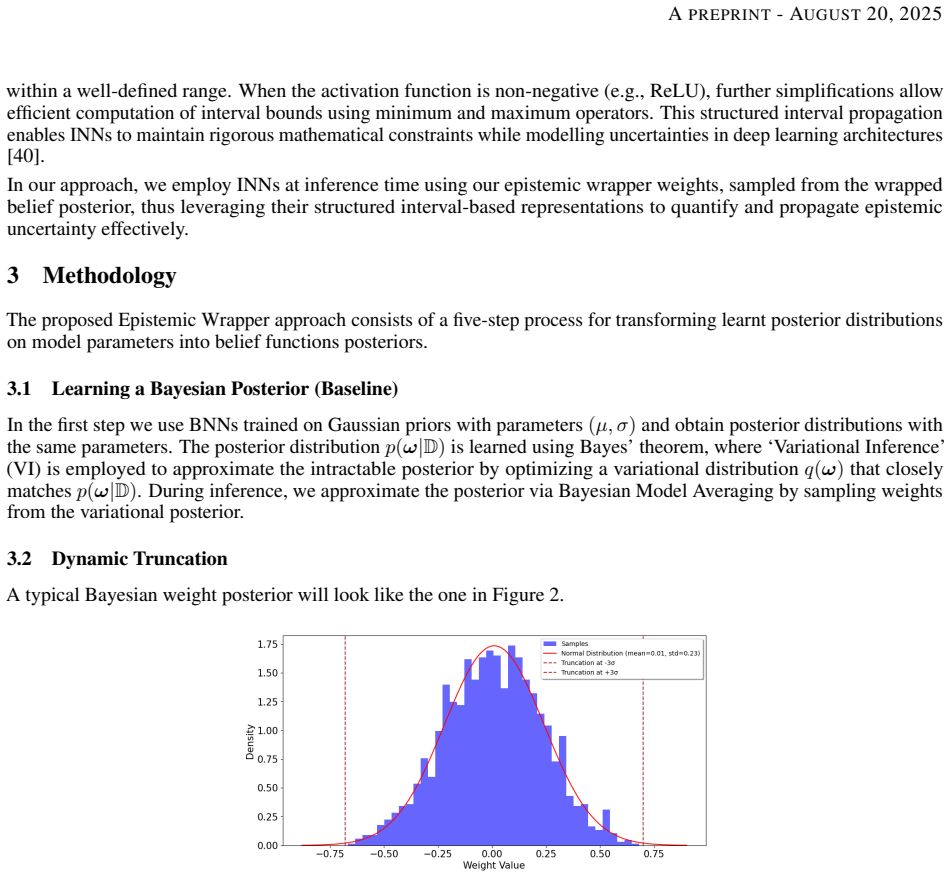
The object that carries the argument is a five-step transformation pipeline applied to the BNN's Gaussian weight posteriors. First the posteriors are truncated to dynamic bounds; second, a continuous belief function is computed over closed intervals, with plausibility defined as the supremum of the normalised posterior on the interval; third, Möbius inversion turns belief values into mass values; fourth, a Dirichlet distribution is fitted to the mass grid by the method of L-moments; fifth, the resulting belief posteriors are turned into weight intervals that initialise a Hybrid Interval Neural Network, which averages upper and lower interval bounds during inference. The theoretical anchor is the containment relation $\mathrm{Bel}(A)\leq P(A)\leq \mathrm{Pl}(A)$, which the paper uses to argue that the wrapper is conservative and consistent with Bayesian inference.
What would settle it
Hold everything fixed but replace the Dirichlet-derived interval bounds with equal-width intervals sampled directly from the BNN posterior; if accuracy and out-of-distribution AUROC remain at the wrapped values, the belief-function conversion is not the cause of the gains.
Extended reading notes
Core claim
The paper's central claim is that epistemic uncertainty can be modelled directly in the parameter space of a neural network by wrapping a learned Bayesian posterior into a belief-function posterior, and that doing so yields better generalisation and uncertainty estimation. The construction is conservative: for every measurable set $A$ of parameters, the original posterior probability $P(A)$ lies between the transformed belief $\mathrm{Bel}(A)$ and plausibility $\mathrm{Pl}(A)$, so the wrapping adds second-order uncertainty without discarding the Bayesian information. Inference is performed by a Hybrid Interval Neural Network whose weight intervals come from Dirichlet-derived samples for wrapped parameters and Gaussian intervals for the rest. The authors report that the wrapper beats both the variational BNN baseline and a randomly initialised interval network, before and after fine-tuning, and that it assigns higher epistemic uncertainty to out-of-distribution inputs.
Load-bearing premise
The paper's load-bearing step is the final conversion of the fitted uncertainty distribution into interval bounds on the network's weights; it is described only in words, with no formula, so if that mapping is arbitrary or lossy the reported gains could come from fine-tuning the interval network rather than from the wrapping itself.
Editorial extensions
If this is right
- Any variational BNN with Gaussian priors can in principle be wrapped after training, with only about 5% of weights transformed, to improve test accuracy: 91.02% vs 72.44% on MNIST and 82.45% vs 58.91% on Fashion-MNIST after fine-tuning.
- Out-of-distribution detection improves: on Fashion-MNIST images presented to an MNIST-trained model, the wrapped interval network raises AUROC from 0.5329 to 0.6673 and roughly doubles the epistemic-uncertainty score on OOD inputs.
- The wrapper is conservative in the sense that the original Bayesian posterior is contained in the credal set defined by the transformed belief function, so the method preserves Bayesian predictive information while enriching it with second-order uncertainty.
- Budgeting matters: selecting the 5% of weights with high mean or high variance outperforms random selection, so the benefit comes from wrapping informative or uncertain parameters rather than any subset.
- Because the BNN itself is not retrained and only the initialisation of the Hybrid-INN changes, the procedure is a drop-in uncertainty-quantification upgrade compatible with existing variational BNNs.
Reading between the lines
- If the conservativeness property holds for the actual weight intervals delivered to the network, one testable extension is that predictive rejection curves and OOD scores should remain stable when the number of closed intervals is varied; the appendix shows interval-count sensitivity but the main text fixes it at 30.
- The method's reliance on a small, budgeted subset of weights suggests a possible link to sparse or pruning-based Bayesian inference: the wrapper could double as an importance measure for deciding which parameters most need second-order treatment.
- A stronger OOD evaluation would pair MNIST with random noise or a structurally different digit-like corpus rather than Fashion-MNIST, which shares low-level features with MNIST; that would separate genuine out-of-distribution sensitivity from feature-level differences.
- The claimed generality across 'any BNN baseline' is not yet demonstrated beyond single-hidden-layer MLPs on two datasets; applying the wrapper to convolutional Bayesian backbones would settle whether the parameter-space belief wrapping scales.
Signed reviews
Editorial analysis
A structured set of objections, weighed in public.
Referee Report
Summary. The paper introduces 'Epistemic Wrapping,' a post hoc procedure that converts the weight posteriors of a trained Bayesian neural network into belief-function posteriors over parameter intervals. The pipeline consists of five steps: extracting the BNN posterior, truncating each univariate posterior, computing continuous belief functions on a grid of closed intervals via Moebius inversion, fitting a Dirichlet distribution to the resulting masses by a method the authors call weighted L-moments, and performing inference with a Hybrid Interval Neural Network whose weights are derived from the wrapped and unwrapped posteriors. Experiments on MNIST and Fashion-MNIST compare the Epi-Wrapper against a randomly initialized INN and a BNN baseline, before and after fine-tuning, and report classification accuracy plus OOD detection metrics (AUROC, AUPRC, epistemic uncertainty). The abstract claims comprehensive experiments on MNIST, Fashion-MNIST, CIFAR-10, and CIFAR-100, but the body only reports MNIST and Fashion-MNIST results.
Significance. If the central mechanism worked as advertised, the paper would make a useful methodological contribution: it is among the few attempts to model epistemic uncertainty in parameter space with higher-order measures, and it proposes a transformation that is, in principle, applicable to any BNN posterior without retraining. The paper also has some praiseworthy elements: it reports means and standard deviations over 15 runs, includes ablation studies on budgeting strategies and on the number of intervals, and is candid about the Hybrid-INN's interval-averaging rule. However, as detailed in the major comments, the evaluation does not actually exercise the belief-function posterior at inference time, the key interval-mapping step is unspecified, and the after-fine-tuning accuracy results do not support the claim of significant generalization gains. The significance of the claimed contribution is therefore not established by the present manuscript.
major comments (5)
- [Section 3.6 and Section 4.4] The paper states that 'the way we handle these intervals is by computing the mean of the upper and lower bounds' and that predictive uncertainty is estimated with MC Dropout in Section 4.4. This means that during inference all wrapped intervals are collapsed to their midpoints, and no interval arithmetic, no belief/plausibility computation, and no Dirichlet sampling is used to obtain the reported predictions or uncertainty scores. Consequently, the OOD detection improvements in Table 3 (AUROC 0.6673 vs 0.5329) cannot be attributed to the epistemic wrapping mechanism, as the same results could be generated by the fine-tuned initialization alone with MC Dropout. The central claim that the Epistemic Wrapper 'significantly enhances ... uncertainty quantification' is therefore unsupported.
- [Section 3.6] The conversion from samples of the fitted Dirichlet distribution over interval masses to lower and upper bounds on the Hybrid-INN weights is never given as a formula or algorithm. The text only says that 'weight intervals are derived from a combination of Dirichlet-derived intervals and Gaussian posteriors.' Without this specification, the experiments are not reproducible, and the reader cannot verify that the implemented model corresponds to the belief-function posterior described in Sections 3.3 and 3.4. This is a load-bearing gap because the paper's entire contribution rests on that mapping.
- [Table 2 and Section 4.5] The claim that the Epi-Wrapper 'significantly outperforms' the baseline is contradicted by the after-fine-tuning numbers. On MNIST the Epi-Wrapper achieves 91.02 ± 0.05 against the INN's 91.12 ± 0.08, which is a slight decrease, and on Fashion-MNIST the values are 82.45 ± 0.10 vs 82.41 ± 0.19, which are statistically indistinguishable. The dramatic before-fine-tuning advantage (51.33% vs 9.33% on MNIST) compares a network initialized from a trained BNN posterior against a randomly initialized INN; this is an initialization comparison, not a test of the belief-function representation.
- [Abstract and Section 4.1] The abstract claims 'Comprehensive experiments ... on the MNIST, Fashion-MNIST, CIFAR-10 and CIFAR-100 datasets,' but no experimental results for CIFAR-10 or CIFAR-100 appear in the paper. Section 4.1 lists CIFAR-10 in the dataset description, yet all reported experiments use MNIST and Fashion-MNIST only; CIFAR-100 appears only in an appendix dataset description. The abstract's claim is therefore inaccurate.
- [Section 3.4, Theoretical Properties] The asserted inequality Bel(A) ≤ P(A) ≤ Pl(A) for all measurable A is stated without proof. With Pl defined as the supremum of the normalized posterior density over A and Bel(A) = 1 − Pl(A^c), it is not generally true that the probability measure P lies between Bel and Pl; a normalized density can exceed 1, and the complement operation can produce negative belief values. A rigorous derivation or a corrected statement is needed before this property can be cited as support for the method.
minor comments (7)
- [Section 3.6] For the unwrapped weights the interval is defined as Lower bound = μ − σ and Upper bound = μ + σ, but for the wrapped weights no analogous formula is given; please specify how the 'Dirichlet-derived intervals' are translated into numeric lower and upper bounds, and how the midpoint averaging is implemented in the forward pass.
- [Table 3] The iD Test Accuracy values in Table 3 (91.07 ± 0.08 for INN and 91.12 ± 0.06 for Epi-Wrapper) are inconsistent with the after-fine-tuning values in Table 2 (91.12 ± 0.08 and 91.02 ± 0.05) for what appears to be the same experimental setting; please reconcile the two tables.
- [Appendix A.3] The sentence 'The results before fine-tuning are presented in Table ??' references a missing table; either include the table or remove the reference.
- [Section 4.2] The text says 'MLP size (no hidden units) = 8' while the tables use 'MLP size' to mean the number of hidden units; this wording is confusing and should be clarified.
- [References] References [45] and [46] both cite Shafer's 'A mathematical theory of evidence' and appear to be duplicates; also, the citation style for [53] is inconsistent with the surrounding references.
- [Conclusions] The word 'Fahion-MNIST' in the concluding paragraph is a typo for 'Fashion-MNIST'.
- [Algorithm 1] The procedure called 'Weighted L-Moments' uses weighted mean and variance with weights given by the mass values, which is not the standard L-moments methodology of Hosking; please justify this estimator or rename it to avoid confusion.
Circularity Check
No load-bearing circularity; the main issues are implementation/evaluation mismatches, not a derivation reducing to its inputs.
full rationale
The claimed derivation chain is not circular in the sense this pass targets. The wrapper starts from an independently trained BNN posterior and applies a fixed transformation: Pl and Bel are defined from the posterior density in Eqs. (3)-(4), masses are obtained by Moebius inversion, and a Dirichlet distribution is fitted to those masses by L-moments. No headline quantity (test accuracy, AUROC, AUPRC, EU) is used as an input to that transformation, and no fitted parameter is renamed as a prediction. The theoretical-property paragraph cites [9] (an author's book), but the stated Bel(A) <= P(A) <= Pl(A) sandwich follows directly from the construction, so the self-citation is not load-bearing. The paper's serious weaknesses are validity problems rather than circularity: Section 3.6 states 'the way we handle these intervals is by computing the mean of the upper and lower bounds', so the interval/belief structure is not propagated to the output; Section 4.4 estimates epistemic uncertainty with MC Dropout rather than from the belief posterior; and Section 4.3 fine-tunes on the same training set, which confounds the comparison with the 72.44% BNN number. Those problems undermine attribution of the reported gains, but they do not exhibit an equation that turns the wrapper's inputs into its claimed predictions by construction.
Assumptions & free parameters
free parameters (5)
- dynamic_multiplier =
min(5.0, 1/sigma)
- number_of_closed_intervals =
30
- posterior_sample_count =
5,000
- budget_percentage =
5%
- dirichlet_alpha_per_weight =
not reported
assumptions (5)
- domain assumption The variational posterior q(omega) from a DenseFlipout BNN is a faithful representation of parameter uncertainty that can be wrapped without losing information.
- standard math Wasserman's likelihood-based transformation (Eqs. 3-4) yields a valid belief function satisfying Bel(A) <= P(A) <= Pl(A) for all measurable sets A.
- domain assumption Discretizing the posterior onto a grid of 30 closed intervals and applying Moebius inversion recovers the continuous mass function closely enough.
- ad hoc to paper Weighted L-moments over interval coordinates estimate a valid Dirichlet distribution whose samples represent the belief posterior.
- ad hoc to paper Sampling from the fitted Dirichlet and converting the samples to interval weights for a Hybrid-INN preserves epistemic uncertainty.
invented entities (1)
-
Hybrid Interval Neural Network (Hybrid-INN)
Cite this review
Pith. "Pith review of Epistemic Wrapping for Uncertainty Quantification." pith.science (2026). https://pith.science/paper/QQNV45FF
@misc{pith2026250502277,
  author       = {Pith},
  title        = {Pith review of: Epistemic Wrapping for Uncertainty Quantification},
  year         = {2026},
  howpublished = {\url{https://pith.science/paper/QQNV45FF}},
  note         = {Machine review of arXiv:2505.02277}
}
read the original abstract
Uncertainty estimation is pivotal in machine learning, especially for classification tasks, as it improves the robustness and reliability of models. We introduce a novel `Epistemic Wrapping' methodology aimed at improving uncertainty estimation in classification. Our approach uses Bayesian Neural Networks (BNNs) as a baseline and transforms their outputs into belief function posteriors, effectively capturing epistemic uncertainty and offering an efficient and general methodology for uncertainty quantification. Comprehensive experiments employing a Bayesian Neural Network (BNN) baseline and an Interval Neural Network for inference on the MNIST, Fashion-MNIST, CIFAR-10 and CIFAR-100 datasets demonstrate that our Epistemic Wrapper significantly enhances generalisation and uncertainty quantification.
Figures


Figures from the paper (4 more)


Forward citations
Cited by 1 Pith paper
-
Epistemic Artificial Intelligence is Essential for Machine Learning Models to Truly 'Know When They Do Not Know'
Machine learning should use second-order uncertainty measures, such as credal sets and random sets, so models can explicitly represent ignorance and avoid overconfident predictions on unfamiliar data.
Reference graph
Works this paper leans on
-
[1]
A review of uncertainty quantification in deep learning: Techniques, applications and challenges
Moloud Abdar, Farhad Pourpanah, Sadiq Hussain, Dana Rezazadegan, Li Liu, Mohammad Ghavamzadeh, Paul Fieguth, Xiaochun Cao, Abbas Khosravi, U Rajendra Acharya, et al. A review of uncertainty quantification in deep learning: Techniques, applications and challenges. Information Fusion, 76:243–297, 2021
2021
-
[2]
Variational inference: A review for statisticians
David M Blei, Alp Kucukelbir, and Jon D McAuliffe. Variational inference: A review for statisticians. Journal of the American statistical Association, 112(518):859–877, 2017
2017
-
[3]
Weight uncertainty in neural network
Charles Blundell, Julien Cornebise, Koray Kavukcuoglu, and Daan Wierstra. Weight uncertainty in neural network. In Proceedings of the International Conference on Machine Learning, pages 1613–1622. PMLR, 2015
work page 2015
-
[4]
Michele Caprio, Maryam Sultana, Eleni Elia, and Fabio Cuzzolin. Credal learning theory. arXiv preprint arXiv:2402.00957, 2024
arXiv 2024
-
[5]
Molina, and Christopher Metzler
Matthew Albert Chan, Maria J. Molina, and Christopher Metzler. Estimating epistemic and aleatoric uncertainty with a single model. In The Thirty-eighth Annual Conference on Neural Information Processing Systems, 2024
work page 2024
-
[6]
Posterior network: Uncertainty estimation without ood samples via density-based pseudo-counts
Bertrand Charpentier, Daniel Zügner, and Stephan Günnemann. Posterior network: Uncertainty estimation without ood samples via density-based pseudo-counts. Advances in neural information processing systems, 33:1356–1367, 2020
work page 2020
-
[7]
On the credal structure of consistent probabilities
Fabio Cuzzolin. On the credal structure of consistent probabilities. In European Workshop on Logics in Artificial Intelligence, pages 126–139. Springer, 2008
work page 2008
-
[8]
Generalised max entropy classifiers
Fabio Cuzzolin. Generalised max entropy classifiers. In Sébastien Destercke, Thierry Denœux, Fabio Cuzzolin, and Arnaud Martin, editors, Belief Functions: Theory and Applications , pages 39–47, Cham, 2018. Springer International Publishing
work page 2018
Show all 54 references
-
[9]
The geometry of uncertainty: The geometry of imprecise probabilities
Fabio Cuzzolin. The geometry of uncertainty: The geometry of imprecise probabilities. Springer Nature, 2020
2020
-
[10]
Uncertainty measures: The big picture
Fabio Cuzzolin. Uncertainty measures: The big picture. arXiv preprint arXiv:2104.06839, 2021
2021 arXiv
-
[11]
Uncertainty measures: A critical survey
Fabio Cuzzolin. Uncertainty measures: A critical survey. Information Fusion, page 102609, 2024
2024
-
[12]
Belief modeling regression for pose estimation
Fabio Cuzzolin and Wenjua Gong. Belief modeling regression for pose estimation. In Proceedings of the 16th International Conference on Information Fusion, pages 1398–1405, 2013
2013
-
[13]
Upper and lower probabilities induced by a multivalued mapping
Arthur P Dempster. Upper and lower probabilities induced by a multivalued mapping. In Classic works of the Dempster-Shafer theory of belief functions, pages 57–72. Springer, 2008
2008
-
[14]
Large scale structure of neural network loss landscapes
Stanislav Fort and Stanislaw Jastrzebski. Large scale structure of neural network loss landscapes. Advances in Neural Information Processing Systems, 32, 2019
2019
-
[15]
Energy-based epistemic uncertainty for graph neural networks
Dominik Fuchsgruber, Tom Wollschläger, and Stephan Günnemann. Energy-based epistemic uncertainty for graph neural networks. In The Thirty-eighth Annual Conference on Neural Information Processing Systems, 2024. 11 A PREPRINT - AUGUST 20, 2025
2024
-
[16]
Dropout as a Bayesian approximation: Representing model uncertainty in deep learning
Yarin Gal and Zoubin Ghahramani. Dropout as a Bayesian approximation: Representing model uncertainty in deep learning. In Proceedings of the International Conference on Machine Learning, pages 1050–1059. PMLR, 2016
2016
-
[17]
A belief-theoretical approach to example-based pose estimation
Wenjuan Gong and Fabio Cuzzolin. A belief-theoretical approach to example-based pose estimation. IEEE Transactions on Fuzzy Systems, 26(2):598–611, 2017
2017
-
[18]
Interval arithmetic: From principles to implementation
Timothy Hickey, Qun Ju, and Maarten H Van Emden. Interval arithmetic: From principles to implementation. Journal of the ACM (JACM), 48(5):1038–1068, 2001
2001
-
[19]
The No-U-Turn sampler: Adaptively setting path lengths in Hamiltonian Monte Carlo
Matthew D Hoffman, Andrew Gelman, et al. The No-U-Turn sampler: Adaptively setting path lengths in Hamiltonian Monte Carlo. J. Mach. Learn. Res., 15(1):1593–1623, 2014
2014
-
[20]
Quantifying aleatoric and epistemic uncertainty: A credal approach
Paul Hofman, Yusuf Sale, and Eyke Hüllermeier. Quantifying aleatoric and epistemic uncertainty: A credal approach. In ICML 2024 Workshop on Structured Probabilistic Inference{\&} Generative Modeling, 2024
2024
-
[21]
J. R. M. Hosking. L-moments: Analysis and estimation of distributions using linear combinations of order statistics. Journal of the Royal Statistical Society: Series B (Methodological), 52(1):105–124, 12 2018
2018
-
[22]
Aleatoric and epistemic uncertainty in machine learning: An introduc- tion to concepts and methods
Eyke Hüllermeier and Willem Waegeman. Aleatoric and epistemic uncertainty in machine learning: An introduc- tion to concepts and methods. Machine Learning, 110(3):457–506, 2021
2021
-
[23]
Hands-on Bayesian neural networks—A tutorial for deep learning users
Laurent Valentin Jospin, Hamid Laga, Farid Boussaid, Wray Buntine, and Mohammed Bennamoun. Hands-on Bayesian neural networks—A tutorial for deep learning users. IEEE Computational Intelligence Magazine , 17(2):29–48, 2022
2022
-
[24]
Is epistemic uncertainty faithfully represented by evidential deep learning methods? In Forty-first International Conference on Machine Learning, 2024
Mira Juergens, Nis Meinert, Viktor Bengs, Eyke Hüllermeier, and Willem Waegeman. Is epistemic uncertainty faithfully represented by evidential deep learning methods? In Forty-first International Conference on Machine Learning, 2024
2024
-
[25]
Understanding the difficulty of training deep feedforward neural networks xavier
LS Kim. Understanding the difficulty of training deep feedforward neural networks xavier. In Proceedings of the International Joint Conference on Neural Networks, volume 2, 1993
1993
-
[26]
Auto-encoding variational Bayes
Diederik P Kingma and Max Welling. Auto-encoding variational Bayes. arXiv preprint arXiv:1312.6114, 2013
2013 arXiv
-
[27]
CIFAR-10 (Canadian Institute For Advanced Research)
Alex Krizhevsky, Vinod Nair, and Geoffrey Hinton. CIFAR-10 (Canadian Institute For Advanced Research). 2009
2009
-
[28]
Reliable confidence measures for medical diagnosis with evolutionary algorithms
Antonis Lambrou, Harris Papadopoulos, and Alex Gammerman. Reliable confidence measures for medical diagnosis with evolutionary algorithms. IEEE Transactions on Information Technology in Biomedicine, 15(1):93– 99, 2010
2010
-
[29]
The MNIST database of handwritten digits
Yann LeCun. The MNIST database of handwritten digits. http: // yann. lecun. com/ exdb/ mnist/, 1998
1998
-
[30]
The enterprise of knowledge: An essay on knowledge, credal probability, and chance
Isaac Levi. The enterprise of knowledge: An essay on knowledge, credal probability, and chance. MIT press, 1980
1980
-
[31]
Graph neural stochastic diffusion for estimating uncertainty in node classification
Xixun Lin, Wenxiao Zhang, Fengzhao Shi, Chuan Zhou, Lixin Zou, Xiangyu Zhao, Dawei Yin, Shirui Pan, and Yanan Cao. Graph neural stochastic diffusion for estimating uncertainty in node classification. In Forty-first International Conference on Machine Learning, 2024
2024
-
[32]
Simple and principled uncertainty estimation with deterministic deep learning via distance awareness
Jeremiah Liu, Zi Lin, Shreyas Padhy, Dustin Tran, Tania Bedrax Weiss, and Balaji Lakshminarayanan. Simple and principled uncertainty estimation with deterministic deep learning via distance awareness. Advances in Neural Information Processing Systems, 33:7498–7512, 2020
2020
-
[33]
Evidence combination based on credal belief redistribution for pattern classification
Zhun-Ga Liu, Yu Liu, Jean Dezert, and Fabio Cuzzolin. Evidence combination based on credal belief redistribution for pattern classification. IEEE Transactions on Fuzzy Systems, 28(4):618–631, 2019
2019
-
[34]
Ensemble distribution distillation
Andrey Malinin, Bruno Mlodozeniec, and Mark Gales. Ensemble distribution distillation. arXiv preprint arXiv:1905.00076, 2019
1905 arXiv
-
[35]
Epistemic deep learning
Shireen Kudukkil Manchingal and Fabio Cuzzolin. Epistemic deep learning. arXiv preprint arXiv:2206.07609, 2022
2022 arXiv
-
[36]
A unified evaluation framework for epistemic predictions, 2025
Shireen Kudukkil Manchingal, Muhammad Mubashar, Kaizheng Wang, and Fabio Cuzzolin. A unified evaluation framework for epistemic predictions, 2025
2025
-
[37]
Random-set convolutional neural network (rs-cnn) for epistemic deep learning
Shireen Kudukkil Manchingal, Muhammad Mubashar, Kaizheng Wang, Keivan Shariatmadar, and Fabio Cuzzolin. Random-set convolutional neural network (rs-cnn) for epistemic deep learning. arXiv preprint arXiv:2307.05772, 2023
2023 arXiv
-
[38]
Random-set neural networks
Shireen Kudukkil Manchingal, Muhammad Mubashar, Kaizheng Wang, Keivan Shariatmadar, and Fabio Cuzzolin. Random-set neural networks. In The Thirteenth International Conference on Learning Representations, 2025. 12 A PREPRINT - AUGUST 20, 2025
2025
-
[39]
Variational dropout sparsifies deep neural networks
Dmitry Molchanov, Arsenii Ashukha, and Dmitry Vetrov. Variational dropout sparsifies deep neural networks. In Proceedings of the International Conference on Machine Learning, pages 2498–2507. PMLR, 2017
2017
-
[40]
Adaptive sampling to reduce epistemic uncertainty using prediction interval-generation neural networks
Giorgio Morales and John Sheppard. Adaptive sampling to reduce epistemic uncertainty using prediction interval-generation neural networks. Proceedings of the AAAI Conference on Artificial Intelligence, Feb. 2025
2025
-
[41]
MCMC using Hamiltonian dynamics
Radford M Neal et al. MCMC using Hamiltonian dynamics. Handbook of Markov Chain Monte Carlo, 2(11):2, 2011
2011
-
[42]
Turner, Rio Yokota, and Mohammad Emtiyaz Khan
Kazuki Osawa, Siddharth Swaroop, Anirudh Jain, Runa Eschenhagen, Richard E. Turner, Rio Yokota, and Mohammad Emtiyaz Khan. Practical deep learning with bayesian principles. arXiv preprint arXiv:1906.02506, 2019
1906 arXiv
-
[43]
Is the volume of a credal set a good measure for epistemic uncertainty? In Uncertainty in Artificial Intelligence, pages 1795–1804
Yusuf Sale, Michele Caprio, and Eyke Höllermeier. Is the volume of a credal set a good measure for epistemic uncertainty? In Uncertainty in Artificial Intelligence, pages 1795–1804. PMLR, 2023
2023
-
[44]
Evidential deep learning to quantify classification uncertainty
Murat Sensoy, Lance Kaplan, and Melih Kandemir. Evidential deep learning to quantify classification uncertainty. Advances in neural information processing systems, 31, 2018
2018
-
[46]
A mathematical theory of evidence, volume 42
Glenn Shafer. A mathematical theory of evidence, volume 42. Princeton university press, 1976
1976
-
[47]
The transferable belief model and other interpretations of Dempster–Shafer’s model
Philippe Smets. The transferable belief model and other interpretations of Dempster–Shafer’s model. In P. P. Bonissone, M. Henrion, L. N. Kanal, and J. F. Lemmer, editors,Uncertainty in Artificial Intelligence, volume 6, pages 375–383. North-Holland, Amsterdam, 1991
1991
-
[48]
Belief functions on real numbers.International Journal of Approximate Reasoning, 40(3):181–223, 2005
Philippe Smets. Belief functions on real numbers.International Journal of Approximate Reasoning, 40(3):181–223, 2005
2005
-
[49]
Thiagarajan
Puja Trivedi, Mark Heimann, Rushil Anirudh, Danai Koutra, and Jayaraman J. Thiagarajan. Accurate and scalable estimation of epistemic uncertainty for graph neural networks. In The Twelfth International Conference on Learning Representations, 2024
2024
-
[50]
Credal wrapper of model averaging for uncertainty estimation on out-of-distribution detection
Kaizheng Wang, Fabio Cuzzolin, Keivan Shariatmadar, David Moens, and Hans Hallez. Credal wrapper of model averaging for uncertainty estimation on out-of-distribution detection. arXiv preprint arXiv:2405.15047, 2024
2024 arXiv
-
[51]
Credal deep ensembles for uncertainty quantification
Kaizheng Wang, Fabio Cuzzolin, Keivan Shariatmadar, David Moens, Hans Hallez, et al. Credal deep ensembles for uncertainty quantification. Advances in Neural Information Processing Systems, 37:79540–79572, 2024
2024
-
[52]
Creinns: Credal-set interval neural networks for uncertainty estimation in classification tasks
Kaizheng Wang, Keivan Shariatmadar, Shireen Kudukkil Manchingal, Fabio Cuzzolin, David Moens, and Hans Hallez. Creinns: Credal-set interval neural networks for uncertainty estimation in classification tasks. Neural Networks, page 107198, 2025
2025
-
[53]
Wasserman
Larry A. Wasserman. Belief functions and statistical inference. Canadian Journal of Statistics, 18(3):183–196, 1990
1990
-
[54]
Flipout: Efficient pseudo-independent weight perturbations on mini-batches
Yeming Wen, Paul Vicol, Jimmy Ba, Dustin Tran, and Roger Grosse. Flipout: Efficient pseudo-independent weight perturbations on mini-batches. In Proceedings of the International Conference on Learning Representations , 2018
2018
-
[55]
Fashion-mnist: a novel image dataset for benchmarking machine learning algorithms
Han Xiao, Kashif Rasul, and Roland V ollgraf. Fashion-mnist: a novel image dataset for benchmarking machine learning algorithms. arXiv preprint arXiv:1708.07747, 2017. 13 A PREPRINT - AUGUST 20, 2025 A Appendix A.1 Interval Neural Networks (INNs) Traditional interval neural ne...
2017 arXiv
Reviewed August 16, 2026 · model on record in the stance chip above.
Discussion (0). Continue with ORCID to comment.