Temporal processing of quantum states with hybrid quantum-classical reservoirs
Pith reviewed 2026-06-26 14:11 UTC · model grok-4.3
The pith
A hybrid quantum-classical reservoir architecture enables nonlinear functional approximation and temporal processing of quantum input states.
A machine-rendered reading of the paper's core claim, the machinery that carries it, and where it could break.
Core claim
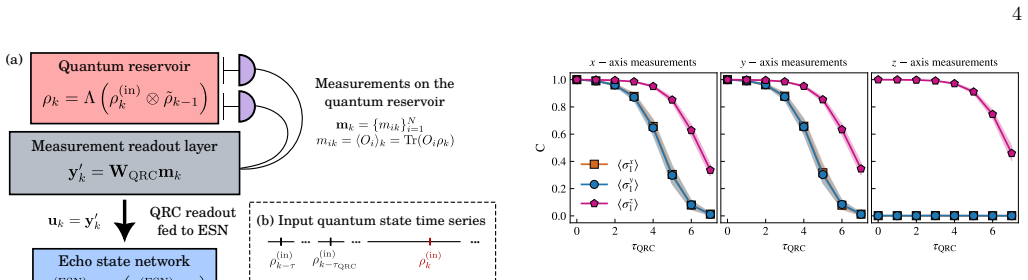
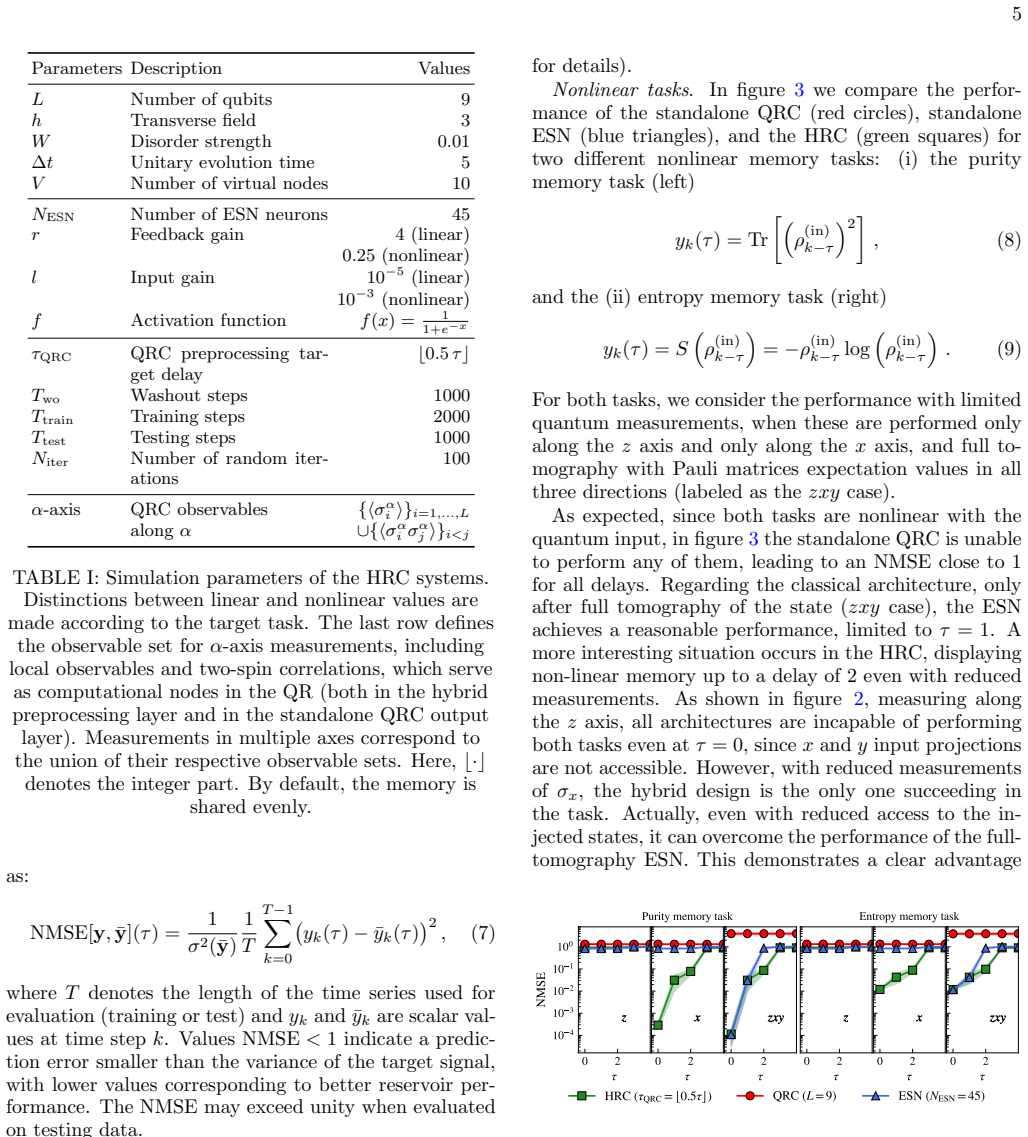
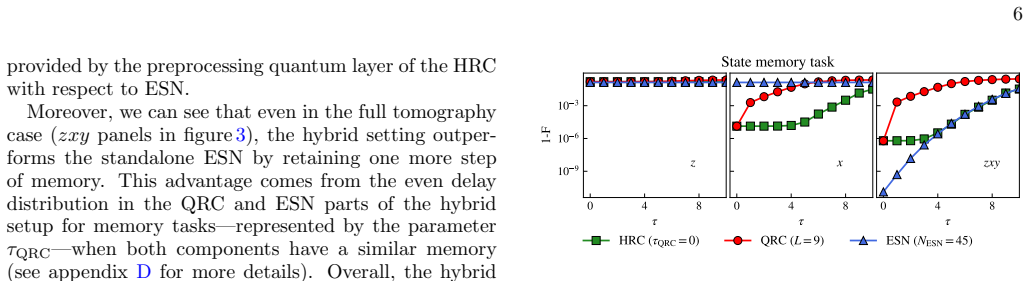
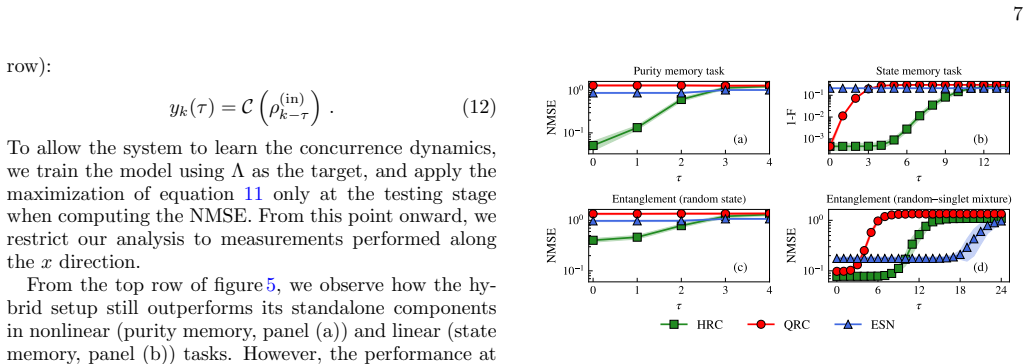
By combining a qubit quantum reservoir, which embeds quantum input states into its dynamics, with a classical echo state network that performs nonlinear readout, the hybrid architecture computes both linear and nonlinear functionals of quantum states while handling temporal sequences, even when only partial single-axis measurements are available and measurement back-action is present.
What carries the argument
Hybrid quantum-classical reservoir formed by a qubit quantum reservoir whose outputs are fed to a classical echo state network for nonlinear transformation.
If this is right
- The hybrid system can approximate nonlinear functionals such as purity and entropy of quantum states.
- Effective temporal processing of sequences of quantum inputs becomes possible within the same architecture.
- Performance gains persist under partial information regimes with only single-axis measurements.
- An online monitoring protocol that accounts for measurement back-action and finite ensembles still yields usable results.
Where Pith is reading between the lines
- The same hybrid layering could be applied to other quantum machine learning primitives that require nonlinearity beyond reservoir dynamics.
- Scaling the quantum reservoir size while keeping the classical layer fixed might reveal whether the information bottleneck shifts.
- Replacing the echo state network with other classical recurrent models could test how much of the gain is specific to echo-state dynamics.
Load-bearing premise
The classical echo state network can reliably extract and nonlinearly transform information from the quantum reservoir even when only single-axis measurements are taken and measurement back-action occurs.
What would settle it
A test in which the hybrid system's accuracy on nonlinear tasks such as purity estimation drops to match the standalone classical echo state network when restricted to single-axis measurements of the quantum reservoir.
Figures
read the original abstract
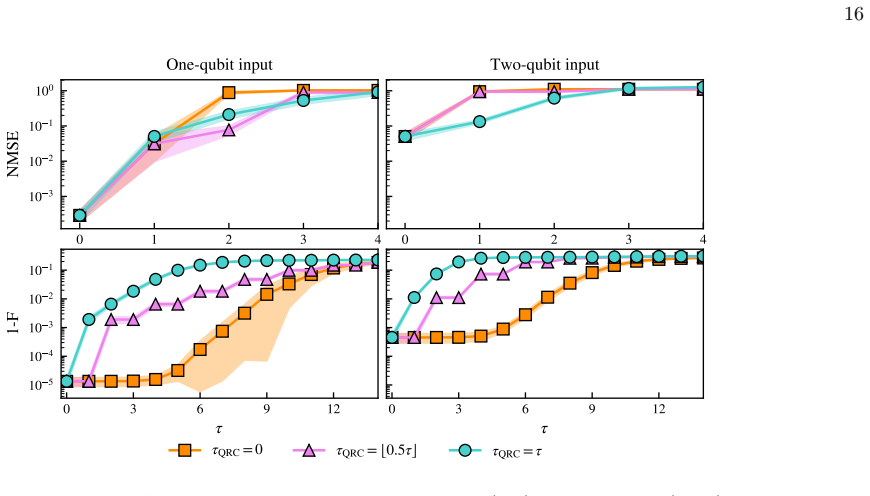
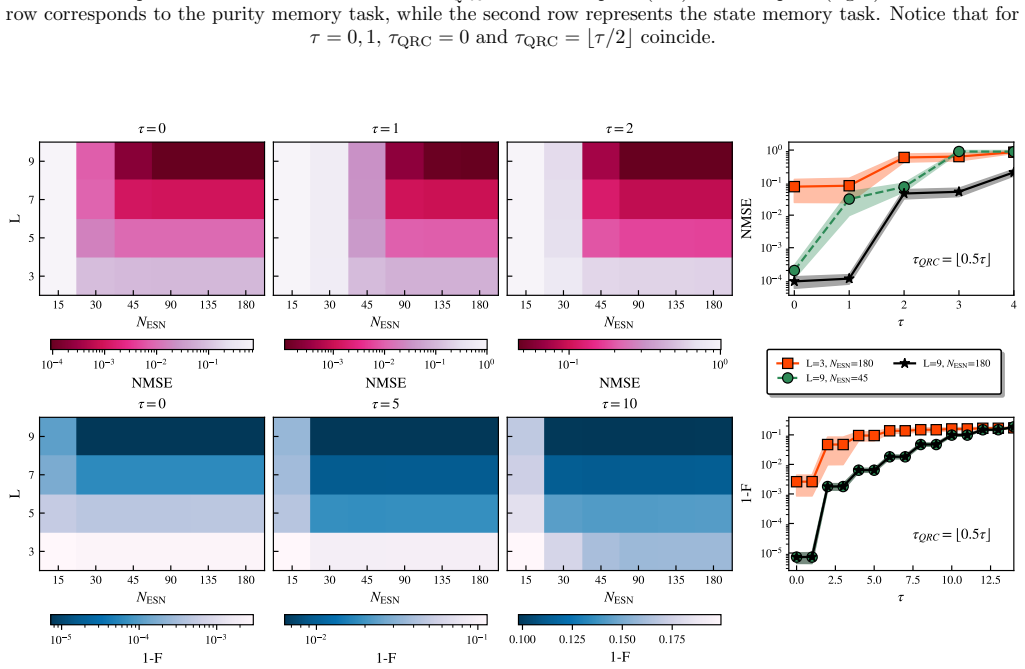
A distinctive feature of Quantum Reservoir Computing (QRC) is the ability to directly embed quantum input states into the reservoir dynamics. However, the resulting output is fundamentally linear for a single input state, preventing QRC from naturally computing nonlinear functionals such as purity or entropy. We overcome this limitation with a quantum-classical hybrid architecture combining a qubit quantum reservoir with a classical echo state network (ESN), allowing both nonlinear functional approximation and effective temporal processing. We systematically study performance under two information regimes: full-tomography and partial information (single-axis measurements), with the latter demonstrating that the hybrid system outperforms its standalone components in both linear and nonlinear tasks due to the enhanced information retrieval provided by the quantum reservoir. Building on these results, we apply an online monitoring protocol that explicitly accounts for measurement back-action and finite measurement ensembles, enabling a realistic assessment of performance under experimental conditions. These results establish hybrid quantum-classical reservoir computing (HRC) architectures as a practical and scalable route for enhanced quantum machine learning on near-term qubit hardware.
Editorial analysis
A structured set of objections, weighed in public.
Referee Report
Summary. The manuscript proposes a hybrid quantum-classical reservoir computing (HRC) architecture that pairs a qubit quantum reservoir with a classical echo state network (ESN). It claims this overcomes the inherent linearity of single-state QRC, enabling nonlinear tasks such as purity and entropy estimation alongside temporal processing. Systematic comparisons are presented between full tomography and partial single-axis measurements, with the hybrid reported to outperform both pure quantum and pure classical reservoirs under partial information; an online protocol is introduced to incorporate measurement back-action and finite ensemble effects for realistic evaluation on near-term hardware.
Significance. If the performance claims are substantiated with quantitative evidence, the work would offer a concrete route to nonlinear quantum state processing on current qubit devices by combining quantum embedding with classical nonlinearity, while addressing experimental constraints such as back-action. The focus on partial measurements and online correction is a practical strength.
major comments (2)
- [Abstract and online monitoring protocol section] Abstract and the section describing the online monitoring protocol: the central claim that the hybrid outperforms standalone components under single-axis measurements relies on the ESN reliably extracting nonlinear features from quantum reservoir dynamics despite projective back-action; the manuscript must demonstrate (via explicit simulation parameters or timescales) that temporal correlations survive repeated measurements long enough for the ESN to learn, rather than the advantage being an artifact of idealized dynamics without back-action.
- [Systematic studies section] The section on systematic studies under partial information: the abstract asserts outperformance in both linear and nonlinear tasks but supplies no numerical metrics, error bars, or baseline comparisons; without these, the load-bearing assertion that the hybrid provides enhanced information retrieval cannot be evaluated for statistical significance or robustness across the reported regimes.
minor comments (2)
- Clarify the precise definition of the 'online monitoring protocol' and how training data are generated under back-action (e.g., ensemble size, measurement frequency relative to reservoir evolution time).
- Ensure all figures comparing hybrid vs. standalone performance include error bars and specify the number of random realizations or training instances used.
Simulated Author's Rebuttal
We thank the referee for the constructive feedback. We address each major comment below with clarifications and proposed revisions where appropriate.
read point-by-point responses
-
Referee: [Abstract and online monitoring protocol section] Abstract and the section describing the online monitoring protocol: the central claim that the hybrid outperforms standalone components under single-axis measurements relies on the ESN reliably extracting nonlinear features from quantum reservoir dynamics despite projective back-action; the manuscript must demonstrate (via explicit simulation parameters or timescales) that temporal correlations survive repeated measurements long enough for the ESN to learn, rather than the advantage being an artifact of idealized dynamics without back-action.
Authors: The online monitoring protocol section already incorporates measurement back-action and finite ensemble effects explicitly in the simulations. To address the concern directly, we will add explicit simulation parameters (such as measurement rate per time step, ensemble sizes, and the timescales over which reservoir correlations persist) to demonstrate that temporal correlations remain sufficient for ESN training under realistic back-action. This will confirm the reported advantage is robust rather than an artifact of idealized dynamics. revision: yes
-
Referee: [Systematic studies section] The section on systematic studies under partial information: the abstract asserts outperformance in both linear and nonlinear tasks but supplies no numerical metrics, error bars, or baseline comparisons; without these, the load-bearing assertion that the hybrid provides enhanced information retrieval cannot be evaluated for statistical significance or robustness across the reported regimes.
Authors: The systematic studies section already includes quantitative performance metrics for the hybrid versus pure quantum and classical reservoirs on linear and nonlinear tasks, with error bars from multiple independent runs and direct baseline comparisons to support evaluation of statistical significance and robustness. The abstract provides only a high-level summary without specific numbers, consistent with standard practice. We can enhance the section with additional tabulated metrics or emphasis if needed for clarity. revision: partial
Circularity Check
No circularity: hybrid architecture and performance claims are independent of input definitions
full rationale
The paper introduces a hybrid qubit quantum reservoir plus classical ESN architecture to address the linearity limitation of standalone QRC for nonlinear tasks. It evaluates this via systematic numerical studies under full tomography and single-axis partial measurements, plus an online protocol accounting for back-action. No equations, fitted parameters, or self-citations are shown that would make reported outperformance equivalent to the architecture definition by construction. The central claims rest on simulation outcomes rather than tautological reductions, making the derivation self-contained against external benchmarks.
Axiom & Free-Parameter Ledger
Reference graph
Works this paper leans on
-
[1]
Jaeger,The ”echo state” approach to analysing and training recurrent neural networks, GMD Report 148 (GMD - German National Research Institute for Com- puter Science, 2001)
H. Jaeger,The ”echo state” approach to analysing and training recurrent neural networks, GMD Report 148 (GMD - German National Research Institute for Com- puter Science, 2001)
2001
-
[2]
Maass, T
W. Maass, T. Natschl¨ ager, and H. Markram, Neural Computation14, 2531 (2002)
2002
-
[3]
Lukoˇ seviˇ cius and H
M. Lukoˇ seviˇ cius and H. Jaeger, Computer Science Re- view3, 127 (2009)
2009
-
[4]
G. V. der Sande, D. Brunner, and M. C. Soriano, Nanophotonics6, 561 (2017)
2017
-
[5]
Appeltant, M
L. Appeltant, M. C. Soriano, G. Van der Sande, J. Danck- aert, S. Massar, J. Dambre, B. Schrauwen, C. R. Mirasso, and I. Fischer, Nature Communications2, 468 (2011)
2011
-
[6]
Hauser, A
H. Hauser, A. J. Ijspeert, R. M. F¨ uchslin, R. Pfeifer, and W. Maass, Biological Cybernetics106, 595 (2012)
2012
-
[7]
Vandoorne, P
K. Vandoorne, P. Mechet, T. Van Vaerenbergh, M. Fiers, G. Morthier, D. Verstraeten, B. Schrauwen, J. Dambre, and P. Bienstman, Nature Communications5, 3541 (2014)
2014
-
[8]
K. Fujii and K. Nakajima, Physical Review Applied8, 10.1103/physrevapplied.8.024030 (2017)
-
[9]
K. Goto, K. Nakajima, and H. Notsu, Computing with vortices: Bridging fluid dynamics and its information- processing capability (2020), arXiv:2001.08502 [physics.flu-dyn]
arXiv 2020
-
[10]
Nakajima, Japanese Journal of Applied Physics59, 060501 (2020)
K. Nakajima, Japanese Journal of Applied Physics59, 060501 (2020)
2020
-
[11]
Z. Chen, W. Li, Z. Fan, S. Dong, Y. Chen, M. Qin, M. Zeng, X. Lu, G. Zhou, X. Gao, and J.-M. Liu, Nature Communications14, 10.1038/s41467-023-39371- y (2023)
-
[12]
Adamatzky,Advances in unconventional computing: Volume 1: Theory, Vol
A. Adamatzky,Advances in unconventional computing: Volume 1: Theory, Vol. 22 (Springer, 2016)
2016
-
[13]
Grigoryeva and J
L. Grigoryeva and J. Ortega, Neural networks : the offi- cial journal of the International Neural Network Society 108, 495 (2018)
2018
-
[14]
P. Mujal, R. Mart´ ınez-Pe˜ na, J. Nokkala, J. Garc´ ıa-Beni, G. L. Giorgi, M. C. Soriano, and R. Zambrini, Advanced Quantum Technologies4, 10.1002/qute.202100027 (2021)
-
[15]
Fujii and K
K. Fujii and K. Nakajima, Quantum reservoir computing: A reservoir approach toward quantum machine learn- ing on near-term quantum devices, inReservoir Com- puting: Theory, Physical Implementations, and Applica- tions, edited by K. Nakajima and I. Fischer (Springer Singapore, Singapore, 2021) pp. 423–450
2021
-
[16]
L. C. G. Govia, G. J. Ribeill, G. E. Rowlands, H. K. Krovi, and T. A. Ohki, Phys. Rev. Res.3, 013077 (2021)
2021
-
[17]
Nokkala, R
J. Nokkala, R. Mart´ ınez-Pe˜ na, G. L. Giorgi, V. Pa- rigi, M. C. Soriano, and R. Zambrini, Communications Physics4, 53 (2021)
2021
-
[18]
Spagnolo, J
M. Spagnolo, J. Morris, S. Piacentini, M. Antesberger, F. Massa, A. Crespi, F. Ceccarelli, R. Osellame, and P. Walther, Nature Photonics16, 318 (2022)
2022
-
[19]
R. A. Bravo, K. Najafi, X. Gao, and S. F. Yelin, PRX Quantum3, 030325 (2022)
2022
-
[20]
J. Garc´ ıa-Beni, G. L. Giorgi, M. C. Soriano, and R. Zam- brini, Physical Review Applied20, 10.1103/physrevap- plied.20.014051 (2023)
-
[21]
F. Hu, S. A. Khan, N. T. Bronn, G. Angelatos, G. E. Rowlands, G. J. Ribeill, and H. E. T¨ ureci, Nature Com- munications15, 7491 (2024)
2024
-
[22]
M. Kornjaˇ ca, H.-Y. Hu, C. Zhao, J. Wurtz, P. Wein- berg, M. Hamdan, A. Zhdanov, S. H. Cantu, H. Zhou, R. A. Bravo, K. Bagnall, J. I. Basham, J. Campo, A. Choukri, R. DeAngelo, P. Frederick, D. Haines, J. Hammett, N. Hsu, M.-G. Hu, F. Huber, P. N. Jepsen, N. Jia, T. Karolyshyn, M. Kwon, J. Long, J. Lopatin, A. Lukin, T. Macr` ı, O. Markovi´ c, L. A. Mart...
arXiv 2024
-
[23]
Senanian, S
A. Senanian, S. Prabhu, V. Kremenetski, S. Roy, Y. Cao, J. Kline, T. Onodera, L. G. Wright, X. Wu, V. Fatemi, and P. L. McMahon, Nature Communications15, 7490 (2024)
2024
-
[24]
S. Das, G. L. Giorgi, and R. Zambrini, Phys. Rev. Res. 8, 023148 (2026)
2026
-
[25]
Llodr` a, P
G. Llodr` a, P. Mujal, R. Zambrini, and G. L. Giorgi, Chaos, Solitons & Fractals195, 116289 (2025)
2025
-
[26]
Carles, J
B. Carles, J. Dudas, L. Balembois, J. Grollier, and D. Markovi´ c, Phys. Rev. Appl.25, 054005 (2026)
2026
-
[27]
Paparelle, J
I. Paparelle, J. Henaff, J. Garc´ ıa-Beni,´E. Gillet, D. Mon- tesinos, G. L. Giorgi, M. C. Soriano, R. Zambrini, and V. Parigi, Nature Photonics20, 413 (2026)
2026
-
[28]
Suzuki, Q
Y. Suzuki, Q. Gao, K. C. Pradel, K. Yasuoka, and N. Ya- mamoto, Scientific Reports12, 1353 (2022)
2022
-
[29]
S. ˇCindrak, B. Donvil, K. L¨ udge, and L. Jaurigue, Phys- ical Review Research 10.1103/physrevresearch.6.013051 (2023)
-
[30]
Mujal, R
P. Mujal, R. Mart´ ınez-Pe˜ na, G. L. Giorgi, M. C. Soriano, and R. Zambrini, npj Quantum Information9, 16 (2023)
2023
-
[31]
Dudas, B
J. Dudas, B. Carles, E. Plouet, F. A. Mizrahi, J. Grollier, and D. Markovi´ c, npj Quantum Information9, 64 (2023)
2023
-
[32]
G¨ otting, F
N. G¨ otting, F. Lohof, and C. Gies, Phys. Rev. A108, 052427 (2023)
2023
-
[33]
C. Zhu, P. J. Ehlers, H. Nurdin, and D. Soh, Physical Review Research 10.1103/wsyq-jyxd (2024)
-
[34]
Sannia, R
A. Sannia, R. Mart´ ınez-Pe˜ na, M. C. Soriano, G. L. Giorgi, and R. Zambrini, Quantum8, 1291 (2024)
2024
-
[35]
Mart´ ınez-Pe˜ na and J.-P
R. Mart´ ınez-Pe˜ na and J.-P. Ortega, Phys. Rev. E111, 065306 (2025)
2025
-
[36]
Ghosh, A
S. Ghosh, A. Opala, M. Matuszewski, T. Paterek, and T. C. H. Liew, npj Quantum Information5, 35 (2019)
2019
-
[37]
Ghosh, A
S. Ghosh, A. Opala, M. Matuszewski, T. Paterek, and T. C. H. Liew, IEEE Transactions on Neural Networks and Learning Systems32, 3148 (2021)
2021
-
[38]
Ghosh, K
S. Ghosh, K. Nakajima, T. Krisnanda, K. Fujii, and T. C. H. Liew, Advanced Quantum Technologies4, 2100053 (2021)
2021
-
[39]
Ghosh, T
S. Ghosh, T. Krisnanda, T. Paterek, and T. C. H. Liew, Communications Physics4, 105 (2021)
2021
-
[40]
Q. H. Tran and K. Nakajima, Phys. Rev. Lett.127, 260401 (2021)
2021
-
[41]
Nokkala, Scientific Reports13, 7694 (2023)
J. Nokkala, Scientific Reports13, 7694 (2023)
2023
-
[42]
D. Zia, L. Innocenti, G. Minati, S. Lorenzo, A. Suprano, R. D. Bartolo, N. Spagnolo, T. Giordani, V. Ci- 12 mini, G. M. Palma, A. Ferraro, F. Sciarrino, and M. Paternostro, Science Advances11, eady7987 (2025), https://www.science.org/doi/pdf/10.1126/sciadv.ady7987
-
[43]
Innocenti, S
L. Innocenti, S. Lorenzo, I. Palmisano, A. Ferraro, M. Pa- ternostro, and G. M. Palma, Communications Physics6, 118 (2023)
2023
-
[44]
L. C. G. Govia, G. Ribeill, G. E. Rowlands, and T. A. Ohki, Neuromorphic Computing and Engineering2, 10.1088/2634-4386/ac4fcd (2021)
-
[45]
Mujal, J
P. Mujal, J. Nokkala, R. Mart´ ınez-Pe˜ na, G. L. Giorgi, M. C. Soriano, and R. Zambrini, Journal of Physics: Complexity2, 045008 (2021)
2021
-
[46]
M. Gili, E. Fiorelli, A. Bl´ azquez-Garc´ ıa, G. L. Giorgi, and R. Zambrini, Quantum Machine Intelligence8, 63 (2026)
2026
-
[47]
J. Nokkala, G. L. Giorgi, and R. Zambrini, Machine Learning: Science and Technology5, 10.1088/2632- 2153/ad5f12 (2024)
-
[48]
Mart´ ınez-Pe˜ na, G
R. Mart´ ınez-Pe˜ na, G. L. Giorgi, J. Nokkala, M. C. So- riano, and R. Zambrini, Phys. Rev. Lett.127, 100502 (2021)
2021
-
[49]
J. Chen, H. I. Nurdin, and N. Yamamoto, Phys. Rev. Appl.14, 024065 (2020)
2020
-
[50]
Kubota, Y
T. Kubota, Y. Suzuki, S. Kobayashi, Q. H. Tran, N. Ya- mamoto, and K. Nakajima, Phys. Rev. Res.5, 023057 (2023)
2023
-
[51]
Domingo, G
L. Domingo, G. Carlo, and F. Borondo, Scientific Reports 13, 8790 (2023)
2023
-
[52]
S. Mifune, T. Kanao, and T. Tanamoto, Japanese Jour- nal of Applied Physics64, 10.35848/1347-4065/adbf9e (2024)
-
[53]
K. Cheamsawat and T. Chotibut, Entropy27, 10.3390/e27010088 (2024)
-
[54]
A. Palacios, R. Mart´ ınez-Pe˜ na, M. C. Soriano, G. L. Giorgi, and R. Zambrini, Communications Physics7, 10.1038/s42005-024-01859-4 (2024)
-
[55]
Pfeffer, F
P. Pfeffer, F. Heyder, and J. Schumacher, Phys. Rev. Res. 4, 033176 (2022)
2022
-
[56]
P. R. Pfeffer, F. Heyder, and J. Schumacher, Physical Re- view Research 10.1103/physrevresearch.5.043242 (2023)
-
[57]
F. Wudarski, D. O‘Connor, S. Geaney, A. A. Asanjan, M. Wilson, E. Strbac, P. A. Lott, and D. Venturelli, Hy- brid quantum-classical reservoir computing for simulat- ing chaotic systems (2024), arXiv:2311.14105 [quant-ph]
arXiv 2024
-
[58]
K. Kobayashi, K. Fujii, and N. Yamamoto, PRX Quan- tum5, 10.1103/prxquantum.5.040325 (2024)
-
[59]
Sakurai, A
A. Sakurai, A. Hayashi, W. Munro, and K. Nemoto, Op- tica Quantum3, 238 (2025)
2025
-
[60]
Settino, L
J. Settino, L. Salatino, L. Mariani, F. D’Amore, M. Channab, L. Bozzolo, S. Vallisa, P. Barill` a, A. Poli- cicchio, N. Lo Gullo, A. Giordano, C. Mastroianni, and F. Plastina, Phys. Rev. Appl.24, 024019 (2025)
2025
- [61]
-
[62]
Mart´ ınez-Pe˜ na, J
R. Mart´ ınez-Pe˜ na, J. Nokkala, G. Giorgi, R. Zambrini, and M. C. Soriano, Cognitive Computation15, 1440 (2020)
2020
-
[63]
I. B. Yildiz, H. Jaeger, and S. J. Kiebel, Neural Networks 35, 1 (2012)
2012
-
[64]
Zhang, D
B. Zhang, D. J. Miller, and Y. Wang, IEEE Transac- tions on Neural Networks and Learning Systems23, 175 (2012)
2012
-
[65]
Zyczkowski and H.-J
K. Zyczkowski and H.-J. Sommers, Journal of Physics A: Mathematical and General34, 7111–7125 (2001)
2001
-
[66]
Jozsa, Journal of Modern Optics41, 2315 (1994)
R. Jozsa, Journal of Modern Optics41, 2315 (1994)
1994
-
[67]
Fette and J
G. Fette and J. Eggert, inArtificial Neural Networks: Bi- ological Inspirations – ICANN 2005, edited by W. Duch, J. Kacprzyk, E. Oja, and S. Zadro˙ zny (Springer Berlin Heidelberg, Berlin, Heidelberg, 2005) pp. 13–18
2005
-
[68]
W. K. Wootters, Phys. Rev. Lett.80, 2245 (1998)
1998
-
[69]
R. F. Werner, Phys. Rev. A40, 4277 (1989)
1989
-
[70]
Assil, A
H. Assil, A. El Allati, and G. L. Giorgi, Phys. Rev. A 111, 022412 (2025)
2025
-
[71]
D. Gauthier, E. Bollt, A. Griffith, and W. A. Barbosa, Nature Communications12, 10.1038/s41467-021-25801- 2 (2021)
-
[72]
L. Wang, P. Sun, L.-J. Kong, Y. Sun, and X. Zhang, Phys. Rev. A111, 022609 (2025)
2025
-
[73]
M. Naghiloo, Introduction to experimental quan- tum measurement with superconducting qubits (2019), arXiv:1904.09291 [quant-ph]
Pith/arXiv arXiv 2019
-
[74]
Y. Pan, J. Zhang, E. Cohen, C.-w. Wu, P.-X. Chen, and N. Davidson, Nature Physics16, 1206–1210 (2020)
2020
-
[75]
O. M. Sancho, G. L. Giorgi, and R. Zambrini, A general framework for online monitoring in quantum circuits for machine learning (2026), in preparation
2026
-
[76]
Franceschetto, M
G. Franceschetto, M. Plodzie´ n, M. Lewenstein, A. Ac´ ın, and P. Mujal, Phys. Rev. X16, 021002 (2026)
2026
-
[77]
Arute, K
F. Arute, K. Arya, R. Babbush, D. Bacon, J. C. Bardin, R. Barends, R. Biswas, S. Boixo, F. G. S. L. Brandao, D. A. Buell, B. Burkett, Y. Chen, Z. Chen, B. Chiaro, R. Collins, W. Courtney, A. Dunsworth, E. Farhi, B. Foxen, A. Fowler, C. Gidney, M. Giustina, R. Graff, K. Guerin, S. Habegger, M. P. Harrigan, M. J. Hartmann, A. Ho, M. Hoffmann, T. Huang, T. S...
2019
-
[78]
Xu, J.-J
K. Xu, J.-J. Chen, Y. Zeng, Y.-R. Zhang, C. Song, W. Liu, Q. Guo, P. Zhang, D. Xu, H. Deng, K. Huang, H. Wang, X. Zhu, D. Zheng, and H. Fan, Phys. Rev. Lett. 120, 050507 (2018)
2018
-
[79]
Zhang, G
J. Zhang, G. Pagano, P. W. Hess, A. Kyprianidis, P. Becker, H. Kaplan, A. V. Gorshkov, Z.-X. Gong, and C. Monroe, Nature551, 601 (2017)
2017
-
[80]
J.-y. Choi, S. Hild, J. Zeiher, P. Schauß, A. Rubio- Abadal, T. Yefsah, V. Khemani, D. A. Huse, I. Bloch, and C. Gross, Science352, 1547–1552 (2016)
2016
discussion (0)
Sign in with ORCID, Apple, or X to comment. Anyone can read and Pith papers without signing in.