REVIEW 3 major objections 5 minor 64 references
Illusion3D: 3D Multiview Illusion with 2D Diffusion Priors
T0 review · 3 major / 5 minor · reviewed 2026-08-11 · deepseek-v4-flash
Pith's one-line read A single texture field can hide several pictures in one 3D object.
desk verdict Solid, honest methods paper that makes 3D multiview illusions from text prompts work in practice, but the central 'one distinct concept per view' claim is not directly measured and the prompt distribution is narrower than the abstract suggests. read the letter →
The pith
A machine-rendered reading of the paper's core claim, the machinery that carries it, and where it could break.
The reading
What carries the argument
The core machinery is Variational Score Distillation (VSD) applied through a multi-resolution hash-encoding MLP texture field (Instant-NGP style), rendered with differentiable rasterization and optimized against a pre-trained Stable Diffusion model. Three stabilization techniques carry the argument: scheduled camera jitter (adding growing Gaussian noise to rotation, translation, and field of view), patch-wise denoising (optimizing random 512x512 patches of a larger render so the low-resolution diffusion prior can guide high-resolution output), and progressive resolution scaling (ramping the render size from 512 up to 1024 or 2048 so the main object is centered and duplication is suppressed). Together they prevent the VSD loss from settling into local optima that duplicate or blend the per-view concepts.
What would settle it
Render a generated cube illusion and ask a judge (human or CLIP-based) to match each of its three views to its intended prompt; if a substantial fraction of views is not best matched to its own prompt, or if a single face shows duplicated content visible from two corners, the central claim of per-view fidelity fails. Concretely, run the released pipeline on 50 random prompt pairs and count views where the intended concept is not the top match.
Extended reading notes
Core claim
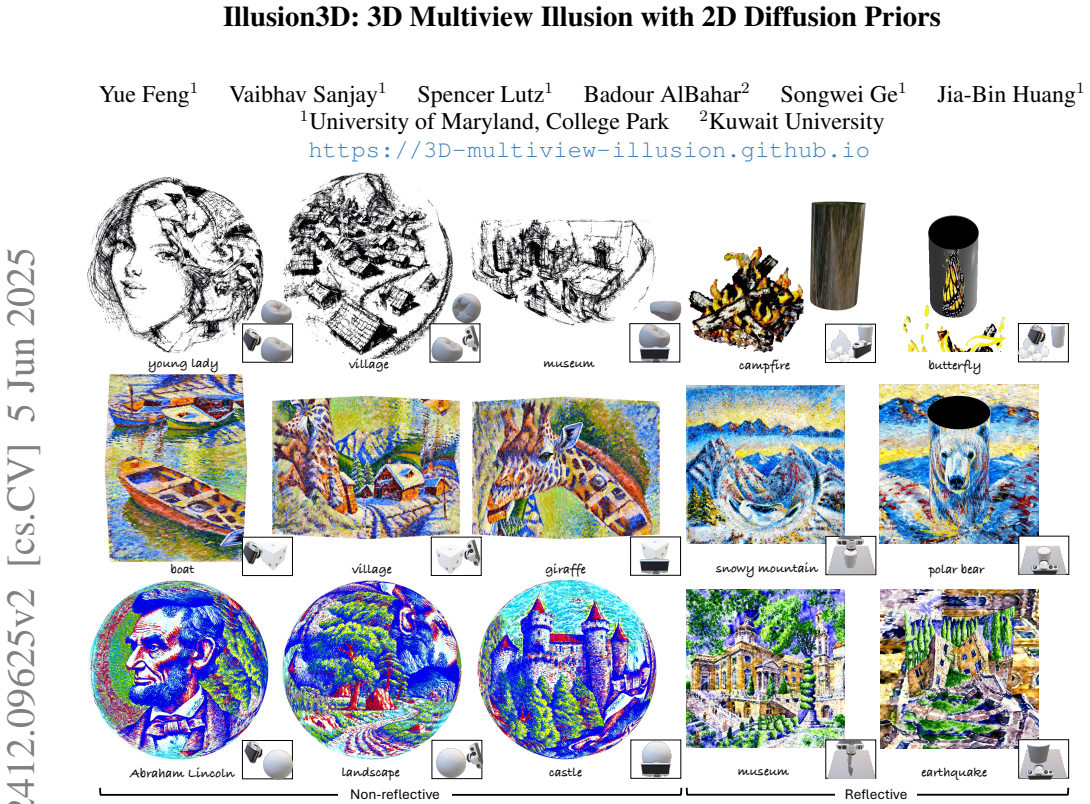
The central claim is that 3D multiview illusions can be generated by optimizing a single texture field on a given 3D shape with 2D diffusion priors, rather than by hand-crafting shadow, wire, or reflective art. Using the Variational Score Distillation gradient from ProlificDreamer, the method distills a separate Stable Diffusion prompt into each assigned viewpoint of a multi-resolution hash-encoding MLP texture field. The paper argues that naive VSD optimization gets stuck in local minima—duplicated concepts on one face, blended content across views, and VAE blind-spot artifacts—and that its three techniques fix these failures: linearly scheduled camera jitter that grows over training, random 512x512 patch denoising of a progressively enlarged render, and a sigmoid schedule for render resolution. Results are shown for cube, sphere, beanbag, Lego, reflective cylinder, and curved-mirror setups, with three to eight views per object, and the method also accepts an image input for one view via L2 supervision.
Load-bearing premise
Each viewpoint's diffusion loss can be satisfied simultaneously on one shared surface without one view's content leaking into another; if the optimization settles into a state where the same concept appears on multiple faces or a view blends two concepts, the claimed illusion is broken.
Editorial extensions
If this is right
- A user can go from two text prompts to a physical 3D object whose front shows one concept and side shows another, with no manual image editing.
- High-resolution texture output (1024x1024 and 2048x2048) means the illusions survive being printed, wrapped, or displayed at human scale rather than only on screen.
- Reflective surfaces can host multiple simultaneous illusions, with the paper's two-cylinder and mirror setups giving three views, which traditional hand-crafted reflective art does not achieve.
- Eight-view cube results show the approach can scale a single object with a sequence of looks, so a sculpture or product could encode a story as the viewer walks around it.
- Image-conditioned views (the Waldo example) indicate the same pipeline can embed a specific picture into one view, enabling personalized objects that hide private content in plain sight.
Reading between the lines
- The VAE blind-spot explanation for artifacts suggests that any latent-diffusion 3D optimization, not just illusions, could benefit from small amounts of scheduled camera jitter; this is a testable transfer to text-to-3D without illusion requirements.
- The duplication and blending failures are likely inherent to optimizing a single texture field for multiple full-image objectives, so more principled fixes, such as spatially explicit view partition masks or equivariance constraints on the VAE encoder, might replace the heuristic schedules.
- If the method extends beyond static textures to geometry optimization, then view-dependent shape changes could create even stronger illusions, since perspective distortion itself would contribute to hiding.
- The paper's success with reflective surfaces suggests a broader recipe: any optical element that maps different rays to different image content, such as mirrors, lenses, or water surfaces, could serve as the canvas for a diffusion-guided illusion.
Editorial analysis
A structured set of objections, weighed in public.
Referee Report
Summary. Illusion3D proposes an optimization-based method for generating 3D multiview illusions from text prompts or reference images. A neural texture field (an InstantNGP hash-encoding MLP) on a fixed 3D shape (cube, sphere, beanbag, Lego, or reflective cylinders/mirrors) is optimized with Variational Score Distillation (VSD) using a pre-trained Stable Diffusion model, with each target viewpoint associated with a distinct prompt or, in the 'Waldo' case, an L2-supervised image view. Three techniques are introduced to stabilize the under-constrained optimization: scheduled camera jittering (Sec. 3.2), random-patch denoising, and progressive render-resolution scaling (Sec. 3.3). The evaluation uses 43 randomly constructed style+object prompt pairs (86 examples on cubes and spheres), comparisons against inverse projection, latent blending, and Burgert et al. [3], systematic ablations, a 40-participant user study, and demonstrations including reflective surfaces, 8-view cubes, and 2048x2048 texture maps.
Significance. The problem is timely and well motivated, and the paper is a credible step from 2D diffusion illusions toward full-color 3D multiview illusions, going beyond shadow/wire art in expressiveness. The method is clearly specified and reproducible: a single hyperparameter set is used for all experiments (Supp. A), prompt pairs are randomly constructed rather than cherry-picked, the three proposed techniques are each ablated, and the reported metrics move consistently with the qualitative story. The authors are also commendably candid about failure cases (Sec. 5, Fig. 10) and about the role of style constraints in prompt selection (Supp. D). The main deficiency is evidentiary rather than conceptual: the metrics do not measure the defining property of an illusion (each view containing its intended concept exactly once, with no duplication or blending), and the tested prompt distribution is narrower than the abstract claims. Both gaps are addressable with additional measurement and a modestly scoped claim, so the contribution is, in my assessment, defensible at the core.
major comments (3)
- [Sec. 4 (Tables 1-2), Sec. 5, Fig. 10] The central claim — that each viewpoint yields its intended concept without duplication or blending — is not measured by the reported quantitative evidence. CLIP score, aesthetic score, and the alignment/concealment scores are all insensitive to the failure modes the paper itself documents: a view containing two monkeys (Fig. 10, row 1) still produces a high CLIP score for the 'monkey' prompt, and a blended view still partially matches both prompt texts. The paper even concedes in Sec. 5 that 'the model can still cheat the optimization criteria,' and Supp. D notes the prompt distribution matters. The user study (Supp. E) asks only about visual appeal and prompt alignment, not about whether a view contains duplicate or mixed primary content. The stress-test concern therefore lands: the reported numbers are compatible with the acknowledged failures. I request (i) a per-view instance-count evaluation, e.g., open-vocabulary detection counting detections of the prompt's object noun per view, and (ii) a reported success rate over the 43 prompt pairs defined as 'no duplicate or blended content in any view.' These are measurement additions, not changes to the method.
- [Abstract, Sec. 1, Sec. 4, Supp. Sec. D] The abstract and introduction claim the method works from 'user-provided text prompts,' but the evaluation distribution is much narrower. All 43 prompt pairs in Sec. 4 are constructed as 'random painting style + primary object,' and Supp. Sec. D explicitly states that prompts without style constraints converge with lower success rates and that 'illusion on real prompts is hard to succeed.' As written, the evidence supports only style-constrained noun+style prompts, not arbitrary prompts. The authors should either restrict the claim to the tested distribution or evaluate on unconstrained or user-provided prompts and report the per-prompt success rate. This matters because the distinction determines whether the paper delivers what its title and abstract promise.
- [Sec. 4 (Tables 1-3), Fig. 12] All reported quantitative results are point estimates without error bars or significance tests. The 86 examples come from only 43 prompt pairs (Sec. 4), so the prompt pair is the natural sampling unit and per-prompt variance is computable; I request bootstrap confidence intervals or paired tests for the headline comparisons in Tables 1-2 and for the user-study preference percentages in Table 3. The importance is visible in the Table 2 margins (e.g., Ablation-C vs. Ablation-D: CLIP 0.155 vs 0.165) and in Table 3 (Ablation-C 29.50% vs Ablation-D 39.80%), which are small relative to the 40-participant, 24-comparison study described in Fig. 12. Without variance information, the claim of 'best among all the metrics' (Sec. 4.1) is not fully substantiated.
minor comments (5)
- [Sec. 3.1] The sentence 'we leverage 2D diffusion priors from a pre-trained Stable Diffusion model [42] via a Score Distillation Sampling [37] is a common method for utilizing 2D diffusion priors, it often produces over-smoothing and color over-saturation artifacts' is garbled and should be split into two correct sentences; the intended meaning (SDS is a common method, VSD is adopted instead) is clear but the current text reads as two sentences fused.
- [Fig. 2 caption] Subfigure (a) is cited as '2D flip illusion [42],' but reference [42] is the Stable Diffusion/LDM paper; the cited work for 2D diffusion illusions should be Burgert et al. [3] and/or Geng et al. [8] (which the text itself cites in Sec. 2 for this figure).
- [Abstract, Sec. 3, Supp. Sec. C] The abstract claims the method optimizes 'textures and geometry,' but Sec. 3 describes only texture-field optimization; the main experiments use fixed geometry, and the 3D-shape case (Fig. 8) is described only by a caption with no training procedure. Also, the 1024/2048 resolution claims: Eq. (6) specifies a final resolution of b=1024, while the abstract promises 2048x2048 outputs; please document the 2048 setting (schedule endpoints, patch size, budget) or align the claims with the described procedure.
- [Table 3 / Fig. 12] In the pairwise preference data, percentages for a pair do not sum to 100 (e.g., Ours 60.61% vs. Burgert et al. 10.14% in Table 3), so it is unclear whether ties were allowed or whether the normalization denominator varies per pairing; please state the exact question format, whether choice was forced, and the denominator used in Eq. (7).
- [General] Typos and formatting artifacts to clean up: Table 2 caption 'CLIP sore' should be 'CLIP score'; Sec. 4.1 'best among all the matrices' should be 'metrics'; Supp. Sec. A 'we set the training time step for 2000' should be 'to 2000'; Fig. 3 caption contains 'duplicate pattern issue issue'; and the reference list contains stray trailing numbers (e.g., refs [3], [14], [25], [43]) that appear to be leftover build artifacts.
Circularity Check
No circular derivation: the illusion texture is optimized against external prompts and evaluated independently; only mild non-load-bearing self-citations and a shared diffusion-prior evaluation family appear.
full rationale
Illusion3D's claimed derivation chain is an optimization: a neural texture field is rendered from target viewpoints and updated with VSD gradients (Eq. 1) using a pre-trained Stable Diffusion model conditioned on user text prompts, with a LoRA module fit to current renderings (Eq. 2). The resulting multiview illusion is not defined as the minimizer of the evaluation metrics; CLIP scores, aesthetic scores, alignment/concealment scores, and user studies are external measurements applied after optimization. No equation in the paper defines a predicted quantity in terms of a fitted parameter of that same quantity, and no 'uniqueness theorem' is imported from the authors' prior work to force a choice. The paper's own Section 5 concedes that the optimization can 'cheat the optimization criteria' and Fig. 10 shows duplicate/blended failure cases, which is an honest admission of non-guarantee rather than a circular validation. The only self-referential elements are minor: [11] and [21] are self-citations in the related-work survey and are not load-bearing for the method, and the diffusion prior used for generation is from the same model family as some evaluation signals, but the evaluation also includes user preference and comparisons against external baselines. These do not amount to a self-definitional or fitted-input circularity, so the score is low.
Assumptions & free parameters
free parameters (5)
- Cmax (camera jitter max) =
0.3
- Camera jitter standard deviations (sigma_R, sigma_T, sigma_FOV) =
1.0
- Render resolution schedule endpoints (a, b) =
a=512, b=1024
- VSD timestep distribution =
U(0.02,0.98), annealed to U(0.02,0.5) after step 1000
- Learning rates =
1e-3 (VSD), 1e-4 (LoRA)
assumptions (3)
- domain assumption VSD provides a valid gradient direction for optimizing a neural texture field toward the distribution of a pretrained 2D diffusion model.
- domain assumption A 2D text-to-image diffusion model (SD v2-1-base) has enough multi-view knowledge of objects to guide 3D-consistent texture optimization.
- ad hoc to paper Scheduled camera jitter, patch denoising, and progressive resolution scaling are sufficient to avoid the local minima that produce duplicate or partial content.
Cite this review
Pith. "Pith review of Illusion3D: 3D Multiview Illusion with 2D Diffusion Priors." pith.science (2026). https://pith.science/paper/QRLM6Z62
@misc{pith2026241209625,
  author       = {Pith},
  title        = {Pith review of: Illusion3D: 3D Multiview Illusion with 2D Diffusion Priors},
  year         = {2026},
  howpublished = {\url{https://pith.science/paper/QRLM6Z62}},
  note         = {Machine review of arXiv:2412.09625}
}
read the original abstract
Automatically generating multiview illusions is a compelling challenge, where a single piece of visual content offers distinct interpretations from different viewing perspectives. Traditional methods, such as shadow art and wire art, create interesting 3D illusions but are limited to simple visual outputs (i.e., figure-ground or line drawing), restricting their artistic expressiveness and practical versatility. Recent diffusion-based illusion generation methods can generate more intricate designs but are confined to 2D images. In this work, we present a simple yet effective approach for creating 3D multiview illusions based on user-provided text prompts or images. Our method leverages a pre-trained text-to-image diffusion model to optimize the textures and geometry of neural 3D representations through differentiable rendering. When viewed from multiple angles, this produces different interpretations. We develop several techniques to improve the quality of the generated 3D multiview illusions. We demonstrate the effectiveness of our approach through extensive experiments and showcase illusion generation with diverse 3D forms.
Figures


Figures from the paper (16 more)


Reference graph
Works this paper leans on
-
[3]
Diffusion illusions: Hiding images in plain sight
Ryan Burgert, Xiang Li, Abe Leite, Kanchana Ranasinghe, and Michael Ryoo. Diffusion illusions: Hiding images in plain sight. In ACM SIGGRAPH 2024 Conference Papers , pages 1–11, 2024. 2, 3, 5, 6, 8, 1
work page 2024
-
[1]
Object perception: When our brain is im- pressed but we do not notice it
Michael Bach. Object perception: When our brain is im- pressed but we do not notice it. 2009. 2
work page 2009
-
[2]
Edwin G. Boring. A new ambiguous figure. American Jour- nal of Psychology, 42:444, 1930. 2
work page 1930
- [4]
-
[5]
Tenenbaum, and Jonathan Ragan-Kelley
Kartik Chandra, Tzu-Mao Li, Joshua B. Tenenbaum, and Jonathan Ragan-Kelley. Designing perceptual puzzles by differentiating probabilistic programs. ACM SIGGRAPH Conference Proceedings, 2022. 2
work page 2022
-
[6]
Fan- tasia3d: Disentangling geometry and appearance for high- quality text-to-3d content creation
Rui Chen, Yongwei Chen, Ningxin Jiao, and Kui Jia. Fan- tasia3d: Disentangling geometry and appearance for high- quality text-to-3d content creation. In ICCV, 2023. 3
2023
-
[7]
Patched denoising diffusion models for high-resolution im- age synthesis
Zheng Ding, Mengqi Zhang, Jiajun Wu, and Zhuowen Tu. Patched denoising diffusion models for high-resolution im- age synthesis. In The Twelfth International Conference on Learning Representations, 2023. 5
work page 2023
-
[8]
Visual ana- grams: Generating multi-view optical illusions with diffu- sion models
Daniel Geng, Inbum Park, and Andrew Owens. Visual ana- grams: Generating multi-view optical illusions with diffu- sion models. ArXiv, abs/2311.17919, 2023. 2, 6
arXiv 2023
Show all 64 references
-
[9]
Georgiades and John Harris
Michael S. Georgiades and John Harris. Biasing effects in ambiguous figures: Removal or fixation of critical features can affect perception. Visual Cognition, 4:383–408, 1997. 2
1997
-
[10]
Visual indeterminacy in gan art
Aaron Hertzmann. Visual indeterminacy in gan art. In ACM SIGGRAPH 2020 Art Gallery, pages 424–428, 2020. 2
2020
-
[11]
Multi- view wire art
Kai-Wen Hsiao, Jia-Bin Huang, and Hung-Kuo Chu. Multi- view wire art. ACM TOG, 37:1 – 11, 2018. 3
2018
-
[12]
Intriguing properties of generative classifiers
Priyank Jaini, Kevin Clark, and Robert Geirhos. Intriguing properties of generative classifiers. ArXiv, abs/2309.16779,
-
[13]
Constructability of trip-lets
JJA Keiren, Freek van Walderveen, and Alexander Wolff. Constructability of trip-lets. In Abstracts 25th European Workshop on Computational Geometry (EuroCG’09, Brus- sels, Belgium, March 16-18, 2009) , pages 251–254, 2009. 3
2009
-
[14]
Kingma and Jimmy Ba
Diederik P. Kingma and Jimmy Ba. Adam: A method for stochastic optimization, 2017. 1
2017
-
[15]
If by deepfloyd lab at stabilityai
Mikhail Konstantinov, Alex Shonenkov, Daria Bakshan- daeva, and Ksenia Ivanova. If by deepfloyd lab at stabilityai. Github Repo, 2023. 2
2023
-
[16]
Ambiguous figures – what happens in the brain when perception changes but not the stimulus
J ¨urgen Kornmeier and Michael Bach. Ambiguous figures – what happens in the brain when perception changes but not the stimulus. Frontiers in Human Neuroscience, 6, 2011. 2
2011
-
[17]
Optimized binarization for eggshell carving art
Thi Ngoc Hanh Le, Sheng-Yi Yao, Chih-Kuo Yeh, Sheng- Jie Wang, and Tong-Yee Lee. Optimized binarization for eggshell carving art. SIGGRAPH Asia 2021 Posters, 2021. 2
2021
-
[18]
Magic3d: High-resolution text-to-3d content creation
Chen-Hsuan Lin, Jun Gao, Luming Tang, Towaki Takikawa, Xiaohui Zeng, Xun Huang, Karsten Kreis, Sanja Fidler, Ming-Yu Liu, and Tsung-Yi Lin. Magic3d: High-resolution text-to-3d content creation. In CVPR, 2023. 3
2023
-
[19]
Long and Thomas C
Gerald M. Long and Thomas C. Toppino. Enduring inter- est in perceptual ambiguity: alternating views of reversible figures. Psychological bulletin, 130 5:748–68, 2004. 2
2004
-
[20]
Camdiff: Camouflage image augmentation via diffusion model.ArXiv, abs/2304.05469, 2023
Xuejiao Luo, Shuo Wang, Zongwei Wu, Christos Sakaridis, Yun Cheng, Deng-Ping Fan, and Luc Van Gool. Camdiff: Camouflage image augmentation via diffusion model.ArXiv, abs/2304.05469, 2023. 2
2023 arXiv
-
[21]
Jacobs, Alexei A
David McAllister, Songwei Ge, Jia-Bin Huang, David W. Jacobs, Alexei A. Efros, Aleksander Holynski, and Angjoo Kanazawa. Rethinking score distillation as a bridge between image distributions. In Advances in Neural Information Pro- cessing Systems, 2024. 3
2024
-
[22]
Latent-nerf for shape-guided generation of 3d shapes and textures
Gal Metzer, Elad Richardson, Or Patashnik, Raja Giryes, and Daniel Cohen-Or. Latent-nerf for shape-guided generation of 3d shapes and textures. In CVPR, 2023. 3
2023
-
[23]
Soft shadow art
Sehee Min, Jaedong Lee, Jungdam Won, and Jehee Lee. Soft shadow art. In International Symposium on Computational Aesthetics in Graphics, Visualization, and Imaging, 2017. 2, 3
2017
-
[24]
Shadow art
Niloy Jyoti Mitra and Mark Pauly. Shadow art. ACM SIG- GRAPH Asia 2009 papers, 2009. 2, 3
2009
-
[25]
Mitra and Mark Pauly
Niloy J. Mitra and Mark Pauly. Shadow art. ACM Transac- tions on Graphics (Proceedings of SIGGRAPH Asia), 28(5): 156:1–156:7, 2009. 3
2009
-
[26]
Instant neural graphics primitives with a multires- olution hash encoding
Thomas M ¨uller, Alex Evans, Christoph Schied, and Alexan- der Keller. Instant neural graphics primitives with a multires- olution hash encoding. ACM TOG, 41:1 – 15, 2022. 3
2022
-
[27]
Ava: A large-scale database for aesthetic visual analysis
Naila Murray, Luca Marchesotti, and Florent Perronnin. Ava: A large-scale database for aesthetic visual analysis. CVPR, pages 2408–2415, 2012. 6
2012
-
[28]
Is clip fooled by optical illusions? In Tiny Papers @ ICLR ,
Jerry Ngo, Swami Sankaranarayanan, and Phillip Isola. Is clip fooled by optical illusions? In Tiny Papers @ ICLR ,
-
[29]
Michael E. R. Nicholls, Owen Churches, and Tobias Loetscher. Perception of an ambiguous figure is affected by own-age social biases. Scientific Reports, 8, 2018. 2
2018
-
[30]
Aude Oliva, Antonio Torralba, and Philippe G. Schyns. Hy- brid images. ACM SIGGRAPH 2006 Papers, 2006. 2
2006
-
[31]
These anamorphic illusions reveal their true form only when viewed in a mirror, 2016
Bored Panda. These anamorphic illusions reveal their true form only when viewed in a mirror, 2016. Accessed: 2024- 05-19. 3
2016
-
[32]
Brascamp
Joel Pearson and Jan W. Brascamp. Sensory memory for ambiguous vision. Trends in Cognitive Sciences , 12:334– 341, 2008. 2
2008
-
[33]
Being alive to the world: an artist’s per- spective on predictive processing
Robert Pepperell. Being alive to the world: an artist’s per- spective on predictive processing. Philosophical Transac- tions of the Royal Society B: Biological Sciences, 379, 2023. 2
2023
-
[34]
Con- structing printable surfaces with view-dependent appear- ance
Maxine Perroni-Scharf and Szymon Rusinkiewicz. Con- structing printable surfaces with view-dependent appear- ance. ACM SIGGRAPH 2023 Conference Proceedings ,
2023
-
[35]
The influence of stimulus duration on visual illusions and simple reaction time
Thorsten Plewan, Ralph Weidner, and Gereon Rudolf Fink. The influence of stimulus duration on visual illusions and simple reaction time. Experimental Brain Research, 223:367 – 375, 2012. 2 9
2012
-
[36]
Sdxl: Improving latent diffusion mod- els for high-resolution image synthesis
Dustin Podell, Zion English, Kyle Lacey, Andreas Blattmann, Tim Dockhorn, Jonas M ¨uller, Joe Penna, and Robin Rombach. Sdxl: Improving latent diffusion mod- els for high-resolution image synthesis. arXiv preprint arXiv:2307.01952, 2023. 2
2023 arXiv
-
[37]
Barron, and Ben Milden- hall
Ben Poole, Ajay Jain, Jonathan T. Barron, and Ben Milden- hall. Dreamfusion: Text-to-3d using 2d diffusion. In ICLR,
-
[38]
Wired perspectives: Multi-view wire art embraces generative ai
Zhiyu Qu, Lan Yang, Honggang Zhang, Tao Xiang, Kaiyue Pang, and Yi-Zhe Song. Wired perspectives: Multi-view wire art embraces generative ai. ArXiv, abs/2311.15421,
-
[39]
Learning transferable visual models from natural language supervision
Alec Radford, Jong Wook Kim, Chris Hallacy, Aditya Ramesh, Gabriel Goh, Sandhini Agarwal, Girish Sastry, Amanda Askell, Pamela Mishkin, Jack Clark, Gretchen Krueger, and Ilya Sutskever. Learning transferable visual models from natural language supervision. In International Con...
2021
-
[40]
Hierarchical text-conditional image gener- ation with clip latents
Aditya Ramesh, Prafulla Dhariwal, Alex Nichol, Casey Chu, and Mark Chen. Hierarchical text-conditional image gener- ation with clip latents. ArXiv, abs/2204.06125, 2022. 2
2022 arXiv
-
[41]
Accelerating 3d deep learning with pytorch3d
Nikhila Ravi, Jeremy Reizenstein, David Novotny, Tay- lor Gordon, Wan-Yen Lo, Justin Johnson, and Georgia Gkioxari. Accelerating 3d deep learning with pytorch3d. arXiv:2007.08501, 2020. 1
2007 arXiv
-
[42]
Blattmann, Dominik Lorenz, Patrick Esser, and Bj ¨orn Ommer
Robin Rombach, A. Blattmann, Dominik Lorenz, Patrick Esser, and Bj ¨orn Ommer. High-resolution image synthesis with latent diffusion models. CVPR, pages 10674–10685,
-
[43]
High-resolution image synthesis with latent diffusion models
Robin Rombach, Andreas Blattmann, Dominik Lorenz, Patrick Esser, and Bj ¨orn Ommer. High-resolution image synthesis with latent diffusion models. In Proceedings of the IEEE/CVF Conference on Computer Vision and Pattern Recognition (CVPR), pages 10684–10695, 2022. 5, 1
2022
-
[44]
Dreambooth: Fine tuning text-to-image diffusion models for subject-driven generation
Nataniel Ruiz, Yuanzhen Li, Varun Jampani, Yael Pritch, Michael Rubinstein, and Kfir Aberman. Dreambooth: Fine tuning text-to-image diffusion models for subject-driven generation. In CVPR, 2023. 3
2023
-
[45]
Shadow art revisited: A differentiable rendering based approach
Kaustubh Sadekar, Ashish Tiwari, and Shanmuganathan Ra- man. Shadow art revisited: A differentiable rendering based approach. CVPR, pages 628–636, 2021. 2, 3
2021
-
[46]
Generation of view dependent models using free form deformation
Guy Sela and Gershon Elber. Generation of view dependent models using free form deformation. The Visual Computer, 23(3):219–229, 2007. 3
2007
-
[47]
Irene Sperandio, Silvia Savazzi, and Carlo A. Marzi. Is sim- ple reaction time affected by visual illusions? Experimental Brain Research, 201:345–350, 2010. 2
2010
-
[48]
Evolving three dimension (3d) abstract art: Fitting concepts by language
Yingtao Tian. Evolving three dimension (3d) abstract art: Fitting concepts by language. ArXiv, abs/2304.12932, 2023. 2
2023 arXiv
-
[49]
Toward quantifying ambiguities in artistic images
Xi Wang, Zoya Bylinskii, Aaron Hertzmann, and Robert Pepperell. Toward quantifying ambiguities in artistic images. ACM Transactions on Applied Perception (TAP), 17:1 – 10,
-
[50]
Prolificdreamer: High-fidelity and diverse text-to-3d generation with variational score distilla- tion
Zhengyi Wang, Cheng Lu, Yikai Wang, Fan Bao, Chongxuan Li, Hang Su, and Jun Zhu. Prolificdreamer: High-fidelity and diverse text-to-3d generation with variational score distilla- tion. In NeurIPS, 2023. 2, 3, 4
2023
-
[51]
Patch diffusion: Faster and more data- efficient training of diffusion models
Zhendong Wang, Yifan Jiang, Huangjie Zheng, Peihao Wang, Pengcheng He, Zhangyang Wang, Weizhu Chen, Mingyuan Zhou, et al. Patch diffusion: Faster and more data- efficient training of diffusion models. NeurIPS, 36, 2024. 5
2024
-
[52]
Richard N. Wilton. The recency effect in the perception of ambiguous figures. Perception, 14:53 – 61, 1985. 2
1985
-
[53]
Children’s perception and understanding of ambiguous figures
Marina C Wimmer. Children’s perception and understanding of ambiguous figures. 2007. 2
2007
-
[54]
Sur- vey on computational 3d visual optical art design
Kang Wu, Xiaoming Fu, Renjie Chen, and Ligang Liu. Sur- vey on computational 3d visual optical art design. Visual Computing for Industry, Biomedicine, and Art, 5, 2022. 2
2022
-
[55]
Ganmouflage: 3d object nondetection with texture fields
Rui xiong Guo, Jasmine Collins, Oscar de Lima, and Andrew Owens. Ganmouflage: 3d object nondetection with texture fields. CVPR, pages 4702–4712, 2022. 2
2022
-
[56]
Discernible image mosaic with edge-aware adaptive tiles
Pengfei Xu, Jianqiang Ding, Hao Zhang, and Hui Huang. Discernible image mosaic with edge-aware adaptive tiles. Computational Visual Media, 5:45 – 58, 2019. 2
2019
-
[57]
Model-guided explorative design of abstract wire art
Pengfei Xu, Zhijin Yang, Hongbo Fu, and Hui Huang. Model-guided explorative design of abstract wire art. 2021. 2, 3
2021
-
[58]
Binary image carving for 3d printing
Jingru Yang, Shan He, and Lin Lu. Binary image carving for 3d printing. Comput. Aided Des., 114:191–201, 2019. 2
2019
-
[59]
Generating virtual wire sculptural art from 3d mod- els
Chih-Kuo Yeh, Thi Ngoc Hanh Le, Zhiling Hou, and Tong- Yee Lee. Generating virtual wire sculptural art from 3d mod- els. ACM Transactions on Multimedia Computing, Commu- nications, and Applications (TOMM) , 18:1 – 23, 2022. 2, 3
2022
-
[60]
Deep camouflage images
Qing Zhang, Gelin Yin, Yongwei Nie, and Weishi Zheng. Deep camouflage images. In AAAI Conference on Artificial Intelligence, 2020. 2
2020
-
[61]
Computational illusion knitting
Amy Zhu, Yuxuan Mei, Benjamin Jones, Zachary Tatlock, and Adriana Schulz. Computational illusion knitting. ACM Trans. Graph., 43(4), 2024. 3 10 Illusion3D: 3D Multiview Illusion with 2D Diffusion Priors Supplementary Material Our results can be best viewed as videos; please se...
2024
-
[62]
Each training takes 2 hours to converge
was used, with learning rates 1 × 10⁻³ for VSD loss and 1×10⁻⁴ for the LoRA loss. Each training takes 2 hours to converge. We use Stable Diffusion v2-1-base [43] as a pre-trained diffusion model. We use one set of parameters with all experiments (no fine-tuning, or selecting r...
-
[63]
an oil painting of
All the prompts are randomly paired. We also have notched box examples in index.html as they appear the same as cubes if we display them as figures. For reflective case, a single reflective surface example is in Fig. 13. Fig. 6 illustrates two reflective objects results. Failu...
-
[64]
Which result is the most visu- ally appealing?
uses a target image to help generate the illusion; this is useful in 2D cases when the view of the images does nott change. In the 3D case, this method fails as it only super- vises pixels within a fixed space that a V AE encoder can see. If we move the camera, the training wi...
Reviewed August 11, 2026 · model on record in the stance chip above.
Discussion (0). Continue with ORCID to comment.