Proportional-Fair Joint User Grouping and Power Allocation for Uplink NOMA-ISAC
Pith reviewed 2026-06-30 02:44 UTC · model grok-4.3
The pith
A proportional-fair method for user grouping and power allocation raises long-term fairness in uplink NOMA-ISAC with only modest sum-rate cost.
A machine-rendered reading of the paper's core claim, the machinery that carries it, and where it could break.
Core claim
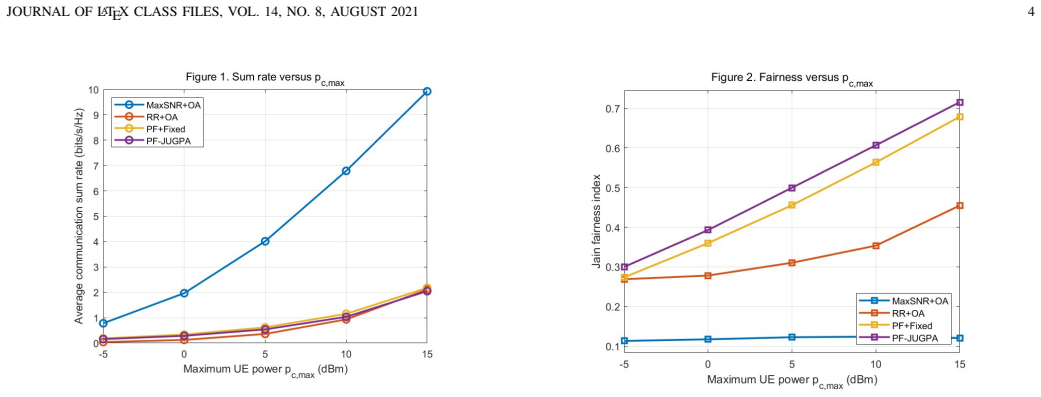
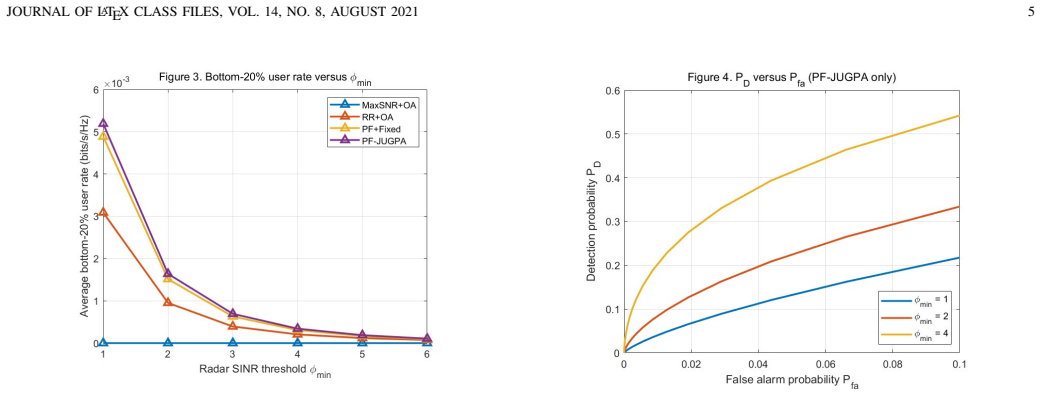
PF-JUGPA first pre-selects users via a PF metric combining instantaneous rate proxies and historical averages, then performs fairness-aware grouping and power allocation by maximizing a weighted sum rate whose weights are inversely proportional to historical service rates. Simulation results show that PF-JUGPA significantly improves the Jain fairness index and weak-user average rates with only a modest sum-rate loss compared to sum-rate-oriented and round-robin baselines.
What carries the argument
PF-JUGPA two-stage procedure: PF-metric user pre-selection followed by weighted sum-rate maximization with weights inversely proportional to historical service rates.
If this is right
- Incorporating historical service rates into both scheduling and resource allocation improves the Jain fairness index.
- Weak-user average rates increase while total sum rate declines only modestly.
- The same weighting produces an effective throughput-fairness-sensing tradeoff in uplink NOMA-ISAC.
- The two-stage structure outperforms both sum-rate maximization and round-robin baselines on equity metrics.
Where Pith is reading between the lines
- The historical averaging window may need adaptation when user mobility increases, otherwise the fairness weights could become stale.
- Because power is allocated under fairness weights, sensing accuracy could shift if the ISAC waveform design is sensitive to the resulting power profile.
- Similar history-based weighting might prevent starvation in other multi-user ISAC or NOMA settings beyond the uplink case examined here.
Load-bearing premise
The assumption that a two-stage procedure of PF pre-selection followed by weighted sum-rate maximization produces stable long-term fairness when channel statistics, mobility patterns, and sensing requirements differ from the simulation setup.
What would settle it
A simulation or field test in which channel fading statistics or user mobility patterns are altered substantially from the paper's setup and the fairness gains over baselines disappear or reverse.
Figures
read the original abstract
This letter addresses long-term fairness in uplink non-orthogonal multiple access integrated sensing and communication (NOMA-ISAC) systems. Existing resource allocation schemes that maximize instantaneous sum rate often favor strong users, leaving historically underserved users with poor long-term throughput. We propose PF-JUGPA, a proportional-fair scheduling based joint user grouping and power allocation method. PF-JUGPA first pre-selects users via a PF metric combining instantaneous rate proxies and historical averages, then performs fairness-aware grouping and power allocation by maximizing a weighted sum rate whose weights are inversely proportional to historical service rates. Simulation results show that PF-JUGPA significantly improves the Jain fairness index and weak-user average rates with only a modest sum-rate loss compared to sum-rate-oriented and round-robin baselines. The findings confirm that embedding long-term service history into both scheduling and resource allocation yields an effective throughput--fairness--sensing tradeoff in uplink NOMA-ISAC.
Editorial analysis
A structured set of objections, weighed in public.
Referee Report
Summary. The manuscript proposes PF-JUGPA, a two-stage proportional-fair method for joint user grouping and power allocation in uplink NOMA-ISAC systems. The first stage pre-selects users using a PF metric that incorporates instantaneous rate proxies and historical averages. The second stage performs grouping and power allocation by maximizing a weighted sum-rate objective with weights inversely proportional to historical service rates. The central claim, supported by simulations, is that this approach improves the Jain fairness index and weak-user average rates compared to sum-rate maximization and round-robin baselines, at the cost of a modest sum-rate reduction, while maintaining a throughput-fairness-sensing tradeoff.
Significance. If the simulation results prove robust, the work provides a concrete heuristic for embedding long-term fairness considerations into resource allocation for NOMA-ISAC, addressing a practical issue in systems where instantaneous optimization disadvantages weak users. This could be relevant for designing fair and efficient integrated sensing-communication networks.
major comments (2)
- [Abstract and simulation results] Abstract and simulation results section: the reported improvements in Jain fairness index and weak-user average rates supply no information on simulation parameters, number of Monte-Carlo runs, statistical significance, or sensitivity to the historical averaging window. This information is load-bearing for verifying that the central empirical claim is robust rather than an artifact of the fixed setup.
- [Method description] Method description (two-stage PF procedure): the weighting uses historical rates updated outside each optimization step, yet no convergence analysis or sensitivity study is supplied to show that the fairness gains remain stable when channel statistics, mobility patterns, or sensing requirements differ from the simulated ensemble. This assumption underpins the long-term fairness claim.
minor comments (1)
- Provide explicit definitions and update equations for the PF metric and historical rate averaging in the main text to support reproducibility.
Simulated Author's Rebuttal
We thank the referee for the detailed and constructive comments. The points raised are valid and will help improve the clarity and robustness of the empirical claims. We address each major comment below and indicate the planned revisions.
read point-by-point responses
-
Referee: [Abstract and simulation results] Abstract and simulation results section: the reported improvements in Jain fairness index and weak-user average rates supply no information on simulation parameters, number of Monte-Carlo runs, statistical significance, or sensitivity to the historical averaging window. This information is load-bearing for verifying that the central empirical claim is robust rather than an artifact of the fixed setup.
Authors: We agree that the simulation results section lacks sufficient detail on these aspects. In the revised version we will explicitly report the full set of simulation parameters, the number of Monte-Carlo runs, any statistical significance measures used, and a sensitivity analysis with respect to the historical averaging window length. These additions will be placed in the simulation results section to allow readers to assess robustness. revision: yes
-
Referee: [Method description] Method description (two-stage PF procedure): the weighting uses historical rates updated outside each optimization step, yet no convergence analysis or sensitivity study is supplied to show that the fairness gains remain stable when channel statistics, mobility patterns, or sensing requirements differ from the simulated ensemble. This assumption underpins the long-term fairness claim.
Authors: PF-JUGPA is presented as a practical heuristic rather than a provably convergent iterative algorithm; the historical-rate weights are computed from long-term averages and held fixed during each per-slot optimization. We acknowledge that a dedicated sensitivity study across varied channel statistics, mobility, and sensing constraints would strengthen the long-term fairness claim. In revision we will add a brief sensitivity discussion and, space permitting, additional simulation curves for different averaging windows and mobility levels. A formal convergence analysis is not applicable to the non-iterative two-stage procedure and will not be added. revision: partial
Circularity Check
No significant circularity in PF-JUGPA heuristic
full rationale
The paper proposes an explicit two-stage heuristic (PF-metric pre-selection followed by weighted sum-rate maximization using historical rates) whose purpose is to enforce long-term fairness by design. Fairness metrics are evaluated via simulation against independent baselines rather than derived or fitted from the same quantities. No self-citations, uniqueness theorems, ansatzes, or renamings of known results are invoked in a load-bearing way; the central claims rest on empirical comparison, not reduction to inputs by construction.
Axiom & Free-Parameter Ledger
Reference graph
Works this paper leans on
-
[1]
Integrated sensing and communications: Toward dual- functional wireless networks for 6G and beyond,
F. Liu et al., “Integrated sensing and communications: Toward dual- functional wireless networks for 6G and beyond,”IEEE J. Sel. Areas Commun., vol. 40, no. 6, pp. 1728–1767, Jun. 2022
2022
-
[2]
A survey on fundamental limits of integrated sensing and communication,
A. Liu et al., “A survey on fundamental limits of integrated sensing and communication,”IEEE Commun. Surveys Tuts., vol. 24, no. 2, pp. 994–1034, 2nd Quart. 2022
2022
-
[3]
Sensing as a service in 6G perceptive networks: A unified framework for ISAC resource allocation,
F. Dong, F. Liu, Y . Cui, W. Wang, K. Han, and Z. Wang, “Sensing as a service in 6G perceptive networks: A unified framework for ISAC resource allocation,”IEEE Trans. Wireless Commun., vol. 22, no. 5, pp. 3522–3536, May 2023
2023
-
[4]
A survey on non-orthogonal multiple access for 5G networks: Research challenges and future trends,
Z. Ding, X. Lei, G. K. Karagiannidis, R. Schober, J. Yuan, and V . K. Bhargava, “A survey on non-orthogonal multiple access for 5G networks: Research challenges and future trends,”IEEE J. Sel. Areas Commun., vol. 35, no. 10, pp. 2181–2195, Oct. 2017
2017
-
[5]
On the study of non-orthogonal multiple access (NOMA)-assisted integrated sensing and communication (ISAC),
L. Sun, Z. Zhao, S. Wang, Z. Ding, and M. Peng, “On the study of non-orthogonal multiple access (NOMA)-assisted integrated sensing and communication (ISAC),”IEEE Trans. Commun., vol. 72, no. 11, pp. 7278–7293, Nov. 2024
2024
-
[6]
NOMA for integrat- ing sensing and communications towards 6G: A multiple access perspective,
Z. Wang, Y . Liu, X. Mu, and Z. Ding, “NOMA for integrat- ing sensing and communications towards 6G: A multiple access perspective,”IEEE Wireless Commun., early access, 2023, doi: 10.1109/MWC.015.2200559
-
[7]
Rendezvous of ISAC and NOMA: Progress and prospects of next-generation multiple access,
A. Nasser, A. Abdallah, A. Celik, and A. M. Eltawil, “Rendezvous of ISAC and NOMA: Progress and prospects of next-generation multiple access,”IEEE Commun. Standards Mag., vol. 8, no. 2, pp. 44–51, Jun. 2024
2024
-
[8]
Joint user grouping and power allocation for uplink NOMA-ISAC systems,
H. Liu, E. Alsusa, and A. Al-Dweik, “Joint user grouping and power allocation for uplink NOMA-ISAC systems,”TechRxiv, Aug. 2025, doi: 10.36227/techrxiv.175624042.25456081/v1
-
[9]
Multi-user proportional fair scheduling for uplink non-orthogonal multiple access (NOMA),
M. Mehrnoush, S. Roy, and V . Sathya, “Multi-user proportional fair scheduling for uplink non-orthogonal multiple access (NOMA),” in Proc. IEEE VTC-Spring, Jun. 2018, pp. 1–5
2018
-
[10]
Maximizing the value of service provisioning in multi-user ISAC systems through fairness guaranteed collaborative resource allocation,
B. Li, X. Wang, and F. Fang, “Maximizing the value of service provisioning in multi-user ISAC systems through fairness guaranteed collaborative resource allocation,”IEEE J. Sel. Areas Commun., vol. 42, no. 9, pp. 2243–2258, Sep. 2024
2024
discussion (0)
Sign in with ORCID, Apple, or X to comment. Anyone can read and Pith papers without signing in.