Tensor molecule J/psi J/psi: A candidate to the resonance X(6200)
Pith reviewed 2026-06-29 11:40 UTC · model grok-4.3
The pith
QCD sum rules give the J/ψ J/ψ molecule a mass of 6290 MeV and width of 149 MeV, identifying it with the X(6200) resonance.
A machine-rendered reading of the paper's core claim, the machinery that carries it, and where it could break.
Core claim
The mass of the J/ψ J/ψ molecule is calculated to be 6290 ± 50 MeV with a decay width of 149 ± 21 MeV; these values, together with the allowed decay channels, place the state in the mass region of the observed X(6200) resonance.
What carries the argument
Two-point and three-point QCD sum rules applied to the J/ψ J/ψ molecular interpolating current.
If this is right
- The molecule decays dominantly to J/ψ J/ψ.
- Annihilation of the constituent charm quarks opens subdominant modes to pairs of charmed mesons such as D D, D D*, and D_s D_s1.
- The calculated width of 149 MeV is consistent with the width reported for X(6200).
Where Pith is reading between the lines
- Confirmation would strengthen the case that some exotic charmonium states are loosely bound molecules rather than compact tetraquarks.
- The same sum-rule framework could be reapplied to other pairs of vector charmonia to predict additional molecular candidates.
- Lattice QCD simulations of the J/ψ J/ψ scattering phase shift near 6.3 GeV would provide an independent test of the bound-state interpretation.
Load-bearing premise
The sum-rule expansions for the molecular current converge well enough that higher resonances and continuum states do not dominate the extracted mass and couplings.
What would settle it
A high-precision measurement of the X(6200) mass lying outside the 6240–6340 MeV window or a width far from 149 MeV would rule out the identification.
Figures
read the original abstract
The hadronic tensor molecule $\mathcal{M}=J/\psi J/\psi$ is investigated in the framework of QCD sum rule method. We evaluate its mass and current coupling using the two-point SR approach. Our result $m=(6290 \pm 50)~ \mathrm{MeV}$ for the mass of $\mathcal{M}$ indicates that it can decay to a pair of mesons $J/\psi J/\psi$. Apart from this dominant channel there are subdominant modes of the molecule $\mathcal{M}$ generated due to annihilation of constituent $\overline{c}c$ quarks to pairs of light quarks $ \overline{q}q$ and $\overline{s}s$. This mechanism launches processes $ \mathcal{M} \to D_{(s)}^{(\ast )+}D_{(s)}^{(\ast )-}$, $DD_{1}(2420)$, $ D_sD_{s1}(2460)$ and $D_{(s)}^{(\ast )0}\overline{D}_{(s)}^{(\ast )0}$. The decays of $\mathcal{M}$ are explored by applying technical tools of the three-point sum rule approach which is necessary to estimate strong couplings at $\mathcal{M}$-meson-meson vertices. Comparing the mass $m$ of the molecule $\mathcal{M}$ and its decay width $\Gamma[\mathcal{M}]=(149 \pm 21)~ \mathrm{MeV}$ with available experimental data, we discuss the molecule $\mathcal{M}$ as a possible candidate to the tensor resonance $X(6200)$.
Editorial analysis
A structured set of objections, weighed in public.
Referee Report
Summary. The paper investigates a tensor J/ψ J/ψ molecular state using QCD sum rules. It employs the two-point sum-rule method to extract the mass m = (6290 ± 50) MeV and current coupling of the state, then applies three-point sum rules to compute strong couplings at the molecule-meson-meson vertices for dominant and subdominant decay channels (J/ψ J/ψ, D(*)D(*), DD1(2420), etc.). The resulting total width Γ = (149 ± 21) MeV is compared with experimental data on X(6200), leading to the suggestion that the molecular state is a candidate for this resonance.
Significance. If the sum-rule results prove robust, the work would supply a concrete molecular interpretation for the X(6200) tensor resonance together with explicit predictions for its mass and partial widths. The calculation of multiple decay channels via three-point rules is a positive technical feature, but the overall significance is limited by the well-known sensitivity of molecular-current sum rules to parameter choices and OPE convergence.
major comments (3)
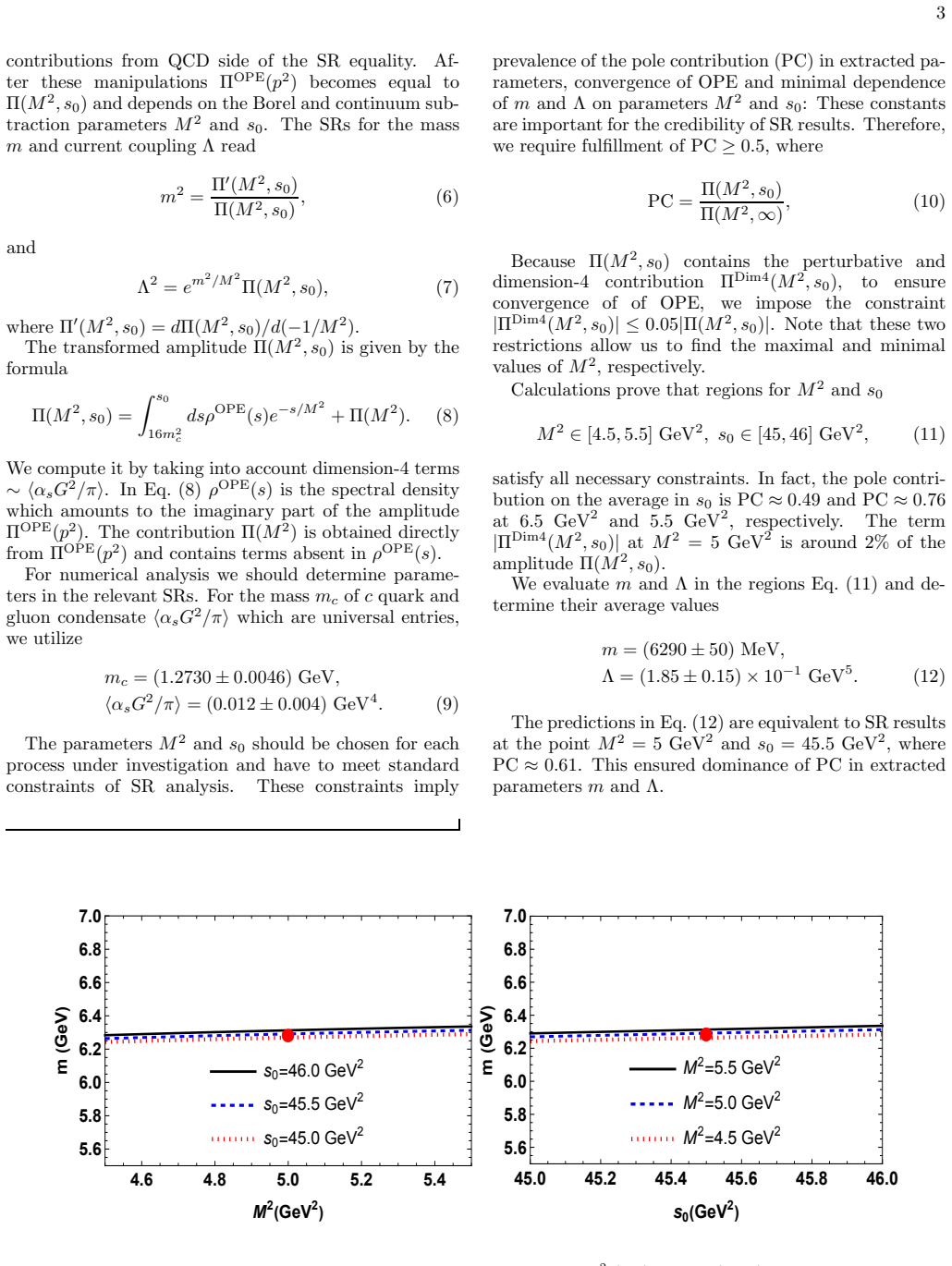
- [§3] §3 (two-point sum rules): the Borel window and continuum threshold s0 are chosen to achieve stability, yet no explicit numerical table or plot demonstrates that the OPE series converges (higher-dimensional condensates contribute <10–15 %) and that the ground-state pole dominates (>50 % of the phenomenological side) inside the chosen window. Without these checks the quoted mass uncertainty of ±50 MeV cannot be regarded as controlled.
- [§4] §4 (three-point sum rules): the same Borel and s0 parameters are reused for the decay-width calculations; the paper does not show that the double-Borel transform simultaneously satisfies OPE convergence and pole dominance for each vertex (J/ψ J/ψ, DD1, etc.). This directly affects the reliability of the reported total width Γ = 149 ± 21 MeV.
- [Eq. (mass formula)] Eq. (mass formula) and subsequent width expressions: the continuum threshold s0 is treated as a free parameter tuned to the expected mass region; the resulting mass and width are therefore not independent predictions but are correlated with the choice of s0, undermining the direct comparison with the experimental X(6200) mass and width.
minor comments (2)
- [Abstract] The abstract and introduction should state the numerical values of the Borel parameter M² and continuum threshold s0 that were ultimately adopted, together with the range explored.
- [Figures] Figure captions for the sum-rule stability plots should include the explicit percentage contributions of the highest OPE terms and the pole fraction at the chosen working point.
Simulated Author's Rebuttal
We thank the referee for the careful reading and constructive comments. We address each major point below, agreeing where additional documentation is warranted and defending the standard aspects of the sum-rule methodology where appropriate.
read point-by-point responses
-
Referee: [§3] §3 (two-point sum rules): the Borel window and continuum threshold s0 are chosen to achieve stability, yet no explicit numerical table or plot demonstrates that the OPE series converges (higher-dimensional condensates contribute <10–15 %) and that the ground-state pole dominates (>50 % of the phenomenological side) inside the chosen window. Without these checks the quoted mass uncertainty of ±50 MeV cannot be regarded as controlled.
Authors: We agree that an explicit table or plot quantifying OPE convergence (condensate contributions below 10–15%) and pole dominance (>50%) would strengthen the control of the quoted uncertainty. The manuscript selected the Borel window using the conventional stability criterion, but did not include these supplementary diagnostics. In the revised version we will add a table listing the relative OPE contributions and pole fraction inside the window. revision: yes
-
Referee: [§4] §4 (three-point sum rules): the same Borel and s0 parameters are reused for the decay-width calculations; the paper does not show that the double-Borel transform simultaneously satisfies OPE convergence and pole dominance for each vertex (J/ψ J/ψ, DD1, etc.). This directly affects the reliability of the reported total width Γ = 149 ± 21 MeV.
Authors: We concur that explicit verification of OPE convergence and pole dominance under the double-Borel transform is desirable for the three-point sum rules. The present manuscript re-uses the two-point parameters without separate diagnostics for each vertex. We will incorporate these checks (either in the main text or as supplementary material) for the dominant channels in the revision. revision: yes
-
Referee: [Eq. (mass formula)] Eq. (mass formula) and subsequent width expressions: the continuum threshold s0 is treated as a free parameter tuned to the expected mass region; the resulting mass and width are therefore not independent predictions but are correlated with the choice of s0, undermining the direct comparison with the experimental X(6200) mass and width.
Authors: The continuum threshold s0 is a standard input parameter in QCD sum rules, chosen to produce a stable mass plateau; this correlation is inherent to the method rather than a flaw. The extracted mass (6290 ± 50) MeV already incorporates the variation of s0 within the stability window, and the comparison with X(6200) is performed at the level of overlap within uncertainties. We will add a clarifying sentence on the role of s0 but maintain the original comparison, as it follows established practice in the literature. revision: partial
Circularity Check
No significant circularity; standard QCD sum-rule application remains self-contained
full rationale
The paper computes the mass and width of the J/ψJ/ψ molecule via two-point and three-point QCD sum rules applied to a molecular interpolating current. The Borel window and continuum threshold are selected according to the usual OPE-convergence and pole-dominance criteria; the resulting numerical values are then compared with the experimental X(6200) candidate. No equation reduces to its own input by construction, no fitted parameter is relabeled as an independent prediction, and no load-bearing premise rests on a self-citation chain or imported uniqueness theorem. The derivation therefore stays within the standard, externally falsifiable framework of QCD sum rules.
Axiom & Free-Parameter Ledger
free parameters (2)
- continuum threshold s0
- Borel mass M^2
axioms (2)
- domain assumption Quark-hadron duality
- domain assumption Convergence of OPE
invented entities (1)
-
J/ψ J/ψ tensor molecule
no independent evidence
Reference graph
Works this paper leans on
-
[1]
The function Π( M2, s0,q 2) is determined as Π( M2, s0,q 2) = ∫ s0 16m2 c ds ∫ s′ 0 4m2 c ds′ρ(s,s ′,q 2) ×e− s/M 2 1 − s′/M 2
is related to J/ψ channel. The function Π( M2, s0,q 2) is determined as Π( M2, s0,q 2) = ∫ s0 16m2 c ds ∫ s′ 0 4m2 c ds′ρ(s,s ′,q 2) ×e− s/M 2 1 − s′/M 2
-
[2]
Our calculations prove that working windows Eq
(21) 5 Constraints on M2 and s0 are standard for SR inves- tigations and have been detailed in the previous section. Our calculations prove that working windows Eq. (11) for the parameters ( M 2 1,s 0) and M 2 2 ∈ [4, 5] GeV 2, s ′ 0 ∈ [12, 13] GeV 2, (22) for (M 2 2,s ′
-
[3]
The sum rule for the form factor G(q2) is applicable in the region q2 < 0
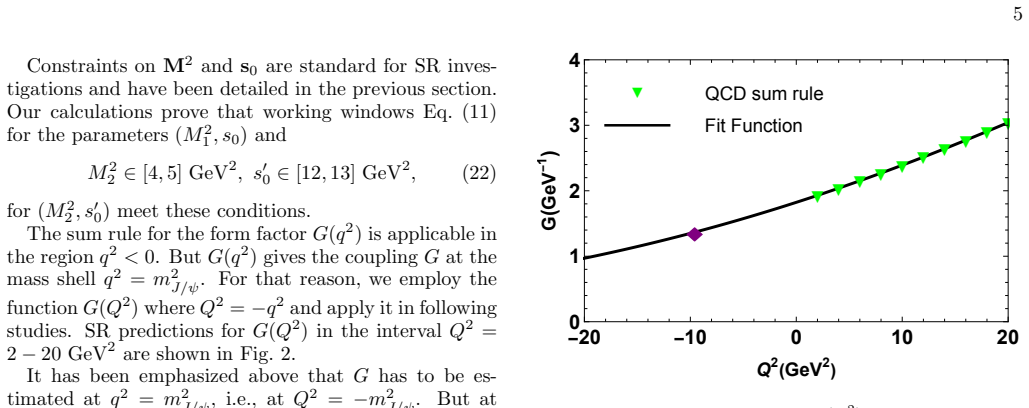
meet these conditions. The sum rule for the form factor G(q2) is applicable in the region q2 < 0. But G(q2) gives the coupling G at the mass shell q2 = m2 J/ψ . For that reason, we employ the functionG(Q2) whereQ2 = −q2 and apply it in following studies. SR predictions for G(Q2) in the interval Q2 = 2 − 20 GeV 2 are shown in Fig. 2. It has been emphasized...
2010
-
[4]
173, and z2 1 = − 1
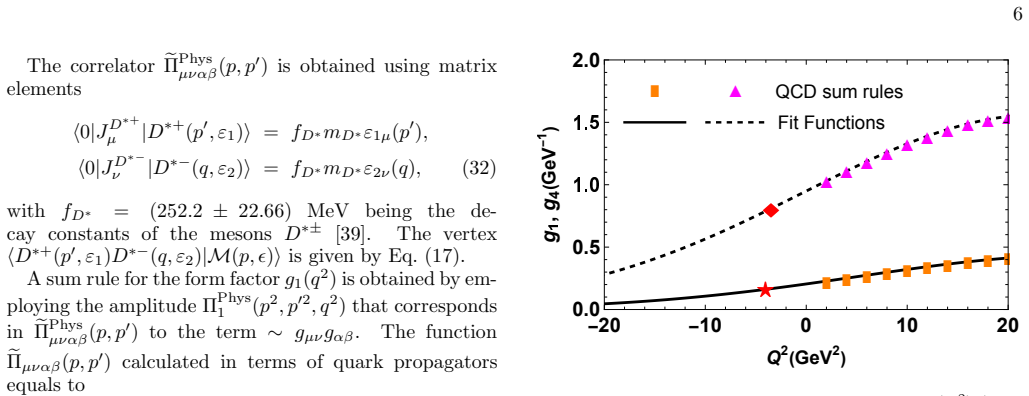
205 GeV − 1, z1 1 = 2. 173, and z2 1 = − 1. 558. The func- tion Z1(Q2) and corresponding SR results are shown in Fig. 3. The coupling g1 is evaluated at q2 =m2 D∗ and is equal to g1 ≡ Z 1(−m2 D∗ ) = (1. 62 ± 0. 31) × 10− 1 GeV− 1. (37) The width of the process M → D∗+D∗− is Γ [ M → D∗+D∗− ] = (7. 5 ± 2. 1) MeV. (38) A difference between decays M → D∗+D∗− a...
1969
-
[5]
Aaij et al
R. Aaij et al. (LHCb Collaboration), Sci. Bull. 65, 1983 (2020)
1983
-
[6]
Aad et al
G. Aad et al. (ATLAS Collaboration), Phys. Rev. Lett. 131, 151902 (2023)
2023
-
[7]
Hayrapetyan et al
A. Hayrapetyan et al. (CMS Collaboration), Phys. Rev. Lett. 132, 111901 (2024)
2024
-
[8]
A. Hayrapetyan et al. (CMS Collaboration), arXiv:2602.02252 [hep-ex]
-
[9]
M. A. Bedolla, J. Ferretti, C. D. Roberts and E. San- topinto, Eur. Phys. J. C 80, 1004 (2020)
2020
-
[10]
J. R. Zhang, Phys. Rev. D 103, 014018 (2021)
2021
-
[11]
Z. G. Wang, Chin. Phys. C 44, 113106 (2020)
2020
-
[12]
R. M. Albuquerque, S. Narison, A. Rabemananjara, D. Rabetiarivony, and G. Randriamanatrika, Phys. Rev. D 102, 094001 (2020)
2020
-
[13]
B. C. Yang, L. Tang, and C. F. Qiao Eur. Phys. J. C 81, 324 (2021)
2021
-
[14]
M. C. Gordillo, F. De Soto, and J. Segovia, Phys. Rev. D 102, 114007 (2020)
2020
-
[15]
X. K. Dong, V. Baru, F. K. Guo, C. Hanhart, and A. Nefediev, Phys. Rev. Lett. 126, 132001 (2021); 127, 119901(E) (2021)
2021
-
[16]
Z. R. Liang, X. Y. Wu, and D. L. Yao, Phys. Rev. D 104, 034034 (2021)
2021
-
[17]
G. J. Wang, L. Meng, M. Oka, and S. L. Zhu, Phys. Rev. D 104, 036016 (2021)
2021
-
[18]
C. Deng, H. Chen, and J. Ping, Phys. Rev. D 103, 014001 (2021)
2021
-
[19]
Z. G. Wang, Nucl. Phys. B 985, 115983 (2022)
2022
-
[20]
R. N. Faustov, V. O. Galkin, and E. M. Savchenko, Sym- 10 metry 14, 2504 (2022)
2022
-
[21]
P. Niu, Z. Zhang, Q. Wang, and M. L. Du, Sci. Bull. 68, 800 (2023)
2023
-
[22]
W. C. Dong and Z. G. Wang, Phys. Rev. D 107, 074010 (2023)
2023
-
[23]
G. L. Yu, Z. Y. Li, Z. G. Wang, J. Lu, and M. Yan, Eur. Phys. J. C 83, 416 (2023)
2023
-
[24]
H. T. An, S. Q. Luo, Z. W. Liu, and X. Liu, Eur. Phys. J. C 83, 740 (2023)
2023
-
[25]
S. Q. Kuang, Q. Zhou, D. Guo, Q. H. Yang, and L. Y. Dai, Eur. Phys. J. C 83, 383 (2023)
2023
-
[26]
M. S. Liu, F. X. Liu, X. H. Zhong and Q. Zhao, Phys. Rev. D 109, 076017 (2024)
2024
-
[27]
Malekhosseini, S
M. Malekhosseini, S. Rostami, A. R. Olamaei and K. Az- izi, Nucl. Phys. B 1018, 116977 (2025)
2025
-
[28]
S. S. Agaev, K. Azizi, B. Barsbay, and H. Sundu, Phys. Lett. B 844, 138089 (2023)
2023
-
[29]
S. S. Agaev, K. Azizi, B. Barsbay and H. Sundu, Eur. Phys. J. Plus 138, 935 (2023)
2023
-
[30]
S. S. Agaev, K. Azizi, B. Barsbay and H. Sundu, Nucl. Phys. A 844, 122768 (2024)
2024
-
[31]
S. S. Agaev, K. Azizi, B. Barsbay and H. Sundu, Eur. Phys. J. C 83, 994 (2023)
2023
-
[32]
Hayrapetyan et al
A. Hayrapetyan et al. (CMS Collaboration), Nature 648, 58 (2025)
2025
-
[33]
S. S. Agaev, K. Azizi and H. Sundu,
-
[34]
M. A. Shifman, A. I. Vainshtein and V. I. Zakharov, Nucl. Phys. B 147, 385 (1979)
1979
-
[35]
M. A. Shifman, A. I. Vainshtein and V. I. Zakharov, Nucl. Phys. B 147, 448 (1979)
1979
-
[36]
Becchi, A
C. Becchi, A. Giachino, L. Maiani, and E. Santopinto, Phys. Lett. B 806, 135495 (2020)
2020
-
[37]
Becchi, A
C. Becchi, A. Giachino, L. Maiani, and E. Santopinto, Phys. Lett. B 811, 135952 (2020)
2020
-
[38]
S. S. Agaev, K. Azizi, B. Barsbay, and H. Sundu, Phys. Rev. D 109, 014006 (2024)
2024
-
[39]
S. S. Agaev, K. Azizi, and H. Sundu, Turk. J. Phys. 44, 95 (2020)
2020
-
[40]
Navas et al
S. Navas et al. [Particle Data Group], Phys. Rev. D 110, 030001 (2024)
2024
-
[41]
Lakhina, and E
O. Lakhina, and E. S. Swanson, Phys. Rev. D 74, 014012 (2006)
2006
-
[42]
S. S. Agaev, K. Azizi, and H. Sundu, Phys. Lett. B 856, 138886 (2024)
2024
-
[43]
Lucha, D
W. Lucha, D. Melikhov, and S. Simula, EPJ Web Conf. 80, 00043 (2014)
2014
-
[44]
J. L. Rosner, S. Stone, and R. S. Van de Water, arXiv:1509.02220
work page internal anchor Pith review Pith/arXiv arXiv
-
[45]
Gubernari, A
N. Gubernari, A. Khodjamirian, R. Mandal and T. Man- nel, JHEP 05, 029 (2022)
2022
-
[46]
Lubicz, A
V. Lubicz, A. Melis, and S. Simula, PoS LAT- TICE2016, 291 (2017)
2017
-
[47]
Z. G. Wang, Eur. Phys. J. C 75, 427 (2015)
2015
discussion (0)
Sign in with ORCID, Apple, or X to comment. Anyone can read and Pith papers without signing in.