REVIEW 3 major objections 5 minor 60 references
Gender and Racial Diversity in Commercial Brands' Advertising Images on Social Media
T0 review · 3 major / 5 minor · reviewed 2026-08-14 · deepseek-v4-flash
Pith's one-line read Automated scan of 85,957 brand ads finds White models dominate and same-race pairings are favored.
desk verdict A solid descriptive extension of the authors' own 2018 study, with a genuinely new permutation-based result on same-race cross-sex pairings, but every headline number depends on unvalidated Face++ labels. read the letter →
The pith
A machine-rendered reading of the paper's core claim, the machinery that carries it, and where it could break.
The reading
What carries the argument
The mechanism is a fully automated pipeline built on the commercial face-analysis service Face++, which detects faces and infers gender (Female or Male), race (White, Asian, or Black), and a smile score from 0 to 100; images with confidence below 0.7 are discarded. On top of these labels, the paper defines three computable metrics: appearance frequency for each demographic group, pair frequencies for cross-sex interactions (images containing at least one male and one female model), and smile-level distributions. The load-bearing statistical object is the permutation null model used for cross-sex pairs: it shuffles models across images while keeping the number of male and female models in every image fixed, then computes 1,000 randomized replicates to produce a z-score for each of the nine race-by-gender pairs. That z-score is what separates a pair appearing often because those models appear often from a pair appearing more often than the base rates would predict.
What would settle it
Take a stratified random sample of the 85,957 images, have independent human annotators label gender and race for each detected face, and compare those labels with Face++'s output; if human labels put Black female models near their 14.4% population share while Face++ put them near 2.9%, or if human-labeled smile scores show no female–male gap, the paper's headline numbers would not survive.
Extended reading notes
Core claim
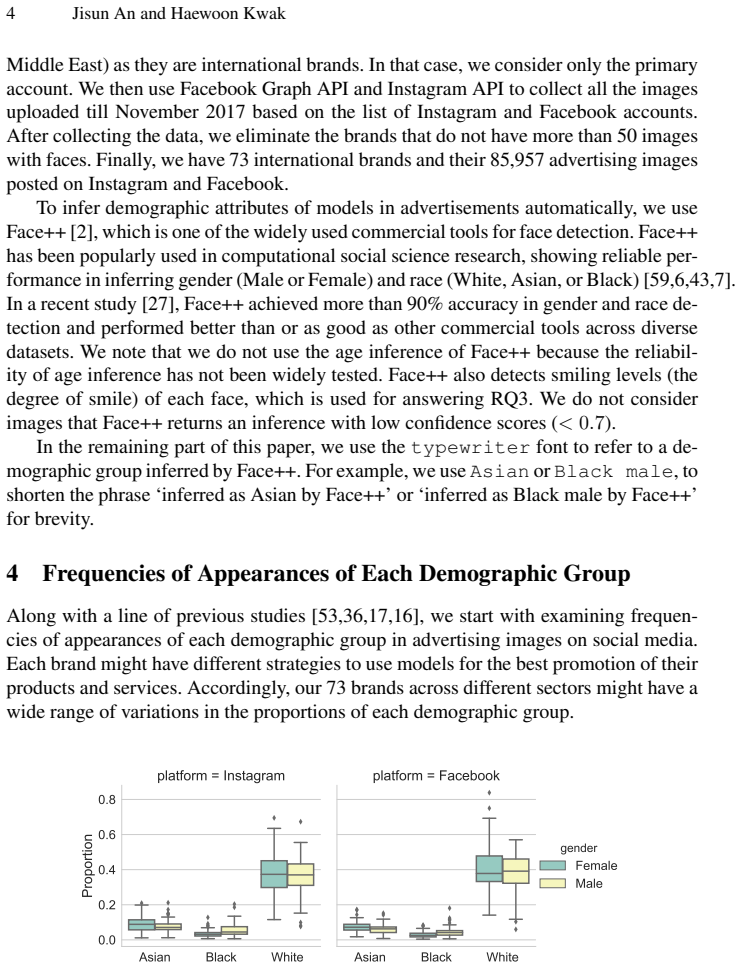
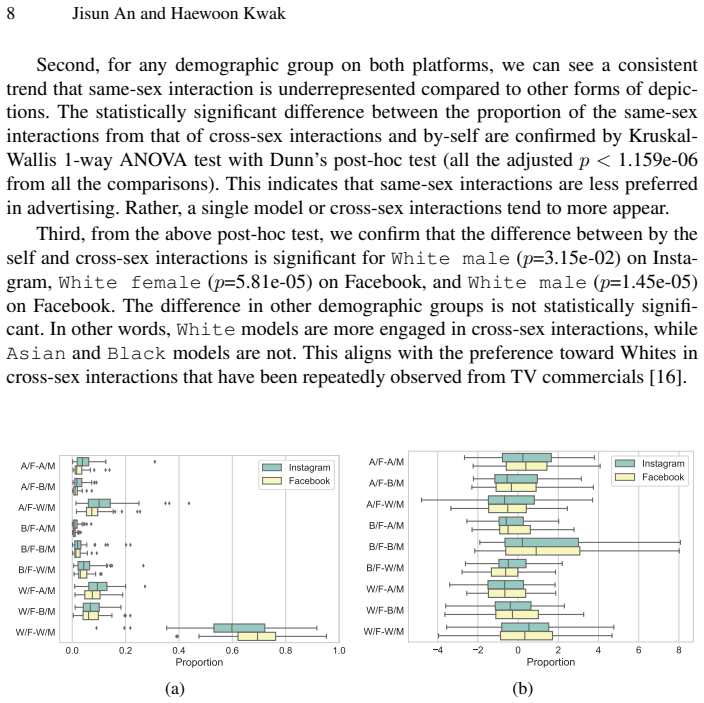
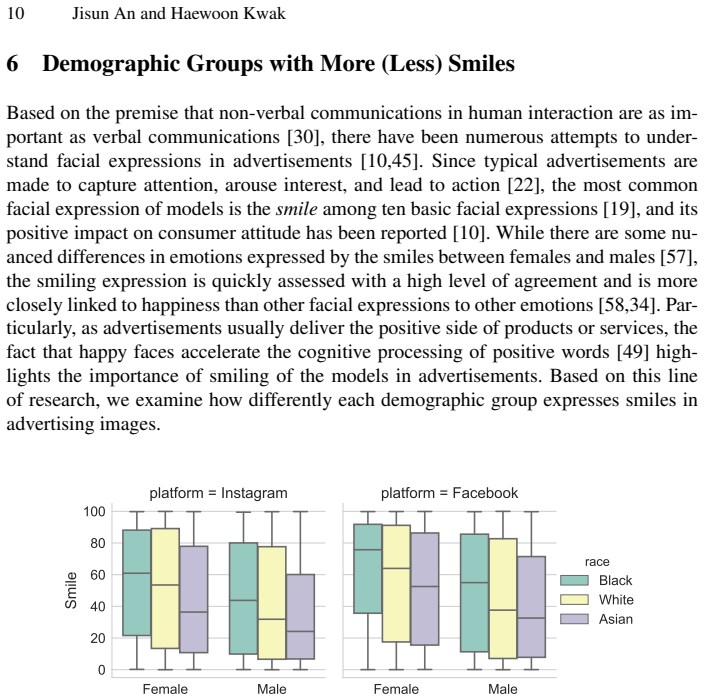
The central discovery is that the demographic imbalances long documented in TV and print advertising reappear in social media advertising, and that at least one imbalance—same-race pairing in cross-sex interactions—is not just a byproduct of White models being more numerous. On the raw counts, White female–White male pairs dominate cross-sex ads (60.3% of pairs on Instagram, 68.9% on Facebook). But the paper's permutation null model, which shuffles models across images while preserving the number of men and women in each image, shows that same-race pairs of every race have positive median z-scores on both platforms, while interracial pairs involving Whites have negative z-scores. In other words, after accounting for how often each group appears, advertisers still pair models of the same race more often than chance. The paper also claims that Black female models are rare (2.9% of Instagram models, 3.6% on Facebook) and that female models smile more than male models with a large effect size.
Load-bearing premise
If Face++'s gender, race, and smile labels are systematically wrong for these advertising images—especially for darker-skinned women—every reported proportion and pairing preference could be an artifact.
Editorial extensions
If this is right
- Brand diversity can be tracked continuously and cheaply: the same pipeline can be rerun as new images are posted, turning diversity monitoring into a near-real-time audit.
- The specific ratios (White 74.2% on Instagram and 79.3% on Facebook; Black 8.9% and 7.4% versus a normalized U.S. population share of 14.4%) give advertisers and watchdogs a concrete, reproducible baseline to measure against.
- Because same-race pairing survives the permutation correction, social media ads join TV and print as a site where interracial romantic and family cues are underused.
- The large smile gap between female and male models (Cohen's d is about 1.05) indicates that gendered display norms persist in online brand imagery, not just in traditional media.
Reading between the lines
- A natural extension is to rerun the same pair analysis on images with exactly two models, where the romantic or family cue is strongest; the paper pools all pairs, so multi-model images may dilute or exaggerate the same-race preference.
- The roughly threefold overrepresentation of Asian models could be tested against regional marketing motives by comparing accounts targeting U.S. audiences with those targeting Asia; the paper uses only primary accounts of U.S.-origin brands.
- The pipeline's confidence threshold could itself be a source of bias: if Face++ drops low-confidence faces unevenly across demographic groups, the reported proportions would be distorted, and that is checkable by comparing the demographic mix of accepted and rejected faces.
- An automated watchdog built on this approach could add other visual attributes—age, body type, clothing, or the role a model plays—to catch stereotyped portrayals that simple headcount ratios miss; the authors note the need for such nuance in their limitations.
Signed reviews
Editorial analysis
A structured set of objections, weighed in public.
Referee Report
Summary. The paper proposes an automated pipeline for measuring gender and racial diversity in advertising images on social media, and demonstrates it on 85,957 images posted by 73 U.S.-originated B2C brands on Instagram and Facebook. Using Face++ for face detection and demographic inference, the authors report the frequencies of six inferred demographic groups (Asian/Black/White by female/male), brand-level gender and racial diversity indices, an analysis of cross-sex interaction pairs with a permutation null model, and an analysis of smile levels. The headline findings are that White models dominate (74.2% of labeled faces on Instagram and 79.3% on Facebook), Black female models appear at only 2.9% and 3.6% of labeled faces on the two platforms, Black models are underrepresented relative to the U.S. Census while Asian models are overrepresented, same-race male-female pairs are preferred in cross-sex interactions once base rates are accounted for, and female models smile more than male models. The paper frames the contribution as a first step toward a fully automated watchdog for diversity in online advertising.
Significance. If the measurement pipeline were validated for this corpus, the paper would provide a valuable large-scale extension of content-analytic studies of advertising from TV and print to social media, with three concrete, computable diversity metrics and a permutation-based null model for pair preferences. The authors are careful to use typewriter font to denote Face++-inferred groups, and they acknowledge in Section 7 that the face-detection tool may have inherent biases. However, the validity of every headline number in Sections 4-6 rests on the accuracy of Face++ for this specific set of advertising images, and that accuracy is not established. The census comparison in Section 4 also conflates Face++'s three race categories with U.S. Census categories, which is a category-mismatch problem rather than a mere labeling-error problem. The contribution is therefore best seen as a promising methodological demonstration whose quantitative conclusions require additional validation and sensitivity analysis.
major comments (3)
- [Section 3; Sections 4-6] The central descriptive claims—White dominance, Black female underrepresentation at 2.9-3.6%, the race-census comparison, the same-race z-scores in Fig. 4(b), and the smile-level results—are all statements about Face++ outputs, yet Face++ is never validated on this corpus. The only accuracy evidence cited is the authors' own prior study (ref [27]) on different data, and the manuscript itself cites Gender Shades (ref [13]) which documents systematic error disparities for darker-skinned women. In addition, the confidence threshold of 0.7 in Section 3 may exclude faces non-uniformly by skin tone, gender, or age, introducing selection bias before any label error is considered. The Section 7 acknowledgement that 'the use of Face detection ... may have inherent biases' is not quantified or addressed empirically. I request a stratified validation sample (by platform, inferred group, and confidence score) with human labels, reported as confusion matrices, plus a sensitivity analysis showing how the headline proportions and z-scores change under plausible misclassification rates. Without this, the load-bearing quantitative claims are not supported.
- [Section 4, 'Compared with the actual population' paragraph] The comparison of Face++ race proportions to the 2010 U.S. Census is not valid as stated. Face++ outputs exactly three race categories (White, Asian, Black), so Hispanic, Middle Eastern, and multiracial models must be forced into one of these or dropped, while the Census treats Hispanic as an ethnicity that can co-occur with any race. The normalized census percentages (5.6% Asian, 14.4% Black, 80% White) are therefore not a proper baseline for 'overrepresented' or 'underrepresented' claims. For example, a Hispanic model may be labeled White by Face++, inflating White counts, and the Census 'White alone' population includes Hispanic Whites. The claims should be reframed as relative to a baseline defined by the same three categories, or the authors should validate a subset with human labels into those exact three categories and compare to that. This directly affects RQ1 and the conclusion that Black models are underrepresented relative to the U.S. population.
- [Section 5, 'To compute the corrected preference' paragraph] The permutation null model is conceptually reasonable, but the manuscript does not specify whether the shuffle is performed separately within each platform and brand, nor how pairs are counted in the null when an image contains more than two models. More importantly, the z-score formula assumes approximate normality of the null distribution of pair counts; for rare pairs such as A/F-B/M, the distribution will be highly skewed and possibly zero-inflated, making the z-score and its boxplots in Fig. 4(b) hard to interpret. The claim that same-race pairs are preferred relies on these z-scores, so I ask the authors to provide details of the shuffling procedure, report null distributions or exact p-values/confidence intervals for rare pairs, and show that the same-race preference is robust to alternative null models (e.g., preserving race as well as gender composition per image).
minor comments (5)
- [Throughout] There are several typos and formatting issues: 'ANOV A' should be 'ANOVA'; in Section 6 '55.6 ad.nd 42.8' should be '55.6 and 42.8'; the subscript formatting for N^b_Female and N^b_Male in Section 4 is broken.
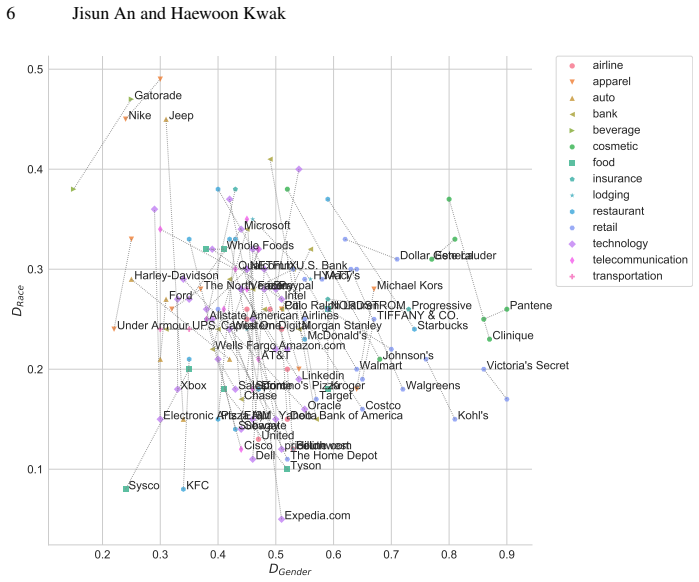
- [Figure 2] Figure 2 is extremely dense, with over 70 brand labels and two connected markers per brand; the labels overlap substantially. A zoomable version or a faceted plot would improve readability.
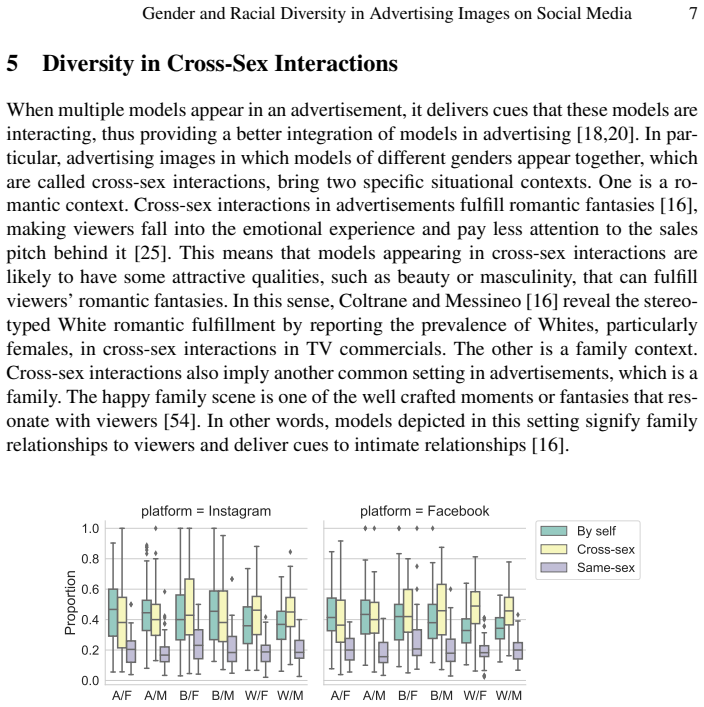
- [Section 5, Figure 3 caption] The notation 'A/', 'B/', 'W/' is only explained in the figure caption; consider defining it in the main text at first use.
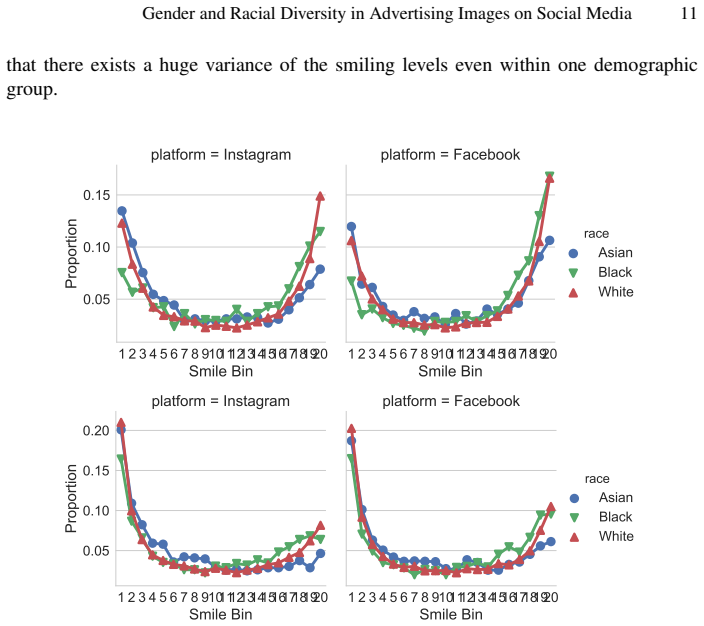
- [Section 6, statistical tests] The t-test and Kruskal-Wallis tests treat faces as independent units, but faces are clustered within images and brands. This likely inflates significance; a mixed-effects model or cluster-robust standard errors would be more appropriate.
- [Section 7, limitations] The paper does not release the image-level data or code, which limits reproducibility of the pipeline. At minimum, a detailed protocol and the list of brand account handles should be provided.
Circularity Check
No circular derivation: all headline numbers are direct Face++ labels analyzed with a permutation null model; the only self-citation is a validation study that is not load-bearing.
full rationale
The paper is an empirical measurement study, not a derivation. Every headline proportion in Sections 4-6 is a direct count or mean of Face++ outputs, and the paper is explicit about this by using typewriter font to indicate 'inferred by Face++' (Section 3). The same-race preference in Section 5 is computed by comparing observed pair counts to a permutation null model that shuffles model placement while preserving the number of models of each gender per image; this is a standard non-parametric test and is not fitted to the data, so no prediction reduces to an input by construction. The only self-citation is Section 3's reliance on the authors' own validation study [27] to justify Face++ accuracy. However, the same sentence also cites non-overlapping prior work [59] and the external Face++ service, and the limitation section explicitly concedes 'inherent biases' [13]. Thus the self-citation is a minor support for the measurement instrument, not a load-bearing derivation that forces the results. The absence of corpus-specific stratified validation of Face++ is a correctness risk, not circularity; if labels are systematically wrong, the headline numbers would describe Face++ outputs rather than the people in the ads, but the paper itself flags this. Score 2 reflects the minor self-citation, not a circular derivation.
Assumptions & free parameters
free parameters (3)
- Face++ confidence threshold =
0.7
- Minimum images with faces per brand =
50
- Smile level bin count =
20
assumptions (5)
- standard math Kruskal-Wallis and Dunn post-hoc tests are valid for comparing demographic group proportions and smile levels across brands.
- domain assumption Images posted by official brand accounts on Instagram and Facebook are advertising images.
- domain assumption US Census 2010 race proportions are the appropriate demographic baseline.
- ad hoc to paper The permutation null model that shuffles models while preserving only the number of models of each gender in every image gives the correct 'by chance' baseline for cross-sex interactions.
- domain assumption Face++ smile scores measure the intended smiling intensity.
Cite this review
Pith. "Pith review of Gender and Racial Diversity in Commercial Brands' Advertising Images on Social Media." pith.science (2026). https://pith.science/paper/QRWDMUZ5
@misc{pith2026190801352,
  author       = {Pith},
  title        = {Pith review of: Gender and Racial Diversity in Commercial Brands' Advertising Images on Social Media},
  year         = {2026},
  howpublished = {\url{https://pith.science/paper/QRWDMUZ5}},
  note         = {Machine review of arXiv:1908.01352}
}
read the original abstract
Gender and racial diversity in the mediated images from the media shape our perception of different demographic groups. In this work, we investigate gender and racial diversity of 85,957 advertising images shared by the 73 top international brands on Instagram and Facebook. We hope that our analyses give guidelines on how to build a fully automated watchdog for gender and racial diversity in online advertisements.
Figures
Figures from the paper (3 more)
Reference graph
Works this paper leans on
-
[27]
Jung, S., An, J., Kwak, H., Salminen, J., Jansen, B.: Assessing the accuracy of four popular face recognition tools for inferring gender, age, and race. In: ICWSM (2018)
work page 2018
-
[13]
In: Conference on fairness, accountability and transparency
Buolamwini, J., Gebru, T.: Gender shades: Intersectional accuracy disparities in commercial gender classification. In: Conference on fairness, accountability and transparency. pp. 77–91 (2018)
work page 2018
-
[1]
https://www.interbrand.com/best-brands/ best-global-brands/2016/, accessed: 2019-04-16
Best global brands 2016. https://www.interbrand.com/best-brands/ best-global-brands/2016/, accessed: 2019-04-16
work page 2016
-
[2]
https://www.faceplusplus.com, accessed: 2019-04-16
Face++. https://www.faceplusplus.com, accessed: 2019-04-16
work page 2019
-
[3]
German diy chain’s ‘racist’ advert provokes anger in south ko- rea. https://www.theguardian.com/world/2019/mar/28/ german-diy-chain-hornbach-racist-advert-provokes-anger-south-korea , accessed: 2019-04-16
work page 2019
-
[4]
https://brandirectory.com/ rankings/global-500-2016, accessed: 2019-04-16
Global 500 2016 — rankings — brandirectory. https://brandirectory.com/ rankings/global-500-2016, accessed: 2019-04-16
work page 2016
-
[5]
https://www.census.gov/prod/cen2010/ briefs/c2010br-14.pdf, accessed: 2019-04-16
Households and families: 2010. https://www.census.gov/prod/cen2010/ briefs/c2010br-14.pdf, accessed: 2019-04-16
work page 2010
-
[6]
#yankees: Demographics and hashtag use on Twitter
An, J., Weber, I.: #greysanatomy vs. #yankees: Demographics and hashtag use on Twitter. In: ICWSM (2016), https://www.aaai.org/ocs/index.php/ICWSM/ICWSM16/ paper/view/13021
work page 2016
Show all 60 references
-
[7]
In: International Conference on Social Informatics
An, J., Weber, I.: Diversity in online advertising: A case study of 69 brands on social media. In: International Conference on Social Informatics. pp. 38–53. Springer (2018)
2018
-
[8]
Journal of Advertising 35(1), 83–104 (2006)
Bailey, A.A.: A year in the life of the african-american male in advertising: A content anal- ysis. Journal of Advertising 35(1), 83–104 (2006)
2006
-
[9]
Handbook of socialization theory and research 213, 262 (1969)
Bandura, A.: Social-learning theory of identificatory processes. Handbook of socialization theory and research 213, 262 (1969)
1969
-
[10]
Journal of Consumer Marketing 32(6), 459–469 (2015)
Berg, H., S ¨oderlund, M., Lindstr ¨om, A.: Spreading joy: examining the effects of smiling models on consumer joy and attitudes. Journal of Consumer Marketing 32(6), 459–469 (2015)
2015
-
[11]
In: Advances in neural information processing systems
Bolukbasi, T., Chang, K.W., Zou, J.Y ., Saligrama, V ., Kalai, A.T.: Man is to computer pro- grammer as woman is to homemaker? debiasing word embeddings. In: Advances in neural information processing systems. pp. 4349–4357 (2016)
2016
-
[12]
Journalism & Mass Communication Quarterly 74(1), 134–146 (1997)
Bowen, L., Schmid, J.: Minority presence and portrayal in mainstream magazine advertising: An update. Journalism & Mass Communication Quarterly 74(1), 134–146 (1997)
1997
-
[14]
Journal of Advertising Research 14(3), 19–22 (1974)
Choudhury, P.K., Schmid, L.S.: Black models in advertising to blacks. Journal of Advertising Research 14(3), 19–22 (1974)
1974
-
[15]
Journal of Social Philosophy 35(2), 165–187 (2004)
Cohen-Eliya, M., Hammer, Y .: Advertisements, stereotypes, and freedom of expression. Journal of Social Philosophy 35(2), 165–187 (2004)
2004
-
[16]
Sex roles 42(5), 363–389 (2000)
Coltrane, S., Messineo, M.: The perpetuation of subtle prejudice: Race and gender imagery in 1990s television advertising. Sex roles 42(5), 363–389 (2000)
2000
-
[17]
The Public Opinion Quarterly 33(4), 603–606 (1969)
Cox, K.K.: Changes in stereotyping of negroes and whites in magazine advertisements. The Public Opinion Quarterly 33(4), 603–606 (1969)
1969
-
[18]
Journal of Advertis- ing Research 26, 169–173 (1970)
Dominick, J.R., Greenberg, B.S.: Three seasons of blacks on television. Journal of Advertis- ing Research 26, 169–173 (1970)
1970
-
[19]
Environmental psychology and non- verbal behavior 1(1), 56–75 (1976)
Ekman, P., Friesen, W.V .: Measuring facial movement. Environmental psychology and non- verbal behavior 1(1), 56–75 (1976)
1976
-
[20]
Journal of Current Issues & Research in Advertising 17(1), 75–86 (1995)
Elliott, M.T.: Differences in the portrayal of blacks: A content analysis of general media versus culturally-targeted commercials. Journal of Current Issues & Research in Advertising 17(1), 75–86 (1995)
1995
-
[21]
Media effects: Advances in theory and research2, 43–67 (2002) 14 Jisun An and Haewoon Kwak
Gerbner, G., Gross, L., Morgan, M., Signorielli, N., Shanahan, J.: Growing up with televi- sion: Cultivation processes. Media effects: Advances in theory and research2, 43–67 (2002) 14 Jisun An and Haewoon Kwak
2002
-
[22]
Psychology Press (2002)
Goddard, A.: The language of advertising: written texts. Psychology Press (2002)
2002
-
[23]
Journal of personality and social psychology 74(6), 1464 (1998)
Greenwald, A.G., McGhee, D.E., Schwartz, J.L.: Measuring individual differences in im- plicit cognition: the implicit association test. Journal of personality and social psychology 74(6), 1464 (1998)
1998
-
[24]
Business horizons 54(3), 265–273 (2011)
Hanna, R., Rohm, A., Crittenden, V .L.: Were all connected: The power of the social media ecosystem. Business horizons 54(3), 265–273 (2011)
2011
-
[25]
Univ of California Press (1997)
Illouz, E.: Consuming the romantic utopia: Love and the cultural contradictions of capital- ism. Univ of California Press (1997)
1997
-
[26]
Howard Journal of Communication 14(2), 97–112 (2003)
Jacobs Henderson, J., Baldasty, G.J.: Race, advertising, and prime-time television. Howard Journal of Communication 14(2), 97–112 (2003)
2003
-
[28]
Journal of personality and social psychology 55(6), 893 (1988)
Katz, I., Hass, R.G.: Racial ambivalence and american value conflict: Correlational and prim- ing studies of dual cognitive structures. Journal of personality and social psychology 55(6), 893 (1988)
1988
-
[29]
In: Proceedings of the 33rd Annual ACM Conference on Human Factors in Computing Systems
Kay, M., Matuszek, C., Munson, S.A.: Unequal representation and gender stereotypes in image search results for occupations. In: Proceedings of the 33rd Annual ACM Conference on Human Factors in Computing Systems. pp. 3819–3828. ACM (2015)
2015
-
[30]
Cen- gage Learning (2013)
Knapp, M.L., Hall, J.A., Horgan, T.G.: Nonverbal communication in human interaction. Cen- gage Learning (2013)
2013
-
[31]
In: ICWSM workshop on news and public opinion (NECO) (2016)
Kwak, H., An, J.: Revealing the hidden patterns of news photos: Analysis of millions of news photos using gdelt and deep learning-based vision apis. In: ICWSM workshop on news and public opinion (NECO) (2016)
2016
-
[32]
In: Proceedings of the 2018 World Wide Web Conference on World Wide Web
Kwak, H., An, J., Salminen, J., Jung, S.G., Jansen, B.J.: What we read, what we search: Media attention and public attention among 193 countries. In: Proceedings of the 2018 World Wide Web Conference on World Wide Web. pp. 893–902. International World Wide Web Conferences Stee...
2018
-
[33]
Psychological bulletin 129(2), 305 (2003)
LaFrance, M., Hecht, M.A., Paluck, E.L.: The contingent smile: a meta-analysis of sex dif- ferences in smiling. Psychological bulletin 129(2), 305 (2003)
2003
-
[34]
The Journal of Social Psychology117(1), 63–67 (1982)
Lau, S.: The effect of smiling on person perception. The Journal of Social Psychology117(1), 63–67 (1982)
1982
-
[35]
Journalism & Mass Communication Quarterly 82(3), 654–671 (2005)
Lee, K.Y ., Joo, S.H.: The portrayal of asian americans in mainstream magazine ads: An update. Journalism & Mass Communication Quarterly 82(3), 654–671 (2005)
2005
-
[36]
Journal of Broadcasting & Electronic Media 47(4), 638–647 (2003)
Mastro, D.E., Stern, S.R.: Representations of race in television commercials: A content anal- ysis of prime-time advertising. Journal of Broadcasting & Electronic Media 47(4), 638–647 (2003)
2003
-
[37]
Sport, Education and Society 8(1), 3–16 (2003)
McCullick, B., Belcher, D., Hardin, B., Hardin, M.: Butches, bullies and buffoons: Images of physical education teachers in the movies. Sport, Education and Society 8(1), 3–16 (2003)
2003
-
[38]
Visual Marketing: From Attention to Action
McQuarrie, E.F.: Differentiating the pictorial element in advertising. Visual Marketing: From Attention to Action. New York: Erlbaum pp. 91–112 (2008)
2008
-
[39]
Sex Roles 54(9-10), 659–673 (2006)
Millard, J.E., Grant, P.R.: The stereotypes of black and white women in fashion magazine photographs: The pose of the model and the impression she creates. Sex Roles 54(9-10), 659–673 (2006)
2006
-
[40]
Howard Journal of Commu- nication 14(4), 225–243 (2003)
Paek, H.J., Shah, H.: Racial ideology, model minorities, and the” not-so-silent partner:” stereotyping of asian americans in us magazine advertising. Howard Journal of Commu- nication 14(4), 225–243 (2003)
2003
-
[41]
Psychology of women quarterly 21(4), 627–644 (1997)
Plous, S., Neptune, D.: Racial and gender biases in magazine advertising: A content-analytic study. Psychology of women quarterly 21(4), 627–644 (1997)
1997
-
[42]
Science advances 3(12), eaao5834 (2017) Gender and Racial Diversity in Advertising Images on Social Media 15
Powell, B., Schnabel, L., Apgar, L.: Denial of service to same-sex and interracial couples: Evidence from a national survey experiment. Science advances 3(12), eaao5834 (2017) Gender and Racial Diversity in Advertising Images on Social Media 15
2017
-
[43]
twittersphere
Reis, J.C., Kwak, H., An, J., Messias, J., Benevenuto, F.: Demographics of news sharing in the u.s. twittersphere. In: Proceedings of the 28th ACM Conference on Hypertext and So- cial Media. pp. 195–204. HT ’17, ACM (2017). https://doi.org/10.1145/3078714.3078734, http://doi.a...
2017
-
[44]
Journal of Nonverbal Behavior 29(1), 75–86 (2005)
Richeson, J.A., Shelton, J.N.: Brief report: Thin slices of racial bias. Journal of Nonverbal Behavior 29(1), 75–86 (2005)
2005
-
[45]
Mass Communication & Society 10(1), 119–138 (2007)
Rodgers, S., Kenix, L.J., Thorson, E.: Stereotypical portrayals of emotionality in news pho- tos. Mass Communication & Society 10(1), 119–138 (2007)
2007
-
[46]
Journal of business ethics 123(3), 421–436 (2014)
Shabbir, H.A., Hyman, M.R., Reast, J., Palihawadana, D.: Deconstructing subtle racist im- agery in television ads. Journal of business ethics 123(3), 421–436 (2014)
2014
-
[47]
Public Opinion Quarterly pp
Shuey, A.M., King, N., Griffith, B.: Stereotyping of negroes and whites: An analysis of magazine pictures. Public Opinion Quarterly pp. 281–287 (1953)
1953
-
[48]
Journal of Broadcasting & Electronic Media 34(3), 243–262 (1990)
Skill, T., Wallace, S.: Family interactions on primetime television: A descriptive analysis of assertive power interactions. Journal of Broadcasting & Electronic Media 34(3), 243–262 (1990)
1990
-
[49]
Cognition & Emotion 12(6), 755–782 (1998)
Stenberg, G., Wiking, S., Dahl, M.: Judging words at face value: Interference in a word processing task reveals automatic processing of affective facial expressions. Cognition & Emotion 12(6), 755–782 (1998)
1998
-
[50]
Stevenson, T.H.: A six-decade study of the portrayal of african americans in business print media: Trailing, mirroring, or shaping social change? Journal of Current Issues & Research in Advertising 29(1), 1–14 (2007)
2007
-
[51]
Industrial Marketing Management 43(5), 873–881 (2014)
Swani, K., Brown, B.P., Milne, G.R.: Should tweets differ for B2B and B2C? an analysis of Fortune 500 companies’ Twitter communications. Industrial Marketing Management 43(5), 873–881 (2014)
2014
-
[52]
Journal of Public Policy & Marketing pp
Taylor, C.R., Lee, J.Y .: Not in vogue: Portrayals of asian americans in magazine advertising. Journal of Public Policy & Marketing pp. 239–245 (1994)
1994
-
[53]
Journal of advertising 26(2), 47–61 (1997)
Taylor, C.R., Stern, B.B.: Asian-americans: Television advertising and the model minority stereotype. Journal of advertising 26(2), 47–61 (1997)
1997
-
[54]
Univ of California Press (1989)
Taylor, E.: Prime-time families: television culture in post-war America. Univ of California Press (1989)
1989
-
[55]
Journal of International Migration and Inte- gration 12(4), 411–428 (2011)
Trebbe, J., Schoenhagen, P.: Ethnic minorities in the mass media: How migrants perceive their representation in swiss public television. Journal of International Migration and Inte- gration 12(4), 411–428 (2011)
2011
-
[56]
Behavioral and brain sciences 32(5), 403–405 (2009)
Vazire, S., Naumann, L.P., Rentfrow, P.J., Gosling, S.D.: Smiling reflects different emotions in men and women. Behavioral and brain sciences 32(5), 403–405 (2009)
2009
-
[57]
Behavioral and Brain Sciences 32(5), 375–390 (2009)
Vigil, J.M.: A socio-relational framework of sex differences in the expression of emotion. Behavioral and Brain Sciences 32(5), 375–390 (2009)
2009
-
[58]
British Journal of Social Psychology 30(3), 207–219 (1991)
Wallbott, H.G.: Recognition of emotion from facial expression via imitation? some indirect evidence for an old theory. British Journal of Social Psychology 30(3), 207–219 (1991)
1991
-
[59]
In: Proceedings of WWW Companion (2014)
Zagheni, E., Garimella, V .R.K., Weber, I., et al.: Inferring international and internal migration patterns from Twitter data. In: Proceedings of WWW Companion (2014)
2014
-
[60]
Journalism Quarterly 67(3), 547–553 (1990)
Zinkhan, G.M., Quails, W.J., Biswas, A.: The use of blacks in magazine and television ad- vertising: 1946 to 1986. Journalism Quarterly 67(3), 547–553 (1990)
1990
Reviewed August 14, 2026 · model on record in the stance chip above.
Discussion (0). Continue with ORCID to comment.