REVIEW 3 major objections 6 minor 1 cited by
Pattern formation in reaction-diffusion systems with piece-wise kinetic modulation: an example study of heterogeneous kinetics
T0 review · 3 major / 6 minor · reviewed 2026-08-14 · deepseek-v4-flash
Pith's one-line read The paper claims that a reaction-diffusion system with a piecewise-constant kinetic coefficient patterns according to the classical Turing conditions evaluated separately on each side of the step: pattern emergence is a local property of…
desk verdict Useful, honest paper whose central claim is a numerically supported conjecture rather than a proof; worth refereeing and citing, but Eq. (20) should not be treated as an established theorem. read the letter →
The pith
A machine-rendered reading of the paper's core claim, the machinery that carries it, and where it could break.
The reading
What carries the argument
The central object is the step function $h(x)=0$ on $(0,\xi)$, $h(x)=s$ on $(\xi,L)$ multiplying the activator's linear kinetic term, together with the four classical Turing conditions $T_1$--$T_4$ evaluated separately on each subinterval. The machinery has three parts: an explicit stationary solution built by solving the affine system on each subinterval and connecting the solutions at the jump; a spectral analysis in which the spatially dependent Jacobian couples all Fourier modes through an infinite matrix, then a truncated-matrix analysis showing that the two largest eigenvalues are of order $-\kappa_N$ while the remaining spectrum follows the smaller truncated matrix; and a boundary-layer analysis of a smoothed step showing that the inner layer has trivial, purely diffusive dynamics. This combination converts the heterogeneous stability question into two independent classical Turing calculations.
What would settle it
Take a parameter set in the affine system where equation (20) predicts no pattern, push the truncation size far beyond $N=1000$ and the domain so large that many eigenmodes fit, and check numerically whether any perturbation grows; a growing mode there would disprove the locality criterion, as would a parameter set where equation (20) predicts a pattern but no growth appears at any accessible truncation.
Extended reading notes
Core claim
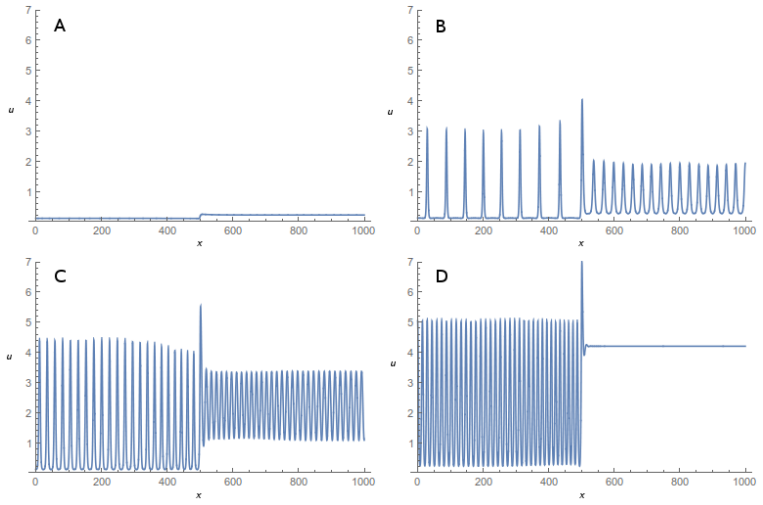
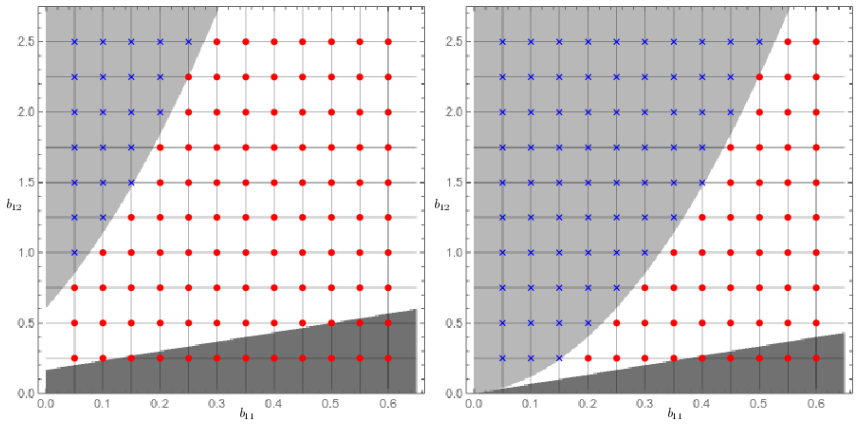
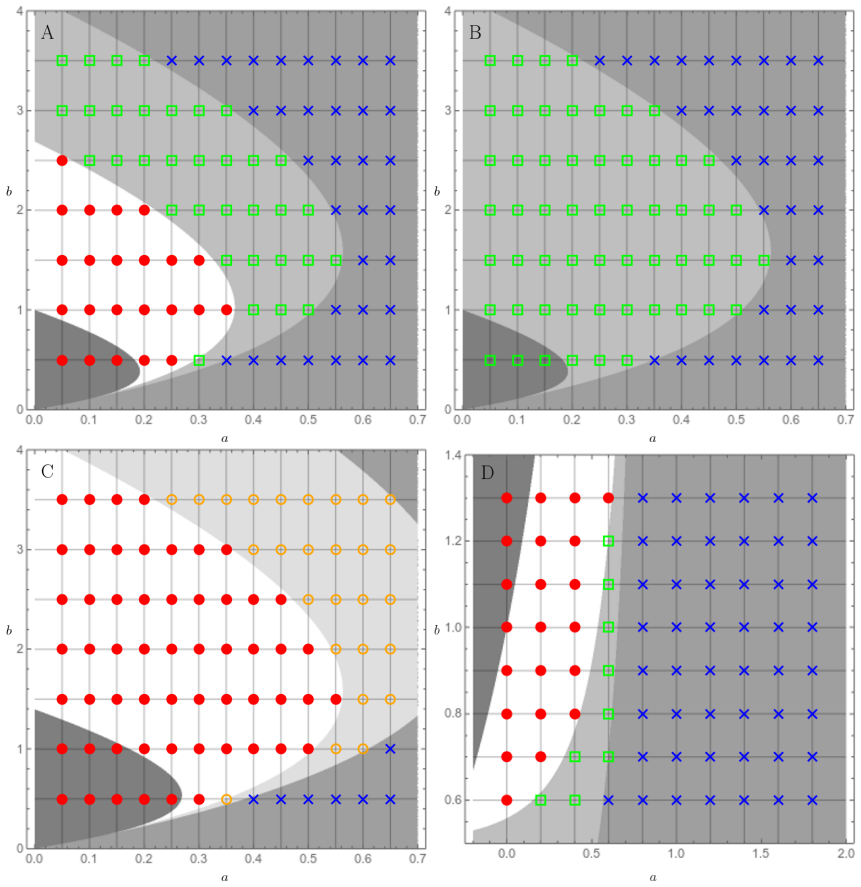
The central discovery, stated as equation (20), is that for the affine system a Turing pattern emerges if and only if the two stability conditions $T_1,T_2$ hold for both subintervals $(0,\xi)$ and $(\xi,L)$ and, in addition, at least one of the two subintervals satisfies the wavenumber conditions $T_3,T_4$. For nonlinear kinetics the paper extends this to a four-way classification: left-sided, right-sided, both-sided, or no pattern. A boundary-layer analysis of a smooth regularisation of the step shows that the inner region near the jump only homogenises by fast diffusion and does not itself drive patterning, so the outer problems on the two sides determine stability. Numerical sweeps with Schnakenberg and Gierer-Meinhardt kinetics agree with this classification. The paper therefore concludes that stability or instability in Turing models is a local property for piecewise-constant kinetic parameters.
Load-bearing premise
The classification rests on the unproven step, stated in Appendix A.3.1, that stability of the infinite linearised system is captured by the finite truncated matrix; the authors explicitly say they cannot prove that the infinite-matrix spectrum is the limit of truncated spectra.
Editorial extensions
If this is right
- A kinetic boundary can act as a pattern boundary: parameters can be tuned so that one side of the step patterns while the other does not, producing one-sided patterns.
- The spatial frequency of the pattern is set independently on each side of the step, so sharp changes in wavelength across a domain can be read as a signature of a sharp kinetic transition.
- The detailed shape of the transition region is not load-bearing: a smoothed step gives the same local classification as the sharp step, up to the small-step-size caveat.
- For a parameter point to support patterning, it suffices that the homogeneous kinetics is stable on both sides and at least one side enters the Turing wavenumber region; no coupled spectrum of the heterogeneous problem is needed.
- A subdomain smaller than roughly one local pattern period can hide a predicted one-sided pattern, so the criterion must be read together with a minimum subdomain size.
Reading between the lines
- Beyond the paper, if the locality principle extends to slowly varying kinetics, spatially resolved Turing-space maps could be built pointwise from local parameter values, making the criterion predictive at tissue scale rather than only for two constant patches.
- One could push beyond the paper's finite-step remark by asking how the locality criterion degrades with step size: as $s$ grows, the localised inhomogeneity at the jump eventually swamps the Turing oscillation, so there should be a threshold curve in $(s, L)$ separating genuine patterning from passive inhomogeneity; measuring that threshold numerically would sharpen the practical reach of the clas
- In developmental contexts where kinetic parameters are graded rather than stepped, the locality claim suggests that patterns can be seeded in a Turing-active zone and propagate into a non-Turing zone by diffusion, so a local Turing-space check would predict where pattern first appears; testing this with a smoothed gradient would connect the criterion to the gradient studies the paper cites.
Signed reviews
Editorial analysis
A structured set of objections, weighed in public.
Referee Report
Summary. This paper studies a two-species reaction-diffusion system on an interval with Neumann boundary conditions and a step-function modulation h(x) multiplying the linear activator term. For affine kinetics, the authors construct the non-constant steady state and analyse linear stability by expanding perturbations in Neumann eigenfunctions, which leads to an infinite matrix that is truncated numerically. In parallel, a formal boundary-layer analysis for a regularised step suggests that the internal layer is diffusive and does not itself generate patterning, so the instability should be governed by the classical Turing conditions evaluated separately on each side of the step. This yields the central conditions (19) and (20): when the homogeneous kinetics are stable on both sides, a pattern emerges iff the Turing conditions (T3,T4) hold on at least one side, with left-sided, right-sided, or both-sided patterns determined by which side satisfies them. The conditions are tested against eigenvalue computations of the truncated matrix and direct simulations of the affine, Schnakenberg, and Gierer-Meinhardt systems.
Significance. If rigorously established, the proposed local characterisation would be practically valuable: it reduces a non-self-adjoint, non-constant-coefficient stability problem to two classical constant-coefficient Turing checks and yields testable predictions of one-sided versus two-sided patterns, including spatial frequency changes across the step. The paper's strengths are its explicit conditions, the extensive numerical parameter sweeps, and the absence of parameter fitting; the agreement between two independent numerical methods and two nonlinear kinetics is genuinely supportive, and the predicted pattern classifications are falsifiable. However, the analytical foundation is incomplete: the spectral-truncation limit is explicitly unproved, and the boundary-layer argument is heuristic. The central claim is therefore currently a well-supported conjecture rather than a theorem.
major comments (3)
- [Appendix A.3.1, Eq. (34); Table 1] The stability classification underlying Eq. (20) depends on the assertion that the spectrum of the infinite matrix (34) is governed by the spectra of the truncated matrices M_N. The text states in Appendix A.3.1, 'We will not be able to show that the spectrum of the infinite matrix is a limit of the spectrum of the truncated matrices.' The subsequent determinant computation only shows that M_{N+1} acquires two eigenvalues of order -kappa_N in addition to, at leading order, the eigenvalues of M_N; it does not rule out spectral pollution or establish convergence of the remaining eigenvalues to those of the differential operator. Since the sign of the rightmost eigenvalue is the criterion used in Table 1, a failure of this limit could change the classification even in the affine case. Please either supply a rigorous functional-analytic argument (for example, relative compactness of the coupling term together with a sectorial-operator convergence theorem) or perform an independent exact eigenvalue computation for the affine linearised operator, such as an Evans-function or shooting method exploiting the piecewise-constant coefficients, and compare the resulting rightmost eigenvalue with Table 1 across the parameter regions.
- [Section 2.2, Eqs. (14)-(17)] The boundary-layer analysis is a formal asymptotic argument: after rescaling X=(x-xi)/delta and T=t/delta^2, the leading-order inner problem is pure diffusion, and the text concludes that the inner layer 'will not drive patterning'. This conclusion is load-bearing for the extension to nonlinear kinetics and for the classification (19), but the matching of the inner constant solution to the outer problems (16)-(17) is not quantified, and no error estimates are given for finite delta or for the limit delta to 0. To support the claim, please provide a rigorous matched-asymptotics justification or, failing that, numerical evidence with the regularised step h_delta (for example, tanh profiles for several small delta) showing that the predicted pattern side and frequency are unchanged as delta decreases and that no instability is introduced in the inner region.
- [Section 3.2 and Section 4] The abstract and conclusion state that 'the presence of stability or instability in Turing models is a local property for piece-wise constant kinetic parameters' as a general statement. However, the nonlinear verification in Section 3.2 covers two specific kinetics and selected parameter sets, and the text elsewhere repeatedly calls conditions (19) 'hypothesised' and lacking rigorous validation. The universal 'local property' claim therefore exceeds the evidence presented. Please either restrict the conclusion to the affine case and present the nonlinear statement as a conjecture, or add a proof, or provide a substantially broader numerical study with a quantitative measure of agreement, before claiming the local property as a general result.
minor comments (6)
- [Section 3.1] The statement that the largest real part of the truncated-matrix eigenvalues is negative if and only if the supremum norm of the evolution solution decreases is qualified only by 'the possible exception of the very near vicinity of the parameter space boundaries'; please quantify the size of this vicinity and report how many sample points fell inside it.
- [Appendix A.3.1, Eq. (34)] The compressed display of the infinite matrix is difficult to read; please present its block structure explicitly, since the construction of M_N is central to the numerical spectral results.
- [Figure 4] The grayscale legend for pattern types appears only in the caption; please also include an explicit legend inside the figure so that the symbols are self-explanatory.
- [Section 3.2] The manuscript does not justify the choices of terminal time tau=10^3 and the norm threshold 10^7 used to classify patterns; a brief justification or a sensitivity check would strengthen the classification protocol.
- [Section 4] The statement that 'the discreteness of eigenmodes results in a lower bound on the size of the supporting intervals of each step' is not quantified; consider giving the expected critical-domain-size relation for the affine case.
- [Section 2.3] Minor grammatical issues: 'to distinguish among all the one-sided pattern and both-sided pattern' should read 'to distinguish among one-sided and both-sided patterns'.
Circularity Check
No circularity: Eq. (20) is a conjectured local Turing condition, proposed independently of the numerics and then tested against both truncated-spectrum and full-evolution simulations; the unproven infinite-matrix limit is a rigor gap, not a circular reduction.
full rationale
The paper's central claims are (18)/(20) for affine kinetics and (19) for nonlinear kinetics. The conditions T1L-T4L and T1R-T4R are written down as classical Turing conditions for the constant-coefficient systems on (0,xi) and (xi,L), not fitted to the outcome. They are proposed as a hypothesis ('we propose and will subsequently numerically verify') and then checked against two independent numerical tools: eigenvalues of the truncated matrix (34) and time integration of the evolution problem (6)/(1). No parameter is fitted to force agreement, and the agreement figures (Figs. 3-4) are external comparisons rather than identities. The strongest caveat in the paper is the explicit admission in Appendix A.3.1 that 'We will not be able to show that the spectrum of the infinite matrix is a limit of the spectrum of the truncated matrices.' This is a mathematical rigor gap in the analytical bridge, not a circularity: the claimed local conditions are not defined in terms of the truncated spectrum, nor does the paper rewrite the classical Turing conditions as the output of the spectral calculation. Self-citations ([12], [14], [16]) support standard background material and are not load-bearing. Therefore no specific circular step can be exhibited, and the appropriate finding is no significant circularity.
Assumptions & free parameters
assumptions (4)
- domain assumption The true stationary solution of the nonlinear system is close enough to the piecewise constant state (uL,vL) on (0,xi) and (uR,vR) on (xi,L) for linearisation about that state to be valid.
- ad hoc to paper The eigenvalues of the truncated spectral matrix MN determine the stability of the full linearised operator.
- domain assumption Small perturbations around the (possibly nonhomogeneous) steady state determine pattern formation, i.e. the standard linearisation principle of Turing analysis.
- ad hoc to paper The boundary layer at the step x=xi, after regularisation and rescaling, behaves as pure diffusion at leading order and does not itself drive patterning.
Cite this review
Pith. "Pith review of Pattern formation in reaction-diffusion systems with piece-wise kinetic modulation: an example study of heterogeneous kinetics." pith.science (2026). https://pith.science/paper/QSE4OSKP
@misc{pith2026190809495,
  author       = {Pith},
  title        = {Pith review of: Pattern formation in reaction-diffusion systems with piece-wise kinetic modulation: an example study of heterogeneous kinetics},
  year         = {2026},
  howpublished = {\url{https://pith.science/paper/QSE4OSKP}},
  note         = {Machine review of arXiv:1908.09495}
}
read the original abstract
The study of pattern emergence together with exploration of the exemplar Turing model is enjoying a renaissance both from theoretical and experimental perspective. Here, we implement a stability analysis of spatially dependent reaction kinetics by exploring the effect of a jump discontinuity within piece-wise constant kinetic parameters, using various methods to identify and confirm the diffusion-driven instability conditions. Essentially, the presence of stability or instability in Turing models is a local property for piece-wise constant kinetic parameters and, as such, may be analysed locally. In particular, a local assessment of whether parameters are within the Turing space provides a strong indication that for a large enough region with these parameters, an instability can be excited.
Figures

Figures from the paper (1 more)
Forward citations
Cited by 1 Pith paper
-
From One Pattern into Another: Analysis of Turing Patterns in Heterogeneous Domains via WKBJ
For slowly varying heterogeneity and small diffusion, a reaction-diffusion system forms localized Turing patterns precisely where the pointwise classical Turing inequalities hold.
Reference graph
Works this paper leans on
-
[1]
Diffusion driven instability in an inhomogeneous domain
Debbie L Benson, Jonathan A Sherratt, and Philip K Maini. Diffusion driven instability in an inhomogeneous domain. Bulletin of mathematical biology, 55(2):365–384, 1993
work page 1993
-
[2]
Mark AJ Chaplain, Mahadevan Ganesh, and Ivan G Graham. Spatio-temporal pattern for- mation on spherical surfaces: numerical simulation and application to solid tumour growth. Journal of mathematical biology, 42(5):387–423, 2001
work page 2001
-
[3]
Thick and thin fingers point out turing waves
Andrew D Economou and Jeremy BA Green. Thick and thin fingers point out turing waves. Genome biology, 14(1):101, 2013
work page 2013
-
[4]
Periodic stripe formation by a turing mechanism operationg at growth zones in the mammalian palate
Andrew D Economou, Atsushi Ohazama, Thantrira Porntaveetus, Paul T Sharpe, Shigeru Kondo, Albert M Basson, Amel Gritli-Linde, Martyn T Cobourne, and Jeremy B A Green. Periodic stripe formation by a turing mechanism operationg at growth zones in the mammalian palate. Nature genetics, 44(3):348–352, 2012
work page 2012
-
[5]
A theory of biological pattern formation
Alfred Gierer and Hans Meinhardt. A theory of biological pattern formation. Biological Cybernetics, 12(1):30–39, 1972
work page 1972
-
[6]
Tilmann Glimm, Jianying Zhang, and Yun-Qiu Shen. Interaction of turing patterns with an external linear morphogen gradient.Nonlinearity, 22(10):2541, 2009
work page 2009
-
[7]
Tilmann Glimm, Jianying Zhang, and Yun-Qiu Shen. Stability of turing-type patterns in a reaction–diffusion system with an external gradient.International Journal of Bifurcation and Chaos, 27(01):1750003, 2017
work page 2017
-
[8]
Tilmann Glimm, Jianying Zhang, Yun-Qiu Shen, and Stuart A Newman. Reaction–diffusion systems and external morphogen gradients: the two-dimensional case, with an application to skeletal pattern formation.Bulletin of mathematical biology, 74(3):666–687, 2012
work page 2012
Show all 36 references
-
[9]
J. D. Glover, K. L. Wells, F. MatthÃďus, K. J. Painter, W. Ho, J. Riddell, J. A. Johansson, M. J. Ford, C. A. B. Jahoda, V. Klika, R. L. Mort, and D. J. Headon. Hierarchical patterning modes orchestrate hair follicle morphogenesis.PloS Biol, 15(7), 2017. 24
2017
-
[10]
Positional information and reaction-diffusion: two big ideas in developmental biology combine.Development, 142:1203–1211, 2015
Jeremy B A Green and James Sharpe. Positional information and reaction-diffusion: two big ideas in developmental biology combine.Development, 142:1203–1211, 2015
2015
-
[11]
Iron and M
D. Iron and M. J. Ward. Spike pinning for the gierer-meinhardt model. Mathematics and computers in simulation, 55(4):419–431, 2001
2001
-
[12]
Significance of non-normality-induced patterns: Transient growth versus asymp- totic stability.Chaos: An Interdisciplinary Journal of Nonlinear Science, 27(7):073120, 2017
Václav Klika. Significance of non-normality-induced patterns: Transient growth versus asymp- totic stability.Chaos: An Interdisciplinary Journal of Nonlinear Science, 27(7):073120, 2017
2017
-
[13]
Theinfluenceofreceptor- mediated interactions on reaction-diffusion mechanisms of cellular self-organisation.Bulletin of Mathematical Biology, 74(4):935–957, Apr 2012
VáclavKlika, RuthE.Baker, DenisHeadon, andEamonnA.Gaffney. Theinfluenceofreceptor- mediated interactions on reaction-diffusion mechanisms of cellular self-organisation.Bulletin of Mathematical Biology, 74(4):935–957, Apr 2012
2012
-
[14]
Domain size driven instability: Self- organization in systems with advection.SIAM Journal on Applied Mathematics, 78(5):2298– 2322, 2018
Václav Klika, Michal Kozák, and Eamonn A Gaffney. Domain size driven instability: Self- organization in systems with advection.SIAM Journal on Applied Mathematics, 78(5):2298– 2322, 2018
2018
-
[15]
Reaction-diffusion model as a framework for understanding biological pattern formation.Science, 329(5999):1616–1620, 2010
Shigeru Kondo and Takashi Miura. Reaction-diffusion model as a framework for understanding biological pattern formation.Science, 329(5999):1616–1620, 2010
2010
-
[16]
Krause, Václav Klika, Thomas E
Andrew L. Krause, Václav Klika, Thomas E. Woolley, and Eamonn A. Gaffney. Heterogeneity induces spatiotemporal oscillations in reaction-diffusion systems.Phys.Rev. E, 97:052206, May 2018
2018
-
[17]
Theturingmodelcomesofmolecular age
PhilipK.Maini, RuthE.Baker, andCheng-MingChuong. Theturingmodelcomesofmolecular age. Science, 314(5804):1397–1398, 2006
2006
-
[18]
Spatial periodic forcing can displace patterns it is intended to control.Physical review letters, 109(3):034102, 2012
Yair Mau, Aric Hagberg, and Ehud Meron. Spatial periodic forcing can displace patterns it is intended to control.Physical review letters, 109(3):034102, 2012
2012
-
[19]
Effect of axial growth on turing pattern formation.Physical review letters, 96(4):048304, 2006
David G Míguez, Milos Dolnik, Alberto P Munuzuri, and Lorenz Kramer. Effect of axial growth on turing pattern formation.Physical review letters, 96(4):048304, 2006
2006
-
[20]
Turing and wopert work together during limb development.Science Signaling, 6(270):1–3, 2013
Takashi Miura. Turing and wopert work together during limb development.Science Signaling, 6(270):1–3, 2013
2013
-
[21]
Mathematical Biology
James D Murray. Mathematical Biology. II Spatial Models and Biomedical Applications {Interdisciplinary Applied Mathematics V. 18}. Springer-Verlag New York Incorporated, 2001
2001
-
[22]
Interactions between ze- brafish pigment cells responsible for the generation of turing patterns.PNAS, 106(21):8429– 8434, 2009
Akiko Nakamasu, GO Takahashi, Akio Kanbe, and Shigeru Kondo. Interactions between ze- brafish pigment cells responsible for the generation of turing patterns.PNAS, 106(21):8429– 8434, 2009
2009
-
[23]
Pattern formation in spatially hetero- geneous turing reaction–diffusion models.Physica D: Nonlinear Phenomena, 181(1):80–101, 2003
Karen Page, Philip K Maini, and Nicholas AM Monk. Pattern formation in spatially hetero- geneous turing reaction–diffusion models.Physica D: Nonlinear Phenomena, 181(1):80–101, 2003
2003
-
[24]
Complex pattern formation in reaction–diffusion systems with spatially varying parameters
Karen M Page, Philip K Maini, and Nicholas AM Monk. Complex pattern formation in reaction–diffusion systems with spatially varying parameters. Physica D: Nonlinear Phenomena, 202(1):95–115, 2005. 25
2005
-
[25]
Towards an integrated experimental–theoretical approach for assessing the mechanistic basis of hair and feather mor- phogenesis
KJ Painter, GS Hunt, KL Wells, JA Johansson, and DJ Headon. Towards an integrated experimental–theoretical approach for assessing the mechanistic basis of hair and feather mor- phogenesis. Interface Focus, 2(4):433–450, 2012
2012
-
[26]
Patterning of palatal rugae through sequential addition reveals an anterior/posterior boundary in palatal development
Sophie Pantalacci, Jan Prochazka, Arnaud Martin, Michaela Rothova, Anne Lambert, Laure Bernard, Cyril Charles, Laurent Viriot, Renata Peterkova, and Vincent Laudet. Patterning of palatal rugae through sequential addition reveals an anterior/posterior boundary in palatal develo...
2008
-
[27]
S. T. A. Pickett and M. L. Cadenasso. Landscape ecology: spatial heterogeneity in ecological systems. Science, 269(52220):331–334, 1995
1995
-
[28]
Digit patterning is controlled by a bmp-sox9- wnt turing network modulated by morphogen gradients.Science, 345(6196):266–570, 2014
J Raspopovic, L Marcon, L Russo, and J Sharpe. Digit patterning is controlled by a bmp-sox9- wnt turing network modulated by morphogen gradients.Science, 345(6196):266–570, 2014
2014
-
[29]
Simple chemical reaction systems with limit cycle behaviour
J Schnakenberg. Simple chemical reaction systems with limit cycle behaviour. Journal of theoretical biology, 81(3):389–400, 1979
1979
-
[30]
Hox genes regulate digit patterning by controlling the wavelength of a turing-type mechanism.Science, 338(1476):1476–1480, 2012
Rushikesh Sheth, Luciano Marcon, M FÃľlix Bastida, Marisa Junco, Laura Quintana, Randall Dahn, Marie Kmita, James Sharpe, and Maria A Ros. Hox genes regulate digit patterning by controlling the wavelength of a turing-type mechanism.Science, 338(1476):1476–1480, 2012
2012
-
[31]
D. Thomas. Artifical enzyme membranes, transport, memory and oscillatory phenomena, in: Analysis and control of immobilized enzyme systems. pages 115–150, 1975
1975
-
[32]
The chemical basis of morphogenesis.Philosophical Transactions of the Royal Society of London B: Biological Sciences, 237(641):37–72, 1952
Alan Mathison Turing. The chemical basis of morphogenesis.Philosophical Transactions of the Royal Society of London B: Biological Sciences, 237(641):37–72, 1952
1952
-
[33]
The dynamics and pinning of a spike for a reaction-diffusion system.SIAM Journal on Applied Mathematics, 62(4):1297–1328, 2002
Michael J Ward, Darragh McInerney, Paul Houston, David Gavaghan, and Philip Maini. The dynamics and pinning of a spike for a reaction-diffusion system.SIAM Journal on Applied Mathematics, 62(4):1297–1328, 2002
2002
-
[34]
Warmflash, B
A. Warmflash, B. Sorre, F. Etoc, E. D. Siggia, and A. H. Brivanlou. A method to recapitulate early embryonic spatial patterning in human stem cells.Nature methods, 11(8):847–854, 2014
2014
-
[35]
Spikes for the gierer–meinhardt system with discontinuous diffusion coefficients.Journal of Nonlinear Science, 19(3):301–339, 2009
Juncheng Wei and Matthias Winter. Spikes for the gierer–meinhardt system with discontinuous diffusion coefficients.Journal of Nonlinear Science, 19(3):301–339, 2009
2009
-
[36]
Positional infromation and the spatial pattern of cellular differentiation.J
Lewis Wolpert. Positional infromation and the spatial pattern of cellular differentiation.J. Theoret. Biol, 25:1–47, 1969. 26
1969
Reviewed August 14, 2026 · model on record in the stance chip above.
Discussion (0). Continue with ORCID to comment.