REVIEW 3 major objections 5 minor 95 references
A neural network can predict large-scale Galactic dust foregrounds from small-scale structure alone, and combining that with multi-frequency cleaning leaves roughly seven times less foreground power than the standard ILC method.
Reviewed by Pith at T0; open to challenge. T0 means a machine referee read the full paper against a public rubric. the ladder, T0–T4 →
T0 review · deepseek-v4-flash
2026-08-03 00:36 UTC pith:QSXNBUYA
load-bearing objection A credible simulation-level proof-of-concept that inter-scale correlations complement ILC, but the fixed low-l Planck template in DustFilaments and an uncalibrated f_resid metric keep me from trusting the headline factors. the 3 major comments →
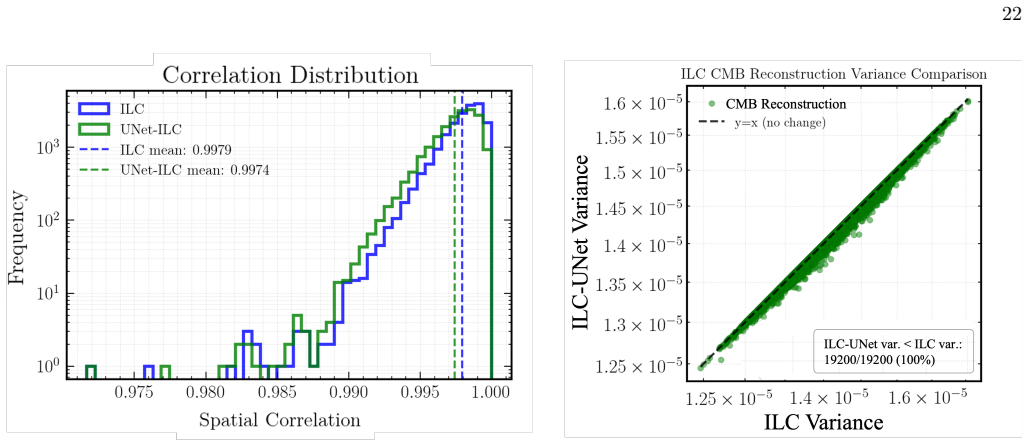
Single Frequency CMB Foreground Removal with Inter-scale Machine Learning
The pith
A machine-rendered reading of the paper's core claim, the machinery that carries it, and where it could break.
Core claim
The central discovery claim is that inter-scale correlations in Galactic dust B-modes—the fact that small-scale filamentary structure predicts large-scale polarized emission—are real, learnable, and complementary to multi-frequency information. The paper demonstrates this by training a U-net to map small-scale (ℓ>200) foreground maps to large-scale (ℓ<200) foreground maps at a single frequency, then by a hybrid network that combines these with frequency-difference inputs from an internal linear combination. On held-out test patches from a filament-based dust simulation, the best hybrid reduces residual foreground power to f_resid = 3.62e-4 (or 4.71e-4 with B-mode-only inputs), roughly seven
What carries the argument
The central object is the inter-scale correlation in Galactic dust polarization: the statistical coupling between small-scale (ℓ>200) and large-scale (ℓ<200) foreground structure. The machinery is a U-net convolutional network trained under a signal-free constraint: inputs are small-scale B-modes (and optionally temperature and E-modes), the target is the large-scale foreground or ILC residual, and the CMB is subtracted from both during training so the network is blind to the cosmological signal. For hybrid cleaning, the network also ingests frequency-difference maps (observed map minus ILC solution), which carry residual foregrounds missed by linear multi-frequency combination. The signal-f
Load-bearing premise
The usefulness of the method for real CMB data rests on the filament-based dust simulation encoding the same inter-scale correlations as actual Galactic dust; if real dust does not share this coupling, the sevenfold improvement could be a simulation artifact.
What would settle it
Train the same hybrid network on an independent dust model with different filament and magnetic-field assumptions and evaluate on held-out patches; if the residual foreground power rises back to ILC-level (around 2.7e-3), the learned scale coupling is simulation-specific. A quicker check: compute the cross-correlation between the network's predicted large-scale foreground from one simulation and the true large-scale foreground from another; if it drops below about 0.3, generalization fails.
If this is right
- If the central claim is right, single-frequency cleaning becomes viable for experiments with limited frequency coverage: small-scale dust structure can be used as a template for large-scale contamination.
- ML foreground cleaning need not bias CMB inference: because inputs and targets are independent of the primordial signal, an imperfect network does not corrupt the cosmological signal.
- Scale correlations and frequency correlations are complementary; combining them yields lower residuals than either alone, so future pipelines can add inter-scale channels to existing ILC-style cleaning.
- Residual foreground power of about 3.6e-4 at ℓ<200 approaches the level needed for inflationary B-mode searches if it survives realistic conditions.
- The gains are currently demonstrated only on one dust simulation; the authors state that generalization across simulations remains a key challenge for robust ML-based foreground removal.
Where Pith is reading between the lines
- Editorial inference: If inter-scale correlations are a universal property of magnetized interstellar turbulence, the same framework could be extended to synchrotron foregrounds or to lensing B-mode templates, where similar scale coupling exists.
- Editorial inference: The signal-free construction suggests a testable path to real data: train on simulations, then verify on sky patches that the predicted large-scale foreground is uncorrelated with an independently estimated CMB signal; any correlation would flag simulation mismatch.
- Editorial inference: The patch-level variability for B-mode-only inputs implies that single-frequency cleaning alone may be insufficient for all-sky surveys, but could still serve as a prior or template inside multi-frequency pipelines.
- Editorial inference: A direct next step would be training on multiple independent dust models and measuring the degradation in f_resid; if the network learns physical coupling rather than simulation-specific texture, transfer should be feasible.
Editorial analysis
A structured set of objections, weighed in public.
Referee Report
Summary. The paper proposes a signal-preserving machine-learning framework for CMB B-mode foreground removal that exploits inter-scale correlations in Galactic dust. Using the DustFilaments simulations, the authors train UNets to reconstruct large-scale (ℓ<200) foregrounds from small-scale (ℓ>200) B-modes, optionally augmented with temperature and E-mode maps, and in a hybrid setup combined with multi-frequency ILC foreground estimates. The headline claim is that the hybrid network (multi-frequency + inter-scale) attains a residual foreground power fraction of f_resid=3.62×10^-4, about 7× lower than spatial ILC's 2.69×10^-3, demonstrating that correlations across scale are not redundant with correlations across frequency. The paper emphasizes that these results are obtained only for the DustFilaments model and that generalization to other simulations remains a challenge.
Significance. If the internal metrics are correctly calibrated and the held-out evaluation is truly independent, the paper makes a novel and useful contribution: it extends the signal-preserving ILC philosophy to single-frequency and inter-scale information, and it provides a concrete demonstration that non-Gaussian, anisotropic foreground structure can be captured by CNNs beyond linear frequency-based methods. Strengths include the explicit signal-free input/target construction, the use of held-out realizations stratified by simulation index, null-correlation tests for spatial alignment, and a candid discussion of the limitation to a single foreground model. The comparison to the hexadecapole estimator of Philcox et al. is also informative. However, the significance is currently limited by two load-bearing issues: the residual-power metric is not derived from actual residual power unless a calibration condition holds, and the DustFilaments large-scale Q/U maps contain a fixed Planck template that compromises the independence of the test set at the low multipoles most relevant for primordial B-modes.
major comments (3)
- The metric f_resid = ⟨1−ρ(ℓ)^2⟩ is labeled 'fraction of foreground power remaining,' but this identity holds only when the prediction is calibrated so that the regression slope of the true field on the prediction is unity. In general, the residual fraction is ⟨|F−F̂|^2⟩/⟨|F|^2⟩ = 1 − 2ρ(σ_hat/σ_F) + (σ_hat/σ_F)^2, which equals 1−ρ^2 only if σ_hat/σ_F = ρ. The manuscript does not report this variance ratio or an equivalent calibration. The discrepancy is already apparent in Table I: for the BS-only network, ⟨ρ⟩=0.51 gives 1−ρ^2=0.74, yet the quoted f_resid is 0.704, indicating that the reported values are not simply 1−ρ^2 computed from the quoted ⟨ρ⟩. Please report the actual residual-power fraction and show that the 7× improvement in Table II survives this calibration.
- Appendix B states that for Q/U at multipoles ℓ≲50, DustFilaments uses a Planck-based template filled in from observations. Consequently, all 150 realizations share the same large-scale polarization template. The train/test split by simulation index therefore does not guarantee independence at the lowest multipoles — precisely the range where primordial B-modes live. A network can learn to identify sky position from small-scale statistics and reproduce the fixed template, inflating the measured harmonic correlation and reducing f_resid in a way that would not generalize to a different large-scale realization. This is a concrete internal validity concern for the central claim, not just an external generalization caveat. Please quantify the effect by (a) reporting f_resid with ℓ<50 excluded, (b) retraining/evaluating with the isotropic large-scale option, or (c) otherwise demonstrating that
- The ILC baselines with 8 and 12 channels (adding T and/or E to the four B-mode channels) are reported with f_resid = 7.69×10^-3 and 1.68×10^-2, respectively, far worse than the 4-channel B-only ILC (2.69×10^-3). Under the usual ILC constraint that the CMB B-mode signal is preserved, channels that do not contain B-mode signal must receive zero weight, so adding T/E should not degrade the solution. The footnote that 'the variance of the ILC solution has not increased' does not explain why the MSE relative to the true CMB increases by factors of 4–5. This inconsistency suggests either an incorrect signal constraint in the multi-channel ILC implementation or an inconsistency in how the MSE is computed. Since the headline 7× improvement is relative to the 4-channel ILC, please clarify the ILC construction or correct the baseline table.
minor comments (5)
- The abstract and discussion contain the typo 'DustFilments' instead of 'DustFilaments' (also in the abstract's 'f_resid' phrasing). Please proofread.
- The sentence 'The MSE is also reduced by a factor of ∼7.18 compared to the ILC baseline (vs a factor of ∼.36 for BS-only)' appears to contain a typo: the factor for BS-only should be ∼4.36 based on the numbers in Table I and the preceding text. Please correct.
- The caption reports 'MSE = 1.29×10^-7 µK^2' for the 16-channel network, while Table II lists MSECMB = 3.66×10^-7 µK^2 for the same configuration. Please reconcile these numbers.
- For the hybrid networks, the text does not explicitly state whether the small-scale B-mode inputs and the T/E inputs are stripped of the primary CMB components during training, as is done for the single-frequency networks in Section II A. Please clarify that the same signal-free procedure is applied, or explain why it is unnecessary.
- The displayed f_resid values in the caption use a mix of superscripts and subscripts (e.g., '𝑓!"#$%=2.13×10&\'' ) that is garbled. Please ensure all figure text is legible and correctly typeset.
Circularity Check
Low-ℓ Planck template shared across DustFilaments realizations makes part of the reported prediction a reproduction of a fixed training-set target.
specific steps
-
fitted input called prediction
[Appendix B (DustFilaments Simulation Normalization); Section IV (Training/test split)]
"At scales (ℓ≲50) for Q, U components, where the model uses a Planck-based template filled in from observations ... Note that a template is not used for the temperature map, which is generated solely from filaments all the way to the largest scales. ... These patches are divided into training (80%), validation (10%), and test (10%) sets, with stratification by simulation index to ensure that patches from the same simulation do not appear in multiple splits to maintain statistical independence."
All 150 'random' DustFilaments realizations share the same Planck-based Q/U template at ℓ<50, so the low-ℓ part of the target F_L is identical in training and test splits. The test set is therefore not independent for the multipoles most relevant to primordial B-modes. The reported ρ(ℓ<50) and the corresponding contribution to f_resid cannot distinguish physical inter-scale prediction from reproduction of a fixed template already seen during training; that component of the result is equivalent, by construction of the simulation, to recalling a training-set constant rather than predicting a new realization.
full rationale
The core supervised regression is self-contained: the network is trained on held-out-realization splits to predict large-scale foregrounds (or ILC residuals) from signal-free small-scale/cross-frequency inputs, and the hybrid ablation supports the complementarity claim within DustFilaments. No equation-level circularity was found: the ILC residual target is not in the linear span of the frequency-difference inputs, and the signal-preserving property follows from the stated independence assumptions. Self-citations to [40], [60], and [61] provide method and simulation provenance rather than an imported uniqueness theorem. However, Appendix B introduces a genuine internal leakage: the low-ℓ Q/U maps are a fixed Planck template repeated in every realization, so the train/test stratification does not isolate that component. Since the paper's f_resid is defined over ℓ<200 and the reported ρ is largest at ℓ<80, part of the headline improvement reflects memorization of a shared template. The paper's own statement that 'network generalization across simulations remains a key challenge' is a broader version of this limitation, but it does not repair the within-DustFilaments low-ℓ dependence. This is a partial, construction-level circularity in the evaluation, not a wholesale collapse of the method.
Axiom & Free-Parameter Ledger
free parameters (2)
- Angular scale cut l_cut =
200
- UNet training hyperparameters =
LR=1e-3, weight decay=5e-4, batch=64, max 200 epochs, early stopping 20
axioms (4)
- domain assumption DustFilaments is an adequate proxy for real Galactic dust foregrounds
- domain assumption Primordial CMB is a statistically isotropic Gaussian field with independent l<200 and l>200 modes and CTB=CEB=0
- ad hoc to paper Filtering and patch apodization do not couple large- and small-scale modes in a way that violates signal-free inputs
- domain assumption Gravitational lensing B-modes are negligible relative to dust at relevant scales
read the original abstract
Accurate measurements of Cosmic Microwave Background (CMB) B-mode polarization, a key probe of inflationary physics, are hindered by complex Galactic dust foregrounds. Traditional foreground removal with Internal Linear Combination (ILC) fully preserves the primordial signal but requires multi-frequency data and is limited to two-point statistics. We present a novel way to estimate and remove foregrounds at single frequency using signal-preserving machine learning that leverages inter-scale correlations. Using the DustFilaments simulations, we train CNNs to reconstruct large-scale foregrounds ($\ell < 200$) from small-scales ($\ell > 200$). We quantify the effectiveness of foreground removal with the residual foreground power, $f_{\rm{resid}}$, which gives the fraction of foreground power remaining after removal. Predictions using only small-scale $B$-modes achieve $f_{\rm{resid}}\simeq 0.704$, while adding temperature and $E$-modes decreases it to $f_{\rm{resid}} \simeq 0.376$. These results are still higher than the spatial ILC, which leverages multi-frequency data at Simons-Observatory-like frequencies. However, a hybrid network that uses both multi-frequency and inter-scale correlations attains $f_{\rm{resid}}=4.71\times10^{-4}$ when using $B$-mode inputs alone, and $3.62\times10^{-4}$ when using temperature and $E/B$-mode inputs. This network achieves a residual power of $\sim 7\times$ lower than ILC, while inheriting ILC's signal-preserving property. This is $\sim 2$--$3\times$ lower than a network that only uses multi-frequency inputs, demonstrating that correlations across scale are not redundant with correlations across frequency and that our techniques are complementary to multi-frequency foreground removal. However, this is achieved only for DustFilments and network generalization across simulations remains a key challenge for robust ML-based foreground removal. (abridged)
Figures



Reference graph
Works this paper leans on
-
[1]
Notably, Ref
Frequency Difference + Small-Scale B While the previous inter-scale results demonstrate that foreground prediction is feasible using only asingle frequency, they do not leverage the rich information available in the SEDs of foreground components across multiple frequencies. Notably, Ref. [40] used that ILC foreground estimates, which are constructed by su...
-
[2]
#$%=2.13×10&' 𝑓!
Frequency Difference + Small-Scale B + T, E We now extend the 8-channel network to include temperature and E-mode polarization information across all four frequency channels, resulting in 16-channel inputs. This UNet combines multi-frequency data (frequency-difference maps ˆF ILC i ), inter-scale correlations (small-scale B-modesB S), and cross-component ...
-
[3]
This network is able to achieve statistically significant correlations between the reconstruction and the truth, in both harmonic and pixel space (see Table
We trained a UNet on small-scale B modes (ℓ >200) to estimate large-scale B modes (ℓ <200). This network is able to achieve statistically significant correlations between the reconstruction and the truth, in both harmonic and pixel space (see Table. I). However, it still leaves a residual foreground power off resid ≃0.704, which is much higher compared to...
-
[4]
These allow the UNet to leverage physical processes in the Galactic field that couple different components of the foregrounds
Next, we augmented the inputs with additional (signal-free) temperature and E-mode (T+E) components at all scales. These allow the UNet to leverage physical processes in the Galactic field that couple different components of the foregrounds. This network is able to achieve significantly higher correlations across all scales andf resid ≃0.376
-
[5]
We find that using just E-modes results in more accurate and consistent reconstructions than the small-scale B-modes alone
We also trained the UNet on various input combinations withT, E, Bcomponents to explore which provides the most information forB-mode reconstruction. We find that using just E-modes results in more accurate and consistent reconstructions than the small-scale B-modes alone. This makes sense given that E-modes probe fluctuations correlated with the GMF [67]...
-
[6]
This is reduced by a network trained on ILC foreground estimates ˆF ILC i tof resid = 1.00×10 −3 (∼2.7×lower), removing residual anisotropic power that ILC could not mitigate
The 4-channel spatial ILC achieves a baseline off resid = 2.69×10 −3. This is reduced by a network trained on ILC foreground estimates ˆF ILC i tof resid = 1.00×10 −3 (∼2.7×lower), removing residual anisotropic power that ILC could not mitigate. This agrees with the results of [40]
-
[7]
Adding small-scale B-modes ( ˆF ILC i +B S) further improves cleaning tof resid = 4.71×10 −4, showing that inter-scale information captures anisotropic structure beyond frequency correlations alone
-
[8]
Going forward, several important limitations must be addressed before these methods can be applied to observational data
The maximal 16-channel network ( ˆF ILC i +B S +T+E) reachesf resid = 3.62×10 −4, leaving only∼0.036% of the large-scale foreground power and demonstrating thatTandEprovide a modest but non-redundant further gain. Going forward, several important limitations must be addressed before these methods can be applied to observational data. First, our networks a...
-
[9]
Architecture The UNet architecture follows the encoder-decoder structure of [69], consisting of 6 encoder levels and decoder levels, with feature channel dimensions of [32,64,128,256,512,1024]. The encoder progressively down-samples the input from 128×128 to 4×4 pixels (bottleneck), while the decoder up-samples back to 128×128 pixels using transpose convo...
-
[10]
We also employ aReduceLROnPlateaulearning rate scheduler that reduces the learning rate by factor 0.5 when validation loss does not change over an interval of 10 epochs
T raining Procedure During training, we use theAdamoptimizer [70] with initial learning rate of 10 −3 and weight decay of 5×10 −4. We also employ aReduceLROnPlateaulearning rate scheduler that reduces the learning rate by factor 0.5 when validation loss does not change over an interval of 10 epochs. We use batch sizes of 64 and train for a maximum 200 epo...
2048
-
[11]
Planck Collaboration, Y. Akrami, M. Ashdown, J. Aumont, C. Baccigalupi, M. Ballardini, A. J. Banday, R. B. Barreiro, N. Bartolo, S. Basak, K. Benabed, J.-P. Bernard, M. Bersanelli, P. Bielewicz, J. R. Bond, J. Borrill, F. R. Bouchet, F. Boulanger, A. Bracco, M. Bucher, C. Burigana, E. Calabrese, J.-F. Cardoso, J. Carron, H. C. Chiang, C. Combet, B. P. Cri...
Pith/arXiv arXiv 2020
-
[12]
P. A. R. Ade, Z. Ahmed, M. Amiri, D. Barkats, R. B. Thakur, C. A. Bischoff, D. Beck, J. J. Bock, H. Boenish, V. Buza, B. Cantrall, J. R. C. , IV, J. Connors, J. Cornelison, M. Crumrine, A. J. Cukierman, E. Denison, L. Duband, M. Echter, M. Eiben, B. D. Elwood, S. Fatigoni, J. P. Filippini, A. Fortes, M. Gao, C. Giannakopoulos, N. Goeckner-Wald, D. C. Gold...
arXiv 2026
-
[13]
G. F. Smoot, arXiv e-prints , astro-ph/9902201 (1999), arXiv:astro-ph/9902201 [astro-ph]
Pith/arXiv arXiv 1999
-
[14]
C. Dickinson, R. D. Davies, and R. J. Davis, MNRAS341, 369 (2003), arXiv:astro-ph/0302024 [astro-ph]
Pith/arXiv arXiv 2003
-
[15]
Planck Collaboration, R. Adam, P. A. R. Ade, N. Aghanim, M. I. R. Alves, M. Arnaud, M. Ashdown, J. Aumont, C. Baccigalupi, A. J. Banday, R. B. Barreiro, J. G. Bartlett, N. Bartolo, E. Battaner, K. Benabed, A. Beno ˆ ıt, A. Benoit- L´ evy, J.-P. Bernard, M. Bersanelli, P. Bielewicz, J. J. Bock, A. Bonaldi, L. Bonavera, J. R. Bond, J. Borrill, F. R. Bouchet...
Pith/arXiv arXiv 2016
-
[16]
C. L. Bennett, D. Larson, J. L. Weiland, N. Jarosik, G. Hinshaw, N. Odegard, K. M. Smith, R. S. Hill, B. Gold, M. Halpern, E. Komatsu, M. R. Nolta, L. Page, D. N. Spergel, E. Wollack, J. Dunkley, A. Kogut, M. Limon, S. S. Meyer, G. S. Tucker, and E. L. Wright, ApJS208, 20 (2013), arXiv:1212.5225 [astro-ph.CO]
Pith/arXiv arXiv 2013
-
[17]
U. Seljak and M. Zaldarriaga, Phys. Rev. Lett.78, 2054 (1997), arXiv:astro-ph/9609169 [astro-ph]
Pith/arXiv arXiv 2054
-
[18]
M. Kamionkowski, A. Kosowsky, and A. Stebbins, Phys. Rev. Lett.78, 2058 (1997), arXiv:astro-ph/9609132 [astro-ph]
Pith/arXiv arXiv 2058
-
[19]
Seljak, ApJ482, 6 (1997), arXiv:astro-ph/9608131 [astro-ph]
U. Seljak, ApJ482, 6 (1997), arXiv:astro-ph/9608131 [astro-ph]
Pith/arXiv arXiv 1997
-
[20]
M. Tristram, A. J. Banday, K. M. G´ orski, R. Keskitalo, C. R. Lawrence, K. J. Andersen, R. B. Barreiro, J. Borrill, L. P. L. Colombo, H. K. Eriksen, R. Fernandez-Cobos, T. S. Kisner, E. Mart ´ ınez-Gonz´ alez, B. Partridge, D. Scott, T. L. Svalheim, and I. K. Wehus, Phys. Rev. D105, 083524 (2022), arXiv:2112.07961 [astro-ph.CO]
Pith/arXiv arXiv 2022
-
[21]
A. Lewis and A. Challinor, Phys. Rep.429, 1 (2006), arXiv:astro-ph/0601594 [astro-ph]
Pith/arXiv arXiv 2006
-
[22]
Planck Collaboration, P. A. R. Ade, N. Aghanim, M. I. R. Alves, M. Arnaud, M. Ashdown, J. Aumont, C. Baccigalupi, A. J. Banday, R. B. Barreiro, J. G. Bartlett, N. Bartolo, E. Battaner, K. Benabed, A. Beno ˆ ıt, A. Benoit-L´ evy, J.- P. Bernard, M. Bersanelli, P. Bielewicz, J. J. Bock, A. Bonaldi, L. Bonavera, J. R. Bond, J. Borrill, F. R. Bouchet, F. Boul...
Pith/arXiv arXiv 2016
-
[23]
Planck Collaboration, Y. Akrami, M. Ashdown, J. Aumont, C. Baccigalupi, M. Ballardini, A. J. Banday, R. B. Barreiro, N. Bartolo, S. Basak, K. Benabed, M. Bersanelli, P. Bielewicz, J. R. Bond, J. Borrill, F. R. Bouchet, F. Boulanger, M. Bucher, C. Burigana, E. Calabrese, J.-F. Cardoso, J. Carron, B. Casaponsa, A. Challinor, L. P. L. Colombo, C. Combet, B. ...
Pith/arXiv arXiv 2020
-
[24]
P. A. R. Ade, Z. Ahmed, M. Amiri, D. Barkats, R. B. Thakur, C. A. Bischoff, D. Beck, J. J. Bock, H. Boenish, E. Bullock, V. Buza, J. R. Cheshire, IV, J. Connors, J. Cornelison, M. Crumrine, A. Cukierman, E. V. Denison, M. Dierickx, L. Duband, M. Eiben, S. Fatigoni, J. P. Filippini, S. Fliescher, N. Goeckner-Wald, D. C. Goldfinger, J. Grayson, P. Grimes, G...
arXiv 2022
-
[25]
P. Ade, J. Aguirre, Z. Ahmed, S. Aiola, A. Ali, D. Alonso, M. A. Alvarez, K. Arnold, P. Ashton, J. Austermann, H. Awan, C. Baccigalupi, T. Baildon, D. Barron, N. Battaglia, R. Battye, E. Baxter, A. Bazarko, J. A. Beall, R. Bean, D. Beck, S. Beckman, B. Beringue, F. Bianchini, S. Boada, D. Boettger, J. R. Bond, J. Borrill, M. L. Brown, S. M. Bruno, S. Brya...
Pith/arXiv arXiv 2019
-
[26]
I. Abril-Cabezas, S. Adachi, P. Ade, A. E. Adler, P. Agrawal, J. Aguirre, S. Aiola, T. Alford, A. Ali, D. Alonso, M. A. Alvarez, R. An, M. Aravena, K. Arnold, P. Ashton, F. Astori, Z. Atkins, J. Austermann, S. Azzoni, C. Baccigalupi, D. Baker, R. Balafendiev, A. Baleato Lizancos, D. Barron, P. Barry, J. Bartlett, A. Basyrov, N. Battaglia, E. S. Battistell...
arXiv 2026
-
[27]
LiteBIRD Collaboration, E. Allys, K. Arnold, J. Aumont, R. Aurlien, S. Azzoni, C. Baccigalupi, A. J. Banday, R. Banerji, R. B. Barreiro, N. Bartolo, L. Bautista, D. Beck, S. Beckman, M. Bersanelli, F. Boulanger, M. Brilenkov, M. Bucher, E. Calabrese, P. Campeti, A. Carones, F. J. Casas, A. Catalano, V. Chan, K. Cheung, Y. Chinone, S. E. Clark, F. Columbro...
Pith/arXiv arXiv 2023
-
[28]
C. L. Bennett, G. F. Smoot, G. Hinshaw, E. L. Wright, A. Kogut, G. de Amici, S. S. Meyer, R. Weiss, D. T. Wilkinson, S. Gulkis, M. Janssen, N. W. Boggess, E. S. Cheng, M. G. Hauser, T. Kelsall, J. C. Mather, S. H. Moseley, Jr., T. L. Murdock, and R. F. Silverberg, ApJ396, L7 (1992)
1992
-
[29]
C. L. Bennett, R. S. Hill, G. Hinshaw, M. R. Nolta, N. Odegard, L. Page, D. N. Spergel, J. L. Weiland, E. L. Wright, M. Halpern, N. Jarosik, A. Kogut, M. Limon, S. S. Meyer, G. S. Tucker, and E. Wollack, ApJS148, 97 (2003), arXiv:astro- ph/0302208 [astro-ph]
arXiv 2003
-
[30]
H. K. Eriksen, A. J. Banday, K. M. G´ orski, and P. B. Lilje, ApJ612, 633 (2004), arXiv:astro-ph/0403098 [astro-ph]
Pith/arXiv arXiv 2004
-
[31]
J. Delabrouille, J.-F. Cardoso, M. Le Jeune, M. Betoule, G. Fay, and F. Guilloux, A&A493, 835 (2009), arXiv:0807.0773 [astro-ph]
Pith/arXiv arXiv 2009
-
[32]
N. W. Boggess, J. C. Mather, R. Weiss, C. L. Bennett, E. S. Cheng, E. Dwek, S. Gulkis, M. G. Hauser, M. A. Janssen, T. Kelsall, S. S. Meyer, S. H. Moseley, T. L. Murdock, R. A. Shafer, R. F. Silverberg, G. F. Smoot, D. T. Wilkinson, and E. L. Wright, ApJ397, 420 (1992)
1992
-
[33]
S. W. Henderson, R. Allison, J. Austermann, T. Baildon, N. Battaglia, J. A. Beall, D. Becker, F. De Bernardis, J. R. Bond, E. Calabrese, S. K. Choi, K. P. Coughlin, K. T. Crowley, R. Datta, M. J. Devlin, S. M. Duff, J. Dunkley, R. D¨ unner, A. van Engelen, P. A. Gallardo, E. Grace, M. Hasselfield, F. Hills, G. C. Hilton, A. D. Hincks, R. Hloˆ zek, S. P. H...
Pith/arXiv arXiv 2016
-
[34]
M. S. Madhavacheril, J. C. Hill, S. Næss, G. E. Addison, S. Aiola, T. Baildon, N. Battaglia, R. Bean, J. R. Bond, E. Calabrese, V. Calafut, S. K. Choi, O. Darwish, R. Datta, M. J. Devlin, J. Dunkley, R. D¨ unner, S. Ferraro, P. A. Gallardo, V. Gluscevic, M. Halpern, D. Han, M. Hasselfield, M. Hilton, A. D. Hincks, R. Hloˇ zek, S.-P. P. Ho, K. M. Huffenber...
Pith/arXiv arXiv 2020
-
[36]
W. Coulton, M. S. Madhavacheril, A. J. Duivenvoorden, J. C. Hill, I. Abril-Cabezas, P. A. R. Ade, S. Aiola, T. Alford, M. Amiri, S. Amodeo, R. An, Z. Atkins, J. E. Austermann, N. Battaglia, E. S. Battistelli, J. A. Beall, R. Bean, B. Beringue, T. Bhandarkar, E. Biermann, B. Bolliet, J. R. Bond, H. Cai, E. Calabrese, V. Calafut, V. Capalbo, F. Carrero, G. ...
Pith/arXiv arXiv 2024
-
[37]
K. Wolz, S. Azzoni, C. Herv ´ ıas-Caimapo, J. Errard, N. Krachmalnicoff, D. Alonso, C. Baccigalupi, A. Baleato Lizancos, M. L. Brown, E. Calabrese, J. Chluba, J. Dunkley, G. Fabbian, N. Galitzki, B. Jost, M. Morshed, and F. Nati, A&A686, A16 (2024), arXiv:2302.04276 [astro-ph.CO]
Pith/arXiv arXiv 2024
-
[38]
A. Carones, S. Jose, A. Mustafa, N. Krachmalnicoff, and C. Baccigalupi, arXiv e-prints , arXiv:2604.14088 (2026), arXiv:2604.14088 [astro-ph.CO]
Pith/arXiv arXiv 2026
-
[39]
A. S. Maniyar, F. Bianchini, W. L. K. Wu, S. Raghunathan, A. J. Anderson, B. Ansarinejad, M. Archipley, L. Balkenhol, D. R. Barron, P. S. Barry, K. Benabed, A. N. Bender, B. A. Benson, L. E. Bleem, S. Bocquet, F. R. Bouchet, L. Bryant, E. Camphuis, M. G. Campitiello, J. E. Carlstrom, J. Carron, C. L. Chang, P. Chaubal, P. M. Chichura, A. Chokshi, T.-L. Ch...
arXiv 2026
-
[40]
L. E. Bleem, T. M. Crawford, B. Ansarinejad, B. A. Benson, S. Bocquet, J. E. Carlstrom, C. L. Chang, R. Chown, A. T. Crites, T. de Haan, M. A. Dobbs, W. B. Everett, E. M. George, R. Gualtieri, N. W. Halverson, G. P. Holder, W. L. Holzapfel, J. D. Hrubes, L. Knox, A. T. Lee, D. Luong-Van, D. P. Marrone, J. J. McMahon, S. S. Meyer, M. Millea, L. M. Mocanu, ...
Pith/arXiv arXiv 2022
-
[41]
Planck Collaboration, N. Aghanim, M. Ashdown, J. Aumont, C. Baccigalupi, M. Ballardini, A. J. Banday, R. B. Barreiro, N. Bartolo, S. Basak, K. Benabed, J.-P. Bernard, M. Bersanelli, P. Bielewicz, L. Bonavera, J. R. Bond, J. Borrill, F. R. Bouchet, F. Boulanger, C. Burigana, E. Calabrese, J.-F. Cardoso, J. Carron, H. C. Chiang, L. P. L. Colombo, B. Comis, ...
Pith/arXiv arXiv 2016
-
[42]
Vansyngel, F
F. Vansyngel, F. Boulanger, T. Ghosh, B. Wandelt, J. Aumont, A. Bracco, F. Levrier, P. G. Martin, and L. Montier, A&A 618, C4 (2018)
2018
-
[43]
A. G. Kritsuk, R. Flauger, and S. D. Ustyugov, Phys. Rev. Lett.121, 021104 (2018), arXiv:1711.11108 [astro-ph.GA]
Pith/arXiv arXiv 2018
-
[44]
D. Kandel, A. Lazarian, and D. Pogosyan, MNRAS472, L10 (2017), arXiv:1707.06276 [astro-ph.GA]
Pith/arXiv arXiv 2017
-
[45]
R. R. Caldwell, C. Hirata, and M. Kamionkowski, ApJ839, 91 (2017), arXiv:1608.08138 [astro-ph.CO]
Pith/arXiv arXiv 2017
-
[46]
I. Abril-Cabezas, C. Herv ´ ıas-Caimapo, S. von Hausegger, B. D. Sherwin, and D. Alonso, MNRAS527, 5751 (2024), arXiv:2309.09978 [astro-ph.CO]
Pith/arXiv arXiv 2024
-
[47]
M. A. Petroff, G. E. Addison, C. L. Bennett, and J. L. Weiland, ApJ903, 104 (2020), arXiv:2004.11507 [astro-ph.CO]
Pith/arXiv arXiv 2020
-
[48]
A. A. S. R. Likhit and R. Saha, arXiv e-prints , arXiv:2512.22683 (2025), arXiv:2512.22683 [astro-ph.CO]
arXiv 2025
-
[49]
G. Puglisi, G. Mihaylov, G. V. Panopoulou, D. Poletti, J. Errard, P. A. Puglisi, and G. Vianello, MNRAS511, 2052 (2022), arXiv:2109.11562 [astro-ph.CO]
Pith/arXiv arXiv 2052
-
[50]
F. McCarthy, J. C. Hill, W. R. Coulton, and D. W. Hogg, Phys. Rev. D111, 063549 (2025), arXiv:2404.03557 [astro- ph.CO]
Pith/arXiv arXiv 2025
-
[51]
V. Bonjean, H. Tanimura, N. Aghanim, T. Bonnaire, and M. Douspis, A&A686, A91 (2024), arXiv:2212.02847 [astro- ph.CO]
Pith/arXiv arXiv 2024
-
[52]
J. M. Casas, L. Bonavera, J. Gonz´ alez-Nuevo, G. Puglisi, C. Baccigalupi, S. R. Cabo, M. M. Cueli, D. Crespo, C. Gonz´ alez- Guti´ errez, and F. J. de Cos, J. Cosmology Astropart. Phys.2025, 063 (2025), arXiv:2310.07590 [astro-ph.CO]
arXiv 2025
-
[53]
Y.-P. Yan, S.-Y. Li, G.-J. Wang, Z. Zhang, and J.-Q. Xia, ApJS274, 4 (2024), arXiv:2406.17685 [astro-ph.CO]
Pith/arXiv arXiv 2024
-
[54]
Y.-P. Yan, G.-J. Wang, S.-Y. Li, and J.-Q. Xia, ApJ947, 29 (2023), arXiv:2302.13572 [astro-ph.CO]
Pith/arXiv arXiv 2023
-
[55]
S. K. Yadav, arXiv e-prints , arXiv:2411.01233 (2024), arXiv:2411.01233 [astro-ph.CO]
Pith/arXiv arXiv 2024
-
[56]
D. Adak, J. Cosmology Astropart. Phys.2025, 058 (2025), arXiv:2501.07469 [astro-ph.CO]
Pith/arXiv arXiv 2025
- [57]
-
[58]
M. Obasho, S. Jaiswal, S. Das, and K. M. Parattu, J. Cosmology Astropart. Phys.2026, 091 (2026), arXiv:2509.00139 [astro-ph.IM]
Pith/arXiv arXiv 2026
-
[59]
V. Sudevan and P. Chen, arXiv e-prints , arXiv:2503.20774 (2025), arXiv:2503.20774 [astro-ph.CO]
Pith/arXiv arXiv 2025
-
[60]
L. Gomez Bachar, C. Dvorkin, and A. D. Supanitsky, arXiv e-prints , arXiv:2603.12364 (2026), arXiv:2603.12364 [astro- ph.CO]
arXiv 2026
-
[61]
N. Jeffrey, F. Boulanger, B. D. Wandelt, B. Regaldo-Saint Blancard, E. Allys, and F. Levrier, MNRAS510, L1 (2022), arXiv:2111.01138 [astro-ph.CO]
Pith/arXiv arXiv 2022
-
[62]
R´ egaldo-Saint Blancard, E
B. R´ egaldo-Saint Blancard, E. Allys, C. Auclair, F. Boulanger, M. Eickenberg, F. Levrier, L. Vacher, and S. Zhang, The Astrophysical Journal943, 9 (2023)
2023
-
[63]
K. Aylor, M. Haq, L. Knox, Y. Hezaveh, and L. Perreault-Levasseur, MNRAS500, 3889 (2021), arXiv:1909.06467 [astro- ph.IM]
Pith/arXiv arXiv 2021
-
[64]
A. J. Duivenvoorden, K. Surrao, A. E. Bayer, A. E. Adler, N. Dachlythra, S. Azzoni, and J. C. Hill, arXiv e-prints , arXiv:2512.16869 (2025), arXiv:2512.16869 [astro-ph.CO]
arXiv 2025
-
[65]
A. Lazarian, S. Xu, and Y. Hu, Frontiers in Astronomy and Space Sciences10, 1154760 (2023), arXiv:2304.02684 [astro- ph.GA]
Pith/arXiv arXiv 2023
-
[66]
J. Cho, A. Lazarian, and E. T. Vishniac, inTurbulence and Magnetic Fields in Astrophysics, Vol. 614, edited by E. Falgarone and T. Passot (Springer Berlin, Heidelberg, 2003) pp. 56–98
2003
-
[67]
M. Kamionkowski and E. D. Kovetz, Phys. Rev. Lett.113, 191303 (2014), arXiv:1408.4125 [astro-ph.CO]
Pith/arXiv arXiv 2014
-
[68]
Pan-Experiment Galactic Science Group, J. Borrill, S. E. Clark, J. Delabrouille, A. V. Frolov, S. Ghosh, B. S. Hensley, M. D. Hicks, N. Krachmalnicoff, K. Lau, M. M. Norton, C. Pryke, G. Puglisi, M. Remazeilles, E. Russier, B. Thorne, J. Yao, and A. Zonca, ApJ991, 23 (2025), arXiv:2502.20452 [astro-ph.CO]
arXiv 2025
-
[69]
B. T. Draine and A. Lazarian, ApJ508, 157 (1998), arXiv:astro-ph/9802239 [astro-ph]. 29
Pith/arXiv arXiv 1998
-
[70]
O. H. E. Philcox, B. D. Sherwin, and A. van Engelen, MNRAS479, 5577 (2018), arXiv:1805.09177 [astro-ph.CO]
Pith/arXiv arXiv 2018
-
[71]
C. Herv ´ ıas-Caimapo and K. M. Huffenberger, ApJ928, 65 (2022), arXiv:2107.08317 [astro-ph.CO]
Pith/arXiv arXiv 2022
-
[72]
Kosowsky, Annals of Physics246, 49 (1996), arXiv:astro-ph/9501045 [astro-ph]
A. Kosowsky, Annals of Physics246, 49 (1996), arXiv:astro-ph/9501045 [astro-ph]
Pith/arXiv arXiv 1996
-
[73]
Planck Collaboration, N. Aghanim, M. I. R. Alves, D. Arzoumanian, J. Aumont, C. Baccigalupi, M. Ballardini, A. J. Banday, R. B. Barreiro, N. Bartolo, S. Basak, K. Benabed, J.-P. Bernard, M. Bersanelli, P. Bielewicz, L. Bonavera, J. R. Bond, J. Borrill, F. R. Bouchet, F. Boulanger, A. Bracco, M. Bucher, C. Burigana, E. Calabrese, J.-F. Cardoso, H. C. Chian...
Pith/arXiv arXiv 2016
- [74]
-
[75]
B. G. Elmegreen and J. Scalo, ARA&A42, 211 (2004), arXiv:astro-ph/0404451 [astro-ph]
Pith/arXiv arXiv 2004
-
[76]
A. J. Cukierman, S. E. Clark, and G. Halal, ApJ946, 106 (2023), arXiv:2208.07382 [astro-ph.GA]
Pith/arXiv arXiv 2023
-
[77]
S. E. Clark, C.-G. Kim, J. C. Hill, and B. S. Hensley, ApJ919, 53 (2021), arXiv:2105.00120 [astro-ph.GA]
Pith/arXiv arXiv 2021
-
[78]
C. Herv ´ ıas-Caimapo, A. J. Cukierman, P. Diego-Palazuelos, K. M. Huffenberger, and S. E. Clark, Phys. Rev. D111, 083532 (2025), arXiv:2408.06214 [astro-ph.CO]
Pith/arXiv arXiv 2025
-
[79]
O. Ronneberger, P. Fischer, and T. Brox, U-net: Convolutional networks for biomedical image segmentation (2015), arXiv:1505.04597 [cs.CV]
Pith/arXiv arXiv 2015
-
[80]
D. P. Kingma and J. Ba, Adam: A method for stochastic optimization (2017), arXiv:1412.6980 [cs.LG]
Pith/arXiv arXiv 2017
-
[81]
T. Akiba, S. Sano, T. Yanase, T. Ohta, and M. Koyama, arXiv e-prints , arXiv:1907.10902 (2019), arXiv:1907.10902 [cs.LG]
Pith/arXiv arXiv 1907
discussion (0)
Sign in with ORCID, Apple, or X to comment. Anyone can read and Pith papers without signing in.