REVIEW 5 major objections 5 minor 2 references
Analyzing Transformer Models and Knowledge Distillation Approaches for Image Captioning on Edge AI
T0 review · 5 major / 5 minor · reviewed 2026-08-07 · deepseek-v4-flash
Pith's one-line read Fine-tuned, distilled transformer pairs retain 90-95% of full-size teacher captioning quality while cutting parameters by 90-95%, enabling edge deployment.
desk verdict Useful but under-verified engineering scan: the 90-95% retention and 12.5x speedup claims need a seeded multi-run check before they can be trusted. read the letter →
The pith
A machine-rendered reading of the paper's core claim, the machinery that carries it, and where it could break.
The reading
What carries the argument
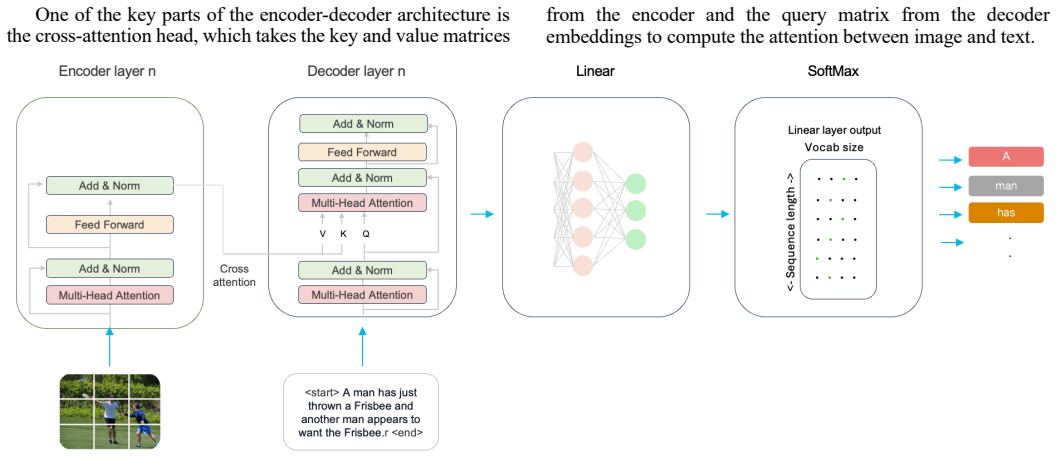
The load-bearing mechanism is an encoder-decoder transformer with a cross-attention head: a vision encoder turns an image into patch embeddings, and a text decoder generates the caption autoregressively by attending to those embeddings. The compact configurations are built from knowledge-distilled variants—DeiT tiny (and its distillation-token version) for vision, and TinyBERT or Transformer TINY for text—which provide most of the parameter reduction. Fine-tuning these pre-trained pairings on an 18,000-image COCO subset, with batch size 16, learning rate 5e-5, and early stopping over up to 18 epochs, is the procedure that turns the individual compressed models into a working captioning system.
What would settle it
Run each encoder-decoder combination on several random 18,000-image subsets of COCO 2014 with multiple random seeds, evaluate ROUGE-1 on a fixed held-out set, and time inference over repeated warm runs on the same single vCPU. If a compact model falls below 90% of its teacher's ROUGE-1, or the 12.5x speedup varies widely between runs, the central claim fails.
Extended reading notes
Core claim
The central discovery is that a distilled encoder-decoder pairing, fine-tuned from pre-trained weights on 18,000 COCO images, can preserve most captioning performance at a fraction of the footprint. Concretely, the paper reports that Distilled DeiT tiny + TinyBERT reached 95% of the ROUGE-1 score of the DeiT + BERT teacher with about 90% fewer parameters (21.6M vs 224.3M), while DeiT tiny + Transformer TINY kept 90% of teacher ROUGE-1 with a 95% parameter reduction and 12.5x faster inference (0.193s vs 2.404s per image on one vCPU). All compact configurations used less than 1GB of memory during inference, the smallest weight files were 41MB, and the compact models required more training data than the teachers to reach stable, scene-aligned captions. The paper reads these results as evidence that transformer-based image captioning can be made to work in compute-light edge environments.
Load-bearing premise
The central figures assume that one hand-selected 18,000-image subset of COCO 2014 and one CPU timing session are representative of true model performance; if the subset is biased or the timing noisy, the reported retention and speedup ratios may not reproduce.
Editorial extensions
If this is right
- A single-vCPU edge device can caption an image in about 0.19-0.44s with less than 1GB memory, putting real-time scene description within reach of IoT and robotics hardware.
- Model weight storage drops from 897MB to 41-86MB, so image captioning models can be embedded in firmware or shipped over constrained networks.
- Compact models need more training data than teachers; increasing the fine-tuning set from 9,000 to 18,000 images was required to align captions with scene content.
- Layer-freezing is not a reliable fine-tuning shortcut for compact variants; unfreezing all layers produced stable convergence and better scores, meaning edge model updates still require full fine-tuning compute.
- The 90-95% ROUGE-1 retention suggests distillation preserves word-level caption content, though the paper's own examples show richer context in teacher captions and simpler descriptions in student captions.
Reading between the lines
- Because the paper reports a single fine-tuning run and a single CPU timing session on a hand-selected 18,000-image subset, the exact 90-95% and 12.5x ratios are best read as estimates; repeated runs across random subsets and seeds would reveal the variance behind those figures.
- ROUGE-1 measures unigram overlap, not caption quality; the same model pairs could score differently on CIDEr or human ratings, and the paper's own examples show students produce simpler captions.
- The speedup is reported on one vCPU; on GPU or batched inference the relative advantage may shrink, but the sub-1GB memory footprint remains the more portable result for edge deployment.
- A natural extension is to map the data-versus-parameters tradeoff: if compact models need more data to reach teacher quality, an optimal student size may exist for a fixed data budget, and this paper's 9,000-versus-18,000 comparison is a first hint.
Editorial analysis
A structured set of objections, weighed in public.
Referee Report
Summary. The paper reports an empirical study of six encoder-decoder transformer combinations for image captioning on edge devices: ViT/DeiT, DeiT tiny, and Distilled DeiT tiny encoders paired with BERT, TinyBERT, and Transformer TINY decoders. All models are fine-tuned on an 18,000-image subset of COCO 2014 with 1,000 validation samples, and evaluated with ROUGE and BLEU metrics, inference time on a single vCPU, and memory usage. The central claim is that compact distilled combinations reduce parameters by 90-95% while retaining 90-95% of teacher ROUGE-1 performance, require under 1GB of memory, and achieve up to a 12.5x inference speedup, making them suitable for edge image captioning. The paper also reports experiments with layer freezing and with a smaller 9,000-image training subset.
Significance. If the reported performance-retention ratios and speedups are reproducible, the paper provides a useful engineering benchmark for deploying transformer captioning models on resource-constrained hardware. The internal ranking of configurations is plausible: larger teachers score higher on ROUGE and BLEU, and distilled variants fall between teachers and the smallest models. The paper is honest in reporting that compact models needed larger training data and that layer freezing did not converge for all variants. However, the central quantitative claims currently rest on single runs with no variance reporting, an unspecified data subset, and incomplete measurement and decoding details, so the practical value of the benchmark cannot yet be assessed. The work introduces no new method, but that is not a defect for an applied evaluation study.
major comments (5)
- [Section III and Section IV.4] The training and validation subsets are not sufficiently described: the paper only states that 18,000 training and 1,000 validation samples from COCO 2014 were used, without specifying the sampling strategy, class distribution, or random seeds. This matters because Section IV.4 reports that 9,000 samples were insufficient for the compact models while 18,000 improved results, so the reported retention ratios may be specific to one favorable draw. A seeded multi-run evaluation with several subsets is needed before the 90-95% retention claim can be considered established.
- [Table III and Section V] The conclusion that compact variants maintain 90-95% of ROUGE-1 performance is not fully supported by Table III: DeiT tiny + Transformer TINY scores 0.3404 versus 0.3790 for DeiT + BERT, which is 89.8%, below the advertised 90% floor. Since no variance or confidence intervals are given, it is unclear whether this shortfall is reproducible or whether run-to-run variation could push other ratios outside the stated band. The conclusions should report the exact computed ratios and their uncertainty.
- [Table I and Table II] The parameter accounting is internally inconsistent: Table I lists BERT as 86M parameters and ViT/DeiT as 86M parameters, which sums to about 172M, while Table II reports the combined ViT + BERT model as 224,270,394 parameters. The unexplained difference of roughly 52M parameters means the advertised 90-95% parameter reduction cannot be precisely verified from the reported numbers.
- [Table IV and Section IV.2] The inference-time and memory measurements are reported as single values with no experimental protocol: the paper does not specify how many runs were averaged, whether warm-up was performed, the CPU governor or virtualization overhead of WSL2, or how memory usage was measured. Memory figures are rounded approximations ('~2GB', '~850MB'), and the 12.5x speedup is derived from single point measurements. Repeating the timing and memory experiments is necessary to support the edge-viability claim.
- [Section III and Table III] The evaluation procedure is under-specified: the paper does not state the decoding scheme (greedy versus beam search, beam width), the maximum caption length, or the exact ROUGE and BLEU implementations and tokenization rules. These choices materially change BLEU and ROUGE scores, so the absolute numbers in Table III are not reproducible from the text alone.
minor comments (5)
- [General] The manuscript contains several typos and formatting issues, including 'auto-progressively' for 'autoregressively' in Section I and 'CONCULSIONS' as the heading of Section V.
- [Table V] Table V is referenced in Section IV.5 but the caption examples are not included in the submitted text, so the qualitative claim that student models provide 'basic description that align with the scenes' cannot be evaluated.
- [References] References [9] and [11] point to blog tutorials rather than archival or peer-reviewed sources; citing the underlying Hugging Face library documentation or a formal paper would be more appropriate for reproducibility.
- [Section IV.2] The speedup comparison uses the slowest teacher (ViT + BERT) against the fastest student (DeiT tiny + Transformer TINY); while 'up to 12.5x' is technically accurate, a paired comparison of the same architecture family or a table of all pairwise speedups would be more informative.
- [Abstract and Section V] The paper does not discuss limitations such as the absence of statistical significance testing, the restricted domain of COCO images, or the lack of comparison with prior model-compression work for image captioning, including reference [12] cited in the related work.
Circularity Check
No circularity: the paper is an empirical benchmark with external evaluation metrics and no self-referential derivation.
full rationale
The paper's central claim is that distilled compact transformer combinations retain 90-95% of teacher ROUGE-1 performance with large parameter reductions and faster inference. This claim is supported by direct measurements: models are fine-tuned on COCO 2014 and evaluated on COCO validation using ROUGE and BLEU, which are external metrics independent of the training procedure. The retention ratios are simple arithmetic comparisons of measured scores (e.g., 0.3596/0.3790), not predictions derived from fitted parameters. The memory and inference-time results are similarly measured, not inferred from a model. There are no self-citations, no unique-theorem imports, and no ansatz smuggled via citation; the method relies on publicly pre-trained models and standard fine-tuning. The only concerns are methodological robustness (single run, unspecified subset sampling), which affect trustworthiness but do not constitute circularity. Therefore, the appropriate circularity score is 0.
Assumptions & free parameters
free parameters (3)
- Training subset size =
18,000 images
- Fine-tuning hyperparameters =
batch size 16, learning rate 5e-5, 18 epochs, early stopping
- Performance retention criterion =
90-95% of teacher ROUGE-1
assumptions (4)
- domain assumption COCO 2014 human captions are valid ground truth for captioning quality.
- domain assumption ROUGE and BLEU n-gram overlap adequately measure caption quality for edge applications.
- domain assumption Pretrained ViT, DeiT, BERT, TinyBERT, and Transformer TINY weights remain effective after fine-tuning on a small COCO subset.
- domain assumption The WSL2 environment on a Lenovo Thinkpad with 1 vCPU and 4GB RAM is representative of practical edge devices.
Cite this review
Pith. "Pith review of Analyzing Transformer Models and Knowledge Distillation Approaches for Image Captioning on Edge AI." pith.science (2026). https://pith.science/paper/QT6PSAAL
@misc{pith2026250603607,
  author       = {Pith},
  title        = {Pith review of: Analyzing Transformer Models and Knowledge Distillation Approaches for Image Captioning on Edge AI},
  year         = {2026},
  howpublished = {\url{https://pith.science/paper/QT6PSAAL}},
  note         = {Machine review of arXiv:2506.03607}
}
read the original abstract
Edge computing decentralizes processing power to network edge, enabling real-time AI-driven decision-making in IoT applications. In industrial automation such as robotics and rugged edge AI, real-time perception and intelligence are critical for autonomous operations. Deploying transformer-based image captioning models at the edge can enhance machine perception, improve scene understanding for autonomous robots, and aid in industrial inspection. However, these edge or IoT devices are often constrained in computational resources for physical agility, yet they have strict response time requirements. Traditional deep learning models can be too large and computationally demanding for these devices. In this research, we present findings of transformer-based models for image captioning that operate effectively on edge devices. By evaluating resource-effective transformer models and applying knowledge distillation techniques, we demonstrate inference can be accelerated on resource-constrained devices while maintaining model performance using these techniques.
Figures

Reference graph
Works this paper leans on
-
[5]
Generated captions Table V provides a comparison of captions generated by each encoder-decoder combination. It shows that the teacher models offer richer context, while the student models can provide basic description that align with the scenes. V. CONCULSIONS In this research, we have demonstrated the effectiveness of integrating vision and language tran...
arXiv 2010
-
[14]
BLEU: a Method for Automatic Evaluation of Machine Translation
Kishore Papineni, Salim Roukos, Todd Ward, Wei-Jing Zhu, “BLEU: a Method for Automatic Evaluation of Machine Translation”. [Online]. Available: https://aclanthology.org/P02-1040.pdf [15] Felix Petersen, Hilde Kuehne, Christian Borgelt, Oliver Deussen, “Differentiable Top-k Classification Learning”. [Online]. Available: https://arxiv.org/abs/2206.07290 [16...
arXiv 2006
Reviewed August 7, 2026 · model on record in the stance chip above.
Discussion (0). Sign in to comment.