REVIEW 3 major objections 5 minor 23 references
Analyzing the structure of basic quantum knowledge for instruction
T0 review · 3 major / 5 minor · reviewed 2026-08-14 · deepseek-v4-flash
Pith's one-line read Seven concept maps reveal the organizing principles of quantum knowledge for instruction.
desk verdict A transparent, useful qualitative synthesis that builds seven concept maps for organizing undergraduate QM knowledge, with an explicit but untested assumption at its core. read the letter →
The pith
A machine-rendered reading of the paper's core claim, the machinery that carries it, and where it could break.
The reading
What carries the argument
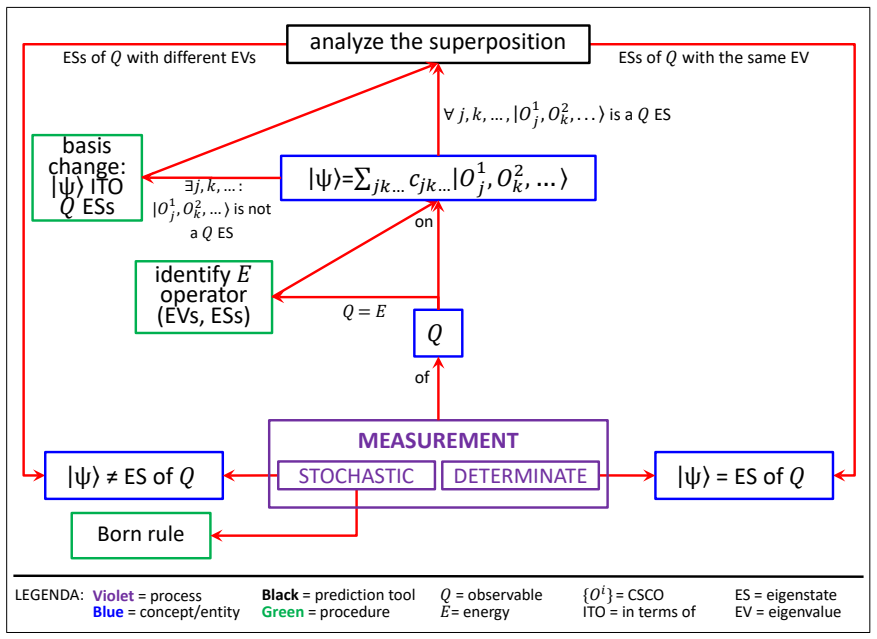
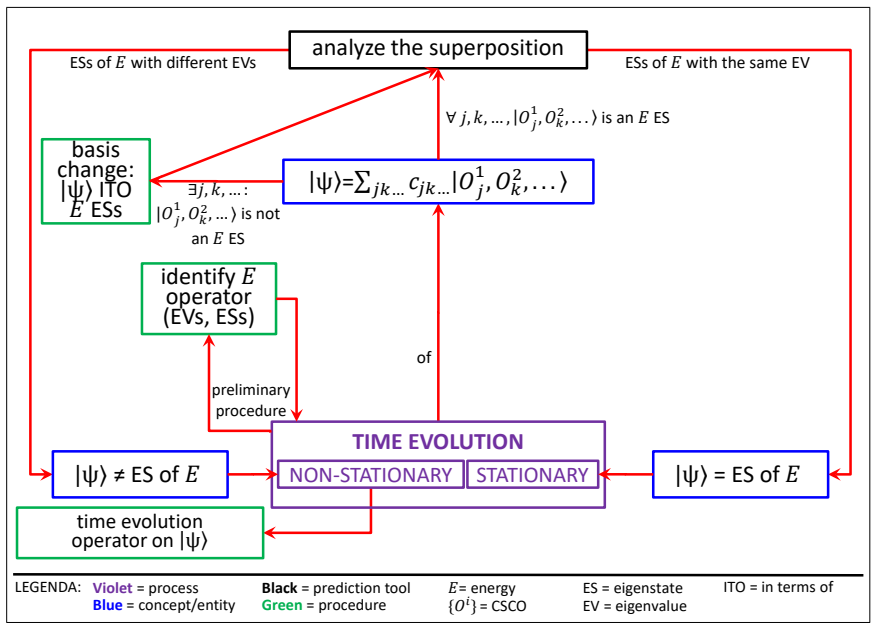
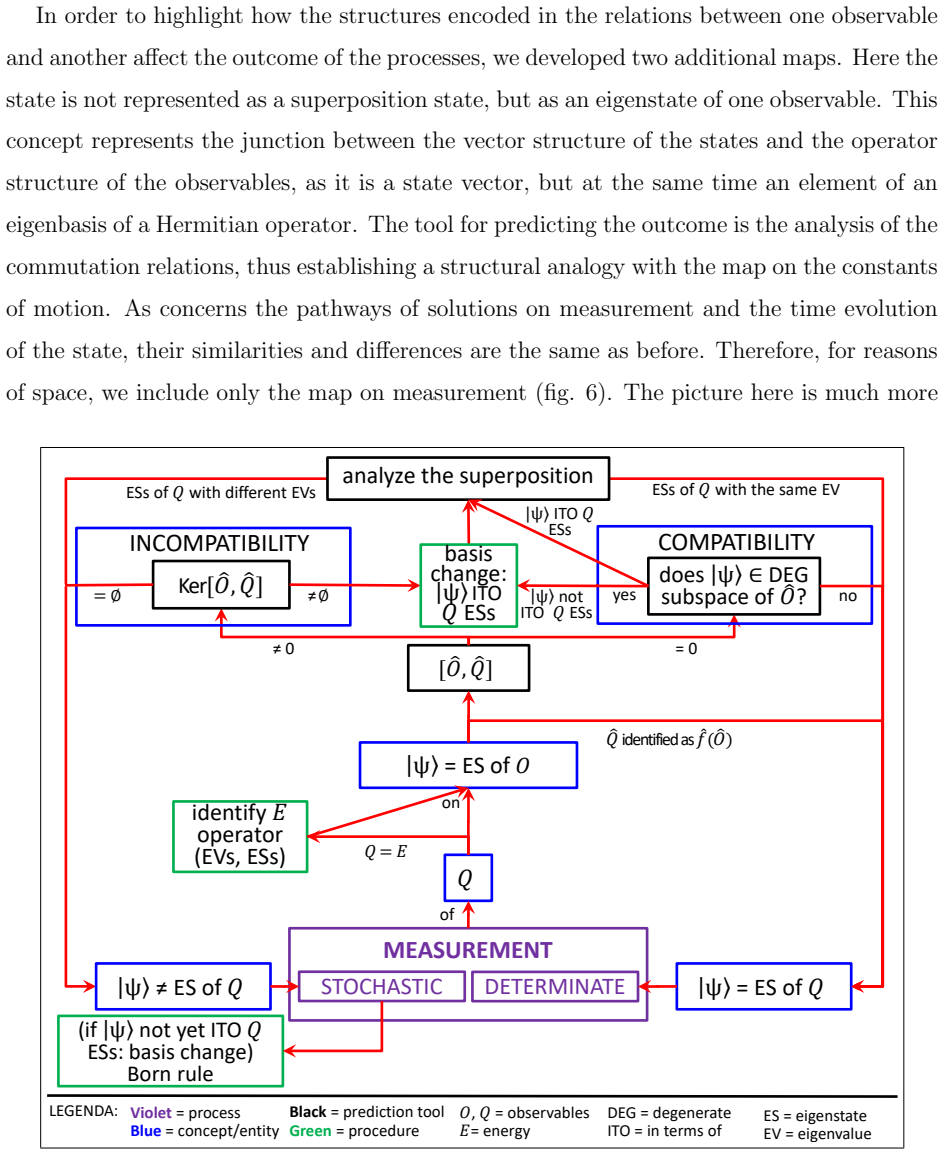
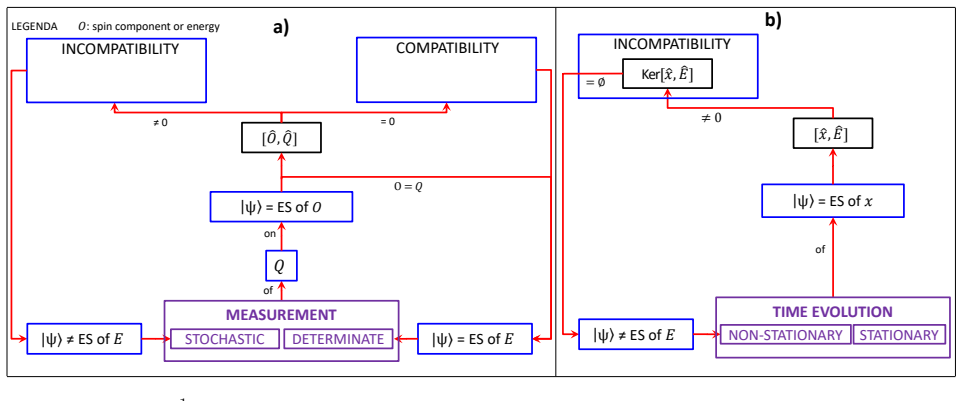
The central objects are the seven concept maps themselves, each a flowchart linking a requested quantum process (measurement of an observable, time evolution of a state, or time evolution of a probability distribution) to qualitative and quantitative predictions. Each map is built from boxes for processes, concepts/entities, prediction tools, and procedures, with the vector structure of quantum states (superpositions of eigenstates of a complete set of commuting observables) and the operator structure of observables (eigenbases, commutators, degeneracy) as the two interacting layers. The two core prediction tools are the analysis of the superposition and the analysis of the commutation relations; the ancillary procedures are the change of basis, the identification of the energy operator, the Born rule, the time evolution operator, and the generalized Ehrenfest theorem. The maps also show how information about the two processes is encoded in the modulus and the relative phases of probability amplitudes in a common eigenbasis.
What would settle it
If a fresh categorization study of quantum mechanics problems found that faculty's best-scoring categories are based on fundamental principles such as conservation laws rather than on the processes of measurement and time evolution, the paper's central claim would be undercut.
Extended reading notes
Core claim
The central claim is that the seven concept maps are models of the organizing principles of non-relativistic quantum mechanics: the intertwined concepts of measurement, time evolution, state, observable, eigenstate, superposition, and compatibility/incompatibility relations between observables, together with the attached prediction tools (analysis of the superposition, analysis of the commutation relations) and ancillary procedures (change of basis, identification of energy eigenstates, Born rule, time evolution operator, generalized Ehrenfest theorem). The maps show that measurement of an observable and time evolution of a state follow structurally parallel pathways: represent the state in a common eigenbasis of a complete set of commuting observables, analyze the superposition or the commutation relations, then apply the Born rule or the time evolution operator. The paper further claims that the relations between observables, not just superposition, carry much of the explanatory load, and that the incompatibility of observables is what generates time evolution and discrete spectra.
Load-bearing premise
The load-bearing premise is that the best-scoring categories in the categorization study used by the paper reflect a highly organized expert knowledge of quantum mechanics, and that collecting them under the labels Measurement, Time Evolution, and Change of Basis correctly identifies the two core processes that organize the subject.
Editorial extensions
If this is right
- Instructors can use the maps as a visual scaffold to walk students through measurement and time evolution problems in any context, connecting each new Hamiltonian to the same global structure.
- The framework indicates that a spin-first approach is better suited to building the organizing principles gradually, because spin-1/2 lets each box of the map be introduced one step at a time, while a waves-first approach forces degeneracy and non-empty commutator kernels almost immediately.
- The maps separate the mathematical recipes from interpretive commitments, since what happens during measurement is deliberately left out, so they can be adopted in courses with different interpretive stances.
- The maps identify the relations between observables, compatibility and incompatibility, as a central explanatory resource, suggesting that instruction should emphasize them more than traditional presentations do.
- The maps supply a structured basis for designing research instruments on student understanding, for instance on the physical information encoded in relative phases of superposition states.
Reading between the lines
- Because the maps treat measurement and time evolution as the two umbrella processes, a natural testable extension is to use them to generate diagnostic questions that probe whether students can transfer a single pathway across contexts such as spin, harmonic oscillator, and hydrogen atom.
- The structural parallel between the measurement map and the time-evolution map suggests an untested instructional hypothesis: explicitly teaching the parallel may help students see stationary states and determinate outcomes as the same kind of 'no superposition in the relevant basis' situation.
- The author's observation that incompatibility generates time evolution and discrete spectra could be developed into a course-level narrative where the commutator is the central object, but the paper does not itself test whether such a narrative improves long-term retention.
- The maps' reliance on complete sets of commuting observables with discrete spectra leaves continuous-spectrum cases to a brief remark; a concrete extension would be to verify whether students can adapt the discrete maps to position and momentum problems without additional scaffolding.
Signed reviews
Editorial analysis
A structured set of objections, weighed in public.
Referee Report
Summary. The paper proposes seven concept maps as models of the organizing principles of basic non-relativistic quantum mechanics, derived from a combination of a published categorization study, content analysis of four undergraduate textbooks, and a review of student difficulties. The maps are organized around two processes, measurement and time evolution, plus change of basis, and are used to argue that a spin-first approach is preferable to a waves-first approach and to sketch a high-school teaching-learning sequence. The central claim is that these maps make visible the interplay between the vector structure of quantum states and the operator structure of observables.
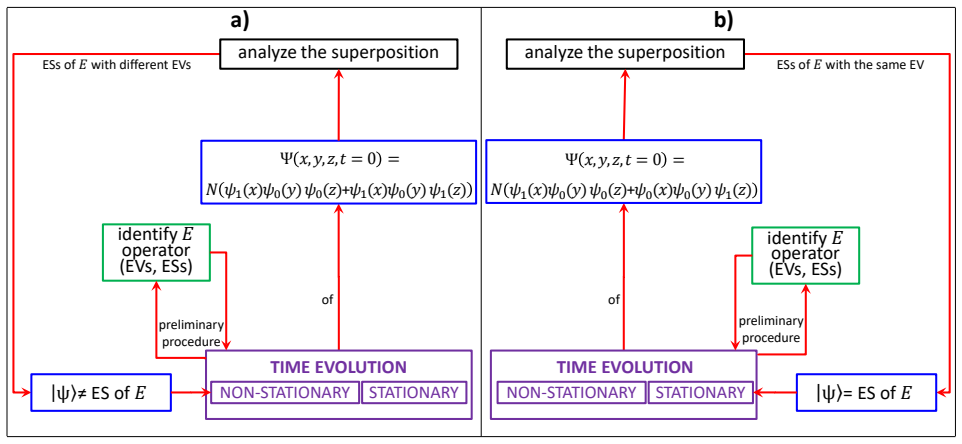
Significance. The paper has several strengths. The reasoning is transparent, and the author explicitly labels the key premise in Sec. III as an assumption. The maps are concrete, well-illustrated tools that could be immediately useful for instructors and for designing interview instruments; the inclusion of worked examples in Figs. 4, 5, and 7 makes the proposals concrete. The paper also respects interpretive pluralism by excluding the projection postulate from the maps. However, the maps are a qualitative, unvalidated model: there is no empirical test of the hypothesized organizing principles, no inter-rater reliability for the content analysis, and the spin-first recommendation rests on an untested pedagogical criterion. These gaps are fixable within the manuscript's scope by reframing the claim as a proposal or by adding a validation study; they do not amount to a logical contradiction.
major comments (3)
- [Sec. III, paragraph 2] The assumption that "categories with the best score (5-6) reflect a highly organized knowledge of the subject" is load-bearing, but it is not tested. Lin and Singh's categories are labels for similarity of solution among 20 problems; they are not independently established measures of deep knowledge structure. The subsequent grouping of categories such as "expectation-value and uncertainty" into the single label "Measurement" in Table I is an interpretive step with no inter-rater reliability. Because the maps, the centrality of the measurement/time-evolution dichotomy, and the spin-first recommendation all depend on this step, the empirical grounding of the central claim is not yet established.
- [Sec. IV.A, content analysis of textbooks] The content analysis from which the first three maps "directly emerge" is not described in enough detail to be reproduced. The text does not specify the units of analysis, the inclusion/exclusion criteria for textbook passages, the coding scheme, or inter-rater reliability. Since the textbooks already adopt one of two pedagogical approaches, reading them through the measurement/time-evolution lens could confirm the lens rather than independently support it. A neutral criterion for why these two processes, rather than others, are fundamental is missing.
- [Sec. VI, gradual construction of the maps] The gradual-construction argument for spin-first rests on an additional assumption, namely that a course should build the maps piece by piece in the order described. This pedagogical criterion is not derived from the categorization data or the textbook analysis, and no learning-outcome evidence is presented for the sequence in Sec. VI. The conclusion that a spin-first approach is "more suitable" is therefore an instructional hypothesis rather than an implication of the maps.
minor comments (5)
- [Sec. IV.A and figures] The paper says "seven concept maps" but only the measurement map is shown for the eigenstate case; the time-evolution analogue is described but not explicitly drawn. Adding it or explicitly renumbering the maps would help readers verify the count.
- [References] The typo "Phisics" appears in reference 17 and should be corrected.
- [Sec. IV.A and figures] The text should clarify the distinction between the seven maps and the additional example figures (Figs. 4, 5, and 9), since the latter are applications or pedagogical sequences rather than independent maps.
- [Sec. III, first paragraph] The sentence "about 8/13 pages dedicated to the presentation of reasoning difficulties" mixes a fraction with two page lengths; consider using a consistent page-count format.
- [Sec. V, third use of maps] The third suggested use of the maps (students on their own) is not accompanied by any evidence or practical guidance on how students would learn to use the maps; a citation or brief description would be helpful.
Circularity Check
No circular derivation; central claim is an interpretive synthesis of external categorization data and textbook content, with only minor non-load-bearing self-citations.
full rationale
The paper does not derive a quantitative prediction from fitted parameters, and its central claim (seven concept maps as organizing principles) is built from external inputs: the Lin and Singh categorization study, four textbooks, and the Singh–Marshman review of student difficulties. The grouping of best-scoring categories into Measurement, Time Evolution, and Change of Basis is an explicit interpretive aggregation of an external study (Sec. III), not a conclusion that feeds back into its own evidence. The maps themselves are presented as models of pathways found in textbooks (Sec. IV.A), and the spin-first recommendation (Sec. VI) is an educational argument from the gradual construction of those maps, not a forced consequence of the maps' construction. The only self-citations, refs. [5] and [22], support the claim that relative-phase interpretation is difficult for graduate students and that a related survey was developed; neither is load-bearing for the derivation of the maps. The paper also explicitly states its key assumption: 'we assumed that categories with the best score (5-6) reflect a highly organized knowledge of the subject' — an assumption, not a circular step. Accordingly, no step reduces by construction to an input; the proper concerns are interpretive and empirical, not circular.
Assumptions & free parameters
assumptions (4)
- domain assumption Categories with the best score (5-6) from the Lin and Singh categorization study reflect a highly organized knowledge of the subject.
- domain assumption The two processes, measurement and time evolution, are the fundamental processes that need to be explained in basic QM.
- domain assumption Content analysis of four textbooks (Griffiths, Gasiorowicz, McIntyre, Townsend) is sufficient to identify the generally valid sequences for measurement and time evolution.
- domain assumption The maps can be adapted to different interpretive stances and still serve as models of organizing principles.
Cite this review
Pith. "Pith review of Analyzing the structure of basic quantum knowledge for instruction." pith.science (2026). https://pith.science/paper/QTINHXLU
@misc{pith2026190804231,
  author       = {Pith},
  title        = {Pith review of: Analyzing the structure of basic quantum knowledge for instruction},
  year         = {2026},
  howpublished = {\url{https://pith.science/paper/QTINHXLU}},
  note         = {Machine review of arXiv:1908.04231}
}
read the original abstract
In order to support students in the development of expertise in quantum mechanics, we asked which concepts and structures can act as organizing principles of the non-relativistic theory. The research question has been addressed in a multi-step process based on the analysis of categorization studies, on a content analysis of a sample of undergraduate textbooks and on the results of existing research on learning difficulties. The answer consists in seven concept maps, intended as models of the organizing principles of quantum knowledge needed to account for the results of measurement and time evolution. By means of these instruments, it is possible to visualize and explore the different facets of the interplay between the vector structure of the quantum states and the operator structure of the observables, and to highlight the educational significance of the relations between observables. The maps can be used by instructors as a support for helping students build a well-organized knowledge structure and by researchers as a basis for the design of investigations into student understanding. While this framework may be adapted to different approaches and interpretive stances, it provides indications in favor of a spin-first approach over a waves-first one.
Figures

Figures from the paper (6 more)



Reference graph
Works this paper leans on
-
[1]
E. Marshman and C. Singh, ``Framework for understanding the patterns of student difficulties in quantum mechanics,'' Physical Review Special Topics - Physics Education Research 11, 020119-1-26 (2015)
work page 2015
-
[2]
C. Singh, ``Student understanding of quantum mechanics at the beginning of graduate instruction,'' American Journal of Physics 76(3), 277-287 (2008)
work page 2008
-
[3]
C. Singh, ``Student understanding of quantum mechanics,'' American Journal of Physics 69(8), 885-895 (2001)
work page 2001
-
[4]
L. D. Carr and S. B. McKagan, ``Graduate quantum mechanics reform,'' American Journal of Physics 77(4), 308-319 (2009)
work page 2009
-
[5]
M. Michelini and G. Zuccarini, ``University students’ reasoning on physical information encoded in quantum state at a point in time'', in 2014 PERC Proceedings, edited by P. Engelhardt, A. Churukian, and D. Jones (Minneapolis, MN, 2014), pp. 187-190
work page 2014
-
[6]
P. J. Emigh, G. Passante, and P. S. Shaffer, ``Student understanding of time dependence in quantum mechanics Paul,'' Physical Review Special Topics - Physics Education Research 11, 020112-1-12 (2015)
work page 2015
-
[7]
G. Passante, P. J. Emigh, and P. S. Shaffer, ``Examining student ideas about energy measurements on quantum states across undergraduate and graduate levels,'' Physical Review Special Topics - Physics Education Research 11, 020111-1-10 (2015)
work page 2015
-
[8]
S. Y. Lin and C. Singh, ``Categorization of quantum mechanics problems by professors and students,'' European Journal of Physics 31, 57-68 (2010)
work page 2010
Show all 23 references
-
[9]
N. L. Harshman, ``Introduction to Quantum Mechanics (3 rd ed.),'' American Journal of Physics 87(3), 237-239 (2019)
2019
-
[10]
Krijtenburg-Lewerissa, H
K. Krijtenburg-Lewerissa, H. J. Pol, A. Brinkman, and W. R. Van Joolingen, ``Insights into teaching quantum mechanics in secondary and lower undergraduate education,'' Physical Review Special Topics - Physics Education Research 13, 1 (2017)
2017
-
[11]
National Research Council, How people learn: Brain, mind, experience, and school: Expanded edition (National Academy Press, Washington, D.C., 2000)
2000
-
[12]
J. P. Mestre, ``Implications of research on learning for the education of prospective science and physics teachers,'' Physics Education 36, 44-51 (2001)
2001
-
[13]
D. H. McIntyre, C. A. Manogue, and J. Tate, Quantum Mechanics: A Paradigms Approach (Pearson Addison-Wesley, San Francisco, CA, 2012)
2012
-
[14]
R. Duit, H. Gropengiesser, U. Kattmann, M. Komorek, and I. Parchmann, ``The model of educational reconstruction - a framework for improving teaching and learning science,'' in Science Education Research and Practice in Europe, edited by D. Jorde and J. Dillon (SENSE Publishers...
2012
-
[15]
M. T. H. Chi, P. J. Feltovich, and R. Glaser, ``Categorization and representation of physics problems by experts and novices,'' Cognitive Science 5, 121-152 (1981)
1981
-
[16]
J. L. Docktor and J. P. Mestre, ``Synthesis of discipline-based education research in Physics,'' Physical Review Special Topics - Physics Education Research 10, 020119-1-58 (2014)
2014
-
[17]
Singh and E
C. Singh and E. Marshman, ``Review of student difficulties in upper-level quantum mechanics,'' Physical Review Special Topics - Phisics Education Research 11, 020117-1-24 (2015)
2015
-
[18]
D. J. Griffiths and D. F. Schroeter, Introduction to Quantum Mechanics, 3rd edition (Cambridge University Press, Cambridge, United Kingdom, 2018)
2018
-
[19]
Dubson, S
M. Dubson, S. Goldhaber, S. J. Pollock, and K. K. Perkins, ``Faculty disagreement about the teaching of quantum mechanics'', in 2009 PERC Proceedings, edited by M. Sabella, C. Singh, and C. Henderson (Ann Arbor, MI, 2009), pp. 137-140
2009
-
[20]
Gasiorowicz, Quantum Physics, 3rd edition (John Wiley & Sons, Hoboken, NJ, 2003)
S. Gasiorowicz, Quantum Physics, 3rd edition (John Wiley & Sons, Hoboken, NJ, 2003)
2003
-
[21]
J. S. Townsend, A Modern Approach to Quantum Mechanics, 2nd edition (University Science Books, Sausalito, CA, 2012)
2012
-
[22]
T. Wan, P. J. Emigh, and P. S. Shaffer, ``Student understanding of the measurable effects of relative phases in superposition states,'' in 2017 PERC Proceedings, edited by L. Ding, A. Traxler, and Y. Cao (Cincinnati, OH, 2017), pp. 420-423
2017
-
[23]
National Research Council, Learning and understanding: Improving advanced study of mathematics and science in US high schools (National Academy Press, Washington, D.C., 2002)
2002
Reviewed August 14, 2026 · model on record in the stance chip above.
Discussion (0). Continue with ORCID to comment.