Schr\"odingerization based quantum algorithms for regularized Wasserstein proximal operators
Pith reviewed 2026-06-30 09:12 UTC · model grok-4.3
The pith
Quantum algorithm for regularized Wasserstein proximal operators achieves O(d N_x T log²(1/ε)) query complexity via Schrödingerization.
A machine-rendered reading of the paper's core claim, the machinery that carries it, and where it could break.
Core claim
By applying the Cole-Hopf transformation to the regularized forward-backward PDE system, both the Fokker-Planck and viscous Hamilton-Jacobi equations become forward heat equations. Schrödingerization solves these heat equations, while the required Hadamard division for initial data and Hadamard product for terminal density recovery are realized as matrix-vector multiplications. The complete quantum algorithm therefore prepares an ε-approximation of the terminal density state with O(d N_x T log²(1/ε)) query complexity, up to constants that depend on the potential and initial density but remain independent of d and N_x.
What carries the argument
Schrödingerization method applied to the pair of heat equations obtained from the Cole-Hopf transformation, together with matrix representations of the Hadamard division and product operations.
If this is right
- The terminal density state can be approximated with only logarithmic dependence on the error tolerance ε.
- The query cost grows linearly with spatial dimension d and with the number of grid points N_x per dimension.
- The algorithm supplies an exponential advantage over classical methods whose per-step cost scales as N_x^d.
- The approach directly applies to the proximal step arising in mean-field games and related variational problems.
Where Pith is reading between the lines
- If the stated polylog overhead is achieved, the same transformation pipeline could be reused for other regularized transport problems whose governing equations admit Cole-Hopf linearization.
- The matrix representations of Hadamard operations may combine with other quantum linear-system solvers to address broader classes of nonlinear PDEs.
- Practical verification on small quantum devices would test whether the hidden constants remain modest when d and N_x are moderate.
Load-bearing premise
The Cole-Hopf transformation together with Schrödingerization and the matrix realizations of Hadamard division and product can be implemented with only polylogarithmic overhead in 1/ε whose constants stay independent of dimension d and grid size N_x.
What would settle it
A concrete calculation or experiment on a sequence of increasing d and N_x that shows the total number of queries or gates grows exponentially rather than linearly with d N_x would falsify the claimed complexity.
Figures
read the original abstract
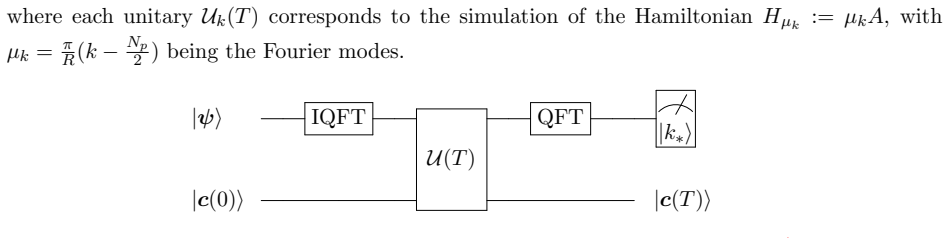
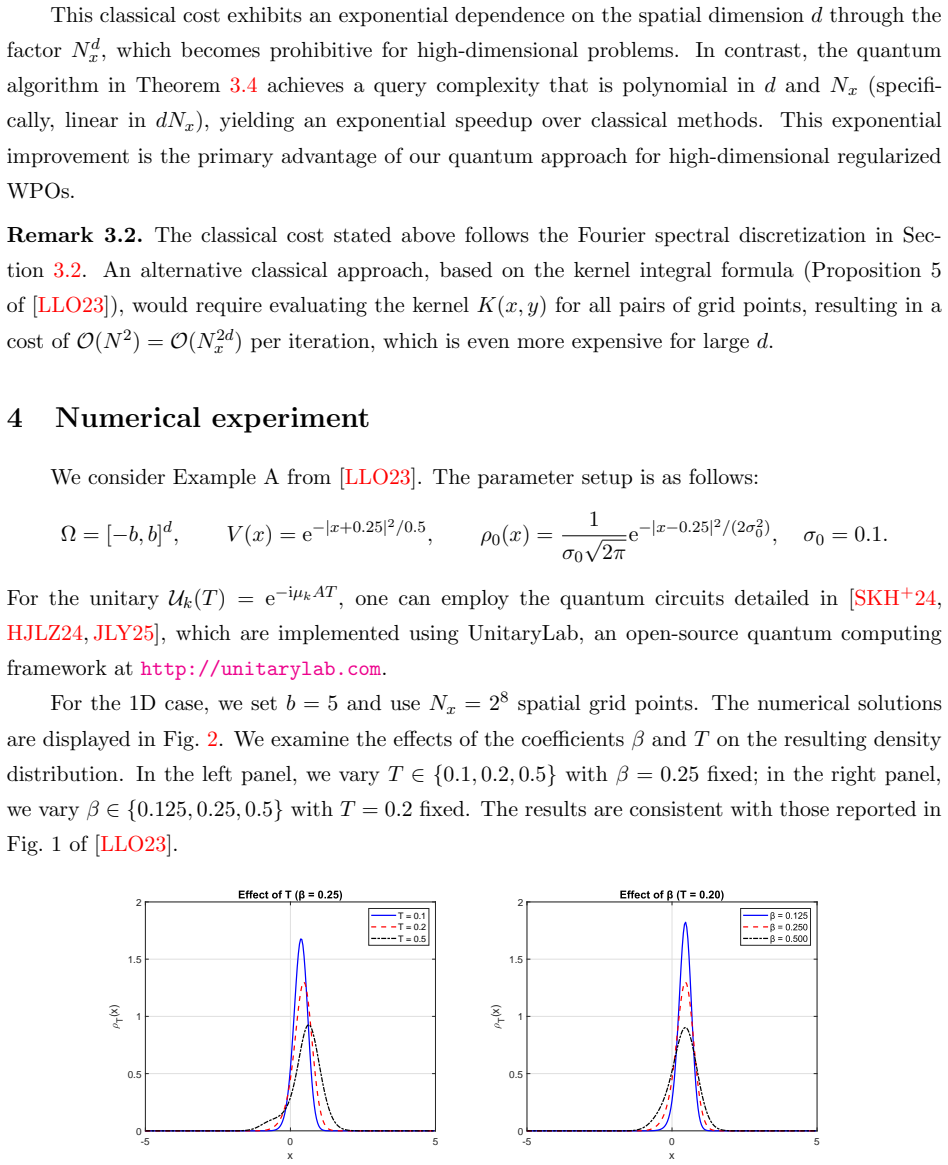
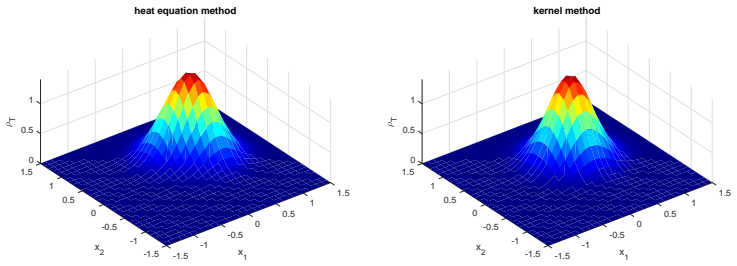
We develop a quantum algorithm for the regularized Wasserstein proximal operator, which is a fundamental tool in optimal transport and mean-field games. The regularization introduces a small diffusive term into the continuity equation of the Benamou-Brenier formulation, which results in a forward-backward PDE system consisting of a Fokker-Planck equation and a viscous Hamilton-Jacobi equation with a quadratic Hamiltonian. Through the Cole-Hopf transformation, both equations are converted to forward heat equations, whose coupling requires a Hadamard division to prepare the initial data for the second heat equation and a Hadamard product to recover the terminal density. We solve these heat equations via the Schr\"odingerization method and implement the Hadamard division and product operations using simple matrix-vector multiplication representations. The complete quantum algorithm prepares an $\varepsilon$-approximation of the terminal density state with $\mathcal{O}(d N_x T \log^2(1/\varepsilon))$ query complexity, up to constants depending on the potential and initial density, where $d$ is the spatial dimension, $N_x$ is the number of grid points per spatial dimension and $T$ is the evolution time. The complexity depends only {\it linearly} on $d N_x$, yielding an {\it exponential} speedup over classical methods, whose cost scales as $N_x^d$ per time step. Numerical experiments validate the effectiveness of the proposed algorithm.
Editorial analysis
A structured set of objections, weighed in public.
Referee Report
Summary. The paper develops a quantum algorithm for the regularized Wasserstein proximal operator arising in optimal transport and mean-field games. Starting from the Benamou-Brenier formulation with diffusive regularization, it obtains a forward-backward PDE system (Fokker-Planck and viscous Hamilton-Jacobi), applies the Cole-Hopf transformation to convert both equations to forward heat equations, handles their coupling via Hadamard division (to prepare initial data) and Hadamard product (to recover the terminal density), and solves the heat equations with the Schrödingerization method. The central claim is that the complete algorithm prepares an ε-approximation of the terminal density state with query complexity O(d N_x T log²(1/ε)), up to constants depending on the potential and initial density, yielding an exponential speedup over classical methods whose cost scales as N_x^d per time step.
Significance. If the stated complexity bound holds with the claimed polylog(1/ε) overhead and d-, N_x-independent constants, the result would constitute a meaningful contribution to quantum algorithms for high-dimensional optimal transport, directly addressing the curse of dimensionality that limits classical grid-based methods. The explicit use of Schrödingerization to obtain linear scaling in d N_x, together with the concrete matrix-vector realizations of the Hadamard operations, is a technical strength worth crediting.
major comments (1)
- [Abstract] Abstract (complexity paragraph): The O(d N_x T log²(1/ε)) query complexity is load-bearing for the exponential-speedup claim, yet the manuscript provides no explicit matrix constructions or norm/condition-number bounds for the Hadamard-division and Hadamard-product operators. Without these bounds it is impossible to verify that their quantum simulation cost is absorbed into the stated polylog(1/ε) factor and remains independent of d and N_x, as required by the weakest assumption underlying the linear scaling.
Simulated Author's Rebuttal
We thank the referee for the careful reading and for identifying the need for additional detail on the Hadamard operations to support the complexity claim. We address the comment below.
read point-by-point responses
-
Referee: [Abstract] Abstract (complexity paragraph): The O(d N_x T log²(1/ε)) query complexity is load-bearing for the exponential-speedup claim, yet the manuscript provides no explicit matrix constructions or norm/condition-number bounds for the Hadamard-division and Hadamard-product operators. Without these bounds it is impossible to verify that their quantum simulation cost is absorbed into the stated polylog(1/ε) factor and remains independent of d and N_x, as required by the weakest assumption underlying the linear scaling.
Authors: We agree that explicit matrix constructions together with norm and condition-number bounds are required to rigorously confirm that the Hadamard operations contribute only a polylog(1/ε) factor independent of d and N_x. The manuscript states that these operations are realized via simple matrix-vector multiplications, but does not supply the concrete matrices or the accompanying bounds. In the revised version we will add a dedicated subsection that (i) gives the explicit matrix representations for both the Hadamard division (used to prepare initial data) and the Hadamard product (used to recover the terminal density), and (ii) proves that the operator norms and condition numbers of these matrices are bounded by quantities depending only on the potential and the initial density, hence independent of d and N_x. With these additions the simulation cost of the Hadamard steps is absorbed into the stated O(log²(1/ε)) overhead, preserving the overall O(d N_x T log²(1/ε)) query complexity. revision: yes
Circularity Check
No significant circularity; derivation rests on external Schrödingerization and standard transformations
full rationale
The paper converts the regularized proximal operator PDEs via the known Cole-Hopf transformation to coupled heat equations, solves them with the Schrödingerization method (treated as an external technique), and realizes Hadamard division/product via matrix-vector multiplications. The O(d N_x T log²(1/ε)) query complexity is stated to follow from these steps with polylog(1/ε) overhead and constants independent of d and N_x in the regime of interest. No self-definitional loop, fitted parameter renamed as prediction, or load-bearing self-citation chain appears in the abstract or described chain; the central claim retains independent content from the cited external method and does not reduce to its own inputs by construction.
Axiom & Free-Parameter Ledger
axioms (2)
- domain assumption Cole-Hopf transformation converts the regularized continuity and Hamilton-Jacobi system into forward heat equations whose coupling is handled by Hadamard division and product.
- domain assumption Schrödingerization solves the resulting heat equations with O(N_x T log²(1/ε)) queries per dimension.
Reference graph
Works this paper leans on
-
[1]
Benamou and Y
J. Benamou and Y. Brenier. A computational fluid mechanics solution to the Monge-Kantorovich mass transfer problem. Numer. Math. , 84(3):375--393, 2000
2000
-
[2]
P. C. S. Costa, D. An, Y. R. Sanders, Y. Su, R. Babbush, and D. W. Berry. Optimal scaling quantum linear-systems solver via discrete adiabatic theorem. PRX quantum , 3(4):040303, 2022
2022
-
[3]
Chakraborty, A
S. Chakraborty, A. Gily\' e n, and S. Jeffery. The power of block-encoded matrix powers: improved regression techniques via faster H amiltonian simulation. In 46th International Colloquium on Automata, Languages, and Programming (ICALP 2019) , volume 132 of Leibniz International Proceedings in Informatics (LIPIcs) , pages 33:1--33:14, 2019
2019
-
[4]
Georgiou, and Michele Pavon
Yongxin Chen, Tryphon T. Georgiou, and Michele Pavon. On the relation between optimal transport and schr \"o dinger bridges: a stochastic control viewpoint. Journal of Optimization Theory and Applications , 169(2):671--691, 2016
2016
-
[5]
K. F. Caluya and A. Halder. Wasserstein proximal algorithms for the Schr\"odinger bridge problem: D ensity control with nonlinear drift. IEEE Trans. Autom. Control , 67(3):1163--1178, 2022
2022
- [6]
-
[7]
Mean field games and applications
Olivier Gu \'e ant, Jean-Michel Lasry, and Pierre-Louis Lions. Mean field games and applications. In Paris--Princeton Lectures on Mathematical Finance 2010 , volume 2003 of Lecture Notes in Mathematics , pages 205--266. Springer, 2011
2010
-
[8]
Gily\' e n, Y
A. Gily\' e n, Y. Su, G. Low, and N. Wiebe. Quantum singular value transformation and beyond: exponential improvements for quantum matrix arithmetics. In Proceedings of the 51st Annual ACM SIGACT Symposium on Theory of Computing , pages 193--204. STOC, 2019
2019
-
[9]
Mean field games equations with quadratic hamiltonian: a specific approach
Olivier Gu \'e ant. Mean field games equations with quadratic hamiltonian: a specific approach. Mathematical Models and Methods in Applied Sciences , 22(09):1250022, 2012
2012
-
[10]
J. Hu, S. Jin, N. Liu, and L. Zhang. Quantum circuits for partial differential equations via S chr\"odingerisation. Multiscale Model. Simulation , 22:1030--1067, 2024
2024
-
[11]
Huang, R
M. Huang, R. P. Malham \'e , and P. E. Caines. Large population stochastic dynamic games: closed-loop McKean-Vlasov systems and the N ash certainty equivalence principle. Commun. Inf. Syst. , 6(3):221--252, 2006
2006
-
[12]
An efficient quantum Hadamard product algorithm for functions
X. Huang, H. Nishi, T. Zushi, and Y. Matsushita. An efficient quantum H adamard product algorithm for functions. arXiv:2606.03612 , 2026
work page internal anchor Pith review Pith/arXiv arXiv 2026
- [13]
-
[14]
F. Han, S. Osher, and W. Li. Tensor train based sampling algorithms for approximating regularized Wasserstein proximal operators. SIAM/ASA J. Uncertain. Quantif. , 13(2):775--804, 2025
2025
-
[15]
Jordan, D
R. Jordan, D. Kinderlehrer, and F. Otto. The variational formulation of the Fokker-Planck equation. SIAM J. Math. Anal. , 29(1):1--17, 1998
1998
-
[16]
Jin and N
S. Jin and N. Liu. Analog quantum simulation of partial differential equations. Quantum Sci. Technol. , 9(3):035047, 2024
2024
-
[17]
S. Jin, N. Liu, and C. Ma. Schr\"odingerisation based computationally stable algorithms for ill-posed problems in partial differential equations. SIAM J. Sci. Comp. , 47(4):B976--B1000, 2025
2025
-
[18]
S. Jin, N. Liu, C. Ma, Y. Peng, and Y. Yu. On the S chr\"odingerization method for linear non-unitary dynamics with optimal dependence on matrix queries. Commun. Math. Sci. , 24(2):565--592, 2026
2026
-
[19]
S. Jin, N. Liu, and Y. Yu. Quantum simulation of partial differential equations: A pplications and detailed analysis. Phys. Rev. A , 108:032603, 2023
2023
-
[20]
S. Jin, N. Liu, and Y. Yu. Quantum simulation of partial differential equations via S chr\"odingerization. Phys. Rev. Lett. , 133(23):230602, 2024
2024
-
[21]
S. Jin, N. Liu, and Y. Yu. Quantum circuits for the heat equation with physical boundary conditions via S chr\"odingerization. J. Comp. Phys. , 538:114138, 2025
2025
-
[22]
From the schr \"o dinger problem to the monge--kantorovich problem
Christian L \'e onard. From the schr \"o dinger problem to the monge--kantorovich problem. Journal of Functional Analysis , 262(4):1879--1920, 2012
1920
- [23]
-
[24]
J. M. Lasry and P. L. Lions. Mean field games. Jpn. J. Math. , 2(1):229--260, 2007
2007
-
[25]
W. Li, S. Liu, and S. Osher. A kernel formula for regularized W asserstein proximal operators. Res. Math. Sci. , 10:43, 2023
2023
-
[26]
A. T. Lin, W. Li, S. Osher, and G. Mont \'u far. Wasserstein proximal of GANs . In International Conference on Geometric Science of Information , pages 524--533. Springer, 2021
2021
-
[27]
Fisher information regularization schemes for wasserstein gradient flows
Wuchen Li, Jianfeng Lu, and Lexing Wang. Fisher information regularization schemes for wasserstein gradient flows. Journal of Computational Physics , 416:109449, 2020
2020
-
[28]
Ramezani, M
M. Ramezani, M. Nikaeen, F. Farman, S. M. Ashrafi, and A. Bahrampour. Quantum multiplication algorithm based on the convolution theorem. Phys. Rev. A , 108:052405, 2023
2023
- [29]
-
[30]
Y. Sato, R. Kondo, I. Hamamura, T. Onodera, and N. Yamamoto. Hamiltonian simulation for hyperbolic partial differential equations by scalable quantum circuits. Phys. Rev. Res. , 6:033246, 2024
2024
-
[31]
Optimal Transport: Old and New
C \'e dric Villani. Optimal Transport: Old and New . Springer, 2009
2009
- [32]
discussion (0)
Sign in with ORCID, Apple, or X to comment. Anyone can read and Pith papers without signing in.