An efficient quantum Hadamard product algorithm for functions
Pith reviewed 2026-06-28 10:07 UTC · model grok-4.3
The pith
When one input function has finitely many non-zero Fourier coefficients, a quantum algorithm prepares the exact Hadamard product state with query complexity independent of grid size N.
A machine-rendered reading of the paper's core claim, the machinery that carries it, and where it could break.
Core claim
The Hadamard product state of two grid functions can be prepared by a quantum circuit whose complexity is controlled by the Fourier regularity of the inputs rather than by the grid size N; in the special case where either function has finite Fourier support the preparation is exact and the query complexity is independent of N.
What carries the argument
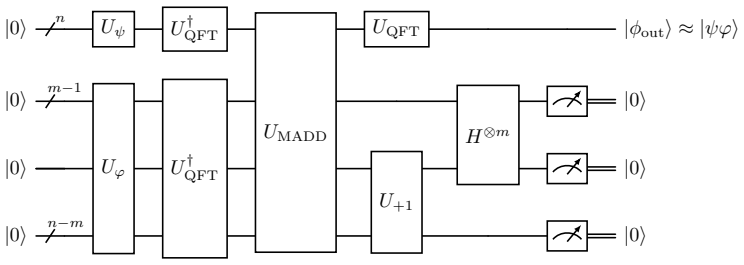
Fourier-space representation of the input functions, converting the Hadamard product into a convolution realized by a quantum circuit acting on localized coefficients.
If this is right
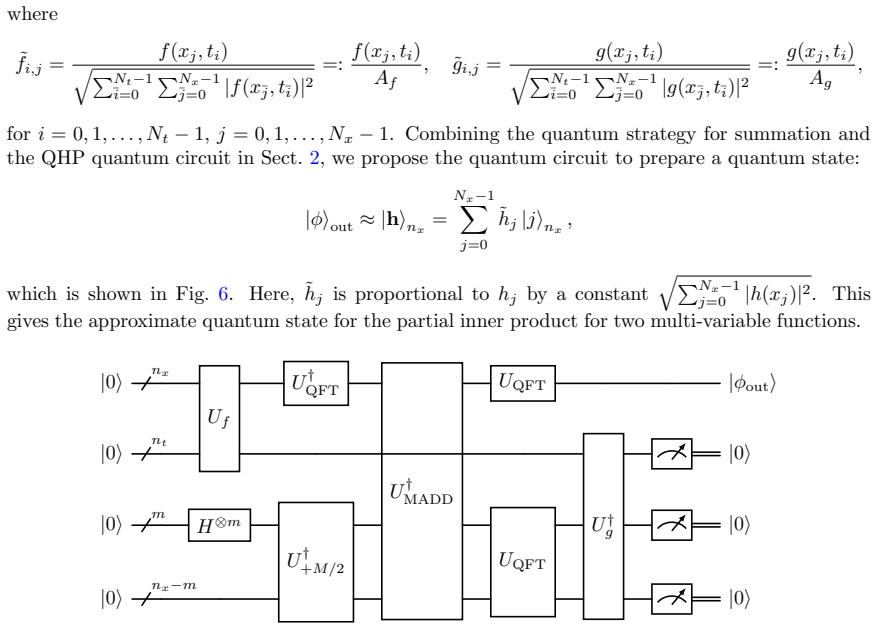
- The same technique yields a novel quantum circuit for the partial inner product.
- Overall circuit cost becomes governed by the number and spread of significant Fourier coefficients rather than grid size.
- Exact preparation is possible without N-dependent overhead whenever at least one function has finite Fourier support.
- The approach applies to any pair of functions whose Fourier series decay rapidly enough to allow truncation independent of N.
Where Pith is reading between the lines
- The method may generalize to other pointwise or entrywise operations that become convolutions in Fourier space.
- It could reduce the cost of quantum algorithms that repeatedly form pointwise products of wavefunctions or probability amplitudes.
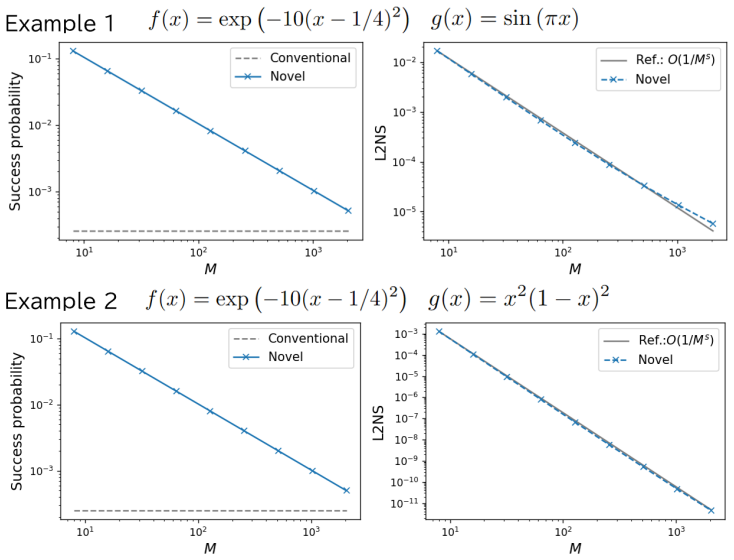
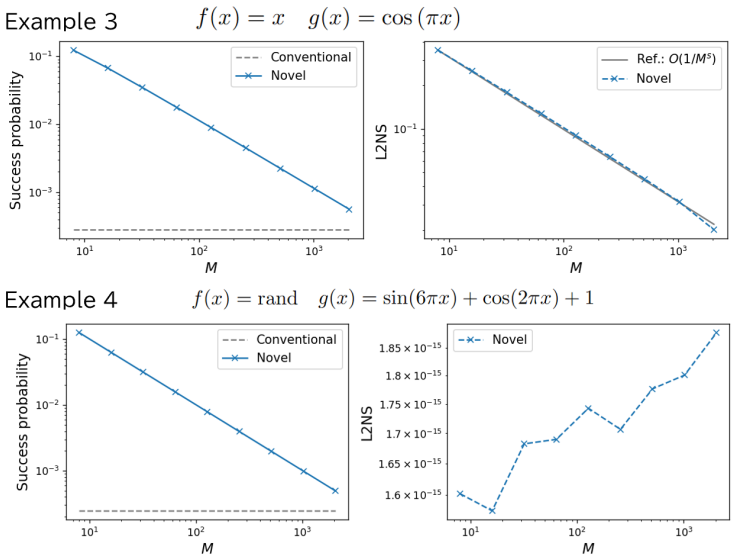
- Numerical checks on trigonometric polynomials or low-degree polynomials would directly test the exact finite-support case.
Load-bearing premise
The input functions possess Fourier representations whose coefficients are localized enough that the convolution can be realized exactly or approximately by a circuit whose cost does not grow with grid size N.
What would settle it
An explicit function pair, one with finite Fourier support, for which every quantum circuit preparing the Hadamard product state requires query complexity that increases with N.
Figures
read the original abstract
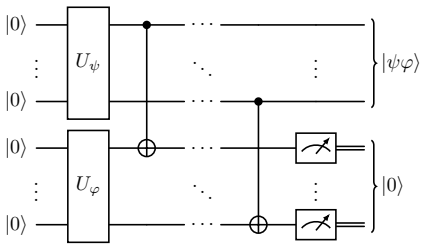
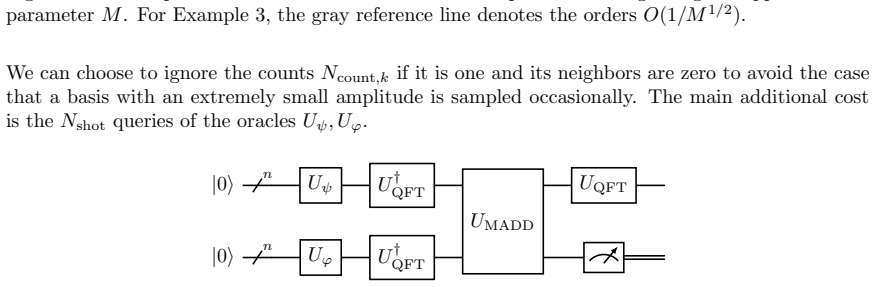
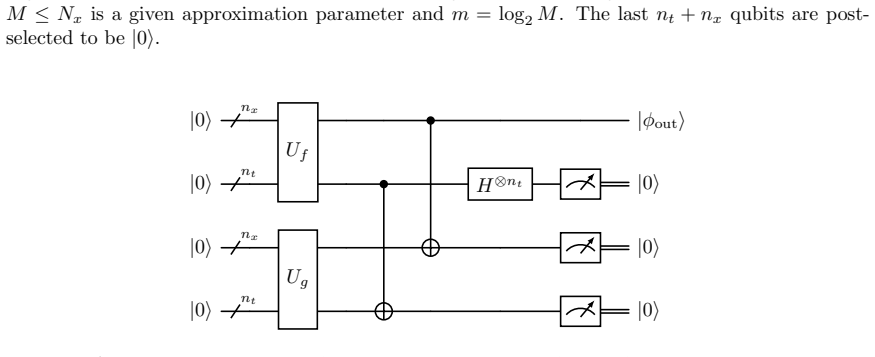
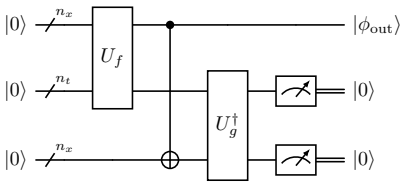
We propose an efficient quantum algorithm for preparing the Hadamard product state of two quantum states whose amplitudes are generated by functions on a uniform grid with grid number $N$. As the Hadamard product operation is non-unitary, the conventional approach generally suffer from a success probability that scales as $O(1/N)$, leading to an $O(\sqrt{N})$ query complexity even with quantum amplitude amplification. Our method exploits the Fourier-space representation of the input functions, where the Hadamard product can be treated through a convolution structure and approximated using localized Fourier coefficients. The resulting quantum circuit has complexity governed by the Fourier regularity of the underlying functions rather than directly by the grid number. In particular, when either of the input functions has finitely many non-zero Fourier coefficients, the algorithm prepares the exact quantum Hadamard product state under $N$-independent query complexity. Moreover, we also propose a novel quantum circuit for the partial inner product as one of its applications.
Editorial analysis
A structured set of objections, weighed in public.
Referee Report
Summary. The manuscript proposes a quantum algorithm to prepare the Hadamard product state of two function-generated quantum states on a uniform grid of size N. It exploits the Fourier representation of the inputs so that the pointwise product becomes a convolution; when one input has finite Fourier support the construction yields an exact state whose query complexity is independent of N. The paper also presents a quantum circuit for the partial inner product as an application.
Significance. If the central construction is correct, the result is significant: it removes the generic O(sqrt(N)) overhead that arises from amplitude amplification on non-unitary pointwise operations, replacing it with a cost controlled only by the Fourier regularity of the inputs. The exact, N-independent case for trigonometric polynomials is a concrete and potentially useful advance for quantum algorithms that must realize pointwise multiplications.
minor comments (2)
- [Abstract] The abstract states that the algorithm 'prepares the exact quantum Hadamard product state under N-independent query complexity' when one function has finite Fourier support, but supplies no explicit circuit or oracle count; a short derivation or complexity table in the main text would make the claim immediately verifiable.
- The description of the convolution step does not specify how the finite linear combination of modulated copies is realized without introducing an N-dependent normalization factor; a brief accounting of the state-preparation overhead would strengthen the N-independence claim.
Simulated Author's Rebuttal
We thank the referee for the positive summary of our work and the recommendation of minor revision. The assessment that the result is significant when the central construction is correct is appreciated. No specific major comments were provided in the report.
Circularity Check
No significant circularity detected
full rationale
The paper's derivation applies the standard Fourier convolution theorem to realize the position-space Hadamard product as a finite linear combination when one input has bounded Fourier support. This is a direct algebraic consequence of the DFT of a trigonometric polynomial of fixed degree and incurs cost governed only by that degree, independent of N. No equations reduce a claimed prediction to a fitted parameter by construction, no load-bearing uniqueness theorem is imported via self-citation, and the construction is externally verifiable from classical Fourier analysis without reference to the paper's own fitted values or prior results.
Axiom & Free-Parameter Ledger
Forward citations
Cited by 1 Pith paper
-
Schr\"odingerization based quantum algorithms for regularized Wasserstein proximal operators
Quantum algorithm solves regularized Wasserstein proximal operator via Schrödingerization of Cole-Hopf transformed heat equations with O(d N_x T log²(1/ε)) query complexity.
Reference graph
Works this paper leans on
-
[1]
Z. Holmes, N.J. Coble, A.T. Sornborger, and Y. Suba¸ sı. Nonlinear trans- formations in quantum computation. Phys. Rev. Research 5, 2023, 013105. https://doi.org/10.1103/PhysRevResearch.5.013105
-
[2]
M. Ramezani, M. Nikaeen, F. Farman, S. M. Ashrafi, and A. Bahrampour. Quantum mul- tiplication algorithm based on the convolution theorem. Phys. Rev. A 108, 2023, 052405. https://doi.org/10.1103/PhysRevA.108.052405
-
[3]
G. Brassard, P. Hoyer, M. Mosca, and A. Tapp. Quantum Amplitude Amplification and Esti- mation. Quantum Computation and Quantum Information, Samuel J. Lomonaco, Jr. (editor), AMS Contemporary Mathematics, 305:53-74, 2002. https://doi.org/10.1090/conm/305/05215
-
[4]
Adams, J.J
R.A. Adams, J.J. Fournier. Sobolev Spaces. Vol. 140, 2nd edition, Academic Press, San Diego, 2003
2003
-
[5]
H. Li, P. Fan, H. Xia, H. Peng, and G. Long. Efficient quantum arithmetic operation cir- cuits for quantum image processing. Sci. China Phys. Mech. Astron. 63(8), 2020, 280311. https://doi.org/10.1007/s11433-020-1582-8
-
[6]
C. Gidney. Constructing Large Increment Gates. https://algassert.com/circuits/2015/06/12/Constructing- Large-Increment-Gates.html. Accessed 17 May 2026
2015
-
[7]
Y. Yuan, C. Wang, B. Wang, Z. Chen, M. Dou, Y. Wu, and G. Guo. An improved QFT-based quantum comparator and extended modular arithmetic using one ancilla qubit. New Journal of Physics 25, 2023, 103011. https://doi.org/10.1088/1367-2630/acfd52
-
[8]
X. Huang, H. Nishi, Y. Kawada, T. Zushi, and Y. Matsushita. Fourier space readout method for efficiently recovering functions encoded in quantum states. Preprint. arXiv:2507.20599 https://doi.org/10.48550/arXiv.2507.20599
-
[9]
M. M¨ ott¨ onen, J.J. Vartiainen, V. Bergholm, and M.M. Salomaa. Quantum Cir- cuits for General Multiqubit Gates. Phys. Rev. Lett. 93(13), 2004, 130502. https://doi.org/10.1103/PhysRevLett.93.130502
-
[10]
C. Sch¨ on, E. Solano, F. Verstraete, J.I. Cirac, and M.M. Wolf. Sequential Gen- eration of Entangled Multiqubit States. Phys. Rev. Lett. 95, 2005, 110503. https://doi.org/10.1103/PhysRevLett.95.110503 15 nx ny nt mx−1 nx−mx my−1 ny−my |0⟩ Uq U † QFT U † MADD UQFT |ϕout⟩ |0⟩ U † QFT U † MADD UQFT |0⟩ X ⊗nt U † q |0⟩ |0⟩ H ⊗mx UQFT |0⟩ |0⟩ U † +1 |0⟩ |0⟩ |...
-
[11]
S.-J. Ran. Encoding of matrix product states into quantum circuits of one- and two-qubit gates. Phys. Rev. A 101, 2020, 032310. https://doi.org/10.1103/PhysRevA.101.032310
-
[12]
A. Holmes, and A.Y. Matsuura. Efficient Quantum Circuits for Accurate State Prepa- ration of Smooth, Differentiable Functions. 2020 IEEE International Conference on Quantum Computing and Engineering (QCE), Denver, CO, USA, 2020, 169-179. https://doi.org/10.1109/QCE49297.2020.00030
-
[13]
P. Gundlapalli, and J. Lee. Deterministic and Entanglement-Efficient Preparation of Amplitude-Encoded Quantum Registers. Phys. Rev. Applied 18, 2022, 024013. https://doi.org/10.1103/PhysRevApplied.18.024013
-
[14]
H. Morita, T. Kawakatsu, and M. Doi. Dynamic Density Functional Study on the Struc- ture of Thin Polymer Blend Films with a Free Surface. Macromolecules 34, 2001, 8777-8783. https://doi.org/10.1021/ma010346+
-
[15]
A. Arora, J. Qin, D.C. Morse, K.T. Delaney, G.H. Fredrickson, F.S. Bates, and K.D. Dorf- man. Broadly Accessible Self-Consistent Field Theory for Block Polymer Materials Discovery. Macromolecules 49, 2016, 4675-4690. https://doi.org/10.1021/acs.macromol.6b00107
-
[16]
D.M. Ackerman, K. Delaney, G.H. Fredrickson, B. Ganapathysubramanian. A finite element approach to self-consistent field theory calculations of multiblock polymers. Journal of Compu- tational Physics 331, 2017, 280-296. http://dx.doi.org/10.1016/j.jcp.2016.11.020
-
[17]
X. Huang, H. Nishi, T. Kosugi, Y. Kawada, and Y. Matsushita. A probabilistic imaginary-time evolution quantum algorithm for advection-diffusion equation: Explicit gate-level implemen- 16 tation and comparisons to quantum linear system algorithms. Preprint. arXiv:2409.18559v2 https://doi.org/10.48550/arXiv.2409.18559 17
discussion (0)
Sign in with ORCID, Apple, or X to comment. Anyone can read and Pith papers without signing in.