REVIEW 4 major objections 4 minor 1 cited by
MARS: Defending Unmanned Aerial Vehicles From Attacks on Inertial Sensors with Model-based Anomaly Detection and Recovery
T0 review · 4 major / 4 minor · reviewed 2026-08-16 · deepseek-v4-flash
Pith's one-line read Physical attacks on a drone's inertial sensors can be survived by estimating attitude from rotor speeds, detecting the attack, and recovering to hover before resuming flight.
desk verdict A genuinely novel tachometer-based IMU-free attitude estimator, evaluated broadly in simulation and with honest (but partial) real-world tests; the near-hovering model and software-injected attacks weaken the strongest claims, but the core idea is solid and worth refereeing. read the letter →
The pith
A machine-rendered reading of the paper's core claim, the machinery that carries it, and where it could break.
The reading
What carries the argument
The load-bearing object is the near-hovering thrust-and-torque estimate of Sec. 3.1.1: when body-frame angular velocity is neglected and all four rotors share the vehicle's earth-frame velocity, Eq. (2) expresses each propeller's force and torque through squared rotor speed and earth-frame velocity, and Eq. (3) sums them to net thrust $f_B$ and torque $\tau_B$ at the center of mass. That $u=[f_B,\tau_B]^T$ replaces IMU acceleration and angular velocity as the driving input to an extended Kalman filter (EKF) that estimates position, velocity, orientation, and body-frame angular velocity. The same estimator yields the residual $r_k = Y_{s,k} - h_r(\hat{x}_{r,k})$ between IMU readings and resilient estimates; a cumulative-sum (CUSUM) statistic with a sliding-window detection rate converts this residual into a system-level alarm that triggers emergency braking, near-hover restoration, and recovered flight.
What would settle it
Run an IMU attack during a fast, banked maneuver with pitch or roll exceeding about 30 degrees and compare the resilient estimator's attitude error to the hover-level errors claimed in Sec. 4.2; if the drone crashes or the attitude estimate diverges before the braking stage restores near-hover, the near-hovering model is falsified as a general recovery mechanism.
Extended reading notes
Core claim
On the paper's own terms, the central result is that a quadrotor's orientation and body-frame angular velocity can be reconstructed without any IMU data under near-hovering conditions. Using the rotor model of Eqs. (1)-(2), each propeller's force and torque depend only on squared rotor speed and the vehicle's earth-frame velocity, so summing over four rotors yields estimates of net thrust and torque at the center of mass; these act as control inputs to an extended Kalman filter that estimates position, velocity, orientation, and angular velocity. The resilient estimator runs continuously beside the standard IMU-based one, and the mismatch between observed IMU readings and the resilient estimate becomes the attack alarm. The paper claims this detector catches acoustic DoS, side-swing, switch, and EMI-saturation attacks in roughly 0.02-0.065 seconds, and that the three-stage recovery—brake, restore near-hover, then resume—lets the drone finish tracked missions with about 0.5 m tracking error and completion time within roughly 30% of nominal.
Load-bearing premise
The load-bearing premise is the near-hovering model: body-frame angular velocity can be neglected and all four rotors share the vehicle's earth-frame velocity, so thrust and torque follow from rotor speeds alone—and, equally, the tachometers and position and heading sensors are themselves immune to the attack.
Editorial extensions
If this is right
- A drone with tachometers can survive all four analyzed attack profiles during hover, whereas low-pass filtering, deep-autoencoder denoising, and geometric attitude reconstruction all crash within roughly 1-3 seconds.
- An attack that begins during a moving mission does not have to be fatal: the emergency-braking stage restores near-hover, and the mission resumes with lateral tracking error below about 0.64 m and completion time no more than about 30% above nominal in the tested tracking task.
- Detection is fast enough for online recovery: average detection times of 0.024-0.039 seconds in simulation and 0.024-0.065 seconds in real flights across the four attack profiles.
- Because the resilient estimator is attack-signature-independent, the same MARS modules handle both patterned acoustic resonance variants and un-patterned EMI saturation, and the anomaly detector also detects weaker step- and ramp-amplitude modulated attacks.
Reading between the lines
- Beyond the paper's quadrotor tests, the same near-hovering rotor-speed-to-thrust reconstruction should transfer to other multirotor geometries such as hexacopters or octocopters, as long as each rotor's speed and the vehicle's body velocity remain measurable; this extension is not demonstrated in the paper.
- The design implicitly assumes the tachometers and the position and heading sensors are outside the attacker's reach; an attacker who could spoof rotor speeds would feed false thrust and torque into the EKF and corrupt the very residual used for detection, so hardening the tachometer and GPS or compass interfaces is a first-order security requirement implied by the architecture.
- Recovery quality during aggressive maneuvers depends on the experimentally tuned torque compensation of Eq. (4); replacing that fixed compensation with an adaptive or learned braking controller could widen the flight envelope in which the near-hovering assumption holds.
Signed reviews
Editorial analysis
A structured set of objections, weighed in public.
Referee Report
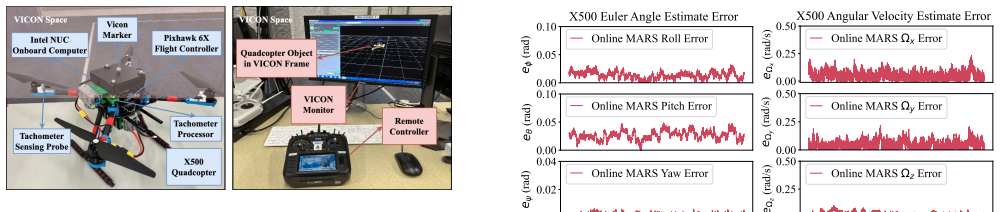
Summary. This manuscript introduces MARS, a defense framework intended to keep quadrotors airborne when IMU readings are maliciously corrupted. The core component is a 'resilient' Extended Kalman Filter that, without using IMU data, estimates attitude and body-frame angular velocity from position, velocity, heading, and rotor-speed (tachometer) measurements. The tachometer measurements are converted into net thrust and torque through a near-hovering propeller model, and a CUSUM statistic on the residual between IMU readings and the resilient estimate, combined with a sliding window, triggers attack detection. A multi-stage recovery strategy brakes the vehicle, restores near-hovering, and then resumes the mission under resilient control. The system is implemented in PX4 and evaluated in software-in-the-loop simulations (160 hovering trials, ROC curves, dynamic tracking missions) and on an X500 quadrotor in an indoor arena, where VICON MOCAP emulates GPS/compass and attack vectors are injected into PX4 firmware.
Significance. If fully validated, MARS would be a useful alternative to filtering-based IMU defenses and to geometric attitude reconstruction: it provides attitude estimates at controller rate without IMU data, detects several attack profiles within tens of milliseconds, and keeps the vehicle flying in the reported comparisons while LPF, DAE, and CAF crash. The paper's open-source code, datasets, demo videos, and measured computation overhead (0.261 ms, about 1% CPU, about 12 KB memory) are notable strengths for reproducibility. The significance is conditional, however, on clarifying the attitude dependence of the near-hovering model and on the fact that the real-world experiments use software-injected faults and MOCAP-emulated GPS/compass rather than physical acoustic or EMI attacks.
major comments (4)
- [Sec. 3.1.1, Eqs. (1)-(3)] The statement that the net thrust and torque 'rely only on rotor speed and earth-frame velocity measurements' is not supported by the equations as written. The rotor-plane normal k_b and the projections V_Ai_perp and V_Ai in Eq. (2) are attitude-dependent quantities; computing f_B and tau_B in the body frame requires the rotation R(q), which contains the unknown roll and pitch. The paper explicitly applies a yaw-only projection for the braking term in Eq. (4) because 'roll and pitch angles are not directly accessible,' but no analogous clarification is given for the nominal thrust/torque computation used as the EKF input u. If the implementation assumes k_b is approximately vertical and uses only the measured yaw, that is a small-angle approximation that should be stated and whose error should be quantified; if instead the previous EKF attitude estimate is used to compute u, the estimator is not independent of the state it is meant to recover. Please clarify which construction is used and bound the resulting bias outside hover.
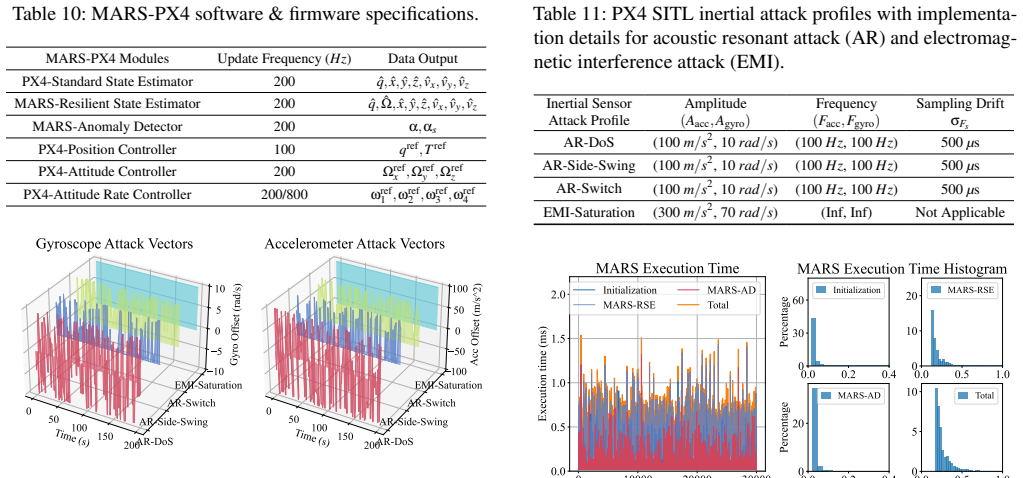
- [Sec. 5 and Sec. 5.1, Table 5] The real-world experiments do not exercise physical acoustic or EMI attacks. Sec. 5.1 states that 'we used realistic attack vectors discussed in Section 4.3 into PX4 firmware,' meaning the IMU outputs are corrupted in software, and VICON MOCAP provides the GPS and compass data at 10 Hz. This validates the estimator and detector on simulated sensor faults but not on the physical attack channels (acoustic resonance with sampling-drift aliasing, EMI-induced bit flips or communication loss) and not on realistic GPS/compass noise and outages. To support the abstract's claim of defending against physical attacks, please either add physical attack experiments or explicitly limit the real-world claim to attacks whose effect is equivalent to injecting corrupted IMU readings, and discuss how MOCAP accuracy affects transferability to outdoor GPS.
- [Sec. 1 contribution bullet; Sec. 3.3; Sec. 6] The contribution bullet claiming universal applicability 'regardless of the UAV's state' is contradicted by the near-hovering assumption and by the paper's own Sec. 6 'intrinsic limitation' statement. The multi-stage recovery relies on the braking stage returning the vehicle to near-hover before the degraded model is used; the paper does not report experiments in which the attack starts during a genuinely aggressive maneuver (e.g., high speed with sustained pitch or roll above about 0.4 rad or with high angular rates). Since Eq. (2) omits angular-velocity terms and uses the near-hover simplification, the estimation error before braking can be large exactly when the drone is most dynamic. Please state the valid operating envelope (velocity and attitude ranges) and temper the universality claim accordingly.
- [Sec. 4.3.2, Fig. 8; Sec. 4.5] The ROC analysis in Fig. 8 appears to be based on hovering no-attack windows; the manuscript does not report the false-alarm rate of MARS-AD during attack-free dynamic flight, where the near-hovering thrust/torque model is least accurate. Since a false alarm causes a switch to resilient mode and mission suspension, the practical detection threshold p should be validated in the dynamic regime, not only in hover. Please provide attack-free dynamic tests with the chosen thresholds, or quantify how model error affects the detection statistic.
minor comments (4)
- [Abstract and throughout] There are several typographical errors, including 'UA Vs' with an extra space, 'aModel-based' in the abstract, and 'indentity matrix' in App. 7.3.
- [Alg. 1, Sec. 3.2.1] The definitions of Y_s,k and Y_r,k could be made clearer: it should be stated explicitly whether Y_s,k includes the IMU readings that are later excluded from Y_r,k, and how the residual r_k is aligned in time when the two estimate modes run at different update rates.
- [Tables 2-6] The reported averages for survival time, tracking error, and Euler-angle fluctuations are given without standard deviations or confidence intervals; given the 160-trial hovering evaluation, adding variance information would materially strengthen the comparison.
- [Sec. 4.4] The DAE baseline is evaluated at 5x slower than real time; this is acknowledged in the text, but Table 2 could still be misread as a real-time comparison, so the caption should repeat that caveat.
Circularity Check
No significant circularity: MARS's IMU-free estimator rests on independent tachometer, GPS, and compass measurements, and the near-hovering model is an explicit approximation rather than a hidden attitude feedback loop.
full rationale
The central derivation is self-contained and not circular. MARS's resilient estimator uses tachometer rotor speeds, GPS position/velocity, and compass heading as independent measurements, and the target outcome (surviving IMU attacks and completing missions) never appears as an input to the estimation or detection equations. The near-hovering thrust/torque model in Sec. 3.1.1 (Eqs. (1)-(3)) is an explicit approximation that neglects body-frame angular velocity terms and assumes all rotors share the vehicle's earth-frame velocity; Eq. (4) further states that only the yaw rotation is used in the velocity projection 'as roll and pitch angles are not directly accessible,' so the model does not secretly feed the estimated roll/pitch attitude back into its own input. The EKF in Sec. 3.1.3 then uses the resulting thrust/torque vector, together with position and heading measurements, to infer attitude through the translational dynamics—this is a legitimate estimation chain. The paper itself flags in Sec. 6 that estimates degrade away from near-hovering conditions, which is a validity limitation on the contribution bullet's 'regardless of the UAV's state' claim, not a circularity. The anomaly detector uses the residual between IMU readings and the IMU-independent resilient estimate, so detection is not defined in terms of the recovery outcome it is meant to enable. Experimentally tuned parameters (Kcp, torque bias, CUSUM thresholds) are controller/detector tuning, not fitted to the attack-recovery result. The only self-citation, [32] (Jovanov and Pajic), is a non-load-bearing example in a list of statistical anomaly detection methods and does not support any uniqueness or forcing claim. No equation in the paper reduces to its own input by construction.
Assumptions & free parameters
free parameters (4)
- Torque compensation gains Kcp =
not reported (tuned experimentally)
- Torque bias tau_B_b =
not reported (tuned experimentally)
- CUSUM drift b, threshold lambda, sliding window length l =
not reported (only p=0.005 is given)
- EKF noise covariances Q and R =
not reported
assumptions (4)
- domain assumption Near-hovering simplification: angular-velocity coupling terms in the propeller force and torque model are neglected, and all rotors have the same earth-frame velocity as the center of mass (Eqs. (1)-(2)).
- domain assumption Tachometers cannot be compromised by acoustic or EMI attacks.
- domain assumption GPS and compass (position, velocity, heading) remain trustworthy during IMU attacks.
- domain assumption Standard nonlinear quadrotor dynamics (Eqs. (8)-(9)) accurately model the vehicle.
Cite this review
Pith. "Pith review of MARS: Defending Unmanned Aerial Vehicles From Attacks on Inertial Sensors with Model-based Anomaly Detection and Recovery." pith.science (2026). https://pith.science/paper/QTOXU223
@misc{pith2026250500924,
  author       = {Pith},
  title        = {Pith review of: MARS: Defending Unmanned Aerial Vehicles From Attacks on Inertial Sensors with Model-based Anomaly Detection and Recovery},
  year         = {2026},
  howpublished = {\url{https://pith.science/paper/QTOXU223}},
  note         = {Machine review of arXiv:2505.00924}
}
read the original abstract
Unmanned Aerial Vehicles (UAVs) rely on measurements from Inertial Measurement Units (IMUs) to maintain stable flight. However, IMUs are susceptible to physical attacks, including acoustic resonant and electromagnetic interference attacks, resulting in immediate UAV crashes. Consequently, we introduce a Model-based Anomaly detection and Recovery System (MARS) that enables UAVs to quickly detect adversarial attacks on inertial sensors and achieve dynamic flight recovery. MARS features an attack-resilient state estimator based on the Extended Kalman Filter, which incorporates position, velocity, heading, and rotor speed measurements to reconstruct accurate attitude and angular velocity information for UAV control. Moreover, a statistical anomaly detection system monitors IMU sensor data, raising a system-level alert if an attack is detected. Upon receiving the alert, a multi-stage dynamic flight recovery strategy suspends the ongoing mission, stabilizes the drone in a hovering condition, and then resumes tasks under the resilient control. Experimental results in PX4 software-in-the-loop environments as well as real-world MARS-PX4 autopilot-equipped drones demonstrate the superiority of our approach over existing IMU-defense frameworks, showcasing the ability of the UAVs to survive attacks and complete the missions.
Figures


Figures from the paper (14 more)





Forward citations
Cited by 1 Pith paper
-
Banshee: Target Switch Attacks on Gimbal-Stabilized Visual Tracking Systems via Acoustic Injection
Acoustic injection on commercial UAV gimbals induces directionally biased camera drift that causes visual trackers to switch to an attacker-selected target with high probability.
Reference graph
Works this paper leans on
-
[9]
Flight recovery of mavs with compro- mised imu
Zhan Tu, Fan Fei, Matthew Eagon, Dongyan Xu, and Xinyan Deng. Flight recovery of mavs with compro- mised imu. In2019 IEEE/RSJ Int. Conf. on Intelligent Robots and Systems (IROS), pages 3638–3644, 2019
work page 2019
-
[14]
Un-rocking drones: Foundations of acoustic injection attacks and 14 recovery thereof
Jinseob Jeong, Dongkwan Kim, Joon-Ha Jang, Juhwan Noh, Changhun Song, and Yongdae Kim. Un-rocking drones: Foundations of acoustic injection attacks and 14 recovery thereof. InNetw. and Distributed Syst. Security Symp. (NDSS), 2023
work page 2023
-
[1]
The true role of ac- celerometer feedback in quadrotor control
Philippe Martin and Erwan Salaün. The true role of ac- celerometer feedback in quadrotor control. InIEEE Int. Conf. Robot. Autom. (ICRA), pages 1623–1629, 2010
work page 2010
-
[2]
Influence of acoustic noise on the dynamic performance of mems gyroscopes
Simon Castro, Robert Dean, Grant Roth, George T Flow- ers, and Brian Grantham. Influence of acoustic noise on the dynamic performance of mems gyroscopes. In ASME International Mechanical Engineering Congress and Exposition, volume 43033, pages 1825–1831, 2007
work page 2007
-
[3]
Rocking drones with intentional sound noise on gyroscopic sensors
Yunmok Son, Hocheol Shin, Dongkwan Kim, Youngseok Park, Juhwan Noh, Kibum Choi, Jungwoo Choi, and Yongdae Kim. Rocking drones with intentional sound noise on gyroscopic sensors. In24th USENIX Security Symposium, pages 881–896, 2015
work page 2015
-
[4]
A systematic study of physical sensor attack hardness
Hyungsub Kim, Rwitam Bandyopadhyay, Mus- lum Ozgur Ozmen, Z Berkay Celik, Antonio Bianchi, Yongdae Kim, and Dongyan Xu. A systematic study of physical sensor attack hardness. In2024 IEEE Symposium on Security and Privacy (SP), pages 143–143. IEEE Computer Society, 2024
work page 2024
-
[5]
Yazhou Tu, Zhiqiang Lin, Insup Lee, and Xiali Hei. In- jected and delivered: Fabricating implicit control over actuation systems by spoofing inertial sensors. In27th USENIX Security Symposium, pages 1545–1562, 2018
work page 2018
-
[6]
Ghost talk: Mitigating emi signal injection attacks against analog sensors
Denis Foo Kune, John Backes, Shane S Clark, Daniel Kramer, Matthew Reynolds, Kevin Fu, Yongdae Kim, and Wenyuan Xu. Ghost talk: Mitigating emi signal injection attacks against analog sensors. In2013 IEEE Symp. on Security and Privacy, pages 145–159, 2013
work page 2013
Show all 43 references
-
[7]
Suscep- tibility of electronic systems to high-power microwaves: Summary of test experience.IEEE Trans
Mats G Backstrom and Karl Gunnar Lovstrand. Suscep- tibility of electronic systems to high-power microwaves: Summary of test experience.IEEE Trans. on Electro- magnetic Compatibility, 46(3):396–403, 2004
2004
-
[8]
Paralyzing drones via emi signal injection on sensory communication channels
Joon-Ha Jang, Mangi Cho, Jaehoon Kim, Dongkwan Kim, and Yongdae Kim. Paralyzing drones via emi signal injection on sensory communication channels. InNetw. and Distributed Syst. Security Symp. (NDSS), 2023
2023
-
[10]
Software-based realtime re- covery from sensor attacks on robotic vehicles
Hongjun Choi, Sayali Kate, Yousra Aafer, Xiangyu Zhang, and Dongyan Xu. Software-based realtime re- covery from sensor attacks on robotic vehicles. In23rd International Symposium on Research in Attacks, Intru- sions and Defenses (RAID), pages 349–364, 2020
2020
-
[11]
Learn-to-recover: Retrofitting uavs with reinforcement learning-assisted flight control under cyber-physical at- tacks
Fan Fei, Zhan Tu, Dongyan Xu, and Xinyan Deng. Learn-to-recover: Retrofitting uavs with reinforcement learning-assisted flight control under cyber-physical at- tacks. InIEEE ICRA, pages 7358–7364, 2020
2020
-
[12]
Real-time attack-recovery for cyber-physical systems using linear approximations
Lin Zhang, Xin Chen, Fanxin Kong, and Alvaro A Car- denas. Real-time attack-recovery for cyber-physical systems using linear approximations. In2020 IEEE Real-Time Systems Symp. (RTSS), pages 205–217, 2020
2020
-
[13]
Recovery-by-learning: Restor- ing autonomous cyber-physical systems from sensor at- tacks
Francis Akowuah, Romesh Prasad, Carlos Omar Es- pinoza, and Fanxin Kong. Recovery-by-learning: Restor- ing autonomous cyber-physical systems from sensor at- tacks. In2021 IEEE 27th Int. Conf. on embedded and real-time computing systems and applications (RTCSA), pages 61–66, 2021
2021
-
[15]
Emc-aware design on a microcontroller for automotive applications
Patrice Joubert Doriol, Yamarita Villavicencio, Cristiano Forzan, Mario Rotigni, Giovanni Graziosi, and Davide Pandini. Emc-aware design on a microcontroller for automotive applications. In2009 Design, Automation & Test in Europe, pages 1208–1213, 2009
2009
-
[16]
Emi shielding: Meth- ods and materials—a review.Journal of applied polymer science, 112(4):2073–2086, 2009
Shielding Geetha, KK Satheesh Kumar, Chepuri RK Rao, M Vijayan, and DC Trivedi. Emi shielding: Meth- ods and materials—a review.Journal of applied polymer science, 112(4):2073–2086, 2009
2009
-
[17]
Low-cost imu data denoising using savitzky- golay filters
Malek Karaim, Aboelmagd Noureldin, and Tashfeen B Karamat. Low-cost imu data denoising using savitzky- golay filters. In2019 Int. Conf. on Comm., Signal Proc., and their Applications (ICCSPA), pages 1–5, 2019
2019
-
[18]
Mahindrakar, Vi- tor Campagnolo Guizilini, Marco Henrique Terra, and Samrat L
Mundla Narasimhappa, Arun D. Mahindrakar, Vi- tor Campagnolo Guizilini, Marco Henrique Terra, and Samrat L. Sabat. Mems-based imu drift minimization: Sage husa adaptive robust kalman filtering.IEEE Sen- sors Journal, 20(1):250–260, 2020
2020
-
[19]
Jamil Asghar, and Adil Sarwar
Syed Javed Arif, Mohammad S. Jamil Asghar, and Adil Sarwar. Measurement of speed and calibration of tachometers using rotating magnetic field.IEEE Trans. on Instrum. and Meas., 63(4):848–858, 2014
2014
-
[20]
An anomaly detection tech- nique based on a chi-square statistic for detecting intru- sions into information systems.Quality and Reliability Eng
Nong Ye and Qiang Chen. An anomaly detection tech- nique based on a chi-square statistic for detecting intru- sions into information systems.Quality and Reliability Eng. Int., 17(2):105–112, 2001
2001
-
[21]
Savior: Secur- ing autonomous vehicles with robust physical invariants
Raul Quinonez, Jairo Giraldo, Luis Salazar, Erick Bau- man, Alvaro Cardenas, and Zhiqiang Lin. Savior: Secur- ing autonomous vehicles with robust physical invariants. In29th USENIX Security Symp., pages 895–912, 2020
2020
-
[22]
Px4: A node-based multithreaded open source robotics framework for deeply embedded platforms
Lorenz Meier, Dominik Honegger, and Marc Pollefeys. Px4: A node-based multithreaded open source robotics framework for deeply embedded platforms. InIEEE ICRA, pages 6235–6240, 2015
2015
-
[23]
Px4 official website
PX4 Development Team. Px4 official website. https: //px4.io/, 2024
2024
-
[24]
Quadcopter flight dynamics.International journal of scientific & technology research, 3(8):130– 135, 2014
Mohd Khan. Quadcopter flight dynamics.International journal of scientific & technology research, 3(8):130– 135, 2014
2014
-
[25]
Strapdown inertial navigation integra- tion algorithm design part 1: Attitude algorithms.Jour- nal of guidance, control, and dynamics, 21(1):19–28, 1998
Paul G Savage. Strapdown inertial navigation integra- tion algorithm design part 1: Attitude algorithms.Jour- nal of guidance, control, and dynamics, 21(1):19–28, 1998
1998
-
[26]
Strapdown inertial navigation integra- tion algorithm design part 2: Velocity and position al- gorithms.Journal of Guidance, Control, and dynamics, 21(2):208–221, 1998
Paul G Savage. Strapdown inertial navigation integra- tion algorithm design part 2: Velocity and position al- gorithms.Journal of Guidance, Control, and dynamics, 21(2):208–221, 1998
1998
-
[27]
Sok: Rethinking sensor spoofing attacks against robotic vehicles from a systematic view
Yuan Xu, Xingshuo Han, Gelei Deng, Jiwei Li, Yang Liu, and Tianwei Zhang. Sok: Rethinking sensor spoofing attacks against robotic vehicles from a systematic view. InIEEE 8th European Symp. on Security and Privacy (EuroS&P), pages 1082–1100, 2023
2023
-
[28]
A survey of unmanned aerial vehicle flight data anomaly detection: Technologies, applica- tions, and future directions.Science China Technologi- cal Sciences, 66(4):901–919, 2023
Lei Yang, ShaoBo Li, ChuanJiang Li, AnSi Zhang, and XuDong Zhang. A survey of unmanned aerial vehicle flight data anomaly detection: Technologies, applica- tions, and future directions.Science China Technologi- cal Sciences, 66(4):901–919, 2023
2023
-
[29]
Mul- tisensor data-fusion-based approach to airspeed mea- surement fault detection for unmanned aerial vehicles
Dingfei Guo, Maiying Zhong, and Donghua Zhou. Mul- tisensor data-fusion-based approach to airspeed mea- surement fault detection for unmanned aerial vehicles. IEEE Trans. Instrum. Meas., 67(2):317–327, 2017
2017
-
[30]
Bias compensation estimation in multi-uav formation and anomaly detection.J
Jian-hong Wang, Yan-xiang Wang, and Yong-hong Zhu. Bias compensation estimation in multi-uav formation and anomaly detection.J. Control Syst. Eng, 4:40–50, 2016
2016
-
[31]
A novel online data-driven algo- rithm for detecting uav navigation sensor faults.Sensors, 17(10):2243, 2017
Rui Sun, Qi Cheng, Guanyu Wang, and Washing- ton Yotto Ochieng. A novel online data-driven algo- rithm for detecting uav navigation sensor faults.Sensors, 17(10):2243, 2017
2017
-
[32]
Jovanov and M
I. Jovanov and M. Pajic. Relaxing integrity require- ments for attack-resilient cyber-physical systems.IEEE Transactions on Automatic Control, 64(12):4843–4858, Dec 2019
2019
-
[33]
Anal- ysis and design of stealthy cyber attacks on unmanned aerial systems.Journal of Aerospace Information Sys- tems, 11(8):525–539, 2014
Cheolhyeon Kwon, Weiyi Liu, and Inseok Hwang. Anal- ysis and design of stealthy cyber attacks on unmanned aerial systems.Journal of Aerospace Information Sys- tems, 11(8):525–539, 2014
2014
-
[34]
Detecting cyber attacks in industrial control systems using convolutional neural networks
Moshe Kravchik and Asaf Shabtai. Detecting cyber attacks in industrial control systems using convolutional neural networks. In2018 Workshop on cyber-physical systems security and privacy, pages 72–83, 2018
2018
-
[35]
https://github.com/amov-lab/Prometheus
Prometheus - open source autonomous drone project. https://github.com/amov-lab/Prometheus. Ac- cessed: Nov. 13, 2024
2024
-
[36]
How the integral operations in ins algorithms overshadow the contribu- tions of imu signal denoising using low-pass filters.The Journal of Navigation, 66(6):837–858, 2013
Yalong Ban, Quan Zhang, Xiaoji Niu, Wenfei Guo, Hongping Zhang, and Jingnan Liu. How the integral operations in ins algorithms overshadow the contribu- tions of imu signal denoising using low-pass filters.The Journal of Navigation, 66(6):837–858, 2013. 15
2013
-
[37]
https://sites.google.com/ view/mars-uav-recovery/home
MARS: Defending unmanned aerial vehicles from at- tacks on inertial sensors with model-based anomaly de- tection and recovery. https://sites.google.com/ view/mars-uav-recovery/home
-
[38]
Almost sure stability of nonlinear systems under random and impulsive sequential attacks.IEEE Trans- actions on Automatic Control, 65(9):3879–3886, 2020
Wangli He, Feng Qian, Qing-Long Han, and Guanrong Chen. Almost sure stability of nonlinear systems under random and impulsive sequential attacks.IEEE Trans- actions on Automatic Control, 65(9):3879–3886, 2020
2020
-
[39]
Department of Defense Handbook.Flying Qualities in Piloted Aircraft, 2012
2012
-
[40]
Jeen-Shing Wang and Yen-Ping Chen. A fully auto- mated recurrent neural network for unknown dynamic system identification and control.IEEE Transactions on Circuits and Systems I: Regular Papers, 53(6):1363– 1372, 2006
2006
-
[41]
Preparing for the unknown: Learning a universal pol- icy with online system identification.arXiv preprint arXiv:1702.02453, 2017
Wenhao Yu, Jie Tan, C Karen Liu, and Greg Turk. Preparing for the unknown: Learning a universal pol- icy with online system identification.arXiv preprint arXiv:1702.02453, 2017
2017 arXiv
-
[42]
A comparative study of nonlinear mpc and differential-flatness-based control for quadrotor agile flight.IEEE Transactions on Robotics, 38(6):3357–3373, 2022
Sihao Sun, Angel Romero, Philipp Foehn, Elia Kauf- mann, and Davide Scaramuzza. A comparative study of nonlinear mpc and differential-flatness-based control for quadrotor agile flight.IEEE Transactions on Robotics, 38(6):3357–3373, 2022
2022
-
[43]
https://invensense
ICM-456XY Motion Sensor. https://invensense. tdk.com/products/motion-tracking/6-axis/ icm-456xy/. Accessed: Nov. 13, 2024. 7 Appendix 7.1 Nonlinear UA V Model The UA V physical dynamics can be captured with a standard nonlinear quadcopter model [42]. The translational motion i...
2024
Reviewed August 16, 2026 · model on record in the stance chip above.
Discussion (0). Continue with ORCID to comment.