REVIEW 1 major objections 5 minor 135 references
Straintronics and twistronics in bilayer graphene
T0 review · 1 major / 5 minor · reviewed 2026-08-03 · deepseek-v4-flash
Pith's one-line read Strain, not just twist, controls flat-band width and valley topology in twisted bilayer graphene.
desk verdict Comprehensive, genuinely useful TB+continuum study of strained TBG, but the commensurate-cell parameter drift is a real blind spot—referee it, but require a convergence check on ε_b→0 and a clear nominal-vs-fitted parameter table. read the letter →
The pith
A machine-rendered reading of the paper's core claim, the machinery that carries it, and where it could break.
The reading
What carries the argument
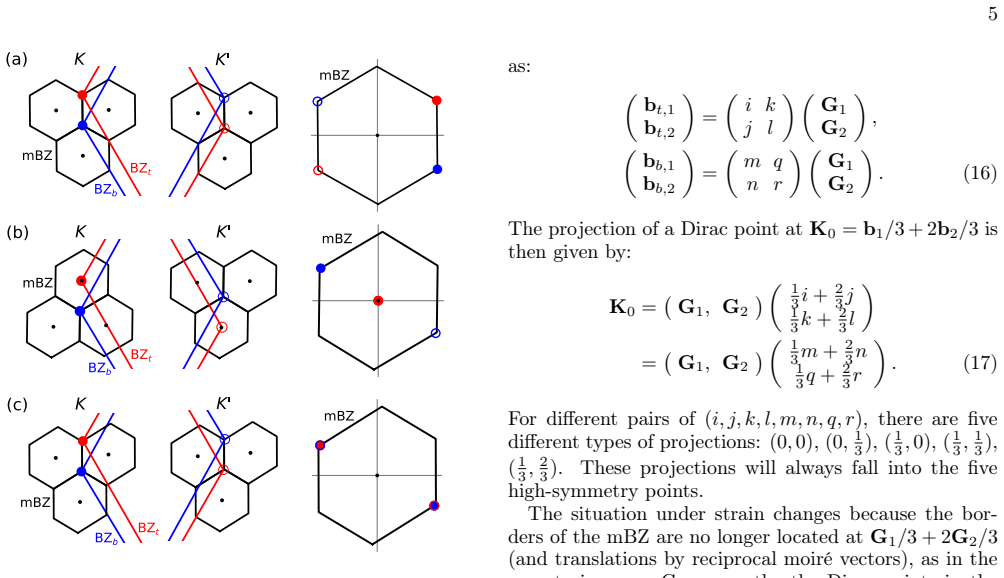
The machinery is a combination of a commensurability algorithm that adds a very small biaxial strain to any twist and heterostrain so that the eight integer parameters of an interlayer transformation matrix can be rounded to define an exact commensurate supercell; a strain-extended continuum Hamiltonian whose strain-induced scalar and gauge potentials (particularly the gauge potential) reproduce the tight-binding spectra; and a self-consistent Hartree potential used to compute the valley Chern numbers of the narrow bands. The paper identifies the linear-in-strain growth of the moiré vectors as the origin of the linear scaling of the minimum bandwidth with strain magnitude.
What would settle it
Measure the gap between the narrow and remote bands in a device under controlled uniaxial strain at the magic angle: if the predicted Chern-number transition (at strain magnitudes around 0.5 to 1.5 percent, depending on direction) is not accompanied by the predicted band-touching signature in magnetotransport or nonlinear Hall measurements, the topological part of the claim fails. Alternatively, compute the same quantities in fully incommensurate large supercells with the residual biaxial strain reduced toward zero; if the transition strain shifts by more than a few tenths of a percent, the co
Extended reading notes
Core claim
The central discovery is that strain acts as a tunable control for flat-band engineering and valley topology in twisted bilayer graphene. At fixed twist angle, strain broadens the narrow bands and splits the van Hove singularities, but the twist angle at which the bandwidth is minimum shifts with strain direction, and the minimum bandwidth itself increases practically linearly with strain magnitude. Under shear strain the distortion is stronger than under uniaxial strain of the same magnitude. A self-consistent Hartree calculation shows that strain-induced broadening reduces the electrostatic renormalization, so the effective interacting bandwidth can be comparable to or smaller than in the
Load-bearing premise
The central assumption is that replacing the real, generally incommensurate twisted-and-strained bilayer with the nearest commensurate supercell—where a tiny residual biaxial strain absorbs the mismatch—does not change the electronic properties, especially the tiny gaps that decide the topological transitions.
Editorial extensions
If this is right
- Because the magic angle shifts with strain direction and magnitude, flat bands can be recovered at twist angles away from 1.05 degrees by applying strain, giving a practical tuning route for experimental devices.
- Shear strain is the stronger distortion: experiments that interpret moiré distortions solely as uniaxial strain would misattribute the electronic signatures, so distinguishing the strain type matters for interpreting STM and transport data.
- Strained samples can keep narrow bands even after electrostatic interactions, because the Hartree potential weakens as the bare bands broaden, so correlated phases are not ruled out in strained devices.
- Strain alone is sufficient to drive the valley Chern numbers of the narrow bands from ±1 to 0, and when combined with interactions it can create a regime with a single topological band, which could be detected as a nonlinear Hall response.
Reading between the lines
- If the linear minimum-bandwidth relation is generic, strain magnitude could serve as a continuous dial between flat and dispersive bands in other moiré systems, such as transition-metal dichalcogenide bilayers, where the same commensurability construction should apply.
- A direct check of the topological claim would be to repeat the Chern-number calculation for progressively smaller residual biaxial strain (toward the true incommensurate limit) and confirm that the strain magnitude at which the gap closes converges; without that check, the topological transitions rest on the commensurate-cell approximation.
- The predicted asymmetric interacting transition suggests a concrete experiment: measuring the nonlinear Hall effect as a function of strain direction and filling factor near the magic angle, where a regime with only one topological band would show a characteristic sign change.
Editorial analysis
A structured set of objections, weighed in public.
Referee Report
Summary. The paper studies twisted bilayer graphene under uniaxial and shear heterostrain. It introduces a commensurate-supercell construction that rounds the eight integer parameters of the Park–Madden transformation and absorbs the residual mismatch with a small biaxial strain. Using atomistic tight-binding and a strain-extended continuum model, it reports strain-induced broadening of the narrow bands, a linear increase of the minimum bandwidth with strain magnitude, a strong dependence of the DOS and magic-angle shift on strain direction, shear strain being more effective than uniaxial strain, and strain-driven topological transitions of the valley Chern numbers, with an asymmetry induced by the Hartree potential in the interacting case.
Significance. If the results hold, the paper provides a useful map of how strain can be used to engineer flat bands and valley topology in twisted bilayer graphene, and it offers a concrete computational recipe for building commensurate strained moiré cells. The combination of atomistic tight-binding calculations, relaxed geometries, and a continuum model with systematic parameter tables in the Supplemental Materials is a strength. The TB/continuum comparison across multiple twist angles and strain configurations is valuable, and the Hartree-level treatment goes beyond the bare band picture. However, the key quantitative claims—especially the strain-direction dependence and the topological transitions—rest on a commensuration approximation whose convergence is not demonstrated, and on continuum-model results that are not independently checked by TB for the topology itself.
major comments (1)
- [Sec. III.E, Fig. 7; SM S12] The linear scaling of the minimum bandwidth with strain is presented as a central result, but the text itself credits this scaling to Ref. [20]. The new element appears to be the strain-direction dependence of the magic-angle shift and the demonstration that the linear scaling persists in the continuum model with fitted parameters. Please clarify the incremental claim relative to Ref. [20], and specify whether the linear fit in the bottom panels of Fig. 7 is a guide to the eye or a numerical fit with a stated functional form and residuals.
minor comments (5)
- [Sec. IV, Eq. (33) and following] In the text after Eq. (33), 'relative primitivity' should be 'relative permittivity'.
- [Eq. (8) and SM S2] The statement that the fitted shear-strain direction is the real direction plus π/4 is confusing. In Table III, the fitted direction for nominal '0' is 0.5266 rad; it would help to state explicitly which column corresponds to the physical strain direction and which to the rotated angle used in Eq. (8).
- [SM S2, Tables II and III] The tables list fitted twist/strain values with many digits but no uncertainties. A modest rounding and a note on the accuracy of the fitting procedure would improve readability.
- [Sec. II.B, Eq. (17)] The sentence 'These projections will always fall into the five high-symmetry points' is only true for the unstrained case. In the strained case, the projections are at arbitrary positions, as the following sentences acknowledge. Please rephrase to avoid contradiction.
- [Sec. V.A, Fig. 10] In the caption, 'top left panel show' should be 'shows'; also, the white crosses are not consistently defined in the text for the shear panel. Please add a legend or explicit description.
Circularity Check
No significant circularity: TB benchmarks are independent, continuum extrapolations are not forced by construction, and self-citations are not load-bearing.
full rationale
The paper's core quantitative claims rest on atomistic tight-binding calculations with Slater-Koster hoppings, a LAMMPS-relaxed geometry, and a valley projector; these are externally defined inputs, not outputs of the continuum model. The strain-extended continuum parameters (u0, u1, ℏv/a, and the nonlocal λ's) are fitted to TB band structures at selected configurations, but the headline results — bandwidth vs θ/ϵ/ϕ, magic-angle shift, Hartree renormalization, and valley-Chern transitions — are computed from the fitted model over new parameter ranges rather than read back from the fit. No equation equates a predicted quantity to a fitted value by construction: for example, Eq. (14) plus SM Table II define the actual commensurate supercell geometry used in TB; the main-text labels are approximate, and the discrepancy is a validation/representativeness concern, not a circular one. Self-citations ([21], [72], [84], [115]) appear, but they are not load-bearing: the moiré-potential form is also supported by external Refs. [17,18], the strain gauge fields by Refs. [54,57,58,85,86], and the topological transitions are recomputed here from the model rather than imported from those references. The rounding-induced offset between nominal and fitted strain direction (e.g., SM Table II: proposed ϕ=0 vs fitted ϕ=0.5256 rad) is a real convergence/validation weakness, but it does not make any claim true by definition. No circular step can therefore be exhibited.
Assumptions & free parameters
free parameters (8)
- TB intralayer hopping t0 =
2.8 eV
- TB interlayer hopping t1 =
0.44 eV
- Continuum Dirac velocity ħv/a (rigid) =
2.15 eV
- Continuum moiré couplings u0=u1 (rigid) =
0.1 eV
- Continuum relaxed couplings u1, u0 =
u1=0.096 eV, u0=0.05952 eV
- Nonlocal moiré couplings λ1, λ2, λ3 =
λ1=9 meV·nm, λ2=18 meV·nm, λ3=0
- Chern mass term m =
10 meV
- Hartree gate distance d, dielectric εr, filling ν =
d=40 nm, εr=7, ν=+2
assumptions (7)
- domain assumption p_z orbital Slater–Koster tight-binding with hopping cutoffs describes low-energy graphene bands
- domain assumption LAMMPS relaxation with AIREBO + Kolmogorov–Crespi potentials gives physical relaxed geometries
- domain assumption Continuum Hamiltonian truncated to three moiré harmonics is valid at small twist/strain
- ad hoc to paper Heterostrain defined by straining only one layer is equivalent to symmetric heterostrain near the first magic angle
- domain assumption Hartree-only mean-field (no Fock exchange) adequately captures electrostatic renormalization trends
- ad hoc to paper Small mass term m=10 meV does not alter the strain values at which topological transitions occur
- ad hoc to paper Rounding to commensurate Park–Madden integers with a tiny biaxial strain leaves electronic structure unchanged
Cite this review
Pith. "Pith review of Straintronics and twistronics in bilayer graphene." pith.science (2026). https://pith.science/paper/QTSVQFVI
@misc{pith2026260202692,
  author       = {Pith},
  title        = {Pith review of: Straintronics and twistronics in bilayer graphene},
  year         = {2026},
  howpublished = {\url{https://pith.science/paper/QTSVQFVI}},
  note         = {Machine review of arXiv:2602.02692}
}
read the original abstract
The interplay of twist and strain in bilayer graphene enables the formation of moir\'e patterns and narrow bands that host correlated and topological phases. While magic-angle twisted bilayer graphene has been widely studied, strain provides an additional and realistic control knob for band engineering. In this work, we first generate a global method to construct commensurate supercells for arbitrary twist and heterostrain. Then, using atomistic tight-binding and strain-extended continuum models to study the commensurate structures, we identify configurations that minimize the bandwidth beyond the magic angle. The results reveal a strong dependence of band narrowing and topology on strain type, magnitude, direction and lattice relaxation. Particularly, shear strain produces a stronger distortion than uniaxial strain. Including electron-electron interactions through a self-consistent Hartree potential shows that strain broadens the bare bands while reducing electrostatic renormalization. Strain also drives topological transitions as the narrow and remote bands hybridize, establishing twisted and strained bilayer graphene as a tunable platform for flat-band and topological phenomena.
Figures


Figures from the paper (8 more)


Reference graph
Works this paper leans on
-
[20]
Z. Bi, N. F. Q. Yuan, and L. Fu, Designing flat bands by strain, Physical Review B100, 035448 (2019)
2019
-
[1]
E. Y. Andrei, D. K. Efetov, P. Jarillo-Herrero, A. H. MacDonald, K. F. Mak, T. Senthil, E. Tutuc, A. Yaz- dani, and A. F. Young, The marvels of moiré materials, Nature Reviews Materials6, 201–206 (2021)
2021
-
[2]
Y. Cao, V. Fatemi, A. Demir, S. Fang, S. L. Tomarken, J. Y. Luo, J. D. Sanchez-Yamagishi, K. Watanabe, T. Taniguchi, E. Kaxiras, R. C. Ashoori, and P. Jarillo- Herrero, Correlated insulator behaviour at half-filling in magic-angle graphene superlattices, Nature556, 80 (2018)
2018
-
[3]
Y. Cao, V. Fatemi, S. Fang, K. Watanabe, T. Taniguchi, E. Kaxiras, and P. Jarillo-Herrero, Unconventional su- perconductivity in magic-angle graphene superlattices, Nature556, 43 (2018)
2018
-
[4]
Kerelsky, L
A. Kerelsky, L. J. McGilly, D. M. Kennes, L. Xian, M. Yankowitz, S. Chen, K. Watanabe, T. Taniguchi, J.Hone, C.Dean, A.Rubio,andA.N.Pasupathy,Maxi- mized electron interactions at the magic angle in twisted bilayer graphene, Nature572, 95 (2019)
2019
-
[5]
Yankowitz, S
M. Yankowitz, S. Chen, H. Polshyn, Y. Zhang, K. Watanabe, T. Taniguchi, D. Graf, A. F. Young, and C. R. Dean, Tuning superconductivity in twisted bilayer graphene, Science363, 1059 (2019)
2019
-
[6]
X. Lu, P. Stepanov, W. Yang, M. Xie, M. A. Aamir, I. Das, C. Urgell, K. Watanabe, T. Taniguchi, G. Zhang, et al., Superconductors, orbital magnets and correlated states in magic-angle bilayer graphene, Nature574, 653 (2019)
2019
-
[7]
Saito, J
Y. Saito, J. Ge, K. Watanabe, T. Taniguchi, and A. F. Young, Independent superconductors and correlated in- sulators in twisted bilayer graphene, Nature Physics16, 926 (2020)
2020
Show all 135 references
-
[8]
Zondiner, A
U. Zondiner, A. Rozen, D. Rodan-Legrain, Y. Cao, R. Queiroz, T. Taniguchi, K. Watanabe, Y. Oreg, F. von Oppen, A.Stern,et al.,Cascadeofphasetransitionsand dirac revivals in magic-angle graphene, Nature582, 203 (2020)
2020
-
[9]
Y. Xu, S. Liu, D. A. Rhodes, K. Watanabe, T. Taniguchi, J. Hone, V. Elser, K. F. Mak, and J. Shan, Correlatedinsulatingstatesatfractionalfillingsofmoiré superlattices, Nature587, 214 (2020)
2020
-
[10]
Y. Choi, H. Kim, Y. Peng, A. Thomson, C. Lewandowski, R. Polski, Y. Zhang, H. S. Arora, K. Watanabe, T. Taniguchi,et al., Correlation-driven topological phases in magic-angle twisted bilayer graphene, Nature589, 536 (2021)
2021
-
[11]
Y. Cao, D. Rodan-Legrain, J. M. Park, N. F. Yuan, K. Watanabe, T. Taniguchi, R. M. Fernandes, L. Fu, andP.Jarillo-Herrero,Nematicityandcompetingorders in superconducting magic-angle graphene, Science372, 264 (2021)
2021
-
[12]
Lopes dos Santos, N
J. Lopes dos Santos, N. Peres, and A. Castro Neto, Graphene bilayer with a twist: Electronic structure, Physical Review Letters99, 256802 (2007)
2007
-
[13]
Trambly de Laissardière, D
G. Trambly de Laissardière, D. Mayou, and L. Mag- aud, Localization of dirac electrons in rotated graphene bilayers, Nano letters10, 804 (2010)
2010
-
[14]
Suárez Morell, J
E. Suárez Morell, J. Correa, P. Vargas, M. Pacheco, and Z. Barticevic, Flat bands in slightly twisted bilayer graphene: Tight-binding calculations, Physical Review B82, 121407 (2010)
2010
-
[15]
Bistritzer and A
R. Bistritzer and A. H. MacDonald, Moiré bands in twisted double-layer graphene, Proceedings of the Na- tional Academy of Sciences108, 12233 (2011)
2011
-
[16]
E. Y. Andrei and A. H. MacDonald, Graphene bilayers with a twist, Nature Materials19, 1265–1275 (2020)
2020
-
[17]
Moon and M
P. Moon and M. Koshino, Optical absorption in twisted bilayer graphene, Physical Review B87, 205404 (2013)
2013
-
[18]
Koshino, Interlayer interaction in general incommen- surate atomic layers, New Journal of Physics17, 015014 (2015)
M. Koshino, Interlayer interaction in general incommen- surate atomic layers, New Journal of Physics17, 015014 (2015)
2015
-
[19]
San-Jose, J
P. San-Jose, J. González, and F. Guinea, Non-abelian gauge potentials in graphene bilayers, Physical Review Letters108, 10.1103/physrevlett.108.216802 (2012)
2012 doi
-
[21]
Escudero, A
F. Escudero, A. Sinner, Z. Zhan, P. A. Pantaleón, and F. Guinea, Designing moiré patterns by strain, Physical Review Research6, 023203 (2024)
2024
-
[22]
Tarnopolsky, A
G. Tarnopolsky, A. J. Kruchkov, and A. Vishwanath, Origin of magic angles in twisted bilayer graphene, Physical Review Letters122, 106405 (2019)
2019
-
[23]
Kapfer, B
M. Kapfer, B. S. Jessen, M. E. Eisele, M. Fu, D. R. Danielsen, T. P. Darlington, S. L. Moore, N. R. Finney, A. Marchese, V. Hsieh,et al., Programming twist an- gle and strain profiles in 2d materials, Science381, 677 (2023)
2023
-
[24]
Y. Hou, J. Zhou, M. Xue, M. Yu, Y. Han, Z. Zhang, and Y. Lu, Strain engineering of twisted bilayer graphene: The rise of strain-twistronics, Small21, 2311185 (2024)
2024
-
[25]
J. S. Alden, A. W. Tsen, P. Y. Huang, R. Hov- den, L. Brown, J. Park, D. A. Muller, and P. L. McEuen, Strain solitons and topological defects in bi- layer graphene, Proceedings of the National Academy of Sciences110, 11256 (2013)
2013
-
[26]
Lu, Y.-C
C.-C. Lu, Y.-C. Lin, Z. Liu, C.-H. Yeh, K. Suenaga, and P.-W. Chiu, Twisting bilayer graphene superlat- tices, ACS Nano7, 2587 (2013)
2013
-
[27]
S. W. Schmucker, C. D. Cress, J. C. Culbertson, J. W. Beeman, O. D. Dubon, and J. T. Robinson, Raman sig- nature of defected twisted bilayer graphene, Carbon93, 250 (2015)
2015
-
[28]
J. H. Wilson, Y. Fu, S. Das Sarma, and J. Pixley, Dis- order in twisted bilayer graphene, Physical Review Re- search2, 023325 (2020)
2020
-
[29]
Schäpers, J.Sonntag, L.Valerius, B.Pestka, J.Stras- das, K
A. Schäpers, J.Sonntag, L.Valerius, B.Pestka, J.Stras- das, K. Watanabe, T. Taniguchi, L. Wirtz, M. Mor- genstern, B. Beschoten,et al., Raman imaging of twist 18 angle variations in twisted bilayer graphene at interme- diate angles, 2D Materials9, 045009 (2022)
2022
-
[30]
T. E. Beechem, T. Ohta, B. Diaconescu, and J. T. Robinson, Rotational disorder in twisted bilayer graphene, ACS Nano8, 1655 (2014)
2014
-
[31]
A. C. Gadelha, D. A. Ohlberg, F. C. Santana, G. S. Eliel, J. S. Lemos, V. Ornelas, D. Miranda, R. B. Nadas, K. Watanabe, T. Taniguchi,et al., Twisted bi- layer graphene: a versatile fabrication method and the detection of variable nanometric strain caused by twist- angle disor...
2021
-
[32]
Huder, A
L. Huder, A. Artaud, T. Le Quang, G. T. De Lais- sardière, A. G. Jansen, G. Lapertot, C. Chapelier, and V. T. Renard, Electronic spectrum of twisted graphene layers under heterostrain, Physical Review Letters120, 156405 (2018)
2018
-
[33]
N. P. Kazmierczak, M. Van Winkle, C. Ophus, K. C. Bustillo, S. Carr, H. G. Brown, J. Ciston, T. Taniguchi, K.Watanabe,andD.K.Bediako,Strainfieldsintwisted bilayer graphene, Nature Materials20, 956 (2021)
2021
-
[34]
Mesple, A
F. Mesple, A. Missaoui, T. Cea, L. Huder, F. Guinea, G. Trambly de Laissardière, C. Chapelier, and V. T. Renard, Heterostrain determines flat bands in magic- angle twisted graphene layers, Physical Review Letters 127, 126405 (2021)
2021
-
[35]
Mannaï and S
M. Mannaï and S. Haddad, Twistronics versus strain- tronics in twisted bilayers of graphene and transition metal dichalcogenides, Physical Review B103, L201112 (2021)
2021
-
[36]
Sinner, P
A. Sinner, P. A. Pantaleón, and F. Guinea, Strain- Induced Quasi-1D Channels in Twisted Moiré Lattices, Physical Review Letters131, 166402 (2023)
2023
-
[37]
X. Wang, J. Finney, A. L. Sharpe, L. K. Rodenbach, C. L. Hsueh, K. Watanabe, T. Taniguchi, M. Kast- ner, O. Vafek, and D. Goldhaber-Gordon, Unusual mag- netotransport in twisted bilayer graphene from strain- induced open fermi surfaces, Proceedings of the Na- tional Academy of...
2023
-
[38]
Jiang, J
Y. Jiang, J. Mao, J. Duan, X. Lai, K. Watanabe, T. Taniguchi, and E. Y. Andrei, Visualizing strain- induced pseudomagnetic fields in graphene through an hbn magnifying glass, Nano Letters17, 2839–2843 (2017)
2017
-
[39]
J. Mao, S. P. MilovanoviC, M. AnđelkoviC, X. Lai, Y. Cao, K. Watanabe, T. Taniguchi, L. Covaci, F. M. Peeters, A. K. Geim, Y. Jiang, and E. Y. Andrei, Ev- idence of flat bands and correlated states in buckled graphene superlattices, Nature584, 215–220 (2020)
2020
-
[40]
T. Peña, A. Dey, S. A. Chowdhury, A. Azizimanesh, W. Hou, A. Sewaket, C. Watson, H. Askari, and S. M. Wu, Moiré engineering in 2d heterostructures with process-induced strain, Applied Physics Letters122, 143101 (2023)
2023
-
[41]
M. Kögl, P. Soubelet, M. Brotons-Gisbert, A. V. Stier, B. D. Gerardot, and J. J. Finley, Moiré straintronics: a universal platform for reconfigurable quantum materi- als, npj 2D Materials and Applications7, 32 (2023)
2023
-
[42]
N.Hasan, T.Peña, A.Dey, D.Yoon, Z.Islam, Y.Zhang, M. V. G. Leal, A. M. van der Zande, H. Askari, and S. M. Wu, Strain-induced moiré reconstruction and memorization in two-dimensional materials without twist, arXiv 10.48550/ARXIV.2510.13699 (2025)
2025 doi
-
[43]
X. Gao, H. Sun, D.-H. Kang, C. Wang, Q. J. Wang, and D. Nam, Heterostrain-enabled dynamically tunable moiré superlattice in twisted bilayer graphene, Scientific Reports11, 21402 (2021)
2021
-
[44]
Sequeira, A
I. Sequeira, A. Z. Barabas, A. H. Barajas-Aguilar, M. G. Bacani, N. Nakatsuji, M. Koshino, T. Taniguichi, K. Watanabe, and J. D. Sanchez-Yamagishi, Manipulat- ing moires by controlling heterostrain in van der waals devices, Nano Letters24, 15662 (2024)
2024
-
[45]
Y. Xie, B. Lian, B. Jäck, X. Liu, C.-L. Chiu, K. Watan- abe, T. Taniguchi, B. A. Bernevig, and A. Yazdani, Spectroscopic signatures of many-body correlations in magic-angle twisted bilayer graphene, Nature572, 101 (2019)
2019
- [46]
-
[47]
Ouyang, J
P. Ouyang, J. Yu, Q. Li, G. Jia, Y. Wang, K. Xiao, H. Zhang, Z. Hu, P. A. Pantaleón, Z. Zhan,et al., Structural and electronic signatures of strain-tunable marginally twisted bilayer graphene, National Science Review13, nwaf568 (2026)
2026
- [48]
-
[49]
Herzog-Arbeitman, J
J. Herzog-Arbeitman, J. Yu, D. Călugăru, H. Hu, N. Regnault, O. Vafek, J. Kang, and B. A. Bernevig, Topological heavy fermion model as an efficient repre- sentation of atomistic strain and relaxation in twisted bilayer graphene, Physical Review B112, 125128 (2025)
2025
-
[50]
Herzog-Arbeitman, D
J. Herzog-Arbeitman, D. Călugăru, H. Hu, J. Yu, N. Regnault, J. Kang, B. A. Bernevig, and O. Vafek, Kekulé spiral order from strained topological heavy fermions, Physical Review B112, 125129 (2025)
2025
- [51]
-
[52]
Gonçalves, B
M. Gonçalves, B. Amorim, F. Riche, E. V. Castro, and P.Ribeiro,Incommensurabilityenabledquasi-fractalor- der in 1d narrow-band moiré systems, Nature Physics 20, 1933–1940 (2024)
1933
-
[53]
V. M. Pereira, A. Castro Neto, and N. Peres, Tight- binding approach to uniaxial strain in graphene, Phys- ical Review B80, 045401 (2009)
2009
-
[54]
M. A. Vozmediano, M. Katsnelson, and F. Guinea, Gauge fields in graphene, Physics Reports496, 109 (2010)
2010
-
[55]
Amorim, A
B. Amorim, A. Cortijo, F. De Juan, A. G. Grushin, F. Guinea, A. Gutiérrez-Rubio, H. Ochoa, V. Parente, R. Roldán, P. San-Jose,et al., Novel effects of strains in graphene and other two dimensional materials, Physics Reports617, 1 (2016)
2016
-
[56]
G. G. Naumis, S. Barraza-Lopez, M. Oliva-Leyva, and H. Terrones, Electronic and optical properties of strained graphene and other strained 2d materials: a re- view, Reports on Progress in Physics80, 096501 (2017)
2017
-
[57]
Suzuura and T
H. Suzuura and T. Ando, Phonons and electron-phonon scattering in carbon nanotubes, Physical review B65, 19 235412 (2002)
2002
-
[58]
J. L. Manes, Symmetry-based approach to electron- phonon interactions in graphene, Physical Review B76, 045430 (2007)
2007
-
[59]
Guinea and N
F. Guinea and N. R. Walet, Electrostatic effects, band distortions, and superconductivity in twisted graphene bilayers, Proceedings of the National Academy of Sci- ences115, 13174 (2018)
2018
-
[60]
T. Cea, N. R. Walet, and F. Guinea, Electronic band structure and pinning of fermi energy to van hove sin- gularities in twisted bilayer graphene: A self-consistent approach, Physical Review B100, 205113 (2019)
2019
-
[61]
Z. A. Goodwin, V. Vitale, X. Liang, A. A. Mostofi, and J. Lischner, Hartree theory calculations of quasiparticle properties in twisted bilayer graphene, Electronic Struc- ture2, 034001 (2020)
2020
-
[62]
Cea and F
T. Cea and F. Guinea, Coulomb interaction, phonons, and superconductivity in twisted bilayer graphene, Pro- ceedings of the National Academy of Sciences118, e2107874118 (2021)
2021
-
[63]
V. T. Phong, P. A. Pantaleón, T. Cea, and F. Guinea, Band structure and superconductivity in twisted tri- layergraphene,PhysicalReviewB104,L121116(2021)
2021
-
[64]
D. E. Parker, T. Soejima, J. Hauschild, M. P. Zaletel, and N. Bultinck, Strain-induced quantum phase transi- tions in magic-angle graphene, Physical Review Letters 127, 027601 (2021)
2021
-
[65]
Wagner, Y
G. Wagner, Y. H. Kwan, N. Bultinck, S. H. Simon, and S. Parameswaran, Global phase diagram of the normal state of twisted bilayer graphene, Physical Review Let- ters128, 156401 (2022)
2022
-
[66]
H. Hu, G. Rai, L. Crippa, J. Herzog-Arbeitman, D. Călugăru, T. Wehling, G. Sangiovanni, R. Valentí, A. M. Tsvelik, and B. A. Bernevig, Symmetric kondo latticestatesindopedstrainedtwistedbilayergraphene, Physical Review Letters131, 166501 (2023)
2023
-
[67]
E. J. Mele, Commensuration and interlayer coherence in twisted bilayer graphene, Physical Review B81, 161405 (2010)
2010
-
[68]
Trambly de Laissardière, D
G. Trambly de Laissardière, D. Mayou, and L. Magaud, Numerical studies of confined states in rotated bilayers of graphene, Physical Review B86, 125413 (2012)
2012
-
[69]
L. D. Landau, L. Pitaevskii, A. M. Kosevich, and E. M. Lifshitz,Theory of elasticity: volume 7, Vol. 7 (Elsevier, 2012)
2012
-
[70]
M. E. Gurtin, E. Fried, and L. Anand,The mechanics and thermodynamics of continua(Cambridge university press, 2010)
2010
-
[71]
F. N. Escudero, F. Guinea, and Z. Zhan, Geometrical properties of strained and twisted moiré heterostruc- tures, Journal of Physics: Condensed Matter (2025)
2025
- [72]
-
[73]
Artaud, L
A. Artaud, L. Magaud, T. Le Quang, V. Guisset, P. David, C. Chapelier, and J. Coraux, Universal classi- fication of twisted, strained and sheared graphene moiré superlattices, Scientific Reports6, 25670 (2016)
2016
-
[74]
X. Lai, G. Li, A. M. Coe, J. H. Pixley, K. Watanabe, T. Taniguchi, and E. Y. Andrei, Moiré periodic and quasiperiodic crystals in heterostructures of twisted bi- layer graphene on hexagonal boron nitride, Nature ma- terials , 1 (2025)
2025
-
[75]
See Supplemental Materials at [URL will be inserted by publisher] for details on commensurate structures with twist and strain, the tight-binding model, relaxation ef- fects, Berry curvature and topology, and extended nu- merical results
-
[76]
J. H. Los, L. M. Ghiringhelli, E. J. Meijer, and A. Fa- solino, Improved long-range reactive bond-order poten- tial for carbon. i. construction, Physical Review B72, 214102 (2005)
2005
-
[77]
A.N.KolmogorovandV.H.Crespi,Registry-dependent interlayer potential for graphitic systems, Physical Re- view B71, 235415 (2005)
2005
-
[78]
Ramires and J
A. Ramires and J. L. Lado, Electrically Tunable Gauge Fields in Tiny-Angle Twisted Bilayer Graphene, Physi- cal Review Letters121, 146801 (2018)
2018
-
[79]
Ramires and J
A. Ramires and J. L. Lado, Impurity-induced triple point fermions in twisted bilayer graphene, Physical Re- view B99, 245118 (2019)
2019
-
[80]
Plimpton, Fast parallel algorithms for short-range molecular dynamics, Journal of Computational Physics 117, 1–19 (1995)
S. Plimpton, Fast parallel algorithms for short-range molecular dynamics, Journal of Computational Physics 117, 1–19 (1995)
1995
-
[81]
Y. Li, Z. Zhan, X. Kuang, Y. Li, and S. Yuan, Tbplas: Atight-bindingpackageforlarge-scalesimulation,Com- puter Physics Communications285, 108632 (2023)
2023
-
[82]
Hams and H
A. Hams and H. De Raedt, Fast algorithm for finding the eigenvalue distribution of very large matrices, Phys- ical Review E62, 4365 (2000)
2000
-
[83]
Polizzi, Density-matrix-based algorithm for solving eigenvalue problems, Physical Review B79, 115112 (2009)
E. Polizzi, Density-matrix-based algorithm for solving eigenvalue problems, Physical Review B79, 115112 (2009)
2009
-
[84]
P. A. Pantaleón, V. T. Phong, G. G. Naumis, and F. Guinea, Interaction-enhanced topological hall effects in strained twisted bilayer graphene, Physical Review B 106, L161101 (2022)
2022
-
[85]
Oliva-Leyva and G
M. Oliva-Leyva and G. G. Naumis, Understanding elec- tron behavior in strained graphene as a reciprocal space distortion, Physical Review B88, 085430 (2013)
2013
-
[86]
Oliva-Leyva and G
M. Oliva-Leyva and G. G. Naumis, Generalizing the fermi velocity of strained graphene from uniform to nonuniform strain, Physics Letters A379, 2645–2651 (2015)
2015
-
[87]
Koshino, N
M. Koshino, N. F. Yuan, T. Koretsune, M. Ochi, K. Kuroki, and L. Fu, Maximally localized wannier or- bitals and the extended hubbard model for twisted bi- layer graphene, Physical Review X8, 031087 (2018)
2018
-
[88]
Koshino and N
M. Koshino and N. N. Nam, Effective continuum model for relaxed twisted bilayer graphene and moiré electron- phonon interaction, Physical Review B101, 195425 (2020)
2020
-
[89]
S. Carr, S. Fang, Z. Zhu, and E. Kaxiras, Exact contin- uum model for low-energy electronic states of twisted bilayer graphene, Physical Review Research1, 013001 (2019)
2019
-
[90]
S. Carr, D. Massatt, S. B. Torrisi, P. Cazeaux, M. Luskin, and E. Kaxiras, Relaxation and domain formation in incommensurate two-dimensional het- erostructures, Physical Review B98, 224102 (2018)
2018
-
[91]
M. M. A. Ezzi, G. N. Pallewela, C. De Beule, E. Mele, and S. Adam, Analytical model for atomic relaxation in twisted moiré materials, Physical Review Letters133, 266201 (2024)
2024
-
[92]
Ceferino and F
A. Ceferino and F. Guinea, Pseudomagnetic fields in fully relaxed twisted bilayer and trilayer graphene, 2D Materials11, 035015 (2024)
2024
-
[93]
V. H. Nguyen and P. Dollfus, Strain-induced modula- 20 tionofdiracconesandvanhovesingularitiesinatwisted graphene bilayer, 2D Materials2, 035005 (2015)
2015
-
[94]
M. Long, Z. Zhan, P. A. Pantaleón, J. A. Silva- Guillén, F. Guinea, and S. Yuan, Electronic properties of twisted bilayer graphene suspended and encapsulated with hexagonal boron nitride, Physical Review B107, 115140 (2023)
2023
-
[95]
M. Long, P. A. Pantaleón, Z. Zhan, F. Guinea, J. A. Silva-Guillén, and S. Yuan, An atomistic approach for the structural and electronic properties of twisted bi- layergraphene-boronnitrideheterostructures,npjCom- putational Materials8, 73 (2022)
2022
-
[96]
G. Li, R. Krishna Kumar, P. Stepanov, P. A. Pan- taleón, Z. Zhan, H. Agarwal, A. Bercher, J. Bar- rier, K. Watanabe, T. Taniguchi, A. B. Kuzmenko, F. Guinea, I. Torre, and F. H. L. Koppens, Infrared spectroscopy for diagnosing superlattice minibands in twisted bilayer graphene...
2024
-
[97]
Escudero, Diagrammatic perturbation approach to moiré bands in twisted bilayer graphene, Physical Re- view B110, 045442 (2024)
F. Escudero, Diagrammatic perturbation approach to moiré bands in twisted bilayer graphene, Physical Re- view B110, 045442 (2024)
2024
-
[98]
Choi, S.-H
S.-M. Choi, S.-H. Jhi, and Y.-W. Son, Controlling en- ergy gap of bilayer graphene by strain, Nano Letters10, 3486 (2010)
2010
-
[99]
Guinea and N
F. Guinea and N. R. Walet, Continuum models for twisted bilayer graphene: Effect of lattice deformation and hopping parameters, Physical Review B99, 205134 (2019)
2019
-
[100]
I. V. Lebedeva and A. M. Popov, Two phases with dif- ferent domain wall networks and a reentrant phase tran- sition in bilayer graphene under strain, Physical Review Letters124, 116101 (2020)
2020
-
[101]
Mesple, N
F. Mesple, N. R. Walet, G. Trambly de Laissardière, F. Guinea, D. Došenović, H. Okuno, C. Paillet, A. Mi- chon, C. Chapelier, and V. T. Renard, Giant atomic swirl in graphene bilayers with biaxial heterostrain, Ad- vanced Materials35, e2306312 (2023)
2023
-
[102]
Meunier, and J.-C
V.HungNguyen, D.Paszko, M.Lamparski, B.VanTro- eye, V. Meunier, and J.-C. Charlier, Electronic localiza- tion in small-angle twisted bilayer graphene, 2D Mate- rials8, 035046 (2021)
2021
-
[103]
Timmel and E
A. Timmel and E. Mele, Dirac-harper theory for one- dimensional moiré superlattices, Physical Review Let- ters125, 166803 (2020)
2020
-
[104]
Kang and O
J. Kang and O. Vafek, Pseudomagnetic fields, particle- hole asymmetry, and microscopic effective continuum hamiltonians of twisted bilayer graphene, Physical Re- view B107, 075408 (2023)
2023
- [105]
-
[106]
Y. H. Kwan, G. Wagner, T. Soejima, M. P. Zaletel, S. H. Simon, S. A. Parameswaran, and N. Bultinck, Kekulé spiral order at all nonzero integer fillings in twisted bi- layer graphene, Physical Review X11, 041063 (2021)
2021
-
[107]
Vafek and J
O. Vafek and J. Kang, Continuum effective hamiltonian for graphene bilayers for an arbitrary smooth lattice de- formation from microscopic theories, Physical Review B 107, 075123 (2023)
2023
-
[108]
Kang and O
J. Kang and O. Vafek, Analytical solution for the re- laxed atomic configuration of twisted bilayer graphene including heterostrain, Physical Review B112, 125138 (2025)
2025
-
[109]
Hsieh, D
V. Hsieh, D. Halbertal, N. R. Finney, Z. Zhu, E. Gerber, M. Pizzochero, E. Kucukbenli, G. R. Schleder, M. An- geli, K. Watanabe,et al., Domain-dependent surface adhesion in twisted few-layer graphene: Platform for moiré-assisted chemistry, Nano Letters23, 3137 (2023)
2023
-
[110]
Cazeaux, D
P. Cazeaux, D. Clark, R. Engelke, P. Kim, and M. Luskin, Relaxation and domain wall structure of bilayer moiré systems, Journal of Elasticity154, 443 (2023)
2023
-
[111]
B. A. Bernevig, Z.-D. Song, N. Regnault, and B. Lian, Twisted bilayer graphene. iii. interacting hamiltonian and exact symmetries, Physical Review B103, 205413 (2021)
2021
-
[112]
Rademaker and P
L. Rademaker and P. Mellado, Charge-transfer insula- tion in twisted bilayer graphene, Physical Review B98, 235158 (2018)
2018
-
[113]
Cea and F
T. Cea and F. Guinea, Band structure and insulating states driven by coulomb interaction in twisted bilayer graphene, Physical Review B102, 045107 (2020)
2020
- [114]
-
[115]
P. A. Pantaleón, T. Low, and F. Guinea, Tunable large berry dipole in strained twisted bilayer graphene, Phys- ical Review B103, 205403 (2021)
2021
-
[116]
Sodemann and L
I. Sodemann and L. Fu, Quantum nonlinear hall effect induced by berry curvature dipole in time-reversal in- variant materials, Physical Review Letters115, 216806 (2015)
2015
-
[117]
T. Low, Y. Jiang, and F. Guinea, Topological currents in black phosphorus with broken inversion symmetry, Physical Review B92, 235447 (2015)
2015
-
[118]
Sinha, P
S. Sinha, P. C. Adak, A. Chakraborty, K. Das, K. Deb- nath, L. D. V. Sangani, K. Watanabe, T. Taniguchi, U. V. Waghmare, A. Agarwal, and M. M. Deshmukh, Berry curvature dipole senses topological transition in a moiré superlattice, Nature Physics18, 765–770 (2022)
2022
-
[119]
Fukui, Y
T. Fukui, Y. Hatsugai, and H. Suzuki, Chern numbers in discretized brillouin zone: Efficient method of com- puting (spin) hall conductances, Journal of the Physical Society of Japan74, 1674 (2005)
2005
-
[120]
J. Pan, H. Wang, L. Zou, X. Wang, L. Zhang, X. Dong, H. Xie, Y. Ding, Y. Zhang, T. Taniguchi,et al., Topo- logical valley transport in bilayer graphene induced by interlayer sliding, Physical Review Letters135, 126603 (2025)
2025
-
[121]
Xiao, M.-C
D. Xiao, M.-C. Chang, and Q. Niu, Berry phase effects on electronic properties, Reviews of modern physics82, 1959 (2010)
1959
-
[122]
Battilomo, N
R. Battilomo, N. Scopigno, and C. Ortix, Berry curva- ture dipole in strained graphene: a fermi surface warp- ing effect, Physical review letters123, 196403 (2019)
2019
-
[123]
Moulsdale, A
C. Moulsdale, A. Knothe, and V. Fal’ko, Engineering of the topological magnetic moment of electrons in bi- layer graphene using strain and electrical bias, Physical Review B101, 085118 (2020)
2020
-
[124]
P. A. Pantaleón, T. Cea, R. Brown, N. R. Walet, and F. Guinea, Narrow bands, electrostatic interactions and band topology in graphene stacks, 2D Materials8, 044006 (2021)
2021
- [125]
- [126]
-
[127]
Dutta, A
R. Dutta, A. Ghosh, S. Mandal, K. Watanabe, T. Taniguchi, H. Krishnamurthy, S. Banerjee, M. Jain, and A. Das, Electric field-tunable superconductivity with competing orders in twisted bilayer graphene near the magic angle, ACS Nano19, 5353 (2025)
2025
-
[128]
Song and B
Z.-D. Song and B. A. Bernevig, Magic-angle twisted bi- layer graphene as a topological heavy fermion problem, Physical Review Letters129, 047601 (2022)
2022
-
[129]
Shi and X
H. Shi and X. Dai, Heavy-fermion representation for twisted bilayer graphene systems, Physical Review B 106, 245129 (2022). 22 Supplemental Materials for: Straintronics and twistronics in bilayer graphene Federico Escudero, Dong Wang, Pierre A. Pantaleón, Shengjun Yuan, Franci...
2022
-
[130]
Start with a set of four parameters (θ, ϵu/s, ϕ, ϵb) that totally determine the twist and strain
-
[131]
(9)–(12) of the main text
Calculate the eight parameters by using Eqs. (9)–(12) of the main text. (Note that the direct solutions of the eight parameters are generally not integers.)
-
[132]
Round the obtained values of the eight parameters to the nearest integers to find the closest commensurate case
-
[133]
(13) of the main text
Calculate (a, b, c, d) by constructing the Park-Madden transformation matrix according to Eq. (13) of the main text
-
[134]
(14) of the main text
Determine the fitted geometrical parameters (θc, ϵc u/s, ϕc, ϵc b) according to Eq. (14) of the main text
-
[135]
(9) and (12) of the main text by using the commensurate twist and strain, respectively
Finally, recalculate the strained lattice vectors and superlattice vectors in Eqs. (9) and (12) of the main text by using the commensurate twist and strain, respectively. This general procedure allows us to generate commensurate structures for arbitrary values of twist and dif...
Reviewed August 3, 2026 · model on record in the stance chip above.
Discussion (0). Sign in to comment.