REVIEW 3 major objections 7 minor 34 references
LPTR-AFLNet: Lightweight Integrated Chinese License Plate Rectification and Recognition Network
T0 review · 3 major / 7 minor · reviewed 2026-08-06 · deepseek-v4-flash
Pith's one-line read A 2.7 MB end-to-end network unifies perspective rectification and recognition of single- and double-line Chinese license plates by letting the recognizer's own output weakly supervise the geometry correction.
desk verdict A competent lightweight LPR pipeline with a clever double-line rectification trick, but the headline double-line accuracy is measured only on synthetic data from the same generator, so the central claim needs independent validation before it can be trusted. read the letter →
The pith
A machine-rendered reading of the paper's core claim, the machinery that carries it, and where it could break.
The reading
What carries the argument
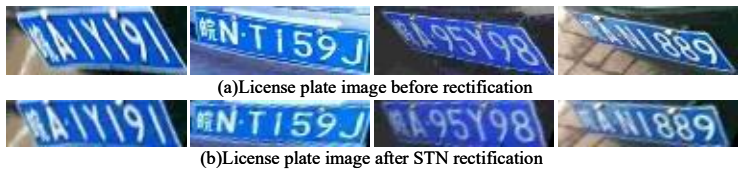
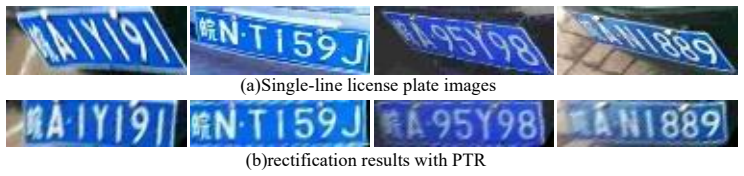
The load-bearing object is the PTR module, a perspective transformation rectifier composed of a vertex-offset estimation subnet, a matrix solver, a grid generator, and a bilinear sampler. Instead of regressing perspective matrix parameters directly, which the paper argues makes STN training diverge, the subnet regresses vertex offsets and the matrix solver obtains the transform by solving the classic eight-point correspondence system. Its training signal is the recognition network's Focal CTC loss, making the whole loop end-to-end and weakly supervised. On the recognition side, LP-CA (lightweight per-channel attention) average-pools each of the 73 character-lexicon channels along height, applies a per-channel 1×3 convolution, and multiplies the sigmoid output back onto the features, suppressing the inter-character spacing confusions shown in the error analysis. Focal CTC replaces vanilla CTC by weighting the CTC loss with $\alpha(1-p)^\gamma$, where $p$ is the probability of the full correct plate. The double-line extension regresses twelve offsets that define six vertices, rectifies upper and lower regions with two matrices, and horizontally concatenates them.
What would settle it
Collect a few thousand real double-line Chinese plates with ground-truth text from multiple provinces, run the trained model without fine-tuning, and compare recognition accuracy against the 99.37% reported on the synthetic test set. A large drop, especially on characters outside the synthetic template set or on plates with real blur and weathering, would show that the rectifier and recognizer learned synthetic statistics rather than true geometry, whereas single-line CCPD accuracy staying high would confirm that the failure is specific to the double-line transfer assumption.
Extended reading notes
Core claim
The central claim is that perspective rectification of license plates becomes stable and annotation-free if the network regresses vertex offsets rather than perspective matrix entries. The PTR module estimates the eight offsets of the plate's four vertices relative to the input corners, solves the standard linear system for the perspective matrix, and samples the corrected image; training is driven entirely by the recognition loss, so the recognizer teaches the rectifier. For double-line plates the same idea is extended by estimating six shared vertices that split the plate into upper and lower regions, rectifying each region separately, and concatenating the two horizontally to form a single line. The recognition network starts from LPRNet and adds two cheap modifications: LP-CA, a per-channel attention that sharpens the 73 lexicon pages of high-level features, and Focal CTC, which reweights hard-to-recognize samples to counter the CCPD dataset's overwhelming 'WAN' majority. The paper claims this combination outperforms LPRNet on all CCPD subsets and reaches 99.37% on the author-built synthetic double-line test set.
Load-bearing premise
The double-line results depend on the assumption that the synthetic double-line dataset, made by blurring, warping, and compositing hand-crafted templates onto CCPD backgrounds, captures the distribution of real double-line plates closely enough that accuracy measured on it (99.37%) predicts accuracy in deployment.
Editorial extensions
If this is right
- If the reported CCPD numbers hold, a 2.7 MB model can match or beat LPRNet on every CCPD subset while running at 107 FPS, so real-time edge deployment does not require giving up perspective robustness.
- Double-line plates become trainable without a dedicated real-world corpus: the synthetic dataset plus recognition-supervised rectification is enough to reach 99.37% on the author's test split, and the unified pipeline removes the need for a separate single/double-line classifier with a tilt-sensitive slicing parameter.
- Weak supervision from recognition means the rectifier can be trained on images with only bounding-box-level localization, avoiding costly vertex annotation for single-line plates.
- The Focal CTC modification alone is reported to raise accuracy on plates with rare Chinese characters by 17%, implying that data imbalance, not just model capacity, is a major source of province-character errors in LPRNet.
- The error statistics table shows the combined model cuts total CCPD misidentifications from 15,660 to 4,034, with the largest absolute reductions in missing characters and Chinese-character errors.
Reading between the lines
- Editorial inference: the same vertex-offset-plus-recognition-loss recipe could transfer to other fixed-layout recognition tasks, such as ID cards, invoices, or shipping labels, where the recognizer's loss can supervise geometry correction without vertex annotations.
- Editorial inference: because the CCPD benchmark is dominated by 'WAN' plates, the numeric gains on CCPD may understate the value of Focal CTC on a geographically balanced set; testing on a multi-province corpus would isolate that effect more cleanly.
- Editorial inference: if the synthetic double-line data transfers as assumed, adding a small set of real double-line plates for final fine-tuning is a natural next step that could close any residual domain gap without retraining the whole network.
- Editorial inference: the LP-CA operator is a generic per-channel temporal attention that could be dropped into other CTC-based OCR models at small parameter cost, so its benefit is testable independently of license plates.
Editorial analysis
A structured set of objections, weighed in public.
Referee Report
Summary. This paper presents LPTR-AFLNet, a lightweight end-to-end network that jointly rectifies and recognizes Chinese license plates for both single- and double-line formats. A perspective transformation rectification (PTR) module estimates per-vertex offsets and solves for a homography instead of regressing the perspective matrix directly, trained with weak supervision from the recognition head. For double-line plates the network estimates six vertices, rectifies the two lines separately, and concatenates them into one line before recognition. The recognition backbone is LPRNet augmented with a lightweight per-channel attention (LP-CA) module and a Focal CTC loss. The authors construct a 200,000-image synthetic double-line dataset from hand-crafted templates, blur, perspective warping, and CCPD background compositing, and they evaluate on CCPD, LSV, and their synthetic double-line test set, reporting accuracy above 99% on several CCPD subsets and 99.37% on the synthetic double-line set at 107 FPS on a TITAN X.
Significance. Assuming the results hold, the paper makes a useful engineering contribution: the PTR formulation avoids known instabilities of STN-based perspective regression, the double-line concatenation design is simple and elegant, and the staged weak-supervision training is clearly described. The large synthetic dataset and the detailed qualitative error analysis (character omission/insertion, Chinese-character imbalance) are valuable parts of the paper. The single-line CCPD results are plausible and consistent with the LPRNet baseline. However, the significance is bounded by three limitations: no code or data are released, all tables are single-run point estimates, and the double-line claim rests entirely on a synthetic test set generated by the same pipeline as the training data. The paper is therefore a solid candidate after major revisions rather than an accept in its current form.
major comments (3)
- [§3.4, Table 2] The headline double-line result (Double=99.37 in Table 2) is computed on the held-out 10% of the 200,000-image synthetic dataset built in §3.4 with hand-crafted templates, random blur, perspective warping from CCPD vertex coordinates, and compositing onto CCPD backgrounds. Since the same generator and the same CCPD-derived geometry are used for training and test, the number measures fit to the synthetic distribution rather than performance on real double-line plates. Real double-line plates (mostly trucks and trailers) differ in fonts, plate proportions, mounting angles, materials, and background/lighting; the paper's own error analysis in §4.4 shows sensitivity to non-Anhui characters, yellow plates, and blur. Without an independent real-world double-line evaluation, or an explicit restriction of the claim to the synthetic distribution, the central claim that LPTR-AFLNet 'excels' at double-line recognition is unvalidated.
- [Tables 2, 3, 5, 6] All accuracy numbers are single-run point estimates with no error bars, repeated-seed statistics, or significance tests. In the CCPD Base ablation (Table 5), PTR+LPRNet+LP-CA (99.39) and PTR+LPRNet+Focal CTC (99.35) differ by 0.04 percentage points, and the full model is only 0.07 points above the LP-CA-only variant; with roughly 100,000 test images and highly correlated CTC predictions, these differences are within plausible run-to-run noise. The claim that LP-CA and Focal CTC each contribute positively, and comparably, is therefore not established at the reported precision. The authors should report mean plus/minus standard deviation over multiple seeds, or a significance test, for the key ablations.
- [§4.3.2, Table 2] The comparison protocol in Table 2 is not apples-to-apples. The table is titled as a CCPD comparison but contains a 'Double' column that is not part of CCPD; the text does not state which double-line test set was used or whether comparison systems (e.g., Eulpr with 98.73) were evaluated on the same synthetic split. Moreover, models with unavailable code are said to recognize vertex-localized crops, while the proposed method is evaluated with random perturbation on the entire sample set, so differences between the upper and lower parts of the table mix algorithmic performance with input-resolution and localization-protocol differences. The authors need to specify the exact protocol per model, including the double-line test split, and define the 'AP' column.
minor comments (7)
- [§4.3.2, Table 4] The abstract's claim of 'less than 10 milliseconds' on 'lower-mid-range GPUs' is not supported by Table 4: the only GPU row is a TITAN X (107 FPS, about 9.3 ms), while the 79/50/33 FPS rows are CPU evaluations. Either report a lower-mid-range GPU result or revise the wording.
- [§3.3.2, Eq. (7)] The definition of p in Eq. (7) as the product of per-character greedy CTC probabilities is not the CTC posterior for the label sequence; please clarify whether this is an intentional sample-difficulty heuristic and, if so, state that the focal weighting is applied to the whole CTC loss rather than derived from per-path reweighting.
- [Table 2] The 'AP' column is never defined; the values appear to be a weighted average over the CCPD test subsets, but the paper should state the formula explicitly.
- [Figures 3 and 7] The label 'ΔY14' in Figures 3 and 7 appears to be a typo for 'ΔY4'; please correct.
- [§4.3.3] The text says the LSV ablation is run on the 'Move and Static' subsets, while Table 6 reports an Accuracy_7c of 41.26 for LPRNet, matching the 'Move vs Static' row in Table 3; please align the terminology.
- [Table 1] The hyperparameter table lists Adam as the optimizer alongside 'Momentum 0.9'; Adam does not take a momentum argument, so please specify whether SGD with momentum is used for any training stage or remove the entry.
- [General] No code or data availability statement is provided; given that the synthetic double-line dataset is central to the paper, releasing the generation code would materially improve reproducibility.
Circularity Check
No derivation-circularity in the core PTR/AFLNet pipeline; single-line claims rest on external CCPD/LSV benchmarks. The double-line accuracy is self-referential because the test set is generated by the same synthetic pipeline used for training.
-
other
[Section 3.4 (Double-line License Plate Dataset Construction) and Table 2 (Double column)]
"First, to ensure the diversity of generated characters, we utilized meticulously designed hand-crafted templates to generate a large number of double-line license plate images ... Finally, to simulate multi-angle perspectives and complex lighting conditions in open environments, we referenced the license plate vertex coordinates provided in the CCPD dataset to apply perspective transformations to the generated double-line license plate images, overlaying the transformed images into corresponding CCPD sample images. ..."
The 99.37% Double accuracy in Table 2 is computed on the held-out slice of the same hand-crafted-template/blur/perspective-warp/composite pipeline that produced the training images. Thus the headline double-line result measures consistency with the authors' own synthetic generator, not generalization to an independent real double-line distribution. The conclusion that LPTR-AFLNet 'excels in handling single/double-line license plate images' draws its double-line support from a benchmark that shares its construction pipeline with the training data, making that portion of the evaluation self-referential. This does not affect the external CCPD/LSV single-line comparisons, so the circularity is localized and partial.
full rationale
Walking the claimed derivation chain, the core PTR module computes a perspective matrix by solving Equation 1 from estimated vertex offsets, and the recognition network is trained with Focal CTC loss against the CCPD/LSV labels; no step reduces an output to its own input by construction. The weak-supervision loop, where recognition loss backpropagates through the rectification module, is a standard end-to-end training loop rather than a circular derivation. The single-line performance claims are grounded in external benchmarks (CCPD subsets and LSV), and the ablations isolate the contributions of PTR, LP-CA, and Focal CTC. The only self-referential element is the double-line evaluation: both training and test double-line images are generated by the same hand-crafted-template and compositing pipeline, so the Double 99.37% is partly self-confirming with respect to that synthetic distribution. There is also a self-citation ([32]) to the authors' prior YOLO-based detection work, but it is illustrative in the perturbation discussion and not load-bearing. Accordingly, the paper has no significant derivation circularity; the localized self-referential evaluation warrants a score of 2 rather than 0.
Assumptions & free parameters
free parameters (4)
- Focal CTC balance factor alpha =
0.5
- Focal CTC adjustment factor gamma =
2.0
- Gaussian perturbation std for localization simulation =
4 pixels
- Label screening IoU threshold =
0.6
assumptions (5)
- domain assumption The synthetic double-line dataset distribution approximates real-world double-line plates.
- standard math A planar license plate's perspective distortion is exactly modeled by an 8-parameter homography with the ninth parameter fixed to 1.
- domain assumption Recognition output provides a sufficiently strong weak supervisory signal to learn vertex offsets.
- domain assumption CCPD labels, after IoU-based screening and manual correction, are accurate enough for training and evaluation.
- ad hoc to paper The greedy CTC probability product in Focal CTC loss is a valid proxy for sample difficulty.
invented entities (1)
-
Synthetic double-line Chinese license plate dataset (200,000 images)
Cite this review
Pith. "Pith review of LPTR-AFLNet: Lightweight Integrated Chinese License Plate Rectification and Recognition Network." pith.science (2026). https://pith.science/paper/QTYLBFXU
@misc{pith2026250716362,
  author       = {Pith},
  title        = {Pith review of: LPTR-AFLNet: Lightweight Integrated Chinese License Plate Rectification and Recognition Network},
  year         = {2026},
  howpublished = {\url{https://pith.science/paper/QTYLBFXU}},
  note         = {Machine review of arXiv:2507.16362}
}
read the original abstract
Chinese License Plate Recognition (CLPR) faces numerous challenges in unconstrained and complex environments, particularly due to perspective distortions caused by various shooting angles and the correction of single-line and double-line license plates. Considering the limited computational resources of edge devices, developing a low-complexity, end-to-end integrated network for both correction and recognition is essential for achieving real-time and efficient deployment. In this work, we propose a lightweight, unified network named LPTR-AFLNet for correcting and recognizing Chinese license plates, which combines a perspective transformation correction module (PTR) with an optimized license plate recognition network, AFLNet. The network leverages the recognition output as a weak supervisory signal to effectively guide the correction process, ensuring accurate perspective distortion correction. To enhance recognition accuracy, we introduce several improvements to LPRNet, including an improved attention module to reduce confusion among similar characters and the use of Focal Loss to address class imbalance during training. Experimental results demonstrate the exceptional performance of LPTR-AFLNet in rectifying perspective distortion and recognizing double-line license plate images, maintaining high recognition accuracy across various challenging scenarios. Moreover, on lower-mid-range GPUs platform, the method runs in less than 10 milliseconds, indicating its practical efficiency and broad applicability.
Figures


Figures from the paper (30 more)







Reference graph
Works this paper leans on
-
[1]
Improvinglicenseplaterecognitionviadiversestylisticplategeneration
Liu,Q.,Chen,S.L.,Chen,Y.X.,Yin,X.C.,2024. Improvinglicenseplaterecognitionviadiversestylisticplategeneration. PatternRecognition Letters 183, 117–124
work page 2024
-
[2]
Kim, D., Kim, J., Park, E., 2024. Afa-net: Adaptive feature attention network in image deblurring and super-resolution for improving license plate recognition. Computer Vision and Image Understanding 238, 103879
work page 2024
-
[3]
Dhyani,S.,Kumar,V.,2023. Real-timelicenseplatedetectionandrecognitionsystemusingyolov7xandeasyocr,in:2023GlobalConference on Information Technologies and Communications (GCITC), IEEE. pp. 1–5
work page 2023
-
[4]
Deeplearningapproachtoautomaticallyrecogniselicensenumberplates
Gautam,A.,Rana,D.,Aggarwal,S.,Bhosle,S.,Sharma,H.,2023. Deeplearningapproachtoautomaticallyrecogniselicensenumberplates. Multimedia Tools and Applications 82, 31487–31504
work page 2023
-
[5]
Two-step algorithm for license plate identification using deep neural networks
Kundrotas, M., Janut˙enait˙e-Bogdanien˙e, J., Šešok, D., 2023. Two-step algorithm for license plate identification using deep neural networks. Applied Sciences 13, 4902
work page 2023
-
[6]
Spatial transformer networks
Jaderberg, M., Simonyan, K., Zisserman, A., et al., 2015. Spatial transformer networks. Advances in neural information processing systems 28
2015
-
[7]
Research on the algorithm of license plate recognition based on mpgan haze weather
Zhang, W., Lu, J., Zhang, J., Li, X., Zhao, Q., 2022. Research on the algorithm of license plate recognition based on mpgan haze weather. IEICE TRANSACTIONS on Information and Systems 105, 1085–1093
work page 2022
-
[8]
Shao, P., Yang, Y., Xu, R., Gao, S., Zhang, S., Wang, J., 2023. Multi-model fusion vehicle supervision system based on deep learning, in: 2023 5th International Conference on Artificial Intelligence and Computer Applications (ICAICA), IEEE. pp. 583–590
work page 2023
Show all 34 references
-
[9]
Spatial transform depthwise over-parameterized convolution recurrent neural network for license plate recognition in complex environment
Deng, J., Wei, H., Lai, Z., Gu, G., Chen, Z., Chen, L., Ding, L., 2023. Spatial transform depthwise over-parameterized convolution recurrent neural network for license plate recognition in complex environment. Journal of Computing and Information Science in Engineering 23, 011010
2023
-
[10]
Internimage: Exploring large-scale vision foundation models with deformable convolutions, in: Proceedings of the IEEE/CVF conference on computer vision and pattern recognition, pp
Wang, W., Dai, J., Chen, Z., Huang, Z., Li, Z., Zhu, X., Hu, X., Lu, T., Lu, L., Li, H., et al., 2023. Internimage: Exploring large-scale vision foundation models with deformable convolutions, in: Proceedings of the IEEE/CVF conference on computer vision and pattern recognitio...
2023
-
[11]
Irregularlicenseplaterecognitionviaglobalinformationintegration,in:International Conference on Multimedia Modeling, Springer
Liu,Y.Y.,Liu,Q.,Chen,S.L.,Chen,F.,Yin,X.C.,2024. Irregularlicenseplaterecognitionviaglobalinformationintegration,in:International Conference on Multimedia Modeling, Springer. pp. 325–339
2024
-
[12]
Real-time vehicle classification and license plate recognition via deformable convolution based yolo v8 network
Srinivasan, R., Rajeswari, D., Arivarasi, A., Govindasamy, A., 2024. Real-time vehicle classification and license plate recognition via deformable convolution based yolo v8 network. IEEE Sensors Journal
2024
-
[13]
A robust layout-independent license plate detection and recognition model based on attention method
Seo, T.M., Kang, D.J., 2022. A robust layout-independent license plate detection and recognition model based on attention method. IEEE Access 10, 57427–57436
2022
-
[14]
Unified chinese license plate detection and recognition with high efficiency
Gong, Y., Deng, L., Tao, S., Lu, X., Wu, P., Xie, Z., Ma, Z., Xie, M., 2022. Unified chinese license plate detection and recognition with high efficiency. Journal of Visual Communication and Image Representation 86, 103541
2022
-
[15]
Peng, W., Hu, Z., Liang, T., 2023. End-to-end efficient cascade license plate recognition system in unconstrained scenarios, in: 2023 IEEE 3rd International Conference on Power, Electronics and Computer Applications (ICPECA), IEEE. pp. 963–968
2023
-
[16]
Improving multi-type license plate recognition via learning globally and contrastively
Liu, Q., Liu, Y., Chen, S.L., Zhang, T.H., Chen, F., Yin, X.C., 2024. Improving multi-type license plate recognition via learning globally and contrastively. IEEE Transactions on Intelligent Transportation Systems 25, 11092–11102. doi:10.1109/TITS.2024.3365537
2024
-
[17]
Pp-ocrv3:Moreattemptsfortheimprovement of ultra lightweight ocr system
Li,C.,Liu,W.,Guo,R.,Yin,X.,Jiang,K.,Du,Y.,Du,Y.,Zhu,L.,Lai,B.,Hu,X.,etal.,2022. Pp-ocrv3:Moreattemptsfortheimprovement of ultra lightweight ocr system. arxiv 2022. arXiv preprint arXiv:2206.03001
2022 arXiv
-
[18]
Lprnet: License plate recognition via deep neural networks
Zherzdev, S., Gruzdev, A., 2018. Lprnet: License plate recognition via deep neural networks. arXiv preprint arXiv:1806.10447
2018 arXiv
-
[19]
License plate detection and recognition based on yolov3 and ilprnet
Zou, Y., Zhang, Y., Yan, J., Jiang, X., Huang, T., Fan, H., Cui, Z., 2022. License plate detection and recognition based on yolov3 and ilprnet. Signal, image and video processing 16, 473–480
2022
-
[20]
Towards end-to-end license plate detection and recognition: A large dataset and baseline, in: Proceedings of the European conference on computer vision (ECCV), pp
Xu, Z., Yang, W., Meng, A., Lu, N., Huang, H., Ying, C., Huang, L., 2018. Towards end-to-end license plate detection and recognition: A large dataset and baseline, in: Proceedings of the European conference on computer vision (ECCV), pp. 255–271
2018
-
[21]
SiLab-Bonn, . Ccpdv2. [Online].https://github.com/ultralytics/ultralytics
-
[22]
Sangctc-improving traditional ctc loss function for optical music recognition (august 2019), in: 2019 IEEE Pune Section International Conference (PuneCon), IEEE
Shah, J.K., Padte, A.S., Ahirao, P.N., 2019. Sangctc-improving traditional ctc loss function for optical music recognition (august 2019), in: 2019 IEEE Pune Section International Conference (PuneCon), IEEE. pp. 1–5
2019
-
[23]
Spatial correction and deblurring fusion algorithm for vehicle license plate images based on deep learning
Ding, F., Zhang, D., 2024. Spatial correction and deblurring fusion algorithm for vehicle license plate images based on deep learning. International Journal of Modeling, Simulation, and Scientific Computing 15, 2450045
2024
-
[24]
A robust license plate detection and recognition system based on detr and cnn
Yang, C., Yu, S., Cai, C., 2022. A robust license plate detection and recognition system based on detr and cnn. Available at SSRN 4184430
2022
-
[25]
Robust license plate detection and recognition with automatic rectification
Xiao, D., Zhang, L., Li, J., Li, J., 2021. Robust license plate detection and recognition with automatic rectification. Journal of Electronic Imaging 30, 013002–013002
2021
-
[26]
Wang,Q.,Lu,X.,Zhang,C.,Yuan,Y.,Li,X.,2022.Lsv-lp:Large-scalevideo-basedlicenseplatedetectionandrecognition.IEEETransactions on Pattern Analysis and Machine Intelligence 45, 752–767
2022
-
[27]
12216–12224
Wang,T.,Zhu,Y.,Jin,L.,Luo,C.,Chen,X.,Wu,Y.,Wang,Q.,Cai,M.,2020.Decoupledattentionnetworkfortextrecognition,in:Proceedings of the AAAI conference on artificial intelligence, pp. 12216–12224
2020
-
[28]
Qin,S.,Liu,S.,2020.Efficientandunifiedlicenseplaterecognitionvialightweightdeepneuralnetwork.IETImageProcessing14,4102–4109
2020
-
[29]
Flexiblecameracalibrationbyviewingaplanefromunknownorientations,in:Proceedingsoftheseventhieeeinternational conference on computer vision, Ieee
Zhang,Z.,1999. Flexiblecameracalibrationbyviewingaplanefromunknownorientations,in:Proceedingsoftheseventhieeeinternational conference on computer vision, Ieee. pp. 666–673
1999
-
[30]
Graves, A., Fernández, S., Gomez, F., Schmidhuber, J., 2006. Connectionist temporal classification: labelling unsegmented sequence data with recurrent neural networks, in: Proceedings of the 23rd international conference on Machine learning, pp. 369–376
2006
-
[31]
Focal loss for dense object detection, in: Proceedings of the IEEE international conference on computer vision, pp
Lin, T.Y., Goyal, P., Girshick, R., He, K., Dollár, P., 2017. Focal loss for dense object detection, in: Proceedings of the IEEE international conference on computer vision, pp. 2980–2988
2017
-
[32]
Accurate license plate location based on synchronous vertex and body region detection
XU, G., LIU, G., KUANG, W., WAN, Q., MA, G., LEI, B., 2022. Accurate license plate location based on synchronous vertex and body region detection. Journal of Beijing University of Aeronautics and Astronautics 50, 376–387. Page 27 of 28
2022
-
[33]
An efficient and layout-independent automatic license plate recognition system based on the yolo detector
Laroca, R., Zanlorensi, L., Gonçalves, G., Todt, E., Schwartz, W., Menotti, D., 2021. An efficient and layout-independent automatic license plate recognition system based on the yolo detector. arxiv 2019. arXiv preprint arXiv:1909.01754
2021 arXiv
-
[34]
Anend-to-endtrainableneuralnetworkforimage-basedsequencerecognitionanditsapplicationtoscenetext recognition
Shi,B.,Bai,X.,Yao,C.,2016. Anend-to-endtrainableneuralnetworkforimage-basedsequencerecognitionanditsapplicationtoscenetext recognition. IEEE transactions on pattern analysis and machine intelligence 39, 2298–2304. Page 28 of 28
2016
Reviewed August 6, 2026 · model on record in the stance chip above.
Discussion (0). Continue with ORCID to comment.