Few-Shot Open-Set Audio Classification Using Attention Information-Fused Prototypes
Pith reviewed 2026-07-03 18:50 UTC · model grok-4.3
The pith
A method using attention-weighted prototypes lets audio classifiers recognize new classes from few examples while rejecting unknown sounds.
A machine-rendered reading of the paper's core claim, the machinery that carries it, and where it could break.
Core claim
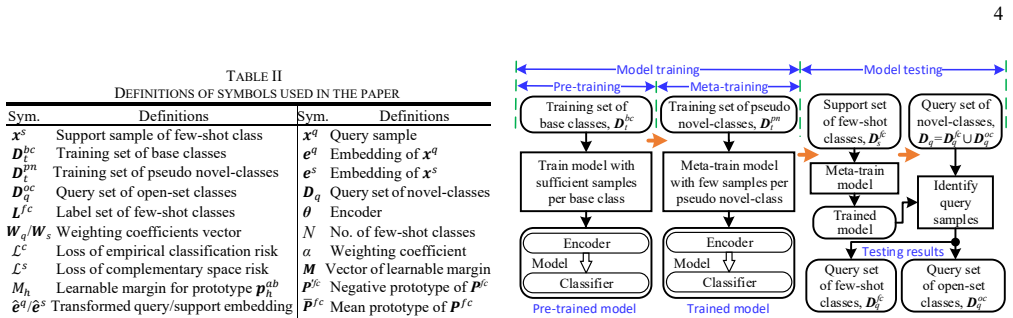
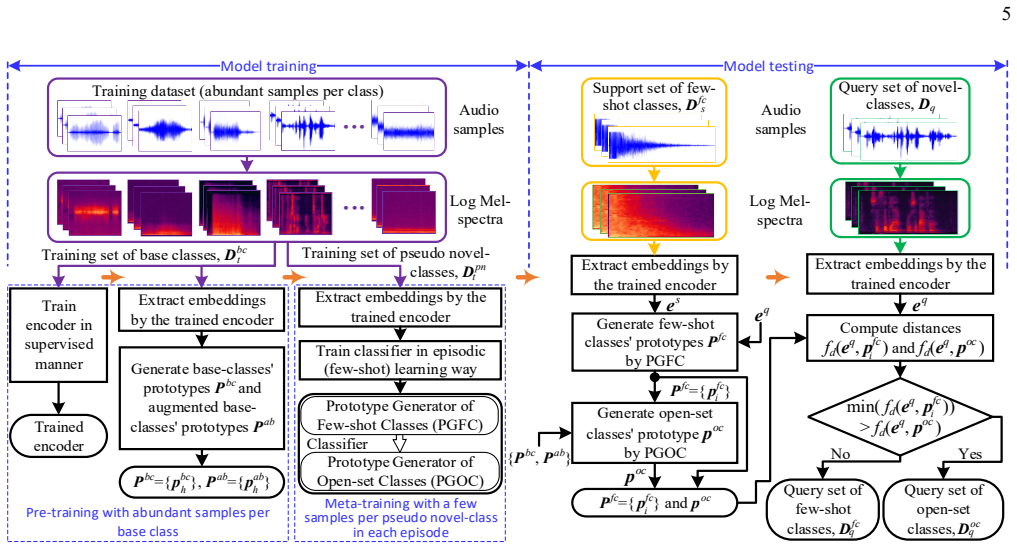
The central claim is that prototypes formed by fusing class-discriminative information from support and query embeddings—with larger coefficients assigned to representative support segments—plus one dedicated open-set prototype, allow a classifier to correctly label query samples from few-shot classes and reject those from unseen classes after the encoder is fixed and the classifier is meta-trained on few samples.
What carries the argument
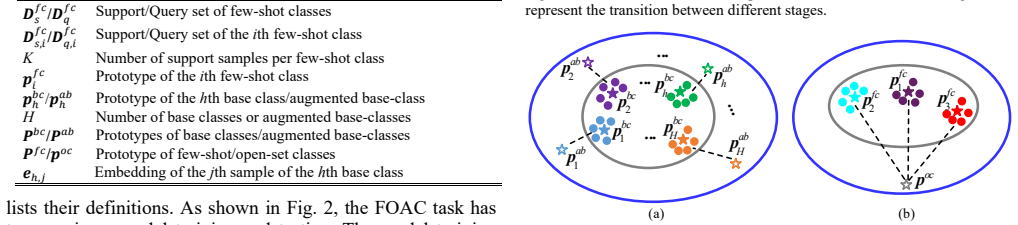
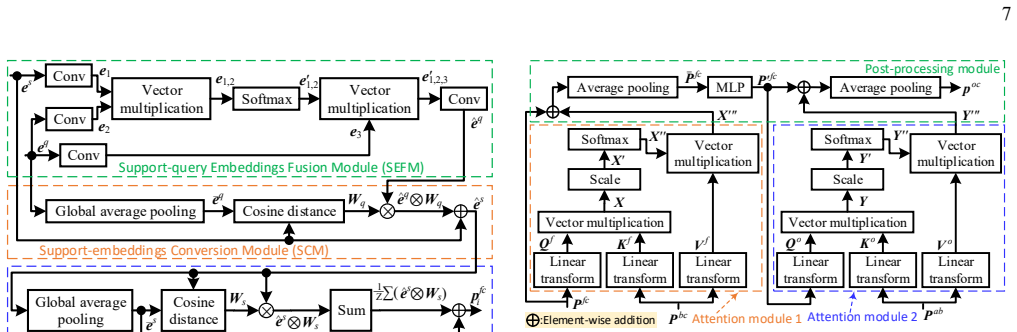
Attention Information-Fused Prototypes, which combine support and query embeddings by weighting the most representative parts of the support set to produce class representatives for both seen few-shot classes and a single open-set class.
If this is right
- A classifier can be updated with only a few support samples per new class without retraining the encoder.
- Query samples from classes never seen during any training stage are rejected instead of misclassified.
- The reported AUROC and accuracy gains hold statistical significance over most compared prior methods.
- Overall computational complexity stays lower than that of most prior methods while achieving the performance lift.
Where Pith is reading between the lines
- The same fusion idea could be tested in image or text few-shot open-set tasks if the encoder produces embeddings with similar transfer properties.
- Real-time audio devices such as hearing aids or voice interfaces could use the dedicated open-set prototype to flag and defer novel sounds rather than guess.
- If the attention weighting proves sensitive to the number of support samples, an ablation varying support-set size from one to ten would reveal the practical minimum.
- Combining the approach with domain-adaptation steps might improve results when test audio differs acoustically from the base-class training data.
Load-bearing premise
Embeddings produced by a ResNet trained on abundant base-class data remain sufficiently discriminative to let a few support samples generate prototypes that separate seen from unseen classes.
What would settle it
Running the method on a held-out audio dataset where the AUROC or accuracy falls below that of the strongest prior method, or where performance collapses when support samples come from acoustically variable classes.
Figures


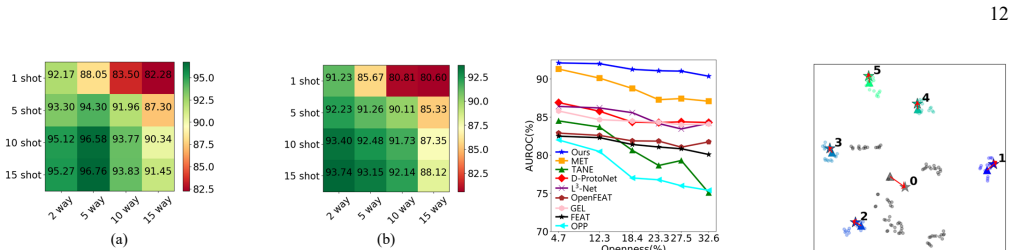
read the original abstract
Most existing audio classification methods suppose that each query (testing) sample belongs to a class of support (training) samples, and misrecognize samples of unseen classes as seen classes (cannot reject samples of unseen classes). In this study, we propose a method for Few-shot Open-set Audio Classification (FOAC), which can recognize query samples of seen classes after updating the model using a few support samples, and meanwhile reject query samples from unseen classes. We design a model consisting of an encoder and a classifier. The encoder is the backbone of a ResNet used for extracting embeddings. The classifier consists of prototype generators of few-shot classes and open-set classes. Prototypes of few-shot classes are obtained by fusing the class-discriminative information of support and query embeddings and by assigning larger weighting coefficient to representative part of the support embeddings. One prototype is generated for open-set classes using the proposed prototype generator. The encoder is trained with abundant samples of base classes in supervised manner, and then the prototypes of base classes are generated under the supervision of a joint loss. The classifier is trained using a few samples of few-shot classes in a meta-training way. Three public datasets (LS-100, NSynth-100, and FSC-89) are used to assess the performance of our method. Experiments show that our method has advantage over prior methods in AUROC and accuracy. This advantage has statistical significance for most prior methods. Our method has lower computational complexity than most prior methods. The code is at https://github.com/Jessytan/FOAC-AIFP.
Editorial analysis
A structured set of objections, weighed in public.
Referee Report
Summary. The manuscript proposes a few-shot open-set audio classification (FOAC) method consisting of a ResNet encoder pre-trained supervised on base-class samples (then frozen) and a classifier with attention information-fused prototype generators for seen classes plus one open-set prototype. Prototypes fuse class-discriminative information from support and query embeddings with higher weighting on representative support parts. The classifier is meta-trained on few-shot classes using a joint loss. Experiments on LS-100, NSynth-100, and FSC-89 report superior AUROC and accuracy versus prior methods (with statistical significance for most) and lower computational complexity; code is released at https://github.com/Jessytan/FOAC-AIFP.
Significance. If the results hold, the attention-fused prototype construction offers a concrete mechanism for separating in-distribution from out-of-distribution queries under few-shot constraints in audio, which could be useful for real-world open-set scenarios. The release of reproducible code is a clear strength that aids verification and extension.
major comments (2)
- [Method] Method section (encoder and prototype generators): The ResNet encoder is trained supervised on base classes and then frozen, with only prototype generators updated during meta-training on few-shot classes. No embedding visualizations, nearest-neighbor distance analysis, or ablation comparing frozen versus fine-tuned encoder is supplied to verify that base-class features remain sufficiently discriminative on the novel-class support/query distributions of the three evaluation datasets. This transferability assumption is load-bearing for the reported AUROC/accuracy gains.
- [Experiments] Experiments section: The abstract claims statistical significance for the AUROC and accuracy advantages over most prior methods, yet provides no information on the number of runs, the exact statistical test, data-split protocol, or implementation details of the baselines. Without these, it is impossible to determine whether the gains are robust or sensitive to post-hoc choices, directly affecting confidence in the central experimental claim.
minor comments (2)
- [Abstract] Abstract: The claim of 'lower computational complexity than most prior methods' is stated without specifying the metric (FLOPs, parameters, or runtime) or providing the comparative numbers.
- [Method] The weighting coefficient for representative support parts is described as a free parameter, but the procedure for selecting its value across datasets is not stated.
Simulated Author's Rebuttal
We thank the referee for the constructive comments. We address each major comment below and will revise the manuscript accordingly to improve clarity and rigor.
read point-by-point responses
-
Referee: [Method] Method section (encoder and prototype generators): The ResNet encoder is trained supervised on base classes and then frozen, with only prototype generators updated during meta-training on few-shot classes. No embedding visualizations, nearest-neighbor distance analysis, or ablation comparing frozen versus fine-tuned encoder is supplied to verify that base-class features remain sufficiently discriminative on the novel-class support/query distributions of the three evaluation datasets. This transferability assumption is load-bearing for the reported AUROC/accuracy gains.
Authors: We agree that the transferability of the frozen encoder to novel classes requires explicit verification, as this is a key assumption. In the revised manuscript, we will add t-SNE visualizations of embeddings from base and novel classes across the three datasets, along with an ablation comparing frozen versus fine-tuned encoder performance to demonstrate that base-class features remain sufficiently discriminative for the reported gains. revision: yes
-
Referee: [Experiments] Experiments section: The abstract claims statistical significance for the AUROC and accuracy advantages over most prior methods, yet provides no information on the number of runs, the exact statistical test, data-split protocol, or implementation details of the baselines. Without these, it is impossible to determine whether the gains are robust or sensitive to post-hoc choices, directly affecting confidence in the central experimental claim.
Authors: We concur that full details on the statistical analysis and experimental protocol are essential for assessing robustness. In the revised version, we will explicitly state the number of independent runs, the statistical test used (e.g., paired t-test), the data-split protocol, and additional implementation details for the baselines to support the significance claims. revision: yes
Circularity Check
No significant circularity; derivation relies on independent empirical evaluation
full rationale
The paper outlines a standard two-stage pipeline (supervised ResNet pretraining on base classes, then meta-training of prototype generators on few-shot support samples) with explicit joint loss and attention fusion steps that are not defined in terms of the final AUROC/accuracy metrics. Experiments use held-out query sets from LS-100, NSynth-100, and FSC-89, and the reported gains are presented as empirical outcomes rather than quantities that reduce by construction to the fitted parameters or self-cited priors. No load-bearing step equates a prediction to its own input via definition, renaming, or self-citation chain.
Axiom & Free-Parameter Ledger
free parameters (1)
- weighting coefficient for representative support parts
axioms (1)
- domain assumption ResNet backbone extracts class-discriminative embeddings suitable for prototype construction in audio
Reference graph
Works this paper leans on
-
[1]
The NSynth-100 has types of 100 sounds emitted by musical instruments
The FSC-89 has 89 types of sounds emitted by humans, animals, nature and objects. The NSynth-100 has types of 100 sounds emitted by musical instruments. The LS-100 is a speech corpus, consisting of utterances of 100 speakers. Each dataset is divided into two subsets: training and testing subsets. The training subset is divided into 𝑫௧ (training set of ...
-
[2]
Hence, there are 100 rankings for each method
We rank all methods in accordance to their AUROC or Acc scores that are achieved on each data subset. Hence, there are 100 rankings for each method. Fig. 7 shows the statistical significance test results for all methods. Fig. 7 (a) and (b) illustrates number of times each method obtains each ranking for computing statistical significance differences in te...
work page 1973
-
[3]
Sound event detection with depthwise s eparable and dilated convolutions,
K. Drossos, et al., “Sound event detection with depthwise s eparable and dilated convolutions,” in Proc. of IJCNN, 2020, pp. 1-7
work page 2020
-
[4]
Z. Lin, et al., “Domestic a ctivities clustering from audio recordings using convolutional capsule autoencoder network,” in Proc. of ICASSP, 2021, pp. 835-839
work page 2021
-
[5]
Acoustic eve nt diarization in TV/movie audi os using deep embedding and integer linear programming,
Y. Li, et al., “Acoustic eve nt diarization in TV/movie audi os using deep embedding and integer linear programming,” Multimedia Tools and Applications, vol. 78, no. 23, pp. 33999-34025, 2019
work page 2019
-
[6]
Y. Li, et al., “Using multi-stream hierarchical deep neural n e t w o r k t o extract deep audio feature for acoustic events detection,” Multimedia Tools and Applications, vol. 77, no. 1, pp. 897-916, 2018
work page 2018
-
[7]
Acoustic s cene classification using aggregation of two- scale deep embeddings,
H.K. Chon, et al., “Acoustic s cene classification using aggregation of two- scale deep embeddings,” in Proc. of IEEE ICCT, 2021, vol.4, pp.1341-1345
work page 2021
-
[8]
Acoustic sce ne classification using deep au dio feature and BLSTM network,
Y. Li, et al., “Acoustic sce ne classification using deep au dio feature and BLSTM network,” in Proc. of ICALIP, 2018, pp. 371-374
work page 2018
-
[9]
K. Wang, et al., “Low-comple xity acoustic scene classificat ion using deep space separable distillation modu le and multi-label learning,” in Technical Report of DCASE2023 Challenge, 2023, pp. 1-4
work page 2023
-
[10]
Low-complex ity acoustic scene classification using parallel attention-convolution network
Y. Li, et al., “Low-complex ity acoustic scene classification using parallel attention-convolution network”, in Proc. of Interspeech, 2024, pp. 1-5
work page 2024
-
[11]
Violence detection in videos based on fus ing visual and audio information,
W. Pang, et al., “Violence detection in videos based on fus ing visual and audio information,” in Proc. of ICASSP, 2021, pp. 2260-2264. [ 1 0 ] W . P a n g , Q . H e , a n d Y . L i , “Predicting skeleton trajectori es using a Skeleton‑Transformer for video anomaly detection,” Multimedia Systems , 2022, vol. 28, pp. 1481-1494
work page 2021
-
[12]
Speaker clustering by co-optimizing deep r epresentation learning and cluster estimation,
Y. Li, et al., “Speaker clustering by co-optimizing deep r epresentation learning and cluster estimation,” IEEE TMM, vol. 23, pp. 3377-3387, 2021
work page 2021
-
[13]
Audio-visual target speaker extraction wi th selective auditory attention,
R. Tao, et al., “Audio-visual target speaker extraction wi th selective auditory attention,” IEEE TASLP, vol. 33, pp. 797-811, 2025
work page 2025
-
[14]
Lightweight speaker verification using tra nsformation module with feature grouping and fusion,
Y. Li, et al., “Lightweight speaker verification using tra nsformation module with feature grouping and fusion,” IEEE/ACM TASLP, vol. 32, pp. 794-806, 2024
work page 2024
-
[15]
Speaker ver ification using attentive multi -scale convolutional recurrent network,
Y. Li, et al., “Speaker ver ification using attentive multi -scale convolutional recurrent network,” Applied Soft Computing , 2022, vol. 126, Article no. 109291, pp. 1-11
work page 2022
-
[16]
Cross-domain few-shot open-set keyword spotting using keyword adaptation and prototype reprojection,
M. Yang, et al., “Cross-domain few-shot open-set keyword spotting using keyword adaptation and prototype reprojection,” in Proc. of ICASSP, 2025, pp. 1-5
work page 2025
-
[17]
Deep enhancement spotting network for lo w-complexity keyword spotting in noisy environments,
Y. Chen, et al., “Deep enhancement spotting network for lo w-complexity keyword spotting in noisy environments,” in Proc. of ICASSP, 2025, pp. 1-5. [ 1 7 ] J . Z h a n , e t a l . , “ A s t a g e m a t c h f o r q u e r y - b y - e x a m p l e s p o k en term detection based on structure information of query,” in Proc. of ICASSP , 2021, pp. 6833-6837
work page 2025
-
[18]
A novel re-weighted CTC loss for data imb alance in speech keyword spotting,
X. Lan, et al., “A novel re-weighted CTC loss for data imb alance in speech keyword spotting,” Chinese J. of Electronics , vol.32, no.3, pp.465- 473, 2023
work page 2023
-
[19]
Few-shot open-set keyword spotting with multi-stage training,
L.Y. Li, et al., “Few-shot open-set keyword spotting with multi-stage training,” in Proc. of APSIPA ASC, 2024, pp. 1-5
work page 2024
-
[20]
Few-shot open-set learning for on-devic e customization of keyword spotting systems,
M. Rusci, et al., “Few-shot open-set learning for on-devic e customization of keyword spotting systems,” in Proc. of Interspeech, 2024, pp. 2768-2772
work page 2024
-
[21]
Dummy prototypical networks for few-shot open-set keyword spotting,
B. Kim, et al., “Dummy prototypical networks for few-shot open-set keyword spotting,” in Proc. of Interspeech, 2022, pp. 4621- 4625
work page 2022
-
[22]
K.C. Kishan et al., “OpenFEAT: Improving speaker identific ation by open-set few-shot embedding adaptation with Transformer,” in Proc. of ICASSP, 2022, pp. 7062-7066
work page 2022
-
[23]
J. Naranjo-Alcazar, et al. “An open-set recognition and fe w-shot learning dataset for audio event classi fication in domestic environments ,” Pattern Recognition Letters, vol. 164, pp. 40-45, 2022
work page 2022
-
[24]
Meta-learning in neural networks: A survey,
T. Hospedales, et al., “Meta-learning in neural networks: A survey,” IEEE TP AMI, vol. 44, no. 9, pp. 5149-5169, 2022
work page 2022
-
[25]
MetaModulation: Learning variational feature hierarchies for few-shot learning with fewer tasks,
W. Sun, et al., “MetaModulation: Learning variational feature hierarchies for few-shot learning with fewer tasks,” in Proc. of ICML, 2023, pp. 32847- 32858
work page 2023
-
[26]
Prototypical networks for few-shot lear ning,
J. Snell, et al., “Prototypical networks for few-shot lear ning,” in Proc. 31st Int. Conf. Neural Inf. Process. Syst., 2017, pp. 4080-4090
work page 2017
-
[27]
A simple neural attentive meta-learner ,
N. Mishra, et al., “A simple neural attentive meta-learner ,” in Proc. of ICLR, 2018, pp. 1-8. TABLE XII RESULTS OBTAINED BY DIFFERENT METHODS ON A DATASET OF DOMESTIC ENVIRONMENTS (IN %) Methods Dataset of domestic environments 5-way 1-shot 5-way 5-shot Acc AUROC Acc AUROC FEAT [37] 77.53 64.62 87.31 65.81 L3-Net [23] 73.42 69.15 77.49 70.35 D-ProtoNet [...
work page 2018
-
[28]
Model-agnostic meta-learning for fast ad aptation of deep networks,
C. Finn, et al., “Model-agnostic meta-learning for fast ad aptation of deep networks,” in Proc. of ICML, 2017, vol. 70, pp. 1126-1135
work page 2017
-
[29]
K. Li, et al., “Learning to optimize,” in Proc. of ICLR, 2017, pp. 1-13
work page 2017
-
[30]
Improving generalization of meta-learnin g with inverted regularization at inner-level,
L. Wang, et al., “Improving generalization of meta-learnin g with inverted regularization at inner-level,” in Proc. of CVPR, 2023, pp. 7826-7835
work page 2023
-
[31]
Meta-learning with a geometry-adaptive preconditioner,
S. Kang, et al., “Meta-learning with a geometry-adaptive preconditioner,” in Proc. of CVPR, 2023, pp. 16080-16090
work page 2023
-
[32]
MARS: Meta-learning as score matc hing in the function space,
K.L. Pavasovic, et al., “MARS: Meta-learning as score matc hing in the function space,” in Proc. of ICLR, 2023, pp. 1-26
work page 2023
-
[33]
Transformer neural processes: Uncertai nty-aware meta learning via sequence modeling,
T. Nguyen, et al., “Transformer neural processes: Uncertai nty-aware meta learning via sequence modeling,” in Proc. of ICML , 2022, pp. 16569- 16594
work page 2022
-
[34]
A closer look at few-shot classification again,
X. Luo, et al., “A closer look at few-shot classification again,” in Proc. of ICML, 2023, pp. 23103-23123
work page 2023
-
[35]
H. Chen, et al., “Using context-guided data augmentation, lightweight CNN, and proximity detection techniques to improve site safety monitoring under occlusion conditions,” Safety science , 2023, vol. 158, article no.: 105958
work page 2023
-
[36]
Task-adaptive negative envision for few -shot open-set recognition,
S. Huang, et al., “Task-adaptive negative envision for few -shot open-set recognition,” in Proc. of IEEE/CVF CVPR, 2022, pp. 7161-7170
work page 2022
-
[37]
Few-shot learning via embedding adaptat ion with set-to- set functions,
H.-J. Ye, et al., “Few-shot learning via embedding adaptat ion with set-to- set functions,” in Proc. of IEEE/CVF CVPR, 2020, pp. 8805-8814
work page 2020
-
[38]
Glocal energy-based learning for few-sho t open-set recognition,
H. Wang, et al., “Glocal energy-based learning for few-sho t open-set recognition,” in Proc. of IEEE/CVF CVPR, 2023, pp. 7507-7516
work page 2023
-
[39]
Overall positive prototype for few-sh ot open-set recognition,
L.-Y ., Sun, et al., “Overall positive prototype for few-sh ot open-set recognition,” Pattern Recognition, vol.151, pp.1-10, 2024
work page 2024
-
[40]
Meta evidential transformer for few-s hot open-set recognition,
H. Sapkota, et al., “Meta evidential transformer for few-s hot open-set recognition,” in Proc. of ICML, 2024, pp. 43389-43406
work page 2024
-
[41]
LCANets++: Robust audio classificatio n using multi- layer neural networks with lateral competition,
S.V. Dibbo, et al., “LCANets++: Robust audio classificatio n using multi- layer neural networks with lateral competition,” in Proc. of ICASSPW, 2024, pp. 129-133
work page 2024
-
[42]
J. Parekh, et al., “Tackli ng interpretability in audio cla ssification networks with non-negativ e matrix factorization,” IEEE/ACM TASLP, vol. 32, pp. 1392-1405, 2024
work page 2024
-
[43]
Light gated multi mini-patch extractor for audio classification,
B. He, et al., “Light gated multi mini-patch extractor for audio classification,” in Proc. of ICASSPW, 2024, pp. 765-769
work page 2024
-
[44]
Time-frequency scattergrams for biomed ical audio signal representation and classification,
G. Sharma, et al., “Time-frequency scattergrams for biomed ical audio signal representation and classification,” IEEE/ACM TASLP , vol. 32, pp. 564-576, 2024
work page 2024
-
[45]
LC-Protonets: Multi-label few-sho t learning for world music audio tagging,
C. Papaioannou, et al., “LC-Protonets: Multi-label few-sho t learning for world music audio tagging,” IEEE Open Journal of Signal Processing , vol. 6, pp. 138-146, 2025
work page 2025
-
[46]
On the transferability of large-scale self-supervision to few-shot audio classification,
C. Heggan, et al., “On the transferability of large-scale self-supervision to few-shot audio classification,” in Proc. of ICASSPW, 2024, pp. 515-519
work page 2024
-
[47]
From pixels to waveforms: evaluating p re-trained image models for few-shot audio classification,
C. Heggan, et al., “From pixels to waveforms: evaluating p re-trained image models for few-shot audio classification,” in Proc. of IJCNN , 2024, pp. 1-8
work page 2024
-
[48]
X. Zhuang, et al., “Episodic fine-tuning prototypical netw orks for optimization-based few-shot learning: application to audio clas sification,” in Proc. of IEEE MLSP, 2024, pp. 1-6. [ 4 9 ] H . J . L e e , e t a l . , “ D e e p g e n erative replay with denoising d iffusion probabilistic models for continua l learning in audio classifica tion,” IEEE Acce...
work page 2024
-
[49]
Audio-visual class-incremental learning,
W. Pian, et al., “Audio-visual class-incremental learning, ” in Proc. of IEEE/CVF ICCV, 2023, pp. 7765-7777. [ 5 1 ] Y . X i a o , e t a l . , “ U C I L : A n u n s u p e r v i s e d c l a s s i n c r e m e n t a l learning approach for sound event detection,” in Proc. of ICASSP, 2025, pp. 1-5. [ 5 2 ] Y . L i , e t a l . , “ F e w - s h o t c l a s s - i...
work page 2023
-
[50]
Few-shot class-incremental audio classifi cation using adaptively-refined prototypes,
W. Xie, et al., “Few-shot class-incremental audio classifi cation using adaptively-refined prototypes,” in Proc. of Interspeech, 2023, pp.301-305
work page 2023
-
[51]
Y. Li, et al., “Few-shot class-incremental audio classific ation with adaptive mitigation of for getting and overfitting,” IEEE/ACM TASLP, vol. 32, pp. 2297-2311, 2024
work page 2024
-
[52]
Fully few-shot class-incremental audio cla ssification using expandable dual-embedding extractor,
Y. Si, et al., “Fully few-shot class-incremental audio cla ssification using expandable dual-embedding extractor,” in Proc. of Interspeech , 2024, pp. 4788-4792
work page 2024
-
[53]
Y. Si, et al., “Fully few-shot class-incremental audio cla ssification with adaptive improvement of stability and plasticity,” IEEE TASLP, vol. 33, pp. 418-433, 2025
work page 2025
-
[54]
Y. Li, et al., “Acoustic sce ne clustering using joint opti mization of deep embedding learning and clustering iteration,” IEEE TMM, vol. 22, no. 6, pp. 1385-1394, 2020
work page 2020
-
[55]
Deep mutual attention network for acousti c scene classification,
W. Xie, et al., “Deep mutual attention network for acousti c scene classification,” Digital Signal Processing, vol. 123, 2022, Art. no. 103450
work page 2022
-
[56]
Domestic activity clustering from audio vi a depthwise separable convolutional autoencoder network,
Y. Li, et al., “Domestic activity clustering from audio vi a depthwise separable convolutional autoencoder network,” in Proc. MMSP , 2022, pp. 1-6
work page 2022
-
[57]
Deep residu al learning for image recogniti on,
K. He, et al., “Deep residu al learning for image recogniti on,” in Proc. of IEEE/CVF CVPR, 2016, pp. 770-778
work page 2016
-
[58]
A. Vaswani et al., “Attention is all you need,” in Proc. of NIPS, 2017, pp. 5998-6008
work page 2017
-
[59]
Statistical comparisons of classifiers over mu ltiple data sets,
J. Demšar, “Statistical comparisons of classifiers over mu ltiple data sets,” Journal of Machine Learning Research, vol.7, pp. 1-30, 2006
work page 2006
-
[60]
Recent adv ances in open set recognition: A s u r v e y ,
C. Geng, et al., “Recent adv ances in open set recognition: A s u r v e y , ” IEEE TP AMI, vol. 43, no. 10, pp. 3614-3631, 2021
work page 2021
-
[61]
W. J. Scheirer, et al., “Toward open set recognition," IEEE TP AMI, vol. 35, no. 7, pp. 1757-1772, 2013
work page 2013
-
[62]
L.v.d. Maaten, et al., “Visualizing data using t-SNE,” Journal of Machine Learning Research, vol. 9, no. 96, pp. 2579-2605, 2008
work page 2008
discussion (0)
Sign in with ORCID, Apple, or X to comment. Anyone can read and Pith papers without signing in.