REVIEW 5 minor 2 cited by
Impulse measurements enhanced with squeezed readout light
T0 review · 0 major / 5 minor · reviewed 2026-08-08 · deepseek-v4-flash
Pith's one-line read Frequency-dependent squeezed light can lower the resolvable impulse of a mechanical sensor below the standard quantum limit, with the ultimate benefit set by the oscillator's quality factor.
desk verdict A clean, self-contained derivation of e^{-r} momentum-threshold scaling for frequency-dependent squeezed readout, with a Q-limited floor; the main caveats are explicit scope conditions, not hidden flaws. read the letter →
The pith
A machine-rendered reading of the paper's core claim, the machinery that carries it, and where it could break.
The reading
What carries the argument
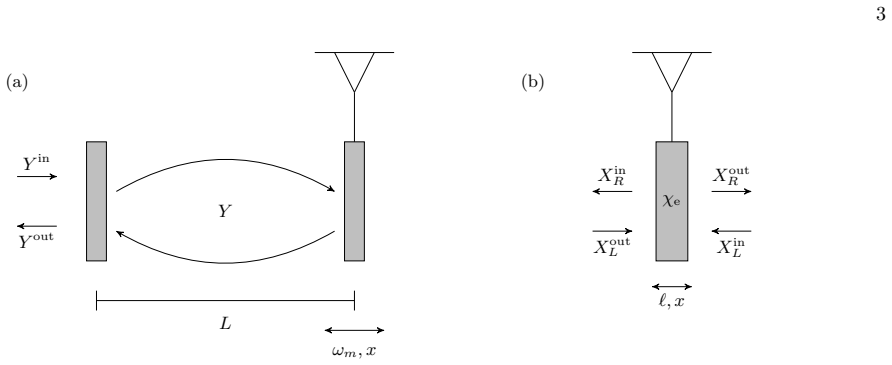
The load-bearing object is the force power spectral density $S_{FF}(\nu)$ of the estimator $F_E = Y^{\mathrm{out}}/\chi_{YF}$, whose inverse is integrated over all frequencies to form the momentum threshold. Squeezed light changes the input quadrature variances and, crucially, makes the cross-correlation $S_{XY}$ nonzero and negative over a chosen bandwidth; frequency-dependent squeezing picks the angle $\theta_*(\nu)$ that minimizes $S_{FF}(\nu)$ at every frequency. The paper proves a correspondence between a bad cavity and a free-space dielectric slab, showing their output phase quadratures have the same functional form, so one calculation covers both systems. The matched-filter SNR integral is then evaluated in the large-$Q$, strong-coupling limit to yield both the exponential improvement and the quality-factor floor.
What would settle it
Measure the momentum threshold of a high-$Q$ suspended oscillator as a function of squeezing strength $r$ at near-unit detection efficiency and with coupling $g$ in the plateau regime $e^r g_* \ll g \ll \sqrt{Q}g_*$; if the threshold does not fall as $e^{-r}$ toward a floor $\Delta p_{\mathrm{SQL}}/\sqrt{Q}$, or if it falls below that floor, the central PSD or the fluctuation-dissipation assumption fails.
Extended reading notes
Core claim
The central claim is that frequency-dependent squeezed readout can push the resolvable impulse of a damped harmonic oscillator below the coherent-state SQL. Working from the input-output relation for the output phase quadrature, the paper obtains the force power spectral density minimized at each frequency by the optimal squeezing angle $\theta_*(\nu)$, and evaluates the momentum threshold $\Delta p = [\int d\nu/(2\pi S_{FF}(\nu))]^{-1/2}$. In the regime $e^{r} g_*(\omega_m) \ll g \ll \sqrt{Q} g_*(\omega_m)$, the threshold is $\Delta p = e^{-r}[(g^2 + g_*^2(\omega_m)e^{2r})/g^2]^{1/2} \Delta p_{\mathrm{SQL}} + O(\tilde{g}^2/Q)$, so choosing $g \gg e^r g_*$ recovers $\Delta p \approx e^{-r}\Delta p_{\mathrm{SQL}}$. The same large-$Q$ expansion breaks down when $e^{2r} \sim Q$, and a separate large-$r$ integration gives the lossless floor $\Delta p_{\min} \approx \Delta p_{\mathrm{SQL}}/\sqrt{Q}$, which the authors attribute to the dissipative part $\gamma$ of the mechanical response. With photodetection efficiency $\eta$, the analytic scalings become $\eta^{-1/4}e^{-r/2}\Delta p_{\mathrm{SQL}}$ at small $\eta$ and $[1+(1-\eta)e^{2r}]^{1/4}e^{-r}\Delta p_{\mathrm{SQL}}$ near unit efficiency.
Load-bearing premise
The results assume the only mechanical noise is the zero-temperature fluctuation-dissipation floor $S_{FF}=m\gamma\nu$ and that, in the slab model, the forward-scattered light carries no position information ($f=0$); both are idealizations, and extra damping or 3D scattering would raise the floor and change the scaling.
Editorial extensions
If this is right
- With 10 dB of frequency-dependent squeezing the plateau-regime threshold is about $e^{-1.15} \approx 0.32$ times the SQL, so the same detector sees kicks roughly three times smaller before losses or the $Q$ floor intervene.
- The lossless floor $\Delta p_{\min} = \Delta p_{\mathrm{SQL}}/\sqrt{Q}$ makes the mechanical quality factor a direct sensitivity parameter: raising $Q$ by a factor of 4 doubles the best possible squeezing benefit.
- On resonance the force noise remains pinned at the SQL, and the coupling needed to reach that point grows as $e^{2r}g_*^2$, so the power budget for squeezing is set by how far one wants to push off-resonance suppression.
- If photodetection is imperfect, the benefit degrades from $e^{-r}$ to $e^{-r/2}$ at large $(1-\eta)e^{2r}$, but sub-SQL thresholds survive, so squeezed readout remains useful even with substantial loss.
- Because the bad-cavity and dielectric-slab output quadratures coincide, any experimental realization of one system inherits the optimal squeezing angle and the scaling laws of the other.
Reading between the lines
- The paper's own caveats imply that its 1D Markovian slab, which sets the forward-scattering coupling $f=0$, is optimistic for a 3D nanosphere: real detectors cannot collect all $4\pi$ of scattered light, so an effective efficiency $\eta<1$ will force the large-squeezing scaling toward $e^{-r/2}$ rather than $e^{-r}$.
- If additional environmental or feedback damping contributes beyond the zero-temperature floor $m\gamma\nu$, the Q-limited floor becomes a best case; the same dissipative argument suggests the plateau height is set by the total damping rate actually present.
- A sharp, testable signature of the theory is the crossover in the slope of $\log(\Delta p)$ versus $r$ from $-1$ to $-1/2$ as $(1-\eta)e^{2r}$ crosses unity; measuring this crossover at fixed $\eta$ would isolate the loss mechanism.
- The broadband-integral logic should extend to other transient signals such as short force bursts or chirped waveforms, for which frequency-dependent squeezing would likewise beat frequency-independent squeezing; the paper does not evaluate those templates.
Editorial analysis
A structured set of objections, weighed in public.
Referee Report
Summary. The paper analyzes impulse (delta-function force) sensing with harmonically suspended optomechanical detectors, using frequency-dependent squeezed readout. It derives the momentum threshold scaling Δp ~ e^{-r} in an intermediate-coupling window, a Q-limited floor Δp_min ≈ Δp_SQL/√Q for lossless measurement, and loss-modified scalings e^{-r/2} for small detection efficiency. The model is developed for a Fabry-Pérot cavity in the bad-cavity limit and a 1D dielectric slab, with the mapping between them established in App. D.
Significance. The e^{-r} scaling and the Q-floor are concrete, falsifiable predictions with direct relevance to levitated optomechanical sensors. The paper is careful to state scope conditions (zero-temperature FDT floor, Markov f=0 approximation), and the central analytical results are cross-checked numerically in Figs. 6 and 7(b). The connection to known limits on dissipative measurements grounds the result in the existing literature.
minor comments (5)
- [II A, Eq. (3)] Equation (3) has a typo: the right-hand side should sum over input operators Oin_j, not output operators Oout_j; as written the relation is circular.
- [III B, Eq. (32)] The derivation of the central floor Δp_min ≈ Δp_SQL/√Q is compressed into a single sentence ("one can fully do the integration..."). Please provide the explicit integral (or a supplementary appendix) so that the large-r expansion and the condition e^{2r} ~ Q can be checked; the numerical check in Fig. 6 is reassuring but does not replace the analytic derivation.
- [IV B, Eq. (42)] In the sentence following Eq. (42), "the shot noise is dominated by the losses, which may be mitigated by increasing the laser power, which in turn may be mitigated by squeezing the back-action" is confusing; suggest rewording to clarify that increasing power raises back-action, which is then reduced by squeezing.
- [I, II A, Fig. 2, App. B, Acknowledgements] There are several typos: "show noise" should be "shot noise" in Sec. I; "diectric" should be "dielectric" in Sec. II A; "loser power" should be "laser power" in the Fig. 2 caption; "derive derive" appears in App. B; "dicussions" should be "discussions" in the Acknowledgements.
- [III B, Eq. (31)] In Eq. (31), state explicitly that the plateau condition is e^{2r} ~ Q, which clarifies the break-down of the large-Q expansion.
Circularity Check
No significant circularity: Eq. (27) and Eq. (32) are derived analytically from the stated input-output model and explicit mγν fluctuation-dissipation floor, not from a fit or self-citation chain.
full rationale
The central claims are derived in-line from the stated model. Eq. (27) is obtained by inserting the frequency-dependent optimal squeezing angle into the force PSD, expanding in g/g*(ωm) and √Q, and performing an integral of the same quartic form as Eq. (18); Eq. (32) follows from the large-r expansion of the same integral when e^{2r} ~ Q. The only added noise floor is S_FF^QN = mγν, which is derived from the fluctuation-dissipation theorem in App. C and stated explicitly as an assumption throughout; the Q-limited floor is therefore a consequence of that input, not a fitted parameter renamed as a prediction. The matched-filter and momentum-threshold formalism is re-derived in Sec. II B rather than imported, so citations to Refs. [12,27] are not load-bearing. The dielectric-slab model's Markov approximation (f = 0) is stated as a simplifying constraint, and its 3D limitation is explicitly noted in App. D and the Outlook. Losses are treated by a standard beamsplitter model with analytic asymptotics that match numerical integration. No step reduces to its own input by construction.
Assumptions & free parameters
assumptions (5)
- standard math Input-output formalism with linear susceptibilities and stationary noise is valid for the measurement.
- domain assumption The quantized test mass contributes minimum force noise S_FF^QN = mγν via the fluctuation-dissipation theorem in the zero-temperature, linear-response limit.
- domain assumption The dielectric slab is treated in 1D with the Markov approximation f=0, so forward-scattered light contains no position information.
- domain assumption The squeezing amplitude r is frequency-independent over the detection band; only the squeezing angle θ(ν) varies with frequency.
- standard math Asymptotic expansions assume large Q and large coupling g >> e^r g*(ωm), with numerics confirming the regimes.
Cite this review
Pith. "Pith review of Impulse measurements enhanced with squeezed readout light." pith.science (2026). https://pith.science/paper/QUQJDROU
@misc{pith2026250205168,
  author       = {Pith},
  title        = {Pith review of: Impulse measurements enhanced with squeezed readout light},
  year         = {2026},
  howpublished = {\url{https://pith.science/paper/QUQJDROU}},
  note         = {Machine review of arXiv:2502.05168}
}
read the original abstract
We quantify how squeezed light can reduce quantum measurement noise to levels below the standard quantum limit in impulse measurements with mechanical detectors. The broadband nature of the signal implies that frequency-dependent squeezing performs better than frequency-independent squeezing. We calculate the optimal scaling of the impulse sensitivity with the squeezing strength, and quantify degradations due to photodetection losses. Even for lossless measurement, we find there exists a fundamental limit to the benefit of squeezing that depends only on the system's mechanical properties.
Figures


Figures from the paper (5 more)


Forward citations
Cited by 2 Pith papers
-
Towards the Direct Detection of Composite Ultraheavy Dark Matter in Quantum Sensor Arrays
A quantum sensor array could be sensitive to Planck-mass composite dark matter with radii around a centimeter via Yukawa forces, with a signal that scales as λ² instead of exponentially for short screening lengths.
-
Searching for Ultralight Dark Matter with MOLeQuTE: a Massive Optically Levitated Quantum Tabletop Experiment
A proposed optically levitated milligram-scale plate sensor could reach the standard quantum limit and probe new parameter space for ultralight B-L vector dark matter.
Reference graph
Works this paper leans on
-
[1]
Advanced LIGO: the next generation of gravitational wave detectors,
LIGO Collaboration, G. M. Harry et al., “Advanced LIGO: the next generation of gravitational wave detectors,” Classical and Quantum Gravity27 no. 8, (2010) 084006
work page 2010
-
[2]
Detector configuration of KAGRA–the Japanese cryogenic gravitational-wave detector,
KAGRA Collaboration, K. Somiya, “Detector configuration of KAGRA–the Japanese cryogenic gravitational-wave detector,” Classical and Quantum Gravity 29 no. 12, (2012) 124007
2012
-
[3]
Advanced VIRGO: a second-generation interferometric gravitational wave detector,
VIRGO Collaboration, F. Acernese et al., “Advanced VIRGO: a second-generation interferometric gravitational wave detector,” Classical and Quantum Gravity 32 no. 2, (2014) 024001
2014
-
[4]
B. M. Brubaker, First results from the HAYSTAC axion search. PhD thesis, Yale U., 2017. arXiv:1801.00835 [astro-ph.CO]
work page Pith review arXiv 2017
-
[5]
Searching for dark matter with a superconducting qubit,
A. V. Dixit, S. Chakram, K. He, A. Agrawal, R. K. Naik, D. I. Schuster, and A. Chou, “Searching for dark matter with a superconducting qubit,” Phys. Rev. Lett. 126 (Apr, 2021) 141302
2021
-
[6]
Quantum-mechanical noise in an interferometer,
C. M. Caves, “Quantum-mechanical noise in an interferometer,” Phys. Rev. D23 (Apr, 1981) 1693–1708
work page 1981
-
[7]
Enhanced sensitivity of the ligo gravitational wave detector by using squeezed states of light,
J. Aasi, J. Abadie, B. Abbott, R. Abbott, T. Abbott, M. Abernathy, C. Adams, T. Adams, P. Addesso, R. Adhikari, et al., “Enhanced sensitivity of the ligo gravitational wave detector by using squeezed states of light,” Nature Photonics 7 no. 8, (2013) 613–619
2013
-
[8]
Frequency-dependent squeezing for advanced ligo,
L. McCuller et al., “Frequency-dependent squeezing for advanced ligo,” Phys. Rev. Lett.124 (Apr, 2020) 171102
work page 2020
Show all 61 references
-
[9]
A quantum enhanced search for dark matter axions,
K. M. Backes, D. A. Palken, S. A. Kenany, B. M. Brubaker, S. Cahn, A. Droster, G. C. Hilton, S. Ghosh, H. Jackson, S. K. Lamoreaux, et al., “A quantum enhanced search for dark matter axions,” Nature 590 no. 7845, (2021) 238–242
2021
-
[10]
Squeezed vacuum used to accelerate the search for a weak classical signal,
M. Malnou, D. A. Palken, B. M. Brubaker, L. R. Vale, G. C. Hilton, and K. W. Lehnert, “Squeezed vacuum used to accelerate the search for a weak classical signal,” Phys. Rev. X9 (May, 2019) 021023. https: //link.aps.org/doi/10.1103/PhysRevX.9.021023
2019 doi
-
[11]
Combining quantum noise reduction resources: a practical approach,
S. Ghosh, M. A. Feldman, S. Hong, C. E. Marvinney, A. M. Marino, R. C. Pooser, and J. M. Taylor, “Combining quantum noise reduction resources: a practical approach,” arXiv:2211.14460 [quant-ph]
-
[12]
Quantum measurements in fundamental physics: a user’s manual,
J. Beckey, D. Carney, and G. Marocco, “Quantum measurements in fundamental physics: a user’s manual,” arXiv:2311.07270 [hep-ph]
-
[13]
Cooling of a levitated nanoparticle to the motional quantum ground state,
U. Deli´ c, M. Reisenbauer, K. Dare, D. Grass, V. Vuleti´ c, N. Kiesel, and M. Aspelmeyer, “Cooling of a levitated nanoparticle to the motional quantum ground state,” Science 367 no. 6480, (2020) 892–895
2020
-
[14]
Quantum control of a nanoparticle optically levitated in cryogenic free space,
F. Tebbenjohanns, M. L. Mattana, M. Rossi, M. Frimmer, and L. Novotny, “Quantum control of a nanoparticle optically levitated in cryogenic free space,” Nature 595 no. 7867, (2021) 378–382
2021
-
[15]
Real-time optimal quantum control of mechanical motion at room temperature,
L. Magrini, P. Rosenzweig, C. Bach, A. Deutschmann-Olek, S. G. Hofer, S. Hong, N. Kiesel, A. Kugi, and M. Aspelmeyer, “Real-time optimal quantum control of mechanical motion at room temperature,” Nature 595 no. 7867, (July, 2021) 373–377
2021
-
[16]
Two-dimensional quantum motion of a levitated nanosphere,
A. Ranfagni, K. Børkje, F. Marino, and F. Marin, “Two-dimensional quantum motion of a levitated nanosphere,” Physical Review Research4 no. 3, (2022) 033051
2022
-
[17]
Optical cold damping of neutral nanoparticles near the ground state in an optical lattice,
M. Kamba, R. Shimizu, and K. Aikawa, “Optical cold damping of neutral nanoparticles near the ground state in an optical lattice,” Optics Express 30 no. 15, (2022) 26716–26727
2022
-
[18]
Search for Millicharged Particles Using Optically Levitated Microspheres,
D. C. Moore, A. D. Rider, and G. Gratta, “Search for Millicharged Particles Using Optically Levitated Microspheres,” Physical Review Letters113 no. 25, (Dec., 2014) 251801
2014
-
[19]
Force and acceleration sensing with optically levitated nanogram masses at microkelvin temperatures,
F. Monteiro, W. Li, G. Afek, C.-l. Li, M. Mossman, and D. C. Moore, “Force and acceleration sensing with optically levitated nanogram masses at microkelvin temperatures,” Phys. Rev. A101 no. 5, (2020) 053835, arXiv:2001.10931 [physics.optics]
2020 arXiv
-
[20]
Searching for new physics using optically levitated sensors,
D. C. Moore and A. A. Geraci, “Searching for new physics using optically levitated sensors,” Quantum Science and Technology6 no. 1, (Jan., 2021) 014008, arXiv:2008.13197 [quant-ph]
2021 arXiv
-
[21]
Search for non-Newtonian interactions at micrometer scale with a levitated test mass,
C. P. Blakemore, A. Fieguth, A. Kawasaki, N. Priel, D. Martin, A. D. Rider, Q. Wang, and G. Gratta, “Search for non-Newtonian interactions at micrometer scale with a levitated test mass,” Physical Review D 104 no. 6, (Sept., 2021) L061101
2021
-
[22]
Levitodynamics: Levitation and control of microscopic objects in vacuum,
C. Gonzalez-Ballestero, M. Aspelmeyer, L. Novotny, R. Quidant, and O. Romero-Isart, “Levitodynamics: Levitation and control of microscopic objects in vacuum,” Science 374 no. 6564, (Oct, 2021)
2021
-
[23]
Continuous force and displacement measurement below the standard quantum limit,
D. Mason, J. Chen, M. Rossi, Y. Tsaturyan, and A. Schliesser, “Continuous force and displacement measurement below the standard quantum limit,” 12 Nature Physics 15 no. 8, (2019) 745–749
2019
-
[24]
Search for composite dark matter with optically levitated sensors,
F. Monteiro, G. Afek, D. Carney, G. Krnjaic, J. Wang, and D. C. Moore, “Search for composite dark matter with optically levitated sensors,” Phys. Rev. Lett.125 no. 18, (2020) 181102, arXiv:2007.12067 [hep-ex]
2020 arXiv
-
[25]
Searches for Massive Neutrinos with Mechanical Quantum Sensors,
D. Carney, K. G. Leach, and D. C. Moore, “Searches for Massive Neutrinos with Mechanical Quantum Sensors,” PRX Quantum 4 no. 1, (2023) 010315, arXiv:2207.05883 [hep-ex]
2023 arXiv
-
[26]
Quantum-limited position detection and amplification: A linear response perspective,
A. A. Clerk, “Quantum-limited position detection and amplification: A linear response perspective,” Physical Review B 70 no. 24, (Dec., 2004) 245306
2004
-
[27]
Backaction-evading impulse measurement with mechanical quantum sensors,
S. Ghosh, D. Carney, P. Shawhan, and J. M. Taylor, “Backaction-evading impulse measurement with mechanical quantum sensors,” Phys. Rev. A102 (Aug,
-
[28]
Quantum noise in the interferometer detector,
W. G. Unruh, “Quantum noise in the interferometer detector,” in Quantum Optics, experimental gravity, and measurement theory, p. 647–660. Plenum Press, 1983
1983
-
[29]
Conversion of conventional gravitational-wave interferometers into quantum nondemolition interferometers by modifying their input and/or output optics,
H. J. Kimble, Y. Levin, A. B. Matsko, K. S. Thorne, and S. P. Vyatchanin, “Conversion of conventional gravitational-wave interferometers into quantum nondemolition interferometers by modifying their input and/or output optics,” Phys. Rev. D65 (Dec, 2001) 022002
2001
-
[30]
Broadband quantum enhancement of the ligo detectors with frequency-dependent squeezing,
D. Ganapathy et al., “Broadband quantum enhancement of the ligo detectors with frequency-dependent squeezing,” Physical Review X13 no. 4, (2023) 041021
2023
-
[31]
Mechanical Detection of Nuclear Decays,
J. Wang, T. W. Penny, J. Recoaro, B. Siegel, Y.-H. Tseng, and D. C. Moore, “Mechanical Detection of Nuclear Decays,” Physical Review Letters133 no. 2, (July, 2024) 023602
2024
-
[32]
Optomechanics with levitated particles,
J. Millen, T. S. Monteiro, R. Pettit, and A. N. Vamivakas, “Optomechanics with levitated particles,” Reports on Progress in Physics83 no. 2, (Jan., 2020) 026401
2020
-
[33]
W. P. Bowen and G. J. Milburn, Quantum Optomechanics. CRC Press, 2016
2016
-
[34]
Template matching: Matched spatial filters and beyond,
R. Brunelli and T. Poggiot, “Template matching: Matched spatial filters and beyond,” Pattern recognition 30 no. 5, (1997) 751–768
1997
-
[35]
Matched filtering of gravitational waves from inspiraling compact binaries: Computational cost and template placement,
B. J. Owen and B. S. Sathyaprakash, “Matched filtering of gravitational waves from inspiraling compact binaries: Computational cost and template placement,” Physical Review D60 no. 2, (1999) 022002
1999
-
[36]
Experimental characterization of frequency-dependent squeezed light,
S. Chelkowski, H. Vahlbruch, B. Hage, A. Franzen, N. Lastzka, K. Danzmann, and R. Schnabel, “Experimental characterization of frequency-dependent squeezed light,” Physical Review A71 no. 1, (Jan.,
-
[37]
Frequency-Dependent Squeezing from a Detuned Squeezer,
J. Junker, D. Wilken, N. Johny, D. Steinmeyer, and M. Heurs, “Frequency-Dependent Squeezing from a Detuned Squeezer,” Physical Review Letters129 no. 3, (July, 2022) 033602
2022
-
[38]
Proposal for gravitational-wave detection beyond the standard quantum limit through epr entanglement,
Y. Ma, H. Miao, B. H. Pang, M. Evans, C. Zhao, J. Harms, R. Schnabel, and Y. Chen, “Proposal for gravitational-wave detection beyond the standard quantum limit through epr entanglement,” Nature Physics 13 no. 8, (2017) 776–780
2017
-
[39]
Overcoming the Standard Quantum Limit in Gravitational Wave Detectors Using Spin Systems with a Negative Effective Mass,
F. Ya. Khalili and E. S. Polzik, “Overcoming the Standard Quantum Limit in Gravitational Wave Detectors Using Spin Systems with a Negative Effective Mass,” Physical Review Letters121 no. 3, (July, 2018) 031101
2018
-
[40]
Gravitational wave detection beyond the standard quantum limit using a negative-mass spin system and virtual rigidity,
E. Zeuthen, E. S. Polzik, and F. Y. Khalili, “Gravitational wave detection beyond the standard quantum limit using a negative-mass spin system and virtual rigidity,” Physical Review D100 no. 6, (Sept.,
-
[41]
High-q magnetic levitation and control of superconducting microspheres at millikelvin temperatures,
J. Hofer, R. Gross, G. Higgins, H. Huebl, O. F. Kieler, R. Kleiner, D. Koelle, P. Schmidt, J. A. Slater, M. Trupke, et al., “High-q magnetic levitation and control of superconducting microspheres at millikelvin temperatures,” Physical Review Letters131 no. 4, (2023) 043603
2023
-
[42]
Observation of squeezed light with 10-db quantum-noise reduction,
H. Vahlbruch, M. Mehmet, S. Chelkowski, B. Hage, A. Franzen, N. Lastzka, S. Gossler, K. Danzmann, and R. Schnabel, “Observation of squeezed light with 10-db quantum-noise reduction,” Physical review letters100 no. 3, (2008) 033602
2008
-
[43]
Detection of 15 db squeezed states of light and their application for the absolute calibration of photoelectric quantum efficiency,
H. Vahlbruch, M. Mehmet, K. Danzmann, and R. Schnabel, “Detection of 15 db squeezed states of light and their application for the absolute calibration of photoelectric quantum efficiency,” Physical review letters 117 no. 11, (2016) 110801
2016
-
[44]
Quantum limits in interferometric measurements,
M. T. Jaekel and S. Reynaud, “Quantum limits in interferometric measurements,” Europhysics Letters13 no. 4, (1990) 301
1990
-
[45]
V. B. Braginsky and F. Y. Khalili, Quantum measurement. Cambridge University Press, 1995
1995
-
[46]
Quantum measurement theory in gravitational-wave detectors,
S. L. Danilishin and F. Y. Khalili, “Quantum measurement theory in gravitational-wave detectors,” Living Reviews in Relativity15 (2012) 1–147
2012
-
[47]
Fundamental quantum limit to waveform estimation,
M. Tsang, H. M. Wiseman, and C. M. Caves, “Fundamental quantum limit to waveform estimation,” Physical review letters106 no. 9, (2011) 090401
2011
-
[48]
Towards the fundamental quantum limit of linear measurements of classical signals,
H. Miao, R. X. Adhikari, Y. Ma, B. Pang, and Y. Chen, “Towards the fundamental quantum limit of linear measurements of classical signals,” Physical review letters 119 no. 5, (2017) 050801
2017
-
[49]
Linear amplifiers and attenuators,
H. Fearn, “Linear amplifiers and attenuators,” Quantum Optics: Journal of the European Optical Society Part B2 no. 2, (1990) 103
1990
-
[50]
Quantum physics of simple optical instruments,
U. Leonhardt, “Quantum physics of simple optical instruments,” Reports on Progress in Physics66 no. 7, (2003) 1207
2003
-
[51]
Quantum delocalization of a levitated nanoparticle,
M. Rossi, A. Militaru, N. C. Zambon, A. Riera-Campeny, O. Romero-Isart, M. Frimmer, and L. Novotny, “Quantum delocalization of a levitated nanoparticle,” 2024. https://arxiv.org/abs/2408.01264
2024 arXiv
-
[52]
Strong squeezing by repeated frequency jumps,
J. Janszky and P. Adam, “Strong squeezing by repeated frequency jumps,” Phys. Rev. A46 (Nov, 1992) 6091–6092. https: //link.aps.org/doi/10.1103/PhysRevA.46.6091
1992 doi
-
[53]
Pulsed quantum optomechanics,
M. R. Vanner, I. Pikovski, G. D. Cole, M. S. Kim, ˇC. Brukner, K. Hammerer, G. J. Milburn, and M. Aspelmeyer, “Pulsed quantum optomechanics,” Proceedings of the National Academy of Sciences108 no. 39, (2011) 16182–16187
2011
-
[54]
The fluctuation-dissipation theorem,
R. Kubo, “The fluctuation-dissipation theorem,” Reports on Progress in Physics29 no. 1, (Jan., 1966) 255
1966
-
[55]
Unification of Thermal and Quantum Noises in Gravitational-Wave Detectors,
C. Whittle, L. McCuller, V. Sudhir, and M. Evans, “Unification of Thermal and Quantum Noises in Gravitational-Wave Detectors,” Phys. Rev. Lett.130 13 no. 24, (2023) 241401, arXiv:2301.00338 [astro-ph.IM]
2023 arXiv
-
[56]
Optically levitating dielectrics in the quantum regime: Theory and protocols,
O. Romero-Isart, A. C. Pflanzer, M. L. Juan, R. Quidant, N. Kiesel, M. Aspelmeyer, and J. I. Cirac, “Optically levitating dielectrics in the quantum regime: Theory and protocols,” Physical Review A83 no. 1, (2011) 013803
2011
-
[57]
Quantum theory of light interaction with a Lorenz-Mie particle: Optical detection and three-dimensional ground-state cooling,
P. Maurer, C. Gonzalez-Ballestero, and O. Romero-Isart, “Quantum theory of light interaction with a Lorenz-Mie particle: Optical detection and three-dimensional ground-state cooling,” Phys. Rev. A 108 no. 3, (2023) 033714, arXiv:2212.04838 [physics.optics]
2023 arXiv
-
[58]
Suppressing Recoil Heating in Levitated Optomechanics Using Squeezed Light,
C. Gonzalez-Ballestero, J. Zieli´ nska, M. Rossi, A. Militaru, M. Frimmer, L. Novotny, P. Maurer, and O. Romero-Isart, “Suppressing Recoil Heating in Levitated Optomechanics Using Squeezed Light,” PRX Quantum 4 no. 3, (Sept., 2023) 030331. Appendix A: Conventions We take the f...
2023
-
[60]
In practice, the trapping poten- tial could be formed by a mechanical suspension system, as depicted in Fig
Impulse sensing with a harmonically trapped dielectric slab We will consider a planar dielectric slab suspended har- monically in free space. In practice, the trapping poten- tial could be formed by a mechanical suspension system, as depicted in Fig. 1(b), or it could be suppl...
-
[61]
Recall Eqs
Mapping between cavity optomechanics and dielectric slab In this appendix, we show how the dynamics of light interacting with a lossy (large κ) optomechanical cavity may be mapped on to the interaction with a dielectric slab. Recall Eqs. (B7) and (D39) for output phase of ligh...
-
[2020]
https: //link.aps.org/doi/10.1103/PhysRevA.102.023525
023525. https: //link.aps.org/doi/10.1103/PhysRevA.102.023525
Reviewed August 8, 2026 · model on record in the stance chip above.
Discussion (0). Continue with ORCID to comment.