REVIEW 2 major objections 5 minor 30 references
The Analytic Eigenvalue Structure of the 1+1 Dirac Oscillator
T0 review · 2 major / 5 minor · reviewed 2026-08-14 · deepseek-v4-flash
Pith's one-line read A two-sheeted Riemann surface in the complex frequency plane connects each Dirac oscillator level to its antiparticle partner.
desk verdict The central claim holds up: the 1+1 Dirac oscillator's particle and antiparticle states of fixed n are connected by a two-sheeted Riemann surface in complex ω, and the n=0 gap is exactly what you get when the branch point runs off to infinity. read the letter →
The pith
A machine-rendered reading of the paper's core claim, the machinery that carries it, and where it could break.
The reading
What carries the argument
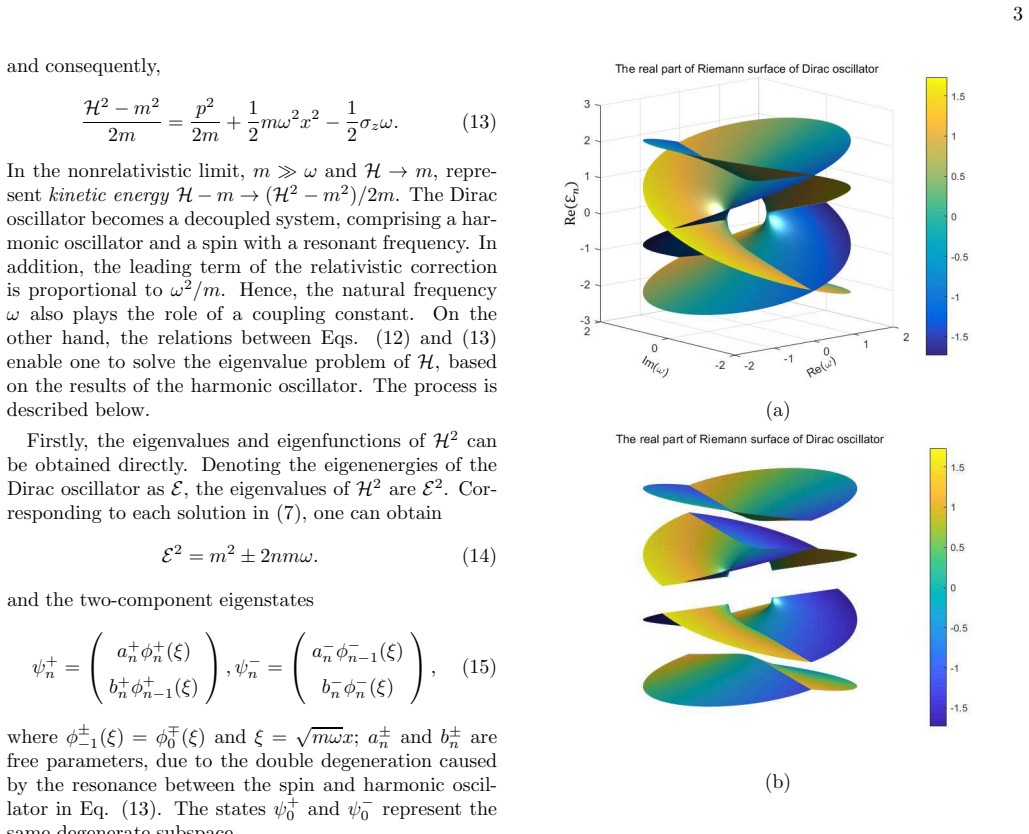
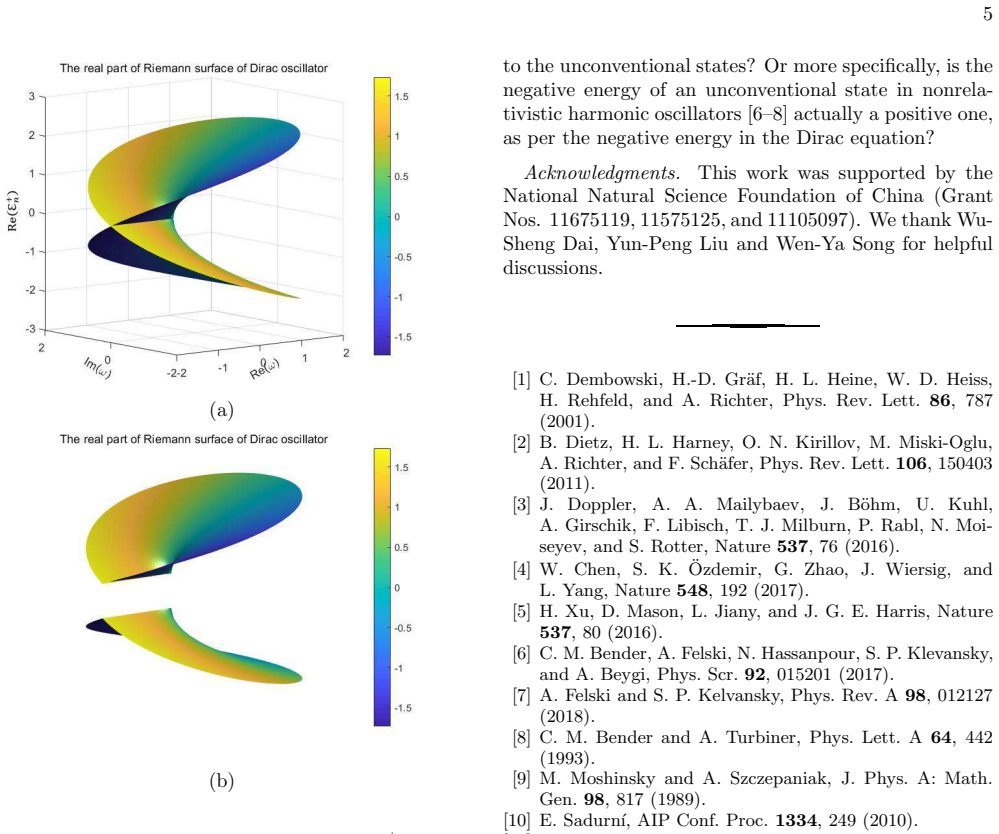
The carrying object is the nested square-root eigenvalue function $E_n(\omega)\equiv\pm\sqrt{m^2\pm 2nm\sqrt{\omega^2}}$ and its decomposition into the two two-valued functions $E_n^\pm(\omega)$. The inner square root encodes the harmonic-oscillator spectrum obtained from $H^2=m^2+p^2+m^2\omega^2x^2-\sigma_z m\omega$, while the outer square roots are the Dirac square-root branches. The branch point at $\omega=-m/(2n)$ in $E_n^+$ is the mechanism: encircling it exchanges the two sheets, corresponding to particle and antiparticle states, and the branch cut on the negative-real axis is where the eigenvalues become complex and PT symmetry is broken.
What would settle it
Diagonalize the 1+1 Dirac oscillator Hamiltonian numerically for complex $\omega$ along a contour enclosing $\omega=-m/(2n)$ and compare the monodromy of the eigenstate with the predicted exchange for $|\omega|>m/(2n)$ and return for $|\omega|<m/(2n)$; any extra branch point or different sheet assignment would disprove the claim.
Extended reading notes
Core claim
The central discovery is that the eigenvalues $E_{\pm n}^{\pm}=\pm\sqrt{m^2\pm 2nm\omega}$ of the 1+1 Dirac oscillator do not form a single nested-square-root Riemann surface. Instead, the two signs inside the square root belong to two independent two-valued functions $E_n^+(\omega)=\pm\sqrt{m^2+2nm\omega}$ and $E_n^-(\omega)=\pm\sqrt{m^2-2nm\omega}$, each with its own two sheets. For $n\neq 0$, $E_n^+$ has one square-root branch point at $\omega=-m/(2n)$; moving $\omega$ once around this point takes the conventional positive-energy state $\Psi_{++n}^+$ to the antiparticle state $\Psi_{+-n}^+$, while the unconventional states are connected by the analogous loop on $E_n^-$. Since the branch point is absent for $n=0$, no such transition exists for the ground level, which the paper presents as the reason the negative-energy state $\Psi_{+-0}^+$ does not appear.
Load-bearing premise
The load-bearing premise is that the spectrum found for real positive $\omega$ continues faithfully into the complex plane, so the nested square-root formula has no branch points beyond $\omega=0$ and $\omega=\pm m/(2n)$ and the eigenstates follow the same sheets.
Editorial extensions
If this is right
- For every $n\neq 0$, a loop of $\omega$ around $-m/(2n)$ sends the positive-energy state $\Psi_{++n}^+$ to the antiparticle state $\Psi_{+-n}^+$ while returning to the original Hamiltonian.
- The transition passes through a broken-PT-symmetry region on the negative-real axis, possible only when $2n|\omega|>m$, so it is intrinsically relativistic.
- For $n=0$, the branch point lies at infinity, giving a visual explanation for the absence of the negative-energy state $\Psi_{+-0}^+$.
- The unconventional states are connected in the same way through the second function $E_n^-$, with both signs in the eigenvalue formula flipped and the spin flipped.
- Applying charge conjugation to the reached antiparticle state yields a positive-energy eigenstate of the antiparticle Hamiltonian $H_c=\alpha(p+i\beta m\omega x)+\beta m$.
Reading between the lines
- I expect the same monodromy to control the Berry phase picked up by the state after a full loop, so measuring that phase in a microwave or quantum-optical simulation would test the two-sheet structure directly.
- If the Dirac oscillator is realized in higher dimensions, the parameter space is larger and may contain branch lines or higher-order branch points; the particle–antiparticle connection could then become a non-Abelian monodromy.
- The fact that the negative-real-axis Hamiltonian reduces to a $2\times2$ PT-symmetric matrix suggests that the particle–antiparticle transition is an exceptional-point phenomenon, which may appear in other relativistic systems with a PT-breaking parameter.
Signed reviews
Editorial analysis
A structured set of objections, weighed in public.
Referee Report
Summary. This paper studies the one-dimensional Dirac oscillator H = alpha(p - i beta m omega x) + beta m. By squaring the Hamiltonian and using harmonic-oscillator eigenfunctions, the authors obtain exact eigenvalues E^±_{±n} = ±√(m² ± 2 n m ω) and corresponding eigenfunctions, Eqs. (16)-(18). They then analytically continue the frequency ω into the complex plane. Although a naively nested square root En(ω) = ±√(m² ± 2 n m √(ω²)) has four sheets, the authors argue that the conventional and unconventional states are separately connected by the two-valued functions E^±_n(ω) = ±√(m² ± 2 n m ω). For n ≠ 0, each of these has a branch point at ω = ∓ m/(2n); encircling that branch point with |ω| > m/(2n) changes the sign of the square root, which the paper claims moves the positive-energy state Ψ^+_{+n} to the negative-energy state Ψ^+_{-n} of the same Hamiltonian, i.e., to an antiparticle state after charge conjugation. The n = 0 case, for which this branch point is absent, is presented as a visual explanation of the absence of a conventional negative-energy state with n = 0. The paper contains plots of the Riemann surfaces and a discussion connecting the structure to PT-symmetric Hamiltonians.
Significance. If fully demonstrated, the result is a clean, exactly solvable example of a particle-antiparticle transition mediated by an eigenvalue Riemann surface in a relativistic quantum system. The derivation is parameter-free and the eigenvalue formula is obtained from first principles, with no fitting to data. The connection to PT-symmetric matrices and to exceptional-point experiments gives the paper a concrete, in-principle falsifiable context, e.g., through microwave simulations of the Dirac oscillator. The main limitation is that the state-transition part of the central claim is asserted more than it is derived: the eigenvalue monodromy is shown, but the corresponding monodromy of the eigenstates is not displayed. This gap is localized and readily fixable, but it is load-bearing for the paper's headline claim.
major comments (2)
- [Dirac Oscillator, around Eq. (20)] The claim that the system 'passes through the branch cut, and reaches its antiparticle state Ψ^+_{-n}' is the central result of the paper, but it is demonstrated only for the eigenvalues, not for the eigenstates. Because the two eigenvalues ±√(m²+2nmω) coalesce at the branch point, the eigenvalue branch alone does not determine which eigenstate is reached. Please add an explicit monodromy calculation for the eigenvectors in Eq. (16): writing a = √(m²+2nmω), the coefficient vector is (m ± a, 2n√(mω)); a loop around ω = -m/(2n) sends a → -a, while √(mω) and φ^+_n(√(mω)x) are single-valued along any contour that avoids ω = 0, so the two states are exchanged. Without this step, the advertised particle-antiparticle transition is an assertion rather than a demonstrated consequence.
- [Abstract and concluding paragraph] The statement that there is no negative-energy state with quantum number n = 0 is too strong as written. In the exact solutions, Eq. (17) with n = 0 yields a formal (non-normalizable) eigenstate Ψ^-_{-0} with eigenvalue -m; what actually disappears is the conventional, normalizable partner Ψ^+_{-0}. The authors should add the qualifier 'conventional' (or 'normalizable') wherever this absence is stated, since otherwise the abstract is literally inconsistent with Eq. (17).
minor comments (5)
- [p. 3, after Eq. (19)] The sentence contains the typo 'Since the the inner ± signs'; it should read 'Since the inner ± signs'.
- [p. 4 and p. 5] There are several spelling errors: 'posotive', 'sencond', and 'dimentional' should be 'positive', 'second', and 'dimensional'.
- [Reference [7]] The author name 'S. P. Kelvansky' is misspelled; it should be 'S. P. Klevansky'.
- [Eqs. (16)-(17)] The states are not written with normalization factors; since the analytic continuation argument relies on the explicit form of the coefficients, it would be helpful to state explicitly that these are unnormalized formal solutions and to specify the chosen branch of √(mω).
- [Figure 3] The caption of Fig. 3 does not explain the color scale, although the text says it represents the imaginary part; please add this information for consistency with Fig. 2.
Circularity Check
No significant circularity: the derivation is self-contained and the analytic-continuation claim follows directly from the explicit eigenvalue formulas.
full rationale
The central derivation is self-contained. The eigenvalues in Eq. (18), E±±n = ±√(m² ± 2nmω), are obtained by squaring the Dirac-oscillator Hamiltonian in Eq. (12), reducing the problem to a harmonic oscillator plus spin, writing the eigenstates of H² in terms of known Hermite-polynomial solutions, and then diagonalizing the degenerate 2×2 subspaces. No parameter is fitted to data, and no empirical input is renamed as a prediction. The Riemann-surface claim is derived directly from the branch structure of the exact functions E±n(ω) = ±√(m² ± 2nmω): the only square-root branch point for fixed n is at ω = -m/(2n), so encircling it exchanges the two signs and hence connects the two conventional eigenstates. The n = 0 case is read off from the same explicit formulas, where Ψ+_{-0} and Ψ-_{+0} vanish and E±0 = ±m has no finite branch point. The only self-citation (Ref. [17], cited among algebraic properties of the Dirac oscillator) is not load-bearing for any step of the derivation. There is therefore no circular step: no defined-in-terms-of relation, no fitted input called a prediction, and no self-citation chain on which the central claim depends.
Assumptions & free parameters
assumptions (3)
- domain assumption The Dirac oscillator Hamiltonian H = α(p − iβmωx) + βm is the correct model for a relativistic oscillator in one spatial dimension.
- domain assumption The eigenvalue formula E±±n = ±√(m² ± 2nmω), derived for real positive ω, continues to hold for complex ω by analytic continuation with the same branch choices.
- standard math Standard facts about multivalued square-root functions (branch points, branch cuts, and coverage of the Riemann surface by analytic continuation) are used without proof.
Cite this review
Pith. "Pith review of The Analytic Eigenvalue Structure of the 1+1 Dirac Oscillator." pith.science (2026). https://pith.science/paper/QUTAKZFT
@misc{pith2026190809352,
  author       = {Pith},
  title        = {Pith review of: The Analytic Eigenvalue Structure of the 1+1 Dirac Oscillator},
  year         = {2026},
  howpublished = {\url{https://pith.science/paper/QUTAKZFT}},
  note         = {Machine review of arXiv:1908.09352}
}
read the original abstract
We study the analytic structure for the eigenvalues of the one-dimensional Dirac oscillator, by analytically continuing its frequency on the complex plane. A twofold Riemann surface is found, connecting the two states of a pair of particle and antiparticle. One can, at least in principle, accomplish the transition from a positive energy state to its antiparticle state by moving the frequency continuously on the complex plane, without changing the Hamiltonian after transition. This result provides a visual explanation for the absence of a negative energy state with the quantum number n=0.
Figures

Reference graph
Works this paper leans on
-
[1]
C. Dembowski, H.-D. Gr¨ af, H. L. Heine, W. D. Heiss, H. Rehfeld, and A. Richter, Phys. Rev. Lett. 86, 787 (2001)
work page 2001
- [2]
-
[3]
Doppler, A
J. Doppler, A. A. Mailybaev, J. B¨ ohm, U. Kuhl, A. Girschik, F. Libisch, T. J. Milburn, P. Rabl, N. Moi- seyev, and S. Rotter, Nature 537, 76 (2016)
2016
-
[4]
W. Chen, S. K. ¨Ozdemir, G. Zhao, J. Wiersig, and L. Yang, Nature 548, 192 (2017)
work page 2017
-
[5]
H. Xu, D. Mason, L. Jiany, and J. G. E. Harris, Nature 537, 80 (2016)
work page 2016
-
[6]
C. M. Bender, A. Felski, N. Hassanpour, S. P. Klevansky, and A. Beygi, Phys. Scr. 92, 015201 (2017)
work page 2017
- [7]
-
[8]
C. M. Bender and A. Turbiner, Phys. Lett. A 64, 442 (1993)
work page 1993
Show all 30 references
-
[9]
Moshinsky and A
M. Moshinsky and A. Szczepaniak, J. Phys. A: Math. Gen. 98, 817 (1989)
1989
-
[10]
Sadurn ´ ı, AIP Conf
E. Sadurn ´ ı, AIP Conf. Proc.1334, 249 (2010)
2010
-
[11]
P. A. M. Dirac, The principles of quantum mechanics (Oxford University Press 1930, 1965)
1930
-
[12]
J. A. Franco-Villafa˜ ne, E. Sadurn ´ ı, S. Barkhofen, U. Kuhl, F. Mortessagne, and T. H. Seligman, Phys. Rev. Lett. 111, 170405 (2013)
2013
-
[13]
O. L. de Lange, J. Phys. A: Math. Gen. 24, 667 (1991)
1991
-
[14]
Benitez, Phys
J. Benitez, Phys. Rev. Lett. 64, 1643 (1990)
1990
-
[15]
Quesne and M
C. Quesne and M. Moshinsky., J. Phys. A: Math. Gen. 23, 2263 (1990)
1990
-
[16]
Lisboa, M
R. Lisboa, M. Malheiro, A. S. de Castro, P. Alberto, and M. Fiolhais, Phys. Rev. C 69, 024319 (2004)
2004
-
[17]
Zhang, B
F.-L. Zhang, B. Fu, and J.-L. Chen, Phys. Rev. A 80, 054102 (2009)
2009
-
[18]
Grineviciute and D
J. Grineviciute and D. Halderson, Phys. Rev. C 85, 054617 (2012)
2012
-
[19]
Romera, Phys
E. Romera, Phys. Rev. A 84, 052102 (2011)
2011
-
[20]
Bermudez, M
A. Bermudez, M. A. Martin-Delgado, and E. Solano, Phys. Rev. A 76, 041801 (2007)
2007
-
[21]
Bermudez, M
A. Bermudez, M. A. Martin-Delgado, and E. Solano, Phys. Rev. Lett. 99, 123602 (2007)
2007
-
[22]
Lamata, J
L. Lamata, J. Le´ on, T. Sch¨ atz, and E. Solano, Phys. Rev. Lett. 98, 253005 (2007)
2007
-
[23]
J. M. Torres, E. Sadurn ´ ı, and T. H. Seligman, AIP Conf. Proc. 1323, 301 (2010)
2010
-
[24]
Sadurn ´ ı, T
E. Sadurn ´ ı, T. H. Seligman, and F. Mortessagne, New J. Phys. 12, 053014 (2010)
2010
-
[25]
Szmytkowski and M
R. Szmytkowski and M. Gruchowski, J. Phys. A: Math. 6 Gen. 34, 4991 (2001)
2001
-
[26]
Greiner, Relativistic quantum mechanics: Wave equa- tions (Springer, 2000), p
W. Greiner, Relativistic quantum mechanics: Wave equa- tions (Springer, 2000), p. 299
2000
-
[27]
C. M. Bender, D. C. Brody, and H. F. Jones, Am. J. Phys. 71, 1095 (2003)
2003
-
[28]
Beygi and S
A. Beygi and S. P. Klevansky, Phys. Rev. A 98, 022105 (2018)
2018
-
[29]
Beygi, S
A. Beygi, S. P. Klevansky, and C. M. Bender, Phys. Rev. A 99, 062117 (2019)
2019
-
[30]
M. V. Berry, Proc. R. Soc. London, Ser. A 392, 45 (1984)
1984
Reviewed August 14, 2026 · model on record in the stance chip above.
Discussion (0). Continue with ORCID to comment.