REVIEW 4 major objections 4 minor 94 references
Nambu variant of Local Resolution of Problem of Time and Background Independence
T0 review · 4 major / 4 minor · reviewed 2026-08-14 · deepseek-v4-flash
Pith's one-line read Nambu brackets reduce the many candidate observables of a constrained theory to a single kind, which itself forms a Nambu algebra.
desk verdict A coherent formal translation of the author's ALToBI program to Nambu brackets, but the central non-proliferation theorem is not proven and as stated Obs2 is all functions. read the letter →
The pith
A machine-rendered reading of the paper's core claim, the machinery that carries it, and where it could break.
The reading
What carries the argument
The Nambu bracket is an n-ary totally antisymmetric product on smooth functions satisfying the fundamental identity; for n=2 it reduces to the usual commutator with the Jacobi identity, and the ternary bracket is the minimal nontrivial case. Its Nambu–Poisson version adds the derivation or Leibniz property and corresponds to mechanics with multiple Hamiltonians. This bracket carries the paper's argument twice: repeated application of the fundamental identity is what collapses the candidate notions of observables and forces constraint or generator closure, and the same identities are recast as first-order quasilinear PDEs solved by the Flow Method. For even n, a Nambu–Dirac bracket generalising Dirac's bracket handles second-class constraints, while odd n is accommodated by embedding lower-arity brackets in higher even-arity ones.
What would settle it
Take any concrete ternary Nambu–Poisson system with a pair of constraints C and a function O for which {C,C,O}=0 holds for all O in a candidate observable algebra, and compute {C,C,C} directly without assuming the theorem; a single example where this bracket does not vanish weakly refutes the proof's key inference and with it the Non-Proliferation Theorem.
Extended reading notes
Core claim
The paper's central claim is a Nambu generalisation of the Local Resolution of the Problem of Time: the machinery used to handle constraints, generators, and observables in gauge theories and canonical gravity can be rebuilt with n-ary Nambu brackets instead of binary Lie or Poisson brackets. The load-bearing result is the Nambu Observables Non-Proliferation Theorem: all a priori notions of Nambu observables, differing in how many constraints or generators occupy the bracket's slots, coincide once the fundamental identity is used repeatedly, and the unique resulting notion itself closes as a Nambu algebra. Consequently, both the Nambu–Dirac Algorithm for constraints and the Nambu Algorithm for generators end with closed Nambu algebraic structures, and the lattice of constraint or generator subalgebras carries a dual lattice of observable subalgebras. The author also poses Nambu versions of deformation-rigidity construction and of Reallocation of Intermediary-Object Invariance, noting that whether the latter actually holds in any nontrivially Nambu theory remains open.
Load-bearing premise
The argument's load-bearing step is the inference that if an observable O satisfies {C,C,O}=0, then repeated use of the fundamental identity forces the constraints themselves to close, so that {C,C,C} also vanishes weakly; if that inference fails in some algebra, the uniqueness and closure results lose their support.
Editorial extensions
If this is right
- For any n, the candidate notions of Nambu observable reduce to one, so observables theory inherits the binary case's uniqueness and closure properties.
- The Nambu–Dirac Algorithm and the Nambu Algorithm terminate in closed Nambu algebraic structures, giving a predictive selection principle for which constraint or generator sets are consistent.
- Each closed subalgebra of constraints or generators induces a dual subalgebra of observables, so the classification of observables is tied to the lattice of constraint structures.
- Even-n Nambu theories admit a Nambu–Dirac bracket for removing second-class constraints, while odd-n theories can use even-n embedding instead.
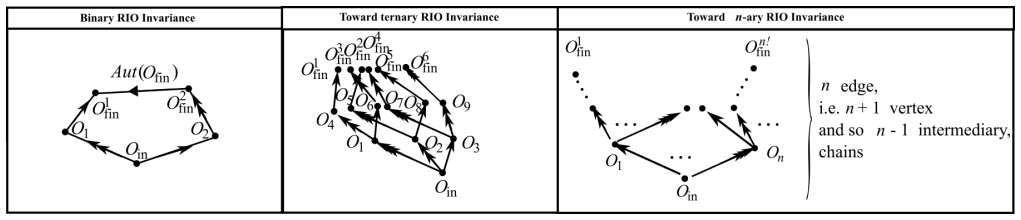
- Deformation and rigidity become tools for constructing more structure from less, and Reallocation of Intermediary-Object Invariance is posed as a selection principle analogous to GR's re-foliation invariance.
Reading between the lines
- Editorial extension: if the non-proliferation theorem holds, the Flow Method PDEs it relies on could be solved in small model arenas such as finite Nambu mechanics to test whether Kuchař- and Chronos-type observables actually exist there.
- Editorial extension: because even-n Nambu brackets can be written as alternating sums of binary brackets, the Nambu observable algebra may be realisable within ordinary Poisson-algebraic data, which would give a direct route to deformation quantization of these systems.
- Editorial extension: whether Reallocation of Intermediary-Object Invariance is actualized in any ternary Nambu theory remains untested; a negative result would select against Nambu theory as a realisation of Background Independence, while a positive one would strengthen it.
Signed reviews
Editorial analysis
A structured set of objections, weighed in public.
Referee Report
Summary. The paper proposes a Nambu-bracket generalization of the author's earlier 'Local Resolution of the Problem of Time' / 'Local Theory of Background Independence' program. It introduces Nambu–Dirac and Nambu algorithms for constraint and generator closure, defines several a priori notions of Nambu observables through zero-commutant Nambu brackets, and claims a 'Nambu Observables Non-Proliferation Theorem' that collapses these notions into one, that the unique notion forms Nambu algebras, and that lattices of constraint/generator subalgebras induce dual lattices of observable subalgebras. The paper further sketches deformation/rigidity and RIO-invariance analogues and discusses Bagger–Lambert–Gustavsson M-theory as motivation.
Significance. If the claimed non-proliferation and algebra-closure results were correct, the paper would provide a structurally interesting extension of Dirac and Lie constraint analysis to Nambu mechanics, with consequences for the problem of time and for comparing background independence in GR, supergravity, and BLG models. The paper is also commendably explicit where it translates the Nambu-observable condition into a linear PDE system (Sec 5.6) and where it writes out the even-n Nambu–Dirac bracket (Sec 3.8). However, the central theorem on which the uniqueness, closure, and lattice-duality claims rest is not proven, and on the natural reading of the definitions it is false. A simple canonical counterexample contradicts the claimed equality of observable spaces, so the main contribution of the manuscript is not established.
major comments (4)
- [Sec 5.2, Eqs. (107)-(108)] The inference from the fundamental identity to {C,C,C}≈0 is a tautology. With {C,C,O1}=0, Eq. (107) reduces to 0 = {{C,C,C},C,O1} + {C,{C,C,C},O1} + 0; the two surviving terms are negatives of each other by total antisymmetry, and {C,C,C} is itself identically zero for a ternary bracket with two equal arguments. Consequently Eq. (108) carries no information about constraint closure, and the same cancellation pattern invalidates the subsequent steps leading to Eqs. (110), (113), and (115). The final paragraph of the proof, describing the general-n case, is only a sketch and cannot repair this ternary-case failure.
- [Sec 5.2, Eq. (104)] Equation (104), {C,O2,O2}≈0, is identically satisfied for every function O2 because any Nambu bracket with two equal slots vanishes by total antisymmetry. Hence Obs2 is the full function space C∞, not a nontrivial constrained observable space. For instance, on R^3 with canonical Nambu–Poisson bracket {x,y,z}=1 and first-class constraints x and y, Obs1 consists of functions independent of z while Obs2 is all smooth functions, so the claimed equality Obs1=Obs2 (Eq. (117)) is false.
- [Sec 3.6] The Nambu Class Non-Proliferation Theorem is stated without proof, and its proof is explicitly deferred to the second and third parts of the Sec 5.2 theorem. Since the Sec 5.2 argument fails both in its fundamental-identity manipulations and in its identification of Obs2, the assertion that first/second-class distinction suffices for Nambu theory has no supporting argument in the manuscript.
- [Sec 8.1 and Abstract] The abstract's claim that 'Nambu observables themselves form Nambu algebras', together with the dual-lattice picture developed in Secs 5.4-5.5 and 6.5, rests entirely on the failed Sec 5.2 theorem. No independent proof of algebra closure or of lattice duality is supplied, and with Obs2 equal to all functions, the claimed uniqueness of the observable algebra is unsupported.
minor comments (4)
- [Sec 5.2, notation] The symbol 'C' is used both for a single constraint and as a placeholder for arbitrary constraints, which makes the proof hard to check; distinct indices (e.g., C1, C2, C3) should be used wherever the arguments of a Nambu bracket are meant to be different.
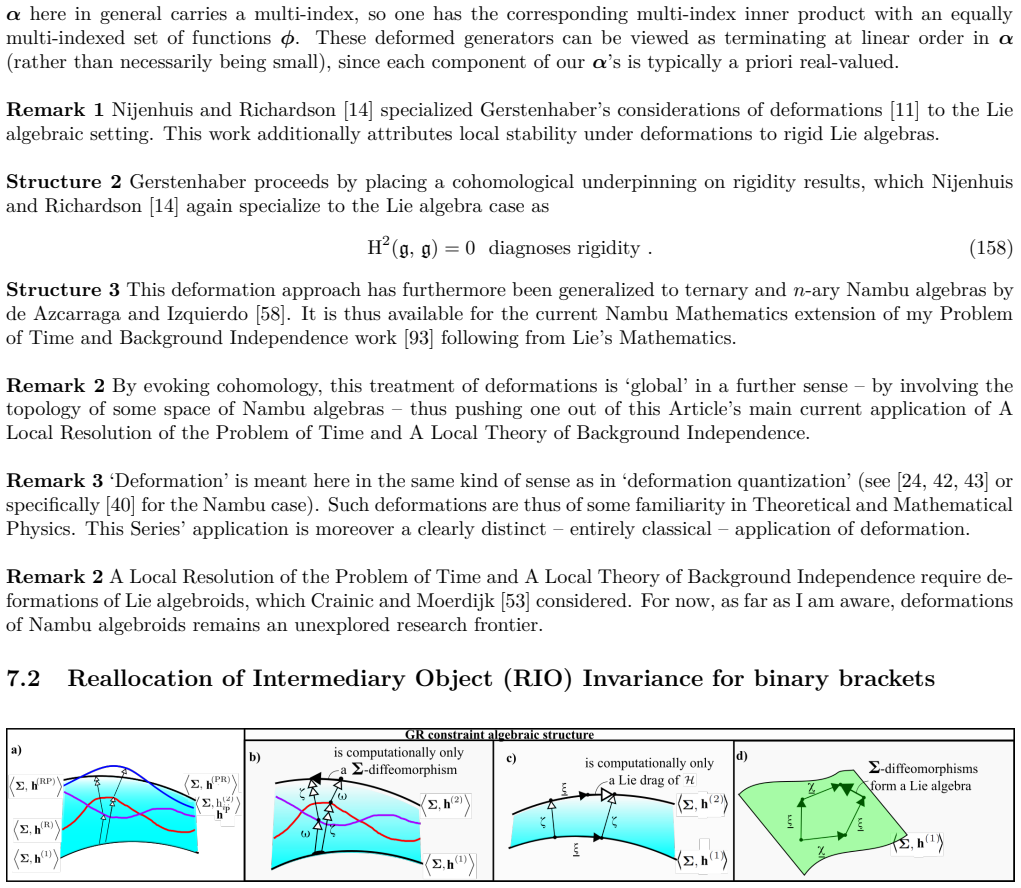
- [Sec 3.11-3.12 and Fig 1] The lattice definitions are presented largely through references to Figure 1 and to the author's prior papers; the figure caption alone does not define the lattice elements, so a reader without the earlier series cannot independently verify the lattice and duality claims.
- [Sec 7.2, Eq. (160)] Equation (160) appears to contain a typographical error in the displayed sum; the intended alternating sum over permutations should be written with explicit permutational notation.
- [Sec 2.2 and Sec 3.3] There are scattered typographical errors (for example 'Poison' for 'Poisson', 'distictions' for 'distinctions') that should be corrected in a revision.
Circularity Check
The central Nambu Observables Non-Proliferation Theorem rests on fundamental-identity manipulations that reduce to 0=0 and on a vacuous defining relation, so the claimed coincidence and Nambu-algebra closure are not derived.
-
self definitional
[Sec 5.2, Eqs. (107)-(108)]
"In the ternary case, { C, C,{ C, C, O1}} = {{ C, C, C}C, O1} + { C,{ C, C, C}, O1} + { C, C{ C, C, O1}} . (107) ⇒{ C, C, C} ‘=’0 , (108)"
The premise of Obs1 is {C,C,O1}=0, so the left-hand side of (107) and the third term on the right are literally the same expression. By total antisymmetry the first two right-hand terms are negatives of each other, so (107) reduces to 0=0. The arrow to (108) is therefore a definitional tautology: it carries no information. Moreover {C,C,C}=0 is already an identity from antisymmetry, and it does not involve {C,C,D} for a different constraint D, so it cannot establish that the constraints close as a Nambu subalgebra. The claimed deduction is the paper's own equation equating an expression with itself.
-
self definitional
[Sec 5.2, Eq. (104) and conclusion (117)]
"{ C, O2, O2} ‘=’0 , (104) ... Together, (111, 116)⇒ Obs1 = Obs2 , (117)"
Condition (104) is satisfied identically by every phase-space function because a Nambu bracket with two equal slots vanishes by total antisymmetry. Hence Obs2 is by definition the unrestricted function space, not a restricted set of observables. The claimed theorem then makes the nontrivial set Obs1 coincide with the full function space, which is not a consequence of the constraints. For example, with the canonical Nambu-Poisson bracket {x,y,z}=1 and constraints x,y, Obs1 is the z-independent functions while Obs2 is all smooth functions, so Obs1=Obs2 is false. The 'coincidence' is either a definitional artifact of a vacuous condition or a false statement, and in either case it is not derived from the constraint dynamics.
1 more flagged steps
-
other
[Sec 3.6, Nambu Class Non-Proliferation Theorem]
"Nambu Class Non-Proliferation Theorem First and second class distinction suffices for Nambu Theory. Proof By definitions by exclusion, formulate our putative distinction in terms of multiple kinds of first-classness. This is then the same shape as the second and third parts of Sec 5’s Nambu Observables Non-Proliferation Theorem."
The proof of the Nambu Class Non-Proliferation Theorem is not self-contained; it is explicitly deferred to the second and third parts of Sec 5's theorem. Since those parts are established only by the fundamental-identity steps shown above to collapse to 0=0, the class theorem inherits no independent support. The load-bearing content of the paper's 'uniquely narrowed down' claim is thus a pointer to a derivation that equals its own input by construction.
full rationale
The paper's broad ALToBI scaffolding is heavily self-cited, but by itself that is not circular: [73,79-93] supply definitions and a framework, and the Nambu-specific claims are supposed to be new. The problem is internal. The Nambu Observables Non-Proliferation Theorem is the load-bearing result behind the abstract's assertion that 'Nambu observables themselves form Nambu algebras' and behind the dual-lattice picture. Its proof, however, repeatedly writes the fundamental identity with the observable condition already imposed, so each displayed equation reduces to the identity 0=0: (107) is an equality of an expression with itself, (109) and (112) have their first two terms cancel by antisymmetry, and (114) does the same. The conclusions marked with arrows never extract new bracket relations from these equations; they merely assert them. In addition, the definition of Obs2 in (104) is vacuous because a bracket with two equal entries vanishes identically, so Obs2 is the full function space; the assertion Obs1=Obs2 is therefore not a derived physical result, and with an explicit Nambu-Poisson example it is false. The Sec 3.6 class theorem is then explicitly handed to this same broken argument. I therefore do not score this as mere self-citation or as a stylistic concern: the central mathematical claim of the paper is unsupported by a proof chain that, at its critical step, equates a statement with itself. Because some parts of the paper, such as the Nambu-Dirac algorithm setup and the RIO discussion, are independent programmatic content and are not themselves reductions, the overall circularity score is high but not maximal.
Assumptions & free parameters
assumptions (6)
- standard math Nambu n-ary brackets exist on smooth functions and satisfy total antisymmetry and the fundamental identity (Def 1 and Eq. 3, Sec 2.1).
- standard math Nambu-Poisson brackets are Nambu brackets that also satisfy the Leibniz rule in one argument (Eq. 11, Sec 2.2).
- domain assumption The Dirac algorithm's notions of weak equality, primary/secondary constraints, and first/second-class constraints carry over to n-ary Nambu brackets (Sec 3.1-3.6).
- domain assumption Even-n Nambu bracket arrays are invertible, allowing construction of Nambu-Dirac brackets; odd-n brackets can be locally embedded into even-n brackets (Sec 3.8, Eqs. 62-63).
- ad hoc to paper Neither topological obstructions nor 'tertiary complications' occur during constraint closure (Modelling assumption, Sec 3.10 and Sec 4.3).
- ad hoc to paper The Nambu Class Non-Proliferation Theorem holds: first/second-class distinction suffices for Nambu theory (Sec 3.6).
Cite this review
Pith. "Pith review of Nambu variant of Local Resolution of Problem of Time and Background Independence." pith.science (2026). https://pith.science/paper/QV4EWRP3
@misc{pith2026190803168,
  author       = {Pith},
  title        = {Pith review of: Nambu variant of Local Resolution of Problem of Time and Background Independence},
  year         = {2026},
  howpublished = {\url{https://pith.science/paper/QV4EWRP3}},
  note         = {Machine review of arXiv:1908.03168}
}
abstract
A Local Resolution of the Problem of Time has recently been given, alongside reformulation as A Local Theory of Background Independence. The classical part of this can be viewed as requiring just Lie's Mathematics, albeit entrenched in subsequent topological and differential-geometric developments and extended to contemporary Physics' state spaces. We now widen this approach by mild recategorization to one based on Nambu's generalization of Lie's Mathematics, as follows. i) In this approach, the Lie derivative still suffices to encode Relationalism. ii) Closure is now assessed using the Nambu bracket - with $n$ slots rather than 2, so the first nontrivially Lie case has 3 slots - and a `Nambu Algorithm' analogue of the Dirac and Lie Algorithms. This produces a class of Nambu algebraic structures of generators or of first-class constraints. iii) Nambu observables are defined by Nambu brackets zero-commutation with generators or with first-class constraints; we use the Nambu analogue of the Jacobi identity to simplify this discussion relative to a previous treatment. These Nambu brackets relations can moreover be recast as explicit PDEs to be solved using the Flow Method. Nambu observables themselves form Nambu algebras. Lattices of Nambu constraint or generator algebraic substructures furthermore induce dual lattices of Nambu observables subalgebras. iv) Deformation of Nambu algebraic structures encountering Rigidity gives a means of Constructing more structure from less. v) Reallocation of Intermediary-Object Invariance gives the general Nambu algebraic structure's analogue of posing Refoliation Invariance for GR. We also draw some motivation from M-Theory's use of Nambu Mathematics along the lines of Bagger, Lambert and Gustavsson, finding some qualitative distinctions between this, GR and Supergravity as regards how Background Independence is realized.
Figures


Figures from the paper (1 more)
Reference graph
Works this paper leans on
- [1]
-
[2]
Über Differentialkonkomitanten zweier kontravarianten Grössen
J.A. Schouten, “Über Differentialkonkomitanten zweier kontravarianten Grössen", Indag. Math. 2: 449-452; “On the Differential Operators of the First Order in Tensor Calculus", in Convegno Int. Geom. Diff. Italia. p1 (1953); A. Nijenhuis, “Jacobi-type Identities for Bilinear Differential Concomitants of Certain Tensor Fields I". Indagationes Math.17 390 (1955)
1953
-
[3]
Lanczos, The Variational Principles of Mechanics(University of Toronto Press, Toronto 1949)
C. Lanczos, The Variational Principles of Mechanics(University of Toronto Press, Toronto 1949)
1949
-
[4]
Forms of Relativistic Dynamics
P.A.M. Dirac, “Forms of Relativistic Dynamics", Rev. Mod. Phys.21 392 (1949)
1949
-
[5]
Yano, “Theory of Lie Derivatives and its Applications (North-Holland, Amsterdam 1955)
K. Yano, “Theory of Lie Derivatives and its Applications (North-Holland, Amsterdam 1955)
1955
-
[6]
Theory of Vector Valued Differential Forms. Part I
A. Frölicher and A. Nijenhuis, “Theory of Vector Valued Differential Forms. Part I.", Indagationes Math.18 338 (1956)
1956
-
[7]
Jacobson, Lie Algebras(Wiley, Chichester 1962, reprinted by Dover, New York 1979)
N. Jacobson, Lie Algebras(Wiley, Chichester 1962, reprinted by Dover, New York 1979)
1962
-
[8]
Guggenheimer, Differential Geometry(McGraw–Hill, New York 1963, reprinted by Dover, New York 1977)
H.W. Guggenheimer, Differential Geometry(McGraw–Hill, New York 1963, reprinted by Dover, New York 1977)
1963
Show all 94 references
-
[9]
Mackey,Mathematical Foundations of Quantum Mechanics(Benjamin, New York 1963)
G. Mackey,Mathematical Foundations of Quantum Mechanics(Benjamin, New York 1963)
1963
-
[10]
The Cohomology Structure of an Associative Ring
M. Gerstenhaber, “The Cohomology Structure of an Associative Ring". Ann. Math.78 267 (1963)
1963
-
[11]
On the Deformation of Rings and Algebras
M. Gerstenhaber, “On the Deformation of Rings and Algebras", Ann. Math.79 59 (1964)
1964
-
[12]
Dirac,Lectures on Quantum Mechanics(Yeshiva University, New York 1964)
P.A.M. Dirac,Lectures on Quantum Mechanics(Yeshiva University, New York 1964)
1964
-
[13]
Serre,Lie Algebras and Lie Groups(Benjamin, New York 1965); Complex Semisimple Lie Algebras(Springer, New York 1966)
J.-P. Serre,Lie Algebras and Lie Groups(Benjamin, New York 1965); Complex Semisimple Lie Algebras(Springer, New York 1966)
1965
-
[14]
Cohomology and Deformations in Graded Lie Algebras
A. Nijenhuis and R. Richardson, “Cohomology and Deformations in Graded Lie Algebras" Bull. Amer. Math.72 1 (1966); “Deformation of Lie Algebra Structures", J. Math. Mech67 89 (1967)
1966
-
[15]
Wheeler, inBattelle Rencontres: 1967 Lectures in Mathematics and Physicsed
J.A. Wheeler, inBattelle Rencontres: 1967 Lectures in Mathematics and Physicsed. C. DeWitt and J.A. Wheeler (Benjamin, New York 1968)
1967
-
[16]
Quantum Theory of Gravity. I. The Canonical Theory
B.S. DeWitt, “Quantum Theory of Gravity. I. The Canonical Theory." Phys. Rev.160 1113 (1967)
1967
-
[17]
Yano,Integral Formulas in Riemannian Geometry(Dekker, New York 1970)
K. Yano,Integral Formulas in Riemannian Geometry(Dekker, New York 1970)
1970
-
[18]
Momentum Constraints as Integrability Conditions for the Hamiltonian Constraint in General Relativity
V. Moncrief and C. Teitelboim, “Momentum Constraints as Integrability Conditions for the Hamiltonian Constraint in General Relativity", Phys. Rev.D6 966 (1972)
1972
-
[19]
How Commutators of Constraints Reflect Spacetime Structure
C. Teitelboim, “How Commutators of Constraints Reflect Spacetime Structure", Ann. Phys. N.Y.79 542 (1973)
1973
-
[20]
Nambu, Generalized Hamiltonian Mechanics
Y. Nambu, Generalized Hamiltonian Mechanics. Phys. Rev.D 7 2405 (1973)
1973
-
[21]
Gilmore, Lie Groups, Lie Algebras, and Some of Their Applications(Dover, New York 2006)
R. Gilmore, Lie Groups, Lie Algebras, and Some of Their Applications(Dover, New York 2006)
2006
-
[22]
Bayen and M
F. Bayen and M. Flato, Phys. Rev.D 11 3049 (1975)
1975
-
[23]
Supergravity and Square Roots of Constraints
C. Teitelboim, “Supergravity and Square Roots of Constraints", Phys. Rev. Lett.38 1106 (1977)
1977
-
[24]
Bayen, M
F. Bayen, M. Flato, C. Fronsdal, A. Lichnerowicz and D. Sternheimer,Deformation Theory and Quantization. I. Deformations of Symplectic StructuresAnn. Phys. 111 61 (1978)
1978
-
[25]
John,Partial Differential Equations(Springer, New York 1982)
F. John,Partial Differential Equations(Springer, New York 1982)
1982
-
[26]
Choquet-Bruhat, C
Y. Choquet-Bruhat, C. DeWitt-Morette and M. Dillard-Bleick,Analysis, Manifolds and PhysicsVol. 1 (Elsevier, Amsterdam 1982)
1982
-
[27]
Kadison and J.R
R.V. Kadison and J.R. RingroseFundamentals of the Theory of Operator Algebras(Academic Press, Orlando 1983)
1983
-
[28]
Topological and Global Aspects of Quantum Theory
C.J. Isham, “Topological and Global Aspects of Quantum Theory", inRelativity, Groups and Topology II, ed. B. DeWitt and R. Stora (North-Holland, Amsterdam 1984)
1984
-
[29]
n-ary Lie Algebras
V.T. Filippov, “n-ary Lie Algebras", Russian Sibirskii Math. J.24 126 (1985)
1985
-
[30]
Unification of Schouten–Nijenhuis and Frölicher–Nijenhuis Brackets, Cohomology and Super Differential Oper- ators
A.M. Vinogradov, “Unification of Schouten–Nijenhuis and Frölicher–Nijenhuis Brackets, Cohomology and Super Differential Oper- ators". Sov. Math. Zametki.47 (1990)
1990
-
[31]
Henneaux and C
M. Henneaux and C. Teitelboim,Quantization of Gauge Systems(Princeton University Press, Princeton 1992)
1992
-
[32]
Time and Interpretations of Quantum Gravity
K.V. Kuchař, “Time and Interpretations of Quantum Gravity", inProceedings of the 4th Canadian Conference on General Relativity and Relativistic Astrophysicsed. G. Kunstatter, D. Vincent and J. Williams (World Scientific, Singapore 1992)
1992
-
[33]
Canonical Quantum Gravity and the Problem of Time
C.J. Isham, “Canonical Quantum Gravity and the Problem of Time", inIntegrable Systems, Quantum Groups and Quantum Field Theories ed. L.A. Ibort and M.A. Rodríguez (Kluwer, Dordrecht 1993), gr-qc/9210011
1993 arXiv
-
[34]
Kolář, P.W
I. Kolář, P.W. Michor and J. Slovák,Natural Operations in Differential Geometry(Springer–Verlag, New York 1993)
1993
-
[35]
Takhatajan,On Foundation of the Generalized Nambu Mechanics, Commun
L. Takhatajan,On Foundation of the Generalized Nambu Mechanics, Commun. Math. Phys.160 295 (1994), hep-th/9301111. 28
1994 arXiv
-
[36]
Canonical Quantum Gravity
K.V. Kuchař, “Canonical Quantum Gravity", inGeneral Relativity and Gravitation 1992, ed. R.J. Gleiser, C.N. Kozamah and O.M. Moreschi M (Institute of Physics Publishing, Bristol 1993), gr-qc/9304012
1992 arXiv
-
[37]
Vaisman,Lectures on the Geometry of Poisson Manifolds, (Birkhäuser, Basel 1994)
I. Vaisman,Lectures on the Geometry of Poisson Manifolds, (Birkhäuser, Basel 1994)
1994
-
[38]
Olver,Equivalence, Invariants and Symmetry(Cambridge University Press, Cambridge 1995)
P.J. Olver,Equivalence, Invariants and Symmetry(Cambridge University Press, Cambridge 1995)
1995
-
[39]
Bertlmann, Anomalies in Quantum Field Theory(Clarendon, Oxford 1996)
R.A. Bertlmann, Anomalies in Quantum Field Theory(Clarendon, Oxford 1996)
1996
-
[40]
G. Dito, M. Flato, D. Sternheimer and L. Takhtajan,Deformation Quantization and Nambu MechanicsCommun. Math. Phys. 183 1 (1997), hep-th/9602016
1997 arXiv
-
[41]
Stanley,Enumerative Combinatorics(Cambridge University Press, Cambridge, 1997)
R.P. Stanley,Enumerative Combinatorics(Cambridge University Press, Cambridge, 1997)
1997
-
[42]
Sternheimer, “Deformation Quantization: Twenty Years After (AIP Conference Proceedings, 1998)
D. Sternheimer, “Deformation Quantization: Twenty Years After (AIP Conference Proceedings, 1998)
1998
-
[43]
Deformation Quantization of Poisson Manifolds, I
M. Kontsevich, “Deformation Quantization of Poisson Manifolds, I.", Lett. Math. Phys.66 157 (2003), q-alg/9709040
2003 arXiv
-
[44]
Generalizedn-Poisson Brackets on a Symplectic Manifold
J. Grabowski and G. Marmo, “Generalizedn-Poisson Brackets on a Symplectic Manifold", Mod. Phys. Lett.A13 3185 (1998), math/9902129
1998 arXiv
-
[45]
Chapter 1 of J.-L
See e.g. Chapter 1 of J.-L. Loday,Cyclic Cohomology(Springer-Verlag, Berlin 1998)
1998
-
[46]
Landsman,Mathematical Topics between Classical and Quantum Mechanics(Springer–Verlag, New York 1998)
N.P. Landsman,Mathematical Topics between Classical and Quantum Mechanics(Springer–Verlag, New York 1998)
1998
-
[47]
Nambu-Lie Groups
I. Vaisman, “Nambu-Lie Groups", arxiv:math.DG/9812064; “A Survey on Nambu–Poisson brackets", Acta Math. Univ. Comenianae Vol.68 213 (1999)
1999
-
[48]
Relativity Without Relativity
J.B. Barbour, B.Z. Foster and N. ó Murchadha, “Relativity Without Relativity", Class. Quant. Grav.19 3217 (2002), gr-qc/0012089
2002 arXiv
-
[49]
Nambu-Dirac Structures on Lie Algebroids
A. Wade, “Nambu-Dirac Structures on Lie Algebroids", math/0204310
-
[50]
Classical and Quantum Nambu Mechanics
T.L. Curtright and C.K. Zachos, “Classical and Quantum Nambu Mechanics", Phys. Rev.D68 085001 (2003), hep-th/0212267
2003 arXiv
-
[51]
Branes, Strings, and Odd Quantum Nambu Brackets
T.L. Curtright and C.K. Zachos, “Branes, Strings, and Odd Quantum Nambu Brackets", Contribution to the Proceedings of QTS3, 10-14 Sep 2003, Cincinnati, World Scientific (SPIRES conf C03/09/10), hep-th/0312048
2003 arXiv
-
[52]
Derived Brackets
Y. Kosmann-Schwarzbach, “Derived Brackets", Lett. Math. Phys.69 61 (2004), arXiv:math/0312524
2004 arXiv
-
[53]
Deformations of Lie Brackets: Cohomological Aspects
M. Crainic and I. Moerdijk, “Deformations of Lie Brackets: Cohomological Aspects", J. European Math. Soc. 10 4 (2008), arXiv:math/0403434
2008 arXiv
-
[54]
Modelling Multiple M2’s
J. Bagger and N. Lambert, “Modelling Multiple M2’s", Phys. Rev.D75 045020 (2007), hep-th/0611108
2007 arXiv
-
[55]
Algebraic Structures on Parallel M2-Branes
A. Gustavsson, “Algebraic Structures on Parallel M2-Branes", Nucl. Phys.B811 66 (2009), hep-th/0709.1260
2009 arXiv
-
[56]
Comments on Multiple M2-Branes
J. Bagger and N. Lambert, “Comments on Multiple M2-Branes", Phys. Rev.D77 065008 (2008), arxiv:0712.3738; “Three-Algebras and N= 6 Chern-Simons Gauge Theories", Phys. Rev.D79 025002 (2009), arxiv:0807.0163
2008 arXiv
-
[57]
Topics in Differential Geometry
P.W. Michor, “Topics in Differential Geometry" (A.M.S., 2008)
2008
-
[58]
n-ary Algebras: a Review with Applications
J.A. de Azcarraga and J.M. Izquierdo, “n-ary Algebras: a Review with Applications", J. Phys.A43 293001 (2010), arXiv/1005.1028
2010 arXiv
-
[59]
Generalized Geometry and M Theory
D.S. Berman and M.J. Perry, “Generalized Geometry and M Theory", JHEP 1106:074 (2011), arXiv:1008.1763
2011 arXiv
-
[60]
Anderson, inClassical and Quantum Gravity: Theory, Analysis and Applicationsed
E. Anderson, inClassical and Quantum Gravity: Theory, Analysis and Applicationsed. V.R. Frignanni (Nova, New York 2011), arXiv:1009.2157
2011 arXiv
-
[61]
Vargas Moniz,Quantum Cosmology – The Supersymmetric Perspective – Vols
P. Vargas Moniz,Quantum Cosmology – The Supersymmetric Perspective – Vols. 1 and 2(Springer, Berlin 2010)
2010
-
[62]
Bojowald, Canonical Gravity and Applications: Cosmology, Black Holes, and Quantum Gravity(Cambridge University Press, Cambridge 2011)
M. Bojowald, Canonical Gravity and Applications: Cosmology, Black Holes, and Quantum Gravity(Cambridge University Press, Cambridge 2011)
2011
-
[63]
The Problem of Time and Quantum Cosmology in the Relational Particle Mechanics Arena
E. Anderson, “The Problem of Time and Quantum Cosmology in the Relational Particle Mechanics Arena", arXiv:1111.1472
-
[64]
Anderson, Annalen der Physik,524 757 (2012), arXiv:1206.2403
E. Anderson, Annalen der Physik,524 757 (2012), arXiv:1206.2403
2012 arXiv
-
[65]
Lee, Introduction to Smooth Manifolds2nd Ed
J.M. Lee, Introduction to Smooth Manifolds2nd Ed. (Springer, New York 2013)
2013
-
[66]
Classical Machian Resolution of the Spacetime Construction Problem
E. Anderson and F. Mercati, “Classical Machian Resolution of the Spacetime Construction Problem", arXiv:1311.6541
-
[67]
Olver,Applications of Lie Groups to Differential Equations2nd Ed
P.J. Olver,Applications of Lie Groups to Differential Equations2nd Ed. (Springer, New York 2013)
2013
-
[68]
Beables/Observables in Classical and Quantum Gravity
E. Anderson, “Beables/Observables in Classical and Quantum Gravity", SIGMA10 092 (2014), arXiv:1312.6073
2014 arXiv
-
[69]
Laurent-Gengoux, A
C. Laurent-Gengoux, A. Pichereau and P. Vanhaecke,Poisson Structures(Springer-Verlag, Berlin 2013)
2013
-
[70]
Hall, Lie Groups, Lie Algebras, and Representations: An Elementary Introduction, Graduate Texts in Mathematics, 222 (Springer, 2015)
B.C. Hall, Lie Groups, Lie Algebras, and Representations: An Elementary Introduction, Graduate Texts in Mathematics, 222 (Springer, 2015)
2015
-
[71]
Six New Mechanics corresponding to further Shape Theories
E. Anderson, “Six New Mechanics corresponding to further Shape Theories", Int. J. Mod. Phys. D 25 1650044 (2016), arXiv:1505.00488. 29
2016 arXiv
-
[72]
On Types of Observables in Constrained Theories
E. Anderson, “On Types of Observables in Constrained Theories", arXiv:1604.05415
-
[73]
Anderson, Problem of Time
E. Anderson, Problem of Time. Quantum Mechanics versus General Relativity , (Springer International 2017) Fun- dam. Theor. Phys. 190 (2017) 1-920 DOI: 10.1007/978-3-319-58848-3; free access to its extensive Appendices is at https://link.springer.com/content/pdf/bbm
2017 doi
-
[74]
A Local Resolution of the Problem of Time
E. Anderson, “A Local Resolution of the Problem of Time", arXiv:1809.01908
-
[75]
Specific PDEs for Preserved Quantities in Geometry. I. Similarities and Subgroups
E. Anderson, “Specific PDEs for Preserved Quantities in Geometry. I. Similarities and Subgroups", arXiv:1809.02045
-
[76]
Spaces of Observables from Solving PDEs. I. Translation-Invariant Theory
E. Anderson, “Spaces of Observables from Solving PDEs. I. Translation-Invariant Theory.", arXiv:1809.07738
-
[77]
Geometry from Brackets Consistency
E. Anderson, “Geometry from Brackets Consistency", arXiv:1811.00564
-
[78]
Shape Theories. I. Their Diversity is Killing-Based and thus Nongeneric
E. Anderson, “Shape Theories. I. Their Diversity is Killing-Based and thus Nongeneric", arXiv:1811.06516. “Shape Theories II. Compactness Selection Principles", arXiv:1811.06528. “Shape Theory. III. Comparative Theory of Backgound Independence", arXiv:1812.08771
-
[79]
A Local Resolution of the Problem of Time. I. Introduction and Temporal Relationalism
E. Anderson, “A Local Resolution of the Problem of Time. I. Introduction and Temporal Relationalism", arXiv:1905.06200
1905 arXiv
-
[80]
A Local Resolution of the Problem of Time. II. Configurational Relationalism
E. Anderson, “A Local Resolution of the Problem of Time. II. Configurational Relationalism", arXiv:1905.06206
1905 arXiv
-
[81]
A Local Resolution of the Problem of Time. III. The other aspects piecemeal
E. Anderson, “A Local Resolution of the Problem of Time. III. The other aspects piecemeal", arXiv:1905.06212
1905 arXiv
-
[82]
A Local Resolution of the Problem of Time. IV. Quantum outline and piecemeal Conclusion
E. Anderson, “A Local Resolution of the Problem of Time. IV. Quantum outline and piecemeal Conclusion", arXiv:1905.06294
1905 arXiv
-
[83]
A Local Resolution of the Problem of Time. V. Combining Temporal and Configurational Relationalism for Finite Theories
E. Anderson, “A Local Resolution of the Problem of Time. V. Combining Temporal and Configurational Relationalism for Finite Theories", arXiv:1906.03630
1906 arXiv
-
[84]
A Local Resolution of the Problem of Time. VI. Combining Temporal and Configurational Relationalism for Field Theories and GR
E. Anderson, “A Local Resolution of the Problem of Time. VI. Combining Temporal and Configurational Relationalism for Field Theories and GR", arXiv:1906.03635
1906 arXiv
-
[85]
A Local Resolution of the Problem of Time. VII. Constraint Closure
E. Anderson, “A Local Resolution of the Problem of Time. VII. Constraint Closure", arXiv:1906.03641
1906 arXiv
-
[86]
A Local Resolution of the Problem of Time. VIII. Expression in Terms of Observables
E. Anderson, “A Local Resolution of the Problem of Time. VIII. Expression in Terms of Observables", forthcoming
-
[87]
A Local Resolution of the Problem of Time. IX. Spacetime Reconstruction
E. Anderson, “A Local Resolution of the Problem of Time. IX. Spacetime Reconstruction", arXiv:1906.03642
1906 arXiv
-
[88]
Problem of Time and Background Independence: Classical Version’s Higher Lie Theory
E. Anderson, “Problem of Time and Background Independence: Classical Version’s Higher Lie Theory", arXiv:1907.00912
1907 arXiv
-
[89]
A Local Resolution of the Problem of Time. X. Spacetime Relationalism
E. Anderson, “A Local Resolution of the Problem of Time. X. Spacetime Relationalism", forthcoming
-
[90]
A Local Resolution of the Problem of Time. XI. Slightly Inhomogeneous Cosmology
E. Anderson, “A Local Resolution of the Problem of Time. XI. Slightly Inhomogeneous Cosmology", forthcoming
-
[91]
A Local Resolution of the Problem of Time. XII. Foliation Independence
E. Anderson, “A Local Resolution of the Problem of Time. XII. Foliation Independence", forthcoming
-
[92]
A Local Resolution of the Problem of Time. XIII. Classical combined-aspects Conclusion
E. Anderson, “A Local Resolution of the Problem of Time. XIII. Classical combined-aspects Conclusion", forthcoming
-
[93]
A Local Resolution of the Problem of Time. XIV. Grounding on Lie’s Mathematics
E. Anderson, “A Local Resolution of the Problem of Time. XIV. Grounding on Lie’s Mathematics", arXiv:1907.13595
1907 arXiv
-
[94]
Nijenhuis-type variants of Local Theory of Background Independence
E. Anderson, “Nijenhuis-type variants of Local Theory of Background Independence", arXiv:1908.00193. 30
1908 arXiv
Reviewed August 14, 2026 · model on record in the stance chip above.
Discussion (0). Continue with ORCID to comment.