REVIEW 3 major objections 4 minor 80 references
Floquet-Bloch Valleytronics
T0 review · 3 major / 4 minor · reviewed 2026-08-11 · deepseek-v4-flash
Pith's one-line read Circularly polarized, below-bandgap infrared pulses transiently create valley-polarized Floquet-Bloch states in the transition metal dichalcogenide 2H-WSe2, with the K and K′ valleys populated asymmetrically by more than 50% under the…
desk verdict First credible demonstration of valley-selective Floquet dressing in a TMDC, but the headline >50% polarization is an inferred decomposition, not a direct measurement—worth refereeing seriously. read the letter →
The pith
A machine-rendered reading of the paper's core claim, the machinery that carries it, and where it could break.
The reading
What carries the argument
The load-bearing object is the first-order Floquet-Bloch sideband created by a sub-gap circularly polarized pump, detected through its quantum path interference with Volkov states—free-electron dressing of the outgoing photoelectron by the same pump pulse. That interference leaves a polarization-dependent modulation of the photoelectron angular distribution, which is the unambiguous marker of Floquet band formation. The theoretical engine is a time-dependent non-equilibrium Green's function (td-NEGF) simulation that treats both the pump dressing and the probe photoemission from first principles, including the momentum-dependent interband dipole matrix element (Berry connection) that carries the valley selection rules. An auxiliary Fresnel model for the pump field inside the sample sets the relative weight of Floquet and Volkov amplitudes; the valley asymmetry of the Floquet-only contribution is extracted from this decomposition.
What would settle it
Using the same experimental data, determine the in-sample pump field from the known momentum dependence of the Volkov sideband (as in the paper's Extended Data Fig. 10) rather than from the assumed dielectric constant, and recompute the Floquet-only valley asymmetry; if the resulting valley polarization no longer exceeds 50%, the quantitative central claim would be falsified.
Extended reading notes
Core claim
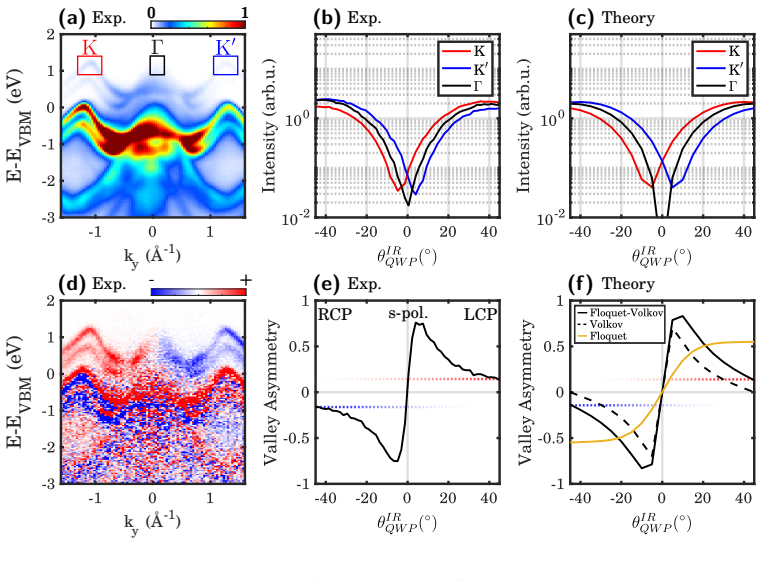
The central claim is that circularly polarized, below-bandgap infrared pulses transiently dress the electronic bands of 2H-WSe2 into valley-polarized Floquet-Bloch states. The paper demonstrates this through polarization-resolved photoemission: the first-order sideband (+ħω at 1.2 eV) shows a valley asymmetry that flips sign when the pump helicity goes from right- to left-circular, reaching about ±15% in sideband intensity. By decomposing the signal into Volkov (laser-assisted photoemission) and Floquet contributions in the td-NEGF simulations, the authors show that the Volkov part is helicity-independent, so the helicity-dependent asymmetry must come from the Floquet part, whose valley polarization they quantify as greater than 50%. They further report that XUV circular dichroism from these dressed states differs from the ground-state dichroism and reveals a momentum-dependent admixture of the conduction band's dz2 orbital into the sideband, a hybridization that standard Floquet spectral functions fail to reproduce and that the authors attribute to real-time population dynamics governed by valley-selective interband matrix elements.
Load-bearing premise
The extraction of a >50% Floquet valley polarization hinges on the Fresnel model's assumed dielectric constant, which sets how strong the pump field is inside the sample and therefore how much of the measured sideband is assigned to Volkov processes; if the real in-sample field differs from that model, the Floquet-only asymmetry could move below 50%.
Editorial extensions
If this is right
- Circularly polarized, below-gap pulses become a direct all-optical knob for valley population in TMDCs, working without resonant excitation and on ultrafast timescales.
- The transiently valley-polarized Floquet bands imply a nonequilibrium anomalous Hall response whose sign follows the pump helicity, so the same geometry could probe Berry-curvature transport out of equilibrium.
- XUV circular dichroism of dressed states can serve as a general probe of orbital-texture changes in Floquet-engineered materials, not just in WSe2.
- Polarization-resolved Floquet-Volkov interference provides a method to detect Floquet bands even when the dressing-induced gaps and band shifts are too small to resolve directly.
Reading between the lines
- A natural next test would be to use the Volkov angular distribution measured in the same dataset to calibrate the actual in-sample pump field, replacing the Fresnel assumption; the reported >50% valley polarization would then become a quantity tied to independently measured optical constants.
- Because the hybridization tracks the momentum-dependent Berry connection, scanning the pump photon energy (as in the paper's detuning study) could turn this experiment into a map of how quantum geometry is modified by dressing, not just of band populations.
- The same circularly-driven Floquet mechanism should leave a measurable imprint in transient optical probes, such as a helicity-dependent shift of excitonic resonances, so combining photoemission and transient absorption on the same sample would test whether the Floquet-only asymmetry extracted here is consistent with the optical Stark and Bloch-Siegert responses.
Editorial analysis
A structured set of objections, weighed in public.
Referee Report
Summary. The manuscript reports time- and polarization-resolved XUV momentum microscopy on 2H-WSe2 driven by 1.2 eV IR pulses, together with td-NEGF simulations, and claims the formation of valley-polarized Floquet-Bloch states. The central observations are a polarization- and valley-dependent modulation of the +ℏω sideband intensity and angular distribution, which the authors attribute to quantum path interference between Floquet-Bloch and Volkov transitions, and an XUV circular dichroism signal from the dressed sideband that indicates VB-CB orbital hybridization. The theoretical modeling is parameterized from DFT and reproduces the qualitative polarization dependence, including a valley asymmetry that flips sign at s-polarization. The main quantitative claim is that circularly polarized driving creates strongly valley-polarized Floquet-Bloch populations, stated as '> 50%' in the main text, extracted by decomposing the total calculated sideband signal into Floquet-only and Volkov-only contributions.
Significance. If the central claim is correct, the paper would be a notable step in Floquet engineering: it would demonstrate valley-selective Floquet-Bloch dressing in a TMDC and connect it to orbital-texture changes visible in XUV CD-ARPES. The strengths of the paper are its integrated experimental-theoretical approach, the use of an external experimental benchmark rather than fitting the valley asymmetry, the inclusion of photoemission matrix elements from first principles, and the open data availability. The qualitative picture of polarization- and valley-dependent Floquet-Volkov interference is credible and is supported by the agreement between the measured and calculated angular distributions near s-polarization. However, the headline quantitative claim of >50% Floquet valley polarization is an inferred decomposition output rather than a directly measured quantity, and the paper does not currently bound the sensitivity of that decomposition to the Fresnel model parameter that controls the Volkov background.
major comments (3)
- [Main text, 'Valley-Polarized Floquet-Bloch States'; Fig. 3(e)-(f)] The assertion that circularly polarized driving yields 'strongly valley-polarized Floquet-Bloch populations, i.e. > 50%' is not directly measured. The measured sideband valley asymmetry at RCP/LCP is about ±15% (Fig. 3e), and the >50% figure is obtained by decomposing the calculated signal into Floquet-only and Volkov-only contributions (Fig. 3f). Because the Volkov background is much larger than the Floquet contribution at circular polarization, the extracted Floquet-only polarization is a sensitive function of the model used for the in-sample field. The manuscript should either provide a sensitivity analysis of the >50% figure with respect to the dielectric constant and other model inputs, or clearly restate the claim as a model-dependent inference rather than a measured polarization.
- [Methods, Theoretical calculations, Eq. (1) and Fresnel discussion; Extended Data Fig. 10] The decomposition that isolates the Floquet-only valley asymmetry is controlled by the magnitude of the Volkov contribution, which in the model is set by the effective in-sample pump vector potential A_pump(t) obtained from a sharp-interface Fresnel model. Extended Data Fig. 10 shows that the valley-resolved Volkov signal changes with the assumed dielectric constant ε_r, and the text acknowledges that 'Volkov-only' simulations reproduce most experimental features. No uncertainty range for ε_r, no error bars on the measured asymmetry, and no propagation of these uncertainties into the >50% Floquet polarization are reported. This is a load-bearing gap: without bounding the model dependence, the quantitative headline claim is not established to the standard implied by the abstract's 'unambiguously'.
- [Main text, 'Valley- and Polarization-Resolved Quantum Path Interferences'; Extended Data Figs. 4 and 8] The manuscript states that the standard Floquet spectral function is independent of the driving helicity and does not reproduce the valley-polarized Floquet bands, whereas the td-NEGF calculation does. This makes the central valley-polarization claim dependent on the specific td-NEGF treatment rather than on a directly observed helicity asymmetry. The paper should make explicit what physical ingredient in the td-NEGF calculation (beyond standard Floquet theory) produces the helicity-dependent valley polarization, and why that ingredient is not itself an artifact of the finite-pulse model or the assumed broadening/dephasing. Without this, the 'unambiguous demonstration' language in the conclusions is stronger than the evidence presented.
minor comments (4)
- [Fig. 3(e) and related text] The experimental valley asymmetry in Fig. 3(e) is shown without statistical or systematic error bars, even though the text quotes a convergence to about ±15%; adding error bars or stating the uncertainty in the caption would help the reader judge the significance of the sign flip and the circular-polarization values.
- [Extended Data Fig. 10 caption] The caption lists results for different dielectric constant ε_r values but does not state which values were used; specifying the ε_r values and the corresponding effective fields would make the sensitivity test reproducible.
- [Main text and Methods] The spacing in 'V olkov' appears throughout the text and likely reflects a typesetting issue; the standard spelling 'Volkov' should be used consistently.
- [Fig. 2 caption] The caption contains a typographical artifact: 'around 65 ◦)' should be 'around 65°' or similar; this should be corrected during production.
Circularity Check
No significant circularity: the valley-polarized Floquet claim is measured against an external experimental benchmark and the td-NEGF decomposition is not fitted to the target asymmetry.
full rationale
The central claim, >50% Floquet valley polarization under circular driving, is not equivalent to any input by construction. The experimentally measured sideband valley asymmetry (about ±15% at circular polarization, Fig. 3e) is an external datum, and the theoretical decomposition in Fig. 3f comes from td-NEGF simulations built from DFT band structure, Wannier Hamiltonians, and first-principles velocity and photoemission matrix elements. No parameter in the theory is fitted to the valley asymmetry or to the >50% number; the Floquet-only contribution is isolated by a controlled numerical substitution (removing LAPE from the phase factor or using field-free Green's functions), not by imposing the desired result. The Fresnel dielectric model enters the Volkov background and is shown in Extended Data Fig. 10 to be epsilon_r-sensitive, making the quantitative >50% figure model-dependent, but this is a calibration/robustness limitation rather than circularity because the dielectric constant does not encode valley-selective Floquet populations. The paper itself concedes that Volkov-only simulations reproduce most observed features, which tempers the 'unambiguous' language but does not create a circular step. Self-citations (refs 44, 50, 60, 79, 80) support the methodology, yet the load-bearing evidence is the experimental observation and the independently parameterized simulation; the cited methods do not assume the target valley polarization. Overall, the derivation chain is self-contained with at most minor, non-load-bearing self-citation, so the circularity score is low.
Assumptions & free parameters
free parameters (2)
- Dielectric constant epsilon_r in Fresnel transmission model =
not stated in text
- Gaussian broadening width in Floquet spectral functions =
not stated
assumptions (5)
- domain assumption A sharp vacuum-sample interface and Fresnel equations give the effective pump field inside 2H-WSe2, defining A_pump(t) in Eq. (1)
- domain assumption The td-NEGF photoemission formula, Eq. (3), with matrix elements from ref. 80 gives a quantitatively accurate trARPES signal
- domain assumption The PBE-DFT Wannier Hamiltonian for a 2H-WSe2 bilayer captures the top-layer d±2 and dz2 orbital texture and the dipole matrix elements
- standard math The interband dipole matrix element D_alpha_beta(k) equals the Berry connection, and Eq. (7) from second-order perturbation theory describes the sideband
- domain assumption Two-photon excited-state population in the Sigma valleys does not contaminate the first-order sideband signal analyzed at K and K'
Cite this review
Pith. "Pith review of Floquet-Bloch Valleytronics." pith.science (2026). https://pith.science/paper/QV7TCJOQ
@misc{pith2026241203935,
  author       = {Pith},
  title        = {Pith review of: Floquet-Bloch Valleytronics},
  year         = {2026},
  howpublished = {\url{https://pith.science/paper/QV7TCJOQ}},
  note         = {Machine review of arXiv:2412.03935}
}
abstract
Driving quantum materials out-of-equilibrium makes it possible to generate states of matter inaccessible through standard equilibrium tuning methods. Upon time-periodic coherent driving of electrons using electromagnetic fields, the emergence of Floquet-Bloch states enables the creation and control of exotic quantum phases. In transition metal dichalcogenides, broken inversion symmetry within each monolayer results in a non-zero Berry curvature at the K and K$^{\prime}$ valley extrema, giving rise to chiroptical selection rules that are fundamental to valleytronics. Here, we bridge the gap between these two concepts and introduce Floquet-Bloch valleytronics. Using time- and polarization-resolved extreme ultraviolet momentum microscopy combined with state-of-the-art ab initio theory, we demonstrate the formation of valley-polarized Floquet-Bloch states in 2H-WSe$_2$ upon below-bandgap coherent electron driving with chiral light pulses. We investigate quantum path interference between Floquet-Bloch and Volkov states, showing that this interferometric process depends on the valley pseudospin and light polarization-state. Conducting extreme ultraviolet photoemission circular dichroism in these nonequilibrium settings reveals the potential for controlling the orbital character of Floquet-engineered states. These findings link Floquet engineering and quantum geometric light-matter coupling in two-dimensional materials. They can serve as a guideline for reaching novel out-of-equilibrium phases of matter by dynamically breaking symmetries through coherent dressing of winding Bloch electrons with tailored light pulses.
Figures


Figures from the paper (1 more)

Reference graph
Works this paper leans on
-
[1]
Culcer, D., Saraiva, A. L., Koiller, B., Hu, X. & Das Sarma, S. Valley-Based Noise-Resistant Quantum Computation Using Si Quantum Dots. Phys. Rev. Lett. 108, 126804 (2012). URL https://link.aps.org/doi/10.1103/PhysRevLett.108.126804
- [2]
-
[3]
Mak, K. F., He, K., Shan, J. & Heinz, T. F. Control of valley polarization in monolayer MoS 2 by optical helicity. Nature Nanotechnology 7, 494–498 (2012). URL https://doi.org/ 10.1038/nnano.2012.96
-
[4]
Zeng, H., Dai, J., Yao, W., Xiao, D. & Cui, X. Valley polarization in MoS 2 monolayers by optical pumping. Nature Nanotechnology 7, 490–493 (2012). URL https://doi.org/ 10.1038/nnano.2012.95
-
[5]
Cao, T. et al. Valley-selective circular dichroism of monolayer molybdenum disulphide. Na- ture Communications3, 887 (2012). URLhttps://doi.org/10.1038/ncomms1882
-
[6]
Schaibley, J. R. et al. Valleytronics in 2D materials. Nature Reviews Materials 1, 16055 (2016). URL https://doi.org/10.1038/natrevmats.2016.55
-
[7]
Tyulnev, I. et al. Valleytronics in bulk MoS 2 with a topologic optical field. Nature 628, 746–751 (2024). URL https://doi.org/10.1038/s41586-024-07156-y. 36
-
[8]
Mak, K. F., McGill, K. L., Park, J. & McEuen, P. L. The valley Hall effect in MoS 2 tran- sistors. Science 344, 1489–1492 (2014). URL https://science.sciencemag.org/ content/344/6191/1489
work page 2014
Show all 80 references
-
[9]
Aivazian, G. et al. Magnetic control of valley pseudospin in monolayer WSe2. Nature Physics 11, 148–152 (2015). URL https://doi.org/10.1038/nphys3201
2015 doi
-
[10]
Zhu, Z.-H. et al. Layer-By-Layer Entangled Spin-Orbital Texture of the Topological Surface State in Bi2Se3. Phys. Rev. Lett. 110, 216401 (2013). URL https://link.aps.org/ doi/10.1103/PhysRevLett.110.216401
2013 doi
-
[11]
Scuri, G. et al. Electrically Tunable Valley Dynamics in Twisted WSe2/WSe2 Bilayers. Phys. Rev. Lett. 124, 217403 (2020). URL https://link.aps.org/doi/10.1103/ PhysRevLett.124.217403
2020
-
[12]
& Kis, A
Radisavljevic, B., Radenovic, A., Brivio, J., Giacometti, V . & Kis, A. Single-layer MoS2 transistors. Nature Nanotechnology 6, 147–150 (2011). URL https://doi.org/10. 1038/nnano.2010.279
2011
-
[13]
Kundu, A., Fertig, H. A. & Seradjeh, B. Floquet-Engineered Valleytronics in Dirac Systems. Phys. Rev. Lett. 116, 016802 (2016). URL https://link.aps.org/doi/10.1103/ PhysRevLett.116.016802
2016
-
[14]
& Devereaux, T
Claassen, M., Jia, C., Moritz, B. & Devereaux, T. P. All-optical materials design of chiral edge modes in transition-metal dichalcogenides. Nature Communications 7, 13074 (2016). URL https://doi.org/10.1038/ncomms13074. 37
2016 doi
-
[15]
& Xie, X
Lu, M., Zeng, J., Liu, H., Gao, J.-H. & Xie, X. C. Valley-selective Floquet Chern flat bands in twisted multilayer graphene. Phys. Rev. B 103, 195146 (2021). URL https://link. aps.org/doi/10.1103/PhysRevB.103.195146
2021 doi
-
[16]
Zhan, F. et al. Floquet valley-polarized quantum anomalous Hall state in nonmagnetic hetero- bilayers. Phys. Rev. B 105, L081115 (2022). URL https://link.aps.org/doi/10. 1103/PhysRevB.105.L081115
2022
-
[17]
Zhan, F. et al. Floquet Engineering of Nonequilibrium Valley-Polarized Quantum Anomalous Hall Effect with Tunable Chern Number. Nano Letters 23, 2166–2172 (2023). URL https: //doi.org/10.1021/acs.nanolett.2c04651
2023 doi
-
[18]
Li, R. et al. Floquet engineering of the orbital Hall effect and valleytronics in two-dimensional topological magnets. Mater. Horiz. 11, 3819–3824 (2024). URL http://dx.doi.org/ 10.1039/D4MH00237G
2024 doi
-
[19]
& Meng, S
Cao, H., Sun, J.-T. & Meng, S. Floquet engineering of anomalous Hall effects in mono- layer MoS2. npj Quantum Materials 9, 90 (2024). URL https://doi.org/10.1038/ s41535-024-00702-x
2024
-
[20]
N., Averitt, R
Basov, D. N., Averitt, R. D. & Hsieh, D. Towards properties on demand in quantum ma- terials. Nature Materials 16, 1077–1088 (2017). URL https://doi.org/10.1038/ nmat5017. 38
2017
-
[21]
de la Torre, A. et al. Colloquium: Nonthermal pathways to ultrafast control in quantum materials. Rev. Mod. Phys. 93, 041002 (2021). URL https://link.aps.org/doi/ 10.1103/RevModPhys.93.041002
2021 doi
-
[22]
& Zhou, S
Bao, C., Tang, P., Sun, D. & Zhou, S. Light-induced emergent phenomena in 2D materials and topological materials. Nature Reviews Physics 4, 33–48 (2022). URL https://doi. org/10.1038/s42254-021-00388-1
2022 doi
-
[23]
& Aoki, H
Oka, T. & Aoki, H. Photovoltaic Hall effect in graphene. Phys. Rev. B 79, 081406 (2009). URL https://link.aps.org/doi/10.1103/PhysRevB.79.081406
2009 doi
-
[24]
& Demler, E
Kitagawa, T., Oka, T., Brataas, A., Fu, L. & Demler, E. Transport properties of nonequilib- rium systems under the application of light: Photoinduced quantum Hall insulators without Landau levels. Phys. Rev. B 84, 235108 (2011). URL https://link.aps.org/doi/ 10.1103/PhysRevB.84.235108
2011 doi
-
[25]
H., Refael, G
Lindner, N. H., Refael, G. & Galitski, V . Floquet topological insulator in semiconductor quantum wells. Nature Physics 7, 490–495 (2011). URL https://doi.org/10.1038/ nphys1926
2011
-
[26]
H., Steinberg, H., Jarillo-Herrero, P
Wang, Y . H., Steinberg, H., Jarillo-Herrero, P. & Gedik, N. Observation of Floquet-Bloch States on the Surface of a Topological Insulator.Science 342, 453–457 (2013). URL https: //www.science.org/doi/abs/10.1126/science.1239834
2013 doi
-
[27]
Sie, E. J. et al. Valley-selective optical Stark effect in monolayer WS2. Nature Materials 14, 290–294 (2015). URL https://doi.org/10.1038/nmat4156. 39
2015 doi
-
[28]
Mahmood, F. et al. Selective scattering between Floquet–Bloch and V olkov states in a topolog- ical insulator. Nature Physics 12, 306–310 (2016). URL https://doi.org/10.1038/ nphys3609
2016
-
[29]
& Kitamura, S
Oka, T. & Kitamura, S. Floquet Engineering of Quantum Materials. Annual Review of Condensed Matter Physics 10, 387–408 (2019). URL https://doi.org/10.1146/ annurev-conmatphys-031218-013423
2019
-
[30]
Rudner, M. S. & Lindner, N. H. Band structure engineering and non-equilibrium dynamics in Floquet topological insulators. Nature Reviews Physics 2, 229–244 (2020). URL https: //doi.org/10.1038/s42254-020-0170-z
2020 doi
-
[31]
& Petek, H
Reutzel, M., Li, A., Wang, Z. & Petek, H. Coherent multidimensional photoelectron spec- troscopy of ultrafast quasiparticle dressing by light. Nature Communications 11, 2230 (2020). URL https://doi.org/10.1038/s41467-020-16064-4
2020 doi
-
[32]
Shan, J.-Y . et al. Giant modulation of optical nonlinearity by Floquet engineering. Nature 600, 235–239 (2021). URL https://doi.org/10.1038/s41586-021-04051-8
2021 doi
-
[33]
McIver, J. W. et al. Light-induced anomalous Hall effect in graphene. Nature Physics 16, 38–41 (2020). URL https://doi.org/10.1038/s41567-019-0698-y
2020 doi
-
[34]
Aeschlimann, S. et al. Survival of Floquet–Bloch States in the Presence of Scattering. Nano Letters 21, 5028–5035 (2021). URL https://doi.org/10.1021/acs.nanolett. 1c00801. 40
2021 doi
-
[35]
Zhou, S. et al. Pseudospin-selective Floquet band engineering in black phosphorus. Nature 614, 75–80 (2023). URL https://doi.org/10.1038/s41586-022-05610-3
2023 doi
-
[36]
Zhou, S. et al. Floquet Engineering of Black Phosphorus upon Below-Gap Pumping. Phys. Rev. Lett. 131, 116401 (2023). URL https://link.aps.org/doi/10.1103/ PhysRevLett.131.116401
2023
-
[37]
Ito, S. et al. Build-up and dephasing of Floquet–Bloch bands on subcycle timescales. Nature 616, 696–701 (2023). URL https://doi.org/10.1038/s41586-023-05850-x
2023 doi
-
[38]
Kobayashi, Y . et al. Floquet engineering of strongly driven excitons in monolayer tungsten disulfide. Nature Physics 19, 171–176 (2023). URL https://doi.org/10.1038/ s41567-022-01849-9
2023
-
[39]
& Meng, S
Liu, H., Cao, H. & Meng, S. Floquet engineering of topological states in realis- tic quantum materials via light-matter interactions. Progress in Surface Science 98, 100705 (2023). URL https://www.sciencedirect.com/science/article/ pii/S0079681623000096
2023
-
[40]
Weitz, T. et al. Lightwave-driven electrons in a Floquet topological insulator. arXiv 2407.17917 (2024). URL https://arxiv.org/abs/2407.17917
2024 arXiv
-
[41]
Bao, C. et al. Manipulating the symmetry of photon-dressed electronic states. Nature Communications 15, 10535 (2024). URL https://doi.org/10.1038/ s41467-024-54760-7. 41
2024
-
[42]
A., De Giovannini, U., Kemper, A
H ¨ubener, H., Sentef, M. A., De Giovannini, U., Kemper, A. F. & Rubio, A. Creating stable Floquet–Weyl semimetals by laser-driving of 3D Dirac materials. Nature Communications 8, 13940 (2017). URL https://doi.org/10.1038/ncomms13940
2017 doi
-
[43]
& Meng, S
Liu, H., Sun, J.-T., Cheng, C., Liu, F. & Meng, S. Photoinduced Nonequilibrium Topological States in Strained Black Phosphorus. Phys. Rev. Lett. 120, 237403 (2018). URL https: //link.aps.org/doi/10.1103/PhysRevLett.120.237403
2018 doi
-
[44]
Sch ¨uler, M. et al. Polarization-Modulated Angle-Resolved Photoemission Spectroscopy: To- ward Circular Dichroism without Circular Photons and Bloch Wave-function Reconstruc- tion. Phys. Rev. X 12, 011019 (2022). URL https://link.aps.org/doi/10.1103/ PhysRevX.12.011019
2022
-
[45]
V ., Arribi, P
Trevisan, T. V ., Arribi, P. V ., Heinonen, O., Slager, R.-J. & Orth, P. P. Bicircular Light Floquet Engineering of Magnetic Symmetry and Topology and Its Application to the Dirac Semimetal Cd3As2. Phys. Rev. Lett.128, 066602 (2022). URL https://link.aps.org/doi/10. 1103/PhysR...
2022
-
[46]
& Daghofer, M
Strobel, P. & Daghofer, M. From linear to circular polarized light: Floquet engineering in Kitaev-Heisenberg materials with Lissajous figures. Phys. Rev. B 108, 035132 (2023). URL https://link.aps.org/doi/10.1103/PhysRevB.108.035132
2023 doi
-
[47]
Sie, E. J. et al. Large, valley-exclusive Bloch-Siegert shift in monolayer WS 2. Science 355, 1066–1069 (2017). URL https://www.science.org/doi/abs/10.1126/ science.aal2241. 42
2017
-
[48]
Park, S. T. Interference in Floquet-V olkov transitions. Phys. Rev. A 90, 013420 (2014). URL https://link.aps.org/doi/10.1103/PhysRevA.90.013420
2014 doi
- [49]
-
[50]
Merboldt, M. et al. Observation of Floquet states in graphene.arXiv 2404.12791 (2024). URL https://doi.org/10.48550/arXiv.2404.12791
2024 doi
-
[51]
Bao, C. et al. Floquet-V olkov interference in a semiconductor. Phys. Rev. B 111, L081106 (2025). URL https://link.aps.org/doi/10.1103/PhysRevB.111.L081106
2025 doi
-
[52]
Sato, S. A. et al. Microscopic theory for the light-induced anomalous Hall effect in graphene. Phys. Rev. B 99, 214302 (2019). URL https://link.aps.org/doi/10.1103/ PhysRevB.99.214302
2019
-
[53]
Murotani, Y . et al. Disentangling the Competing Mechanisms of Light-Induced Anoma- lous Hall Conductivity in Three-Dimensional Dirac Semimetal. Phys. Rev. Lett. 131, 096901 (2023). URL https://link.aps.org/doi/10.1103/PhysRevLett. 131.096901
2023 doi
-
[54]
& Kirschner, J
Winkelmann, A., Lin, W.-C., Bisio, F., Petek, H. & Kirschner, J. Interferometric Control of Spin-Polarized Electron Populations at a Metal Surface Observed by Multiphoton Photoemis- sion. Phys. Rev. Lett. 100, 206601 (2008). URL https://link.aps.org/doi/10. 1103/PhysRevLett.10...
2008
-
[55]
& Petek, H
Reutzel, M., Li, A. & Petek, H. Above-threshold multiphoton photoemission from noble metal surfaces. Phys. Rev. B 101, 075409 (2020). URL https://link.aps.org/doi/10. 1103/PhysRevB.101.075409
2020
-
[56]
Zhang, X., Liu, Q., Luo, J.-W., Freeman, A. J. & Zunger, A. Hidden spin polarization in inversion-symmetric bulk crystals. Nature Physics 10, 387–393 (2014). URL https:// doi.org/10.1038/nphys2933
2014 doi
-
[57]
Riley, J. M. et al. Direct observation of spin-polarized bulk bands in an inversion-symmetric semiconductor. Nature Physics10, 835–839 (2014). URLhttps://doi.org/10.1038/ nphys3105
2014
-
[58]
Razzoli, E. et al. Selective Probing of Hidden Spin-Polarized States in Inversion-Symmetric Bulk MoS2. Phys. Rev. Lett. 118, 086402 (2017). URL https://link.aps.org/doi/ 10.1103/PhysRevLett.118.086402
2017 doi
-
[59]
Fanciulli, M. et al. Ultrafast Hidden Spin Polarization Dynamics of Bright and Dark Excitons in 2H−WSe2. Phys. Rev. Lett. 131, 066402 (2023). URL https://link.aps.org/ doi/10.1103/PhysRevLett.131.066402
2023 doi
-
[60]
Beaulieu, S. et al. Revealing Hidden Orbital Pseudospin Texture with Time-Reversal Dichro- ism in Photoelectron Angular Distributions. Phys. Rev. Lett. 125, 216404 (2020). URL https://link.aps.org/doi/10.1103/PhysRevLett.125.216404. 44
2020 doi
-
[61]
Rostami, H. et al. Layer and orbital interference effects in photoemission from transition metal dichalcogenides. Phys. Rev. B 100, 235423 (2019). URL https://link.aps. org/doi/10.1103/PhysRevB.100.235423
2019 doi
-
[62]
Kim, J. et al. Ultrafast generation of pseudo-magnetic field for valley excitons in WSe2 mono- layers. Science 346, 1205–1208 (2014). URL https://www.science.org/doi/abs/ 10.1126/science.1258122
2014 doi
-
[63]
Cho, S. et al. Experimental Observation of Hidden Berry Curvature in Inversion-Symmetric Bulk 2H−WSe2. Phys. Rev. Lett. 121, 186401 (2018). URL https://link.aps.org/ doi/10.1103/PhysRevLett.121.186401
2018 doi
-
[64]
Sch ¨uler, M. et al. Local Berry curvature signatures in dichroic angle-resolved photoelectron spectroscopy from two-dimensional materials. Science Advances 6, eaay2730 (2020). URL https://www.science.org/doi/abs/10.1126/sciadv.aay2730
2020 doi
-
[65]
¨Unzelmann, M. et al. Momentum-space signatures of Berry flux monopoles in the Weyl semimetal TaAs. Nature Communications 12, 3650 (2021). URL https://doi.org/ 10.1038/s41467-021-23727-3
2021 doi
-
[66]
Yen, Y . et al. Controllable orbital angular momentum monopoles in chiral topo- logical semimetals. Nature Physics (2024). URL https://doi.org/10.1038/ s41567-024-02655-1. 45
2024
-
[67]
Circular Dichroism and Spin Polarization in Photoemission from Adsor- bates and Non-Magnetic Solids
Sch ¨onhense, G. Circular Dichroism and Spin Polarization in Photoemission from Adsor- bates and Non-Magnetic Solids. Physica Scripta T31, 255–275 (1990). URL https: //iopscience.iop.org/article/10.1088/0031-8949/1990/T31/035
1990 doi
-
[68]
A toy model for dichroism in angle resolved photoemission
Moser, S. A toy model for dichroism in angle resolved photoemission. Journal of Elec- tron Spectroscopy and Related Phenomena 262, 147278 (2023). URL https://www. sciencedirect.com/science/article/pii/S0368204822001116
2023
-
[69]
Boban, H. et al. Scattering makes a difference in circular dichroic angle-resolved photoemis- sion. arXiv 2410.19652 (2024). URL https://arxiv.org/abs/2410.19652
2024 arXiv
-
[70]
Comby, A. et al. Ultrafast polarization-tunable monochromatic extreme ultraviolet source at high-repetition-rate. Journal of Optics 24, 084003 (2022). URL https://dx.doi.org/ 10.1088/2040-8986/ac7a49
2022 doi
-
[71]
& Vishwanath, A
Ahn, J., Guo, G.-Y ., Nagaosa, N. & Vishwanath, A. Riemannian geometry of resonant optical responses. Nature Physics 18, 290–295 (2022). URL https://doi.org/10.1038/ s41567-021-01465-z
2022
-
[72]
Medjanik, K. et al. Direct 3D mapping of the Fermi surface and Fermi velocity. Nature Materials 16, 615–621 (2017). URL https://doi.org/10.1038/nmat4875
2017 doi
-
[73]
Tkach, O. et al. Multi-Mode Front Lens for Momentum Microscopy: Part I Theory and Part II Experiments. arXiv 2408.10104 and 2401.10084 (2024). URL https://arxiv.org/ abs/2408.10104andhttps://arxiv.org/abs/2401.10084. 46
2024
-
[74]
Xian, R. P. et al. An open-source, end-to-end workflow for multidimensional photoemis- sion spectroscopy. Scientific Data 7, 442 (2020). URL https://doi.org/10.1038/ s41597-020-00769-8
2020
-
[75]
P., Rettig, L
Xian, R. P., Rettig, L. & Ernstorfer, R. Symmetry-guided nonrigid registration: The case for distortion correction in multidimensional photoemission spectroscopy. Ultramicroscopy 202, 133 – 139 (2019). URL http://www.sciencedirect.com/science/article/ pii/S0304399118303474
2019
-
[76]
Giannozzi, P. et al. QUANTUM ESPRESSO: a modular and open-source software project for quantum simulations of materials. J. Phys.: Condens. Matter 21, 395502 (2009). URL http://stacks.iop.org/0953-8984/21/i=39/a=395502
2009
-
[77]
van Setten, M. et al. The PseudoDojo: Training and grading a 85 element optimized norm- conserving pseudopotential table. Comp. Phys. Commun. 226, 39–54 (2018). URL https: //linkinghub.elsevier.com/retrieve/pii/S0010465518300250
2018
-
[78]
Keunecke, M. et al. Electromagnetic dressing of the electron energy spectrum of Au(111) at high momenta. Phys. Rev. B 102, 161403 (2020). URL https://link.aps.org/doi/ 10.1103/PhysRevB.102.161403
2020 doi
-
[79]
& Sentef, M
Sch ¨uler, M. & Sentef, M. A. Theory of subcycle time-resolved photoemission: Application to terahertz photodressing in graphene. Journal of Electron Spectroscopy and Related Phe- nomena 253, 147121 (2021). URL https://www.sciencedirect.com/science/ article/pii/S0368204821000736. 47
2021
-
[80]
& Sch ¨uler, M
Yen, Y ., Parusa, G. & Sch ¨uler, M. First-principle tight-binding approach to angle-resolved photoemission spectroscopy simulations: importance of light-matter gauge and ubiquitous interference effects. arXiv 2402.14496 (2024). URL https://arxiv.org/abs/2402. 14496. 48
2024 arXiv
Reviewed August 11, 2026 · model on record in the stance chip above.
Discussion (0). Continue with ORCID to comment.