REVIEW 3 major objections 5 minor 50 references
Tools for the Performance Optimization of Single-Photon Quantum Key Distribution
T0 review · 3 major / 5 minor · reviewed 2026-08-14 · deepseek-v4-flash
Pith's one-line read Temporal filtering of single-photon pulses can maximize QKD key rate or extend its reach.
desk verdict A careful experimental study of temporal filtering for single-photon QKD; the qualitative optimization is solid, but the headline key-rate numbers depend on model parameters the paper never reports. read the letter →
The pith
A machine-rendered reading of the paper's core claim, the machinery that carries it, and where it could break.
The reading
What carries the argument
The central object is the two-dimensional temporal acceptance filter $(\Delta t, t_c)$ applied to Bob's time-tagged detection events: it selects which photon clicks enter the sifted key, changing both the error rate and the key fraction. The performance estimate is carried by the secret-key expression $S = \frac{p_{\mathrm{click}}}{2}(\beta\tau(e) - f(e)h(e))$ together with the multi-photon bound $p_m \le \mu^2 g^{(2)}(0)/2$ from the security model underlying the paper. Here $g^{(2)}(0)$ is the two-photon emission probability, a measure of single-photon purity. The filter's effect is quantified through the QBER, the sifted fraction, and the $g^{(2)}(0)$ evaluated from the same time-tags, and the paper searches the $(\Delta t, t_c)$ plane for the optimum; in simulations the same machinery is used with synthetic pulse shapes to predict performance for different source lifetimes and noise levels.
What would settle it
Run a full QKD exchange with active gating at Alice and a finite-key analysis: if, after the gating's added loss and timing overhead, the maximum tolerable channel loss does not reach the predicted 35 dB for a source with $g^{(2)}(0)\approx0.09$, the optimization claim is falsified. Alternatively, a simulation that lets an eavesdropper intercept the photons outside Bob's acceptance window and checks whether the filtered key remains secret would settle the security question directly.
Extended reading notes
Core claim
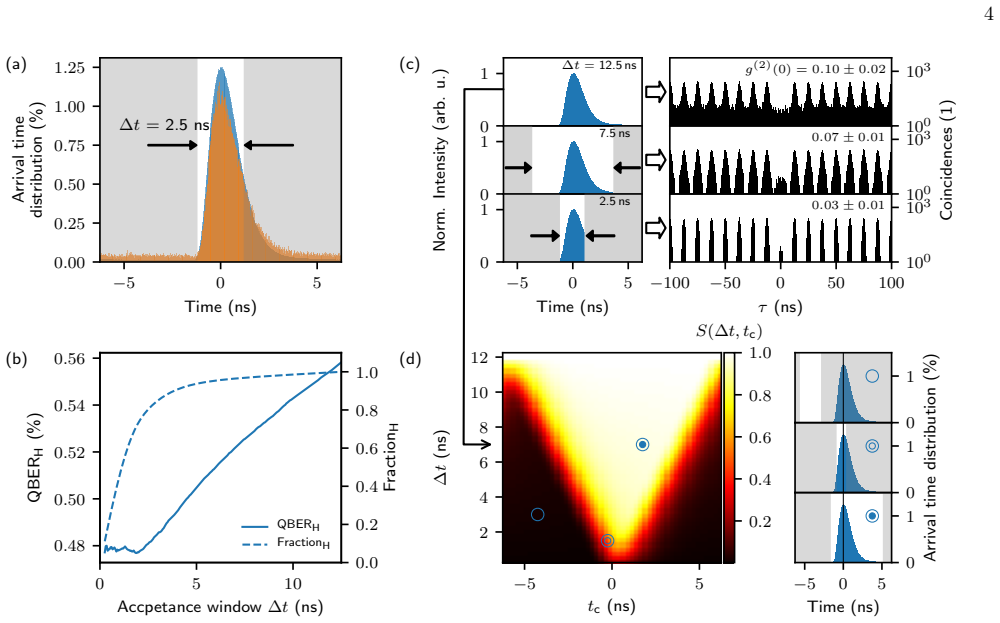
The paper's central claim is that optimal QKD performance for a given triggered single-photon source is achieved not by changing the source, but by carefully choosing Bob's acceptance time windows, the width $\Delta t$ and center $t_c$ of the temporal filter applied to the recorded click times. Narrowing the window improves the signal-to-noise ratio and lowers the quantum bit error rate, but discards part of the sifted key; the paper maps this trade-off in a two-dimensional parameter space and shows that the best operating point either maximizes the back-to-back secret key rate or extends the maximum tolerable channel loss. With their quantum-dot source and four-state BB84 receiver, the optimized filter raises the tolerable loss from 28.28 dB to 35.15 dB (about a 23% range extension), and to 37.98 dB with a very narrow window at the cost of a much smaller sifted fraction. The paper additionally shows that narrowing the acceptance window improves the measured $g^{(2)}(0)$ of the emitted pulses, from $0.104\pm0.017$ at full width to $0.032\pm0.007$ at 2.5 ns, and that this filtered value can only be used for security if Alice actively gates her source to prevent photon-number-splitting attacks outside the window; their quoted rates therefore use the unfiltered $g^{(2)}(0)$. Real-time monitoring of $g^{(2)}(0)$ from the receiver's four ports is demonstrated over 90 minutes, with 60-second blocks giving $g^{(2)}(0)$ to about 16% uncertainty.
Load-bearing premise
The rate and range figures depend on the assumption that the two-photon emission probability measured over the whole pulse period still bounds the information an eavesdropper can obtain about the temporally filtered key, even though the experiment lacks the active gating at Alice's side that would prevent attacks using the photons discarded by the filter.
Editorial extensions
If this is right
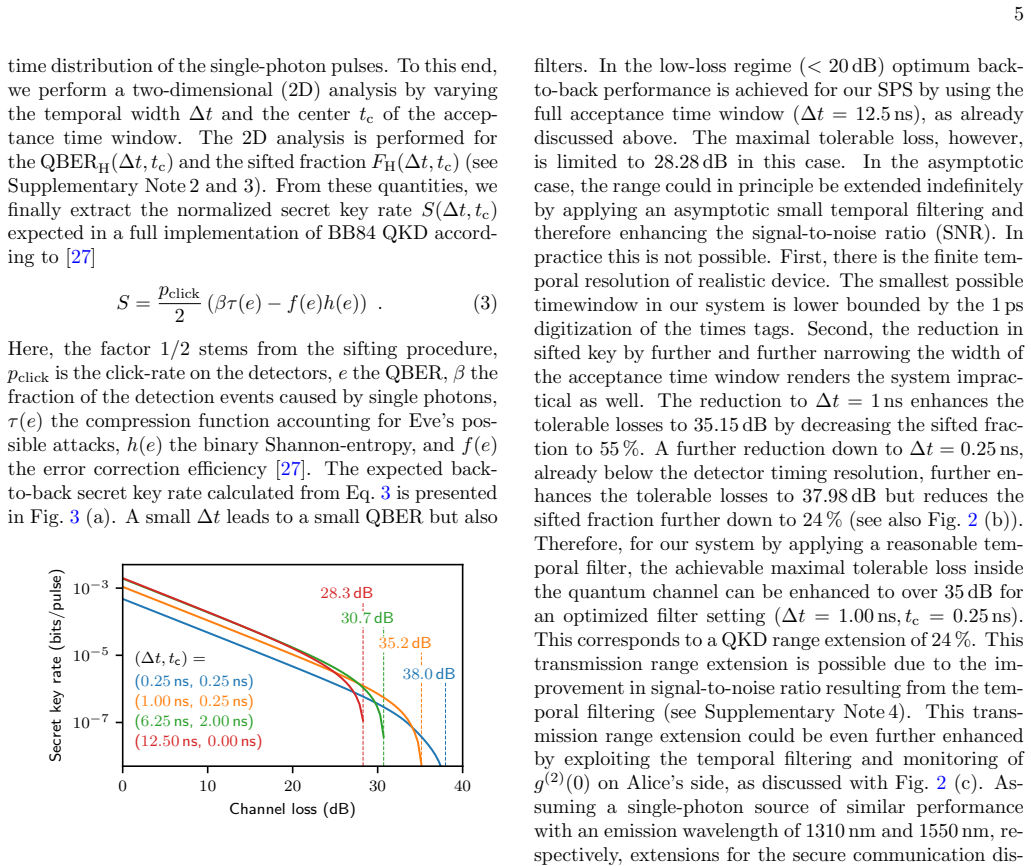
- With an optimized acceptance window, a quantum-dot source with $g^{(2)}(0)=0.089$ can tolerate 35.15 dB of channel loss instead of 28.28 dB, a range extension of about 23% for the tested receiver.
- At fiber attenuations of 0.31 dB/km (1310 nm) and 0.17 dB/km (1550 nm), the same optimization would extend secure communication distance by roughly 22 km and 40 km, to about 113 km and 207 km, respectively.
- The improvement is largest in the high-noise, high-loss regime: simulations with synthetic pulses show secret-key gains of 184.5% and 148.3% when detector noise is high.
- Real-time $g^{(2)}(0)$ monitoring inside the quantum channel makes it possible to detect an eavesdropper who injects light with different photon statistics or performs a photon-number-splitting attack, by comparing the statistics seen by Bob with those seen by Alice.
- The optimization routine transfers to measurement-device-independent QKD and quantum repeater architectures based on sub-Poissonian sources, where the same temporal-filter trade-off applies.
Reading between the lines
- Beyond the paper, if Alice-side active gating is added so the filtered $g^{(2)}(0)$ can be used in security, the same data predict a further increase in tolerable loss beyond 38 dB, since the narrow-window data in the supplement show both lower $g^{(2)}(0)$ and lower QBER.
- The authors do not discuss it, but the optimal window width should shrink as detector timing jitter improves; with superconducting detectors, the high-noise regime where filtering matters most is replaced by a low-noise regime, shifting the optimum toward wider windows.
- An implicit testable extension is to run the same 2D optimization for decoy-state weak-coherent-pulse systems; the paper's framework would predict a much smaller gain there, because Poissonian light has no antibunching to improve.
- Beyond the paper's asymptotic analysis, narrowing the window cuts the sifted block size, so finite-key effects become more severe at the optimized operating points; a practical implementation would need to choose the window with block-size constraints in mind.
Signed reviews
Editorial analysis
A structured set of objections, weighed in public.
Referee Report
Summary. The manuscript reports an experimental BB84-type QKD testbed built around a triggered quantum-dot single-photon source and a four-state polarization receiver. The authors record photon arrival-time distributions at Bob's four detectors and study how the choice of acceptance time window (width Δt and center tc) affects QBER, sifted-key fraction, and g(2)(0). Using Eq. (3) from the Waks security model, they translate these measured quantities into expected secret-key rates as a function of channel loss, and claim that temporal filtering optimizes back-to-back key rate or extends the maximally tolerable channel loss by about 23-24%. They also demonstrate real-time g(2)(0) monitoring from Bob's time-tags, and extend the study with simulations for synthetic pulse shapes and noise levels.
Significance. The qualitative core of the paper—that temporal filtering trades QBER against sifted fraction and has an optimum that depends on pulse shape and noise—is convincingly supported by the time-resolved data and is a useful practical design rule for single-photon QKD. The channel-side, real-time g(2)(0) monitoring using the four receiver ports is a genuinely useful certification tool, and the authors are explicit that exploiting the improved filtered g(2)(0) requires Alice-side gating, which is not implemented. The strengths are therefore real, but the headline quantitative figures (maximally tolerable loss and range extension) are computed from an incompletely specified model and contain an internal numerical inconsistency; these need to be fixed before the central claim can be accepted.
major comments (3)
- [Eq. (3) and Methods, 'Estimation of expected secret key rates'] The rate-loss curves in Fig. 3 are computed from Eq. (3), which contains β, the fraction of detection events caused by single photons, and τ(e), the privacy-amplification compression function. The Methods paragraph on secret-key estimation gives μ=0.0043, pclick, and pdc=1.22e-6 but never states the value or estimation procedure for β and τ(e). Because β = p_single/p_click is loss-dependent and becomes small when dark counts dominate at high loss, the tolerable-loss values (35.15 dB and 37.98 dB) and the associated 23-24% range extension cannot be reproduced or audited from the reported information. Please report β and τ(e) explicitly, specify whether β was held constant or recalculated at each loss value, and provide a sensitivity analysis showing how the tolerable-loss curves depend on these assumptions.
- [Results, 'Performance optimization via temporal filtering' (paragraph on μ_c and Tmin)] The text states that for the maximal acceptance window the critical photon number μc=0.0053 corresponds to Tmin=33.24 dB and refers to Fig. 3, but Fig. 3 shows a maximal tolerable loss of only 28.28 dB for the same window (Δt=12.50 ns, tc=0.00 ns). The text goes on to say that the actual μ=0.0043 leads to a 'slightly reduced maximal tolerable loss (cf. Fig. 3)', which is difficult to reconcile with a 5 dB gap between 33.24 dB and 28.28 dB. This inconsistency undermines confidence in the quantitative range-extension numbers; please clarify which model convention produces Tmin=33.24 dB and correct either the text or the figure accordingly.
- [Results, 'Real-time photon statistics monitoring'] The claim that a 60 s accumulation block 'should already be enough to allow for a secret key distillation incorporating finite-key size effects' is presented without any finite-key calculation or block-size analysis, and the experiment is an off-line post-processing of recorded time-tags rather than live key distillation. Please either provide the finite-key estimate or rephrase the statement as an asymptotic-parameter indication; otherwise the 'real-time security monitoring' claim exceeds what is demonstrated.
minor comments (5)
- [Fig. 2 caption and axis labels] There are typos in the text and figures: 'fiexd' should be 'fixed' in the Fig. 2 caption, and the horizontal axis label 'Accpetance window Δt (ns)' should read 'Acceptance window Δt (ns)'.
- [Methods, 'Estimation of expected secret key rates'] Please clarify the conversion from the cumulative dark-count rate (<100 Hz) to the per-pulse probability pdc=1.22e-6 for Δt=12.5 ns; state explicitly whether pdc is per pulse and how the 80 MHz repetition rate enters the calculation.
- [Methods, 'Comparison of Device Performance', Eq. (4)] In Eq. (4), the symbol f_rep is not defined, and the expression changes units relative to Eq. (3) (bits/pulse versus bits per second); please define f_rep and state the relationship between the two rate conventions.
- [Results, 'Real-time photon statistics monitoring'] In the sentence describing over- and underestimation of g(2)(0), the second occurrence of 'overestimation' is apparently meant to be 'underestimation', since only underestimation can lead to information leakage; please correct this.
- [Results, 'Performance optimization via temporal filtering'] The paper quotes the range extension as both '23%' in the Results section and '24%' in the same section and abstract-level discussion; please use one value consistently or state the rounding convention.
Circularity Check
No significant circularity: the key-rate and range-extension claims follow from an external security model applied to measured QBER, sifted fraction, and unfiltered g(2)(0); the temporal-filter optimization is a trade-off within that model, not a self-derived prediction.
full rationale
The paper's central quantitative claims are not circular. The key-rate formula in Eq. (3), S = (p_click/2)(βτ(e) − f(e)h(e)), and the multi-photon bound in Eq. (2), p_m ≤ μ²g(2)(0)/2, are taken from the independent security analysis of Waks et al. (Ref. [27]), not derived from the authors' own data or prior work. The optimization of Bob's acceptance time window is presented as a trade-off between the measured QBER and the measured sifted-key fraction F(Δt,tc), evaluated inside that external model; the reported tolerable-loss values (28.28 dB, 35.15 dB, 37.98 dB) are consequences of the measured error curves, not artifacts of normalization or of a fitted parameter renamed as a prediction. Importantly, the paper explicitly does not use the improved, temporally filtered g(2)(0) in its security analysis: it states that benefiting from the filtered g(2)(0) would require active gating at Alice's side to avoid photon-number-splitting attacks, and that the unfiltered value from the full repetition period is used. This removes the one place where a quantity derived from the same data could have been fed back into the claimed performance. Self-citations to the authors' earlier work on quantum-dot sources and QKD testbeds appear in the experimental setup and contextual review, but they are not load-bearing for the optimization claim, which is anchored to measured data and an external security model. Concerns about unreported parameters such as β and τ(e), and the apparent inconsistency between T_min = 33.24 dB and the 28.28 dB value in Fig. 3, are reproducibility or correctness issues, not circularity.
Assumptions & free parameters
free parameters (3)
- Simulation noise offset (low/high) =
0.01 and 0.3 counts per bin
- Simulated pulse lifetimes =
0.5 ns and 1.5 ns
- Simulated wrong-channel fraction =
1%
assumptions (5)
- domain assumption Waks et al. security model for sub-Poissonian sources, including Eq. (3) and the multi-photon bound pm <= mu^2 g(2)(0)/2.
- domain assumption The unfiltered g(2)(0) measured at Bob over the full repetition period bounds the multi-photon probability relevant for the sifted, filtered key.
- domain assumption Asymptotic security analysis neglecting finite-key effects and side channels.
- domain assumption Ideal error correction efficiency f(e) as in Ref. [27].
- domain assumption Detection efficiency mismatch across Bob's channels is treated via the reduced tolerable QBER bound from Lydersen and Skaar [29].
Cite this review
Pith. "Pith review of Tools for the Performance Optimization of Single-Photon Quantum Key Distribution." pith.science (2026). https://pith.science/paper/QVHVQMDH
@misc{pith2026190802672,
  author       = {Pith},
  title        = {Pith review of: Tools for the Performance Optimization of Single-Photon Quantum Key Distribution},
  year         = {2026},
  howpublished = {\url{https://pith.science/paper/QVHVQMDH}},
  note         = {Machine review of arXiv:1908.02672}
}
abstract
Quantum light sources emitting triggered single photons or entangled photon pairs have the potential to boost the performance of quantum key distribution (QKD) systems. Proof-of-principle experiments affirmed these prospects, but further efforts are necessary to push this field beyond its current status. In this work, we show that temporal filtering of single-photon pulses enables a performance optimization of QKD systems implemented with realistic quantum light sources, both in experiment and simulations. To this end, we analyze the influence of temporal filtering of sub-Poissonian single-photon pulses on the expected secret key fraction, the quantum bit error ratio, and the tolerable channel losses. For this purpose, we developed a basic QKD testbed comprising a triggered solid-state single-photon source and a receiver module designed for four-state polarization coding via the BB84 protocol. Furthermore, we demonstrate real-time security monitoring by analyzing the photon statistics, in terms of $g^{(2)}(0)$, inside the quantum channel by correlating the photon flux recorded at the four ports of our receiver. Our findings are useful for the certification of QKD and can be applied and further extended for the optimization of various implementations of quantum communication based on sub-Poissonian quantum light sources, including measurement-device-independent schemes of QKD as well as quantum repeaters. Our work represents an important contribution towards the development of QKD-secured communication networks based on quantum light sources.
Figures

Figures from the paper (2 more)


Reference graph
Works this paper leans on
- [1]
-
[2]
Gisin, G
N. Gisin, G. Ribordy, W. Tittel, and H. Zbinden, Rev. Mod. Phys. 74, 145 (2002)
2002
-
[3]
H.-K. Lo, M. Curty, and K. Tamaki, Nat. Photon. 8, 595 (2014)
2014
-
[4]
E. Diamanti, H.-K. Lo, B. Qi, and Z. Yuan, npj Quan- tum Inf. 2, 16025 (2016)
work page 2016
-
[5]
C. H. Bennett and G. Brassard, Proceedings of IEEE In- ternational Conference on Computers, Systems and Sig- nal Processing, Bangalore, India , 175 (1984)
work page 1984
-
[6]
A. K. Ekert, Phys. Rev. Lett. 67, 661 (1991)
1991
-
[7]
Wang, Phys
X.-B. Wang, Phys. Rev. Lett. 94, 230503 (2005)
2005
-
[8]
The upper bound for the multi-photon emission probability from [27] yields P (n = 1) ≥ µ−µ2g(2)(0)
have an even lower value of P (n = 1) ≃ 0.3. The upper bound for the multi-photon emission probability from [27] yields P (n = 1) ≥ µ−µ2g(2)(0). Therefore, to surpass the performance of a WCP-based QKD sys- tem at same ηsifting and frep, Alice using an ideal SPS (g(2)(0) = 0) must achieve µ = 0.3 into the quantum channel. This efficiency is within reach usi...
Show all 50 references
-
[9]
H.-K. Lo, X. Ma, and K. Chen, Phys. Rev. Lett. 94, 230504 (2005)
2005
-
[10]
Schlehahn, M
A. Schlehahn, M. Gaafar, M. Vaupel, M. Gschrey, P. Schnauber, J.-H. Schulze, S. Rodt, A. Strittmatter, W. Stolz, A. Rahimi-Iman, T. Heindel, M. Koch, and S. Reitzenstein, Appl. Phys. Lett. 107, 041105 (2015)
2015
-
[11]
Hargart, C
F. Hargart, C. A. Kessler, T. Schwarzb¨ ack, E. Koroknay, S. Weidenfeld, M. Jetter, and P. Michler, App. Phys. Lett. 102, 011126 (2013)
2013
-
[12]
Schlehahn, A
A. Schlehahn, A. Thoma, P. Munnelly, M. Kamp, S. H¨ ofling, T. Heindel, C. Schneider, and S. Reitzen- stein, APL Photonics 1, 011301 (2016)
2016
-
[13]
Somaschi, V
N. Somaschi, V. Giesz, L. De Santis, J. C. Loredo, M. P. Almeida, G. Hornecker, S. L. Portalupi, T. Grange, C. Ant´ on, J. Demory, C. G´ omez, I. Sagnes, N. D. Lanzillotti-Kimura, A. Lema´ ıtre, A. Auffeves, A. G. White, L. Lanco, and P. Senellart, Nat. Photon. (2016)
2016
-
[14]
Wang, Z.-C
H. Wang, Z.-C. Duan, Y.-H. Li, S. Chen, J.-P. Li, Y.-M. He, M.-C. Chen, Y. He, X. Ding, C.-Z. Peng, and et al., Phys. Rev. Lett. 116 (2016)
2016
-
[15]
Heindel, C
T. Heindel, C. Schneider, M. Lermer, S. H. Kwon, T. Braun, S. Reitzenstein, S. H¨ ofling, M. Kamp, and A. Forchel, Appl. Phys. Lett. 96, 011107 (2010)
2010
-
[16]
H. Wang, H. Hu, T.-H. Chung, J. Qin, X. Yang, J.-P. Li, R.-Z. Liu, H.-S. Zhong, Y.-M. He, X. Ding, Y.-H. Deng, Q. Dai, Y.-H. Huo, S. H¨ ofling, C.-Y. Lu, and J.-W. Pan, Phys. Rev. Lett. 122 (2019)
2019
-
[17]
Schweickert, K
L. Schweickert, K. D. J¨ ons, K. D. Zeuner, S. F. Covre da Silva, H. Huang, T. Lettner, M. Reindl, J. Zichi, R. Trotta, A. Rastelli, and V. Zwiller, Appl. Phys. Lett. 112, 093106 (2018)
2018
-
[18]
Hanschke, K
L. Hanschke, K. A. Fischer, S. Appel, D. Lukin, J. Wierzbowski, S. Sun, R. Trivedi, J. Vuˇ ckovi´ c, J. J. Finley, and K. M¨ uller, npj Quantum Inf. 4 (2018)
2018
-
[19]
S. Rodt, S. Reitzenstein, and T. Heindel, J. Phys. Con- dens. Matter 32, 153003 (2020)
2020
-
[20]
E. Waks, K. Inoue, C. Santori, D. Fattal, J. Vuckovic, G. S. Solomon, and Y. Yamamoto, Nature 420, 762 (2002)
2002
-
[21]
Beveratos, R
A. Beveratos, R. Brouri, T. Gacoin, A. Villing, J.-P. Poizat, and P. Grangier, Phys. Rev. Lett. 89, 187901 (2002)
2002
-
[22]
Allaume, F
R. Allaume, F. Treussart, G. Messin, Y. Dumeige, J.-F. Roch, A. Beveratos, R. Brouri-Tualle, J.-P. Poizat, and P. Grangier, New J. Phys. 6, 92 (2004)
2004
-
[23]
P. M. Intallura, M. B. Ward, O. Z. Karimov, Z. L. Yuan, P. See, A. J. Shields, P. Atkinson, and D. A. Ritchie, Appl. Phys. Lett. 91, 161103 (2007)
2007
-
[24]
R. J. Collins, P. J. Clarke, V. Fern´ andez, K. J. Gordon, M. N. Makhonin, J. A. Timpson, A. Tahraoui, M. Hop- kinson, A. M. Fox, M. S. Skolnick, and G. S. Buller, J. Appl. Phys 107, 073102 (2010)
2010
-
[25]
Takemoto, Y
K. Takemoto, Y. Nambu, T. Miyazawa, K. Wakui, S. Hi- rose, T. Usuki, M. Takatsu, N. Yokoyama, K. Yoshino, A. Tomita, S. Yorozu, Y. Sakuma, and Y. Arakawa, App. Phys. Express 3, 092802 (2010)
2010
-
[26]
Heindel, C
T. Heindel, C. A. Kessler, M. Rau, C. Schneider, M. F¨ urst, F. Hargart, W.-M. Schulz, M. Eichfelder, R. Robach, S. Nauerth, M. Lermer, H. Weier, M. Jet- ter, M. Kamp, S. Reitzenstein, S. H¨ ofling, P. Michler, H. Weinfurter, and A. Forchel, New J. Phys. 14, 083001 (2012)
2012
-
[27]
M. Rau, T. Heindel, S. Unsleber, T. Braun, J. Fischer, S. Frick, S. Nauerth, C. Schneider, G. Vest, S. Reitzen- stein, M. Kamp, A. Forchel, S. H¨ ofling, and H. Wein- furter, New J. Phys. 16, 043003 (2014)
2014
-
[28]
E. Waks, C. Santori, and Y. Yamamoto, Phys. Rev. A 66, 042315 (2002)
2002
-
[29]
Gschrey, A
M. Gschrey, A. Thoma, P. Schnauber, M. Seifried, R. Schmidt, B. Wohlfeil, L. Kr¨ uger, J. H. Schulze, T. Heindel, S. Burger, F. Schmidt, A. Strittmatter, S. Rodt, and S. Reitzenstein, Nat. Commun. 6, 7662 (2015)
2015
-
[30]
Lydersen and J
L. Lydersen and J. Skaar, Quantum Inf. Comput. 10, 60 (2010)
2010
-
[31]
C. Gao, D. Jiang, Y. Guo, and L. Chen, Opt. Express 27, 14545 (2019)
2019
-
[32]
Ko, K.-J
H. Ko, K.-J. Kim, J.-S. Choe, B.-S. Choi, J.-H. Kim, Y. Baek, and C. J. Youn, Sci. Rep. 8 (2018)
2018
-
[33]
Sch¨ oll, L
E. Sch¨ oll, L. Hanschke, L. Schweickert, K. D. Zeuner, M. Reindl, S. F. C. da Silva, T. Lettner, R. Trotta, J. J. Finley, K. Mller, A. Rastelli, V. Zwiller, and K. D. J¨ ons, Nano Lett. 19, 2404 (2019)
2019
-
[34]
Takemoto, Y
K. Takemoto, Y. Nambu, T. Miyazawa, Y. Sakuma, T. Yamamoto, S. Yorozu, and Y. Arakawa, Sci. Rep. 5 (2015)
2015
-
[35]
Wang, Y.-M
H. Wang, Y.-M. He, T.-H. Chung, H. Hu, Y. Yu, S. Chen, X. Ding, M.-C. Chen, J. Qin, X. Yang, R.-Z. Liu, Z.-C. Duan, J.-P. Li, S. Gerhardt, K. Winkler, J. Jurkat, L.-J. Wang, N. Gregersen, Y.-H. Huo, Q. Dai, S. Yu, S. Hfling, C.-Y. Lu, and J.-W. Pan, Nat. Photon. 13, 770 (2019)
2019
-
[36]
H.-K. Lo, M. Curty, and B. Qi, Phys. Rev. Lett. 108 (2012)
2012
-
[37]
V. V. Kuzmin, D. V. Vasilyev, N. Sangouard, W. Dr, and C. A. Muschik, npj Quantum Inf. 5 (2019)
2019
-
[38]
Tomamichel, C
M. Tomamichel, C. C. W. Lim, N. Gisin, and R. Renner, Nat. Commun. 3 (2012)
2012
-
[39]
J. F. Dynes, M. Lucamarini, K. A. Patel, A. W. Sharpe, M. B. Ward, Z. L. Yuan, and A. J. Shields, Opt. Express 26, 22733 (2018). 11
2018
-
[40]
Kumazawa, T
M. Kumazawa, T. Sasaki, and M. Koashi, Opt. Express 27, 5297 (2019)
2019
-
[41]
I. E. Zadeh, J. W. N. Los, R. B. M. Gourgues, V. Stein- metz, G. Bulgarini, S. M. Dobrovolskiy, V. Zwiller, and S. N. Dorenbos, APL Photonics 2, 111301 (2017)
2017
-
[42]
Boaron, G
A. Boaron, G. Boso, D. Rusca, C. Vulliez, C. Autebert, M. Caloz, M. Perrenoud, G. Gras, F. Bussi` eres, M.-J. Li, D. Nolan, A. Martin, and H. Zbinden, Phys. Rev. Lett. 121 (2018)
2018
-
[43]
Tomita, Adv
A. Tomita, Adv. Quantum Technol. 2, 1900005 (2019)
2019
-
[44]
Sajeed, P
S. Sajeed, P. Chaiwongkhot, J.-P. Bourgoin, T. Jen- newein, N. L¨ utkenhaus, and V. Makarov, Phys. Rev. A 91 (2015)
2015
-
[45]
Scarani, H
V. Scarani, H. Bechmann-Pasquinucci, N. J. Cerf, M. Duˇ sek, N. L¨ utkenhaus, and M. Peev, Rev. Mod. Phys. 81, 1301 (2009)
2009
-
[46]
Curty, F
M. Curty, F. Xu, W. Cui, C. C. W. Lim, K. Tamaki, and H.-K. Lo, Nat. Commun. 5, 3732 (2014)
2014
-
[47]
Zhang, Q
Z. Zhang, Q. Zhao, M. Razavi, and X. Ma, Phys. Rev. A 95, 012333 (2017)
2017
-
[48]
Single- photon sources based on deterministic quantum-dot mi- crolenses,
T. Heindel, S. Rodt, and S. Reitzenstein, “Single- photon sources based on deterministic quantum-dot mi- crolenses,” in Quantum Dots for Quantum Information Technologies, edited by P. Michler (Springer Interna- tional Publishing, Cham, 2017) pp. 199–232
2017
-
[49]
X.-X. Xia, Z. Zhang, H.-B. Xie, X. Yuan, J. Lin, S.-K. Liao, Y. Liu, C.-Z. Peng, Q. Zhang, and J.-W. Pan, Photon. Res. 7, 1169 (2019)
2019
-
[50]
H.-K. Lo, H. Chau, and M. Ardehali, J. Cryptol. 18, 133 (2004). S1 SUPPLEMENT Note 1: Measurement data for QBER and signal fraction for each polarization Fig. S1 shows the sifted key fraction and the QBER extracted from the data in Fig. 1(d) of the main article for all four de...
2004
Reviewed August 14, 2026 · model on record in the stance chip above.
Discussion (0). Continue with ORCID to comment.