REVIEW 3 major objections 5 minor 1 cited by
Multi-component secluded WIMP dark matter and Dirac neutrino masses with an extra Abelian gauge symmetry
T0 review · 3 major / 5 minor · reviewed 2026-08-11 · deepseek-v4-flash
Pith's one-line read The paper builds a complete dark-sector model in which two WIMP dark matter candidates, a dark photon, and a dark Higgs arise from one extra Abelian gauge symmetry, and claims this sector alone can produce the observed relic abundance…
desk verdict A solid first phenomenology scan of a specific chiral secluded WIMP benchmark; the thermal-equilibrium assumption is the main thing to push on. read the letter →
The pith
A machine-rendered reading of the paper's core claim, the machinery that carries it, and where it could break.
The reading
What carries the argument
The central object is the anomaly-free charge vector $D=[(1,-10),(1,-10),(-4,-5),9,9,9]$ under $U(1)_D$, with dark Higgs charge $S=9$. This vector solves the anomaly equations, gives three massive Dirac pairs after symmetry breaking (one of which is a two-flavor system whose lightest mass eigenstate is the first dark matter candidate, and a one-generation Dirac fermion is the second), and leaves three massless charge-9 right-handed neutrinos. A dark photon $Z'$ and a dark Higgs $h_2$ mediate annihilation; two inert scalars, a doublet $\eta$ and a singlet $\Phi$, close the one-loop 'scotogenic' Dirac neutrino mass diagram, meaning neutrinos remain massless at tree level. The load-bearing equation is the coupled Boltzmann system, whose conversion term $\langle\sigma_{2211}v\rangle$ couples the two number densities and is what makes the two-component nature change the relic density.
What would settle it
Measure the dark photon's invisible decay to neutrinos at a beam-dump or fixed-target experiment over the 1-100 GeV mass range; if a $Z'$ with the required coupling is absent, or its lifetime exceeds one second so it survives to Big Bang nucleosynthesis, the model's central compatibility claim is ruled out.
Extended reading notes
Core claim
The central claim is that a single self-consistent charge assignment $D=[(1,-10),(1,-10),(-4,-5),9,9,9]$ under $U(1)_D$, with a dark Higgs of charge $9$, yields all the ingredients at once: two stable Dirac fermions (the lightest state of a two-flavor pair and a single one-generation Dirac fermion), a dark photon that decays directly into three right-handed neutrinos, and a radiative Dirac neutrino mass from a decoupled inert scalar sector. Solving the two coupled Boltzmann equations with the conversion process $\Psi_2\Psi_2\to\Psi_1\Psi_1$, the paper finds parameter regions where the two components together saturate $\Omega h^{2}=0.12$, with dark matter masses from about 1 GeV to a few TeV. The neutrino decay mode of the dark photon opens a channel that keeps the model consistent with Big Bang nucleosynthesis and $\Delta N_{\text{eff}}$ even at zero kinetic mixing, and a scan under all constraints leaves viable points above the projected sensitivity of future liquid-xenon direct-detection experiments.
Load-bearing premise
The dark sector and the Standard Model plasma came into thermal equilibrium in the early Universe, and the same tiny couplings later decoupled it before Big Bang nucleosynthesis; the paper takes this equilibrium as a starting point rather than deriving it from a full thermal-history calculation.
Editorial extensions
If this is right
- With zero kinetic mixing, the relic abundance can still reach $\Omega h^{2}=0.12$, because the dark photon's decay into right-handed neutrinos provides the connection back to the Standard Model without needing $\epsilon$.
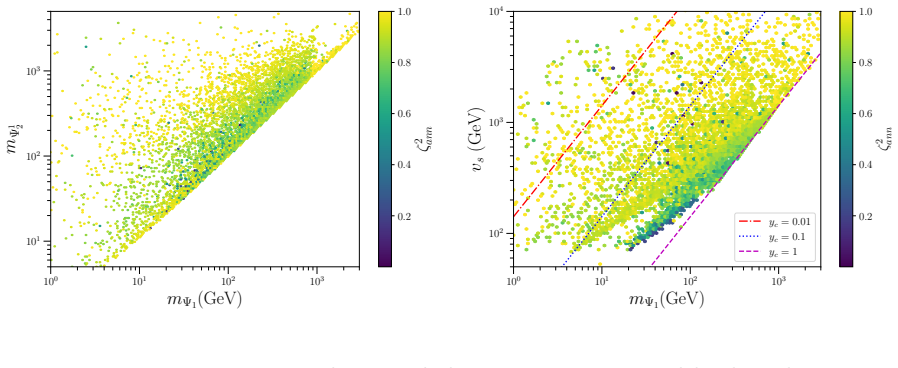
- Whenever the two dark matter candidates are close in mass and the dark Yukawa coupling $y_c$ is above about 0.1, the conversion process $\Psi_2\Psi_2\to\Psi_1\Psi_1$ affects the heavier component's abundance, so isolated single-component freeze-out calculations are not reliable in this model.
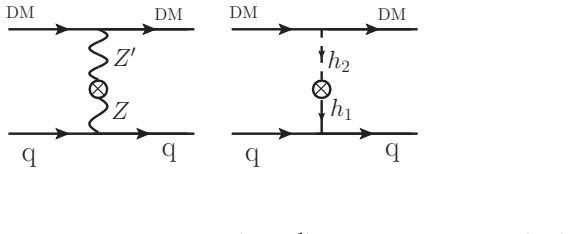
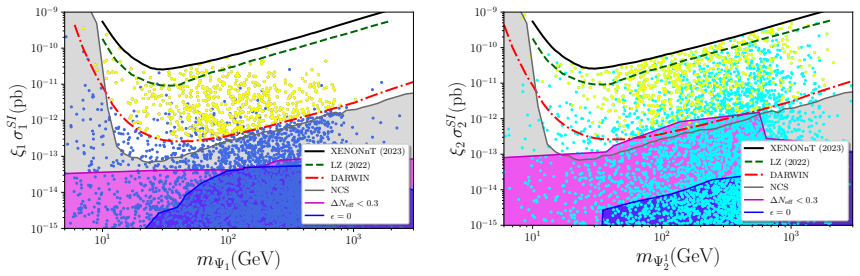
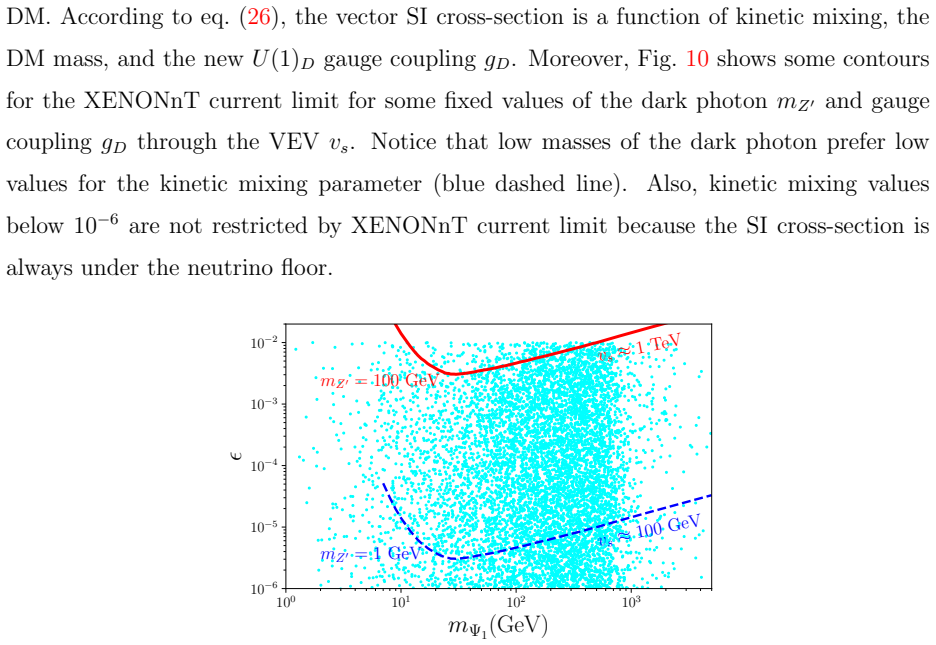
- Spin-independent direct detection is dominated by the vector portal and scales as $\epsilon^{2}$, so the $\epsilon=0$ region is currently invisible; nonetheless a slice of the viable parameter space lies above the projected sensitivity of the next generation of xenon-based detectors.
- Annihilation into the Standard Model is dominated by neutrino final states, making the model effectively dark for gamma-ray telescopes; the strongest experimental probes are therefore direct detection, collider searches, and possibly neutrino telescopes.
- The neutrino spectrum is Dirac and radiatively generated, so the model predicts no neutrinoless double beta decay, in contrast with Majorana seesaw constructions.
Reading between the lines
- An extension the authors do not pursue: because the dark photon decays predominantly to neutrinos, its most direct experimental signature may be missing-energy events in beam-dump and fixed-target searches rather than dilepton resonances.
- The charge assignment studied here is one benchmark from a family of about a thousand anomaly-free solutions, and the paper's own comparison suggests the same two-mediator, two-component phenomenology can be realized by other charge vectors; whether the relic-density behavior is identical for the rest of the family is a testable extension.
- The near-decoupled dark Higgs, with mixing angle below $10^{-3}$ and mass near 550 GeV, could still be probed by precision measurements of the 125 GeV Higgs couplings at future colliders, giving a complementary handle on the viable points that direct detection cannot reach.
- Quantifying the cascade annihilation $\Psi\Psi\to Z'Z'\to 4\nu$ at neutrino telescopes could make the model's otherwise dark indirect signal visible; the paper notes the neutrino-flux enhancement but leaves the calculation for future work.
Editorial analysis
A structured set of objections, weighed in public.
Referee Report
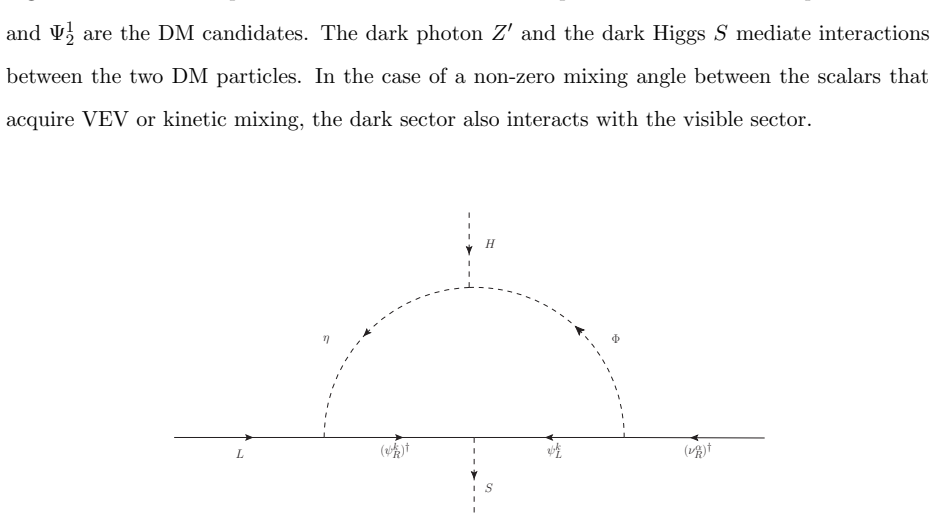
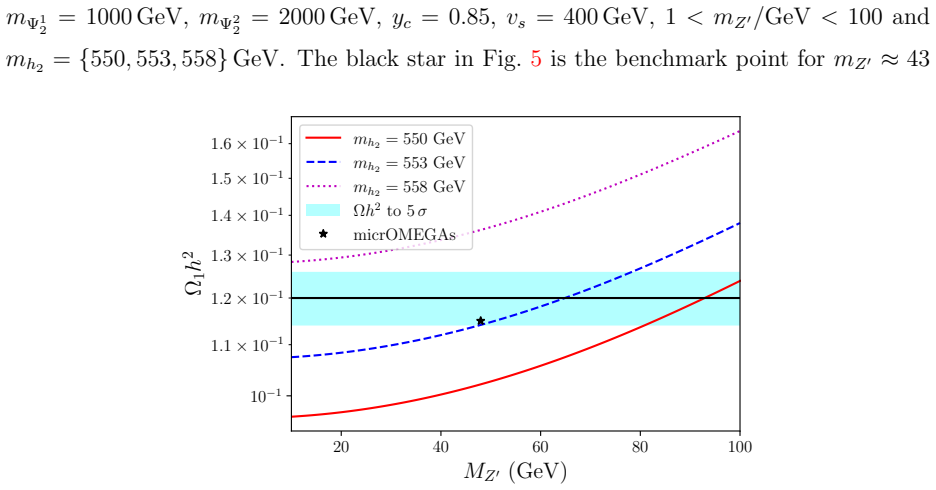
Summary. The paper presents a UV-complete, anomaly-free extension of the Standard Model with a secluded U(1)_D gauge symmetry. The new fields (Table I) comprise a dark Higgs S that breaks U(1)_D, a dark photon Z', a dark Higgs h2, nine chiral fermions including three massless right-handed neutrinos charged under U(1)_D, and a decoupled inert scalar sector (eta, Phi). Two Dirac fermions, Psi1 and the lighter of the two mixed states Psi_2^1, are stable dark matter candidates; the right-handed neutrinos plus the inert scalars generate Dirac neutrino masses at one loop (Fig. 2), with the couplings y_nR solved from the measured neutrino masses and PMNS matrix (App. A). The relic density is computed in a one-component WIMP limit (Eqs. (24)-(25), App. C) and with micrOMEGAs 6.0.3 for the full two-component system (Eqs. (18), Figs. 6-7) over the scan ranges of Table III, selecting points with Omega h^2 equal to about 0.12. The paper shows direct-detection prospects (Figs. 9-10) and claims compatibility with invisible-decay, BBN, and Delta N_eff constraints, including for zero kinetic mixing (epsilon = 0).
Significance. The paper's main asset is completeness: it is the first phenomenological exploration of the model class catalogued in Ref. [23], with an explicit anomaly-free charge assignment, one-loop Dirac neutrino masses, and relic densities computed with standard tools. The analytic one-component calculation is cross-checked against micrOMEGAs (Fig. 5), and the annihilation cross-sections in App. C reproduce known vector and axial-vector limits. The fits are transparently labelled: y_nR is fixed 'by construction' (App. A) to reproduce neutrino data, and the scan is filtered on Omega h^2 = 0.12, so the results establish existence of viable parameter regions and falsifiable direct-detection targets (Fig. 9) rather than sharp predictions. The significance is tempered by the two gaps identified below: the assumed early-universe thermal history of the dark sector, and the epsilon = 0 Delta N_eff claim; both are load-bearing for the headline 'even without kinetic mixing' statement.
major comments (3)
- [Sec. IV; App. F] The stress-test concern about the thermal history is warranted. Section IV opens with 'Since the dark sector is in thermal equilibrium,' and the same section asserts that the visible and dark sectors decouple when epsilon ~ 10^-6, theta < 10^-3, and m_Xi > 1 TeV, citing Ref. [24]; neither statement is derived for the model's own couplings. This assumption is load-bearing because the Boltzmann equations (18), the analytic relic density (24), and the Delta N_eff treatment of Appendix F all presuppose a single thermal bath at temperature T with standard equilibrium initial abundances. At epsilon = 0 the only channels connecting the dark sector to the SM are the scalar mixing theta and the y_nL Yukawa couplings to inert scalars with m_Xi > 1 TeV, and it is a parametric question (depending on the Table III ranges) whether these equilibrate the dark sector at T larger than about m_Psi/25 and later decouple it before BBN. If the dark sector never equilibrated, the correct computation would be freeze-in or a two-temperature Boltzmann system, and Figs. 5-7 would not determine the relic abundance. I request a rate-versus-Hubble comparison for the dominant DS-SM equilibration processes for the benchmark of Fig. 5 and for representative epsilon = 0 points, or a coupled T_DS/T_SM evolution.
- [App. F; Fig. 9] The epsilon = 0 Delta N_eff claim is not supported by the presented calculation. Appendix F computes Gamma_nuR only for the kinetic-mixing-mediated coupling (Eqs. (F2)-(F3)), and the text concludes that the blue epsilon = 0 region in Fig. 9 has 'zero contribution to the relativistic degrees of freedom at tree level.' But at epsilon = 0 the dark sector is still populated (the freeze-out mechanism requires it), and after freeze-out the DM annihilation energy is transferred to Z' and h2, which decay predominantly into the massless right-handed neutrinos; that nu_R population is a decoupled dark-radiation component whose contribution to Delta N_eff is not computed anywhere in the paper. The magenta-region constraint in Fig. 9 therefore reflects only the kinetic-mixing channel, and the abstract and Sec. VI claims of compatibility with Delta N_eff 'even without kinetic mixing' need either a computation of this channel or a quantitative demonstration that it is negligible (e.g., early decoupling and entropy dilution).
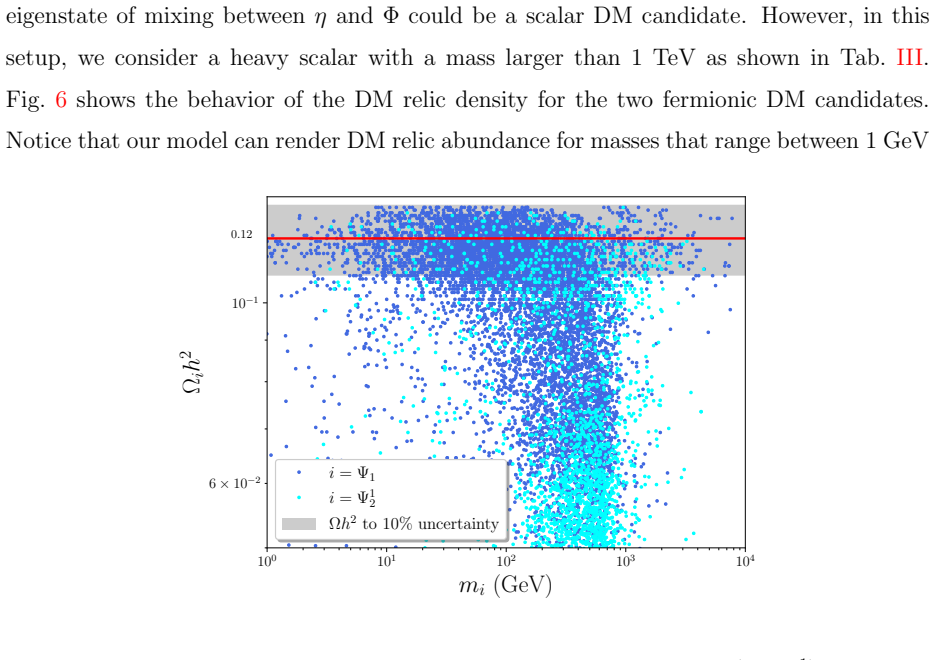
- [Eq. (21); Table III; Figs. 6-10] The paper's headline statements are existence claims, and the reader should be able to judge how representative the viable regions are. The scan filters on Omega h^2 = 0.12 (Eq. (21)) and fixes y_nR from neutrino data (Eqs. (A13)-(A14)); the manuscript should report the fraction of randomly scanned points that pass Eq. (21) and all other constraints, and how the viable regions shift under the Table III bounds. Note also a quantitative inconsistency: Eq. (21) imposes Omega h^2 = 0.1200 +- 0.0012, while Fig. 6 and its text use a 10% band; the actual filter used to produce Figs. 6-10 should be stated once, precisely.
minor comments (5)
- [Eq. (F1)] Equation (F1) is dimensionally inconsistent as printed: Gamma_nuR has dimension of energy while 3H n_nuR has dimension of energy to the fourth power; the intended condition is presumably Gamma_nuR > 3H, so the 'n_nuR' should be removed.
- [Figs. 5-7] The notation for the second dark matter fermion is hard to parse: the mass eigenstates are written as m_Psi1_2 and m_Psi2_2 in the Fig. 5 caption and as Psi_2^1, Psi_2^2 elsewhere; a consistent notation such as m_{Psi_2^{(1)}} and m_{Psi_2^{(2)}} would remove the ambiguity with the first DM candidate Psi1.
- [Sec. V (Fig. 7 discussion)] The text says the relic abundance is 'almost always dominated by annihilation processes directly to the SM particles,' but in Table II the classes 1100 and 2200 include final states with Z' and h2, and the secluded regime is dominated by annihilation into dark mediators; the phrase should be reconciled with the classification.
- [Sec. V] Please state whether the SARAH/SPheno/micrOMEGAs model files and the scan-filtering code will be made available; the reproducibility of Figs. 6-10 depends on these.
- [Abstract; Sec. V] Minor typos and infelicities: 'Bolztmann equations' (Sec. V), 'the branching ratio of Standard model particles into invisible' (abstract), and 'that is below the current limit of XENONnT for the two DM components' (Sec. V) should be reworded.
Circularity Check
Neutrino mass generation reduces to a fit: ynR is solved from measured masses and the PMNS matrix, so reproducing oscillation data is true by construction; relic-density and direct-detection results remain genuine outputs.
-
self definitional
[Section V (scan paragraph) and Appendix A, Eqs. (A13)-(A14)]
"Finally, the Yukawa couplings (ynR)αi in Lagrangian (6) were parameterized in terms of the (ynL)iα Yukawa couplings, the neutrino masses mνα and the Pontecorvo-Maki-Nakagawa-Sakata matrix [67] as described in Appendix A. In this model, the new Yukawa couplings reproduce the current neutrino oscillation data by construction [37]."
In Appendix A, Eqs. (A13)-(A14) explicitly solve the couplings ynR in terms of the target observables: the measured masses mν2, mν3 and the PMNS matrix U. Feeding these couplings back into the one-loop mass formula (A5) reproduces those masses by construction. Therefore the paper's stated success that the model 'generates Dirac neutrino masses' and is compatible with neutrino oscillation data is an inversion of the input data rather than a first-principles prediction. The loop diagram and the functional form are genuine model content, but the neutrino mass eigenvalues themselves are fitted inputs, so this headline result is built in by definition.
full rationale
The only identifiable circular step is the neutrino sector, where Eqs. (A13)-(A14) invert the one-loop formula to determine ynR from the measured neutrino masses and PMNS matrix, making the subsequent agreement with oscillation data tautological; the paper itself labels this 'by construction,' and it is central to the title and abstract. The rest of the analysis is not circular in the same sense: the relic density is imposed as a constraint (Ωh^2 = 0.1200 ± 0.0012) and points are filtered, not fitted and then renamed as a prediction; the DM conversion fractions ζ and the direct-detection cross sections of Eqs. (26)-(27) are computed outputs that were not used as inputs; and the ΔNeff/BBN and invisible-decay checks are comparisons against external constraints. The early-universe thermal-equilibrium statement in Section IV is an unproved premise and a correctness risk, but it is an assumption rather than a derivation from the model's outputs. Self-citations to Refs. [23] and [25] provide the charge classification and scotogenic framework, but they do not force the relic-density or direct-detection conclusions. Score 6 rather than 8 because the DM relic-density content and direct-detection predictions retain independent content; score not lower because a headline 'prediction' — Dirac neutrino masses matching oscillation data — is explicitly fitted by construction.
Assumptions & free parameters
free parameters (10)
- g_D (dark gauge coupling) =
10^-3 to 1 (scan)
- y_c (Yukawa coupling for Psi1) =
10^-3 to 1 (scan)
- m_Z' (dark photon mass) =
1 to 1000 GeV (scan)
- m_h2 (dark Higgs mass) =
125 to 5000 GeV (scan)
- theta (scalar mixing angle) =
10^-6 to 10^-3 (scan)
- epsilon (kinetic mixing) =
10^-12 to 10^-2 (scan)
- ynL (neutrino Yukawa matrix entries) =
10^-4 to 1 (scan)
- Dark sector mass splittings and inert scalar masses =
ranges in Table III
- Quartic scalar couplings lambda_k =
10^-4 to 1 (scan)
- Dark fermion mixing angles theta_L, theta_R =
10^-3 to 2 pi (scan)
assumptions (6)
- standard math Anomaly cancellation conditions (sum Zi = 0 and sum Zi^3 = 0) are the full consistency requirement for the U(1)_D sector.
- domain assumption The dark sector was in thermal equilibrium with the Standard Model in the early Universe.
- domain assumption A residual discrete Z_|S| symmetry after spontaneous symmetry breaking stabilizes the lightest dark fermion.
- ad hoc to paper The inert scalar sector (eta, Phi) does not develop VEVs and is heavy and decoupled with m_Xi above 1 TeV.
- domain assumption Numerical codes SARAH, SPheno, and micrOMEGAs 6.0.3 correctly implement the model and solve the two-component Boltzmann system.
- domain assumption Neutrino oscillation data (normal ordering, m_nu1 = 0) can be reproduced by the one-loop formula with perturbative couplings.
invented entities (5)
-
Dark photon Z'
-
Dark Higgs S (mass eigenstate h2)
-
Chiral dark fermions Psi1 and Psi2^1 (two-component DM)
-
Massless right-handed neutrinos nu_R^alpha with charge -9
-
Inert scalars eta (SU(2)_L doublet) and Phi (singlet)
Cite this review
Pith. "Pith review of Multi-component secluded WIMP dark matter and Dirac neutrino masses with an extra Abelian gauge symmetry." pith.science (2026). https://pith.science/paper/QVRBRLOC
@misc{pith2026241202027,
  author       = {Pith},
  title        = {Pith review of: Multi-component secluded WIMP dark matter and Dirac neutrino masses with an extra Abelian gauge symmetry},
  year         = {2026},
  howpublished = {\url{https://pith.science/paper/QVRBRLOC}},
  note         = {Machine review of arXiv:2412.02027}
}
read the original abstract
Scenarios for secluded WIMP dark matter models have been extensively studied in simplified versions. This paper shows a complete UV realization of a secluded WIMP dark matter model with an extra Abelian gauge symmetry that includes two-component dark matter candidates, where the dark matter conversion process plays a significant role in determining the relic density in the Universe. The model contains two new unstable mediators: a dark Higgs and a dark photon. It generates Dirac neutrino masses and can be tested in future direct detection experiments of dark matter. The model is also compatible with cosmological and theoretical constraints, including the branching ratio of Standard model particles into invisible, Big Bang nucleosynthesis restrictions, and the number of relativistic degrees of freedom in the early Universe, even without kinetic mixing.
Figures
Figures from the paper (7 more)
Forward citations
Cited by 1 Pith paper
-
Prospecting bipartite Dark Matter through Gravitational Waves
A two-component dark matter model with an inert triplet scalar and a singlet fermion can explain the relic abundance while producing a strong electroweak phase transition and gravitational wave signals detectable by L...
Reference graph
Works this paper leans on
-
[24]
Secluded U(1) below the weak scale,
Maxim Pospelov, “Secluded U(1) below the weak scale,” Phys. Rev. D 80, 095002 (2009), arXiv:0811.1030 [hep-ph]
arXiv 2009
-
[23]
Maxim Pospelov, Adam Ritz, and Mikhail B. Voloshin, “Secluded WIMP Dark Matter,” Phys. Lett. B 662, 53–61 (2008), arXiv:0711.4866 [hep-ph]
arXiv 2008
-
[1]
− σ1122 v n2 1 − n2 2 n2 1 n2 − 3Hn 1 , d n2 d t = − σ2200 v (n2 2 − n2
-
[2]
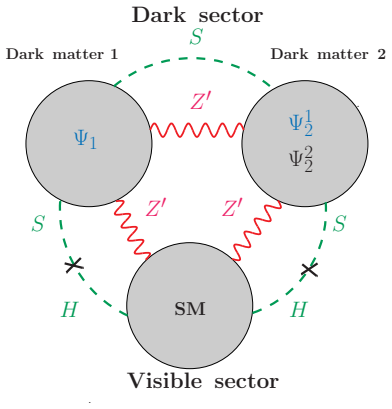
(12) Regarding the fermion spectrum, in this model, we have two DM particles (DM1 and DM2) that are connected by the dark photonZ ′ and the Higgs portal S as is shown in Fig
, (11) with UΞ = cos θΞ sin θΞ − sin θΞ cos θΞ . (12) Regarding the fermion spectrum, in this model, we have two DM particles (DM1 and DM2) that are connected by the dark photonZ ′ and the Higgs portal S as is shown in Fig. 1. According to the Lagrangian 6 and after electroweak and U (1)D symmetry breaking, we get a Dirac fermion DM candidate, Ψ 1...
-
[3]
that result from the mixing of the four chiral fermions ( ψi R)† and ψj L (i, j= 1, 2). Therefore, the Lagrangian in the mass eigenstate basis includes: L ⊃mΨ1Ψ1Ψ1 + 2X i=1 mΨi 2 Ψ i 2Ψi 2 , (13) where Ψ1 and Ψ1 2 are the two DM particles in the model (we assume that Ψ2 2 is heavier than Ψ1 2). Notice that the fermions Ψ i 2 correspond to the eigenstates ...
-
[4]
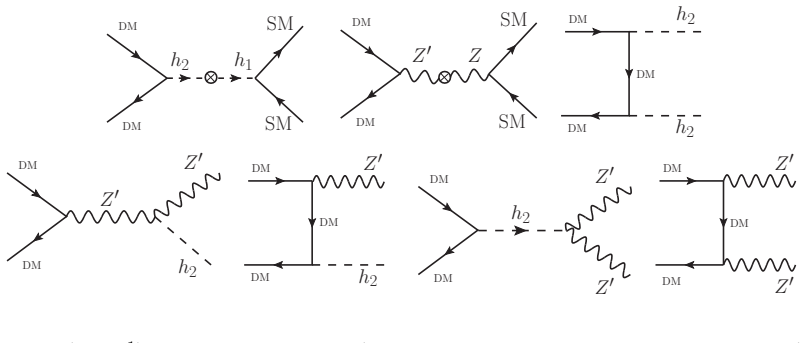
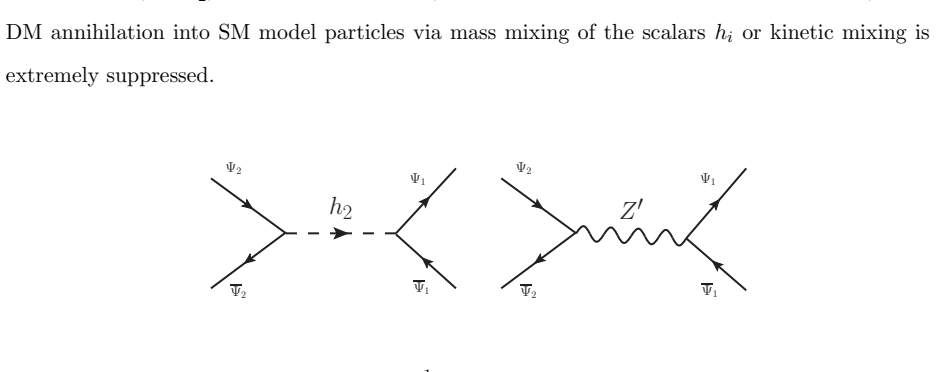
The DM annihilation into SM model particles via mass mixing of the scalars hi or kinetic mixing is extremely suppressed
annihilation channels (we do not show the corresponding u-channels.). The DM annihilation into SM model particles via mass mixing of the scalars hi or kinetic mixing is extremely suppressed. Ψ2 Ψ2 h2 Ψ1 Ψ1 Ψ2 Ψ2 Z′ Ψ1 Ψ1 Figure 4. DM conversion channels Ψ 1 ↔ Ψ1 2 mediated by the dark Higgs h2 or the dark photon Z′. Dirac neutrinos, the dark Higgs h2, and...
-
[5]
The 2 → 2 processes allowed in this model that can modify the relic density of DM particles
is obtained by solving the Boltz- 12 Processes Type Ψ1 Ψ1 → SM SM 1100 Ψ 1 2 Ψ1 2 → SM SM 2200 Ψ1 Ψ1 → Ψ 1 2 Ψ1 2 1122 Ψ 1 2 Ψ1 2 → Ψ1 Ψ1 2211 Table II. The 2 → 2 processes allowed in this model that can modify the relic density of DM particles. mann equations: d n1 d t = − σ1100 v (n2 1 − n2
-
[6]
left-right equilibration
− σ2211 v n2 2 − n2 1 n2 2 n1 − 3Hn 2 , (18) where ni (i = 1, 2) is the number density for the DM particle, ni are their respective equi- librium values and σabcd v is the thermally averaged cross section, that satisfies the relation nanbσabcd v = ncndσcdab v . In the next section, we compute the analytical expression for the relic density in a simplified...
Show all 94 references
-
[7]
In addition, the interaction between the two candidates for DM gives the value Ωh2 ≈ 0.12 [41]
could render the 100% of the DM abundance, those are the points in the grey horizontal band with 10% of uncertainty and ξi = (Ω i/Ω) ≈ 1. In addition, the interaction between the two candidates for DM gives the value Ωh2 ≈ 0.12 [41]. They correspond to the models below the gre...
-
[8]
where µ = MN mΨi/(MN + mΨi) is the reduced mass, MN ≈ 939 MeV is the nucleon mass (neutron or proton), BΨ1 = (qχL − qχR) = 1, BΨ2 = (qψL − qψR) = 9 (see Tab
with nuclei: vector (left) and scalar (right) portals. where µ = MN mΨi/(MN + mΨi) is the reduced mass, MN ≈ 939 MeV is the nucleon mass (neutron or proton), BΨ1 = (qχL − qχR) = 1, BΨ2 = (qψL − qψR) = 9 (see Tab. I). On the other hand, the contribution of the scalar portal (ri...
2023
-
[9]
Higgs decay into dark fermions If mΨi < mh1/2 = 64.5 GeV, the Higgs h1 decays into DM particles Ψi = Ψ1, Ψ2 1 through the s-channel with the Z ′ boson with a decay width given by Γ(h1 → ΨiΨi) = mh1|yi|2 sin2(θ) 16π 1 − 4 ri 3 2 (D1) where ri = m2 h1/mΨ2 i and y1 =yc y2 =(ZR)11...
-
[10]
Cosmological Constraints on the Properties of Weakly Interacting Massive Particles,
Gary Steigman and Michael S. Turner, “Cosmological Constraints on the Properties of Weakly Interacting Massive Particles,” Nucl. Phys. B 253, 375–386 (1985)
1985
-
[11]
Working Group Report: WIMP Dark Matter Direct Detection,
P. Cushman et al., “Working Group Report: WIMP Dark Matter Direct Detection,” in Snowmass 2013: Snowmass on the Mississippi(2013) arXiv:1310.8327 [hep-ex]
2013 arXiv
-
[12]
History of dark matter,
Gianfranco Bertone and Dan Hooper, “History of dark matter,” Rev. Mod. Phys. 90, 045002 (2018), arXiv:1605.04909 [astro-ph.CO]
2018 arXiv
-
[13]
The WIMP paradigm: Theme and variations,
Jonathan L. Feng, “The WIMP paradigm: Theme and variations,” SciPost Phys. Lect. Notes 71, 1 (2023), arXiv:2212.02479 [hep-ph]
2023 arXiv
-
[14]
Cosmology of the Invisible Axion,
John Preskill, Mark B. Wise, and Frank Wilczek, “Cosmology of the Invisible Axion,” Phys. Lett. B 120, 127–132 (1983)
1983
-
[15]
A Cosmological Bound on the Invisible Axion,
L. F. Abbott and P. Sikivie, “A Cosmological Bound on the Invisible Axion,” Phys. Lett. B 120, 133–136 (1983)
1983
-
[16]
The Not So Harmless Axion,
Michael Dine and Willy Fischler, “The Not So Harmless Axion,” Phys. Lett. B 120, 137–141 (1983)
1983
-
[17]
Sterile neutrinos as dark matter candidates,
Joachim Kopp, “Sterile neutrinos as dark matter candidates,” SciPost Phys. Lect. Notes 36, 1 (2022), arXiv:2109.00767 [hep-ph]
2022 arXiv
-
[18]
Constraints on primordial black holes,
Bernard Carr, Kazunori Kohri, Yuuiti Sendouda, and Jun’ichi Yokoyama, “Constraints on primordial black holes,” Rept. Prog. Phys.84, 116902 (2021), arXiv:2002.12778 [astro-ph.CO]
2021 arXiv
-
[19]
Did LIGO detect dark matter?
Simeon Bird, Ilias Cholis, Julian B. Mu˜ noz, Yacine Ali-Ha ¨ ımoud, Marc Kamionkowski, Ely D. Kovetz, Alvise Raccanelli, and Adam G. Riess, “Did LIGO detect dark matter?.” Phys. Rev. Lett. 116, 201301 (2016), arXiv:1603.00464 [astro-ph.CO]
2016 arXiv
-
[20]
Asymmetries from a charged memory- burdened PBH,
Basabendu Barman, Kousik Loho, and ´Oscar Zapata, “Asymmetries from a charged memory- burdened PBH,” JCAP 02, 052 (2025), arXiv:2412.13254 [hep-ph]
2025 arXiv
-
[21]
Theory and phenomenology of Dirac neutrinos,
Salvador Centelles Chuli´ a, “Theory and phenomenology of Dirac neutrinos,” (10 2021), arXiv:2110.15755 [hep-ph]
2021 arXiv
-
[22]
From the trees to the forest: a review of radiative neutrino mass models,
Yi Cai, Juan Herrero-Garc ´ ıa, Michael A. Schmidt, Avelino Vicente, and Raymond R. Volkas, “From the trees to the forest: a review of radiative neutrino mass models,” Front. in Phys. 30 5, 63 (2017), arXiv:1706.08524 [hep-ph]
2017 arXiv
-
[25]
Two U(1)’s and Epsilon Charge Shifts,
Bob Holdom, “Two U(1)’s and Epsilon Charge Shifts,” Phys. Lett. B 166, 196–198 (1986)
1986
-
[26]
The windows for kinetically mixed Z’-mediated dark matter and the galactic center gamma ray excess,
James M. Cline, Grace Dupuis, Zuowei Liu, and Wei Xue, “The windows for kinetically mixed Z’-mediated dark matter and the galactic center gamma ray excess,” JHEP 08, 131 (2014), arXiv:1405.7691 [hep-ph]
2014 arXiv
-
[27]
X,78, arXiv:2005.01515 [hep-ph]
Marco Fabbrichesi, Emidio Gabrielli, and Gaia Lanfranchi, The Dark Photon, SpringerBriefs in Physics (Springer, 2020) ISBN 978-3-030–62519-1, pp. X,78, arXiv:2005.01515 [hep-ph]
2020 arXiv
-
[28]
Impact of mass generation for spin-1 mediator simplified models,
Nicole F. Bell, Yi Cai, and Rebecca K. Leane, “Impact of mass generation for spin-1 mediator simplified models,” JCAP 01, 039 (2017), arXiv:1610.03063 [hep-ph]
2017 arXiv
-
[29]
Interaction energy in electrodynamics and in the field theory of nuclear forces,
E. C. G. Stueckelberg, “Interaction energy in electrodynamics and in the field theory of nuclear forces,” Helv. Phys. Acta 11, 225–244 (1938)
1938
-
[30]
Dark matter from dark photons: a taxonomy of dark matter production,
Thomas Hambye, Michel H. G. Tytgat, J´ erˆ ome Vandecasteele, and Laurent Vanderheyden, “Dark matter from dark photons: a taxonomy of dark matter production,” Phys. Rev. D 100, 095018 (2019), arXiv:1908.09864 [hep-ph]
2019 arXiv
-
[31]
General Solution to the U(1) Anomaly Equations,
Davi B. Costa, Bogdan A. Dobrescu, and Patrick J. Fox, “General Solution to the U(1) Anomaly Equations,” Phys. Rev. Lett. 123, 151601 (2019), arXiv:1905.13729 [hep-th]
2019 arXiv
-
[32]
Effective Dirac Neutrino Mass Operator in the Standard Model With a Local Abelian Extension,
Diego Restrepo and David Suarez, “Effective Dirac Neutrino Mass Operator in the Standard Model With a Local Abelian Extension,” Front. in Phys.10, 838531 (2022), arXiv:2112.09524 [hep-ph]
2022 arXiv
-
[33]
Anomaly-free chiral U (1)D and its scotogenic implication,
Chi-Fong Wong, “Anomaly-free chiral U (1)D and its scotogenic implication,” Phys. Dark Univ. 32, 100818 (2021), arXiv:2008.08573 [hep-ph]
2021 arXiv
-
[34]
Anomaly-free Abelian gauge symmetries with Dirac scotogenic models,
Nicol´ as Bernal, Juli´ an Calle, and Diego Restrepo, “Anomaly-free Abelian gauge symmetries with Dirac scotogenic models,” Phys. Rev. D 103, 095032 (2021), arXiv:2102.06211 [hep-ph]
2021 arXiv
-
[35]
Simple model for (3+2) neutrino oscillations,
K. S. Babu and Gerhart Seidl, “Simple model for (3+2) neutrino oscillations,” Phys. Lett. B 591, 127–136 (2004), arXiv:hep-ph/0312285 31
2004 arXiv
-
[36]
Anomaly-free sets of fermions,
Puneet Batra, Bogdan A. Dobrescu, and David Spivak, “Anomaly-free sets of fermions,” J. Math. Phys. 47, 082301 (2006), arXiv:hep-ph/0510181
2006 arXiv
-
[37]
New Chiral Fermions, a New Gauge Interaction, Dirac Neutrinos, and Dark Matter,
Andr´ e de Gouvˆ ea and Daniel Hern´ andez, “New Chiral Fermions, a New Gauge Interaction, Dirac Neutrinos, and Dark Matter,” JHEP 10, 046 (2015), arXiv:1507.00916 [hep-ph]
2015 arXiv
-
[38]
Chiral Abelian gauge theories with few fermions,
Davi B. Costa, Bogdan A. Dobrescu, and Patrick J. Fox, “Chiral Abelian gauge theories with few fermions,” Phys. Rev. D 101, 095032 (2020), arXiv:2001.11991 [hep-ph]
2020 arXiv
-
[39]
Closing the dark photon window to thermal dark matter,
Leon M. G. de la Vega, R. Ferro-Hernandez, A. Garc ´ ıa-Viltres, Eduardo Peinado, and E. V´ azquez-J´ auregui, “Closing the dark photon window to thermal dark matter,” (11 2023), arXiv:2311.17987 [hep-ph]
2023 arXiv
-
[40]
Linkage of Dirac Neutrinos to Dark U(1) Gauge Symmetry,
Ernest Ma, “Linkage of Dirac Neutrinos to Dark U(1) Gauge Symmetry,” Phys. Lett. B 817, 136290 (2021), arXiv:2101.12138 [hep-ph]
2021 arXiv
-
[41]
The Reactor Antineutrino Anomaly,
G. Mention, M. Fechner, Th. Lasserre, Th. A. Mueller, D. Lhuillier, M. Cribier, and A. Letourneau, “The Reactor Antineutrino Anomaly,” Phys. Rev. D 83, 073006 (2011), arXiv:1101.2755 [hep-ex]
2011 arXiv
-
[42]
Mod- els of neutrino mass with a low cutoff scale,
Hooman Davoudiasl, Ryuichiro Kitano, Graham D. Kribs, and Hitoshi Murayama, “Mod- els of neutrino mass with a low cutoff scale,” Phys. Rev. D 71, 113004 (2005), arXiv:hep- ph/0502176
2005
-
[43]
Exotic Charges, Multicomponent Dark Matter and Light Sterile Neutrinos,
Julian Heeck and He Zhang, “Exotic Charges, Multicomponent Dark Matter and Light Sterile Neutrinos,” JHEP 05, 164 (2013), arXiv:1211.0538 [hep-ph]
2013 arXiv
-
[44]
Dark Discrete Gauge Symmetries,
Brian Batell, “Dark Discrete Gauge Symmetries,” Phys. Rev. D 83, 035006 (2011), arXiv:1007.0045 [hep-ph]
2011 arXiv
-
[45]
Dirac neutrino mass generation from a Majorana messenger,
Julian Calle, Diego Restrepo, and ´Oscar Zapata, “Dirac neutrino mass generation from a Majorana messenger,” Phys. Rev. D 101, 035004 (2020), arXiv:1909.09574 [hep-ph]
2020 arXiv
-
[46]
Status of neutrino oscillations 2018: 3 σ hint for normal mass ordering and improved CP sensitivity,
P. F. de Salas, D. V. Forero, C. A. Ternes, M. Tortola, and J. W. F. Valle, “Status of neutrino oscillations 2018: 3 σ hint for normal mass ordering and improved CP sensitivity,” Phys. Lett. B 782, 633–640 (2018), arXiv:1708.01186 [hep-ph]
2018 arXiv
-
[47]
Hunting All the Hidden Photons,
Martin Bauer, Patrick Foldenauer, and Joerg Jaeckel, “Hunting All the Hidden Photons,” JHEP 07, 094 (2018), arXiv:1803.05466 [hep-ph]
2018 arXiv
-
[48]
micrOMEGAs4.1: two dark matter candidates,
G. B´ elanger, F. Boudjema, A. Pukhov, and A. Semenov, “micrOMEGAs4.1: two dark matter candidates,” Comput. Phys. Commun. 192, 322–329 (2015), arXiv:1407.6129 [hep-ph] 32
2015 arXiv
-
[49]
micrOMEGAs 6.0: N-component dark matter,
G. Alguero, G. Belanger, F. Boudjema, S. Chakraborti, A. Goudelis, S. Kraml, A. Mjallal, and A. Pukhov, “micrOMEGAs 6.0: N-component dark matter,” Comput. Phys. Commun. 299, 109133 (2024), arXiv:2312.14894 [hep-ph]
2024 arXiv
-
[50]
Planck 2018 results. VI. Cosmological parameters,
N. Aghanim et al. (Planck), “Planck 2018 results. VI. Cosmological parameters,” Astron. Astrophys. 641, A6 (2020), [Erratum: Astron.Astrophys. 652, C4 (2021)], arXiv:1807.06209 [astro-ph.CO]
2020 arXiv
-
[51]
Neutrino decoupling in the early universe,
Steen Hannestad and Jes Madsen, “Neutrino decoupling in the early universe,” Phys. Rev. D 52, 1764–1769 (1995), arXiv:astro-ph/9506015
1995 arXiv
-
[52]
MeV scale reheating temperature and thermalization of neutrino background,
M. Kawasaki, Kazunori Kohri, and Naoshi Sugiyama, “MeV scale reheating temperature and thermalization of neutrino background,” Phys. Rev. D 62, 023506 (2000), arXiv:astro- ph/0002127
2000
-
[53]
Light from darkness: history of a hot dark sector,
Rupert Coy, Jean Kimus, and Michel H. G. Tytgat, “Light from darkness: history of a hot dark sector,” (5 2024), arXiv:2405.10792 [hep-ph]
2024 arXiv
-
[54]
Nonthermal cosmic neutrino back- ground,
Mu-Chun Chen, Michael Ratz, and Andreas Trautner, “Nonthermal cosmic neutrino back- ground,” Phys. Rev. D 92, 123006 (2015), arXiv:1509.00481 [hep-ph]
2015 arXiv
-
[55]
The Early Universe,
Edward W. Kolb and Michael S. Turner, “The Early Universe,” Front. Phys.69, 1–547 (1990)
1990
-
[56]
Calculations of Relic Densities in the Early Universe,
Mark Srednicki, Richard Watkins, and Keith A. Olive, “Calculations of Relic Densities in the Early Universe,” Nucl. Phys. B310, 693 (1988), [,247(1988)]
1988
-
[57]
Generating Feynman diagrams and amplitudes with FeynArts 3,
Thomas Hahn, “Generating Feynman diagrams and amplitudes with FeynArts 3,” Comput. Phys. Commun. 140, 418–431 (2001), arXiv:hep-ph/0012260
2001 arXiv
-
[58]
FEYN CALC: Computer algebraic calculation of Feynman amplitudes,
R. Mertig, M. Bohm, and Ansgar Denner, “FEYN CALC: Computer algebraic calculation of Feynman amplitudes,” Comput. Phys. Commun. 64, 345–359 (1991)
1991
-
[59]
New Developments in FeynCalc 9.0,
Vladyslav Shtabovenko, Rolf Mertig, and Frederik Orellana, “New Developments in FeynCalc 9.0,” Comput. Phys. Commun. 207, 432–444 (2016), arXiv:1601.01167 [hep-ph]
2016 arXiv
-
[60]
FeynCalc 9.3: New features and improvements,
Vladyslav Shtabovenko, Rolf Mertig, and Frederik Orellana, “FeynCalc 9.3: New features and improvements,” Comput. Phys. Commun. 256, 107478 (2020), arXiv:2001.04407 [hep-ph]
2020 arXiv
-
[61]
Connecting dark gauge symmetry to the standard model,
Ernest Ma, “Connecting dark gauge symmetry to the standard model,” Phys. Lett. B 833, 137282 (2022), 2203.12034 [hep-ph]
2022 arXiv
-
[62]
Dark Matter Complementarity and the Z ′ Portal,
Alexandre Alves, Asher Berlin, Stefano Profumo, and Farinaldo S. Queiroz, “Dark Matter Complementarity and the Z ′ Portal,” Phys. Rev. D 92, 083004 (2015), arXiv:1501.03490 33 [hep-ph]
2015 arXiv
-
[63]
Dirac-fermionic dark matter in U(1) X models,
Alexandre Alves, Asher Berlin, Stefano Profumo, and Farinaldo S. Queiroz, “Dirac-fermionic dark matter in U(1) X models,” JHEP 10, 076 (2015), arXiv:1506.06767 [hep-ph]
2015 arXiv
-
[64]
Staub, “SARAH,” (6 2008), arXiv:0806.0538 [hep-ph]
F. Staub, “SARAH,” (6 2008), arXiv:0806.0538 [hep-ph]
2008 arXiv
-
[65]
From Superpotential to Model Files for FeynArts and CalcHep/CompHep,
Florian Staub, “From Superpotential to Model Files for FeynArts and CalcHep/CompHep,” Comput. Phys. Commun. 181, 1077–1086 (2010), arXiv:0909.2863 [hep-ph]
2010 arXiv
-
[66]
Automatic Calculation of supersymmetric Renormalization Group Equations and Self Energies,
Florian Staub, “Automatic Calculation of supersymmetric Renormalization Group Equations and Self Energies,” Comput. Phys. Commun. 182, 808–833 (2011), arXiv:1002.0840 [hep-ph]
2011 arXiv
-
[67]
SARAH 3.2: Dirac Gauginos, UFO output, and more,
Florian Staub, “SARAH 3.2: Dirac Gauginos, UFO output, and more,” Comput. Phys. Commun. 184, 1792–1809 (2013), arXiv:1207.0906 [hep-ph]
2013 arXiv
-
[68]
SARAH 4 : A tool for (not only SUSY) model builders,
Florian Staub, “SARAH 4 : A tool for (not only SUSY) model builders,” Comput. Phys. Commun. 185, 1773–1790 (2014), arXiv:1309.7223 [hep-ph]
2014 arXiv
-
[69]
SPheno, a program for calculating supersymmetric spectra, SUSY particle decays and SUSY particle production at e+ e- colliders,
Werner Porod, “SPheno, a program for calculating supersymmetric spectra, SUSY particle decays and SUSY particle production at e+ e- colliders,” Comput. Phys. Commun. 153, 275–315 (2003), arXiv:hep-ph/0301101
2003 arXiv
-
[70]
SPheno 3.1: Extensions including flavour, CP-phases and models beyond the MSSM,
W. Porod and F. Staub, “SPheno 3.1: Extensions including flavour, CP-phases and models beyond the MSSM,” Comput. Phys. Commun. 183, 2458–2469 (2012), arXiv:1104.1573 [hep- ph]
2012 arXiv
-
[71]
A second Higgs from the Higgs portal,
Adam Falkowski, Christian Gross, and Oleg Lebedev, “A second Higgs from the Higgs portal,” JHEP 05, 057 (2015), arXiv:1502.01361 [hep-ph]
2015 arXiv
-
[72]
Dark Matter through the Higgs portal,
Giorgio Arcadi, Abdelhak Djouadi, and Martti Raidal, “Dark Matter through the Higgs portal,” Phys. Rept. 842, 1–180 (2020), arXiv:1903.03616 [hep-ph]
2020 arXiv
-
[73]
Dark Higgs bosons at colliders,
Torben Ferber, Alexander Grohsjean, and Felix Kahlhoefer, “Dark Higgs bosons at colliders,” Prog. Part. Nucl. Phys. 136, 104105 (2024), arXiv:2305.16169 [hep-ph]
2024 arXiv
-
[74]
A portrait of the Higgs boson by the CMS experiment ten years after the discovery
Armen Tumasyan et al. (CMS), “A portrait of the Higgs boson by the CMS experiment ten years after the discovery..” Nature 607, 60–68 (2022), [Erratum: Nature 623, (2023)], arXiv:2207.00043 [hep-ex]
2022 arXiv
-
[75]
Chiral dark matter and radiative neutrino masses from gauged U(1) symmetry,
K. S. Babu, Shreyashi Chakdar, and Vishnu P. K, “Chiral dark matter and radiative neutrino masses from gauged U(1) symmetry,” (9 2024), arXiv:2409.09008 [hep-ph] 34
2024 arXiv
-
[76]
Remarks on the unified model of ele- mentary particles,
Ziro Maki, Masami Nakagawa, and Shoichi Sakata, “Remarks on the unified model of ele- mentary particles,” Prog. Theor. Phys. 28, 870–880 (1962)
1962
-
[77]
Theory for Baryon Number and Dark Matter at the LHC,
Michael Duerr and Pavel Fileviez Perez, “Theory for Baryon Number and Dark Matter at the LHC,” Phys. Rev. D 91, 095001 (2015), arXiv:1409.8165 [hep-ph]
2015 arXiv
-
[78]
Dirac dark matter, neutrino masses, and dark baryogenesis,
Diego Restrepo, Andr´ es Rivera, and Walter Tangarife, “Dirac dark matter, neutrino masses, and dark baryogenesis,” Phys. Rev. D 106, 055021 (2022), arXiv:2205.05762 [hep-ph]
2022 arXiv
-
[79]
Singlet Dirac dark matter streamlined,
Carlos E. Yaguna and ´Oscar Zapata, “Singlet Dirac dark matter streamlined,” JCAP 06, 049 (2024), arXiv:2401.13101 [hep-ph]
2024 arXiv
-
[80]
First Dark Matter Search with Nuclear Recoils from the XENONnT Experiment,
E. Aprile et al. (XENON), “First Dark Matter Search with Nuclear Recoils from the XENONnT Experiment,” Phys. Rev. Lett. 131, 041003 (2023), arXiv:2303.14729 [hep-ex]
2023 arXiv
-
[81]
First Dark Matter Search Results from the LUX-ZEPLIN (LZ) Experiment,
J. Aalbers et al. (LZ), “First Dark Matter Search Results from the LUX-ZEPLIN (LZ) Experiment,” Phys. Rev. Lett. 131, 041002 (2023), arXiv:2207.03764 [hep-ex]
2023 arXiv
-
[82]
DAR WIN: towards the ultimate dark matter detector,
J. Aalbers et al.(DAR WIN), “DAR WIN: towards the ultimate dark matter detector,” JCAP 11, 017 (2016), arXiv:1606.07001 [astro-ph.IM]
2016 arXiv
-
[83]
Implication of neutrino backgrounds on the reach of next generation dark matter direct detection experiments,
J. Billard, L. Strigari, and E. Figueroa-Feliciano, “Implication of neutrino backgrounds on the reach of next generation dark matter direct detection experiments,” Phys. Rev. D 89, 023524 (2014), arXiv:1307.5458 [hep-ph]
2014 arXiv
-
[84]
Concealing Dirac neutrinos from cosmic microwave background,
Anirban Biswas, Dilip Kumar Ghosh, and Dibyendu Nanda, “Concealing Dirac neutrinos from cosmic microwave background,” JCAP 10, 006 (2022), arXiv:2206.13710 [hep-ph]
2022 arXiv
-
[85]
Constraining the spin-dependent WIMP-nucleon cross sections with XENON1T,
E. Aprile et al. (XENON), “Constraining the spin-dependent WIMP-nucleon cross sections with XENON1T,” Phys. Rev. Lett. 122, 141301 (2019), arXiv:1902.03234 [astro-ph.CO]
2019 arXiv
-
[86]
Dark Matter Signals from Cascade Annihilations,
Jeremy Mardon, Yasunori Nomura, Daniel Stolarski, and Jesse Thaler, “Dark Matter Signals from Cascade Annihilations,” JCAP 05, 016 (2009), arXiv:0901.2926 [hep-ph]
2009 arXiv
-
[87]
Indirect Searches for Secluded Dark Matter,
Clarissa Siqueira, Guilherme N. Fortes, Aion Viana, and Farinaldo S. Queiroz, “Indirect Searches for Secluded Dark Matter,” PoS ICRC2021, 577 (2021), arXiv:2107.04053 [hep- ph]
2021 arXiv
-
[88]
Searching for Dark Matter Annihilation from Milky Way Dwarf Spheroidal Galaxies with Six Years of Fermi Large Area Telescope Data,
M. Ackermann et al.(Fermi-LAT), “Searching for Dark Matter Annihilation from Milky Way Dwarf Spheroidal Galaxies with Six Years of Fermi Large Area Telescope Data,” Phys. Rev. Lett. 115, 231301 (2015), arXiv:1503.02641 [astro-ph.HE] 35
2015 arXiv
-
[89]
Search for dark matter annihilations towards the inner Galac- tic halo from 10 years of observations with H.E.S.S,
H. Abdallah et al.(H.E.S.S.), “Search for dark matter annihilations towards the inner Galac- tic halo from 10 years of observations with H.E.S.S,” Phys. Rev. Lett. 117, 111301 (2016), arXiv:1607.08142 [astro-ph.HE]
2016 arXiv
-
[90]
Sensitivity of the Cherenkov Telescope Array to a dark matter signal from the Galactic centre,
A. Acharyya et al. (CTA), “Sensitivity of the Cherenkov Telescope Array to a dark matter signal from the Galactic centre,” JCAP 01, 057 (2021), arXiv:2007.16129 [astro-ph.HE]
2021 arXiv
-
[91]
A next-generation ground-based wide field-of-view gamma-ray observatory in the southern hemisphere,
H. Schoorlemmer (SWGO), “A next-generation ground-based wide field-of-view gamma-ray observatory in the southern hemisphere,” PoS ICRC2019, 785 (2020), arXiv:1908.08858 [astro-ph.HE]
2020 arXiv
-
[92]
Neutrinos and gamma rays from long-lived mediator decays in the Sun,
Carl Niblaeus, Ankit Beniwal, and Joakim Edsjo, “Neutrinos and gamma rays from long-lived mediator decays in the Sun,” JCAP 11, 011 (2019), arXiv:1903.11363 [astro-ph.HE]
2019 arXiv
-
[93]
Solar gamma ray constraints on dark matter annihilation to secluded mediators,
Nicole F. Bell, James B. Dent, and Isaac W. Sanderson, “Solar gamma ray constraints on dark matter annihilation to secluded mediators,” Phys. Rev. D 104, 023024 (2021), arXiv:2103.16794 [hep-ph]
2021 arXiv
-
[94]
Review of particle physics,
S. Navas et Al (Particle Data Group Collaboration), “Review of particle physics,” Phys. Rev. D 110, 030001 (Aug 2024), https://link.aps.org/doi/10.1103/PhysRevD.110.030001 36
2024 doi
Reviewed August 11, 2026 · model on record in the stance chip above.
Discussion (0). Continue with ORCID to comment.