REVIEW 5 major objections 7 minor 34 references
A Unified LLM-Adaptable Framework for Cold-Start Cognitive Diagnosis
T0 review · 5 major / 7 minor · reviewed 2026-08-07 · deepseek-v4-flash
Pith's one-line read LMCD claims that causal attention over a prepended student token plus LLM-enriched exercise text yields a personalized relative-difficulty representation that lets standard cognitive diagnosis models beat state-of-the-art cold-start…
desk verdict Genuinely novel architecture, but the 'significantly outperforms' claim is not supported by the paper's own tables. read the letter →
The pith
A machine-rendered reading of the paper's core claim, the machinery that carries it, and where it could break.
The reading
What carries the argument
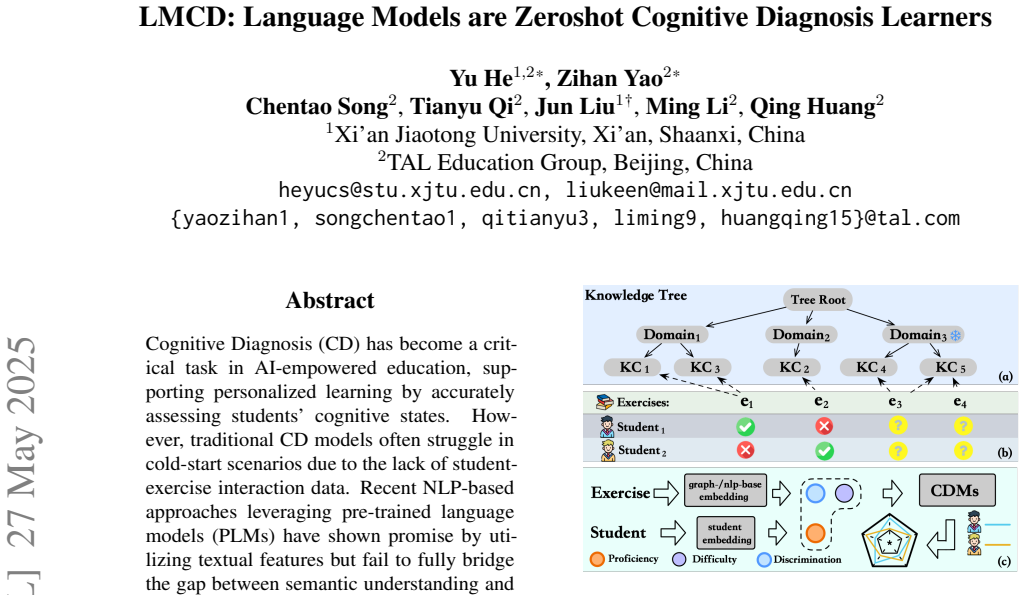
The load-bearing mechanism is the fusion embedding $E_{fusion}=[E_v;E_u]$: $E_v$ is the LLM's embedding of the concatenated enriched knowledge-concept description and exercise text, and $E_u$ is a learned cognitive embedding for a special student token. Passing this sequence through the causal Transformer and reading the last position gives the feedback representation $O_{feedback}$, projected by $W_d$ into the CDM's difficulty $d_{uv}$; the second-to-last position gives $O_v$, projected into discrimination $\beta$; proficiency $p$ comes from $E_u$ alone via $W_p$. Causal masking is what makes the final position a function of both the text and the student state, which is where relative difficulty enters. The other pillar is Knowledge Diffusion, LLM generation of enriched KC descriptions prompted with the target KC, example exercises, and distractor sibling KCs to sharpen semantic discrimination.
What would settle it
Take a trained LMCD on hot data and swap the learned student tokens of two students on the same cold exercise; if predicted difficulty and response probability do not move with the swap, the final-token hidden state is not carrying a genuine student-exercise interaction. A directional check: a student who is weaker on the target knowledge concept should receive a higher difficulty value for that exercise than a stronger student, and repeating this over many student pairs yields a quantitative test.
Extended reading notes
Core claim
The central discovery is that a frozen LLM's causal attention can act as a semantic-cognitive fusion mechanism: after inserting a learned token for each student into the sequence of enriched exercise and knowledge-concept text, the hidden state of the final token encodes the student-exercise interaction and can be mapped to a difficulty parameter, while the second-to-last token encodes the exercise alone and maps to discrimination. Because difficulty becomes student-specific, termed relative difficulty, the model separates correct from incorrect responses more cleanly than text-only absolute-difficulty models. Knowledge diffusion, where the LLM generates enriched knowledge-concept descriptions conditioned on target and distractor concepts, establishes transferable semantic links across unseen domains. The resulting representations can be trained end-to-end with off-the-shelf cognitive diagnosis models, preserving their theoretical structure while improving cold-start accuracy.
Load-bearing premise
The whole mechanism depends on the assumption that, after prepending a student token to the exercise text, the last token's hidden state in a causally masked LLM genuinely combines the student's cognitive state with the exercise's semantics, so treating it as a personalized difficulty parameter is more than a learned constant offset.
Editorial extensions
If this is right
- New exercises can be diagnosed without any interaction history: a cold exercise's text and knowledge-route information suffice to produce difficulty and discrimination parameters for a standard CDM.
- Cross-domain transfer works even when knowledge concepts are disjoint between training and cold domains, because enriched KC descriptions carry semantic overlap that graph structure cannot provide.
- Existing interpretable CDM frameworks such as IRT, MIRT, and NCDM keep their parameter meanings while gaining a plug-in text-and-cognitive representation layer, so deployed diagnosis systems need not be replaced wholesale.
- Response prediction and downstream personalized practice recommendations should improve wherever exercise text is informative, even when student-exercise logs are sparse.
- Difficulty should be modeled as a student-item interaction rather than an item constant, because the paper's evidence indicates relative difficulty separates correct and incorrect responses more clearly than absolute difficulty.
Reading between the lines
- The fusion mechanism is generic: any setting where an outcome depends jointly on a textual item and a latent respondent state—surveys, medical symptom checkers, adaptive quizzes—could use the same student-token-plus-causal-attention design, though the paper only tests education.
- The paper demonstrates relative difficulty's advantage using five NIPS34 students; whether the cleaner correct-versus-incorrect separation persists across all students, languages, and item types is untested, so a natural extension is measuring the overlap of difficulty distributions over the full datasets.
- Because the LLM backbone is frozen and only LoRA adapters plus token embeddings are trained, part of the observed gain may come from the learned student-token embeddings rather than the LLM's deep semantics; an ablation replacing the student token with a constant shared vector would isolate the cognitive contribution.
- The authors note their framework is computationally heavy; if the fusion can be distilled into a smaller student model, the practicality objection would be answered without losing the relative-difficulty mechanism.
Editorial analysis
A structured set of objections, weighed in public.
Referee Report
Summary. The paper proposes LMCD, a framework for cold-start cognitive diagnosis that combines (1) Knowledge Diffusion, where an LLM generates enriched descriptions of knowledge concepts using distractor examples, and (2) Semantic-Cognitive Fusion, where a special student token is appended to the exercise text and processed by a causally-masked LLM to produce a personalized feedback representation, mapped to the difficulty parameter of off-the-shelf CDMs (IRT, MIRT, NCDM). The authors claim significant outperformance over state-of-the-art methods in both exercise-cold and cross-domain cold-start settings on two real-world datasets, NIPS34 and XES3G5M. The code is publicly available. The evaluation uses k-fold cross-validation, but no statistical significance tests or error bars are reported. The central claim of significant improvement is only partially supported by the paper's own tables, and the core mechanism of causal-attention-based relative difficulty is not directly validated.
Significance. The framework is a plausible and interesting attempt to use LLMs for cold-start cognitive diagnosis, with a concrete contribution in the form of distractor-aware knowledge concept enrichment via LLM generation. The code release supports reproducibility. If the mechanism were rigorously validated and the empirical claims properly supported with significance testing, the work would be a useful addition to the field, as it introduces a principled way to inject student-specific cognitive state into the difficulty parameter while preserving the interpretability of classical CDMs. However, the current evidence is mixed: the framework does not consistently beat KCD, a strong LLM-based baseline, and the paper's novelty claims about causal attention and relative difficulty are not backed by sufficiently targeted ablations or quantitative analysis.
major comments (5)
- [Abstract and Tables 1-2] The abstract's claim that 'LMCD significantly outperforms state-of-the-art methods in both exercise-cold and domain-cold settings' is contradicted by the paper's own results. In Table 1, on XES3G5M, KCD beats LMCD on the IRT head in ACC (0.7584 vs 0.7560) and on the NCDM head in all three metrics (ACC 0.7602 vs 0.7436, AUC 0.6741 vs 0.6408, RMSE 0.4162 vs 0.4284). In Table 2, on the Number target domain, KCD outperforms LMCD on IRT AUC (0.6945 vs 0.6837) and on MIRT ACC/AUC (0.6500/0.6974 vs 0.6269/0.6888). Section 4.3 itself acknowledges that KCD performed best in the Number domain. The qualitative superlative in the abstract is thus unsupported by the reported numbers and needs to be substantially qualified or the experimental evidence needs to be strengthened.
- [Section 4, Tables 1-2 and Section 4.5] No error bars, confidence intervals, or significance tests are reported for any of the main experimental results, despite using 5-fold cross-validation in Table 1 and 3-fold in Table 2. The word 'significantly' appears in the abstract and in Section 4.5 ('significantly better discrimination') without any statistical justification. Given that the crucial performance gaps are small (e.g., the ablation differences in Table 3 are 0.001-0.005 in ACC/AUC/RMSE), significance testing is essential to support the claims. This is a load-bearing omission for the paper's central contribution.
- [Section 3.3, Eqs. (4)-(6)] The paper's core novelty is the claim that the last-token hidden state of a causally-masked LLM, after prepending a student token to the exercise text, captures the student-exercise interaction and yields a personalized difficulty parameter. This is an inductive assumption that is never directly validated. The ablation in Table 3 only swaps the roles of Ofeedback and Ov in the output projection, which does not isolate the effect of causal attention versus a simpler fusion mechanism. The paper does not compare against a non-LLM baseline that concatenates the student embedding and exercise embedding and passes them through an MLP, nor does it test alternative pooling methods (e.g., mean-pooling the hidden states) or a bidirectional transformer setting. Without such ablations, it is unclear whether the causal-attention mechanism itself contributes to the observed gains or whether the benefit comes from the additional trainable student embedding and the larger model capacity. This concern is central to the claimed contribution of 'relative difficulty.'
- [Abstract and Section 3.2] The abstract and the contribution list state that LMCD generates enriched content for both exercises and knowledge concepts (KCs). However, Section 3.2 only describes KC diffusion; equation (3) concatenates the enriched KC description k' with the original exercise text v, and no enriched exercise representation is ever created elsewhere in the paper. The 'exercise diffusion' mentioned in Figure 2(a) and the abstract is not realized in the methodology. This inconsistency between the stated contributions and the actual implementation needs to be resolved, either by adding the exercise diffusion step or by removing it from the claims.
- [Section 4.5, Figure 4] The RQ4 analysis purportedly demonstrates that relative difficulty is more reasonable than absolute difficulty. The evidence is limited to a qualitative inspection of difficulty distributions from five selected students, with no quantitative measure of separation (e.g., AUC between correct and incorrect response difficulty distributions) and no statistical test. The claim 'significantly better discrimination' in Section 4.5 is therefore not substantiated. This is a load-bearing issue because the superiority of relative difficulty is one of the paper's stated contributions.
minor comments (7)
- [Table 2] The column header 'Algerbra' is a typo and should be 'Algebra'.
- [Table 5] The table header 'NIPS35' is a typo and should be 'NIPS34'.
- [Section 2.2] The generic CDM definition yuv = σ(β(p-d)) is ambiguous: the parameter α is mentioned in the text but never appears in the formula, and the dimensionality of p, d, and β is not clearly specified. Clarification would improve reproducibility.
- [Section 3.3, Eq. (4)] The notation [Ev; Eu] is unclear: please specify the concatenation dimension explicitly, since Ev is S×H and Eu is 1×H, and the resulting E_fusion has shape (S+1)×H. Also, the subscript in 'Ofusion = hl' should be h_N to denote the final layer.
- [Section 3.3, Eq. (12)] In the loss function, the same symbol y_uv is used for both the true label and the predicted probability. Use \hat{y}_{uv} for the prediction to avoid ambiguity.
- [Section 4.1 and Appendix A.2] The paper mentions LRCD in the related work but does not include it in the experimental comparison. If LRCD is not applicable to the cold-start setting, this should be explicitly stated; otherwise, a comparison would strengthen the evaluation.
- [Section 4.1] The details of the cross-validation protocol are confusing (e.g., '80% for validation or Oracle model training'). Please clarify what proportion of the cold-start fold is used for oracle training versus validation, and whether the oracle model is trained on labels from the cold subset.
Circularity Check
No circularity: the core evaluation is on held-out cold exercises/domains, and the learned representations are trained only on hot-subset labels, making the derivation self-contained.
full rationale
The paper's derivation chain is not circular. The central prediction pipeline computes the difficulty parameter d_uv from the personalized feedback representation Ofeedback (Eq. 9), which is the final-token hidden state of a causally-masked LLM fed with the concatenation of the student embedding Eu (Eq. 2) and the exercise content embedding Ev (Eq. 3), and then optimizes via cross-entropy loss on the hot-subset logs R_H (Eq. 12). Cold-start evaluation on held-out exercises (exercise cold-start) or held-out domains (cross-domain cold-start) does not use the corresponding test labels to set the parameters that produce the reported metrics. The Knowledge Diffusion step generates enriched KC descriptions from prompts containing KC names and example exercise texts (Appendix A.3), not from response labels, so no reported prediction is algebraically or statistically forced by a fitted input. There is also no load-bearing self-citation chain: the references to prior LLM-based CDMs and LLM-reasoning works are contextual and do not supply an unverified premise on which the framework's validity depends. The limitations section candidly notes that new-student cold-start is not supported, which narrows the scope but does not make the exercise/domain cold-start results circular. The abstract's 'significantly outperforms' claim is weakened by mixed results in Tables 1 and 2 and the absence of significance tests, but that is a statistical-rigor concern, not a circularity concern. Overall, the central claim is supported by a genuine generalization test rather than by construction or self-citation.
Assumptions & free parameters
assumptions (4)
- domain assumption Knowledge concepts are organized in a tree such that different domains have disjoint sets of KCs (Section 2.1).
- domain assumption LLM-generated enriched descriptions improve discriminative semantic links between similar knowledge concepts (Section 3.2, Figure 3).
- ad hoc to paper The last-token hidden state of a causally masked LLM, given a concatenated student token and exercise text, captures the student-exercise interaction (Section 3.3, Eq. 4-6).
- domain assumption Projecting the feedback representation to the difficulty parameter, the student embedding to proficiency, and the exercise representation to discrimination yields a valid CDM (Eq. 8-11).
Cite this review
Pith. "Pith review of A Unified LLM-Adaptable Framework for Cold-Start Cognitive Diagnosis." pith.science (2026). https://pith.science/paper/QWLZVXVV
@misc{pith2026250521239,
  author       = {Pith},
  title        = {Pith review of: A Unified LLM-Adaptable Framework for Cold-Start Cognitive Diagnosis},
  year         = {2026},
  howpublished = {\url{https://pith.science/paper/QWLZVXVV}},
  note         = {Machine review of arXiv:2505.21239}
}
read the original abstract
Cognitive Diagnosis has become a critical task in AI-empowered education, supporting personalized learning by accurately assessing students' cognitive states. However, traditional cognitive diagnosis models (CDMs) often struggle in cold-start scenarios due to the lack of student-exercise interaction data. Recent NLP-based approaches leveraging pre-trained language models (PLMs) have shown promise by utilizing textual features, but they fail to fully bridge the gap between semantic understanding and cognitive profiling. To address this limitation, we propose \textbf{L}anguage \textbf{M}odel-based \textbf{C}ognitive \textbf{D}iagnosis (LMCD), a unified, LLM-adaptable framework designed to tackle cold-start challenges by harnessing the advanced capabilities of large language models (LLMs). LMCD operates via two primary phases: (1) Knowledge Diffusion, where LLMs generate enriched content for exercises and knowledge concepts (KCs) to establish stronger semantic links; and (2) Semantic-Cognitive Fusion, which leverages LLMs to deeply integrate textual information with student cognitive states. By unifying the semantic and cognitive spaces, LMCD creates comprehensive representations that serve as a plug-and-play enhancement for various off-the-shelf CDMs. Experiments on two real-world datasets demonstrate that LMCD significantly outperforms state-of-the-art methods in both exercise-cold and domain-cold settings. https://github.com/TAL-auroraX/LMCDThe code is publicly available at https://github.com/TAL-auroraX/LMCD
Figures


Figures from the paper (1 more)

Reference graph
Works this paper leans on
-
[1]
online" 'onlinestring :=
ENTRY address archivePrefix author booktitle chapter edition editor eid eprint eprinttype howpublished institution journal key month note number organization pages publisher school series title type volume year doi pubmed url lastchecked label extra.label sort.label short.list INTEGERS output.state before.all mid.sentence after.sentence after.block STRING...
-
[2]
write newline
" write newline "" before.all 'output.state := FUNCTION n.dashify 't := "" t empty not t #1 #1 substring "-" = t #1 #2 substring "--" = not "--" * t #2 global.max substring 't := t #1 #1 substring "-" = "-" * t #2 global.max substring 't := while if t #1 #1 substring * t #2 global.max substring 't := if while FUNCTION word.in bbl.in capitalize " " * FUNCT...
-
[3]
Haoyang Bi, Haiping Ma, Zhenya Huang, Yu Yin, Qi Liu, Enhong Chen, Yu Su, and Shijin Wang. 2020. Quality meets diversity: A model-agnostic framework for computerized adaptive testing. In 2020 IEEE International Conference on Data Mining (ICDM), pages 42--51. IEEE
work page 2020
-
[4]
Tom Brown, Benjamin Mann, Nick Ryder, Melanie Subbiah, Jared D Kaplan, Prafulla Dhariwal, Arvind Neelakantan, Pranav Shyam, Girish Sastry, Amanda Askell, and 1 others. 2020. Language models are few-shot learners. Advances in neural information processing systems, 33:1877--1901
2020
-
[5]
Xiangzhi Chen, Le Wu, Fei Liu, Lei Chen, Kun Zhang, Richang Hong, and Meng Wang. 2023. Disentangling cognitive diagnosis with limited exercise labels. Advances in Neural Information Processing Systems, 36:18028--18045
work page 2023
-
[6]
Jimmy De La Torre. 2009. Dina model and parameter estimation: A didactic. Journal of educational and behavioral statistics, 34(1):115--130
work page 2009
-
[7]
Jacob Devlin, Ming-Wei Chang, Kenton Lee, and Kristina Toutanova. 2019. Bert: Pre-training of deep bidirectional transformers for language understanding. In Proceedings of the 2019 conference of the North American chapter of the association for computational linguistics: human language technologies, volume 1 (long and short papers), pages 4171--4186
2019
-
[8]
Zhiang Dong, Jingyuan Chen, and Fei Wu. 2025. Knowledge is power: Harnessing large language models for enhanced cognitive diagnosis. In Proceedings of the AAAI Conference on Artificial Intelligence
work page 2025
Show all 34 references
-
[9]
Weibo Gao, Qi Liu, Hao Wang, Linan Yue, Haoyang Bi, Yin Gu, Fangzhou Yao, Zheng Zhang, Xin Li, and Yuanjing He. 2024. Zero-1-to-3: Domain-level zero-shot cognitive diagnosis via one batch of early-bird students towards three diagnostic objectives. In Proceedings of the AAAI Co...
2024
-
[10]
Weibo Gao, Hao Wang, Qi Liu, Fei Wang, Xin Lin, Linan Yue, Zheng Zhang, Rui Lv, and Shijin Wang. 2023. Leveraging transferable knowledge concept graph embedding for cold-start cognitive diagnosis. In Proceedings of the 46th international ACM SIGIR conference on research and de...
2023
-
[11]
Edward J Hu, Yelong Shen, Phillip Wallis, Zeyuan Allen-Zhu, Yuanzhi Li, Shean Wang, Lu Wang, Weizhu Chen, and 1 others. 2022. Lora: Low-rank adaptation of large language models. ICLR, 1(2):3
2022
-
[12]
Zhenya Huang, Qi Liu, Chengxiang Zhai, Yu Yin, Enhong Chen, Weibo Gao, and Guoping Hu. 2019 a . Exploring multi-objective exercise recommendations in online education systems. In Proceedings of the 28th ACM international conference on information and knowledge management, page...
2019
-
[13]
Zhenya Huang, Qi Liu, Chengxiang Zhai, Yu Yin, Enhong Chen, Weibo Gao, and Guoping Hu. 2019 b . https://doi.org/10.1145/3357384.3357995 Exploring multi-objective exercise recommendations in online education systems . In CIKM '19, CIKM '19, page 1261–1270, New York, NY, USA. As...
2019
-
[14]
Takeshi Kojima, Shixiang Shane Gu, Machel Reid, Yutaka Matsuo, and Yusuke Iwasawa. 2022. Large language models are zero-shot reasoners. Advances in neural information processing systems, 35:22199--22213
2022
-
[15]
Shuo Liu, Junhao Shen, Hong Qian, and Aimin Zhou. 2024 a . Inductive cognitive diagnosis for fast student learning in web-based intelligent education systems. In Proceedings of the ACM Web Conference 2024, pages 4260--4271
2024
-
[16]
Shuo Liu, Zihan Zhou, Yuanhao Liu, Jing Zhang, and Hong Qian. 2025. Language representation favored zero-shot cross-domain cognitive diagnosis. In Proceedings of the 31st ACM SIGKDD Conference on Knowledge Discovery and Data Mining, Toronto, Canada
2025
-
[17]
Yinhan Liu, Myle Ott, Naman Goyal, Jingfei Du, Mandar Joshi, Danqi Chen, Omer Levy, Mike Lewis, Luke Zettlemoyer, and Veselin Stoyanov. 2019. Roberta: A robustly optimized bert pretraining approach. arXiv preprint arXiv:1907.11692
2019 arXiv
-
[18]
Yuanhao Liu, Shuo Liu, Yimeng Liu, Jingwen Yang, and Hong Qian. 2024 b . A dual-fusion cognitive diagnosis framework for open student learning environments. arXiv preprint arXiv:2410.15054
2024 arXiv
-
[19]
Zitao Liu, Qiongqiong Liu, Teng Guo, Jiahao Chen, Shuyan Huang, Xiangyu Zhao, Jiliang Tang, Weiqi Luo, and Jian Weng. 2023. Xes3g5m: A knowledge tracing benchmark dataset with auxiliary information. Advances in Neural Information Processing Systems, 36:32958--32970
2023
-
[20]
Ting Long, Jiarui Qin, Jian Shen, Weinan Zhang, Wei Xia, Ruiming Tang, Xiuqiang He, and Yong Yu. 2022. Improving knowledge tracing with collaborative information. In Proceedings of the fifteenth ACM international conference on web search and data mining, pages 599--607
2022
-
[21]
Frederic Lord. 1952. A theory of test scores. Psychometric monographs
1952
-
[22]
Haiping Ma, Yue Yao, Changqian Wang, Siyu Song, and Yong Yang. 2025 a . Ad4cd: Causal-guided anomaly detection for enhancing cognitive diagnosis. In Proceedings of the AAAI Conference on Artificial Intelligence, volume 39, pages 12337--12345
2025
-
[23]
Jie Ma, Zhitao Gao, Qi Chai, Wangchun Sun, Pinghui Wang, Hongbin Pei, Jing Tao, Lingyun Song, Jun Liu, Chen Zhang, and 1 others. 2025 b . Debate on graph: a flexible and reliable reasoning framework for large language models. In Proceedings of the AAAI Conference on Artificial...
2025
-
[24]
Jeff Rasley, Samyam Rajbhandari, Olatunji Ruwase, and Yuxiong He. 2020. Deepspeed: System optimizations enable training deep learning models with over 100 billion parameters. In Proceedings of the 26th ACM SIGKDD international conference on knowledge discovery & data mining, p...
2020
-
[25]
Mark D Reckase. 2006. 18 multidimensional item response theory. Handbook of statistics, 26:607--642
2006
-
[26]
Ashish Vaswani, Noam Shazeer, Niki Parmar, Jakob Uszkoreit, Llion Jones, Aidan N Gomez, ukasz Kaiser, and Illia Polosukhin. 2017. Attention is all you need. Advances in neural information processing systems, 30
2017
-
[27]
Howard Wainer, Neil J Dorans, Ronald Flaugher, Bert F Green, and Robert J Mislevy. 2000. Computerized adaptive testing: A primer. Routledge
2000
-
[28]
Fei Wang, Weibo Gao, Qi Liu, Jiatong Li, Guanhao Zhao, Zheng Zhang, Zhenya Huang, Mengxiao Zhu, Shijin Wang, Wei Tong, and 1 others. 2024 a . A survey of models for cognitive diagnosis: New developments and future directions. arXiv preprint arXiv:2407.05458
2024 arXiv
-
[29]
Fei Wang, Qi Liu, Enhong Chen, Zhenya Huang, Yuying Chen, Yu Yin, Zai Huang, and Shijin Wang. 2020 a . Neural cognitive diagnosis for intelligent education systems. In Proceedings of the AAAI conference on artificial intelligence, volume 34, pages 6153--6161
2020
-
[30]
Shanshan Wang, Zhen Zeng, Xun Yang, Ke Xu, and Xingyi Zhang. 2024 b . Boosting neural cognitive diagnosis with student’s affective state modeling. In Proceedings of the AAAI Conference on Artificial Intelligence, volume 38, pages 620--627
2024
-
[31]
Zichao Wang, Angus Lamb, Evgeny Saveliev, Pashmina Cameron, Yordan Zaykov, Jos \'e Miguel Hern \'a ndez-Lobato, Richard E Turner, Richard G Baraniuk, Craig Barton, Simon Peyton Jones, and 1 others. 2020 b . Instructions and guide for diagnostic questions: The neurips 2020 educ...
2020 arXiv
-
[32]
Shitao Xiao, Zheng Liu, Peitian Zhang, Niklas Muennighoff, Defu Lian, and Jian-Yun Nie. 2024. C-pack: Packed resources for general chinese embeddings. In Proceedings of the 47th international ACM SIGIR conference on research and development in information retrieval, pages 641--649
2024
-
[33]
An Yang, Baosong Yang, Beichen Zhang, Binyuan Hui, Bo Zheng, Bowen Yu, Chengyuan Li, Dayiheng Liu, Fei Huang, Haoran Wei, and 1 others. 2024. Qwen2. 5 technical report. arXiv preprint arXiv:2412.15115
2024 arXiv
-
[34]
Xiaoshan Yu, Chuan Qin, Qi Zhang, Chen Zhu, Haiping Ma, Xingyi Zhang, and Hengshu Zhu. 2024. Disco: A hierarchical disentangled cognitive diagnosis framework for interpretable job recommendation. In 2024 IEEE International Conference on Data Mining (ICDM). IEEE
2024
Reviewed August 7, 2026 · model on record in the stance chip above.
Discussion (0). Sign in to comment.