REVIEW 4 major objections 5 minor 10 references
Habitability of galaxies and application of merger trees in astrobiology
T0 review · 4 major / 5 minor · reviewed 2026-08-14 · deepseek-v4-flash
Pith's one-line read This paper claims that a galaxy's merger history is a first-order astrobiological variable: galaxies that undergo more mergers end up with higher stellar metallicity, and this chemical enrichment shapes whether and where habitable planets…
desk verdict A useful review of galactic habitability with an illustrative merger-tree analysis whose central trend is not yet separated from the mass–metallicity relation. read the letter →
The pith
A machine-rendered reading of the paper's core claim, the machinery that carries it, and where it could break.
The reading
What carries the argument
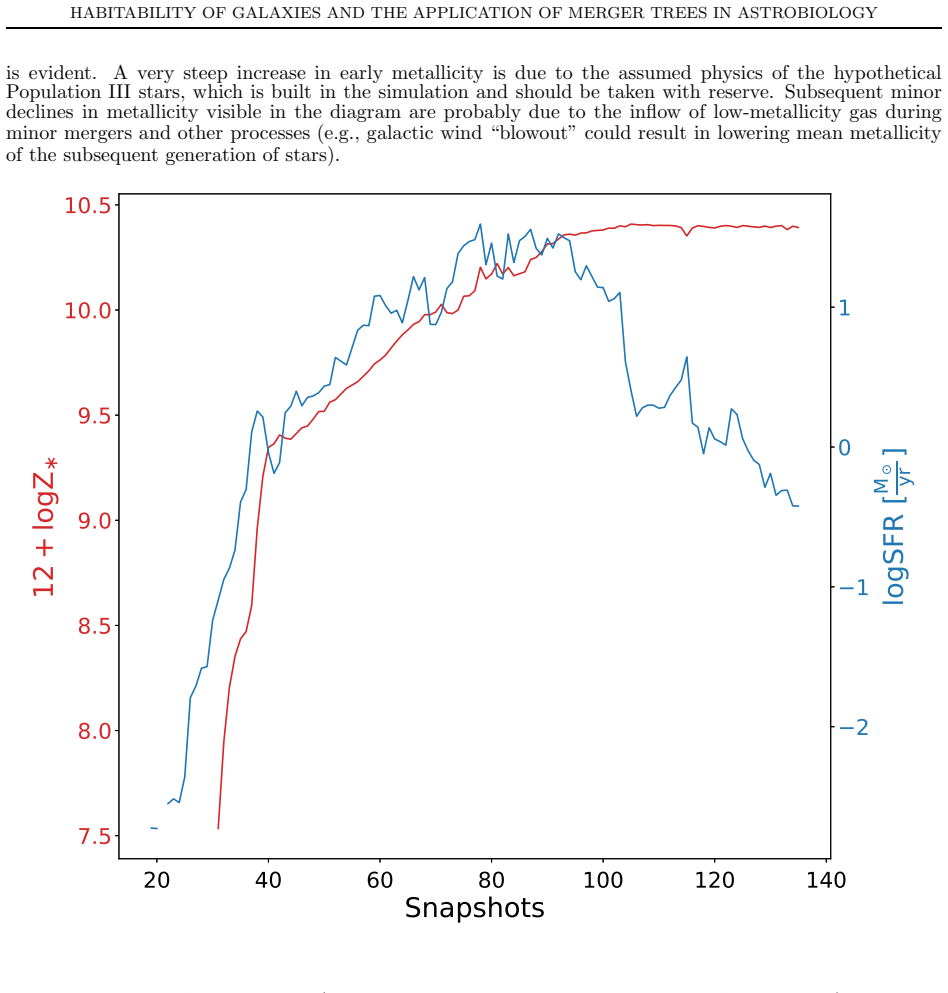
The central machinery is the cosmological merger tree: a genealogy in which a simulated galaxy is traced back through its progenitor dark-matter haloes at successive simulation snapshots, with a merger counted whenever a galaxy has more than one direct progenitor. The trees are extracted from the Illustris simulation, and for each of the 908 selected subhaloes the paper tabulates the total merger count together with stellar mass, stellar and gas-phase metallicity, and star formation rate. The merger count is the organising variable: plotting metallicity against merger count is what turns an abstract method into a claim about habitability.
What would settle it
Run the same analysis on merger trees built from the same galaxies with twice the time resolution or with a different tree-construction algorithm; if the metallicity-versus-merger-count trend weakens or disappears, it is an artifact of how mergers are counted. Observationally, a substantial population of high-merger-count galaxies with low stellar metallicity would contradict the reported correlation.
Extended reading notes
Core claim
The paper's central discovery is a correlation: among 908 simulated galaxies of total mass in the range $[8 \times 10^{11}, 2 \times 10^{12}]\,M_\odot$, the number of mergers in a galaxy's history correlates with its present-day stellar metallicity, and a similar trend holds for gas-phase metallicity. The stellar trend is presented as the cleaner of the two, which the paper explains by noting that merger-driven starbursts enrich both components but the gas is partially diluted by the infall of low-metallicity gas from the smaller merging systems. The paper then makes the interpretation that this enrichment boost is a genuine habitability factor, but one that can be counterbalanced by the temporary increase in star formation and supernova rate that accompanies mergers, so the net effect on habitability depends on where a given galaxy sits in this balance.
Load-bearing premise
The argument assumes that the merger trees correctly recover the number and timing of past collisions for each of the 908 galaxies, so that the counted mergers are a faithful record of the events that drive chemical enrichment.
Editorial extensions
If this is right
- Habitability rankings based solely on present-day morphology or stellar mass are incomplete; merger count is a distinct historical variable that must be included.
- The enrichment boost from mergers increases the mass of stars around which terrestrial planets can form, while the accompanying starbursts raise the supernova and gamma-ray-burst irradiation rate, so the most habitable galaxies may be those with an intermediate merger load.
- Properties that correlate with merger count across many trees are systematic and lawful, while scatter at fixed merger count marks the contingent part of galactic history.
- The balance between enrichment and irradiation can reconcile the earlier conflicting conclusions: both quiescent early-type galaxies and actively star-forming spirals can be highly habitable, at different phases of their histories.
Reading between the lines
- If the trend is robust, merger count could serve as a practical, distance-independent proxy for chemical enrichment in galaxies too faint for detailed abundance measurements.
- The enrichment-irradiation trade-off suggests a testable hump-shaped relation between habitability and merger count: too few mergers leaves gas too metal-poor for rocky planets, and too many makes sterilising events too frequent.
- The same merger trees could be re-weighted with explicit models of active galactic nuclei and cosmic-ray transport, and the correlation could be checked in higher-resolution zoom-in simulations or at lower galaxy masses to see whether it extends beyond the selected massive sample.
Signed reviews
Editorial analysis
A structured set of objections, weighed in public.
Referee Report
Summary. The paper aims to systematize the concept of galactic habitability, critically review the major factors invoked in the literature (age, metallicity, stellar explosion rates, nuclear activity, dynamical stability), and propose cosmological merger trees as a method for separating lawful from contingent evolutionary influences on habitability. As a proof of concept, the authors extract merger trees from the Illustris simulation for 908 subhaloes with total masses in [8e11, 2e12] M_sun and plot stellar and gas-phase metallicity against the total number of mergers in each galaxy's history (Figures 4 and 5). They interpret the apparent positive trend as evidence that mergers significantly boost stellar metallicity and argue that this effect, counterbalanced by merger-driven star formation and supernova irradiation, can reconcile the conflicting habitability conclusions of Dayal et al. (2015) and Gobat and Hong (2016).
Significance. If the merger-metallicity correlation were established as mass-independent and causal, the paper would introduce a genuinely new variable into galactic astrobiology and would provide a concrete method for connecting cosmological structure formation to habitability. The conceptual taxonomy in Sections 2-3 is useful, and the use of public Illustris data with a clearly described subhalo sample is a strength. The central empirical result, however, is only a qualitative trend: the paper itself labels the results preliminary, and the displayed analysis includes no statistical measure of significance and no control for the mass-metallicity relation. The contribution is therefore more methodological and programmatic than a demonstrated result.
major comments (4)
- [Section 5, Figure 4] The central correlation is not adjusted for galaxy mass. Within the stated sample, total mass ranges over a factor of 2.5 ([8e11, 2e12] M_sun), while the plotted merger counts span roughly an order of magnitude. Both merger count and metallicity increase with halo mass in Lambda-CDM models, and Section 5 itself acknowledges that the mass-metallicity relation is reproduced in Illustris. Since no mass-binned version, partial correlation, or regression with mass as a covariate is provided, the figure as presented cannot distinguish a genuine merger effect from a residual mass-metallicity trend. This is load-bearing because the causal wording ('significant boost') and the proposed reconciliation of Dayal et al. (2015) and Gobat and Hong (2016) rest on this correlation.
- [Section 5, Figures 4 and 5] The figures are two-dimensional histograms with no error bars, no correlation coefficient, and no significance test. The selection of the 908 subhaloes is described only as 'chosen for this precursor study'; no criteria are given regarding mass binning provenance, merger-tree completeness cuts, or redshift cuts. The paper should state the selection function explicitly and add at least a Spearman rank correlation with a significance level, ideally after stratifying by total or stellar mass.
- [Section 5, merger counts] The number of mergers is resolution-dependent, as the authors note: 'this is dependent on the temporal/redshift resolution of the simulation' (citing Fakhouri and Ma 2008). The tree construction is adopted from Rodriguez-Gomez et al. (2015) without validating that the snapshot cadence recovers the complete merger history for this specific subhalo sample. If merger counts are systematically undercounted or overcounted as a function of mass, the trend in Figure 4 could be an artifact of the tree builder. A convergence test using higher-cadence snapshots or a comparison with an independent tree builder would address this concern.
- [Section 5, final paragraph] The claim that 'the emerging picture is likely to resolve the tension' between Dayal et al. (2015) and Gobat and Hong (2016) is not supported by the displayed data, because no link has been shown between merger count and the actual irradiated mass/volume fractions used in those models. The authors show a metallicity trend; they do not compute habitability fractions. A quantitative model or at least a scaling argument connecting merger number to star-formation rate and lethal-radius-weighted volume is needed before this claim can be made.
minor comments (5)
- [Title] The title in the extracted manuscript has a typo: 'MERGER TREE S' should be 'MERGER TREES'.
- [Figures 1-5] Several axis labels render as 'uni2299' instead of the solar-mass symbol; the figures should be regenerated with correct encoding.
- [Section 5, Figures 4 and 5] The axis titles should specify the exact definition and units of metallicity; the text defines Z as the mass fraction of elements heavier than helium, but the figure labels show only '12 + log Z*' and '12 + log Zg'.
- [References] The reference entry for Hoffman et al. (1998) appears to be corrupted, listing the same volume and pages as Heller et al. (2014); the correct bibliographic data should be verified.
- [References] Two submitted papers ('Cirkovic and Balbi 2019' and 'Stojkovic et al. 2019') are cited; these should be updated or clearly marked as submitted/in press in the final version.
Circularity Check
No significant circularity: the central merger–metallicity trend is an externally benchmarked correlation from Illustris data, not a fitted parameter renamed as a prediction.
full rationale
The load-bearing result (Section 5, Figure 4) is a descriptive correlation between merger counts from Illustris merger trees and stellar metallicity for 908 subhaloes. Neither variable is fitted in this paper; both come from the public Illustris simulation and the independent merger-tree construction of Rodriguez-Gomez et al. (2015). The paper explicitly credits Stanway et al. (2018) for originating the merger-tree method and Vogelsberger et al. (2014) for the simulation, so the trend is not derived from the authors' own input. Self-citations to Vukotić et al. (2016) and Stojković et al. (2019) occur in background and discussion contexts and do not support the Figure 4 correlation; therefore they are not load-bearing. The possible mass–metallicity confound identified by a skeptical reading is a causal-inference and control concern, not a circularity of the paper's derivation chain: the paper does not define metallicity in terms of merger count or fit a parameter that is later reported as a prediction. Accordingly no circular step can be exhibited from the text, and the honest finding is no significant circularity (score 0).
Assumptions & free parameters
assumptions (4)
- domain assumption The lambda-CDM cosmological model and the Illustris hydrodynamical simulation adequately reproduce galaxy formation and chemical enrichment.
- domain assumption The merger tree algorithm of Lacey and Cole (1993) and successors used by Rodriguez-Gomez et al. (2015) correctly maps progenitors to descendants across simulation snapshots.
- domain assumption Stellar and gas metallicity are usable proxies for galactic habitability.
- ad hoc to paper The selected sample of 908 subhaloes is representative of the mass range considered.
Cite this review
Pith. "Pith review of Habitability of galaxies and application of merger trees in astrobiology." pith.science (2026). https://pith.science/paper/QWXI2RPK
@misc{pith2026190805935,
  author       = {Pith},
  title        = {Pith review of: Habitability of galaxies and application of merger trees in astrobiology},
  year         = {2026},
  howpublished = {\url{https://pith.science/paper/QWXI2RPK}},
  note         = {Machine review of arXiv:1908.05935}
}
read the original abstract
Galaxies represent the main form of organization of matter in our universe. Therefore, they are of obvious interest for the new multidisciplinary field of astrobiology. In particular, to study habitability of galaxies represents one of the main emerging challenges of theoretical and numerical astrobiology. Its theoretical underpinnings are, however, often confused and vague. Here we present a systematic attempt to list and categorize major causal factors playing a role in emergent habitability of galaxies. Furthermore, we argue that the methodology of cosmological merger trees is particularly useful in delineating what are systematic and lawful astrobiological properties of galaxies at present epoch vs. those which are product of historical contingency and, in particular, interaction with wider extragalactic environment. Employing merger trees extracted from cosmological N-body simulations as a new and promising research method for astrobiology has been pioneered by Stanway et al. (2018). We analyse the general issue of applicability of merger trees and present preliminary results on a set of trees extracted from the Illustris Project. In a sense, this approach is directly complementary to using large-scale cosmological simulations to study habitable zones of individual galaxies with high mass/spatial resolution; taken together, they usher a new era of synergy and synthesis between cosmology and astrobiology.
Figures


Figures from the paper (2 more)


Reference graph
Works this paper leans on
-
[1]
Annis, J.: 1999, J. Brit. Interpl. Soc. , 52, 33-36. Babcock, E. B. and Collins, J. L.: 1929, Proceedings of the National Academy of Sciences of the Unite d States of America , 15, 623-628. Balbi, A. and Tombesi, F.: 2017, Nature Scientific Reports , 7, 16626 (6pp). Balogh, M., et al.: 2004, Mon. Not. R. Astron. Soc. , 348, 1355-1372. Barnes, R., Meadows, ...
work page 1999
-
[102]
Stellar encounters with giant molecular clouds
Kokaia, G. and Davies, M. B.: 2019, Mon. Not. R. Astron. Soc. , in press (preprint arXiv:1903.08026v2). Kragh, H.: 1996, Cosmology and Controversy, Princeton Universit y Press, Princeton. Krasovsky, V. I. and Shklovsky, I. S.: 1957, Dokl. Akad. Nauk SSSR , 116,
work page Pith review arXiv 2019
-
[120]
Habitability of the Universe Before Earth
Turner, M.S.: 2018, Foundations of Physics , 48, 1261-1278. van Bueren, H. G.: 1978, Astron. Astrophys. , 70, 707-717. Vermeij, G. J.: 2006, PNAS, 103, 1804-1809. Vogelsberger, M., Sijacki, D., Kereˇ s, D., Springel, V., and Hernquist, L.: 2012, Mon. Not. R. Astron. Soc. , 425, 3024?3057. Vogelsberger, M., Genel, S., Springel, V., Torrey, P., Sijacki, D.,...
work page 2018
-
[142]
Horneck, G. and Rettberg, P. (eds.): 2007, Complete Course in As trobiology, Wiley-VCH, Weinheim. Hoyle, F. and Hoyle, G.: 1973, The Inferno, William Heinemann, London . Humphries, C. J. and Parenti, L. R.: 1999, Cladistic biogeography, O UP, Oxford. Jagadeesh, M.K., Gudennavar, S.B., Doshi, U. and Safonova, M.: 201 7, Astrophys. Space Sci. , 362(8), 146 ...
work page 2007
-
[177]
Seager, S.: 2013, Science, 340, 577-581. Shields, A. L., Ballard, S. and Johnson, J. A.: 2016, Physics Reports, 663, 1-38. Shock, E. L. and Holland, M. E.: 2007, Astrobiology, 7, 839-851. Simpson, G. G.: 1968, Science, 162, 140-141. 46 HABITABILITY OF GALAXIES AND THE APPLICATION OF MERGER TREE S IN ASTROBIOLOGY Stanway, E. R., Hoskin, M. J., Lane, M. A.,...
work page 2013
-
[183]
Thomas, B. C., Jackman, C. H., Melott, A. L., Laird, C. M., Stolarski, R . S., Gehrels, N., Cannizzo, J. K., Hogan, D. P.: 2005, Astrophys. J. , 622, L153. Thomas, B. C., Melott, A. L., Fields, B. D. and Anthony-Twarog, B. J . : 2008, Astrobiology, 8, 9-16. Thomas, B. C. and Melott, A. L.: 2006, New Journal of Physics , 8,
work page 2005
-
[197]
45 N. STOJKOVI ´C, B. VUKOTI ´C and M.M. ´CIRKOVI´C Lacey, C. and Cole, S.: 1993, Mon. Not. R. Astron. Soc. , 262, 627-649. Laster, H., Tucker, W. H., and Terry, K. D.: 1968, Science, 160, 1138-1139. Laughlin, G. and Adams, F. C.: 2000, Icarus, 145, 614-627. Li, Y. and Zhang, B.: 2015, Astrophys. J. , 810, 41 (7pp). Lineweaver, C. H.: 2001, Icarus, 151, 3...
work page 1993
-
[217]
:1997, Diaspora, Orion/Millennium, London
Egan, G. :1997, Diaspora, Orion/Millennium, London. Ellis, J. and Schramm, D.N.: 1995, Proceedings of the National Academy of Sciences , 92, 235-238. 44 HABITABILITY OF GALAXIES AND THE APPLICATION OF MERGER TREE S IN ASTROBIOLOGY Erlykin, A. D. and Wolfendale, A. W.: 2010, Surveys in Geophysics , 31, 383-398. Fakhouri, O. and Ma, C. P.: 2008, Mon. Not. R...
work page 1997
Show all 10 references
-
[375]
and Schneider, D.P.,: 2012, Astrophys
Cheng, J.Y., Rockosi, C.M., Morrison, H.L., Sch¨ onrich, R.A., Lee, Y.S., Beers, T.C., Bizyaev, D., Pan, K. and Schneider, D.P.,: 2012, Astrophys. J. , 746, 149 (23pp). Chopra, A. and Lineweaver, C. H.: 2016, Astrobiology, 16, 7-22. Chyba, C. F. and Hand, K.: 2005, Annu. Rev. ...
2012
-
[1102]
Franck, S., Block, A., von Bloh, W., Bounama, C., Garrido, I
Forgan, D., Dayal, P., Cockell, C., and Libeskind, N.: 2017, International Journal of Astrobiology , 16, 60-73. Franck, S., Block, A., von Bloh, W., Bounama, C., Garrido, I. and Sche llnhuber, H. -J.: 2001, Naturwiss., 88, 416?426. Gehrels, N., Laird, C.M., Jackman, C.H., Cann...
2017
Reviewed August 14, 2026 · model on record in the stance chip above.
Discussion (0). Continue with ORCID to comment.