The B^+ to K^+ ν bar ν decay as a QCD axion search: comparing reinterpretation approaches
Pith reviewed 2026-06-26 16:40 UTC · model grok-4.3
The pith
Choice of kinematic axes alone produces the factor-of-four difference in Belle II limits on B+ to K+ a.
A machine-rendered reading of the paper's core claim, the machinery that carries it, and where it could break.
Core claim
The central claim is that the kinematic-axes choice alone accounts for the factor-of-four sensitivity difference, and that the B+ to K+ a bound varies sizeably within the q2_rec times eta(BDT2) space, depending on the SM-likeness of B+ to K+ nu nubar, thus losing the dual-probe feature of the q2_rec-based approach.
What carries the argument
The reconstructed di-neutrino invariant mass q2_rec, whose fine-grained binning isolates the narrow axion peak while coarse binning dilutes it into background.
If this is right
- The B+ to K+ a bound varies sizeably across the q2_rec times eta(BDT2) plane once the SM-likeness of the background is varied.
- Likelihoods dominated by BDT variables lose discriminating power when the signal shape differs appreciably from the training signal.
- Experimental collaborations should publish likelihood projections in physical variable spaces alongside BDT-based likelihoods.
Where Pith is reading between the lines
- Searches for other light invisible particles in rare B decays would gain from reanalyses that prioritize q2_rec-style variables over BDT combinations.
- Data releases that include only BDT-dominated likelihoods systematically reduce the ability of theorists to test models whose kinematics deviate from the training sample.
- Adopting fine q2_rec binning as a standard could tighten axion and dark-photon constraints from existing B-factory data without new runs.
Load-bearing premise
That including the omitted subleading shape systematics would lower rather than raise the B+ to K+ a limit by better accommodating the nu nubar shape.
What would settle it
A re-fit of the published Belle II data that uses only the published q2_rec binning and no BDT2 axis, which should recover a limit within a factor of roughly four of the tighter published result.
Figures

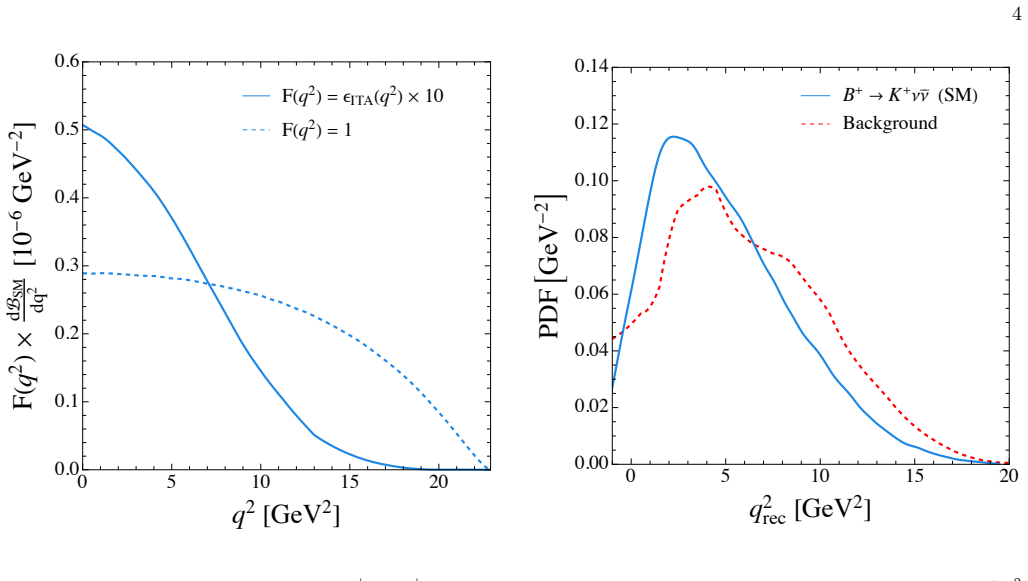

read the original abstract
Two recent independent analyses of Belle II $B^+ \! \to \! K^+\nu\bar\nu$ data yield limits on ${\mathcal B}(B^+ \! \to \! K^+ a)$ -- the two-body mode to a light invisible particle such as the QCD axion -- differing by a factor of roughly four; we trace this to the choice of kinematic variable space. The central figure of merit is the resolution in the reconstructed di-neutrino invariant mass $q^2_{\rm rec}$: fine-grained binning resolves the narrow axion signal, while coarse binning dilutes it into a background-dominated range. A BDT axis trained on $B^+ \! \to \! K^+\nu\bar\nu$ adds little discriminating power for $B^+ \! \to \! K^+ a$, as this axis is largely uncorrelated with $q^2$. These expectations are confirmed by a set of numerical tests. The subleading shape systematics omitted from our $q^2_{\rm rec}$-based approach {\em lower}, not raise, the $B^+ \! \to \! K^+ a$ limit: by better accommodating the $B^+ \! \to \! K^+\nu\bar\nu$ shape, they leave less room for the axion signal, making our $q^2_{\rm rec}$-based bound conservative, if anything. A dedicated reanalysis confirms that the kinematic-axes choice alone accounts for the factor-of-four sensitivity difference, and that the $B^+ \! \to \! K^+ a$ bound varies sizeably within the $q^2_{\rm rec}\times\eta({\rm BDT}_2)$ space, depending on the SM-likeness of $B^+ \! \to \! K^+\nu\bar\nu$, thus losing the dual-probe feature of our $q^2_{\rm rec}$-based approach. These results point to a broader consideration: likelihoods dominated by BDT variables are of limited use for reinterpretations when the signal shape differs appreciably from the BDT's training signal. We therefore advocate that experimental collaborations publish likelihood projections in physical variable spaces alongside BDT-based likelihoods, to maximise the reinterpretability of their measurements.
Editorial analysis
A structured set of objections, weighed in public.
Referee Report
Summary. The paper claims that the factor-of-four discrepancy in Belle II limits on ℬ(B⁺ → K⁺ a) from two independent analyses of B⁺ → K⁺ νν̄ data arises solely from the choice of kinematic axes: fine binning in the reconstructed q²_rec resolves the narrow axion peak while coarse binning or BDT₂ axes dilute it. This is supported by numerical tests and a dedicated reanalysis showing that the B⁺ → K⁺ a bound varies substantially across the q²_rec × η(BDT₂) space. The manuscript further asserts that subleading shape systematics omitted from the q²_rec approach lower (rather than raise) the axion limit by better accommodating the SM shape, rendering the bound conservative, and concludes that experiments should publish likelihoods in physical variables to improve reinterpretability for signals differing from the BDT training sample.
Significance. If the central result on the kinematic origin of the sensitivity difference holds, the work provides a concrete, actionable illustration of how variable choice affects reinterpretation power in rare-decay searches for light invisible particles. The dedicated reanalysis and numerical tests constitute a strength, offering direct, falsifiable evidence that isolates the effect of the axes choice and demonstrates sizeable variation of the bound within the BDT space, thereby supporting the broader recommendation on publishing physical-variable likelihoods.
major comments (1)
- [Abstract] Abstract (and the section discussing the q²_rec-based approach): the assertion that omitted subleading shape systematics 'lower, not raise, the B⁺ → K⁺ a limit' because they 'better accommodate the B⁺ → K⁺ νν̄ shape' is load-bearing for the claim that the q²_rec bound is conservative. However, the manuscript supplies no description of the numerical tests (construction, size of shape variations, or quantitative limit shift), leaving the directionality unverified a priori and weakening support for the overall reinterpretation recommendation.
minor comments (1)
- [Abstract] The abstract is dense and would benefit from a single quantitative statement of the factor-of-four difference and the size of the variation found in the dedicated reanalysis.
Simulated Author's Rebuttal
We thank the referee for their careful reading of the manuscript and for highlighting this important point regarding the presentation of our numerical tests. We address the comment below.
read point-by-point responses
-
Referee: [Abstract] Abstract (and the section discussing the q²_rec-based approach): the assertion that omitted subleading shape systematics 'lower, not raise, the B⁺ → K⁺ a limit' because they 'better accommodate the B⁺ → K⁺ νν̄ shape' is load-bearing for the claim that the q²_rec bound is conservative. However, the manuscript supplies no description of the numerical tests (construction, size of shape variations, or quantitative limit shift), leaving the directionality unverified a priori and weakening support for the overall reinterpretation recommendation.
Authors: We agree that the current manuscript lacks sufficient detail on the numerical tests underlying the claim about subleading shape systematics. These tests consist of introducing controlled variations to the SM background shape parameters (within the range of subleading uncertainties not included in the primary fit) and refitting the axion signal strength in the q²_rec distribution; the resulting limits are observed to weaken relative to the baseline. In the revised version we will add an explicit description of the test construction, the size of the variations explored, and the quantitative shift in the extracted B⁺ → K⁺ a limit, thereby verifying the stated directionality and strengthening support for the reinterpretation recommendation. revision: yes
Circularity Check
No significant circularity detected
full rationale
The paper's core claim—that the factor-of-four difference arises from the kinematic variable choice—is supported by explicit numerical tests and a dedicated reanalysis of public data, which constitute independent verification rather than reduction to self-definitional equations, fitted inputs renamed as predictions, or load-bearing self-citations. No self-citation chains, ansatzes smuggled via prior work, or uniqueness theorems imported from the authors appear in the derivation. The statement on subleading systematics is an ancillary observation also tied to the same tests and does not form the load-bearing step for the main result.
Axiom & Free-Parameter Ledger
axioms (2)
- domain assumption Belle II detector resolution permits fine binning in q2_rec that can isolate a narrow two-body signal from three-body background
- domain assumption The BDT axis trained on the SM decay is largely uncorrelated with q2
Reference graph
Works this paper leans on
-
[1]
The $B^+ \to K^+ \nu \bar \nu$ decay as a search for the QCD axion
M. Abumusabh, G. Dujany, D. Guadagnoli, A. Iohner, and C. Toni, UsingB+→K+ν¯νto search for the QCD axion, Phys. Rev. Res.8, 023129 (2026), arXiv:2510.18953 [hep-ph]. 8
work page internal anchor Pith review Pith/arXiv arXiv 2026
-
[2]
J. Martin Camalich, M. Pospelov, P. N. H. Vuong, R. Ziegler, and J. Zupan, Quark Flavor Phenomenology of the QCD Axion, Phys. Rev. D102, 015023 (2020), arXiv:2002.04623 [hep-ph]
- [3]
-
[4]
L. Gärtner, N. Krug, T. Kuhr, M. A. Schmidt, S. Stefkova, and B. Yabsley, Constraints on invisibleB+→K+Xdecays from the Belle IIB+→K+ν¯νmeasurement, (2026), arXiv:2602.09666 [hep-ph]
-
[5]
M. Abumusabhet al.(Belle-II), Model-agnostic likelihood for the reinterpretation of theB +→K+ν¯νmeasurement at Belle II, Phys. Rev. D112, 092016 (2025), arXiv:2507.12393 [hep-ex]
-
[6]
Adachiet al.(Belle-II), Evidence forB +→K+ν¯νdecays, Phys
I. Adachiet al.(Belle-II), Evidence forB +→K+ν¯νdecays, Phys. Rev. D109, 112006 (2024), arXiv:2311.14647 [hep-ex]
-
[7]
K. Fridell, M. Ghosh, T. Okui, and K. Tobioka, Decoding theB→Kν¯νexcess at Belle II: Kinematics, operators, and masses, Phys. Rev. D109, 115006 (2024), arXiv:2312.12507 [hep-ph]
- [8]
- [9]
-
[10]
Navaset al.(Particle Data Group), Review of particle physics, Phys
S. Navaset al.(Particle Data Group), Review of particle physics, Phys. Rev. D110, 030001 (2024)
2024
discussion (0)
Sign in with ORCID, Apple, or X to comment. Anyone can read and Pith papers without signing in.