REVIEW 1 major objections 22 references
Encounter-based information propagation in multi-robot systems is limited by access, staleness, and geometry.
Reviewed by Pith at T0; open to challenge. T0 means a machine referee read the full paper against a public rubric. the ladder, T0–T4 →
T0 review · grok-4.3
2026-06-28 14:31 UTC pith:QXHJVPJD
load-bearing objection The paper frames encounter-based info flow in robot teams as an access-staleness-geometry decomposition and shows that the coordinates track tracking error in large idealized simulations. the 1 major comments →
A Kinetic Theory of Encounter-Based Information Propagation in Multi-Robot Systems
The pith
A machine-rendered reading of the paper's core claim, the machinery that carries it, and where it could break.
Core claim
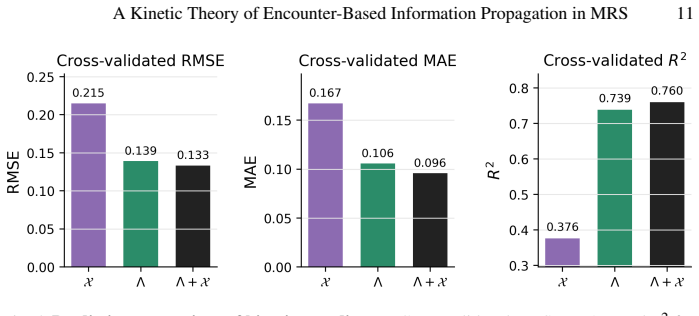
The paper claims that tracking error under encounter-based communication decomposes into an access transition governed by communication coverage, a staleness regime shaped by target displacement, and a geometry saturation regime where further communication gains have diminishing returns. The access and staleness coordinates derived from this decomposition reliably describe tracking performance across controlled sweeps and joint variation of team size, operating area, communication range, and target speed.
What carries the argument
The access-staleness-geometry decomposition, which partitions tracking error according to whether information has spread to the team, how much the target has moved since the last update, and the spatial constraints on encounter-driven transport.
Load-bearing premise
Large-scale simulations with idealized encounter models and target motion capture the kinetic information-transport dynamics without unmodeled effects such as localization error, packet loss, or non-uniform robot distributions.
What would settle it
Real-robot experiments in which the access and staleness coordinates no longer reliably predict observed tracking error under conditions that include localization error or packet loss would falsify the decomposition's applicability.
If this is right
- Communication coverage governs the access transition.
- Once information is accessible, tracking error is shaped by target displacement.
- This response is locally linear in restricted regimes but nonlinear over broader ranges because of sensing refreshes and bounded geometry.
- When target motion outpaces information transport, tracking error approaches saturation where communication improvements alone have diminishing returns.
Where Pith is reading between the lines
- Robot motion strategies could be tuned to raise encounter rates and thereby lower the access limit.
- The same decomposition may apply to information flow in other encounter-driven mobile systems such as vehicle fleets.
- Hardware validation would test whether the coordinates remain predictive once real effects like localization error are present.
Editorial analysis
A structured set of objections, weighed in public.
Referee Report
Summary. The paper develops a kinetic theory of encounter-based information propagation in multi-robot target tracking. It identifies three limits (access, staleness, geometry) and claims that derived access and staleness coordinates reliably describe tracking performance, supported by large-scale simulations varying team size, operating area, communication range, and target speed.
Significance. If the decomposition holds, the work provides a structured kinetic-theoretic framework for predicting information transport and tracking error in intermittently connected multi-robot systems, identifying regimes where communication gains saturate due to geometry. This could aid design in communication-limited robotics settings.
major comments (1)
- [Simulation evaluation and results] The evaluation consists exclusively of large-scale simulations that instantiate the exact idealized encounter models, random target motion, and perfect communication assumptions used to derive the access-staleness-geometry limits (abstract). No perturbations such as localization error, packet loss, or spatial inhomogeneity are introduced, so the claim that the coordinates 'reliably describe tracking performance across controlled sweeps and joint variation' is shown only within the model and remains untested against the model-reality gap. This is load-bearing for the central contribution.
Simulated Author's Rebuttal
We thank the referee for the detailed and constructive review. We address the major comment below.
read point-by-point responses
-
Referee: [Simulation evaluation and results] The evaluation consists exclusively of large-scale simulations that instantiate the exact idealized encounter models, random target motion, and perfect communication assumptions used to derive the access-staleness-geometry limits (abstract). No perturbations such as localization error, packet loss, or spatial inhomogeneity are introduced, so the claim that the coordinates 'reliably describe tracking performance across controlled sweeps and joint variation' is shown only within the model and remains untested against the model-reality gap. This is load-bearing for the central contribution.
Authors: We acknowledge that the simulations instantiate the idealized encounter models, random target motion, and perfect communication assumptions of the kinetic theory without introducing perturbations such as localization error, packet loss, or spatial inhomogeneity. This design choice isolates the access-staleness-geometry decomposition to validate the theory under the exact conditions in which it is derived. The results demonstrate that the derived coordinates reliably describe tracking performance trends across the controlled sweeps and joint variations within this setting. We agree that the evaluation does not address the model-reality gap and that this limits direct claims about physical systems. In the revised manuscript we will explicitly clarify the scope of the evaluation, state that the validation is within the model assumptions, and add a discussion of the model-reality gap together with suggested extensions for future work. The central contribution remains the derivation of the kinetic framework and its confirmation under the stated assumptions. revision: partial
Circularity Check
No circularity: kinetic limits derived from encounter model assumptions, then checked against independent simulation runs under the same assumptions.
full rationale
The abstract states that the access, staleness, and geometry limits are identified from the kinetic theory of encounter-based propagation. Simulations are then used to evaluate whether the derived coordinates describe performance across parameter sweeps. No equations or steps are shown that define the coordinates by fitting to the validation data, nor is any load-bearing claim reduced to a self-citation or ansatz smuggled from prior author work. The derivation chain therefore remains independent of the reported simulation outcomes.
Axiom & Free-Parameter Ledger
read the original abstract
Multi-robot systems cannot assume persistent network connectivity. We study this problem through target tracking, where performance depends on how quickly target information is sensed, transported through the team, and used before it becomes stale. When robots exchange information only through physical encounters, tracking becomes a kinetic information-transport problem: robot motion induces encounters, encounters carry target-state estimates, information age determines staleness, and stale information produces tracking error. This paper develops a kinetic theory of encounter-based information propagation and identifies three limits. The first is an access limit -- information cannot support team-level coordination unless it spreads beyond the robots that sensed it. The second is a staleness limit -- even propagated information loses value as the target moves. The third is a geometry limit -- when target motion outpaces information transport, tracking error approaches a saturation regime where communication improvements alone have diminishing returns. We evaluate the theory through large-scale simulations varying team size, operating area, communication range, and target speed. Results support the proposed access-staleness-geometry decomposition: communication coverage governs the access transition; once information is accessible, tracking error is shaped by target displacement; and this response is locally linear in restricted regimes but nonlinear over broader ranges because of sensing refreshes and bounded geometry. Across controlled sweeps and joint variation, the derived access and staleness coordinates reliably describe tracking performance. Together, these results establish a kinetic-theoretic framework for predicting and designing encounter-based multi-robot systems.
Figures




Reference graph
Works this paper leans on
-
[1]
A multi-robot control policy for information gathering in the presence of unknown hazards,
M. Schwager, P. Dames, D. Rus, and V . Kumar, “A multi-robot control policy for information gathering in the presence of unknown hazards,” inRobotics Research: The 15th International Symposium ISRR, pp. 455–472, Springer, 2016
2016
-
[2]
Distributed robotic sensor networks: An information-theoretic approach,
B. J. Julian, M. Angermann, M. Schwager, and D. Rus, “Distributed robotic sensor networks: An information-theoretic approach,”The International Journal of Robotics Research, vol. 31, no. 10, pp. 1134–1154, 2012
2012
-
[3]
Communication-aware information-gathering experiments with an unmanned aircraft system,
M. Stachura and E. Frew, “Communication-aware information-gathering experiments with an unmanned aircraft system,”Journal of Field Robotics, vol. 34, no. 4, pp. 736–756, 2017
2017
-
[4]
Path-based sensors: Paths as sensors, bayesian updates, and shannon information gathering,
M. Otte and D. Sofge, “Path-based sensors: Paths as sensors, bayesian updates, and shannon information gathering,”IEEE Transactions on Automation Science and Engineering, vol. 18, no. 3, pp. 946–967, 2021
2021
-
[5]
Distributed multi-robot information gathering using path-based sensors in entropy-weighted voronoi regions,
A. K. Srivastava, G. P. Kontoudis, D. Sofge, and M. Otte, “Distributed multi-robot information gathering using path-based sensors in entropy-weighted voronoi regions,” inInternational Symposium on Distributed Autonomous Robotic Systems, pp. 286–299, Springer, 2022. 16 A.K. Srivastava and P. Dames
2022
-
[6]
Valuing attrition in a fleet of robots used as path- based sensors for gathering information in a communications restricted environment,
L. McGuire, M. Otte, and D. Sofge, “Valuing attrition in a fleet of robots used as path- based sensors for gathering information in a communications restricted environment,” in2024 IEEE/RSJ International Conference on Intelligent Robots and Systems (IROS), pp. 7633–7640, IEEE, 2024
2024
-
[7]
A. K. Srivastava, A. Suresh, and C. Nieto-Granda, “Behaviorally adaptive multi-robot hazard localization in failure-prone, communication-denied environments,”arXiv preprint arXiv:2508.04537, 2025
-
[8]
Beyond robustness: A taxonomy of approaches towards resilient multi-robot systems,
A. Prorok, M. Malencia, L. Carlone, G. S. Sukhatme, B. M. Sadler, and V . Kumar, “Beyond robustness: A taxonomy of approaches towards resilient multi-robot systems,”arXiv preprint arXiv:2109.12343, 2021
-
[9]
Multi-robot target tracking with sensing and communication danger zones,
J. Liu, P. Li, Y . Wu, G. S. Sukhatme, V . Kumar, and L. Zhou, “Multi-robot target tracking with sensing and communication danger zones,” inInternational Symposium on Distributed Autonomous Robotic Systems, pp. 600–615, Springer, 2024
2024
-
[10]
Bayesian networks for path-based sensors: Gathering information and path planning in communication denied environments,
A. K. Srivastava, G. P. Kontoudis, D. Sofge, and M. Otte, “Bayesian networks for path-based sensors: Gathering information and path planning in communication denied environments,” World Symposium on the Algorithmic Foundations of Robotics (WAFR), 2026
2026
-
[11]
Age of information: An introduction and survey,
R. D. Yates, Y . Sun, D. R. Brown, S. K. Kaul, E. Modiano, and S. Ulukus, “Age of information: An introduction and survey,”IEEE Journal on Selected Areas in Communications, vol. 39, no. 5, pp. 1183–1210, 2021
2021
-
[12]
Age of information: A new concept, metric, and tool,
A. Kosta, N. Pappas, and V . Angelakis, “Age of information: A new concept, metric, and tool,” Foundations and Trends in Networking, vol. 12, no. 3, pp. 162–259, 2017
2017
-
[13]
Version age of information with contact mobility in gossip networks,
I. Hasan and A. Arafa, “Version age of information with contact mobility in gossip networks,” inProceedings of the 61st Allerton Conference on Communication, Control, and Computing, Allerton Conference Proceedings, Allerton Conference on Communication, Control, and Computing, 2025
2025
-
[14]
Information distribution in multi-robot systems: Utility-based evaluation model,
M. Barci´s, A. Barci´s, and H. Hellwagner, “Information distribution in multi-robot systems: Utility-based evaluation model,”Sensors, vol. 20, no. 3, p. 710, 2020
2020
-
[15]
Gossip algorithms: Design, analysis and applications,
S. Boyd, A. Ghosh, B. Prabhakar, and D. Shah, “Gossip algorithms: Design, analysis and applications,” inProceedings IEEE 24th Annual Joint Conference of the IEEE Computer and Communications Societies., vol. 3, pp. 1653–1664, IEEE, 2005
2005
-
[16]
Gossip-based ad hoc routing,
Z. J. Haas, J. Y . Halpern, and L. Li, “Gossip-based ad hoc routing,” inProceedings. Twenty- first Annual Joint Conference of the IEEE Computer and Communications Societies, vol. 3, pp. 1707–1716, IEEE, 2002
2002
-
[17]
Efficient routing in intermittently connected mobile networks: The multiple-copy case,
T. Spyropoulos, K. Psounis, and C. S. Raghavendra, “Efficient routing in intermittently connected mobile networks: The multiple-copy case,”IEEE/ACM Transactions on Networking, vol. 16, no. 1, pp. 77–90, 2008
2008
-
[18]
Stauffer and A
D. Stauffer and A. Aharony,Introduction to percolation theory. Taylor & Francis, 2018
2018
-
[19]
Hydrodynamic limits for kinetic flocking models of Cucker-Smale type,
P. Aceves-Sánchez, M. Bostan, J.-A. Carrillo, and P. Degond, “Hydrodynamic limits for kinetic flocking models of Cucker-Smale type,”Mathematical Biosciences and Engineering, vol. 16, no. 6, pp. 7883–7910, 2019
2019
-
[20]
Kinetic theory of self-propelled particles with nematic alignment,
H.-H. Boltz, B. Kohler, and T. Ihle, “Kinetic theory of self-propelled particles with nematic alignment,”Entropy, vol. 26, no. 12, p. 1054, 2024
2024
-
[21]
New trends in kinetic theory toward the complexity of living systems,
N. Bellomo, D. Burini, and J. Liao, “New trends in kinetic theory toward the complexity of living systems,”Mathematical Models and Methods in Applied Sciences, pp. 1–57, 2026
2026
-
[22]
Towards predicting collective performance in multi-robot teams,
P. Xin, Z. Xie, and P. Dames, “Towards predicting collective performance in multi-robot teams,”IEEE Transactions on Robotics, vol. 41, pp. 5229–5245, 2025
2025
discussion (0)
Sign in with ORCID, Apple, or X to comment. Anyone can read and Pith papers without signing in.