REVIEW 3 major objections 4 minor 76 references
Deep Contextualized Word Embeddings in Transition-Based and Graph-Based Dependency Parsing -- A Tale of Two Parsers Revisited
T0 review · 3 major / 4 minor · reviewed 2026-08-14 · deepseek-v4-flash
Pith's one-line read The paper claims that deep contextualized word embeddings reduce parsing errors more in transition-based dependency parsers than in graph-based ones, across 13 languages.
desk verdict A solid, carefully controlled empirical comparison whose aggregate claim holds up, but the family-level conclusion is stretched beyond the single parser pair tested, and one per-language claim is contradicted by the paper's own table. read the letter →
The pith
A machine-rendered reading of the paper's core claim, the machinery that carries it, and where it could break.
The reading
What carries the argument
The machinery is the pairing of a common parser infrastructure with two scoring models and two embedding regimes. The transition-based system is an arc-hybrid parser with a swap transition, scored by an MLP over the top of the stack and the buffer; the graph-based system is an arc-factored model that scores all head-dependent arcs and extracts a maximum spanning tree with the Chu-Liu-Edmonds algorithm. The intervention is deep contextualized embeddings—ELMo's layer-wise BiLSTM combination and BERT's transformer layers 4 through 8, concatenated with token vectors. The mechanism doing the explanatory work is that these embeddings inject global sentence context into the local feature vectors each parser scores, which should differentially rescue the greedy transition-based parser from search errors while giving the graph-based parser only a marginal feature-scope extension.
What would settle it
Repeat the 13-language comparison with a biaffine graph-based parser and a beam-search or globally trained transition-based parser under identical ELMo and BERT embeddings, and check whether the transition-based parser still shows a significantly larger error reduction; if it does not, the central claim is falsified.
Extended reading notes
Core claim
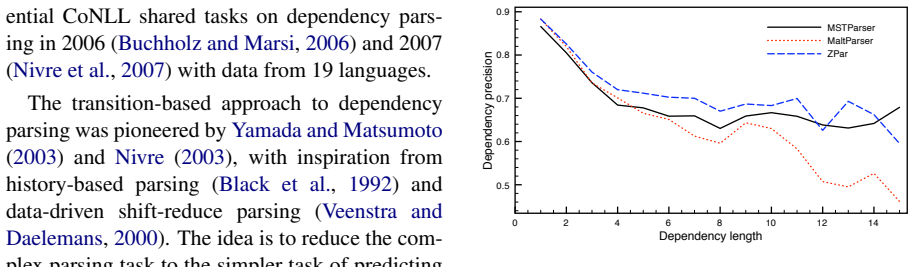
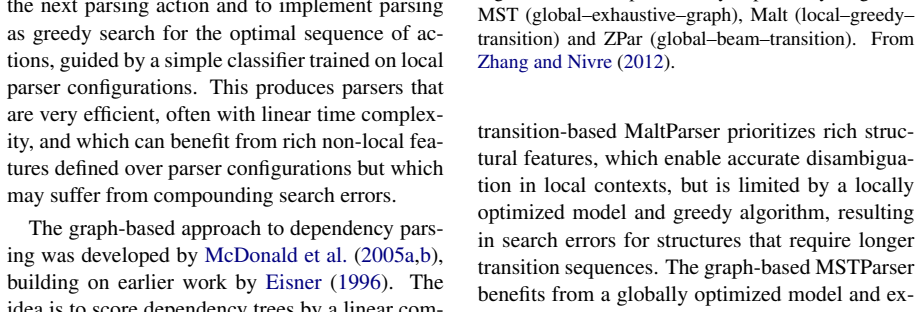
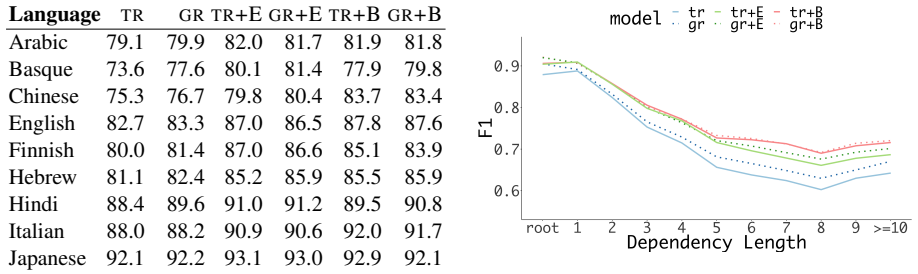
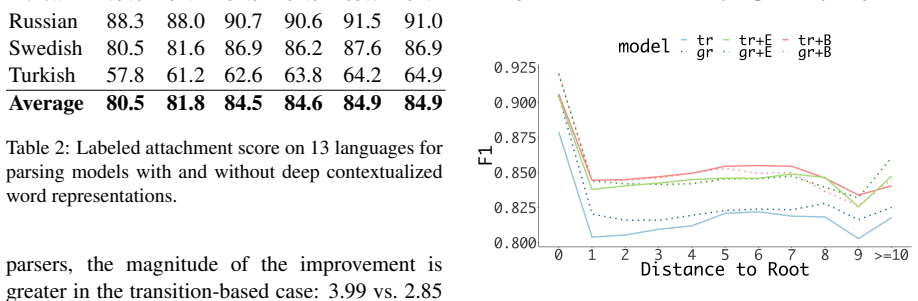
The central discovery is that the historical complementarity of transition-based and graph-based dependency parsers persists in neural baselines but largely disappears when deep contextualized word representations are added, because the representations help the transition-based parser more. On 13 Universal Dependencies treebanks, adding ELMo improves average labeled attachment score by 3.99 points for the transition-based parser versus 2.85 for the graph-based parser, and BERT gives 4.47 versus 3.13; in relative error reduction that is 21.1% versus 16.5% and 22.5% versus 17.4%, differences significant at alpha = 0.01. Error analysis shows the transition-based parser gains most on long dependencies and dependencies near the root—the places where greedy search previously failed—and both parsers improve on longer sentences, sometimes parsing medium-length sentences better than short ones. The authors argue this happens because contextualized embeddings make global sentence structure locally available, reducing search errors while preserving the transition-based parser's strength in local decisions.
Load-bearing premise
The load-bearing premise is that the two UUParser configurations represent their parser families fairly; if stronger graph-based parsers or beam-search transition-based parsers were used, the measured differential benefit of contextual embeddings could shrink, reverse, or vanish.
Editorial extensions
If this is right
- With contextualized embeddings, the two parser families reach nearly identical average labeled attachment score (84.5 vs 84.6 with ELMo, 84.9 vs 84.9 with BERT), closing the historical accuracy gap.
- The transition-based parser improves more than the graph-based parser in every one of the 13 languages, not just on average.
- Error analysis shows the transition-based parser's extra gains concentrate on long dependencies and dependencies near the root, the structures where greedy search previously failed.
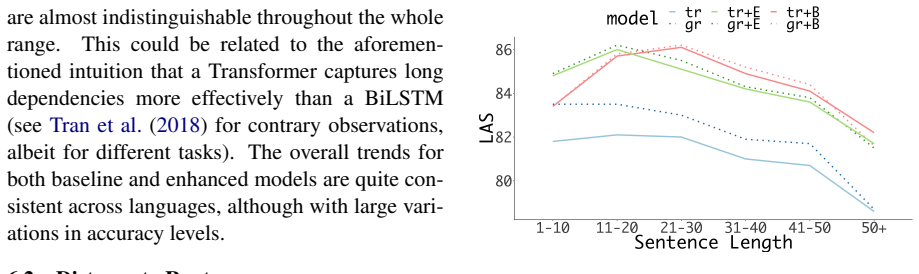
- Both enhanced parsers parse longer sentences better, and several language-model combinations even score higher on medium-length sentences than on short ones.
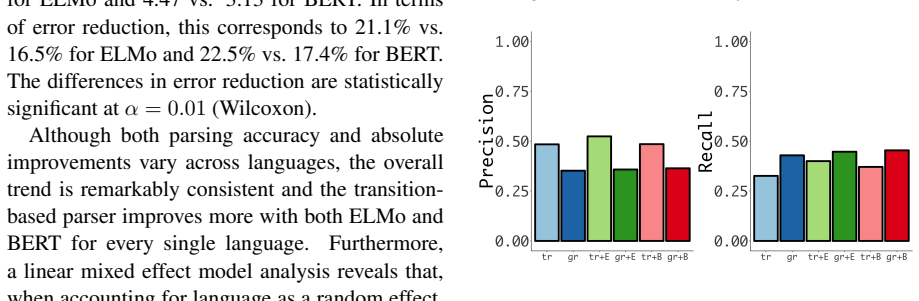
- Adding contextualized embeddings improves the transition-based parser's precision and recall on non-projective dependencies while leaving the graph-based parser's non-projective behavior nearly unchanged.
Reading between the lines
- Beyond the paper's design, a stronger graph-based parser (for example, a biaffine model) or a beam-search transition-based parser could change the measured differential, since each family is represented here by a single implementation.
- If the proposed mechanism is correct, further improvements in contextual representations should continue to shrink architecture-driven differences, making parser family a smaller factor in dependency parsing accuracy.
- A direct test of the explanation would be to compare oracle transition sequences with and without contextual embeddings; the paper's account predicts a sharp drop in search errors for the transition-based parser.
Signed reviews
Editorial analysis
A structured set of objections, weighed in public.
Referee Report
Summary. The paper revisits McDonald and Nivre's classic comparison of transition-based and graph-based dependency parsers in the neural era. Using UUParser, the authors compare an arc-hybrid transition-based parser and an arc-factored first-order graph-based parser under three input conditions: baseline (fastText + character BiLSTM), ELMo-augmented, and BERT-augmented, across 13 Universal Dependencies treebanks. The central hypothesis is that deep contextualized word embeddings reduce errors more in transition-based parsing than in graph-based parsing. Average LAS results show larger absolute and relative improvements for the transition-based parser (ELMo: +3.99 vs. +2.85, 21.1% vs. 16.5% error reduction; BERT: +4.47 vs. +3.13, 22.5% vs. 17.4%), and the paper reports a Wilcoxon test significant at α = 0.01. The authors support their explanation with error analyses by dependency length, distance to root, non-projectivity, part of speech, dependency relation, and sentence length, and attribute the transition-based gain to a reduction in search errors enabled by globally informative local representations.
Significance. If the headline finding is robust, it provides an important empirical bridge between classical parser taxonomies and modern contextualized representations, showing that the traditional rich-features-versus-global-optimization trade-off persists and that contextual embeddings differentially alleviate the search-error weakness of greedy transition-based parsers. The study has clear strengths: a controlled comparison within a common parser infrastructure, identical hyperparameters and preprocessing across conditions, three random seeds per configuration, 13 typologically varied languages, open-source code, and a multi-dimensional error analysis that goes well beyond averaged LAS. The paper also makes a concrete, falsifiable hypothesis and tests it directly. The main weaknesses are that the headline conclusion is drawn from one parser per family and that some reported per-language claims are not supported by the paper's own results table.
major comments (3)
- [Section 6, Table 2] The sentence "the transition-based parser improves more with both ELMo and BERT for every single language" is contradicted by the authors' own table. For ELMo, Russian improves by 2.4 LAS points for TR (88.3 to 90.7) but by 2.6 points for GR (88.0 to 90.6), i.e., GR improves more. For BERT, Hindi improves by 1.1 points for TR (88.4 to 89.5) but by 1.2 points for GR (89.6 to 90.8). This statement should be corrected and the "remarkably consistent" characterization revised, since the per-language pattern is not universal even though the aggregate direction is clear.
- [Section 6, statistical test] The paper reports that "the differences in error reduction are statistically significant at α = 0.01 (Wilcoxon)" but gives no test statistic, no exact p-values, no statement of whether the test is one- or two-tailed, and no specification of what quantity was tested (per-language relative error reduction, absolute LAS gain, or something else). Given that Table 2 contains at least two per-language reversals relative to the aggregate direction, the reader cannot determine whether the significant result is driven by the full set of languages or by a few large-magnitude cases. Please report the full test details for the ELMo and BERT comparisons separately, and ideally include confidence intervals or a seed-level analysis.
- [Section 4 and Section 5.1] The hypothesis and conclusions are framed at the level of parser families ("transition-based parsing" vs. "graph-based parsing"), but the evidence comes from exactly one transition-based parser (arc-hybrid with greedy search and dynamic oracle) and one graph-based parser (arc-factored first-order with Chu-Liu-Edmonds) implemented in UUParser. These two models differ not only in family but also in feature scope (up to 12 BiLSTM vectors for the transition-based parser vs. 2 for the graph-based parser), search strategy, and inference algorithm, and the paper explicitly excludes stronger graph-based models such as Dozat et al. (2017). The measured differential benefit may therefore be implementation-specific. Please either add at least one additional parser per family (e.g., a biaffine graph-based parser and a transition-based parser with beam search) to test the family-level claim, or rewrite the central claim to be explicitly about the two specific parsers and motivate why their controlled comparison is nevertheless diagnostic of the underlying trade-off.
minor comments (4)
- [Abstract and Section 7] The abstract says "the basic trade-off ... remains essentially the same," but the paper later concludes that with contextualized embeddings the two parsers become "virtually equivalent" in accuracy and error profile; this wording should be harmonized to avoid seeming contradictory.
- [Section 5.2] The description of preliminary BERT layer-selection experiments ("the latter approach over layers 4–8 consistently yielded the best results") would be more informative with the range of configurations tested and the magnitude of the differences, which is relevant to the reproducibility of the setup.
- [Section 6.5] The phrase "the graph-based parser is more accurate on short sentences and degrades faster" is ambiguous; it should be clarified that the graph-based baseline degrades faster with increasing sentence length, not with decreasing length.
- [Section 4] There is a typo in the repeated phrase "recent recent work" in the third paragraph; also, in Section 2 the word "accurracy" should be "accuracy." A general proofreading pass is recommended.
Circularity Check
No significant circularity: the conclusion is an empirical measurement, not a derivation from fitted inputs or self-cited premises.
full rationale
The paper's central claim is an experimental comparison, not a derivation. The hypothesis in Section 4 that deep contextualized word representations reduce errors more in transition-based than graph-based parsing is tested by running six UUParser configurations (TR/GR, TR+E/GR+E, TR+B/GR+B) on 13 treebanks, with hyperparameters and the ELMo layer-mixture and BERT layer-range choices selected before the hypothesis test in preliminary experiments. The reported differences in error reduction (21.1% vs. 16.5% for ELMo; 22.5% vs. 17.4% for BERT) are measured outcomes, not consequences of the hypothesis or of the fitted representation parameters. Self-citations to UUParser and to McDonald and Nivre (2007, 2011) supply the shared parsing infrastructure and the error-analysis template; they are not invoked to forbid alternatives or to define the target result, and the older error profiles were established on external CoNLL systems. The stated exclusion of the Dozat et al. (2017) biaffine graph-based parser in Section 5.1 is a limitation on external generalization, not a circular reduction, because the comparison is explicitly restricted to parsers sharing the same infrastructure. One internal inconsistency bears on correctness but not circularity: Section 6 claims the transition-based parser improves more 'for every single language,' whereas Table 2 shows Russian improving 2.4 points for TR+E (88.3 to 90.7) and 2.6 points for GR+E (88.0 to 90.6). This overstates per-language consistency and should be weighed in assessing the robustness of the average claim, but it does not make the average result equivalent to its inputs.
Assumptions & free parameters
free parameters (3)
- ELMo layer weights s_j and scalar gamma =
learned per task, values not reported
- BERT layer range for linear combination =
layers 4 to 8
- Parser hyperparameters =
BiLSTM dim 125, MLP dim 100, dropout 0.33, 30 epochs
assumptions (4)
- standard math Chu-Liu-Edmonds algorithm returns a maximum spanning tree for arc-factored scores
- domain assumption Pretrained ELMo and BERT representations contain syntactic structure useful for parsing
- domain assumption Dependency length and distance to root are valid proxies for search-error exposure in transition-based parsing
- domain assumption Pooling 484-sentence samples from each of 13 development sets gives a representative cross-linguistic error profile
Cite this review
Pith. "Pith review of Deep Contextualized Word Embeddings in Transition-Based and Graph-Based Dependency Parsing -- A Tale of Two Parsers Revisited." pith.science (2026). https://pith.science/paper/QY3GHHAA
@misc{pith2026190807397,
  author       = {Pith},
  title        = {Pith review of: Deep Contextualized Word Embeddings in Transition-Based and Graph-Based Dependency Parsing -- A Tale of Two Parsers Revisited},
  year         = {2026},
  howpublished = {\url{https://pith.science/paper/QY3GHHAA}},
  note         = {Machine review of arXiv:1908.07397}
}
read the original abstract
Transition-based and graph-based dependency parsers have previously been shown to have complementary strengths and weaknesses: transition-based parsers exploit rich structural features but suffer from error propagation, while graph-based parsers benefit from global optimization but have restricted feature scope. In this paper, we show that, even though some details of the picture have changed after the switch to neural networks and continuous representations, the basic trade-off between rich features and global optimization remains essentially the same. Moreover, we show that deep contextualized word embeddings, which allow parsers to pack information about global sentence structure into local feature representations, benefit transition-based parsers more than graph-based parsers, making the two approaches virtually equivalent in terms of both accuracy and error profile. We argue that the reason is that these representations help prevent search errors and thereby allow transition-based parsers to better exploit their inherent strength of making accurate local decisions. We support this explanation by an error analysis of parsing experiments on 13 languages.
Figures
Figures from the paper (3 more)
Reference graph
Works this paper leans on
-
[1]
URL: " 'urlintro :=
ENTRY address author booktitle chapter edition editor howpublished institution journal key month note number organization pages publisher school series title type volume year eprint doi pubmed url lastchecked label extra.label sort.label short.list INTEGERS output.state before.all mid.sentence after.sentence after.block STRINGS urlintro eprinturl eprintpr...
-
[2]
write newline
" write newline "" before.all 'output.state := FUNCTION n.dashify 't := "" t empty not t #1 #1 substring "-" = t #1 #2 substring "--" = not "--" * t #2 global.max substring 't := t #1 #1 substring "-" = "-" * t #2 global.max substring 't := while if t #1 #1 substring * t #2 global.max substring 't := if while FUNCTION word.in bbl.in capitalize " " * FUNCT...
-
[3]
Daniel Andor, Chris Alberti, David Weiss, Aliaksei Severyn, Alessandro Presta, Kuzman Ganchev, Slav Petrov, and Michael Collins. 2016. Globally normalized transition-based neural networks. In Proceedings of the 54th Annual Meeting of the Association for Computational Linguistics ( ACL ) , pages 2442--2452
work page 2016
-
[4]
Giuseppe Attardi, Felice Dell’Orletta, Maria Simi, and Joseph Turian. 2009. Accurate dependency parsing with a stacked multilayer perceptron. In Proceedings of EVALITA 2009
work page 2009
-
[5]
Miguel Ballesteros, Chris Dyer, and Noah A. Smith. 2015. Improved transition-based parsing by modeling characters instead of words with LSTM s. In Proceedings of the Conference on Empirical Methods in Natural Language Processing ( EMNLP ) , pages 349--359
work page 2015
-
[6]
Ezra Black, Frederick Jelinek, John D. Lafferty, David M. Magerman, Robert L. Mercer, and Salim Roukos. 1992. Towards history-based grammars: Using richer models for probabilistic parsing. In Proceedings of the 5th DARPA Speech and Natural Language Workshop, pages 31--37
work page 1992
-
[7]
Bernd Bohnet and Jonas Kuhn. 2012. The best of both worlds -- a graph-based completion model for transition-based parsers. In Proceedings of the 13th Conference of the European Chpater of the Association for Computational Linguistics ( EACL ) , pages 77--87
work page 2012
-
[8]
Piotr Bojanowski, Edouard Grave, Armand Joulin, and Tomas Mikolov. 2016. Enriching word vectors with subword information. arXiv preprint arXiv:1607.04606
arXiv 2016
Show all 76 references
-
[9]
Sabine Buchholz and Erwin Marsi. 2006. CoNLL-X shared task on multilingual dependency parsing. In Proceedings of the 10th Conference on Computational Natural Language Learning ( CoNLL ) , pages 149--164
2006
-
[10]
Xavier Carreras. 2007. Experiments with a higher-order projective dependency parser. In Proceedings of the CoNLL Shared Task of EMNLP-CoNLL 2007, pages 957--961
2007
-
[11]
Wanxiang Che, Yijia Liu, Yuxuan Wang, Bo Zheng, and Ting Liu. 2018. Towards better UD parsing: Deep contextualized word embeddings, ensemble, and treebank concatenation. In Proceedings of the C o NLL 2018 Shared Task: Multilingual Parsing from Raw Text to Universal Dependencie...
2018
-
[12]
Danqi Chen and Christopher Manning. 2014. A fast and accurate dependency parser using neural networks. In Proceedings of the Conference on Empirical Methods in Natural Language Processing ( EMNLP ) , pages 740--750
2014
-
[13]
Jacob Devlin, Ming-Wei Chang, Kenton Lee, and Kristina Toutanova. 2019. BERT: pre-training of deep bidirectional transformers for language understanding. In Proceedings of the 2019 Conference of the North A merican Chapter of the Association for Computational Linguistics: Huma...
2019
-
[14]
Timothy Dozat and Christopher D. Manning. 2017. Deep biaffine attention for neural dependency parsing. In Proceedings of the 5th International Conference on Learning Representations
2017
-
[15]
Timothy Dozat, Peng Qi, and Christopher D. Manning. 2017. Stanford's graph-based neural dependency parser at the conll 2017 shared task. In Proceedings of the CoNLL 2017 Shared Task: Multilingual Parsing from Raw Text to Universal Dependencies, pages 20--30
2017
-
[16]
Chris Dyer, Miguel Ballesteros, Wang Ling, Austin Matthews, and Noah A. Smith. 2015. Transition-based dependency parsing with stack long short-term memory. In Proceedings of the 53rd Annual Meeting of the Association for Computational Linguistics ( ACL ) , pages 334--343
2015
-
[17]
Jack Edmonds. 1967. Optimum branchings. Journal of Research of the National Bureau of Standards, 71B:233--240
1967
-
[18]
Jason M. Eisner. 1996. Three new probabilistic models for dependency parsing: An exploration. In Proceedings of the 16th International Conference on Computational Linguistics ( COLING ) , pages 340--345
1996
-
[19]
Agnieszka Falenska and Jonas Kuhn. 2019. The (non-)utility of structural features in B i LSTM -based dependency parsers. In Proceedings of the 57th Annual Meeting of the Association for Computational Linguistics ( ACL ) , pages 117--128
2019
-
[20]
Yoav Goldberg. 2019. Assessing BERT 's syntactic abilities. CoRR, abs/1901.05287
2019 arXiv
-
[21]
Yoav Goldberg and Joakim Nivre. 2012. A dynamic oracle for arc-eager dependency parsing. In Proceedings of the 24th International Conference on Computational Linguistics ( COLING ) , pages 959--976
2012
-
[22]
Yoav Goldberg and Joakim Nivre. 2013. Training deterministic parsers with non-deterministic oracles. Transactions of the Association for Computational Linguistics, 1:403--414
2013
-
[23]
Edouard Grave, Piotr Bojanowski, Prakhar Gupta, Armanpd Joulin, and Tomas Mikolov. 2018. Learning word vectors for 157 languages. In Proceedings of the International Conference on Language Resources and Evaluation (LREC 2018)
2018
-
[24]
Dryer, David Gil, and Bernard Comrie
Martin Haspelmath, Matthew S. Dryer, David Gil, and Bernard Comrie. 2005. Thw World Atlas of Language Structures. Oxford University Press
2005
-
[25]
John Hewitt and Christopher D. Manning. 2019. A structural probe for finding syntax in word representations. In Proceedings of the 2019 Conference of the North A merican Chapter of the Association for Computational Linguistics: Human Language Technologies
2019
-
[26]
Sepp Hochreiter, Yoshua Bengio, Paolo Frasconi, J \"u rgen Schmidhuber, et al. 2001. Gradient flow in recurrent nets: the difficulty of learning long-term dependencies
2001
-
[27]
Sepp Hochreiter and J \"u rgen Schmidhuber. 1997. Long short-term memory. Neural computation, 9(8):1735--1780
1997
-
[28]
Liang Huang and Kenji Sagae. 2010. Dynamic programming for linear-time incremental parsing. In Proceedings of the 48th Annual Meeting of the Association for Computational Linguistics ( ACL ) , pages 1077--1086
2010
-
[29]
Ganesh Jawahar, Benjamin Muller, Amal Fethi, Louis Martin, Eric Villemonte de la Clergerie, Beno \^ t Sagot, and Djam \'e Seddah. 2018. ELM o L ex: Connecting ELM o and lexicon features for dependency parsing. In Proceedings of the C o NLL 2018 Shared Task: Multilingual Parsin...
2018
-
[30]
Richard Johansson and Pierre Nugues. 2007. Incremental dependency parsing using online learning. In Proceedings of the CoNLL Shared Task of EMNLP-CoNLL 2007, pages 1134--1138
2007
-
[31]
Eliyahu Kiperwasser and Yoav Goldberg. 2016. Simple and accurate dependency parsing using bidirectional lstm feature representations. Transactions of the Association for Computational Linguistics, 4:313--327
2016
-
[32]
Daniel Kondratyuk. 2019. 75 languages, 1 model: Parsing universal dependencies universally. CoRR, abs/1904.02099
2019 arXiv
-
[33]
Terry Koo and Michael Collins. 2010. Efficient third-order dependency parsers. In Proceedings of the 48th Annual Meeting of the Association for Computational Linguistics ( ACL ) , pages 1--11
2010
-
[34]
Rush, Michael Collins, Tommi Jaakkola, and David Sontag
Terry Koo, Alexander M. Rush, Michael Collins, Tommi Jaakkola, and David Sontag. 2010. Dual decomposition for parsing with non-projective head automata. In Proceedings of the 2010 Conference on Empirical Methods in Natural Language Processing, pages 1288--1298
2010
-
[35]
Marco Kuhlmann, Carlos G\' o mez-Rodr\' i guez, and Giorgio Satta. 2011. Dynamic programming algorithms for transition-based dependency parsers. In Proceedings of the 49th Annual Meeting of the Association for Computational Linguistics ( ACL ) , pages 673--682
2011
-
[36]
Miryam de Lhoneux, Yan Shao, Ali Basirat, Eliyahu Kiperwasser, Sara Stymne, Yoav Goldberg, and Joakim Nivre. 2017 a . From raw text to U niversal D ependencies -- L ook, no tags! In Proceedings of the CoNLL 2017 Shared Task: Multilingual Parsing from Raw Text to Universal Depe...
2017
-
[37]
Miryam de Lhoneux, Sara Stymne, and Joakim Nivre. 2017 b . Arc-hybrid non-projective dependency parsing with a static-dynamic oracle. In Proceedings of the 15th International Conference on Parsing Technologies, pages 99--104
2017
-
[38]
Miryam de Lhoneux, Sara Stymne, and Joakim Nivre. 2017 c . Old school vs. new school: Comparing transition-based parsers with and without neural network enhancement. In Proceedings of the 15th Treebanks and Linguistic Theories Workshop (TLT)
2017
-
[39]
KyungTae Lim, Cheoneum Park, Changki Lee, and Thierry Poibeau. 2018. SE x B i ST : A multi-source trainable parser with deep contextualized lexical representations. In Proceedings of the C o NLL 2018 Shared Task: Multilingual Parsing from Raw Text to Universal Dependencies , p...
2018
-
[40]
Liu, Matt Gardner, Yonatan Belinkov, Matthew E
Nelson F. Liu, Matt Gardner, Yonatan Belinkov, Matthew E. Peters, and Noah A. Smith. 2019. Linguistic knowledge and transferability of contextual representations. CoRR, abs/1903.08855
2019 arXiv
-
[41]
Ryan McDonald, Koby Crammer, and Fernando Pereira. 2005 a . Online large-margin training of dependency parsers. In Proceedings of the 43rd Annual Meeting of the Association for Computational Linguistics ( ACL ) , pages 91--98
2005
-
[42]
Ryan McDonald, Kevin Lerman, and Fernando Pereira. 2006. Multilingual dependency analysis with a two-stage discriminative parser. In Proceedings of the 10th Conference on Computational Natural Language Learning ( CoNLL ) , pages 216--220
2006
-
[43]
Ryan McDonald and Joakim Nivre. 2007. Characterizing the errors of data-driven dependency parsing models. In Proceedings of the 2007 Joint Conference on Empirical Methods in Natural Language Processing and Computational Natural Language Learning ( EMNLP-CoNLL ) , pages 122--131
2007
-
[44]
Ryan McDonald and Joakim Nivre. 2011. Analyzing and integrating dependency parsers. Computational Linguistics, pages 197--230
2011
-
[45]
Ryan McDonald and Fernando Pereira. 2006. Online learning of approximate dependency parsing algorithms. In Proceedings of the 11th Conference of the European Chapter of the Association for Computational Linguistics ( EACL ) , pages 81--88
2006
-
[46]
Ryan McDonald, Fernando Pereira, Kiril Ribarov, and Jan Haji c . 2005 b . Non-projective dependency parsing using spanning tree algorithms. In Proceedings of the Human Language Technology Conference and the Conference on Empirical Methods in Natural Language Processing (HLT/EM...
2005
-
[47]
Tomas Mikolov, Kai Chen, Greg Corrado, and Jeffrey Dean. 2013. Efficient estimation of word representations in vector space. arXiv preprint arXiv:1301.3781
2013 arXiv
-
[48]
Joakim Nivre. 2003. An efficient algorithm for projective dependency parsing. In Proceedings of the 8th International Workshop on Parsing Technologies ( IWPT ) , pages 149--160
2003
-
[49]
Joakim Nivre. 2008. Algorithms for deterministic incremental dependency parsing. Computational Linguistics, 34:513--553
2008
-
[50]
Joakim Nivre. 2009. Non-projective dependency parsing in expected linear time. In Proceedings of the Joint Conference of the 47th Annual Meeting of the ACL and the 4th International Joint Conference on Natural Language Processing of the AFNLP (ACL-IJCNLP), pages 351--359
2009
-
[51]
o rstell, Cristina Bosco, Gosse Bouma, Sam Bowman, Adriane Boyd, Aljoscha Burchardt, Marie Candito, Bernard Caron, Gauthier Caron, G \
Joakim Nivre, Mitchell Abrams, Z eljko Agi \'c , Lars Ahrenberg, Lene Antonsen, Katya Aplonova, Maria Jesus Aranzabe, Gashaw Arutie, Masayuki Asahara, Luma Ateyah, Mohammed Attia, Aitziber Atutxa, Liesbeth Augustinus, Elena Badmaeva, Miguel Ballesteros, Esha Banerjee, Sebastia...
2018
-
[52]
Joakim Nivre, Johan Hall, Sandra K\"ubler, Ryan McDonald, Jens Nilsson, Sebastian Riedel, and Deniz Yuret. 2007. The CoNLL 2007 shared task on dependency parsing. In Proceedings of the CoNLL Shared Task of EMNLP-CoNLL 2007, pages 915--932
2007
-
[53]
Joakim Nivre, Johan Hall, Jens Nilsson, G \"u lsen Eryi g it, and Svetoslav Marinov. 2006. Labeled pseudo-projective dependency parsing with support vector machines. In Proceedings of the 10th Conference on Computational Natural Language Learning ( CoNLL ) , pages 221--225
2006
-
[54]
Joakim Nivre and Ryan McDonald. 2008. Integrating graph-based and transition-based dependency parsers. In Proceedings of the 46th Annual Meeting of the Association for Computational Linguistics ( ACL ) , pages 950--958
2008
-
[55]
Joakim Nivre and Jens Nilsson. 2005. Pseudo-projective dependency parsing. In Proceedings of the 43rd Annual Meeting of the Association for Computational Linguistics ( ACL ) , pages 99--106
2005
-
[56]
Jeffrey Pennington, Richard Socher, and Christopher Manning. 2014. G love: Global vectors for word representation. In Proceedings of the Conference on Empirical Methods in Natural Language Processing ( EMNLP ) , pages 1532--1543
2014
-
[57]
Peters, Mark Neumann, Mohit Iyyer, Matt Gardner, Christopher clark, Kenton Lee, and Luke Zettlemoyer
Matthew E. Peters, Mark Neumann, Mohit Iyyer, Matt Gardner, Christopher clark, Kenton Lee, and Luke Zettlemoyer. 2018. Deep contextualized word representations. In Proceedings of the 2018 Conference of the North A merican Chapter of the Association for Computational Linguistic...
2018
-
[58]
Peng Qi, Timothy Dozat, Yuhao Zhang, and Christopher D Manning. 2018. Universal dependency parsing from scratch. In Proceedings of the 2018 CoNLL Shared Task: Multilingual Parsing from Raw Text to Universal Dependencies, page 160
2018
-
[59]
Kenji Sagae and Alon Lavie. 2006. Parser combination by reparsing. In Proceedings of the Human Language Technology Conference of the NAACL, Companion Volume: Short Papers, pages 129--132
2006
-
[60]
Tal Schuster, Ori Ram, Regina Barzilay, and Amir Globerson. 2019. https://doi.org/10.18653/v1/N19-1162 Cross-lingual alignment of contextual word embeddings, with applications to zero-shot dependency parsing . In Proceedings of the 2019 Conference of the North A merican Chapte...
2019 doi
-
[61]
Aaron Smith, Bernd Bohnet, Miryam de Lhoneux, Joakim Nivre, Yan Shao, and Sara Stymne. 2018 a . 82 treebanks, 34 models: Universal dependency parsing with multi-treebank models. In Proceedings of the 2018 CoNLL Shared Task: Multilingual Parsing from Raw Text to Universal Dependencies
2018
-
[62]
Aaron Smith, Miryam de Lhoneux, Sara Stymne, and Joakim Nivre. 2018 b . An investigation of the interactions between pre-trained word embeddings, character models and pos tags in dependency parsing. In Proceedings of the 2018 Conference on Empirical Methods in Natural Language...
2018
-
[63]
Thomas McCoy, Najoung Kim, Benjamin Van Durme, Samuel R
Ian Tenney, Patrick Xia, Berlin Chen, Alex Wang, Adam Poliak, R. Thomas McCoy, Najoung Kim, Benjamin Van Durme, Samuel R. Bowman, Dipanjan Das, and Ellie Pavlick. 2019. What do you learn from context? probing for sentence structure in contextualized word representations. In Pr...
2019
-
[64]
Ivan Titov and James Henderson. 2007. A latent variable model for generative dependency parsing. In Proceedings of the 10th International Conference on Parsing Technologies ( IWPT ) , pages 144--155
2007
-
[65]
Ke Tran, Arianna Bisazza, and Christof Monz. 2018. The importance of being recurrent for modeling hierarchical structure. In Proceedings of the 2018 Conference on Empirical Methods in Natural Language Processing, pages 4731--4736
2018
-
[66]
Ashish Vaswani, Noam Shazeer, Niki Parmar, Jakob Uszkoreit, Llion Jones, Aidan N Gomez, ukasz Kaiser, and Illia Polosukhin. 2017. Attention is all you need. In Advances in Neural Information Processing Systems, pages 5998--6008
2017
-
[67]
Jorn Veenstra and Walter Daelemans. 2000. A memory-based alternative for connectionist shift-reduce parsing. Technical Report ILK-0012, Tilburg University
2000
-
[68]
Alex Wang, Amanpreet Singh, Julian Michael, Felix Hill, Omer Levy, and Samuel R. Bowman. 2019. GLUE : A multi-task benchmark and analysis platform for natural language understanding. In Proceedings of the 7th International Conference on Learning Representations
2019
-
[69]
David Weiss, Chris Alberti, Michael Collins, and Slav Petrov. 2015. Structured training for neural network transition-based parsing. In Proceedings of the 53rd Annual Meeting of the Association for Computational Linguistics ( ACL ) , pages 323--333
2015
-
[70]
Yonghui Wu, Mike Schuster, Zhifeng Chen, Quoc V Le, Mohammad Norouzi, Wolfgang Macherey, Maxim Krikun, Yuan Cao, Qin Gao, Klaus Macherey, et al. 2016. Google's neural machine translation system: Bridging the gap between human and machine translation. arXiv preprint arXiv:1609.08144
2016 arXiv
-
[71]
Hiroyasu Yamada and Yuji Matsumoto. 2003. Statistical dependency analysis with support vector machines. In Proceedings of the 8th International Workshop on Parsing Technologies ( IWPT ) , pages 195--206
2003
-
[72]
Daniel Zeman, Jan Haji c , Martin Popel, Martin Potthtyersast, Milan Straka, Filip Ginter, Joakim Nivre, and Slav Petrov. 2018. CoNLL 2018 Shared Task: Multilingual Parsing from Raw Text to Universal Dependencies . In Proceedings of the CoNLL 2018 Shared Task: Multilingual Par...
2018
-
[73]
Hao Zhang and Ryan McDonald. 2012. Generalized higher-order dependency parsing with cube pruning. In Proceedings of the 2012 Joint Conference on Empirical Methods in Natural Language Processing and Computational Natural Language Learning ( EMNLP-CoNLL ) , pages 320--331
2012
-
[74]
Yue Zhang and Stephen Clark. 2008. A tale of two parsers: I nvestigating and combining graph-based and transition-based dependency parsing. In Proceedings of the Conference on Empirical Methods in Natural Language Processing ( EMNLP ) , pages 562--571
2008
-
[75]
Yue Zhang and Joakim Nivre. 2011. Transition-based parsing with rich non-local features. In Proceedings of the 49th Annual Meeting of the Association for Computational Linguistics ( ACL ) , pages 188--193
2011
-
[76]
Yue Zhang and Joakim Nivre. 2012. Analyzing the effect of global learning and beam-search on transition-based dependency parsing. In Proceedings of COLING 2012: Posters, pages 1391--1400
2012
Reviewed August 14, 2026 · model on record in the stance chip above.
Discussion (0). Continue with ORCID to comment.