REVIEW 3 major objections 5 minor 45 references
Learning golf swing signatures from a single wrist-worn inertial sensor
T0 review · 3 major / 5 minor · reviewed 2026-08-06 · deepseek-v4-flash
Pith's one-line read This paper claims that a single wrist-worn inertial sensor, trained on synthetic signals simulated from video-derived professional swings, can reconstruct full-body 3D golf swing kinematics with a mean joint position error of $5.3 \pm…
desk verdict Solid sim-to-real engineering and a useful dataset, but the headline accuracy claims are measured inside a closed synthetic loop and need external validation before believing 'lab-grade on-course'. read the letter →
The pith
A machine-rendered reading of the paper's core claim, the machinery that carries it, and where it could break.
The reading
What carries the argument
The load-bearing mechanism is a synthetic-data loop that turns public swing videos into paired inertial signals and body poses. A video-based whole-body mesh recovery method (WHAM) produces SMPL body parameters from each swing; the poses are then refit with inverse kinematics onto a biomechanical musculoskeletal model whose joint centers and degrees of freedom are anatomically grounded; a simulated wrist sensor on that model generates accelerometer and gyroscope readings. A two-block MLP with 1D convolutions regresses 6D rigid-body orientations from those readings, and OpenSim's inverse kinematics converts the orientations into joint angles and positions. For the signature side, a compositional vector-quantized variational autoencoder (VQ-VAE) using finite scalar quantization discretizes each body part into 210 possible tokens per timestep, and a bidirectional masked transformer learns the spatiotemporal prior over those tokens. The token prior is the device that makes anomaly detection and inpainting possible.
What would settle it
Take a wrist-worn inertial sensor into a motion-capture laboratory, record a set of real swings alongside optical ground truth, and run the trained model on the real sensor readings. If the mean joint position error against optical capture is noticeably larger than the reported $5.3 \pm 1.1$ cm, or if event-detection accuracy drops well below 82.1%, then the synthetic-data premise fails and the on-course claim does not transfer.
Extended reading notes
Core claim
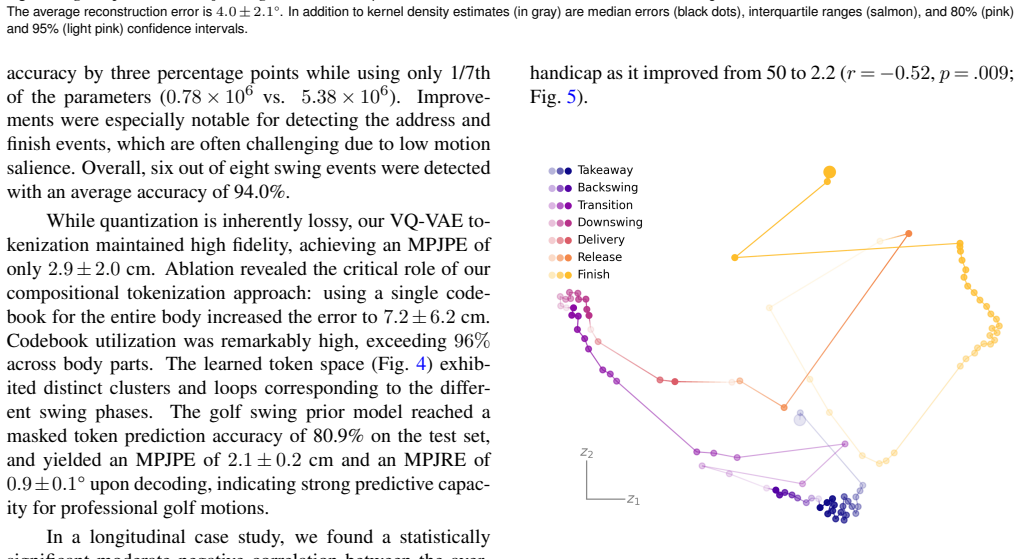
The paper's claim is that accurate, biomechanically meaningful full-body golf swing kinematics can be recovered from a single wrist-worn sensor, and that the recovered motion can be reduced to a discrete codebook of swing primitives without losing the individuality of each player's movement. The network predicts 6D orientations of 26 rigid bodies of a biomechanical model from short windows of simulated inertial data; for professionally annotated swing events, wrist-derived predictions give a mean per-joint position error of $5.3 \pm 1.1$ cm and a mean per-joint rotation error of $4.0 \pm 2.1$ degrees. The tokenization stage, a compositional vector-quantized autoencoder with separate codebooks for arms, legs, and backbone, reconstructs motion with $2.9 \pm 2.0$ cm error, and a masked-transformer prior over tokens reaches 80.9% masked-token prediction accuracy. Downstream, these tokens predict player identity at 87.1% accuracy, club type at 80.3%, sex at 97.6%, and age with a mean absolute error of 4.70 years, using only motion. The authors interpret this as evidence that subtle, distributed movement patterns constitute an individual swing signature.
Load-bearing premise
The entire approach depends on synthetic inertial signals, simulated from video-derived poses, behaving like real wrist-worn sensor readings well enough that a network trained only on simulations works on actual devices.
Editorial extensions
If this is right
- A single wrist-worn inertial sensor could put lab-grade full-body biomechanics on the golf course, removing the need for multi-camera optical capture and expert labor for routine swing analysis.
- The eight key swing events, including hard-to-detect ones like address and finish, can be timed from wrist data alone, making automated swing-phase feedback available to casual players.
- Because the discrete motion tokens carry identity, club type, sex, and age information, the same representation can support player-specific coaching, equipment fitting, and movement-based phenotyping.
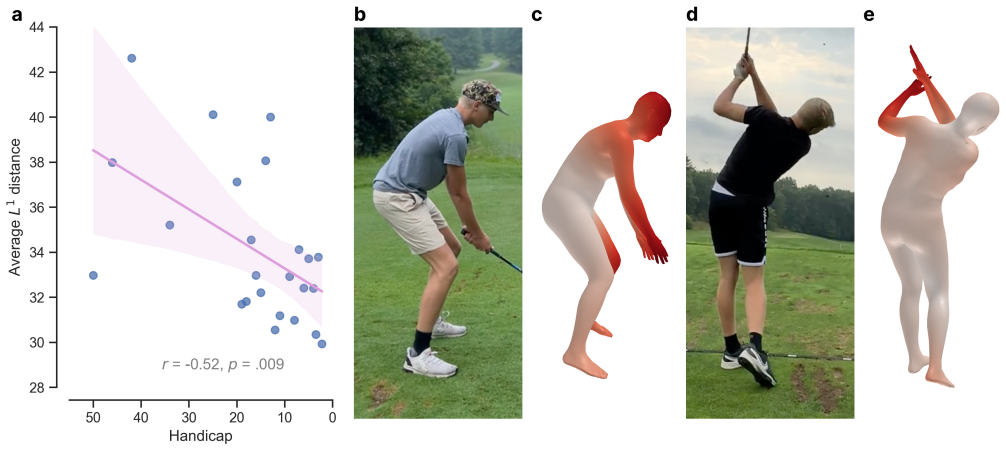
- The reported correlation between a player's token-distance-to-professional-database and improving handicap (from 50 to 2.2) suggests that technical progress can be tracked automatically over time.
- The architecture's separation of body parts into independent codebooks means anomalies can be localized to a limb or phase, allowing feedback to say which movement to change rather than only that a swing is unusual.
Reading between the lines
- Because the pipeline is not golf-specific apart from data and event definitions, the same video-to-synthetic-IMU-to-token recipe could be applied to other cyclic or ballistic sports (tennis serve, baseball pitch, weightlifting) with the same claims of lab-grade field analysis.
- The high player-identification accuracy points toward wearable identity biometrics during movement, but 87.1% across 77 players is not near forensic certainty; scaling to thousands of golfers would test whether the signature remains discriminative.
- The paper's stated limitation about clubhead tracking implies that adding a second sensor on the club could tighten pose estimation and add directly measurable performance variables such as clubhead speed, which the current system cannot report.
- The inpainting mechanism, which replaces anomalous tokens with high-likelihood professional tokens, could be turned into real-time corrective cues if the model is deployed on-device; the paper notes on-device real-time implementation is not yet done.
Editorial analysis
A structured set of objections, weighed in public.
Referee Report
Summary. The paper proposes a framework for golf swing analysis from a single wrist-worn inertial sensor. The authors construct a large dataset of professional golf swing videos, reconstruct 3D kinematics with WHAM, convert the output to a biomechanical musculoskeletal model (BSM), and generate synthetic IMU signals using OpenSense. A neural network is trained to regress full-body BSM kinematics from the synthetic IMU data, and a compositional VQ-VAE tokenizes the motion into discrete per-body-part primitives. Downstream applications include swing-event detection, player identification, club-type and sex classification, age regression, anomaly detection, and a longitudinal case study. The paper reports a mean per-joint position error of 5.3±1.1 cm and a mean per-joint rotation error of 4.0±2.1° on held-out synthetic data, event detection PCE of 82.1%, and 87.1% player identification accuracy from tokenized motion.
Significance. If the synthetic-to-real transfer were validated, this framework could provide scalable, field-based biomechanical analysis for golf and other sports, replacing cumbersome optical motion capture for many applications. The use of a biologically accurate musculoskeletal model, the compositional tokenization, and the analysis of individualized movement signatures are thoughtful and potentially impactful contributions. The paper is also strong in providing a detailed, reproducible pipeline built on open tools (OpenSim, WHAM, SMPL). However, the central quantitative claims rest entirely on a closed simulation loop with no real-sensor or optical-capture validation, which currently limits the significance of the results to a simulation study.
major comments (3)
- [Results, Fig. 3; Discussion] The headline claim of 'lab-grade motion analysis on-course' is not supported by the evidence: the reported MPJPE of 5.3±1.1 cm and MPJRE of 4.0±2.1° are computed on held-out synthetic IMU data generated from the same WHAM-derived BSM poses that serve as ground-truth labels. The Discussion explicitly states that 'the generalizability to real-world sensor inputs... remains an open question' and that WHAM 'only provides pseudo-ground truth.' No experiment uses real wrist-worn sensor data or compares against optical motion capture. Because this is the central claim, the manuscript either needs external validation or must be reframed as a simulation-only study, with the abstract and introduction revised accordingly.
- [Methods: Synthetic data generation] The training and evaluation pipeline is self-referential: OpenSense simulates IMU signals from BSM skeletons fitted to WHAM poses, the regressor is trained to map those signals back to the same BSM poses, and the metrics are measured against those identical poses. The network may therefore be learning the inverse of the OpenSense forward model, and the reported 5.3 cm error could reflect simulator consistency rather than true kinematic accuracy. A sanity check would be to record real IMU data (even a few swings) and quantify the sim-to-real gap, or to state explicitly that all results pertain to the synthetic domain.
- [Results: Event detection, Table 1] The comparison to SwingNet is confounded by input modality: SwingNet processes raw video frames, while the proposed event detector uses predicted BSM poses that are outputs of the same synthetic pipeline and closely match the pseudo-ground truth used for training. The three-point PCE improvement (82.1% vs. 79.2%) may thus reflect a near-perfect pose prior rather than a better event-detection architecture. Please justify the comparison or analyze the sensitivity of PCE to pose error.
minor comments (5)
- [Abstract and Results] Explicitly label the evaluation as 'synthetic' (e.g., 'on simulated IMU signals') to avoid the implication of real-device validation.
- [Fig. 2 caption] State that the 'ground truth' shown in red is the WHAM-derived pseudo-ground truth, not an independent reference.
- [Discussion] The statement 'under 5° of joint angle error' is measured against pseudo-ground truth; consider citing typical errors of marker-based systems for context.
- [Longitudinal case study, Fig. 5] As a single-subject study (N=24 swings from one golfer), the correlation of r=-0.52 should be presented as anecdotal rather than as broad evidence of technical progress.
- [Table 2] Report the number of identities for player identification and the chance-level accuracy to calibrate the 87.1% figure.
Circularity Check
Closed-loop evaluation: synthetic IMU signals are generated from the same WHAM/BSM poses used as ground truth, so the headline 5.3 cm and 4.0° errors validate simulator inversion rather than on-course accuracy.
-
self definitional
[Methods, 'Synthetic data generation' and 'Full-body 3D kinematics prediction']
"From the resulting trajectories of states, synthetic accelerometer and gyroscope data were generated by simulating the output of a wearable sensor artificially placed on the model at the wrist using OpenSense utilities. ... we aimed to predict the corresponding skeleton pose y ... (6D orientation in the global coordinate system of BSM's 26 rigid bodies)."
The input sensor signal x is defined by OpenSense simulation from the BSM pose y, and the network is trained and evaluated to recover that same y from x. The reported mean errors (MPJPE 5.3±1.1 cm, MPJRE 4.0±2.1°) therefore measure how well the network inverts its own sensor simulator on the training distribution. They do not measure accuracy against an independent gold standard such as optical motion capture, so the abstract's 'lab-grade motion analysis on-course' is drawn from a closed loop.
-
other
[Discussion, Limitations]
"our pipeline relies on WHAM (17) for video-based motion reconstruction, which, despite offering state-of-the-art performance, only provides pseudo-ground truth."
The same WHAM-derived poses serve both as the source of the synthetic IMU data and as the reference for the error metrics. Any error in WHAM is invisible to the reported numbers, so the evaluation cannot establish absolute kinematic accuracy; it only checks consistency with the pseudo-ground-truth labels. This makes the headline accuracy numbers self-referential rather than externally validated.
full rationale
The paper's central quantitative claim is evaluated entirely within a simulation loop: WHAM video reconstructions provide SMPL/BSM poses, OpenSense synthesizes wrist IMU signals from those poses, the network is trained to map the synthetic IMU signals back to those same BSM poses, and the error metrics compare the prediction to the same BSM poses. No real wrist-worn sensor data or independent optical motion capture is used in the evaluation. The Discussion explicitly concedes that 'generalizability to real-world sensor inputs, subject to noise, calibration errors, and drift, remains an open question' and that WHAM 'only provides pseudo-ground truth.' Thus the 5.3 cm and 4.0° figures are consistency checks on the synthetic pipeline, not demonstrations of lab-grade on-course accuracy. The downstream signature results (player identification, club type, etc.) inherit the same pseudo-ground-truth limitation, though they are internally valid as representation-learning benchmarks. No self-citation or uniqueness-theorem issue is present. The circularity is partial, not total: the network could still fail to invert the simulator, so the numbers are not vacuous, but the central 'on-course' claim goes beyond what the closed-loop evaluation can support.
Assumptions & free parameters
free parameters (5)
- FSQ quantization levels per body part =
[7,6,5] (codebook size 210)
- Velocity loss weight lambda =
0.5
- Input sequence length L =
32
- Anomaly likelihood threshold =
p < 0.05
- MLP latent dimension =
256
assumptions (7)
- domain assumption WHAM video-based pose estimates are accurate enough to serve as ground-truth labels for training and evaluation
- domain assumption OpenSense synthetic IMU simulation faithfully represents real wrist-worn accelerometer and gyroscope signals
- domain assumption The BSM musculoskeletal model converted to OpenSim preserves biomechanically valid joint kinematics
- domain assumption GolfDB event annotations are accurate and consistently extended to the 288 new clips
- standard math Standard neural network training (backpropagation, Adam, batch normalization) yields the reported generalization within the synthetic distribution
- domain assumption Layer-wise relevance propagation scores identify biomechanically meaningful movement features rather than model artifacts
- domain assumption The longitudinal YouTube video provides reliable handicap labels and consistent recording conditions over 1.5 years
Cite this review
Pith. "Pith review of Learning golf swing signatures from a single wrist-worn inertial sensor." pith.science (2026). https://pith.science/paper/QYMFQCSN
@misc{pith2026250617505,
  author       = {Pith},
  title        = {Pith review of: Learning golf swing signatures from a single wrist-worn inertial sensor},
  year         = {2026},
  howpublished = {\url{https://pith.science/paper/QYMFQCSN}},
  note         = {Machine review of arXiv:2506.17505}
}
read the original abstract
Despite its importance for performance and injury prevention, golf swing analysis is limited by isolated metrics, underrepresentation of professional athletes, and a lack of rich, interpretable movement representations. We address these gaps with a holistic, data-driven framework for personalized golf swing analysis from a single wrist-worn sensor. We build a large dataset of professional swings from publicly available videos, reconstruct full-body 3D kinematics using biologically accurate human mesh recovery, and generate synthetic inertial data to train neural networks that infer motion and segment swing phases from wrist-based input. We learn a compositional, discrete vocabulary of motion primitives that facilitates the detection and visualization of technical flaws, and is expressive enough to predict player identity, club type, sex, and age. Our system accurately estimates full-body kinematics and swing events from wrist data, delivering lab-grade motion analysis on-course and supporting early detection of anomalous movement patterns. Explainability methods reveal subtle, individualized movement signatures, reinforcing the view that variability is a hallmark of skilled performance. Longitudinal tracking demonstrates practical value: as one player's handicap improved from 50 to 2.2 over 1.5 years, our system captured measurable technical progress and provided targeted, actionable feedback. Our findings challenge common assumptions, such as swing consistency across clubs and the existence of a single "ideal" swing, and uncover latent biomarkers shaped by both intrinsic traits and task-specific constraints. This work bridges lab and field-based biomechanics, offering scalable, accessible, high-fidelity motion analysis for research, coaching, and injury prevention, while opening new directions in movement-based phenotyping, personalized equipment design, and motor skill development.
Figures


Figures from the paper (3 more)

Reference graph
Works this paper leans on
-
[1]
Golf industry facts 2024.https://www.ngf.org/the-clubhouse/ golf-industry-research/
NGF . Golf industry facts 2024.https://www.ngf.org/the-clubhouse/ golf-industry-research/. Accessed: 2024-05-08
work page 2024
-
[2]
R&A. Global golf participation 2024.https://www.ega-golf.ch/sites/ega/ files/ckeditor/Sporting%20Insights%20Report_The%20R%26A_Global% 20Golf%20Participation%202023_August%202024.pdf. Accessed: 2024-05- 08
work page 2024
-
[3]
Thériault, G., Lacoste, E., Gadoury, M., Ouellet, S. & Leblanc, C. Golf injury characteristics: a survey from 528 golfers.Medicine & Science in Sports & Exercise28, 65 (1996)
work page 1996
-
[4]
Hume, P . A., Keogh, J. & Reid, D. The role of biomechanics in maximising distance and accuracy of golf shots.Sports medicine35, 429–449 (2005)
work page 2005
-
[5]
Keogh, J. W. & Hume, P . A. Evidence for biomechanics and motor learning research im- proving golf performance.Sports Biomechanics11, 288–309 (2012)
work page 2012
-
[6]
Thériault, G. & Lachance, P . Golf injuries: an overview.Sports medicine26, 43–57 (1998). 8
work page 1998
-
[7]
Bourgain, M., Rouch, P ., Rouillon, O., Thoreux, P . & Sauret, C. Golf swing biomechanics: A systematic review and methodological recommendations for kinematics.Sports10, 91 (2022)
work page 2022
-
[8]
Smith, A., Roberts, J., Wallace, E., Kong, P . W. & Forrester, S. Golf coaches’ perceptions of key technical swing parameters compared to biomechanical literature.International Journal of Sports Science & Coaching10, 739–755 (2015)
work page 2015
Show all 45 references
-
[9]
& Federolf, P
Gløersen, Ø., Myklebust, H., Hallén, J. & Federolf, P . Technique analysis in elite athletes using principal component analysis.Journal of sports sciences36, 229–237 (2018)
2018
-
[10]
Suo, X., Tang, W. & Li, Z. Motion capture technology in sports scenarios: a survey.Sensors 24, 2947 (2024)
2024
-
[11]
Y amamoto, K.et al.Extracting proficiency differences and individual characteristics in golfers’ swing using single-video markerless motion analysis.Frontiers in Sports and Active Living5, 1272038 (2023)
2023
-
[12]
& Hwang, J.-N
Jiang, Z., Ji, H., Menaker, S. & Hwang, J.-N. Golfpose: Golf swing analyses with a monoc- ular camera based human pose estimation. In2022 IEEE International Conference on Multimedia and Expo Workshops (ICMEW), 1–6 (IEEE, 2022)
2022
-
[13]
& Koike, H
Liao, C.-C., Hwang, D.-H. & Koike, H. Ai golf: Golf swing analysis tool for self-training.IEEE Access10, 106286–106295 (2022)
2022
-
[14]
& Lee, D.-H
Ju, C.-Y ., Kim, J.-H. & Lee, D.-H. Golfmate: Enhanced golf swing analysis tool through pose refinement network and explainable golf swing embedding for self-training.Applied Sciences13, 11227 (2023)
2023
-
[15]
& Tseng, Y .-C
Lee, M.-H., Zhang, Y .-C., Wu, K.-R. & Tseng, Y .-C. Golfpose: From regular posture to golf swing posture. InInternational Conference on Pattern Recognition, 387–402 (Springer, 2025)
2025
-
[16]
InProceedings of the IEEE/CVF Conference on Computer Vision and Pattern Recognition (CVPR) Workshops (2019)
McNally, W.et al.Golfdb: A video database for golf swing sequencing. InProceedings of the IEEE/CVF Conference on Computer Vision and Pattern Recognition (CVPR) Workshops (2019)
2019
-
[17]
& Black, M
Shin, S., Kim, J., Halilaj, E. & Black, M. J. Wham: Reconstructing world-grounded humans with accurate 3d motion. InProceedings of the IEEE/CVF Conference on Computer Vision and Pattern Recognition (CVPR), 2070–2080 (2024)
2024
-
[18]
F ., Pons-Moll, G
Mahmood, N., Ghorbani, N., Troje, N. F ., Pons-Moll, G. & Black, M. J. Amass: Archive of mo- tion capture as surface shapes. InProceedings of the IEEE/CVF International Conference on Computer Vision (ICCV), 5442–5451 (2019)
2019
-
[19]
& Black, M
Loper, M., Mahmood, N., Romero, J., Pons-Moll, G. & Black, M. J. Smpl: a skinned multi- person linear model.ACM Trans. Graph.34(2015). URLhttps://doi.org/10.1145/ 2816795.2818013
2015
-
[20]
ACM Trans
Keller, M.et al.From skin to skeleton: Towards biomechanically accurate 3d digital humans. ACM Trans. Graph.42(2023). URLhttps://doi.org/10.1145/3618381
2023 doi
-
[21]
URL https://doi.org/10.1371/journal.pcbi.1006223
Seth, A.et al.Opensim: Simulating musculoskeletal dynamics and neuromuscular control to study human and animal movement.PLOS Computational Biology14, 1–20 (2018). URL https://doi.org/10.1371/journal.pcbi.1006223
2018 doi
-
[22]
Zhou, Y ., Barnes, C., Lu, J., Y ang, J. & Li, H. On the continuity of rotation representations in neural networks. InProceedings of the IEEE/CVF Conference on Computer Vision and Pattern Recognition (CVPR)(2019)
2019
-
[23]
InProceedings of the IEEE/CVF Conference on Computer Vision and Pattern Recognition (CVPR), 481–490 (2023)
Du, Y .et al.Avatars grow legs: Generating smooth human motion from sparse tracking inputs with diffusion model. InProceedings of the IEEE/CVF Conference on Computer Vision and Pattern Recognition (CVPR), 481–490 (2023)
2023
-
[24]
Van Den Oord, A., Vinyals, O.et al.Neural discrete representation learning.Advances in neural information processing systems30(2017)
2017
-
[25]
Petrovich, M., Black, M. J. & Varol, G. Action-conditioned 3d human motion synthesis with transformer vae. InProceedings of the IEEE/CVF International Conference on Computer Vision, 10985–10995 (2021)
2021
-
[26]
InProceedings of the IEEE/CVF Conference on Computer Vision and Pattern Recognition, 469–480 (2023)
Yi, H.et al.Generating holistic 3d human motion from speech. InProceedings of the IEEE/CVF Conference on Computer Vision and Pattern Recognition, 469–480 (2023)
2023
-
[27]
InEuropean Conference on Computer Vision, 126–143 (Springer, 2024)
Zou, Q.et al.Parco: Part-coordinating text-to-motion synthesis. InEuropean Conference on Computer Vision, 126–143 (Springer, 2024)
2024
-
[28]
& Tschannen, M
Mentzer, F ., Minnen, D., Agustsson, E. & Tschannen, M. Finite scalar quantization: Vq-vae made simple.arXiv preprint arXiv:2309.15505(2023)
2023 arXiv
-
[29]
& Courville, A
Bengio, Y ., Léonard, N. & Courville, A. Estimating or propagating gradients through stochas- tic neurons for conditional computation.arXiv preprint arXiv:1308.3432(2013)
2013 arXiv
-
[30]
& Mylonopoulos, D
Kaufmann, M., Vechev, V. & Mylonopoulos, D. aitviewer (2022). URLhttps://github. com/eth-ait/aitviewer
2022
-
[31]
& Vinyals, O
Razavi, A., Van den Oord, A. & Vinyals, O. Generating diverse high-fidelity images with vq-vae-2.Advances in neural information processing systems32(2019)
2019
-
[32]
Advances in Neural Information Processing Systems37, 130739–130763 (2024)
Yuan, W.et al.Mogents: Motion generation based on spatial-temporal joint modeling. Advances in Neural Information Processing Systems37, 130739–130763 (2024)
2024
-
[33]
& Toutanova, K
Devlin, J., Chang, M.-W., Lee, K. & Toutanova, K. BERT: Pre-training of deep bidirectional transformers for language understanding. In Burstein, J., Doran, C. & Solorio, T. (eds.) Proceedings of the 2019 Conference of the North American Chapter of the Association for Computati...
2019
-
[34]
Chang, H.et al.Muse: Text-to-image generation via masked generative transformers.arXiv preprint arXiv:2301.00704(2023)
2023 arXiv
-
[35]
Bach, S.et al.On pixel-wise explanations for non-linear classifier decisions by layer-wise relevance propagation.PloS one10, e0130140 (2015)
2015
-
[36]
& Schöllhorn, W
Horst, F ., Lapuschkin, S., Samek, W., Müller, K.-R. & Schöllhorn, W. I. Explaining the unique nature of individual gait patterns with deep learning.Scientific reports9, 2391 (2019)
2019
-
[37]
J., Neumann, D., Samek, W., Müller, K.-R
Anders, C. J., Neumann, D., Samek, W., Müller, K.-R. & Lapuschkin, S. Software for dataset- wide xai: From local explanations to global insights with Zennit, CoRelAy, and ViRelAy. arXiv preprint arXiv:2106.13200(2021)
2021 arXiv
-
[38]
& Park, S
Kim, M. & Park, S. Enhancing accuracy and convenience of golf swing tracking with a wrist-worn single inertial sensor.Scientific Reports14, 9201 (2024)
2024
-
[39]
Murray, A.et al.International consensus statement: methods for recording and reporting of epidemiological data on injuries and illnesses in golf.British journal of sports medicine54, 1136–1141 (2020)
2020
-
[40]
G.et al.Systematic review of musculoskeletal injuries in professional golfers
Robinson, P . G.et al.Systematic review of musculoskeletal injuries in professional golfers. British journal of sports medicine53, 13–18 (2019)
2019
-
[41]
G.et al.A prospective study of injuries and illnesses among 910 amateur golfers during one season.BMJ Open Sport & Exercise Medicine10, e001844 (2024)
Robinson, P . G.et al.A prospective study of injuries and illnesses among 910 amateur golfers during one season.BMJ Open Sport & Exercise Medicine10, e001844 (2024)
2024
-
[42]
Glazier, P . S. An ecological-dynamical approach to golf science: implications for swing biomechanics, club design and customisation, and coaching practice.Sports Biomechanics 23, 2467–2488 (2024)
2024
-
[43]
& Chollet, D
Egret, C., Vincent, O., Weber, J., Dujardin, F . & Chollet, D. Analysis of 3d kinematics concerning three different clubs in golf swing.International journal of sports medicine24, 465–470 (2003)
2003
-
[44]
& Ball, K
Joyce, C., Burnett, A., Cochrane, J. & Ball, K. Three-dimensional trunk kinematics in golf: between-club differences and relationships to clubhead speed.Sports Biomechanics12, 108–120 (2013)
2013
-
[45]
& Liu, C
Van Wouwe, T., Lee, S., Falisse, A., Delp, S. & Liu, C. K. Diffusionposer: Real-time hu- man motion reconstruction from arbitrary sparse sensors using autoregressive diffusion. InProceedings of the IEEE/CVF Conference on Computer Vision and Pattern Recognition (CVPR), 2513–252...
2024
Reviewed August 6, 2026 · model on record in the stance chip above.
Discussion (0). Sign in to comment.