Algorithms and Complexity of Influence Maximization on Directed Acyclic Graphs
Pith reviewed 2026-06-28 18:20 UTC · model grok-4.3
The pith
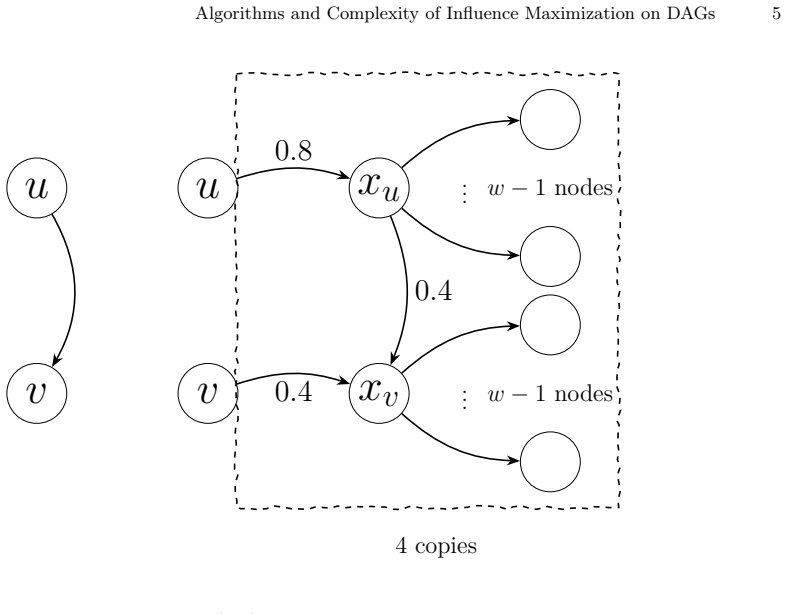
Influence maximization under the linear threshold model remains APX-hard on directed acyclic graphs.
A machine-rendered reading of the paper's core claim, the machinery that carries it, and where it could break.
Core claim
Influence maximization remains APX-hard on DAGs under the LT model, so acyclicity alone is insufficient for a PTAS. On out-arborescences the IC and LT models are equivalent and both admit exact polynomial-time solutions via dynamic programming. On in-arborescences the LT model is polynomial-time solvable while the IC model admits an FPTAS.
What carries the argument
An APX-hardness reduction that embeds a known hard instance into an LT diffusion process on a DAG without creating cycles, together with dynamic programming that computes exact influence along the unique paths of arborescences.
If this is right
- No PTAS exists for LT influence maximization on DAGs unless P=NP.
- Exact polynomial-time algorithms exist for both IC and LT on out-arborescences.
- An FPTAS exists for IC influence maximization on in-arborescences.
- The IC and LT models coincide exactly on out-arborescences.
Where Pith is reading between the lines
- The hardness may stem from multiple overlapping paths rather than the mere presence of cycles.
- Similar dynamic programming techniques could apply to other tree-like or low-treewidth DAGs.
- The FPTAS for IC on in-arborescences may extend to DAGs with bounded in-degree.
Load-bearing premise
The reduction produces a valid DAG whose maximum influence value and approximation gap are preserved from the original APX-hard problem.
What would settle it
A polynomial-time algorithm that approximates the maximum influence value under the LT model on DAGs to within a factor better than the known APX-hardness threshold would falsify the claim.
Figures
read the original abstract
This paper investigates the influence maximization problem under the Independent Cascade(IC) and Linear Threshold (LT) models. While this problem is known to be APX-hard on general graphs, we explore its computational limits by focusing on Directed Acyclic Graphs (DAGs) and more restricted tree structures. Our primary result demonstrates that influence maximization remains APX-hard on DAGs under the LT model, suggesting that the absence of cycles is insufficient to achieve a polynomial-time approximation scheme (PTAS). In contrast, we show that the problem becomes tractable when the topology is further restricted to out-arborescences and in-arborescences. Specifically, for out-arborescences, we show that the IC model and the LT model are equivalent, and we develop exact polynomial-time algorithms based on dynamic programming that leverage the unique path properties of these structures. For in-arborescences, it is known that the problem is polynomial-time solvable under the LT model, and it is NP-hard under the IC model. We complement these results by presenting a fully polynomial-time approximation scheme (FPTAS) for the IC model.
Editorial analysis
A structured set of objections, weighed in public.
Referee Report
Summary. The paper investigates influence maximization under the Independent Cascade (IC) and Linear Threshold (LT) models, focusing on DAGs and restricted arborescence topologies. It claims APX-hardness for LT on general DAGs (showing acyclicity alone does not yield a PTAS), equivalence of IC and LT with exact DP algorithms on out-arborescences, known poly-time solvability for LT and NP-hardness for IC on in-arborescences, and a new FPTAS for IC on in-arborescences.
Significance. If the hardness reduction is correct, the result clarifies the boundary between approximable and inapproximable cases for influence maximization by showing that DAG structure is insufficient for a PTAS under LT; this narrows the topological conditions needed for efficient approximation. The exact DP algorithms on out-arborescences and the FPTAS on in-arborescences are constructive contributions that exploit path uniqueness and could be useful in applications with tree-like networks.
minor comments (3)
- The abstract and introduction should explicitly define out-arborescences versus in-arborescences (including direction of edges) before stating the equivalence and complexity results.
- In the DP sections for out-arborescences, include a brief statement confirming that the recurrence runs in polynomial time (e.g., O(n^2) or similar) and state the precise running time.
- Add a short remark on whether the FPTAS for IC on in-arborescences is tight or if a PTAS is also possible, to contextualize the result relative to the NP-hardness.
Simulated Author's Rebuttal
We thank the referee for their positive summary, significance assessment, and recommendation to accept the manuscript. The review accurately captures the main results on APX-hardness of LT on DAGs, equivalence and exact DP on out-arborescences, and the FPTAS for IC on in-arborescences.
Circularity Check
No significant circularity
full rationale
The paper establishes APX-hardness of influence maximization under the LT model on DAGs via an explicit reduction from a known hard problem that preserves acyclicity and the approximation gap; this is an independent constructive argument, not a self-definition or fitted input. Tractability results on out-arborescences and in-arborescences rely on dynamic programming that exploits unique path properties and known equivalences between models, again without reducing to self-referential definitions or self-citation chains. No equations or claims equate a derived quantity to its own inputs by construction, and external citations (e.g., prior poly-time results on in-arborescences) are not load-bearing for the novel DAG hardness claim. The derivation chain is therefore self-contained as standard complexity-theoretic reasoning.
Axiom & Free-Parameter Ledger
axioms (1)
- standard math Standard assumptions of complexity theory (P ≠ NP, existence of APX-hard problems)
Reference graph
Works this paper leans on
-
[1]
In: Web and Internet Economics: 13th International Conference, WINE 2017, Bangalore, India, December 17–20, 2017, Proceedings 13
Angell, R., Schoenebeck, G.: Don’t be greedy: Leveraging community structure to find high quality seed sets for influence maximization. In: Web and Internet Economics: 13th International Conference, WINE 2017, Bangalore, India, December 17–20, 2017, Proceedings 13. pp. 16–29. Springer (2017)
2017
-
[2]
Journal of Consumer Research14(3), 350–362 (12 1987)
Brown, J.J., Reingen, P.H.: Social Ties and Word-of-Mouth Referral Behavior*. Journal of Consumer Research14(3), 350–362 (12 1987). https://doi.org/10.1086/209118, https://doi.org/10.1086/209118
-
[3]
Chen,N.:Ontheapproximabilityofinfluenceinsocialnetworks.SIAMJournalonDiscreteMathematics 23(3), 1400–1415 (2009)
2009
-
[4]
In: Proceedings of the 16th ACM SIGKDD international conference on Knowledge discovery and data mining
Chen, W., Wang, C., Wang, Y.: Scalable influence maximization for prevalent viral marketing in large- scale social networks. In: Proceedings of the 16th ACM SIGKDD international conference on Knowledge discovery and data mining. pp. 1029–1038 (2010)
2010
-
[5]
In: 2010 IEEE international conference on data mining
Chen, W., Yuan, Y., Zhang, L.: Scalable influence maximization in social networks under the linear threshold model. In: 2010 IEEE international conference on data mining. pp. 88–97. IEEE (2010)
2010
-
[6]
Journal of the ACM (JACM)54(3), 12–es (2007)
Dinur, I.: The pcp theorem by gap amplification. Journal of the ACM (JACM)54(3), 12–es (2007)
2007
-
[7]
Domingos, P., Richardson, M.: Mining the network value of customers. In: Proceedings of the Seventh ACM SIGKDD International Conference on Knowledge Discovery and Data Min- ing. p. 57–66. KDD ’01, Association for Computing Machinery, New York, NY, USA (2001). https://doi.org/10.1145/502512.502525, https://doi.org/10.1145/502512.502525
-
[8]
Feige, U.: A threshold of ln n for approximating set cover. J. ACM45(4), 634–652 (jul 1998). https://doi.org/10.1145/285055.285059, https://doi.org/10.1145/285055.285059
-
[9]
Theory Comput.11, 105–147 (2015)
Kempe, D., Kleinberg, J.M., Tardos, É.: Maximizing the spread of influence through a social network. Theory Comput.11, 105–147 (2015)
2015
-
[10]
In: Proceedings of the twenty- fifth annual ACM-SIAM symposium on Discrete algorithms
Khanna, S., Lucier, B.: Influence maximization in undirected networks. In: Proceedings of the twenty- fifth annual ACM-SIAM symposium on Discrete algorithms. pp. 1482–1496. SIAM (2014)
2014
-
[11]
Proceedings of the International AAAI Conference on Web and Social Media4(1), 90–97 (May 2010)
Lerman, K., Ghosh, R.: Information contagion: An empirical study of the spread of news on digg and twitter social networks. Proceedings of the International AAAI Conference on Web and Social Media4(1), 90–97 (May 2010). https://doi.org/10.1609/icwsm.v4i1.14021, https://ojs.aaai.org/index.php/ICWSM/article/view/14021
-
[12]
Journal of Combinatorial Optimization33, 803–808 (2017)
Lu, Z., Zhang, Z., Wu, W.: Solution of bharathi–kempe–salek conjecture for influence maximization on arborescence. Journal of Combinatorial Optimization33, 803–808 (2017)
2017
-
[13]
SIAM Journal on Computing39, 2176–2188 (1 2010)
Mossel, E., Roch, S.: Submodularity of influence in social networks: From local to global. SIAM Journal on Computing39, 2176–2188 (1 2010). https://doi.org/10.1137/080714452
-
[14]
Mathematical programming14, 265–294 (1978)
Nemhauser, G.L., Wolsey, L.A., Fisher, M.L.: An analysis of approximations for maximizing submodular set functions—i. Mathematical programming14, 265–294 (1978)
1978
-
[15]
IEEE Journal on Se- lected Areas in Communications31(6), 1084–1094 (2013)
Nguyen, H., Zheng, R.: On budgeted influence maximization in social networks. IEEE Journal on Se- lected Areas in Communications31(6), 1084–1094 (2013)
2013
-
[16]
Phys- ical Review E63(6), 066117 (2001)
Pastor-Satorras, R., Vespignani, A.: Epidemic dynamics and endemic states in complex networks. Phys- ical Review E63(6), 066117 (2001)
2001
-
[17]
In: Proceedings of the eighth ACM SIGKDD international conference on Knowledge discovery and data mining
Richardson, M., Domingos, P.: Mining knowledge-sharing sites for viral marketing. In: Proceedings of the eighth ACM SIGKDD international conference on Knowledge discovery and data mining. pp. 61–70 (2002)
2002
-
[18]
Rigobon, R.: Contagion: How to Measure It? In: Preventing Currency Crises in Emerging Markets, pp. 269–334. NBER Chapters, National Bureau of Economic Research, Inc (2002), https://ideas.repec.org/h/nbr/nberch/10638.html
2002
-
[19]
ACM Transactions on Computation Theory (TOCT)11(3), 1–56 (2019)
Schoenebeck, G., Tao, B.: Beyond worst-case (in) approximability of nonsubmodular influence maxi- mization. ACM Transactions on Computation Theory (TOCT)11(3), 1–56 (2019)
2019
-
[20]
ACM Transactions on Economics and Computation (TEAC)8(4), 1–36 (2020)
Schoenebeck, G., Tao, B.: Influence maximization on undirected graphs: Toward closing the (1-1/e) gap. ACM Transactions on Economics and Computation (TEAC)8(4), 1–36 (2020)
2020
-
[21]
arXiv preprint arXiv:2002.11679 (2020)
Schoenebeck, G., Tao, B., Yu, F.Y.: Limitations of greed: Influence maximization in undirected networks re-visited. arXiv preprint arXiv:2002.11679 (2020)
-
[22]
Information and Computation285, 104919 (2022) Algorithms and Complexity of Influence Maximization on DAGs 15
Schoenebeck, G., Tao, B., Yu, F.Y.: Think globally, act locally: On the optimal seeding for nonsubmod- ular influence maximization. Information and Computation285, 104919 (2022) Algorithms and Complexity of Influence Maximization on DAGs 15
2022
-
[23]
Journal of Combinatorial Optimization31, 1678–1684 (2016)
Wang, A., Wu, W., Cui, L.: On bharathi–kempe–salek conjecture for influence maximization on arbores- cence. Journal of Combinatorial Optimization31, 1678–1684 (2016)
2016
discussion (0)
Sign in with ORCID, Apple, or X to comment. Anyone can read and Pith papers without signing in.