REVIEW 3 major objections 5 minor 5 references
Parametric Gaussian Human Model: Generalizable Prior for Efficient and Realistic Human Avatar Modeling
T0 review · 3 major / 5 minor · reviewed 2026-08-07 · deepseek-v4-flash
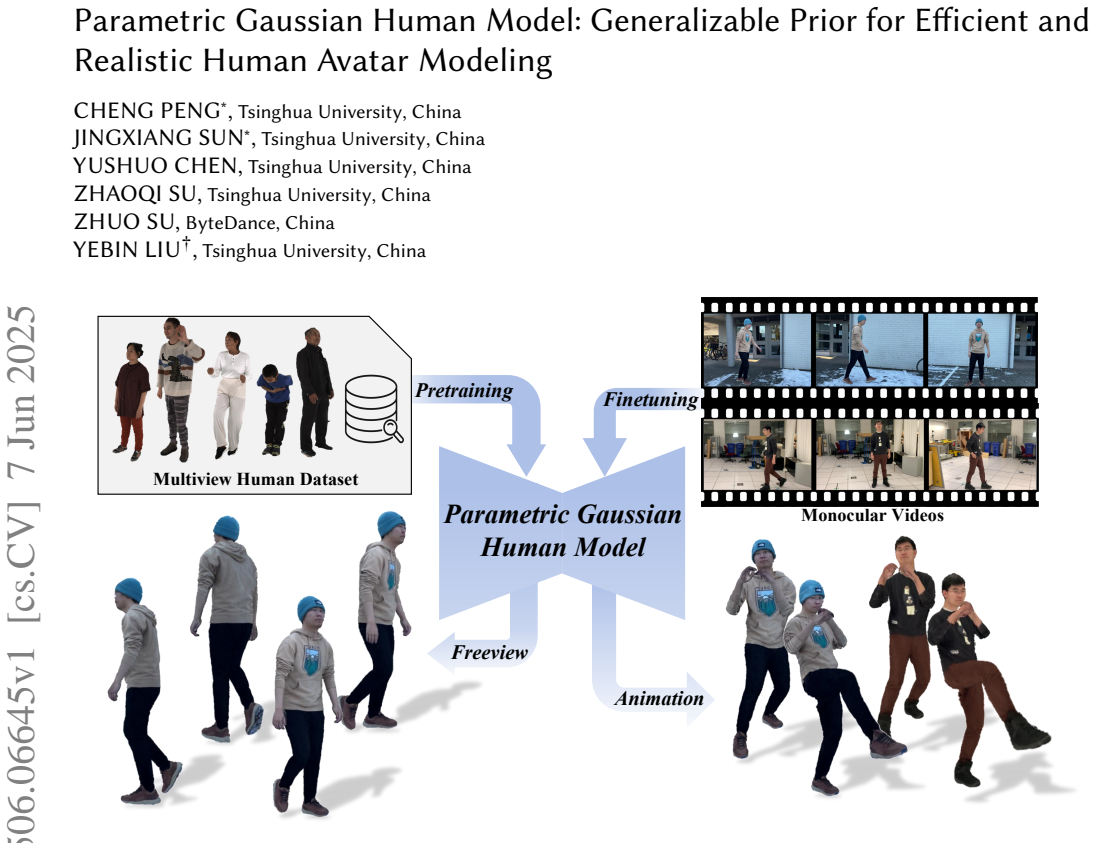
Pith's one-line read A parametric Gaussian human prior, pretrained on multi-view human data, enables photorealistic and animatable avatar reconstruction from monocular video in about 20 minutes per subject, beating slower optimization-based baselines.
desk verdict A credible pretrained Gaussian avatar prior with real efficiency gains, but the 20-minute claim depends on pose accuracy that the paper never verifies. read the letter →
The pith
A machine-rendered reading of the paper's core claim, the machinery that carries it, and where it could break.
The reading
What carries the argument
The load-bearing machinery is the combination of a UV-aligned latent identity map and a disentangled Multi-Head U-Net. The identity map is a compact feature tensor that can be decoded and fine-tuned alone; the U-Net has one encoder and three decoder heads (static, pose, and view) with pose and view information injected via lightweight convolutional encoders, so Gaussian attributes are explicitly decomposed and then composed through LBS and 3DGS rasterization.
What would settle it
Run the same 20-minute personalization on monocular videos where the pose initialization is known to be inaccurate (for example, by adding noise to the SMPL-X fits or using a different pose estimator), and measure the drop in PSNR and LPIPS relative to ground truth; if the quality collapses on such inputs, the claimed generality to challenging monocular conditions is not met.
Extended reading notes
Core claim
PGHM establishes that a generalizable Gaussian avatar prior can be pretrained on a mix of MVHumanNet and DNA-Rendering sequences and then adapted to a new subject with only about 2,000 optimization steps, taking roughly 20 minutes per subject on a single GPU while surpassing GaussianAvatar and ExAvatar on NeuMan and THuman4.0 in PSNR, SSIM, and LPIPS. The architecture attaches isotropic Gaussians to SMPL-X UV positions; a UV-aligned latent identity map encodes identity, and a disentangled Multi-Head U-Net predicts the static position/scale/color maps plus pose-dependent position/scale offsets and view-dependent color offsets, with Linear Blend Skinning for articulation. Two renderings (static and pose-dependent) are supervised jointly, and pose parameters are optimized during pretraining.
Load-bearing premise
The claim assumes that the SMPL-X pose estimates for the monocular video are accurate enough that the UV position map and skinning give a valid starting point; if pose estimation is poor, the identity map and U-Net cannot recover the avatar quality.
Editorial extensions
If this is right
- Monocular avatar creation moves from hours or days to about 20 minutes of GPU time, with quality that beats per-subject optimization baselines.
- The number of identities used in pretraining scales generalization: the ablation shows 0, 6, 60, and 600 pretrained IDs give progressively better fine-tuning fidelity.
- The disentangled multi-head design preserves dynamic wrinkles and lighting that a single-head U-Net misses.
- Because only the identity map and the U-Net are fine-tuned per subject, the method needs a small parameter budget for each new avatar.
Reading between the lines
- The identity map effectively acts as a per-subject latent code; a natural extension the paper only gestures at is to regress this map directly from a single image, removing the need for video optimization entirely.
- The method's dependence on accurate SMPL-X pose initialization suggests that a pose-refinement step during personalization could further close the gap on challenging in-the-wild videos.
- If the disentangling of pose and view holds up, the same three-branch decomposition could be reused for avatar editing (relighting or re-posing) without retraining.
- The loose-clothing limitation noted in the conclusion points to a testable boundary: the prior is likely tuned to tight-fitting garments, and adding a physics or template layer could extend it to skirts and robes.
Editorial analysis
A structured set of objections, weighed in public.
Referee Report
Summary. The paper proposes PGHM, a generalizable prior for 3D Gaussian Splatting human avatars. The representation couples a UV-aligned latent identity map with a disentangled Multi-Head U-Net that predicts static, pose-dependent, and view-dependent Gaussian attributes from pose and view conditioning. After pretraining on a combined MVHumanNet/DNA-Rendering corpus, personalization to a new subject from monocular video is performed by first adapting the identity map and then jointly fine-tuning the identity map and U-Net, with a reported cost of about 20 minutes per subject. Experiments on NeuMan and THuman4.0 report PSNR/SSIM/LPIPS improvements over the baselines considered, together with qualitative comparisons and ablations for identity count and the multi-head U-Net.
Significance. If the reported results are reproducible, the paper would provide a practical speed/quality tradeoff for monocular avatar creation: a single pretrained prior that adapts in tens of minutes rather than hours or days. The architectural ideas—per-identity UV latent maps and explicit decomposition into static/pose/view decoders—are reasonable and clearly described, and the paper includes both quantitative tables and qualitative visualizations. The authors also state limitations (dependence on input video sequences and difficulty with loose clothing), which is helpful. However, the evidence as presented is not yet sufficient to support the broad 'consistently surpasses all existing baselines' claim: the baseline set is narrow, the THuman4.0 protocol is underspecified, and the personalization stage does not refine test-time poses even though pretraining refines training poses.
major comments (3)
- [Section 3.3, Section 4, Section 5.1] The personalization protocol adapts only the identity map and the Multi-Head U-Net; it does not refine SMPL-X poses at test time, whereas pretraining explicitly optimizes the training poses (Section 3.3). The pose-conditioned decoders are therefore trained on refined pose inputs but receive raw monocular estimates (Moon et al. 2024a for NeuMan, original poses for THuman4.0) during adaptation. Because the UV position map and the LBS deformation are computed directly from these poses, a systematically biased pose estimate cannot be corrected by the identity map, which encodes appearance. To support the 20-minute quality claim, the paper should either (a) add pose refinement during personalization, or (b) provide a sensitivity analysis quantifying performance as a function of pose-estimation error. Without this, the reported results are conditional on favorable input poses.
- [Section 5.3, Tables 1 and 2] The claim that the method 'consistently surpasses all existing baselines' is not fully supported by the comparison set. On THuman4.0 only GaussianAvatar and ExAvatar are evaluated; on NeuMan the baselines include several older NeRF-based methods, and the concurrent Vid2Avatar-Pro, which the paper discusses in Section 1 as having comparable optimization time, is not quantitatively compared. A direct comparison with Vid2Avatar-Pro, or a clear explanation of why it is excluded, is necessary to substantiate the SOTA claim.
- [Section 5.1] The THuman4.0 evaluation protocol is underspecified. The dataset is described as a high-resolution multi-view collection, but the paper does not state whether the selected 500 training frames and 50 test frames come from a single camera or from multiple synchronized views. If multiple views are used, the comparison with monocular baselines is not apples-to-apples, and the abstract's 'monocular video' claim would be misleading. Please specify the camera configuration explicitly, or restrict the evaluation to a single viewpoint.
minor comments (5)
- [Section 5.4, Figures 5–6] The ablations for identity count and for the multi-head vs single-head U-Net are presented only qualitatively; reporting PSNR/SSIM/LPIPS for the ablated variants would make the component contributions more convincing.
- [Section 1 and Table 1] The abstract says the method is 'significantly more efficient than optimization-from-scratch methods,' yet Table 1 lists InstantAvatar at 5 minutes. The speed advantage is only meaningful at comparable quality; please clarify this framing.
- [Section 2.2] The sentence 'Our concurrent work [Guo et al. 2023] introduces a unified clothed-human prior' appears to cite Vid2Avatar, which is not a universal prior; this likely should refer to Vid2Avatar-Pro [Guo et al. 2025a].
- [Section 5.2 and Table 1] The reported metrics are computed on the full image with white background; reporting foreground-only or masked metrics would help readers judge how much of the gain comes from the human region rather than the background.
- [Conclusion] The heading 'Conculsion' is a typo, and the received/revised dates in the document footer appear to be from a different submission.
Circularity Check
No significant circularity: the pretraining data, per-subject fine-tuning, and held-out evaluation keep the central claims independent of their inputs.
full rationale
The paper's derivation chain is self-contained. The parametric prior is pretrained on MVHumanNet and DNA-Rendering (Section 5.1), which are external datasets not used for evaluation; NeuMan and THuman4.0 are held out. Personalization optimizes a per-subject identity map and the Multi-Head U-Net on training frames (Section 4) and reports metrics on held-out frames (Section 5.3), so the reported numbers are not fitted inputs renamed as predictions. The identity map is an explicit per-subject latent code optimized at test time, and the ablations in Figure 5 directly test the prior's contribution by varying the number of pretrained identities; this is an empirical comparison, not a circular definition. The only notable gap is that poses are not refined during personalization while pretraining refines poses (Section 3.3 vs. Section 5.1), but this is a correctness and robustness limitation, not a circular step: nothing in the paper defines the predicted Gaussian attributes in terms of the evaluation targets, nor does any load-bearing claim rely on a self-citation chain. Self-citations to prior avatar work occur only as background or architectural inspiration, not as proof of the central claim. The conclusion's stated limitations (dependence on input video sequences and difficulty with loose clothing) are acknowledged and do not affect circularity. Therefore no circularity is present.
Assumptions & free parameters
free parameters (3)
- Per-identity UV-aligned latent identity map F' =
Optimized per subject during personalization; trained per identity on MVHumanNet/DNA-Rendering
- Loss weights lambda1=0.8, lambda2=0.2, lambda3=0.2, lambda4=0.1 =
0.8, 0.2, 0.2, 0.1
- Pretraining dataset composition =
300 DNA-Rendering identities + 300 MVHumanNet identities
assumptions (4)
- domain assumption SMPL-X provides a valid parametric body model (shape, pose, UV unwrapping) for representing clothed humans.
- domain assumption The multi-view datasets (MVHumanNet, DNA-Rendering) with fitted SMPL-X poses provide sufficiently accurate 3D supervision for learning a generalizable prior.
- ad hoc to paper Isotropic Gaussians (scale=1, rotation=identity, opacity=1) are sufficient for high-fidelity human avatar rendering.
- standard math 3D Gaussian Splatting rendering (Kerbl et al. 2023) is an accurate and unbiased renderer for the purpose of supervision.
Cite this review
Pith. "Pith review of Parametric Gaussian Human Model: Generalizable Prior for Efficient and Realistic Human Avatar Modeling." pith.science (2026). https://pith.science/paper/QYWCG6YJ
@misc{pith2026250606645,
  author       = {Pith},
  title        = {Pith review of: Parametric Gaussian Human Model: Generalizable Prior for Efficient and Realistic Human Avatar Modeling},
  year         = {2026},
  howpublished = {\url{https://pith.science/paper/QYWCG6YJ}},
  note         = {Machine review of arXiv:2506.06645}
}
read the original abstract
Photorealistic and animatable human avatars are a key enabler for virtual/augmented reality, telepresence, and digital entertainment. While recent advances in 3D Gaussian Splatting (3DGS) have greatly improved rendering quality and efficiency, existing methods still face fundamental challenges, including time-consuming per-subject optimization and poor generalization under sparse monocular inputs. In this work, we present the Parametric Gaussian Human Model (PGHM), a generalizable and efficient framework that integrates human priors into 3DGS for fast and high-fidelity avatar reconstruction from monocular videos. PGHM introduces two core components: (1) a UV-aligned latent identity map that compactly encodes subject-specific geometry and appearance into a learnable feature tensor; and (2) a disentangled Multi-Head U-Net that predicts Gaussian attributes by decomposing static, pose-dependent, and view-dependent components via conditioned decoders. This design enables robust rendering quality under challenging poses and viewpoints, while allowing efficient subject adaptation without requiring multi-view capture or long optimization time. Experiments show that PGHM is significantly more efficient than optimization-from-scratch methods, requiring only approximately 20 minutes per subject to produce avatars with comparable visual quality, thereby demonstrating its practical applicability for real-world monocular avatar creation.
Figures


Figures from the paper (3 more)


Reference graph
Works this paper leans on
-
[3]
MetaCap: Meta-learning Priors from Multi-View Imagery for Sparse-view Human Performance Capture and Rendering. InECCV. Jingxiang Sun, Xuan Wang, Lizhen Wang, Xiaoyu Li, Yong Zhang, Hongwen Zhang, and Yebin Liu. 2023. Next3D: Generative Neural Texture Rasterization for 3D-Aware Head Avatars. InProceedings of the IEEE/CVF Conference on Computer Vision and P...
arXiv 2004
-
[4]
InProceedings of the IEEE/CVF Conference on Computer Vision and Pattern Recognition
Gomavatar: Efficient animatable human modeling from monocular video using gaussians-on-mesh. InProceedings of the IEEE/CVF Conference on Computer Vision and Pattern Recognition. 2059–2069. Chung-Yi Weng, Brian Curless, Pratul P Srinivasan, Jonathan T Barron, and Ira Kemelmacher-Shlizerman. 2022. Humannerf: Free-viewpoint rendering of moving people from mo...
arXiv 2024
-
[2022]
InProceedings of the IEEE/CVF Conference on Computer Vision and Pattern Recognition (CVPR)
Structured Local Radiance Fields for Human Avatar Modeling. InProceedings of the IEEE/CVF Conference on Computer Vision and Pattern Recognition (CVPR). Zerong Zheng, Xiaochen Zhao, Hongwen Zhang, Boning Liu, and Yebin Liu. 2023. AvatarReX: Real-time Expressive Full-body Avatars.ACM Transactions on Graphics (TOG)42, 4 (2023), 1–19. doi:10.1145/3592101 Hemi...
arXiv 2023
-
[2023]
InProceedings of the IEEE/CVF International Conference on Computer Vision
Preface: A Data-driven Volumetric Prior for Few-shot Ultra High-resolution Face Synthesis. InProceedings of the IEEE/CVF International Conference on Computer Vision. 3402–3413. Chen Cao, Tomas Simon, Jin Kyu Kim, Gabe Schwartz, Michael Zollhoefer, Shun-Suke Saito, Stephen Lombardi, Shih-En Wei, Danielle Belko, Shoou-I Yu, Yaser Sheikh, and Jason Saragih. ...
arXiv 2021
-
[2024]
In IEEE/CVF Conference on Computer Vision and Pattern Recognition (CVPR)
3DGS-Avatar: Animatable Avatars via Deformable 3D Gaussian Splatting. In IEEE/CVF Conference on Computer Vision and Pattern Recognition (CVPR). Lingteng Qiu, Xiaodong Gu, Peihao Li, Qi Zuo, Weichao Shen, Junfei Zhang, Kejie Qiu, Weihao Yuan, Guanying Chen, Zilong Dong, et al. 2025. LHM: Large Animatable Human Reconstruction Model from a Single Image in Se...
arXiv 2025
Reviewed August 7, 2026 · model on record in the stance chip above.
Discussion (0). Sign in to comment.