REVIEW 3 major objections 4 minor 31 references
Single- and Two-Mode Squeezing by Modulated Coupling to a Rabi Driven Qubit
T0 review · 3 major / 4 minor · reviewed 2026-08-06 · deepseek-v4-flash
Pith's one-line read A Rabi-driven qubit with four sideband tones can continuously squeeze one or two cavity modes, with simulated 13.5 dB and 12.1 dB of squeezing.
desk verdict A sound two-mode squeezing proposal whose main textual error—inconsistent Eq. (1)—is fixable, with a sloppy but salvageable universal-control proof. read the letter →
The pith
A machine-rendered reading of the paper's core claim, the machinery that carries it, and where it could break.
The reading
What carries the argument
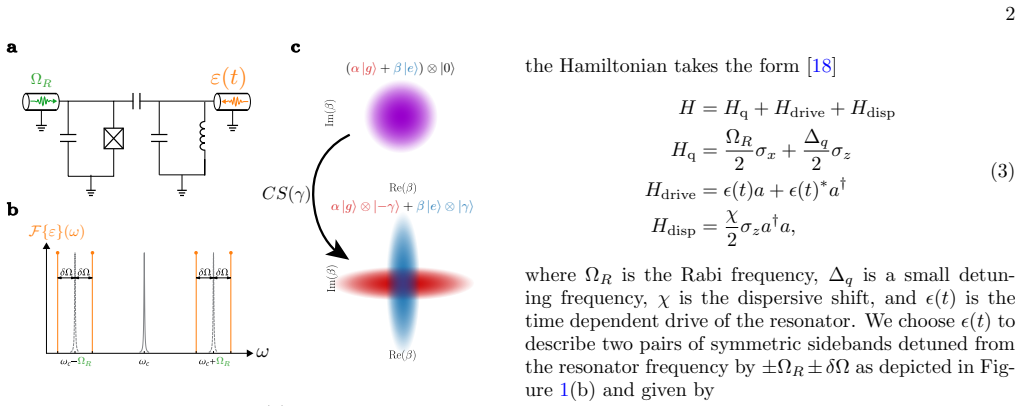
The machinery is the modulated coupling of Eq. (1): a Jaynes-Cummings term cosine-modulated at frequency $\delta\Omega$ plus an anti-Jaynes-Cummings term sine-modulated at the same frequency. Because $\delta\Omega \gg g$, the Magnus expansion over one period $2\pi/\delta\Omega$ leaves only the secular term $\sigma_z(g^* a^\dagger a^\dagger + g^2 aa)/(2\delta\Omega)$ (and the analogous $ab$ term for two modes). On hardware, this coupling is built from four sideband tones placed at $\pm\Omega_R \pm \delta\Omega$ relative to the cavity, which periodically displace the cavity field; after a displacement transformation, a Hadamard rotation, and a frame rotating at the Rabi frequency, the dispersive interaction $\chi\sigma_z a^\dagger a/2$ is converted into the modulated Jaynes-Cummings and anti-Jaynes-Cummings form. The effective coupling is $g = \chi\bar{a}_0/2$, so the squeezing rate is $\chi^2\bar{a}_0^2/(8\delta\Omega)$.
What would settle it
Set up the four sideband drives exactly as in Section 2.1 on a transmon-cavity system with $\chi/2\pi = -50$ kHz and $\Omega_R/2\pi = 40$ MHz, initialize the cavity in vacuum, post-select on the qubit state, and measure the quadrature variance as a function of time. The central claim predicts the variance of one quadrature falls by about 13.5 dB at $t \approx 20$ $\mu$s; observing a plateau or a rise before that time, or a dependence of the squeezing limit on photon number that does not match the bound $n \approx (2\delta\Omega/\chi\bar{a}_0)^2$, would falsify the effective Hamiltonian of Eq. (2).
Extended reading notes
Core claim
The central claim is that a time-modulated coupling of the form $H_{\mathrm{coup}} = i\cos(\delta\Omega t)(g\sigma_+ a - g^*\sigma_- a^\dagger) - \sin(\delta\Omega t)(g\sigma_+ a^\dagger + g^*\sigma_- a)$, obtained by Rabi-driving a qubit dispersively coupled to a resonator and applying four sideband drives, gives an effective Hamiltonian $H_{\mathrm{squeezing}} = \frac{1}{2\delta\Omega}\sigma_z\big((g^*)^2 aa + g^2 a^\dagger a^\dagger\big)$ after one Magnus period. This is a continuous, qubit-conditioned squeezing interaction with rate $g^2/2\delta\Omega$. The same construction, with the anti-Jaynes-Cummings term applied to a second mode, produces two-mode conditional squeezing $H_{\mathrm{squeezing}} = \frac{1}{2\delta\Omega}\sigma_z\big((g^*)^2 ab + g^2 a^\dagger b^\dagger\big)$. Simulating the unapproximated driven dynamics with experimentally realistic parameters ($\chi/2\pi = -50$ kHz, $\Omega_R/2\pi = 40$ MHz) yields 13.5 dB single-mode squeezing after about 20 $\mu$s and 12.1 dB two-mode squeezing after about 33 $\mu$s; a superposition of squeezed states reaches only 4 dB because the higher-order correction of Eq. (13) interferes. A Lie-algebra argument shows that the conditional-squeezing operation, combined with displacements and qubit rotations, spans the full operator algebra of a harmonic oscillator, hence gives universal control.
Load-bearing premise
The scheme works only while the rotating-wave and Magnus approximations hold, which requires the modulation frequency $\delta\Omega$ and Rabi frequency $\Omega_R$ to stay large compared with the effective interaction strength and the photon number in the cavity; when the photon number exceeds roughly $n \approx (2\delta\Omega/\chi\bar{a}_0)^2$, higher-order corrections appear and limit the achievable squeezing.
Editorial extensions
If this is right
- The scheme produces intra-cavity squeezing without the Kerr nonlinearity that distorts states in earlier circuit-QED demonstrations.
- Two-mode squeezing is generated with no extra hardware beyond additional sideband drives, enabling distributed entanglement between two cavity modes in the same device.
- The conditional nature entangles the qubit with the squeezed field, producing states of the form $(|e,\xi\rangle + |g,-\xi\rangle)/N$ that can serve as a computational basis for rotation-symmetric bosonic codes.
- Because the operation is continuous, it can run while other Hamiltonian terms are present, and the Rabi drive doubles as dynamical decoupling, lengthening qubit coherence during squeezing.
- The Lie-algebra proof shows that controlled squeezing plus displacements and qubit rotations is sufficient for universal control of a harmonic oscillator, overcoming the known insufficiency of unconditional squeezing and displacements alone.
Reading between the lines
- If the effective Hamiltonian of Eq. (2) holds in experiment, the same sideband engineering should work in trapped-ion systems, where the paper notes the appropriate sidebands exist; testing this would require a platform change rather than new physics.
- The photon-number bound $n \lesssim (2\delta\Omega/\chi\bar{a}_0)^2$ suggests a direct route to surpassing the 4 dB superposition limit: shaped pulses that cancel the cubic term of Eq. (13) could restore ideal conditional squeezing at higher amplitude.
- The universal-control proof likely extends to multiple modes: commuting the two-mode controlled squeezing with displacements on either mode should generate controlled two-mode operations, providing a route to continuous-variable cluster states from the same drive setup.
Editorial analysis
A structured set of objections, weighed in public.
Referee Report
Summary. The paper proposes a circuit-QED scheme for continuous, qubit-conditioned single- and two-mode squeezing. A Rabi-driven transmon is dispersively coupled to one or two resonators, and four sideband drives produce a time-modulated effective coupling. The authors use a Magnus expansion to derive effective conditional-squeezing Hamiltonians (Eqs. (2) and (8)), simulate the full driven dynamics without making the effective approximation, and report 13.5 dB single-mode, 4 dB conditional-superposition, and 12.1 dB two-mode squeezing. They also argue that controlled-squeezing, together with single-qubit rotations and displacements, yields universal control of a bosonic mode.
Significance. If the claims hold, the scheme offers a hardware-efficient route to intra-cavity conditional squeezing and two-mode entanglement without extra nonlinear elements such as a SQUID, with predicted squeezing levels comparable to state-of-the-art experiments. The paper's strengths include explicit Hamiltonians, numerical simulation of the full driven dynamics rather than only the effective model, an honest account of the 4 dB limitation from higher-order terms, and publicly available simulation code. The main numerical results are ideal-limit predictions; decoherence is omitted, as the authors acknowledge. However, the theoretical derivation as printed contains internal inconsistencies: Eqs. (1) and (7) do not Magnus-expand to Eqs. (2) and (8). These issues are load-bearing for the central claim and must be corrected before the paper can be accepted.
major comments (3)
- [Section 2.1, Eqs. (1)-(2)] Equation (1) as written cannot Magnus-expand to Eq. (2). Writing H(t)=i cos(δΩt)A−sin(δΩt)B with A=gσ+a−g*σ−a† and B=gσ+a†+g*σ−a, the second-order Magnus term is proportional to [A,B], and [A,B]=g²σ+²+(g*)²σ−²=0 because σ+²=σ−²=0. The leading Magnus contribution therefore vanishes identically, so the displayed modulated coupling cannot produce the conditional-squeezing Hamiltonian of Eq. (2). A correct reduction must be rederived from the displaced-frame Hamiltonian (6); as it stands, the statement in the text that the RWA 'arrive[s] at the modulated coupling of Equation 1' is not supported by the displayed equations.
- [Section 2.2, Eqs. (7)-(8)] The two-mode coupling of Eq. (7) has the same defect. For A′=gσ+a−g*σ−a† and B′=gσ+b†+g*σ−b, the Hamiltonian H=i cos(δΩt)A′−sin(δΩt)B′ gives an effective second-order Hamiltonian proportional to −|g|²σz(ab+a†b†) (up to the overall rotating-frame sign convention), which contains no dependence on the phase of g. Equation (8) instead contains (g*)²ab+g²a†b† with explicit phase dependence. The two expressions disagree for complex g and generically also in sign for real g. The correct two-mode modulated coupling should be displayed explicitly from Eq. (12).
- [Section 4, universal-control proof] Several commutator identities in the universal-control argument are incorrect as written. With the convention [p,q]=−i used in the paper, [(p²−q²)σz,p²]=(2−4ipq)σz, not 2σz−2ipqσz; [qσz,σx]=2iqσy, not iqσy; and [qσx,qσy]=2iq²σz, not iq²σz. The same factor-of-two error affects [q²σx,qσy]. Because a nonzero constant prefactor and an already-available σz term do not change the generated operator algebra, the qualitative conclusion may survive, but the proof as printed is not correct and should be fixed or explicitly stated to hold up to proportionality and known terms.
minor comments (4)
- [Figure captions] The captions of Fig. 2 and Fig. 3 are identical apart from the figure titles; the Fig. 2 caption should instead describe the (δΩ,g) sweep in panel (a) and the time traces in panel (c).
- [Section 2.3] The bound '¯a0 is limited to about 400 MHz · 2π/ΩR' mixes units; since ¯a0 is a dimensionless displacement amplitude, the limit should be stated as |¯a0| ≲ 2π(400 MHz)/ΩR or an equivalent dimensionless ratio.
- [Introduction and Eq. (1)] There are typographical errors: 'Jeynes-Cummings' should be 'Jaynes-Cummings', and 'weekly anharmonic oscillator' should be 'weakly anharmonic oscillator'.
- [Section 3.1 and Abstract] Because decoherence is not included in the simulations, the 13.5 dB and 12.1 dB values are ideal-limit predictions; the abstract should state this explicitly rather than leaving the qualification only to the main text.
Circularity Check
No significant circularity: the effective-Hamiltonian derivation and numerical squeezing predictions are self-contained, with parameters taken from existing experiments or chosen to maximize simulated output.
full rationale
The paper's central claim is the derivation of Eq. (2) from the modulated coupling of Eq. (1), and Eq. (8) from Eq. (7), via Magnus expansion and rotating-wave approximations. The modulated coupling itself is derived from the dispersive driven Hamiltonian of Eq. (6) by explicit displacement, Hadamard, and Rabi-frame transformations, so the chain does not presuppose the squeezing result. The 13 dB, 12 dB, and 4 dB predictions are outputs of numerical integration of the stated full dynamics, not fitted quantities renamed as predictions. Parameters such as chi/2pi = -50 kHz and Omega_R/2pi = 40 MHz are cited from prior experimental work, and g and delta-Omega are optimized over the plotted sweep in Fig. 2(a); optimization is not circular reasoning. The self-citations [19] and [21] are background references for controlled displacements and experimental Rabi rates, not load-bearing justifications of the squeezing derivation. The acknowledged limitations in Sec. 2.3 (RWA validity and the higher-order correction Eq. (13)) are stated as assumptions and verified by simulation, again not circular. A possible phase-consistency issue between Eq. (1) and Eq. (2) for complex g is a correctness or consistency concern, not a circularity, and therefore does not raise the circularity score.
Assumptions & free parameters
free parameters (4)
- dispersive shift χ/2π =
-50 kHz
- Rabi frequency ΩR/2π =
40 MHz
- effective coupling g/2π =
0.16 MHz
- modulation frequency δΩ/2π =
1.6 MHz
assumptions (5)
- standard math Magnus expansion can be truncated at second order for the modulated coupling with δΩ ≫ g
- domain assumption Rotating-wave approximation: rapid terms at frequencies ≥ ΩR-δΩ and the 2δΩ Stark term can be neglected
- domain assumption The transmon is an ideal two-level system with no leakage to higher levels
- domain assumption The system is decoherence-free for the simulation duration
- standard math Standard canonical commutation [q,p]=i and Pauli commutation relations
Cite this review
Pith. "Pith review of Single- and Two-Mode Squeezing by Modulated Coupling to a Rabi Driven Qubit." pith.science (2026). https://pith.science/paper/QZ445DTH
@misc{pith2026250722641,
  author       = {Pith},
  title        = {Pith review of: Single- and Two-Mode Squeezing by Modulated Coupling to a Rabi Driven Qubit},
  year         = {2026},
  howpublished = {\url{https://pith.science/paper/QZ445DTH}},
  note         = {Machine review of arXiv:2507.22641}
}
read the original abstract
Advanced bosonic quantum computing architectures demand nonlocal Gaussian operations such as two-mode squeezing to unlock universal control, enable entanglement generation, and implement logical operations across distributed modes. This work presents a novel method for generating conditional squeezing using a Rabi-driven qubit dispersively coupled to one or two harmonic oscillators. A proof that this enables universal control over bosonic modes is provided, expanding the toolkit for continuous-variable quantum information processing. Using modulated Jaynes-Cummings interactions in circuit QED, the simulation predicts intra-cavity squeezing of 13dB (single-mode), 4dB (superimposed single-mode), and 12dB (two-mode), with the latter two yet to be demonstrated experimentally. These results establish a new paradigm for qubit-conditioned control of photonic states, with applications to quantum sensing and continuous-variable computation on readily available systems.
Figures


Figures from the paper (1 more)

Reference graph
Works this paper leans on
-
[15]
J. Hastrup, K. Park, R. Filip, and U. L. Andersen, Phys. Rev. Lett. 126, 153602 (2021)
work page 2021
-
[1]
INTRODUCTION Quantum squeezed states and quantum squeezing op- erations are widely used for quantum sensing [1, 2]. They are useful for improving the signal-to-noise ratio by amplifying one quadrature and squeezing the other. Amplification may overwhelm noise in an amplification chain [3], and squeezing can reduce the quantum uncer- tainty of an observabl...
-
[2]
THEOR Y 2.1. Single-mode squeezing Hamiltonian Let us consider a system composed of a qubit and a quantum harmonic oscillator coupled by a time- modulated interaction described by Hcoup = i cos(δΩt) gσ+a − g∗σ−a† − sin(δΩt) gσ+a† + g∗σ−a , (1) arXiv:2507.22641v1 [quant-ph] 30 Jul 2025 2 χS (γ) χ(t) F{ χ≫(ω ) χ χ |g⟩≫| −γ⟩+ β |σ⟩≫|γ⟩ (χ |g⟩ + β |e⟩)≫|0⟩ ΩR...
work page Pith review arXiv 2025
-
[3]
RESUL TS AND DISCUSSION We simulated the full dynamics in the displaced frame, as captured by Hq + H ′ disp for single-mode squeezing (Equation 6) and Hq + H ′TMS disp for two-mode squeezing (Equation 12) (the simulations code is available at [18]). This allowed us to keep the Hilbert space of the resonator 4 /uni00000372/uni00000373/uni00000374/uni000003...
-
[4]
The idea here is to show the conditional nature of the operation. Specif- ically, to generate entanglement between the qubit and the oscillator such that we will end up with a state of the 5 form |ψentangled⟩ = CS(ξ) |+, 0⟩ = 1 N (ξ) (|e, ξ⟩ + |g, −ξ⟩) , (14) where the conditional squeezing operation is defined by CS (ξ) = S(σzξ) = |e⟩ ⟨e| ⊗S(ξ) +|g⟩ ⟨g| ...
-
[5]
UNIVERSAL CONTROL USING CONTROLLED-SQUEEZING Universal control of a system is the promise that re- peated applications of Hamiltonians from a given set can generate all unitary operations from within the Hilbert space of said system [23]. To learn what operations can be effectively generated by repeatedly applying control- lable Hamiltonians, one needs to...
-
[6]
CONCLUSIONS We have presented a novel scheme for the continu- ous intra-cavity generation of both single- and two-mode squeezed states using a Rabi-driven qubit dispersively coupled to quantum harmonic oscillators. By engineer- ing a modulated Jaynes-Cummings interaction through Rabi and sideband drives, our approach enables condi- tional squeezing, in wh...
-
[7]
ACKNOWLEDGEMENTS This research was partially funded by the Israeli Sci- ence Foundation (ISF), the Binational Science Founda- tion (BSF), and the Hellen Diller Quantum Center at Technion Israel Institute of Technology
Show all 31 references
-
[8]
X. Pan, T. Krisnanda, A. Duina, K. Park, P. Song, C. Y. Fontaine, A. Copetudo, R. Filip, and Y. Y. Gao (2024), 2403.14967
2024 arXiv
-
[9]
Zheng, M
H. Zheng, M. Silveri, R. T. Brierley, S. M. Girvin, and K. W. Lehnert (2016), 1607.02529
2016 arXiv
-
[10]
Krantz, M
P. Krantz, M. Kjaergaard, F. Yan, T. P. Orlando, S. Gus- tavsson, and W. D. Oliver, Applied Physics Reviews 6, 021318 (2019), ISSN 1931-9401
2019
-
[11]
J. Aasi, J. Abadie, B. P. Abbott, R. Abbott, T. D. Ab- bott, M. R. Abernathy, C. Adams, T. Adams, P. Ad- desso, R. X. Adhikari, et al., Nature Photonics 7, 613 (2013), ISSN 1749-4893
2013
-
[12]
Zhong, E
L. Zhong, E. P. Menzel, R. Di Candia, P. Eder, M. Ih- mig, A. Baust, M. Haeberlein, E. Hoffmann, K. Inomata, T. Yamamoto, et al., New Journal of Physics 15, 125013 (2013)
2013
-
[13]
R. E. Slusher, L. W. Hollberg, B. Yurke, J. C. Mertz, and J. F. Valley, Phys. Rev. Lett. 55, 2409 (1985)
1985
-
[14]
Eickbusch, V
A. Eickbusch, V. Sivak, A. Z. Ding, S. S. Elder, S. R. Jha, J. Venkatraman, B. Royer, S. M. Girvin, R. J. Schoelkopf, and M. H. Devoret, Nature Physics 18, 1464 (2022)
2022
-
[16]
Y. Cai, X. Deng, L. Zhang, Z. Ni, J. Mai, P. Huang, P. Zheng, L. Hu, S. Liu, Y. Xu, et al. (2025), 2503.08197
2025 arXiv
-
[17]
Copetudo, C
A. Copetudo, C. Y. Fontaine, F. Valadares, and Y. Y. Gao, Applied Physics Letters 124, 080502 (2024), ISSN 0003-6951
2024
-
[18]
X. Pan, J. Schwinger, N.-N. Huang, P. Song, W. Chua, F. Hanamura, A. Joshi, F. Valadares, R. Filip, and Y. Y. Gao (2022), 2212.01271
2022 arXiv
-
[19]
Hastrup and U
J. Hastrup and U. L. Andersen, Phys. Rev. Lett. 128, 170503 (2022)
2022
-
[20]
A. L. Grimsmo, J. Combes, and B. Q. Baragiola, Phys. Rev. X 10, 011058 (2020)
2020
-
[21]
M. K. Hope, J. Lidal, and F. Massel, Preparation of conditionally-squeezed states in qubit-oscillator systems (2025), 2504.01664
2025
-
[22]
N. F. Del Grosso, R. G. Corti˜ nas, P. I. Villar, F. C. Lom- bardo, and J. P. Paz, Phys. Rev. A 111, 042606 (2025)
2025
-
[23]
Jaynes and F
E. Jaynes and F. Cummings, Proceedings of the IEEE 51, 89 (1963)
1963
-
[24]
Blanes, F
S. Blanes, F. Casas, J. Oteo, and J. Ros, Physics Reports 470, 151 (2009), ISSN 0370-1573
2009
-
[25]
GitHub Repository: https://github.com/eliyablum/ qubitSqueezing
-
[26]
A. A. Diringer, E. Blumenthal, A. Grinberg, L. Jiang, and S. Hacohen-Gourgy, Physical Review Letters 14, 011055 (2024)
2024
-
[27]
Milul, B
O. Milul, B. Guttel, U. Goldblatt, S. Hazanov, L. M. Joshi, D. Chausovsky, N. Kahn, E. C ¸ ifty¨ urek, F. Lafont, and S. Rosenblum, PRX Quantum 4, 030336 (2023)
2023
-
[28]
Hacohen-Gourgy, L
S. Hacohen-Gourgy, L. S. Martin, E. Flurin, V. V. Ra- masesh, K. B. Whaley, and I. Siddiqi, Nature 538, 491 (2016)
2016
-
[29]
V. V. Sivak, A. Eickbusch, B. Royer, S. Singh, I. Tsiout- sios, S. Ganjam, A. Miano, B. L. Brock, A. Z. Ding, L. Frunzio, et al., Nature 616, 50 (2023)
2023
-
[30]
Lloyd, Physical Review Letters 75, 346 (1995)
S. Lloyd, Physical Review Letters 75, 346 (1995)
1995
-
[31]
Lloyd and S
S. Lloyd and S. L. Braunstein, Physical Review Letters 82 (1999)
1999
Reviewed August 6, 2026 · model on record in the stance chip above.
Discussion (0). Sign in to comment.